A REVIEW BY FRANCIS M. NEVINS, JR.         


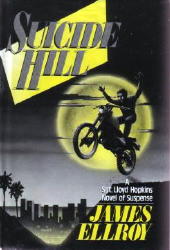
JAMES ELLROY – Suicide Hill. Mysterious Press, hardcover, 1986; paperback, April 1987. Reprinted in hardcover with Blood on the Moon and Because the Night as L. A. Noir, Warner, 1998. Trade paperback reprint: Vintage, 2006.
– Reprinted from The MYSTERY FANcier, Vol. 9, No. 2, March/April 1987.


JAMES ELLROY Suicide Hill

   Readers and moviegoers of the nineteen forties and fifties didn’t know it at the time, but they were living through the first wave of the harsh, moody, downbeat suspense novels and films we now describe as noir.

   Since around 1970 we’ve been battered by a second wave of noir in print and on the screen: Joseph Wambaugh, George V. Higgins, Elmore Leonard, James Crumley, Dirty Harry, The French Connection, Death Wish, Chinatown, Taxi Driver, Body Double — only this time the imagery is in color, not black-and-white, the sex and violence are graphic, not poetic, and the sense of sleaze is overpowering.

   For better or worse, it’s the books and films of the neo-noir configuration that most vividly shape our perception of American urban life today.

   James Ellroy is part of that configuration. He was born in 1948 and marked forever at age ten when his mother was strangled to death by a man she’d picked up in a bar. He drifted into the hippie-druggie subculture of the Vietnam years.

    “From ’65 to ’77,” he says, “I lived mostly on the streets, flopping out in parks, with about fifty arrests for drunk, trespassing, shoplifting, disturbing the peace, and other Mickey Mouse, booze-related misdemeanors. I imagine I did a total of about six months’ county jail time.
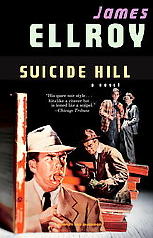
JAMES ELLROY Suicide Hill

    “I almost croaked from a series of booze- and dope-related maladies early in ’77. Realizing that it was live or die, I opted for life. I’ve been sober since August of ’77.”

   He began writing a year or two later. Suicide Hill is his fifth novel in as many years and the third of his police procedurals featuring L.A.P.D. detective sergeant Lloyd Hopkins, Los Angeles’ version of Dirty Harry.

   The Hopkins books are contrapuntally structured, with the alternation of perpetrator-cop-perpetrator-cop chapters borrowed from Wambaugh’s 1974 classic, The Onion Field, and are punctuated with blood orgies borrowed from neo-noir movie directors like Brian De Palma.

   By Ellroy’s standards the first half of Suicide Hill is quiet and almost sedate, introducing the sleaze ball cast — a white psycho, a Chicano psycho, the Chicano’s weak-willed kid brother, the coked-out porn video star by whom the white psycho is obsessed, a call girl with a master’s in economics and a habit of reading George Gilder’s capitalist manifestos between tricks — and setting us up for confrontations between each of these characters and Crazy Lloyd Hopkins.

   The blood and brains flow in earnest during the book’s second half, with five gruesome killings between pages 149 and 168 alone, as Hopkins comes closer and closer to the showdown which, for weird reasons of his own, Ellroy never lets happen.
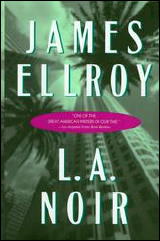
JAMES ELLROY Suicide Hill

   Crazy Lloyd is a walking time-bomb, clearly just as sick as the pervs and perps he deals with. He routinely commits burglary to obtain evidence and perjury to get convictions. He fantasizes maiming the people he hates, such as a left-wing lawyer or his estranged wife’s new lover, and every so often he makes good on his dreams.

   Ellroy draws all sorts of parallelisms between cops and creeps, but at the same time he wants us to accept Hopkins as a Jesus of the gutters, the way Wambaugh portrays his own police heroes. It’s one of Suicide Hill‘s many weaknesses that Ellroy never fuses the two sides of his protagonist’s character into a unity.

   There are other problems, too: key scenes that are nearly incomprehensible, slipshod construction in spots, constant grammatical flubs that betray the white heat in which the book was written. And yet with all its faults this book has power. Ellroy is a master of the single most crucial neo-noir skill: he can make the nightworld of sleaze and street monsters come alive on the page.

   At one point he has a character “wondering if the world was nothing but wimps, pimps, psychos and sex fiends.”

   For Ellroy, child of violence and the city, the answer is Yes, and so far he has not conjured up an effective redeemer. If you can stand the relentless assault, on every level from physical butchery to sex abuse to four-, ten-, and twelve-letter words to racist humor, this is a perversely fascinating evocation of a world gone mad.

Bibliographic Update:  The three novels included in L. A. Noir (see above), were the only appearances of Sgt. Lloyd Hopkins in print.
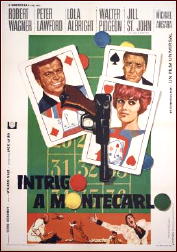
THREE FROM THE SMALL SCREEN, PART 1.

Movie Reviews by David L. Vineyard

   The sixties and early seventies were the heyday of the made for television movie, and while most were tired and unimaginative, a few gems did emerge. The three films I’ll be covering in a series of upcoming posts featured excellent casts, intriguing plots, and above average production values.

   As far as I know none of them have been on VHS or DVD, but that should be changed. They were all superior entertainment. All three aired originally on NBC.

HOW I SPENT MY SUMMER VACATION.

HOW I SPENT MY SUMMER VACATION. Made for TV. Universal/NBC-TV; telecast 07 Jan 1967. Robert Wagner, Jill St. John, Peter Lawford, Lola Albright, Walter Pidgeon, Michael Ansara. Teleplay: Gene R. Kearney; director: William Hale.

   Aging hip graduate student Jack Washington (Wagner) is in Europe living on the fringes of the Jet Set when he meets Nikki Pine (St. John) and begins to pursue her. At first her charming father billionaire Ned Pine (Lawdord) and mother (Albright) seem like nice people, but when Jack gets serious he finds himself out on his ear, framed for a crime he didn’t commit and roughed up.

   Out of revenge he begins compiling a dossier on Pine, and soon finds himself up to his ears in trouble with a army of killers out to get him led by Pine’s top man Pucci (Ansara). Lewis Gannett (Pidgeon) the Pine’s lawyer knows where the bodies are buried — literally — and is fed up with Pine’s murderous ways, Jack hopes to use him it get the secrets of who Pine is.

   Vacation is a slight but entertaining little fable that plays heavily on the charm and skill of its cast and is rewarded by being a fast paced film much slicker and better than many that found their way to the big screen. As Wagner’s Jack changes from aging hipster to amateur James Bond, the film grows darker and ends in a nice slam bang finale that leaves Jack in the catbird seat.

   This sort of fluff can go wrong quickly, but thanks to the cast and script doesn’t. Lawford does a nice sinister turn and Albright is darker than she is painted. Even St. John shines in what could have been a throwaway role.

Coming soon:

   Run a Crooked Mile (1969), with Louis Jourdan and Mary Tyler Moore.

    It took some cropping to do it, but my nephew Ben came up with a fairly decent photo of me taken the evening before his sister Joey’s wedding. It’s hidden in the comments following my previous post about the big day, three before this one, so you might not have known about it without my telling you. Don’t all rush there at once.

THE BACKWARD REVIEWER
William F. Deeck

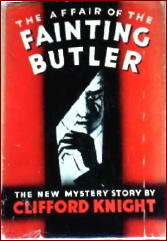
CLIFFORD KNIGHT – The Affair of the Fainting Butler.

Dodd Mead, hardcover, 1943. Hardcover reprint, Detective Book Club, 3-in-1 edition, November 1943.

CLIFFORD KNIGHT Affair of Fainting Butler

   There are those, and I am among them, who read mysteries primarily to find out if the butler did indeed do it. Unfortunately, these days there are few novels in which you can suspect the butler, a breed that has been an endangered and even vanishing species for years.

   This is one of the old-fashioned novels that still affords us that pleasure. And, yes, the butler does faint. In fact, he faints three times. Did he do it? That would be telling.

   Larry Weeks, agent — or flesh peddler, if you prefer — for Jenifer Janeway, who wrote magazine serials “that made worrying wives, whose husbands had young sophisticated secretaries, think of Reno,” goes to Janeway’s home to try to keep her from carrying out her threat to commit suicide. She is about to start writing screenplays, and she is his meal ticket.

   While Janeway and Weeks are in her garden, Sloan Hinckley, Shakespearean actor and Weeks’s other but lesser client, appears on the wall. He is Janeway’s neighbor — ah, coincidence, where would mystery writers be without you? — and has come to report that he has discovered a corpse on her grounds.

   No corpse, however, is to be found. When Janeway is visited shortly thereafter by an old friend, Hinckley claims that the old friend was the corpse.

   There are several murders of varying unlikelihood for equally unlikely reasons. The amateur detective, Prof. Huntoon Rogers, is a veritable nonentity. Though he is present throughout the novel and solves the crimes, if his name isn’t before you at all times, you tend to forget his existence.

– From The MYSTERY FANcier, Vol. 10, No. 3, Summer 1988.


[EDITORIAL COMMENT.] You can google Huntoon Rogers, Clifford Knight’s detective character, all you want, but you won’t find much out about him. He’s about as anonymous as Bill Deeck suggests, especially considering he was the leading character in 18 of Knight’s detective novels in an 11-year period between 1937 and 1947, all of which began with The Affair of …

   But think about it. Eighteen books in eleven years. That’s a pretty good track record for an author and a series character both of whom are all but forgotten now. (I read one once, and I can’t even tell you now which one of them it was.)

        Bibliographic data:

   Taken from the Revised Crime Fiction IV, by Allen J. Hubin:

ROGERS, PROF. HUNTOON.    Series character created by Clifford Knight, 1886-1963.
      The Affair of the Heavenly Voice (n.) Dodd 1937 [California]
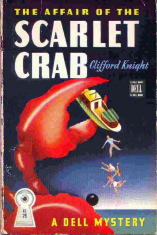
      The Affair of the Scarlet Crab (n.) Dodd 1937 [Ship]

CLIFFORD KNIGHT

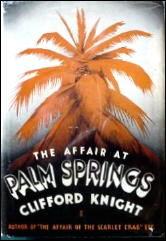
      The Affair at Palm Springs (n.) Dodd 1938 [California]

CLIFFORD KNIGHT

      The Affair of the Ginger Lei (n.) Dodd 1938 [Hawaii]
      The Affair of the Black Sombrero (n.) Dodd 1939 [Mexico]
      The Affair on the Painted Desert (n.) Dodd 1939 [Arizona]
      The Affair in Death Valley (n.) Dodd 1940 [California]
      The Affair of the Circus Queen (n.) Dodd 1940 [Manila]
      The Affair of the Crimson Gull (n.) Dodd 1941 [California]
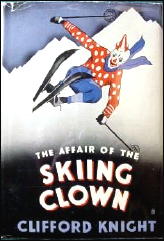
      The Affair of the Skiing Clown (n.) Dodd 1941 [California]

CLIFFORD KNIGHT

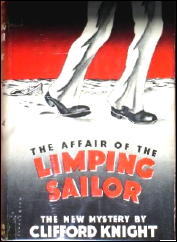
      The Affair of the Limping Sailor (n.) Dodd 1942 [California]

CLIFFORD KNIGHT

      The Affair of the Splintered Heart (n.) Dodd 1942 [Hawaii]
      The Affair of the Fainting Butler (n.) Dodd 1943 [Los Angeles, CA]
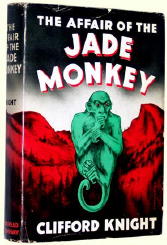
      The Affair of the Jade Monkey (n.) Dodd 1943 [California]

CLIFFORD KNIGHT

      The Affair of the Dead Stranger (n.) Dodd 1944 [California]
      The Affair of the Corpse Escort (n.) McKay 1946 [Los Angeles, CA]
      The Affair of the Golden Buzzard (n.) McKay 1946 [California]
      The Affair of the Sixth Button (n.) McKay 1947 [California]

PostScript: You probably do not want to know how much those books in dust jacket would set you back, but I’ll tell you anyway. Excluding the Dell mapback (approximately $15) perhaps mid-three figures each, on the average.

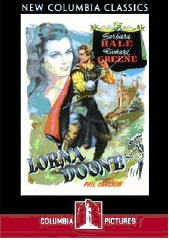
LORNA DOONE. Columbia/Edward Small Productions, 1951. Barbara Hale, Richard Greene, Carl Benton Reid, William Bishop, Ron Randell, Sean McClory, Onslow Stevens, John Dehner. Loosely based on the book Lorna Doone: A Romance of Exmoor (1869) by R. D. Blackmore; adapted by George Bruce. Director: Phil Karlson.

LORNA DOONE

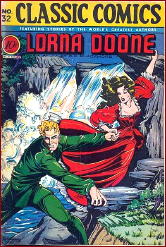
   Cramming a long book into a 90-minute movie is not an easy task, but as far I know, the essence of the story is all there. The reason I’m hedging in that last statement is that all I’ve ever read of the book, which has never been out of print, is the comic book version, Classics Illustrated edition (#32), the cover of which I show you here.

   I had this comic book for many years, primarily for the cover, I think, but it finally went with the rest of my hoard of Golden Age comics about 15 years ago. I sold most of them off — unfortunately so, as I sorely miss them now.

   But speaking of the cover, I didn’t know this when I was young, but it was done by Matt Baker, famed GGA artist of the late 1940s and 50s. GGA stands for Good Girl Art, a statement with which (in Baker’s case) I heartily agree. (And do follow the link. The covers on that site are terrific.)

   The story of Lorna Doone takes place in an isolated valley in England in the late 17th century, isolated enough that the Doones rule the area at their whim, taxing the peasants unmercifully and punishing them viciously if they protest — roguish if not utterly outlaw actions which take place unknown to King Charles II.

   When John Ridd’s father is killed at the hands of the Doones while he is yet a young lad, he vows revenge. When he is older (and looks like Richard Greene — an obvious choice, the latter later becoming TV’s Robin Hood), he’s also in love with Lorna Doone, the granddaughter of Sir Ensor, the patriarch of the family.

LORNA DOONE

   The movie is beautifully filmed — the colors are generally top notch, and the waterfall plunging downward near the Doone castle is rather spectacular — but it’s the actors that often seem to get in the way.

   I don’t mean that as disparagingly as it sounds. There’s enough action and romance to satisfy almost anyone who watches, and Barbara Hale (who later became Perry Mason’s Della Street) is as ravishing beautiful as a young royal damsel could be — a perfect replica, I thought, of a Matt Baker drawing.

   Otherwise, though, if you were to take another look through the cast, I think you will see as well as I what’s missing: no one of star quality. Workmanlike actors all, but no one with the flair of an Errol Flynn or an Olivia de Havilland (to pick a couple of obvious examples) who might have taken this film a step or two out of the ordinary.

   Pleasurable enough then, but still ordinary and not more than mildly satisfying. The book been made into numerable films and various TV movies and mini-series. I’ll try another of them sometime, I think, as well as see if I can’t find another copy of the comic book as nice as the one I had.

Wedding of Jocelyn Susannah Lewis and Sheldon James Morris.

      Ceremony on June 6th 2009 at Elsie Perrin Williams Estate, London Ontario.

This particular set of photos was taken by Joey’s brother Ben. I’m not in any of the ones I’m showing you. Someone in every picture I was in is grumpy-looking and/or has their eyes closed, not always me. If you want professionally-edited photos from special occasions, you may consider seeking photo retouching services.

Those who are also planning to get married should consider looking at a prenup example to learn what should be included in their own prenup agreement.

JOCELYN LEWIS & SHELDON MORRIS

Sheldon, Joey, my brother Merwin and his wife Carol.

JOCELYN LEWIS & SHELDON MORRIS

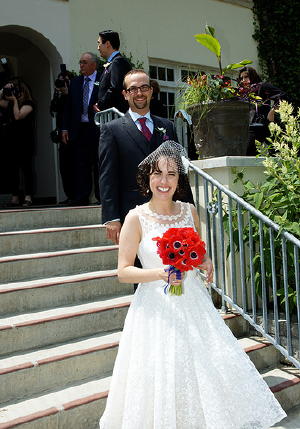
Sheldon and Joey after the ceremony.

JOCELYN LEWIS & SHELDON MORRIS

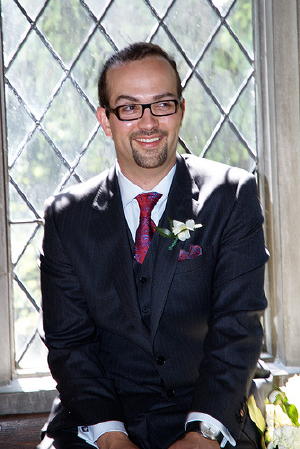
Sheldon.

JOCELYN LEWIS & SHELDON MORRIS

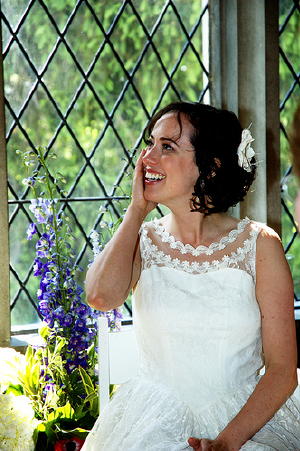
Joey.

JOCELYN LEWIS & SHELDON MORRIS

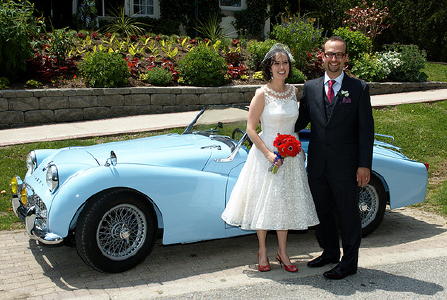
Joey, Sheldon and a restored 1959 (or early 1960s) Triumph.

JOCELYN LEWIS & SHELDON MORRIS

REVIEWED BY DAN STUMPF:         


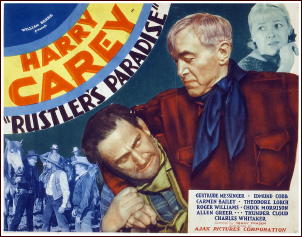
RUSTLER’S PARADISE. Ajax Pictures, 1935. Harry Carey, Gertrude Messinger, Edmund Cobb, Carmen Bailey, Theodore Lorch. Story-screenwriter-director: Harry L. Fraser.

   Rustler’s Paradise.could have sat right up there with Ride Lonesome and The Searchers for sheer perverse obsession, but as served up in the clumsy mitts of Director Harry Fraser, it just seems a bit quirky.

RUSTLER'S PARADISE Harry Carey

   Loveable, crusty old Harry Carey Sr. plays a vengeful cowboy out to get the guy who seduced his wife and stole his daughter, and in his late 50s here, he’s a bit old to be carrying the heavy heroics, but he acquits himself with his own unassuming charm, and his age even lends a bit of authenticity to the proceedings.

   Just as engaging is Edmond Cobb, looking like a cartoon villain with oversize nose and pointy chin, and his final comeuppance at the hands of loveable, crusty old Harry comes as rather a shock.

   There’s a potentially very effective moment where the outlaw gang, rushing to the hideout to dispose of Carey, see what he’s done to their boss, and all the fight just runs right out of them.

   Which could have been quite enjoyable in the hands of a capable director.

   But director Harry Fraser snuffs the glimmerings of anything strange and memorable in Rustler’s Paradise pretty quickly. Fans of Ed Wood should take a look at Fraser’s oeuvre and be humbled at the feet of the master.

   Where Wood made a few bad movies, Fraser was an auteur of epic ineptitude who stayed in the cheap-movie industry for a quarter century, turning out things like Captain America (the serial with the Atomic Vibrator), Chained for Life (a murder movie with actual conjoined twins as stars) and The White Gorilla, which features Ray Corrigan chasing himself in an ape suit.

   In Rustler’s Paradise Fraser takes the directorial reins, uses them to strangle a fine actor, and turns an off-beat story into something barely coherent. Dreadful, but typical of the man.

REVIEWED BY WALTER ALBERT:         


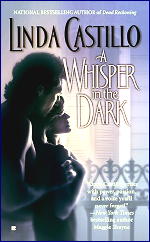
LINDA CASTILLO – A Whisper in the Dark. Berkley Sensation; paperback original, August 2006.

LINDA CASTILLO A Whisper in the Dark

   The brief notice about this book in my local mystery supplier’s bi-monthly newsletter described the protagonist as the owner of an antiquarian bookstore in New Orleans.

   That sounded promising so I bought the book and, some weeks later, settled down to read it on a very cold day in February. What was not noted was that the writer is generally known as a writer of romantic suspense, and Whisper has far too much heavy breathing and fatal attraction romantic fol-de-rol for me.

   A stalker is targeting Julia Wainwright because of her pseudonymous soft-corn pornographic novel that he considers sinful and makes of her a harlot. Yet he’s aroused by her while she’s irresistibly drawn to a former cop she lusted after when she was 15 and who has returned to New Orleans after killing an undercover cop in a Chicago shoot-out and is drinking himself into oblivion as he fights his primal urges that have him lusting after…

   Oh, this isn’t worth taking up anymore of anybody’s time. I will add that Julia’s father is a prominent church leader who’s unaware of her novel. I read the beginning, sampled the middle and raced through the climax.

   I need to look more closely at the books I buy, and especially at the writers’ track record.

IT’S ABOUT CRIME, by Marvin Lachman


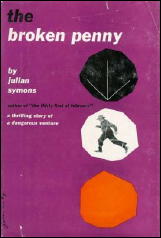
JULIAN SYMONS The Broken Penny

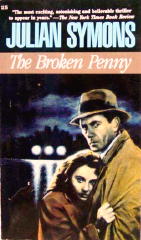
JULIAN SYMONS – The Broken Penny. Victor Gollancz, UK. hardcover, 1953. Harper & Bros., US, hc, 1953*. US paperback reprints include: Dolphin C227, 1960; Beagle, 1971; Perennial Library P480, 1980; Carroll & Graf, 1988*.     (* = shown)

   Many writers of espionage are content to rely on newspaper stories thinly disguised as fiction, with terrorism and hijacking their stock in trade. Though The Broken Penny (1953), recently reprinted by Carroll and Graf, is flawed, it remains a much more imaginative cold-war thriller.

   Telling of the attempt to oust the communist government of a country never named, but apparently based on Poland, Symons provides a devastating picture of people under the totalitarian yoke, but he saves some room to show Britain and the British army in what is not their finest hour.

   There is suspense, but mostly The Broken Penny is about the attempt of its protagonist to maintain his Idealism in a world that had gone mad in the early 1950s — and isn’t much saner as I write these words.

– From The MYSTERY FANcier, Vol. 10, No. 3, Summer 1988          (very slightly revised).


JULIAN SYMONS The Broken Penny

   [EDITORIAL COMMENT.] The fellow in the cover of the Carroll & Graf paperback edition looks a lot like Henry Fonda to me. The girl looks familiar as well, but I can’t put a name to the face. This is rather surprising, as there never was a film version of The Broken Penny.

   In fact, and what’s even more surprising, is that according to the Revised Crime Fiction IV, of all the mystery novels that Julian Symons wrote, only one of them has ever been made into a movie, that one being The Narrowing Circle (1954; film, 1955).

   The detective in that book was Inspector Crambo, who also appeared in The Gigantic Shadow (1958, published in the US as The Pipe Dream). According to IMDB, Trevor Reid played Inspector ‘Dumb’ Crambo in The Narrowing Circle, which also featured Paul Carpenter, Hazel Court and Russell Napier. (And if Hazel Court is in it, then it’s a must find.)

   Included in the online Addenda to the Revised Crime Fiction IV, a series episode of Kraft Suspense Theater entitled “Twixt the Cup and the Lip” was based on a short story in the collection How to Trap a Crook and 12 Other Mysteries.

   But it looks as though I’ll have to tell Al Hubin about this: According to IMDB, the following Symons novels were also turned to movies:

      Criss Cross Code (*) as Counterspy.

      The Man Who Killed Himself as Arthur! Arthur!

      The Blackheath Poisonings, as a 3-part miniseries.

      [??] as Die Spur führt ins Verderben. (**)

  (*) This is not a novel, but a perhaps uncollected novelette first published in Lilliput, Aug-Sept 1951. (**) According to Babel Fish, a direct translation is “The trace leads into spoiling.”

[UPDATE] 06-17-09.   Al Hubin has agreed that items 2 and 3 should be in CFIV, and the first also, but only if “Criss Cross Code” appeared in a Symons story collection, perhaps in retitled form.

   Also, in the comments, Steve W. has pointed out that The Thirty-First of February “was made into what I remember to be a quite good episode of the Alfred Hitchcock Hour.”

   True. It was, and I missed it when I was researching Symons on IMDB last night. Date: 4 January 1963, and as Steve advised me in a followup email, “the whole season is available at Hulu. Here’s the link to the Symons adaptation: HULU: 31st of February.”

   So far, I’ve managed to stay away from Hulu. I spend too much time at the computer as it is, and to start watching TV here at my desk might mean never getting anything done. Nonetheless, there might be a possibility of exceptions being made. Maybe now and then?

A 1001 MIDNIGHTS Review
by Newell Dunlap:


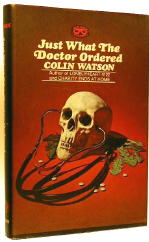
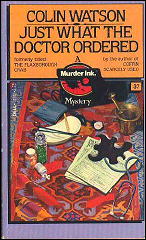
COLIN WATSON – Just What the Doctor Ordered.

G. P. Putnam’s Sons, hardcover, 1969. Paperback reprint: Dell, US, 1982 [Murder Ink #37]. Published earlier in the UK as The Flaxborough Crab; Eyre, hc, 1969.

COLIN WATSON Just What the Doctor Ordered

   One measure of accomplishment for any writer of fiction is how successfully he or she transports us to his/her own individual world of imagination. Certainly one of the more successful in this regard is Colin Watson and his fictional town of Flaxborough.

   Much to our delight, and to the chagrin of Inspector Purbright of the Flaxborough Police Department, an amazing amount of crime seems to occur in this English village.

   Just What the Doctor Ordered begins with a number of sexual assaults on the women of the town. Miss Butters is accosted in Gorry Wood; Miss Sweeting on Heston Lane; Miss Pollock by the reservoir; and at St. Hilda’s a man threatens to “pollinate” Mrs. Pasquith.

   The fact that the attacks are perpetrated by elderly gentlemen, who make their escape by running sideways, only adds to the puzzlement. Inspector Purbright at first suspects an herbal concoction that promises amazing renewed virility. But few cases are quite so simple, as any Colin Watson fan will tell you, and this one takes several additional turns, including murder, before a solution is found.

COLIN WATSON Just What the Doctor Ordered

   Inspector Purbright –flanked by his superior, Chief Constable Chubb; his subordinate, Sergeant Love; and his perpetual thorn-in-the-side, Miss Lucilla Teatime — is at the center of the Flaxborough novels, but the real stars are the amusing and eccentric townspeople themselves.

   This and the other novels in the series are recommended without reservation. Those other novels include Hopjoy Was Here (1963), Charity Ends at Home (1968), Six Nuns and a Shotgun (1975), Plaster Sinners (1981), and Whatever Happened at Mumbleshy? (1983).

   Colin Watson is also the author of an excellent sociological study of the British crime novel between the two world wars, Snobbery with Violence (1971; revised edition, 1979).

         ———
   Reprinted with permission from 1001 Midnights, edited by Bill Pronzini & Marcia Muller and published by The Battered Silicon Dispatch Box, 2007.   Copyright © 1986, 2007 by the Pronzini-Muller Family Trust.

[EDITORIAL COMMENT.]   Flaxborough fans — and I’m sure you already know who you are — will have already recognized this particular adventure — under its British title, of course — as the third of four Inspector Purbright cases that were adapted for TV by the BBC in 1977. The first two in the recently released box set were reviewed here not so very long ago.

[UPDATE] 06-17-09.   Check the comments for a complete list of all of the Inspector Purbright novels, taken from the Revised Crime Fiction IV, by Allen J. Hubin.

« Previous Page — Next Page »