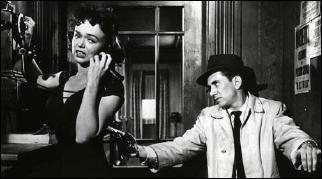
A REVIEW BY DAVID L. VINEYARD:         


BULLDOG DRUMMOND

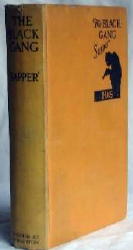
H. C. McNEILE [SAPPER] – The Black Gang.

Hodder & Stoughton, UK, hardcover, 1922, as by “Sapper.” Doubleday Doran & Co., US, hardcover, 1922. Reprinted many times in both hardcover and soft. Filmed as The Return of Bulldog Drummond: BIP, 1934, screenwriter/director: Walter Summers.

   Readers should be warned that I am going to write a positive review of one of the most excoriated books in the thriller genre, and I should know since I have been among those excoriating it. That said, I think someone needs to point out why Sapper (Herman Cyril McNeile) and Bulldog Drummond have lingered so long in the public imagination and are still read today by some — myself included.

   The reasons aren’t just historical nor the relative low state of the public taste, and there are reasons Drummond inspired writers like Ian Fleming and Clive Cussler, not to mention Lester Dent and Doc Savage, Mickey Spillane and Mike Hammer, Leslie Charteris and the Saint, and John Creasey and Patrick Dawlish.

   There is more going on here than just a brief popular phenomena. Today the name still has a certain evocation, a fact expressed by it’s use by a well known design firm and it’s presence in the rock lyrics of the band the Coasters in their 1957 song “Searchin!”

No matter where she’s a-hidin’, she’s gonna hear me a-comin’
Gonna walk right down that street like Bulldog Drummond!

   Sapper was one of the writers critic and journalist Richard Usborne defined as “The Clubland Heroes,” in his book of that name, a study of Dornford Yates, Sapper, and John Buchan’s novels about West End club men heroes of a particular brand of thriller (or shocker as Buchan preferred) that was popular in the period between WWI and WWII. (Buchan, it should be noted, began as early as 1910).

   Sapper began his career writing in the Kipling mode (which he never fully escaped) in short stories set in the trenches of WWI France. His popular collections of short fiction exemplified the British soldier and particularly the upper middle class Englishman, a sportsman who for some tragic reason might be an ordinary ranker or perhaps an officer, and become involved in some dramatic wartime incident (and following Kipling’s lead from the Soldier’s Three stories, a fair number of comic ones). At the site devoted to the artwork on the dust jackets of books about the Great War (I) an entire page is devoted to Sapper.
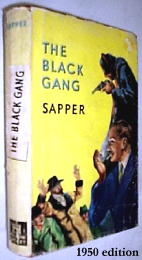
BULLDOG DRUMMOND

   At the war’s end McNeile returned to England, and like many men in his position he was dissatisfied and found it difficult to readjust. He probably didn’t feel the general malaise and depression many veterans did, he just wasn’t the type, but it was a result of his war experience and disillusion with civilian life that he wrote his 1920 novel Bulldog Drummond: the Story of a Demobilized Officer Who Found Peacetime Dull.

   Captain Hugh “Bulldog” Drummond is a large cheerfully ugly type (with beautiful eyes and a charming smile) who indeed finds peacetime dull, so from his flat in Half Moon Street in London’s fashionable West End he takes out an ad advertising his services.

… “Demobilized officer,” she read slowly, “finding peace incredibly tedious, would welcome diversion. Legitimate, if possible; but crime, if of a comparatively humorous description, no objection. Excitement essential. Would be prepared to consider permanent job if suitably impressed by applicant for his services. Reply at once Box X10.”

   The ad brings one Phyllis Benton (of the golden brown curls), a lady in distress whose father is being held by mysterious men. And we’re off. Soon Drummond is joined by his friends Peter Darrell (second in command), Algy Longworth (silly ass), Ted Jerringham (�a good amateur actor”) and Toby Sinclair (V.C. no less).

   As Usborne points out it is the world of the public school scrum with beer and martinis. (Sapper had obviously read his Baroness Orczy, for the lads sound an awful lot like the League of the Scarlet Pimpernel and much of Drummond’s drawling and babbling is drawn from the Pimpernel himself, Sir Percy Blakeney.) An entire generation of young Englishmen had died in the trenches of the Great War, and in the adventures of Drummond and his friends they were reborn in the popular imagination.
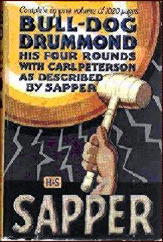
BULLDOG DRUMMOND

   But as in the public school scrum there is the ‘enemy’, and here Sapper outdoes himself, for in his first four adventures Drummond is opposed by one of the great villains in popular literature, a figure of cunning and cold intellect who could give Moriarity and Fu Manchu a run for their money and was the inspiration for Ian Fleming’s James Bond’s ultimate rival Ernst Stavro Blofield of Spectre, namely Carl Peterson.

   Indeed Peterson is such a good villain Usborne gives him his own chapter in The Clubland Heroes, the only villain to earn such an honor, or deserve it.

   And if Peterson isn’t enough Sapper outdoes himself by giving him an adoring and worshipful black widow of a mistress, Irma Peterson, the slinkiest deadliest and most evil companion in the literature. If Peterson didn’t consistently overestimate Drummond’s intelligence and always fail to plan for the most obvious action it is pretty clear our hero would never have had a chance. He’s outmatched by a mile.

   There’s a plot in progress to bring ruin not just to Phyllis’s father, but the entire British economic system. Before it’s over Drummond will have strangled a full grown ape in a pitched battle in the dark, played commando assaulting Peterson’s stronghold, and tossed Peterson’s second in command Henry Lakington into a much deserved acid bath. (�The retribution is just.”)

   England is saved, Peterson and Irma escape, and Drummond marries Phyllis, who has already begun her notable career of being the most kidnapped wife in literature. (The Spider’s companion Nita Van Sloan may have outdone Phyllis, but then she wasn’t a wife.)
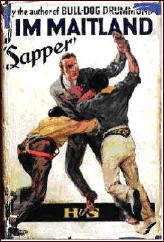
BULLDOG DRUMMOND

   Sapper may not have been subtle, but he had a fine eye for melodrama. Bulldog Drummond was an immediate success and there was little doubt he would be back, although between the first and second books Sapper produced a series of connected stories about another hero, monocled Jim Maitland.

   Jim Maitland (1921) is probably Sapper’s best book and best character, but in this article slash review we are involved with Drummond, and his second adventure, The Black Gang, the latter referring to Drummond’s black-hooded and black leather clad team of self-styled vigilantes who have been terrorizing the criminal element in England in the period before the novel begins.

   The focus of the book is another plot against England that’s afoot at Carl Peterson’s hands. (He’s now disguised as “a splendid example of the right sort of clergyman, tall, broad shouldered, with a pair of shrewd, kindly eyes.”)

   This time Carl is behind a phony peace movement and in league with actual Bolsheviks, including the murderous Yulowski who has brought to England with him the very rifle with which he clubbed the Romanov royals to death. (Before it’s over Drummond and Phyllis will only just escape the same fate with the royally blooded rifle.) Nothing less than a Communist Revolution in England is at hand.
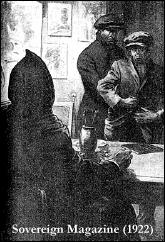
BULLDOG DRUMMOND

   Meanwhile Sir Bryan Johnstone, the Yard’s Director of Criminal Investigation and Chief Inspector MacIver are getting nowhere with a mysterious group of ruffians in black leather and hoods who have been making hay with London’s less social class of criminals.

   White slavers, pimps (though implied, never mentioned obviously), usurers, and the like have been disappearing, and when they do show up again keeping silence after some decidedly rough treatment that has shown them the error of their ways, while the Reds are up to something.

   In the meantime, if things aren’t bad enough for Hugh Drummond, the boy who had been Johnstone’s fag at school (and no, it doesn’t have the same meaning in England) shows up on his door burbling nonsense.

   Before it’s over Drummond will just miss being blown up by a grenade (the fellow beside him gets blown to gory bits — it hardly puts Drummond off his beer or his feed though), and just misses being poisoned by a Borgia poison in a doyley at the Ritz, not to mention that Russian rifle butt that once graced royal skulls. Drummond and Phyllis are captured, Carl takes the time to gloat:
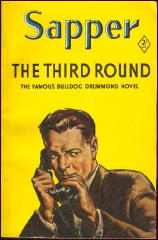
    “Eminently satisfactory, my friend, eminently. And when your dear wife returns from the country–if she does — well, Captain Drummond, it will be a very astute member of Scotland Yard who will associate her little adventure with that benevolent old clergyman, the Reverend Theodosius Longmoor, who recently spent two or three days at the Ritz. Especially in view of your kindly telephone message to Mr. — what’s his name? — Mr. Peter Darrell?”

BULLDOG DRUMMOND

   He glanced at his watch and rose to his feet. “I fear that that is all the spiritual consolation that I can give you this evening, my dear fellow,” he remarked benignly. “You will understand, I’m sure, that there are many calls on my time. Janet (Irma), my love” — he raised his voice — “our young friend is leaving us now. I feel sure you’d like to say good-bye to him.”

   She came into the room, walking a little slowly and for a while she stared in silence at Hugh. And it seemed to him that in her eyes there was a gleam of genuine pity. Once again he made a frantic effort to speak–to beg, beseech, and implore them not to hurt Phyllis — but it was useless. And then he saw her turn to Peterson.

    “I suppose,” she said regretfully, “that it is absolutely necessary.”

    “Absolutely,” he answered curtly. “He knows too much, and he worries us too much.”

    She shrugged her shoulders and came over to Drummond. “Well, good-bye, mon ami,” she remarked gently. “I really am sorry that I shan’t see you again. You are one of the few people that make this atrocious country bearable.”

   Of course Drummond does escape, foils Peterson’s plot, and rescues Phyllis, he even convinces Scotland Yard that the Black Gang has played an important role in the deadly doings. He also spares Peterson’s life at Phyllis insistence:

    And then she saw her husband bending Carl Peterson’s neck farther and farther back, till at any moment it seemed as if it must crack. For a second she stared at Hugh’s face, and saw on it a look which she had never seen before–a look so terrible, that she gave a sharp, convulsive cry.

    “Let him go, Hugh: let him go. Don’t do it.”
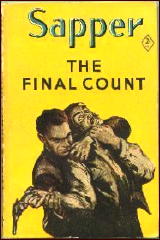
BULLDOG DRUMMOND

   To be fair, Phyllis is less concerned about Peterson than the inhuman rage her husband is in, having moments before pinned the murderous Yulowski to the wall with his own bayonet like a giant butterfly on cardboard. Carl won’t be quite so lucky two books later in The Final Count, when he meets his end at Drummond’s hands in an airship (the Megalithic) over London.

    “If you won’t drink � have it the other way, Carl Peterson. But the score is paid.”

   His grip relaxed on Peterson’s throat: he stood back, arms folded, watching the criminal. And whether it was the justice of fate, or whether it was that previous applications of the antidote had given Peterson a certain measure of immunity, I know not. But for full five seconds did he stand there before the end came. And in that five seconds the mask slipped from his face, and he stood revealed for what he was. And of that revelation no man can write…

   Richard Usborne thinks Sapper blows this moment, which he humorously attributes to the narrator of the story, but I agree with Kingsley Amis in his book on James Bond, The James Bond Dossier. It is Sapper at his most powerful.

   The plot is averted, and the Black Gang retired, but they wait, they wait. Irma comes back in the fifth book, The Female of the Species, for revenge (Phyllis gets kidnapped again, and kills her first man with a spanner) and then off and on for the rest of the series, well into the ones written by Sapper’s successor Gerard Fairlie (who was a better writer overall, and the actual model for Drummond as well as an actual secret agent who operated behind enemy lines in WWII). The latter even brought the Black Gang back in the last Drummond novel, The Return of the Black Gang (1952), but in a much more politically correct fashion.
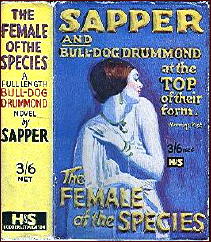
BULLDOG DRUMMOND

   Now, what was so objectionable? Well, in The Black Gang maybe it’s the constant harping on the clique of murderous Russian Jews who killed the Tsar, or the flashy types who are in the white slavery business, or maybe it’s the little island the Black Gang have set up where an ex-sergeant major and some demobilized officers have set up a concentration camp for these low types — Jews and foreigners and other less attractive sorts — where they have been taught the error of their ways with a bullwhip and the boot.

   Fortunately this happens offstage, but it is difficult for a modern reader to read this passage without visions of jackboots and SS uniforms. But the fault is history’s and not Sapper’s. If we apply the same standards, Mickey Spillane only fares a little better.

   And look at it this way. In England where there was the outlet of popular literature this only happened in a book, and only to actual criminals, not ordinary people, and no women or children or innocents. In Germany where there was no real tradition of this kind of thriller literature to speak of; it happened in the streets and people looked away or pretended it wasn’t happening.

   Some, there, and here, still pretend it didn’t happen today, but while the attitudes of the Drummond books and others may not be enlightened, it isn’t fair to brand them as would-be storm troopers either.

   By the standards of the day Sapper is only a minor offender. It takes Sydney Horler or M.P. Shiel to really be offensive. Sapper was at worst only aping popular sentiments and opinions that, however despicable, need to be viewed in historical perspective. This is not an apologia for him or others, only a perspective.

   If you can’t overlook or understand the limits of older popular fiction then you probably would do best to avoid it.
BULLDOG DRUMMOND

   By its very nature popular fiction reflects popular views, and luckily as time passes we progress, slowly, in our recognition of our prejudices and failures. Popular fiction is at worst a bellwether, not a clarion call to action.

   No apology, it’s nasty stuff, but it isn’t quite as bad as it sounds. The Black Gang was written in 1922, long before the horrors of the Holocaust and at a time when ‘concentration camp’ only referred to the prisons where Boers had been held in the Boer War.

   The casual Anti-Semitism of the book was fairly standard in popular fiction of the day. (It even shows up a little in Buchan, who was not the least anti-Semitic and indeed an early voice to warn of Fascism.) This is before Mussolini and his Blackshirts, well before Hitler and the Brownshirts, and still several years out from Sir Oswald Mosely and his own Black Gang of would be traitors.

   Sapper’s overgrown bully boys aren’t that far off from Sherlock Holmes taking the law into his own hands, the Scarlet Pimpernel’s League, or even the Saint’s war on boredom, just a bit less smooth and suave about it. There is no excuse, but you can’t judge the book or Sapper based on what happened over a decade later. No one really understood, not even the victims, until if was too late.

   But judge The Black Gang on its own merits and it is one of the best of the Drummond books. The incidents are exciting, Drummond is probably at his most attractive (and least annoying), and as a thriller it is first rate entertainment. There are some splendid set pieces such as when Peterson’s men are hunting Drummond who picks them off one by one in the dark, and the final confrontation with Yulowski and Peterson, and in Drummond’s defense Peterson’s victims number in the hundreds.

   Carl may be a charming monster, but he’s a monster none the less, who plots to overthrow England for nothing more than his own financial improvement and a distaste for England and the English. Carl believes in nothing but Carl and is loyal to no cause but his own.

   The Black Gang came to the screen as The Return of Bulldog Drummond (not based on the book of that name) with Ralph Richardson as Drummond and Francis L. Sullivan a fine Peterson.
BULLDOG DRUMMOND

   The Black Gang was present in black leather and on motorbikes, but some of the less appealing aspects of the book were left off. It’s not a bad little movie, and Richardson is quite good (ironically he plays the villain in the spoof Bulldog Jack penned by Sapper and Gerard Fairlie) looking forward to the role in Q Planes (Clouds Over Europe) where his suave British agent would inspire the creation of John Steed of the Avengers.

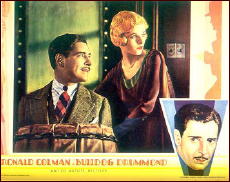
    Drummond found his way to the screen as early as the silents, but it was 1929’s talkie Bulldog Drummond with Ronald Colman as Drummond, Joan Bennett as Phyllis, and Montagu Love as Peterson that really put the character in the public eye. It seems strange today when we note Colman was nominated for an Academy Award playing Drummond (stranger still that he was beaten by Warner Baxter in In Old Arizona playing the Cisco Kid).

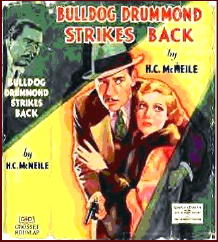
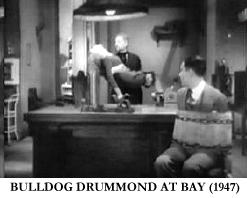
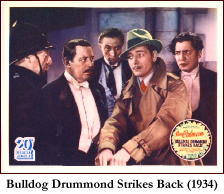
   Temple Tower (a lost film), The Return of …, and Bulldog Drummond At Bay (with American John Lodge coming physically closest to Sapper’s interpretation of Drummond) followed, but it’s 1934’s Bulldog Drummond Strikes Back that inspired the series that followed.

   Ronald Colman was again Drummond, Charles Butterworth a droll Algy (and Ona Munson his long suffering bride), Loretta Young the lady in danger, Sir C. Aubrey Smith Colonel Neilson Drummond’s friend at the Yard, and no less than Charlie Chan and Fu Manchu Warner Oland as an Egyptian prince involved in dastardly doings.
BULLDOG DRUMMOND

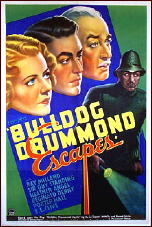
   It is one of the brightest mystery comedies of an age when the form was at its peak and still holds up today thanks to fine performances, direction, and script. It was also a big hit and inspired a series of B films. The first was Bulldog Drummond Escapes with Ray Milland as Drummond, but the series proper featured John Howard (who played Colman’s younger brother in Frank Capra’s Lost Horizon), Reginald Denny as Algy, E. E. Clive as Drummond’s servant Tenny (changed from Denny in the novels for obvious reasons), and John Barrymore as Neilson (eventually replaced by veteran H.B. Warner).

   A running gag had Drummond’s pending marriage to Phyllis (Louise Campbell and later Heather Angel) always being put off by his latest adventure. The series was well produced and written, and had a fine array of villains including George Zucco, Porter Hall, Leo G. Carroll, Anthony Quinn, and Eduardo Cianelli.

   When the Howard series ended Tom Conway and Ron Randell each did two Drummond films, and in 1951, Victor Saville did an A picture, Calling Bulldog Drummond, based on one of Fairlie’s books (and written by him) with Walter Pidgeon as Drummond and a supporting cast that included David Tomlinson (Father in Mary Poppins) as Algy, Margaret Leighton as an undercover policewoman, Robert Beatty (who would play Drummond in a television pilot aired on the Douglas Fairbanks Jr,. Show) as a gangster, and James Bond’s future M, Bernard Lee in a key role.
BULLDOG DRUMMOND

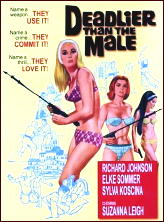
   Save for the television pilot Drummond lay in doggo until 1966 when he was revived for two Bondish outings starring Richard Johnson as an updated Drummond, Deadlier Than the Male and Some Girls Do. Both films are fun, with a deadly game of chess on a giant board an excellent set piece in the first one, and Nigel Green outstanding as Peterson. (James Villiers is only a little less perfect in the second film.) Elke Summer and Sylvia Koscina in the first and Daliah Lavi in the second are Peterson’s murderous cohorts.

   Drummond also had a long and successful career on radio (�Out of the fog, out of the night …”) in a series starring Santos Ortega and Sir Cedric Hardwicke. In 2006 Moonstone Comics brought Drummond back in a comic book written by William Messner Loebs in which Drummond becomes a sort of private detective and we discover Phyllis and Irma are one and the same.

It’s a terrific little adventure that remains true to Sapper’s Drummond while updating many aspect of the story. Drummond also features in Kim Newman’s second book in his Anno Dracula trilogy, The Bloody Red Baron, as a nasty vampire, and a psychotic violent old prig in the third volume of Alan Moore’s graphic novel series The League of Extraordinary Gentleman.

   Seems you can’t keep a good — or bad — man down. There is even a play and movie by Alan Shearman, Bullshot Crummond, that is a dead on send up of all things Drummond.
BULLDOG DRUMMOND

   Drummond has been around close to ninety years now, and is still going fairly strong. The name still evokes foggy roads, low slung speeding sports cars, dastardly villains, and dangerous adventure with pitched battles in which the fate of nations is at stake.

   Leslie Charteris modeled the early Saint on Drummond (but he was a much better writer) and Doc Savage and his crew owe more than at little to Drummond and his.

   Mickey Spillane was a fan, as was Ian Fleming. (British traitor Guy Burgess supposedly observed that James Bond was Bulldog Drummond to the waist and Mike Hammer from the waist down.) More recently Clive Cussler has mentioned Drummond as a major influence on Dirk Pitt. When Paul Gallico reviewed Casino Royale he called James Bond “Bulldog Drummond with brains.”

   The first seven books in the Drummond series (Bulldog Drummond, The Black Gang, The Third Round, The Final Count, Female of the Species, The Return of Bulldog Drummond, and Temple Tower can be found online in free ebook editions with a little searching.

   Jim Maitland, and at least three of the short story collections are available too. The Howard films are easy (and inexpensive) to find on DVD, Deadlier Than the Male and Some Girls Do are a bit more expensive but also available in handsome DVD packages.

   The pilot film with Robert Beatty can be found on some sets of old television detective series. Calling Bulldog Drummond often shows up on TCM as it was an MGM film. Most of the others can be found on the gray market with the exception of Temple Tower and the silent Drummonds.
BULLDOG DRUMMOND

   The first Colman film is in public domain and can be downloaded direct to your PC. Several old-time radio sites offer free episodes of the radio series you can listen to or download, and cassettes and CDs of many episodes are available as well.

   The Fairlie books, some of which were not published in the United States, are a bit harder to find than the original Sapper books, but none of them are really all that difficult with a little effort. There are also five Drummond short stories (the best known being “The Thirteen Lead Soldiers” basis for one of the Conway films) collected for the first time in The Best Short Stories By Sapper.

   Bulldog Drummond is still with us. He can be a bit noisy, and he has a tendency to blather in the way of heroes of his era, but he’s good company on an adventure where the stakes are high and the odds are dicey.

   Before you dismiss him you might keep in mind that half the books on the shelves of the mystery and thriller genre owe something to him. He’s a bit like one of those uncles that you love, but sometimes hate to admit you are related to. But bless him or damn him, he’s one of the family, and the resemblance can’t be denied.
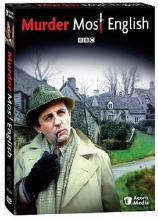
MURDER MOST ENGLISH: A FLAXBOROUGH CHRONICLE. TV series: BBC, 1977. Anton Rodgers (Detective Inspector Purbright), Christopher Timothy (Detective Sergeant Love), John Comer (Sergeant Malley), Moray Watson (Chief Constable Chubb).

MURDER MOST ENGLISH

● Hopjoy Was Here. May 8 & May 15, 1977. John Normington, Lynn Farleigh, Gary Watson, Michael Robbins. Based on the novel by Colin Watson; screenplay: Richard Harris. Director: Ronald Wilson.

● Lonelyheart 4122. May 15 & May 22, 1977. Brenda Bruce (Lucy Teatime), John Carson, Gillian Martell, Erin Geraghty. Based on the novel by Colin Watson; screenplay: Richard Harris. Director: Ronald Wilson.

   In the seven episodes of this (alas) short-lived series, a total of four of Colin Watson’s “Flaxborough” mysteries were adapted. So far I’ve watched only the two above. The other two are:

    ● The Flaxborough Crab. May 29 & June 5, 1977.

    ● Coffin Scarcely Used. June 12 & June 19, 1977.

… and both are on my “to be watched soon” list, although I’m not likely to review them here. (There are too many TV detective shows to be watched and too little time to report on them, I’m sorry to say, or rather I’m only sorry about the second part of that sentence.)

MURDER MOST ENGLISH

   There is more wickedness going on in small villages, I believe Watson is trying to say — and successfully, too, as far as I’m concerned — than meets the eye, or the eye, that is to say, of the most cosmopolitan resident of London, Liverpool or any other large British city.

   In Hopjoy Was Here, for example, a fellow named Hopjoy has disappeared and is most probably dead, his body most likely dissolved in acid and quietly disposed of down the bathtub drain. He was secretly working as an espionage agent for some hush-hush secret agency, and while two of his colleagues are working on their side of the tracks, Inspector Purbright is working quite another.

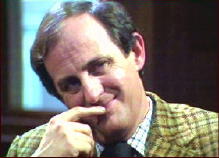
   It is quite amusing to see the two agents flailing around in their darkness of broad daylight, while Purbright, who knows the countryside and the people who inhabit it, calmly smokes his pipe (most often in ugly plaid jackets that were quite the rage in the 1970s) and comes out far ahead of the game.

MURDER MOST ENGLISH

   Not that the case doesn’t have its challenges. By the time the second installment began, I was sure I was far ahead of the good inspector, but he soon had caught up to me, only to … but I can’t tell you that.

   The solution depends greatly on a working knowledge of people and their faults and foibles, and Purbright seems to a gentle, bucolic master of it, to the (sometimes perplexed) delight of his Chief Constable, and the dismay of Hopjoy’s fellow agents.

   In Lonelyheart 4122, Purbright finds himself competing with another protagonist to solve the disappearance of two lonely women who had signed up for the same matrimonial service several months apart. Meet the very capable (and cigar-smoking) Lucy Teatime, who also seems to have designs on the killer — but for what reason?

MURDER MOST ENGLISH

   Again you will have to watch to find out. The game of wits between Purbright and Miss Teatime is delightful, but the mystery itself is not nearly the challenge that was presented in Episode One, as the killer is quite obvious. Even so, there’s a kicker in the plot toward the end that I’m sure you will find quite satisfying.

   And, oh yes, there’s one more thing. While the production values are of good television quality, they’re nowhere near as fine as even the most average movie. That doesn’t mean, though — and this is a big “though” — that you shouldn’t be watching every corner of the screen for small bits of business in the background.

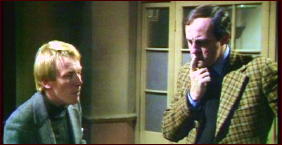
   This entails anything involving any of the other players, both those important to the plot and those really only incidentally in the scene, with a special mention going to Christopher Timothy as Detective Sergeant Love and his aversion to “human remains.” (He’s the one on the left in the second scene down.)

IT’S ABOUT CRIME, by Marvin Lachman


DOROTHY B. HUGHES Ride the Pink Horse

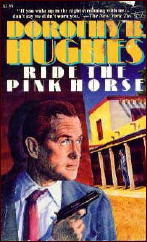
 DOROTHY B. HUGHES – Ride the Pink Horse.

Duell, Sloan & Pearce, hardcover, 1946. Reprinted many times in both hardcover and soft, including Carroll & Graf, pb, 1988.

● Film: Universal International, 1947. Robert Montgomery, Wanda Hendrix, Andrea King, Thomas Gomez, Fred Clark. Screenwriter: Ben Hecht, Charles Lederer; director: Robert Montgomery.

   I’m especially fond of regional mysteries, especially those set in New Mexico, a state as beautiful as any in the United States.

   Fortunately, the state has had some good mystery writers use it, including Richard Martin Stern, Tony Hillerman, and Dorothy B. Hughes in Ride the Pink Horse, recently reprinted by Carroll and Graf.

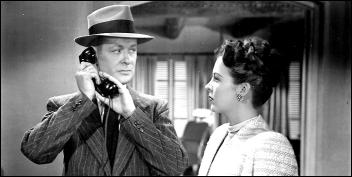
   Many mystery fans remember the excellent movie based on it and, indeed, the cover of this reprint portrays a man who looks like Robert Montgomery, the film’s star. (That’s he in the scene below, along with Andrea King.)

DOROTHY B. HUGHES Ride the Pink Horse

   The book is set in Santa Fe during that city’s most colorful time, the annual Labor Day weekend fiesta. Hughes captures the city and its mixture of three cultures: Indian, Spanish, and “Gringo.”

   Though some of the attitudes in the book seem a bit dated, i.e., the post World War II mixture of cynicism and idealism, here, too, is a book which has stood the difficult test of time.

– From The MYSTERY FANcier, Vol. 10, No. 3, Summer 1988          (very slightly revised).


THE BACKWARD REVIEWER
William F. Deeck


STEWART STERLING – Where There’s Smoke.

J. B. Lippincott, hardcover, 1946. Hardcover reprint: Unicorn Mystery Book Club, 4-in1 edition, April 1947. Paperback reprint: Dell 275, mapback edition, 1949.

STEWART STERLING Where There's Smoke

    Saying that the Dell mapback has a great cover and leaving it at that is a temptation. But our noble editor has a strange notion that his readers should get their money’s worth, so ever onward and downward.

    A two-alarm fire at the Brockhurst Theater leads to the discovery of a body burned to death, although the chap would also have died shortly from drinking denatured alcohol. The fire was deliberately set. Whoever was after the poor guy, and apparently. he had nothing but enemies, wasn’t taking any chances.

    Fire Marshal Ben Pedley investigates this fire and a later fire and is involved in a third one. He also —

    — Is “barrelling” up “sleet greased” Broadway in New York at a “screaming” seventy miles per hour worrying about the equipment responding to the second alarm because “no driver could get up to speed” on those streets. He then bears down on the gas.

    — Nearly dies in the first fire rescuing a damsel in distress.

    — Is conked over the head and tied up while searching the dead man’s apartment. (A killer, who later tries to do away with Pedley, does the conking and tieing. Why he doesn’t get it over with then is only conjecture, but it’s probably because there was still four fifths of the novel yet to come.)

    — Nearly dies when the floor collapses under him while he is investigating a fire in progress.

STEWART STERLING Where There's Smoke

    — Lets a prisoner drive his car, rather than cuff the guy. (“Better this way,” Pedley says smugly and erroneously. The prisoner wrecks the car at fifty miles per hour. He escapes unscathed, while Pedley gets a bruised thigh.)

    — Is shot at in a lawyer’s office by the guy who didn’t kill him at the apartment. I’m taking the author’s word for it here. I’m still trying to figure out how and why it happened the way he says it happened.

    — Is nearly drowned in the pool at a Turkish bath by the guy who didn’t. try to kill him at the apartment and failed to kill him at the lawyer’s office. .

    — Is laid out by a blow from a revolver butt to the bridge of his nose.

    — Rescues again, more or less, the same damsel in distress from another fire and comes close to being burned alive.

    One doesn’t expect a novel to be completely realistic, but there ought to be some connection with the real world.

    Fire-fighting buffs should stick to Dennis Smith.

– From The MYSTERY FANcier, Vol. 9, No. 2, March/April 1987.


THOMAS GIFFORD – The Glendower Legacy.

G. P. Putnam’s Sons, hardcover, 1978. Paperback reprint: Pocket, 1979.

THOMAS GIFFORD

   The world of academia scores a couple of telling blows to the ungodly in this, the latest thriller to come from the typewriter of the author of the highly acclaimed The Wind Chill Factor, but otherwise not all is well.

   To borrow a term from the incomparable Mr. Hitchcock of movie fame, the MacGuffin, the object that all parties devoutly desire but which in fact may be all that keeps the plot moving, is a document dating from the days of the American Revolution — from Valley Forge, to be precise, at a time when morale was low and the ravages of dysentery were visibly high.

   Betrayal at any moment, even by the commander-in-chief himself, given the right conditions and frame of mind, was a distinct possibility.

   If this document could be authenticated, the resulting scandal would rock the nation, and a director of the Russian KGB with a sense of humor takes a serious interest as well. The scene shifts dramatically to Harvard Square and then to the remotest crannies of Maine before heading even further north, to a massive house located high up on the rocks of the Nova Scotia coast.

THOMAS GIFFORD

   The hero, taking the role that Cary Grant would play, is a naive, middle-aged professor of American history, and in spite of their initial mutual antagonisms, when he takes refuge in the home of the fiercely liberated TV newsperson (Audrey Hepburn), you know that everything is just going to work out all right.

   Harvard, however, will hardly be the same. Bodies pile up, torture scenes (with pliers) abound — and, you might ask — for what?

   Successful combinations of comedy, blood and suspense can be done. They are a specialty of the Mr. Hitchcock previously referred to. Gifford can weave a nasty spell with words, but the enormous improbability of such a sequence of events, given the timetable suggested, drags the early part of the story into a morass of page-flipping, and the jagged abruptness with which it’s all wrapped up only points out the lack of solid substance throughout.

   Nothing is gained. Pessimistically a number of lives are lost, and the pretense that it’s all in good fun can’t be maintained forever.

   Definitely written with the movies in mind, and it could very well make a good one. It’s flashy and glib, and the weaknesses in the foundation can be easily overlooked. After the end of the book is reached — and believe me, once started, you most definitely will — that’s when the sugar-coating will be recognized, alas, for what it is.

   Artificial, that is, and not altogether satisfying.

– From The MYSTERY FANcier, Vol. 3, No. 3, May-June 1979, slightly revised. The original review also appeared earlier in the Hartford Courant.


Bibliography —     

      The Wind Chill Factor, Putnam, 1975.
      The Cavanaugh Quest, Putnam, 1976. (Nominated for the Edgar Award, Best Novel, 1977.)

THOMAS GIFFORD

      The Man from Lisbon, McGraw, 1977.
      The Glendower Legacy, Putnam, 1978.
      Hollywood Gothic, Putnam, 1979.
      The Assassini, Bantam, 1990.
      Praetorian, Bantam, 1993.
      The First Sacrifice, Bantam, 1994.
      Saint’s Rest, Bantam, 1996.

as Thomas Maxwell —

      Kiss Me Once, Mysterious Press, 1986.

THOMAS GIFFORD

      The Saberdene Variations, Mysterious Press, 1987.
      Kiss Me Twice, Mysterious Press, 1998.
      The Suspense Is Killing Me, Mysterious Press, 1990.

as Dana Clarins —

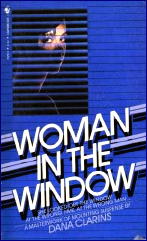
      Woman in the Window, Bantam, pbo, 1984.

THOMAS GIFFORD

      Guilty Parties, Bantam, pbo, 1985.
      The Woman Who Knew Too Much, Bantam, pbo, 1986.

[UPDATE] 06-14-09.   I mentioned The Wind Chill Factor in the opening paragraph, a reference that was more useful when this review first appeared, as the book is all but forgotten now.

THOMAS GIFFORD

   In fact August West reviewed it as just that not so long ago on his blog, as one of Patti Abbott’s “Friday Forgotten Books” project. It’s a spy thriller that starts out in Minnesota, but it quickly goes international with a stirred-up nest of neo-Nazis.

   I reviewed it myself back when it first came out, and one of these days I’ll come across it again, so maybe my review (also positive) will show up here some day as well.

   I wrote this review a few years before the movie I predicted did come out, and of course I was right about that, but I was wrong about who the stars were going to be.

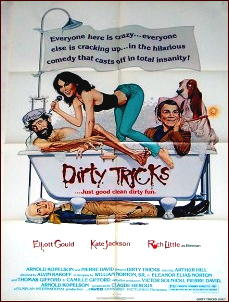
   The movie was called Dirty Tricks — and are you ready for this? — the stars were Elliott Gould and Kate Jackson. Passable choices, perhaps, but they were never to be confused with Cary Grant and Audrey Hepburn, and the inclusion of Rich Little as one of the players shows what the primary thrust of the movie was.

   I’ve not seen it myself, but its rating on IMDB is 4.4 out of 10, which is Not Very Good.

   The passing of author Tedd Thomey was not known to the crime fiction community until quite recently, when Al Hubin came across the news as he was recently putting data together for the online Addenda to his Revised Crime Fiction IV.

   (Note that Part 33 has just been uploaded. This installment is much shorter and earlier than usual, but in time, Al hopes, for the information to be included in the 2009 edition of the Revised CFIV on CD-Rom.)

   Mr. Thomey died on December 1st of last year. A tribute to him by Tom Hennessy, a longtime friend, can be found online here, along with several photographs.

      Some excerpts:

    “Harold John Thomey was born July 19, 1920, in Butte, Mont. His father, who admired Theodore Roosevelt, called him Teddy. The second ‘d’ in Tedd was an affectation, added by a young man hoping to be noticed.”

    Storming Iwo Jima: “Tedd landed with the Fifth Marine Division in the Third Wave . He hunkered down in a shell crater. That’s where he was when a bullet pierced his heel and his boot filled with blood. Removed to a hospital ship, he was eating ice cream that night while his buddies tried to establish a foothold on the beach.

TEDD THOMEY

    “He cried the first time he told me of eating ice cream while his buddies fought for a toehold on the beach. He cried the second time, too.”

    After the war: “Tedd became a reporter for the San Francisco Chronicle, whose photo staff included [Iwo Jima photographer Joe] Rosenthal. They remained friends until Rosenthal’s death two years ago.

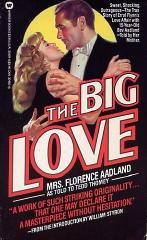
    “Tedd also began writing pulp fiction articles, then turned to books, 18 in all, including The Big Love. It was about actor Erroll Flynn’s love affair with 15-year-old Beverly Aadland. Told to Tedd by her mother, Florence, it became a Broadway play starring Tracey Ullman.

    “He also did profiles of celebrities, most assigned to him by his New York agent, Scott Meredith. Among his subjects: Humphrey Bogart, Peter Sellers, Judy Garland and Peter O’Toole.”

      Bibliographic data.   [Crime fiction only, expanded from the Revised CFIV, by Allen J. Hubin] —

THOMEY, TEDD. Full name: Harold John Thomey, 1920-2008.

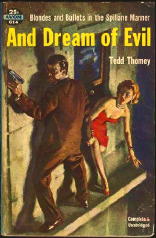
      And Dream of Evil (n.) Abelard-Schuman, hc, 1954; Avon 614, pb, 1956. [Los Angeles, CA]

TEDD THOMEY

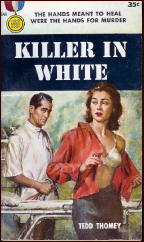
      Killer in White (n.) Gold Medal 546, pbo, 1956 [Los Angeles, CA]

TEDD THOMEY

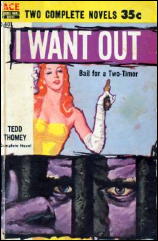
      I Want Out (n.) Ace Double D-401, pbo, 1959

TEDD THOMEY

      The Sadist (n.) Berkley G-568, pbo, 1960 [Oregon]
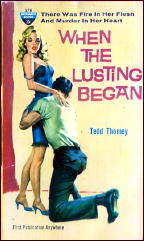
       -When the Lusting Began (n.) Monarch 178, pbo, 1960

TEDD THOMEY

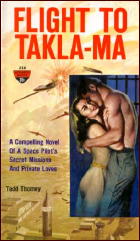
      Flight to Takla-Ma (n.) Monarch 216, pbo, 1962 [China]

TEDD THOMEY

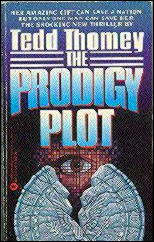
      The Prodigy Plot (n.) Warner, pbo, 1987

TEDD THOMEY


[UPDATE] Later the same day. Thanks to Juri Nummelin who points out on his Pulpetti blog another website dedicated to Tedd Thomey’s books, including his non-criminous ones.

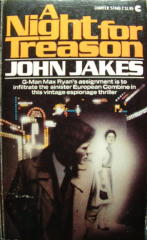
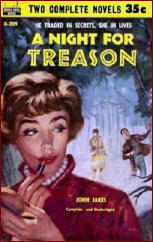
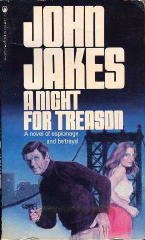
JOHN JAKES – A Night for Treason. Charter; reprint paperback, circa 1980. Hardcover edition, Mystery House (Bouregy & Curl), 1956. Other paperback editions: Ace Double D-209, 1957; Tor/Pinnacle, 1981.

JOHN JAKES Night of Treason

   In the mid-70s, around the time of the American Bicentennial, John Jakes struck a pan of gold and became famous (perhaps even wealthy) for his Kent Family Chronicles and other works of early colonial and frontier America.

   Before then he was only a journeyman author, writing science fiction and fantasy (Brak the Barbarian, among others), mysteries (the Johnny Havoc series, among still more others) and generally speaking, whatever would sell.

   This is clearly one of his early efforts, and the only way it was reprinted some 25 years later is that someone was convinced that his name on a book would sell the book. In theory at least. It doesn’t turn up in used book stores all that often, and I don’t think it’s because it’s being held onto by scores of discriminating collectors.

JOHN JAKES Night of Treason

   Quoting from the front cover: “G-Man Max Ryan’s assignment is to infiltrate the sinister European Combine in this vintage espionage thriller,” and from the first page on you know it’s the purest sort of pulp fiction writing at its finest. By which I definitely do not mean Bad, but on the other hand, it’s not necessarily a compliment, either:

    “Max Ryan drained the last of his coffee and placed the cup on the counter. His palms had started to sweat. He would have to do it soon, now… Max followed Gib out of the small roadside diner. The semi-trailer hulked like a giant animal on the shoulder of the turnpike. The sky was dark and cold with a pre-dawn chill. Few automobiles moved on the long stretch of highway, far apart.”

JOHN JAKES Night of Treason

   Even though the events are intended to be earth-shattering, the scope is strictly small scale, constricted in budget in the same way the old black-and-white second features at the movies were, back in the 50s.

   A lot of the early action takes place in and around the Coco Club, for example, with a secret mastermind known only by his voice over the telephone orchestrating the nefarious criminal activities of the two or three henchmen he has under his control.

   There is a surprise in store for Max on page 163, and it stunned me as well, at least at first. Given a chance to sit back down and think about it, my second reaction was probably closer to disbelief. You might respond the same way, but on the other hand, now that I’ve read the book and told you about it, think of it this way: you might not need to.

— March 2003


[UPDATE] 06-12-09.   Up until getting this review ready to be posted, I was blissfully unaware of the other two paperback editions of this book. I should have remembered that it once was half an Ace Double, since I’ve been collecting them for over 40 years, but for some reason I can’t explain, I didn’t. Shame on me.

REVIEWED BY WALTER ALBERT:         


J. B. STANLEY

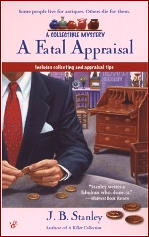
  J. B. STANLEY – A Fatal Appraisal. Berkley Prime Crime, pb original, Oct 2006.

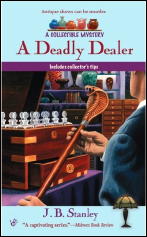
      — A Deadly Dealer. Berkley Prime Crime, pbo, August 2007.

   Molly Appleby is a writer for Collector’s Weekly, and in the second of the series (I’ve not read the first, A Killer Collection, Jan 2006) she’s sent by her irascible editor to Richmond, to cover a taping of the TV series, “Hidden Treasures,” which lands her in the middle of an investigation of the murder of two of the show’s appraisers.

   Stanley seems knowledgeable about antiques, but there’s little to distinguish this from any of the several other similar series that have recently been popular. In fact, it was so unmemorable that I was well into a second reading before I stopped short, realizing that I had already read it within the last six months.

J. B. STANLEY

   Never noted for my consistency, I bought A Deadly Dealer, the third in the series and discovered, to my surprise, that I was thoroughly enjoying the book.

   The antiques that fuel this enjoyable outing are an eighteenth-century desk whose ownership is contested by two dealers and an early 19th century walking cane that conceals a deadly secret.

   Molly’s relationship with her domineering mother bothers me somewhat, but there was just the right mix of antiques lore and crime narrative to engage my attention.

   Now, maybe I will go back and look up the first book in the series.

EDITORIAL COMMENT. From all appearances, these three books are all there’s going to be in the Molly Appleby series. J. B. Stanley is having a much greater success with her “Supper Club Mystery series,” of which there are now five, the most recent being The Battered Body, which came out in March 2009.

A REVIEW BY DAVID L. VINEYARD:         


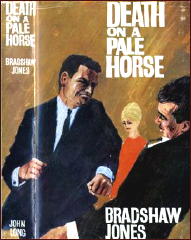
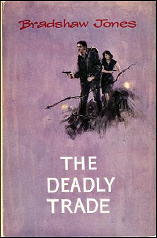
BRADSHAW JONES – Death on a Pale Horse.

John Long, UK, hardcover, 1964. Paperback reprint: Bridbooks, Israel, no date.

   Malcolm Bradshaw Jones was an oil executive who retired to the Channel Islands off of Great Britain, and wrote eleven mysteries featuring tough special agent Claude Ravel and his wife Monique, an Anglo-French couple who first work for Cabinet Security under that “terrible old man James Keen” and later work for Interpol and their Home Office liaison, Peter Calvert.

BRADSHAW JONES The Deadly Trade

   Ravel is something of a rogue agent with a nose for trouble: “He’s about the most ruthless hell-bender I’ve ever met. And he’s got a wife, Monique, who works with him, who is almost as bad. She looks like something out of the fashion magazines and fights like a tiger. She’s French and Ravel is half French and completely bilingual. Between them they used to break just about every law we’ve got, all in the name of justice.”

   Of course in real life Interpol (*) never had agents, and was in fact a front organization for Nazi sympathizers well into the 1960’s, but here we are dealing with the Interpol of fiction not fact, and anyway Ravel and his wide Monique behave like no police you have ever encountered.

   Ruthless, blood thirsty, and deadly are the kindest thing you can say about them. That said, Jones writes this stuff with some small flare and obviously knows his locales. The scenes in Paris may not be Simenon, but they are authentic and redolent of the real place and not just the tourist trap version most fiction gives us.

   In Death on a Pale Horse a naked man is found off the southwest coast of England, a small time thief, who died of some mysterious intestinal disorder. Interpol, and through them the Ravels are called in.

   Soon they are on the trail of a defecting British chemist who has left behind a nasty bug that starts killing people, all leading to a remote private lab in San Stefano, and a trail of bodies and violence. The idealistic Dr. Porter’s trail takes them to Italy and into the hands of the ruthless drug smuggler Pavesi as the epidemic in England spreads. Now all they have to do is find Porter alive and “unseat death from his pale horse.”

   There is nothing special here, but the writing is good, the plot moves well, and Ravel and Monique are an engaging pair of homicidal heroes, believably tough and ruthless. You could do a lot worse than Jones books about the Ravels and in some cases not a lot better.

   I’ll be keeping an eye out for more books about them. It’s not often you encounter a husband and wife team who both carry concealed switchblades and have few compunctions about using them. It’s a bit as if James Bond had married Modesty Blaise, or a continental John Steed and Mrs. Peel after a session of SAS training.

   Death On a Pale Horse is a short book, around 60,000 words, and a well done thriller with some interests and attractive, if ruthless, protagonists in the Ravels.

CLAUDE RAVEL. Series character created by (Malcolm Henry) BRADSHAW JONES, 1904- .   Data taken from the Revised Crime Fiction IV, by Allen J. Hubin:

      The Hamlet Problem (n.) Long 1962.
      The Crooked Phoenix (n.) Long 1963.
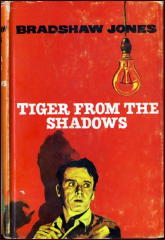
      Tiger from the Shadows (n.) Long 1963.

BRADSHAW JONES The Deadly Trade

      Death on a Pale Horse (n.) Long 1964.
      Private Vendetta (n.) Long 1964.
      The Embers of Hate (n.) Long 1966.
      Testament of Evil (n.) Long 1966.
      The Deadly Trade (n.) Long 1967.

BRADSHAW JONES The Deadly Trade

      A Den of Savage Men (n.) Long 1967.

      ______________________________________________________

   (*) Interpol is a private organization founded in the mid 1930’s to gather information on criminal activities and provide it to subscribing police agencies around the world (for instance the FBI has never subscribed and does not receive Interpol bulletins despite what you see in movies and books).

   It was infiltrated by the Nazis from the first and their influence continued into the 1960’s when it was finally purged. (Interpol refused to help in the hunt for Nazi war criminals on the grounds they were “political” crimes.)

   Interpol is primarily a counting house for information and sends out bulletins on persons of interest; yellow sheets for those who do not have an active criminal record and are not wanted for a crime, and red sheets for wanted felons.

   In the 1990’s Interpol began to employ investigators for the first time in its history. It has no enforcement duties, and the liaison to Interpol at most police departments are just some unlucky communications officer who receives no extra pay for his service. The Interpol agent of countless novels, movies, and television series is a myth that never existed, but has taken on a life of its own.

      ______________________________________________________

[UPDATE] 06-14-09.   A tip of the hat to British mystery bookseller Jamie Sturgeon, who provided the cover images for both Death on a Pale Horse and Tiger from the Shadows. He also sent Al Hubin and I a long list of additional information about the settings and additional series characters in Jones’ books, all of which will appear in the next installment of the online Addenda for the Revised Crime Fiction IV.

REVIEWED BY DAN STUMPF:         


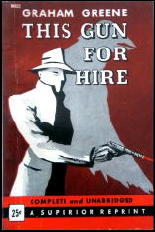
GRAHAM GREENE – This Gun for Hire. Doubleday, US, 1936. Previously published in the UK as A Gun for Sale, Heinemann, 1936. Reprinted many times in both hardcover and soft.

GRAHAM GREENE This Gun for Hire

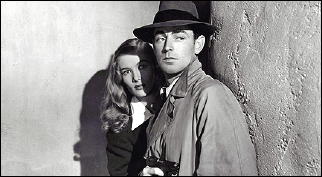
● Filmed as This Gun for Hire. Paramount, 1942. Veronica Lake, Robert Preston, Laird Cregar, Alan Ladd, Tully Marshall, Marc Lawrence. Screenwroters: Albert Maltz & W. R. Burnett; director: Frank Tuttle).

● Also filmed as Short Cut to Hell. Paramount, 1957. William Bishop, Robert Ivers, Georgann Johnson, Yvette Vickers, Murvyn Vye. Director: James Cagney.

   Written in 1936 and very much aware of its time, Grahame Greene’s This Gun for Hire spins a (mostly) taut tale of an ugly little paid killer played false by his employers, evading the law and pursuing his lonely revenge, but at the same time manages to evoke much more.

   There are themes of isolation and alienation here, vividly rendered by a simple plot that manages to turn most of its protagonists into outcasts at one point or another: the heroine goes from hostage to accomplice; her detective-boyfriend gets betrayed and bitter; the slimy go-between finds himself abandoned in his turn… and Greene sharpens his point with background motifs of Britain trying to celebrate Christmas on the eve of war. (In 1936, Europe was teetering on the brink of conflict like a drunk at the edge of a swimming pool, but there were still those who thought it could be avoided.) This Gun is filled with War headlines, nativity displays, civil defense drills and holiday shoppers in splendid counterpoint to its fast-moving tale of hunter/hunted.

GRAHAM GREENE This Gun for Hire

   Some of the players in this thing get a bit too much detail, and things slow up for characters we never really care much about, but Greene’s heroine breaks the mold, a tough proto-feminist who gets kidnapped, shot at, beaten, bound and stuffed up a chimney without once losing her wise-cracking, hard-boiled aplomb. A marvelous creation in a classic thriller.

***

   This Gun for Hire was filmed twice, and both times the Christmas/War motifs were jettisoned as the action was moved from 1936 England to contemporary America.

GRAHAM GREENE This Gun for Hire

   Greene’s preoccupation with man’s relationship to God and Society got short shrift too, while in the 1942 film writer W.R. Burnett focused on spies, poison gas, action and pace. Also, the hero/killer’s disfigured face, a major element in the book, was completely reversed by boyish Alan Ladd.

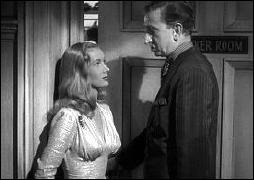
   Still, the 1942 film of This Gun for Hire is a fine thing, with Veronica Lake ably translating Greene’s heroine, Laird Cregar memorably sucking chocolates as he orders a killing, and Alan Ladd, who turned out to be an actor of rather limited resources, achieving stardom as a hired killer — the perfect fusion of Actor and Role.

GRAHAM GREENE This Gun for Hire

   Then in 1955 producer A.C. Lyles (best remembered for a series of geriatric B-westerns in the 196Os) remade This Gun for Hire as Short Cut to Hell, directed by James Cagney, of all people.

   It’s a difficult film to like: crude, sloppy, brutal and rather pointless, but Robert Ivers and Georgann Johnson (whose careers went nowhere) do surprisingly apt interpretations of Greene’s ratty little killer and smart-ass heroine.

« Previous Page — Next Page »