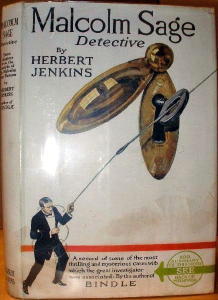
Malcolm Sage, detective, created by author Herbert Jenkins, is one of the few fictional characters who are covered in both Kevin Burton Smith’s Thrilling Detective website dedicated to Private Eye fiction, and Michael Grost’s Guide to Classic Mystery and Detection website dedicated to precisely that.

   Kevin leads off his comments by saying: “Malcolm Sage had been a hot shot intelligence agent for Britain’s Division Z during the Great War, but when the fighting ceased, his thirst for action and adventure didn’t. Fortunately, his old chief from Division Z helped him set up the Malcolm Sage Detective Bureau, and much merry mayhem and more than a few ripping good yarns ensued.”

   Says Mike, in part: “Jenkins’ work has some similarities to R. Austin Freeman’s. Malcolm Sage, like Thorndyke, is a private investigator; he is hired by the insurance companies, similar to the arrangement in Thorndyke’s books. Sage, like Thorndyke, emphasizes photography in his work. He is also skeptical of fingerprints. Most of the clues he follows up on in his cases fall within the parameters of Freeman’s world.”

   Besides the stories collected in the volume Mary reviews below, Malcom Sage appeared a year earlier in a novel entitled John Dene of Toronto; A Comedy of Whitehall (Herbert Jenkins Ltd, London, 1920; George H. Doran Co., New York, 1919). Another short story is included in the collection The Stiffsons, and Other Stories (Jenkins, 1928). (Strangely enough, no source seems to know which one it is.) Herbert Jenkins the publisher was the also Herbert Jenkins the author, in case you were wondering.

   A complete bibliography for Herbert Jenkins the author can be found online, many of his novels chronicling the humorous adventures of the Bindle family.

— Steve


HERBERT JENKINS – Malcolm Sage, Detective

Jenkins, 1921; Doran, 1921. The complete contents are as listed below, as given in Crime Fiction IV, by Allen J. Hubin. Some of these are apparently bridging episodes only and not complete stories in themselves.

• Gladys Norman Dines with Thompson • ss
• The Great Fight at the Olympia • ss
• The Gylston Slander • ss Hutchinson’s Story Magazine Jul ’20
• The Holding Up of Lady Glanedale • ss
• Inspector Wensdale Is Surprised • ss
• Lady Dene Calls on Malcolm Sage • ss
• A Lesson in Deduction • ss
• Malcolm Sage Plays Patience • ss
• Malcolm Sage’s Mysterious Moments • ss
• The Marmalade Clue • ss
• The McMurray Mystery • ss
• The Missing Heavyweight • nv
• The Outrage at the Garage • ss
• Sir John Dene Receives His Orders • ss
• The Stolen Admiralty Memorandum • nv
• The Strange Case of Mr. Challoner • ss
• The Surrey Cattle-Maiming Mystery • ss
Malcolm Sage

   Malcolm Sage was an accountant who was always finding “little wangles” in the books. Refused for war service by the army, he worked for the Ministry of Supply and found a much larger wangle, eventually transferring to Department Z in Whitehall. The department handled secret service work during the war and now the conflict is over and the Department is being demobilised, Sir John Dene, his old chief, agrees with Lady Dene Sage that Sage should be set up in a private detective agency.

   Sage has a “bald, conical head”, a “determined” jaw, and protruding ears. His keen gaze is aided by gold-rimmed spectacles and his “shapely” hands are always restless, drawing on his blotting pad, balancing a spoon on a knife, constructing geometrical designs with matches, that sort of thing. He is kind, quiet, and never smiles. Nevertheless Sage’s Whitehall staff is devoted to him and it is from their ranks he chooses a handful to work at his agency. Gladys Norman will continue as his secretary and other departmental personnel engaged for the new venture are Sage’s assistant James Thompson, office junior William Johnson, and chauffeur Arthur Tims.

   ● This collection of investigations kicks off with “The Strange Case of Mr Challoner,” who was found an apparent suicide in a locked library. However, foul play is suspected and Richard Dane, Mr Challoner’s nephew is fingered as the likely culprit, having violently quarreled with the dead man the day before.

   ● In “The Surrey Cattle-Maiming Mystery,” Sage is called in to hunt down the person responsible for the crimes. There had been almost thirty going back over two years, despite villagers organising a committee to keep watch at night. Peppery General Sir John Hackblock, whose mare has been similarly mutilated, asks Sage to look into the matter since he is not satisfied with what he was told when he consulted Scotland Yard.

   ● “The Stolen Admiralty Memorandum” opens with a summons to a country mansion where the Prime Minister, the First Lord of the Admiralty, and the Secretary of War are both weekend house guests – and all are in a panic. The memorandum has disappeared and could do a great deal of damage in the wrong hands. Who is responsible for its theft? There are plenty of suspects, including over a dozen house servants and a number of other guests along with their ladies’ maids and valets.

   Next we have an interlude in which secretary “Gladys Norman Dines with Thompson,” Sage’s assistant. Gladys debates why the staff is so loyal to their employer, with a nice little sideswipe at expectations raised by romance novels (E. M. Hull sprang to mind!). Their conversation explains how Gladys came to work for Sage and where Thompson first met their employer, fleshing out the lives of the bureau employees as also happens elsewhere. The reader never has the impression the staff are spear carriers whose role is to admire Sage’s brilliance, and learning something of their lives was an attractive sidelight.

   ● Then it’s back to criminous business with “The Holding Up of Lady Glanedale,” wife of margarine magnate Sir Roger Glanedale. She has been robbed at gun point in a nocturnal burglary at the family’s country house. The Twentieth Century Insurance Corporation Limited calls Sage in to investigate the circumstances and find the missing jewelry.

   ● “The McMurray Mystery” deals with Professor James McMurray, found murdered in a locked laboratory. It is a particularly mysterious matter because the body of the professor displays a strangely youthful appearance. McMurray’s friend and philanthropist Sir Jasper Chambers was the last person to talk to the professor, who was in the habit of living in his laboratory for days on end and refusing to admit anyone for any reason. How then did his murderer get
in and out and what is the role of marmalade in the affair?

   ● A flurry of scandalous poison pen letters allege a vicar’s daughter and his curate are carrying on an intrigue. Naturally these foul communications cause much distress and agitate the villagers of Gylston and its surrounding area. “The Gylston Slander” sees Sage called in to find the culprit.

   ● Charley Burns is “The Missing Heavyweight,” who disappears on the eve of an important fight on which many have wagered large sums. Where has he gone and why? Was he taken ill, kidnapped, or did he run away, afraid to fight? This particular entry includes an excellent example of Sage’s deductions from evidence, in this case a patch of garden soil. Unlike some of the more startling deductions made by Holmes, here as in other stories the detective’s explanations seem reasonable and the reader is left with the impression they too could have made the same conclusions, if not as quickly.

   In the final chapter, “Lady Dene Calls on Malcolm Sage,” Lady Dene arrives at the bureau with an unusual aim. To the amazement of the staff she’s there to decorate Sage’s office with vast quantities of red and white roses on the anniversary of the agency’s founding and to present him with an antique platinum and lapis lazuli ring from her husband and herself to set off his “lovely” hand. To the astonishment of secretary Gladys and disbelief of Thompson, Sage accepts the gift — and smiles at Lady Dene.

   My verdict: Malcolm Sage is clever and yet an “ordinary shmoe” protagonist surrounded by a likable staff. It would be difficult not to warm to him and them. No astounding leaps of deduction or parade of esoteric knowledge here! Sages uses common sense, a keen eye, and the occasional bit of psychology to solve the cases he investigates. I enjoyed this collection a great deal.

Etext: http://gutenberg.net.au/ebooks02/0200921.txt

      Mary Reed
http://home.epix.net/~maywrite/
   Not too many mystery writers can claim to have created a whole new sub-genre, but according to his obituary in yesterday’s New York Times, that’s what Paul Erdman did. Mr. Erdman died on Monday, April 23rd, on his ranch in California at the age of 74.

   If I were to list the books to his credit, as supplied by Allen J. Hubin’s Crime Fiction IV, and give you a hint: “fi-fi,” I think perhaps you may be able to work it out. (In all truthfulness, “fi-fi” is not a term I had seen used myself until yesterday.)

ERDMAN, PAUL E(mil) (1932-2007)
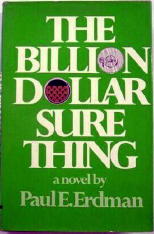
      * The Billion Dollar Killing (n.) Hutchinson 1973 [Switzerland] U.S. title: The Billion Dollar Sure Thing.
      * The Billion Dollar Sure Thing (n.) Scribner 1973; See: The Billion Dollar Killing.
      * The Silver Bears (n.) Hutchinson 1974. Scribner, 1974. Film: EMI, 1977 (scw: Peter Stone; dir: Ivan Passer).
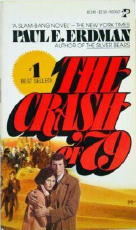
      * The Crash of ’79 (n.) Secker 1976. Simon, 1977. [Middle East].

Crash of 79

      * The Last Days of America (n.) Secker 1981. Simon, 1981. [Switzerland; 1985]
      * The Panic of ’89 (n.) Deutsch 1986. Doubleday, 1987. [1988]
      * The Palace (n.) Deutsch 1987. Doubleday, 1988. [New Jersey]
      * The Swiss Account (n.) Deutsch 1991. Tor, 1992. [Switzerland; 1945]
      * Zero Coupon (n.) Macmillan 1994. Forge, 1993. [San Francisco, CA]
      * The Set-Up (n.) St. Martin’s 1997. Macmillan (London), 1997. [Switzerland]

   The earliest reference found to “fi-fi” after a quick search on Google was in the opening paragraph of a 1992 review of The Swiss Account:

   “No one ever accused Paul Erdman of being neutral about the Swiss. After all, they put him in jail while they were investigating his bank, inadvertently starting him on a career as a best-selling writer of financial thrillers, or fi-fi, as someone once tagged the genre that has earned him millions.”

   In the second paragraph of this review written by Lawrence Malkin for the International Herald Tribune, he goes on to say:

   “His latest book is an attempt to settle accounts with the Swiss, who tried to block publication of his 1959 doctoral thesis at the University of Basel because it uncovered part of the story of Swiss banks and their Nazi clients.”

    “Fi-fi” refers to financial fiction, of course, and if Mr. Erdman didn’t invent the genre, he was certainly the one who popularized it. Published in the US as The Billion Dollar Sure Thing, his first book won an Edgar from the Mystery Writers of America in 1974 for Best First Novel.

Billion

   The story is true. Paul Erdman was in a Swiss jail when he wrote that first book. After a bank he established had collapsed in 1970, incurring a loss of tens of millions of dollars, he spent eight months in prison, posted bail, moved to the US and after being convicted in absentia, never returned to Switzerland.

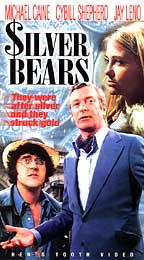
   His novel The Silver Bears was filmed in 1978, the movie starring Michael Caine, Martin Balsam, Cybill Shepherd and Jay Leno. Says IMDB of the story line: “Financial wizard “Doc” Fletcher (Michael Caine) is sent by crime boss Joe Fiore (Martin Balsam) to buy a bank in Switzerland in order to more easily launder their profits.” Things go downhill from there. Turns out that the story (as filmed) is a comedy.

Silver  Bears

   Mr. Erdman’s unplanned career change obviously went well with him, and the millions of readers he garnered never complained either. Along with the abundant dose of criminal intent in each of his thrillers, there was enough real world application that came with them that, if they were paying attention, his readers could have earned a practical degree in economics or international finance as well. Many of his readers probably already had one.

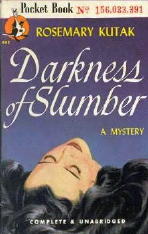
   Mystery author Rosemary Kutak has two books to credit, both written in the 1940s. Up until today, her entry in Crime Fiction IV, by Allen J. Hubin, has looked like this :

KUTAK, ROSEMARY (1908- )

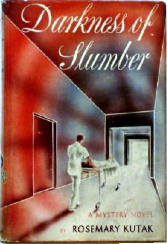
      * Darkness of Slumber (Lippincott, 1944, hc) [Dr. Marc Castleman]
      * I Am the Cat (n.) Farrar, 1948, hc. [Dr. Marc Castleman; Long Island, NY]

Kutak Darkness

   At some point in her life, as it turns out, Mrs. Kutak seems to have subtracted a few years from her age. Victor Berch has learned that — well, wait, I’ll let him tell it:

   “She and her husband had taken a European ocean trip and were returning on the SS Olympic, which sailed from Cherbourg, France, on Aug. 21, 1933 and arrived in NY on Sep. 6, 1933. Her birth information (apparently from her passport) gave her birth date as May 8, 1905, born in Anderson, Indiana.”

   In a later email, Victor reported further that “Rosemary shows up as Margaret Rosemary Norris in the 1910 Census. Daughter of Samuel C. and Luella Norris.”

   This investigation began when Al Hubin had discovered earlier that:

    “The Library of Congress gives a 1908 birth date to her, which I’ve used. But I can’t trace anyone alive with that name and birth year, and I’m rather wondering if the Rosemary N. Kutak (with the N probably standing for Norris) in the social security records isn’t the author. Her dates are [born] 5/8/1905 [and died] 7/8/1999 (in Louisville, KY).”

   Al was right and the Library of Congress, as Victor has shown, was wrong. The heading for Mrs. Kutak in the online Addenda for CFIV will look like this

KUTAK, (MARGARET) ROSEMARY (NORRIS). 1905-1999.

   A blurb for Darkness of Slumber, which was reprinted as Pocket #402 in 1946, described the story thusly: “A young doctor investigates the sudden madness of a beautiful woman.” Another dealer quotes from the Canadian hardcover: “We got murder, we got a madhouse, and we got a beautiful woman — add to that a doctor with a reputation he wants to clear, and you’ve got a book the New York Times Book Review said was one of the ‘Ten Best.'”

Kutak Pocket

   I Am the Cat was reprinted twice in paperback, first as a digest-sized softcover in abridged form as Mercury Mystery #130 (December 1948), then by Collier in 1966 with an introduction by Anthony Boucher.

   My apologies for the lack of a cover image, but one online seller says: “Great old plot here, a Long Island mansion, six guest/suspects, mysterious events, all the typical players in a suspenseful story. […] The dust jacket is dark green, with foreboding picture of a stairway leading to where?”

***

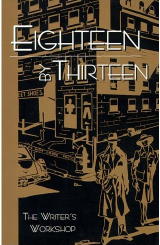
   Author Freda Kreitzman is difficult to locate in CFIV. The book she was in part responsible for is entitled Eighteen by Thirteen (1998), a group-effort novel published as by The Writer’s Workshop. The entry looks like this:

WRITER’s WORKSHOP

      * Eighteen by Thirteen (Connecticut: Rutledge, 1998, pb) Round-robin novel by Molly Bartel, Doris Bissette, John Fisher, Orel Friedman, 1913- , Charlotte Hartman, Frieda Kreitzman, Erwin Lissau, Grace Marks, Julia Nyfield, Leon Robinson, Ruth Robinson, Betty Webster, and Gertrude Welt.

   She was one of the thirteen writers. Neither she nor any of the other twelve participants have another credit in CFIV. Using social security records, however, Al Hubin has come up with the following dates for Ms. Kreitzman: She was born November 28, 1917, and died December 9, 2006.

18 x 13

   A website page for the Southern Adirondack Library System no longer functioning, but entitled New York State Regional Authors, says of one of the book’s participating writers:

    “Orel Friedman was born in Glens Falls 85 years ago and practiced medicine here until retirement in 1980. A widower with three children and eleven grandchildren, his interests include gerontology, golf, bridge, travel and writing. He is a member of The Writer’s Workshop at his winter residence in Florida where he co-authored Eighteen By Thirteen.”

   Freda Kreitzman was 80 or 81 years old when the book was published. Further investigation has revealed that the The Writer’s Workshop met at the Forum, a Marriott Senior Center Living Community in Deerfield Beach, Florida.

[UPDATE] 04-27-07.  Excerpted from an email from Victor Berch, who did some investigation into the other members of The Writer’s Workshop:

   I have the dates of some more of those writers. The hard part is finding the women authors’ maiden names. Some of their obituaries were in local Sun-Sentinel newspaper for Broward county, but [they are not generally available online]. At any rate, here are some of the dates from the SSDI   [Social Security Death Index]:

   Bartel, Molly (or Mollie) [H], May 2, 1911 – Nov. 11, 2003

   Bissette, Doris [W], Aug. 2,1923 – Nov. 28, 2005

   Hartman, Charlotte, Nov. 17, 1923 – Nov. 8, 2005

   Nyfield, Julia [S], May 4, 1909 – Nov. 24, 2003

   Robinson, Leon, Dec. 26, 1910 – Aug. 21, 2001

   Webster, Betty [i.e. Elizabeth J], May 2, 1927 – June 23, 1999

   Erwin Lissau was an interesting one. He was born in Vienna, Austria on Feb. 17, 1916. He and his younger brother were living as students in Zagreb, Yugoslavia after Hitler had taken over Austria. They came to the US in 1939. Erwin joined the Army in 1941 and more than likely obtained his citizenship because of that. He died Aug. 10, 2001.

MARGUERITE SILVERMAN – The Vet It Was That Died. Nicholson & Watson; UK hardcover. First edition: 1945. No US edition.

   Of the three mystery novels written by this author, this one is the most common among those found offered for sale online: there are six copies available at the time I am writing this. Of Silverman’s second (Who Should Have Died?, Nicholson, 1948) there are none, and of her third (9 Had No Alibi, Nicholson, 1951) there is but one.

   According to Al Hubin’s Crime Fiction IV, the primary detective in each is Chief Inspector Christopher Adrian. Coming to his assistance in this one, at least, a relatively minor affair, is a newly graduated veterinarian surgeon by the name of Helena Goodwin.

    Helena’s involvement with the mystery is due only to this, her first job, however, and in fact she’s one of those immediately on the scene when her body of her veterinarian employer is found. (Hence the title.) And yet, even though both the inspector and his wife are old friends of her family, it doesn’t seem as though there?s enough of a connection there to warrant her presence in any of Adrian?s other cases. I could be wrong. It will also be difficult to find out, but if and when I do, I will be sure to tell you.

    It comes as no surprise that “the vet it was that died,” as both Mr. Thorpe and his wife are two of the most terrifically unlikable people that one can imagine. They are hated by their niece Carol, who lives with them; Dora, the other girl who works for them; their neighbors, and even their clientele, believe it or not. That the couple were not especially fond of each other is also an understatement, to put it mildly. When Mr. Thorpe is found poisoned to death, what Adrian and Helena quickly realize is that they have a lengthy list of suspects to work with. There is no need at all to start looking under rocks or for tramps passing by.

    By page 92, however, the list has been narrowed down to five: the only ones who had access to the brandy to which the strychnine was added, but with 100 pages yet to go, it takes quite a bit of time (and false leads) to whittle the list down any further.

    I called this mystery a “minor affair” a short while back, and truthfully that is all it is. The dialogue on occasion is rather juvenile in tone, and on other occasions one gets the unsettling feeling that the author is making up facts as she is going along. Neither of these are necessarily fatal flaws, mind you, but neither of them allows for much in the way of recommendation, either.

— October 2006

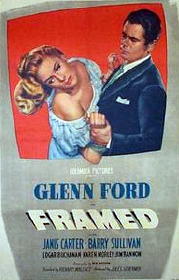
FRAMED. Columbia, 1947. Glenn Ford, Janis Carter, Barry Sullivan, Edgar Buchanan. Director: Richard Wallace.

   More than a B-movie, but not quite an “A,” Framed is generally considered to fall into the noir style of filmmaking. One definition I found online (Encyclopædia Britannica) is that noir is “a film genre that offers dark or fatalistic interpretations of reality. The term is applied to U.S. films of the late 1940s and early ’50s that often portrayed a seamy or criminal underworld and cynical characters. The films were noted for their use of stark, expressionistic lighting and stylized camera work, often employed in urban settings.”

Poster

   I’ll tell you the general plot line, then you tell me. An unemployed mining engineer named Mike Lambert (Glenn Ford) comes into a cheap bar where a beautiful girl named Paula (Janis Carter) is a waitress.

   Bad luck seems to follow Lambert, even getting him into trouble almost as soon as he hits town (literally), but – good luck at last? – Paula is there to bail him out of jail. Of course she has ulterior motives, and Lambert almost realizes it, but he can’t quite make a break from her.

Glenn Ford

   One of Paula’s bedtime buddies is a local banker named Steve Price (Barry Sullivan), and their plans for Mike Lambert are both sinister and obvious. Of course we, the viewer, know full well that plans of this nature do not always work out the way they’re expected to, and in this movie, no exception is made.

   Noir? I thought you’d say so, and I’d agree, but I don’t think it fits the definition above, unless it’s expanded to include “… dark or fatalistic interpretations of reality, often involving unexpected twists of fate, against which the participants feel helpless to react.” Well, maybe the phrasing needs some work, but work on it I will.

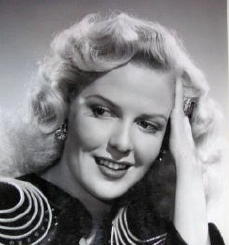
   Glenn Ford’s sometimes goofy-faced grin serves him well in this film, but the chemistry between Paula and him doesn’t quite seem to work. She’s also a little too glamorous – especially to be a waitress in a cheap bar – and not quite vampish or seductive or dangerous enough. (If I include enough words here, maybe the point I’m making will also make itself clear.)

Janis Carter

   As Jeff Cunningham, though, the genial old prospector whom Lambert hopes to work for, and who – completely bewildered – ends up in jail, Edgar Buchanan is in a role made expressly for him. All in all, while you may find the plot line a little too familiar, if this is the kind of movie you like, then you won’t mind seeing yet another variation on the same theme, one more time, with just enough gusto to get by.

   Two more recently discovered deaths, the first in this post being that of spy fiction writer Owen John. Born in Wales in 1918, he passed away there in January 1995. Added also to his entry in Crime Fiction IV, by Allen J. Hubin, is his first name, Leonard, unused in his byline for the following crime novels, the last three marginal (as usual, so indicated by a dash in front of the title):

JOHN, (Leonard) OWEN (1918-1995)

      * Thirty Days Hath September (n.) Joseph 1966 [Haggai Godin; Italy] Dutton, 1967; Paperback Library 63-127, pb, 1969.

      * The Disinformer (n.) Joseph 1967 [Haggai Godin; Canada] Paperback Library 53-773, pb, 1968.

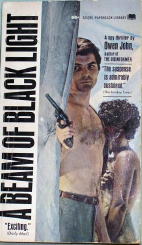
      * A Beam of Black Light (n.) Joseph 1968 [Haggai Godin; Russia] Paperback Library 63-085, pb, 1969. “The story of a young British civil servant planted in a fantastic Russian secret laboratory in the wildest terrain in the world, is insidiously terrifying.”

Beam

      * Dead on Time (n.) Joseph 1969 [Haggai Godin; Middle East] Paperback Library, pb, 1969. “The Arab-Isaeli conflict is the setting for a tale full of action and tension … reality is blended with fiction, with great skill and dash.”

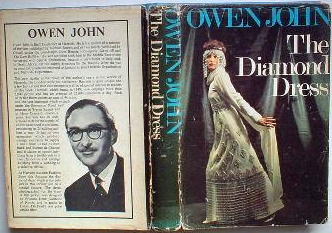
      * The Diamond Dress (n.) Cassell 1970

Diamond Dress

      * The Shadow in the Sea (n.) Cassell 1972 [Haggai Godin; Russia] Dutton, 1972. Fawcett Crest M1928, pb, 1973. “A mysterious Russian submarine is discovered patrolling off the coast of England — Haggai Godin was the one man who could stop it.”

      * Sabotage (n.) Cassell 1973 [Haggai Godin; Wales] Dutton, 1973. Fawcett Crest M2097, pb, 1974. “Two men meet at night on a dark road in Carreg Wales. In London, Roge Platt, Chief of Special Operations, and his agent, Haggai Godin, discover that a nuclear power plant somewhere in England may be sabotaged.”

      * Getaway (n.) Coronet 1976 [Haggai Godin]

      * -The Controller (n.) Hale 1978

      * -Festival (n.) Hale 1978

      * -McGregor’s Island (n.) Hale 1979 [Hebrides]

   Haggai Godin, presumably the young man pictured without a shirt in the paperback cover above, is the agent whose adventures took him all over the world.

*

   Another writer whose death Al Hubin has recently found out about is Henry Kolarz, who died in 2001. He was the author of one book included in CFIV:

KOLARZ, HENRY
(1927-2001)

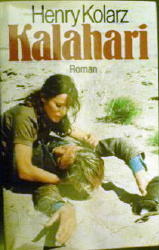
      * Kalahari (Fawcett Popular Library, 1979, pb) [Africa] Translation of “Kalahari” from the German. Frankfort, 1977. Reprinted in a Reader’s Digest hardcover collection of condensed novels, 1980.

Kalahari

   Kalahari is one of a extremely small number of crime novels to have taken place in Botswana. A description of the book, as provided by the Reader’s Digest edition:

   “The shot had come without warning. As if the arid wastes of Kalahari were not enemy enough, somewhere in the darkness there lurked a merciless gunman.

   “There had been no doubt in Dieter Hahn’s mind, when the shabby African had appeared out of the bush, that he should give him a lift in the VSO truck. It was common humanity, nothing more.

   “Even now he did not regret his decision. For there was more at stake than just his own life. There was everything he stood for: equality, justice, freedom itself.”

   Kolarz was the author of at least one other work of crime fiction that was never translated from German into English, Nachts um 4 wird nicht geklingelt (1961), a novel based on an actual event, that of the escape of 19 prisoners from a North Carolina security prison in 1959.

   The following correspondence came about after Mike Braham saw that I had one of his father’s books for sale and bought it from me. Seeing the name of the purchaser, I asked the obvious question. I was right.   – Steve


   Hal Braham was my father. I stumbled onto the list of his books still out there by mistake the other night, and saw there are a few I don’t have, so I’ve been rounding them up.

   My father wrote extensively in the 1950s, and published a great deal in the old pulp detective magazines (of which I have a collection). He supported us by working as a technical writer by day. The rhythmic sound of his typing on his old Underwood upright lulled me to sleep many a night during my childhood. He also worked as a private investigator and took police science courses. He captures the color and character of Los Angeles and San Pedro of the post-war years extremely well in Call Me Deadly. He also co-wrote a screenplay, Tramp, Tramp, Tramp, which starred Jackie Gleason. It was one of Gleason’s earliest films.

   He belonged to a group of L.A. writers called the Fictioneers. Among them were Ray Bradbury, Richard Matheson (Duel and other screenplays), Charles Beaumont (Twilight Zone), William Campbell Gault (murder mysteries and juveniles), Les Savage (westerns) and Bill Cox. I remember some of their parties at our house with great affection.

   I have followed my father into the writing profession. I am a journalist, currently working at The Fresno Bee. I’ve not published any books as all my work has been newspaper related. Writing seems to be in the family genes. Nelson Algren (Walk on the Wild Side, Man With the Golden Arm) was a cousin and grew up with my father in Chicago.

      From a later email:

   You might add that my father had a passion for writing, and it was a passion of joy. He never agonized; he wrote with pure enjoyment and when he talked about the process of writing there was a twinkle in his eyes. I’ve never been comfortable writing fiction because I can’t be as good as he was. I feel he is looking over my shoulder. He never did, of course. He always encouraged and supported me, and was never critical. But I held him in such high esteem that all my efforts seemed to fall short.

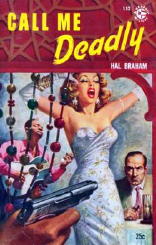
   I’ve always been intrigued by the cover illustrations. They stood out all right, but they never really had anything to do with the novel, and I always tried to imagine a plot based on the drawings. But if they sold more books, who can complain?

   One of my father’s best friends, the author William Campbell Gault (now deceased, sadly), told the story of how his juveniles used to be stolen from the libraries in Santa Barbara, where he lived. The librarians were livid, with the appropriate priggish indignation of how bad the youth of our day have become. Bill thought it was great. “It just meant they had to replace my books, which meant more money for me,” he said.


BIBLIOGRAPHY. Expanded from an updated entry for Hal Braham in the Revised Crime Fiction IV, by Allen J. Hubin:

BRAHAM, HAL [i.e., Harold Braham] (1910-1993); see pseudonyms Mel Colton & Merrill Trask

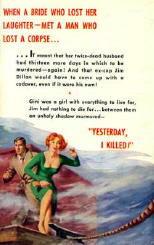
* Call Me Deadly (n.) Graphic #152, pbo, 1957. [Los Angeles, CA] “When a bride who lost her laughter – met a man who lost a corpse …”

Braham


Back Cover

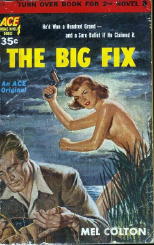
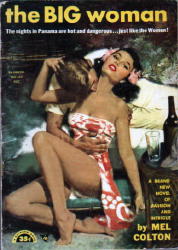
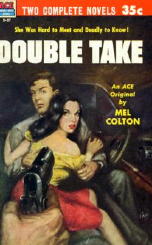
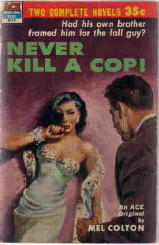
COLTON, MEL; pseudonym of Hal Braham, (1910-1993); other pseudonym Merrill Trask

* The Big Fix (n.) Ace Double D-3, pbo, 1952. “He’d won a hundred grand – and a sure bullet if he claimed it.”

Big Fix

* Big Woman (n.) Rainbow 1953 [Panama] “The nights in Panama are hot and dangerous — just like the women!”

Big Woman

* Double Take (n.) Ace Double D-27, pbo, 1953 [Los Angeles, CA]. “She was hard to meet and deadly to know.”

Double Take

* Never Kill a Cop! (n.) Ace Double D-19, pbo, 1953. “Had his own brother framed him for the fall guy?”

Never Kill a Cop

* Point of No Escape (n.) Ace Double D-101, pbo, 1955

TRASK, MERRILL; pseudonym of Hal Braham, (1910-1993); other pseudonym Mel Colton

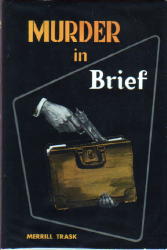
* Murder in Brief (n.) Mystery House 1956 [Los Angeles, CA]

Trask

SHORT FICTION: All stories as by Mel Colton.

“Dead Men Can’t Welsh” — Black Mask, November 1948
“No Time to Burn” — Dime Detective, July 1949
“Dreamer with a Gun” — Dime Detective, December 1949
“Death Insurance” — F.B.I. Detective Stories, April 1950
“Corpse-Gathering Cutie” — Dime Detective, June 1950
“Hot-Scotch Polka” — F.B.I. Detective Stories, October 1950
“Kill and Make Up” — Dime Detective, October 1950
“Her Perfect Frame” — Dime Detective, December 1950
“Win, Lose–or Kill” — Black Mask Detective, March 1951
“Something to Shoot About” — Dime Detective, October 1952
“Murder Pays Double” — Pursuit, July 1954
“Ring Around a Murder” — Hunted, April 1955
“Murder on Account” — Pursuit, May 1955
“The Vicious Ones” — Hunted, August 1955
“Don’t Wait for Me” — Pursuit, September 1955
“Justice on the Death Prowl” — Short Stories, November 1956
“Second Guess” — ­Pursuit, November 1956
“Red Death” — Short Stories, June 1957

FILMS:

Hal Braham wrote the story which was the basis for Tramp, Tramp, Tramp (Columbia, 1942), starring Jackie Gleason, Jack Durant and Florence Rice.

Synopsis: A pair of barbers are driven out of business because most of the men in their small town are being drafted into the army. When they attempt to enlist and are turned down, they decide to form a Home Defense Force, getting them involved with a gang of crooks.

—

Thanks to Bill Pronzini for providing several of the cover images and the big assist in putting together the list of Hal Braham’s short fiction.

   I’ve been falling behind in terms of pointing out the deaths of a number of mystery authors that Al Hubin has been uncovering recently. Sources that he uses to come up with the dates they died include Contemporary Authors and various sites on the Internet. Eventually the information will appear in the online (and ongoing) Addenda to his Revised Crime Fiction IV, but it’s my intention to post them here on the M*F blog as well, adding to their profiles as I’m able.

   There’s such a backlog now that it no longer makes sense to try to do them all at once. If I do only two or three at a time the task won’t seem so overwhelming, and even so, I’d better not put it off any longer.

   First in this particular post is Benedict Kiely, born August 15, 1919 in Ireland, author of two titles in CFIV, one marginally crime-related. He died on February 8th earlier this year.

KIELY, BENEDICT (1919-2007)
      * -The Cards of the Gambler (Methuen, 1953, hc)
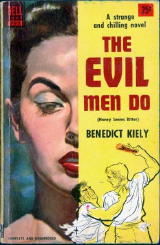
      * Honey Seems Bitter (Methuen, 1954, hc) Dutton, 1952. Also published as: The Evil Men Do; Dell, 1954.

   Mr. Keily was a Irish journalist, writer and critic, and literary editor of the Irish Press beginning in 1950, overcoming the banning of three early novels, including Honey Seems Bitter. Under Ireland’s censorship laws at the time, the books were deemed to be “in general tendency indecent or obscene.”

   Moving to the US in 1964, he was the writer-in-residence and/or visiting professors at three different universities, returning the Ireland in 1968, later receiving the Award for Literature from the Irish Academy of Letters, and was awarded honorary doctorates by the National University of Ireland and the Queen’s University, Belfast.

   In 1996 he received the highest honour of Aosdána, the Irish artists’ body, when he was elected a Saoi, in recognition of his contribution to literature, his work displaying both “a deep affection for and exasperation with Ireland.” At the time of his death Benedict Kiely had become one of Ireland’s best-known broadcasters, storytellers and short story writers.

   The theme of Honey Seems Bitter is murder and in essence is a psychological study of the dark side of humanity bordering on existentialism. Without seeing the book itself, the blurb for the Dell paperback edition seems shallow in comparison: “Beautiful Lily Morgan had been murdered and defiled, yet even in death she held two men in an unnatural grip.”

Kiely

   Mavis Eileen Underwood, learned to have died in January, 1987, was born 1916 in Guernsey, Channel Islands. She wrote one novel included in CFIV, a Crime Club mystery published under the byline of Sarah Kilpatrick:

KILPATRICK, SARAH; pseudonym of Mavis Eileen Underwood, (1916-1987 )
      * Wake All the Dead (Doubleday, 1970, hc) [England] White Lion, 1974.

      Again as Sarah Kilpatrick, she wrote a small handful of other books, one of which, Fanny Burney (David & Charles, UK, 1980), was a biography of the 18th century novelist of the same name. The blurb of Ladies’ Close (Gollancz, UK, 1967), one of three works of fiction, compares the novel to the work of Jane Austen except, as one bookseller puts it, “this is more sexual.”

      As for Wake All the Dead, it has to do with Rose Tallis, a newcomer to a small English village, a local pub, hippies, an ancient cemetery, drugs, and an old verger’s death.

   Not many writers have had a career lasting as long as the 56 years that British mystery writer E. R. Punshon happened to have. Even so, Nick Fuller, on the pages of his website devoted to Punshon’s detective fiction, calls him “one of the most shamefully neglected writers of detective fiction,” with plots “rivaled only by [those of] John Dickson Carr.”

   He had, Nick goes on to say, the same “gift of conveying atmosphere and setting [and with the same adeptness] at devising clues and situations.” His work are also studies of character, of “the catalyst that drives an ordinary human being to commit the ultimate crime.”

Secrets

   A complete list of Punshon’s mystery fiction in book form will follow Mary’s review of The Bittermeads Mystery, taken from Crime Fiction IV, by Allen J. Hubin. The detective twosome of Inspector Carter and Sergeant Bell appears in some his early books, but the series character who appears most often is Bobby Owen, who, according to Nick, “rises from the rank of police constable (in Information Received, 1933) to Commander of Scotland Yard by the later books.”

   The Bittermeads Mystery is a stand-alone, however. Robert Dunn appeared in this book and no other.        – Steve


E. R. PUNSHON – The Bittermeads Mystery

Knopf, hc, 1922. [No British edition?]

   The Bittermeads Mystery gets off to a lively start with protagonist Robert Dunn eluding pursuit after a donnybrook (or should I say a Dunnybrook?) with a man he was following through a wood.

   Dunn continues his nocturnal activities by sloping along to Bittermeads, the titular house, where he finds a burglary in progress. Seizing the day, or rather the night, Dunn knocks the burglar out and after exchanging clothing with the unconscious man (subsequently concealed on the village common opposite the house) he enters the dwelling hoping to be discovered.

   An unusual ambition, you may say, but since a burglar is a shady sort he hopes to be invited to join the murky band associated with Bittermeads. His reasoning is he will not be turned him over to the police as the residents don’t want attention drawn to the house. In this way he hopes to find out what has happened to his old chum Charley Wright, who was romantically involved with Ella Cayley, the daughter of the house, but has disappeared. (He has another reason for his interest in joining the enemy camp, but it is not revealed until some way into the narrative.)

   The only people at home are Ella and her ailing mother and after tying Ella up and promising not to disturb her mother, Dunn explores the house – only to find the murdered Charley in a packing case in an attic.

   Ella’s stepfather, Deede Dawson, returns home and nabs Dunn but decides to employ him as chauffeur and gardener – not an action one would expect of an honest man. Dunn’s first task is to finish nailing down the lid of the packing case without revealing he knows what is in it. But then Ella takes the packing case away in a car, thus removing the only evidence he can produce to launch a police investigation.

   Then there is another murder as the plot thickens up in satisfactory fashion.

   My verdict: The two matters Dunn is investigating have no immediate apparent link but ultimately are shown to be intertwined. Although the close reader may well deduce a certain hidden identity and the name of the person masterminding the mayhem, it will likely not be until fairly late in the book.

   The action gallops along and we have an unusual look at the romantic agony of a male protagonist as well as his internal musings as the plot develops. Although it is a fast, light read there are noir underpinnings and the whole is resolved with a satisfactory comeuppance for the egregious villain of the piece.

   Etext: http://www.geocities.com/hacklehorn/punshon/index.html

         Mary R
http//home.epix.net/~maywrite/

BIBLIOGRAPHY [British editions only, unless retitled in the US; all covers shown are those of the US editions, however.] —

PUNSHON, E(rnest) R(obertson) (1872-1956); see pseudonym Robertson Halket

* Earth’s Great Lord (n.) Ward 1901 [Australia]
* -Constance West (n.) Lane 1905 [England]
* The Mystery of Lady Isobel (n.) Hurst 1907 [England]
* The Choice (n.) Ward 1908 [England]
* The Spin of the Coin (n.) Hurst 1908 [England]
* The Glittering Desire (n.) Ward 1910 [England]
* Hidden Lives (n.) Ward 1913 [England]
* -The Crowning Glory (n.) Hodder 1914 [England]
* Arrows of Chance (n.) Ward 1917 [England]
* The Miser Earl (n.) Newnes 1917
* The Solitary House (n.) Ward 1919 [England]
* The Woman’s Footprint (n.) Hodder 1919 [England]
* The Ruby Bracelet (n.) Newnes 1920 [England]
* The Bittermeads Mystery (n.) Knopf 1922 [England]
* Dunslow (n.) Ward 1922 [England]
* The Blue John Diamond (n.) Clode 1929 [England]
* The Unexpected Legacy (n.) Benn 1929 [Insp. Carter; Sgt. Bell; England]
* The Cottage Murder (n.) Benn 1931 [Insp. Carter; Sgt. Bell; England]
* Proof, Counter Proof (n.) Benn 1931 [Insp. Carter; Sgt. Bell; England]
* Genius in Murder (n.) Benn 1932 [Insp. Carter; Sgt. Bell; England]
* Truth Came Out (n.) Benn 1932 [Insp. Carter; Sgt. Bell; England]
* Information Received (n.) Benn 1933 [Det. Sgt. Bobby Owen; England]
* The Crossword Murder (n.) Knopf 1934; See: Crossword Mystery (Gollancz 1934).
* Crossword Mystery (n.) Gollancz 1934 [Det. Sgt. Bobby Owen; England]
* Death Among the Sunbathers (n.) Benn 1934 [Det. Sgt. Bobby Owen; England]
* Mystery Villa (n.) Gollancz 1934 [Det. Sgt. Bobby Owen; England]
* Death Comes to Cambers (n.) Gollancz 1935 [Det. Sgt. Bobby Owen; England]
* Death of a Beauty Queen (n.) Gollancz 1935 [Det. Sgt. Bobby Owen; England]
* The Bath Mysteries (n.) Gollancz 1936 [Det. Sgt. Bobby Owen; London]
* The Dusky Hour (n.) Gollancz 1937 [Det. Sgt. Bobby Owen; England]
* Mystery of Mr. Jessop (n.) Gollancz 1937 [Det. Sgt. Bobby Owen; England]
* Comes a Stranger (n.) Gollancz 1938 [Det. Sgt. Bobby Owen; England]
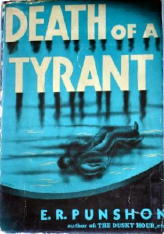
* Death of a Tyrant (n.) Hillman-Curl 1938; See: Dictator’s Way (Gollancz 1938).

Tyrant

* Dictator’s Way (n.) Gollancz 1938 [Det. Sgt. Bobby Owen; England]
* Murder Abroad (n.) Gollancz 1939 [Det. Sgt. Bobby Owen; France]
* Suspects-Nine (n.) Gollancz 1939 [Det. Sgt. Bobby Owen; England]
* Four Strange Women (n.) Gollancz 1940 [Det. Sgt. Bobby Owen; England]
* The Dark Garden (n.) Gollancz 1941 [Det. Sgt. Bobby Owen; England]
* Death in the Chalkpits (n.) Mystery Novel of the Month 1941; See: The Dusky Hour (Gollancz 1937).
* Ten Star Clues (n.) Gollancz 1941 [Det. Sgt. Bobby Owen; England]
* The Bathtub Murder Case (n.) Detective Novel Classics 1942; See: The Bath Mysteries (Gollancz 1936).
* Diabolic Candelabra (n.) Gollancz 1942 [Det. Sgt. Bobby Owen; England]
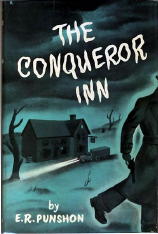
* The Conqueror Inn (n.) Gollancz 1943 [Det. Sgt. Bobby Owen; England]

Inn

* Night’s Cloak (n.) Gollancz 1944 [Det. Sgt. Bobby Owen; England]
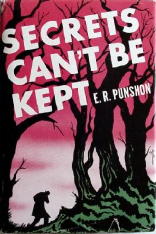
* Secrets Can’t Be Kept (n.) Gollancz 1944 [Det. Sgt. Bobby Owen; England]
* There’s a Reason for Everything (n.) Gollancz 1945 [Det. Sgt. Bobby Owen; England]
* It Might Lead Anywhere (n.) Gollancz 1946 [Det. Sgt. Bobby Owen; England]
* Helen Passes By (n.) Gollancz 1947 [Det. Sgt. Bobby Owen; England]
* The House of Godwinsson (n.) Gollancz 1948 [Det. Sgt. Bobby Owen; England]
* Music Tells All (n.) Gollancz 1948 [Det. Sgt. Bobby Owen; Sgt. Bell; England]
* So Many Doors (n.) Gollancz 1949 [Det. Sgt. Bobby Owen; England]
* Everybody Always Tells (n.) Gollancz 1950 [Det. Sgt. Bobby Owen; England]
* The Golden Dagger (n.) Gollancz 1951 [Det. Sgt. Bobby Owen; England]
* The Secret Search (n.) Gollancz 1951 [Det. Sgt. Bobby Owen; England]
* The Attending Truth (n.) Gollancz 1952 [Det. Sgt. Bobby Owen; England]
* Strange Ending (n.) Gollancz 1953 [Det. Sgt. Bobby Owen; England]
* Brought to Light (n.) Gollancz 1954 [Det. Sgt. Bobby Owen; England]
* Dark Is the Clue (n.) Gollancz 1955 [Det. Sgt. Bobby Owen; England]
* Triple Quest (n.) Gollancz 1955 [Det. Sgt. Bobby Owen; England]
* Six Were Present (n.) Gollancz 1956 [Det. Sgt. Bobby Owen; England]

HALKET, ROBERTSON; pseudonym of E. R. Punshon, (1872-1956)

* Where Every Prospect Pleases (Benn, 1933, hc) [France]
* Documentary Evidence (Nicholson, 1936, hc) [England]


      —

   Mary Reed and Eric Mayer are in the process of compiling an online directory of all freely available etexts of mystery fiction published during the Golden Age of Detection. If you know of any they’ve missed, additions are extremely welcome.

   Peter Rozovsky has just left a comment after my review of Step by Step, posted about this same time yesterday. Peter found what NY Times movie critic Bosley Crowther said about the film to be very interesting. (Crowther didn’t like it very much, and he said so.)

   What’s even more interesting is that in the same column Crowther also reviewed the film version of The Big Sleep, which many people today find one of the classics of the hard-boiled private eye genre. He didn’t care for this one either, and he said so – and at even greater length. You can read the entire review online yourself, and you should, but here are some excerpts:

   If somebody had only told us – the script-writers, preferably – just what it is that happens in the Warners’ and Howard Hawks’ The Big Sleep, we might be able to give you a more explicit and favorable report on this over-age melodrama which came yesterday to the Strand. But with only the foggiest notion of who does what to whom – and we watched it with closest attention – we must be frankly disappointing about it.

Big Sleep

   For The Big Sleep is one of those pictures in which so many cryptic things occur amid so much involved and devious plotting that the mind becomes utterly confused. And, to make it more aggravating, the brilliant detective in the case is continuously making shrewd deductions which he stubbornly keeps to himself. What with two interlocking mysteries and a great many characters involved, the complex of blackmail and murder soon becomes a web of utter bafflement. Unfortunately, the cunning script-writers have done little to clear it at the end.

      […]

   Through it all, Humphrey Bogart stalks his cold and laconic way as the resolute private detective who has a mind and a body made of steel. And Lauren Bacall (Mrs. Bogart) plays the older of the daughters languidly. (Miss Bacall is a dangerous looking female, but she still hasn’t learned to act.) A dozen or so other actors play various tramps and tough guys acidly, and the whole thing comes off a poisonous picture lasting a few minutes shy of two hours.

   On the other hand, to pick a critic whose comments are always handy, Leonard Maltin gives The Big Sleep four stars (****) and in part agreeing with Crowther says, “So convoluted even [Raymond] Chandler didn’t know who committed one murder,” then going on immediately to say, “but so incredibly entertaining that no one has ever cared. Powerhouse direction, unforgettable dialogue…”

   I realize that it’s unfair not to give Mr. Crowther a chance to reconsider – and later on perhaps he did. No one always gets everything right the first time, and I do mean no one.

   And, just in case you might be wondering, Mr. Maltin gives Step by Step two stars (**), but other than a one line summary of the plot, his only critical judgment is that it is a “patriotic programmer.”

« Previous Page — Next Page »