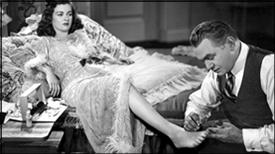
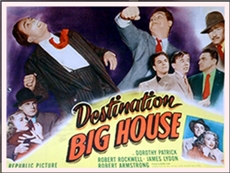
THE GANG’S ALL HERE. Monogram Pictures, 1941. Frankie Darro, Marcia Mae Jones, Jackie Moran, Keye Luke, Mantan Moreland. Director: Jean Yarbrough.

   Frankie Darro and his pal Jeff (Mantan Moreland0 land jobs with a trucking company that, unknown to them, is having a problem with hijackers. What’s worse, even though the boss and his daughter are fine people, the problem is an inside one.

   The budget restrictions were painfully obvious, but this is my kind of movie. It has everything: action, comedy, romance, mystery. Frankie Darro is short, with a fuse to match. Moreland was, simply put, a super super comedian.Who could ask for anything more?

— Reprinted from Movie.File.2, April 1988.

JULIE SMITH – Tourist Trap. Rebecca Schwartz #3. Mysterious Press, hardcover, 1986; paperback, August 1987. Fawcett, paperback, 1992.

   Rebecca Schwartz is an outspoken Jewish feminist lawyer who lives in San Francisco, and I wish I liked the mysteries she gets involved in more than I do. In this one, a madman disrupts the local tourist trade by committing a series of more or less random killings.

   And in the process frames Rebecca’s latest client for the deeds. Totally incompetent police work keeps the case open, even after the real culprit has been identified, halfway through the book. From that point on, there is little more to the story but wheel spinning.

— Reprinted from Mystery.File.5, May 1988.


      The Rebecca Schwartz series

1. Death Turns a Trick (1982)
2. The Sourdough Wars (1984)
3. Tourist Trap (1986)
4. Dead in the Water (1991)
5. Other People’s Skeletons (1993)
Blood types (2014)
Cul-de-Sac (2014)

ELLERY QUEEN – Kiss and Kill. PI Barney Burgess. Ghost-written by Charles W. Runyon. Dell, paperback original; 1st printing, April 1969. Cover art by Robert McGinnis.

   The opening is meant to grab you, and it does A man looks up from his work to find his wife missing from the kitchen, and a search of the neighborhood leads nowhere. The police cannot help, and the man turns to private eye Barney Burgess. The pace then shifts, noticeably so. Events hurtle along, coming faster and faster. There is a villain, one (if I may say so) who crosses the line of reality, and one who is all the more chilling for it. There is also money that corrupts, plus the twist that comes at the end.

   Barney Burgess is a typical PI as a character, one I think modeled after Humphrey Bogart. (Not that there’s anything wrong with that.) He may have been more adventurous in this one, but he is who he is. Only minor flashes of the Queen style are present, sorry to say.

   The beginning, though, could have led to so many wonderfully mysterious endings. This one, following as it does the fates of the hapless members of a Mexican tourist party, may or may not be one of them. Me? More like brutal.

Rating: ***

— June 1969 .
A 1001 MIDNIGHTS Review
by John Lutz


PAULA GOSLING – The Zero Trap. Coward McCann, hardcover, 1980. Warner Books, paperback, 1981. Published earlier in the UK by Macmillan, hardcover, 1979.

   Paula Gosling’s first novel, Fair Game, won critical acclaim and the 1978 John Creasey Award in England. In this, her second novel, she creates an elegant psychological thriller involving a hijacked military aircraft.

   On a routine flight, the plane’s nine passengers are gassed into unconsciousness. They awaken in a luxurious, isolated house stocked with the necessities for survival, and comfortable survival at that. Though they arc not guarded, they cannot leave the house, because it is surrounded by snow and hone-cracking cold. And they have no idea where they arc or why they are there.

   These captives of cold are a diverse group. Laura Ainslie is the daughter of a U.S. Army general. Frank Dcning is a federal marshal escorting accused murderer Joe Hallick to trial. There are also a sexpot entertainer who disturbs male libidos, an antagonistic army sergeant, and an outwardly mild astronomer, David Skinner, who turns out to be the toughest of the lot and becomes romantically involved with Laura Ainslee.

   Obviously the unseen kidnappers want one or more of the captives for a reason. But which of the captives? And why? The bewildered hostages (and the reader) try to figure it all out as tension and isolation fray nerves and create friction.

   This neatly plotted novel is full of convolutions as the hostages’ plight becomes increasingly serious and the cfforts to identify the extortionists keep falling short. In the confines of the house, anger, romance, fear, and lust cause problems that arc almost as dire a threat to survival as are the mysterious captors.

   There arc plenty of plausible and fairly clued surprises, and finally everything is resolved in a twist on a twist.

   Among Gosling’s other novels arc Solo Blues (1981). The Woman in Red (1984), and The Monkey Puzzle (1985).

———
   Reprinted with permission from 1001 Midnights, edited by Bill Pronzini & Marcia Muller and published by The Battered Silicon Dispatch Box, 2007.   Copyright © 1986, 2007 by the Pronzini-Muller Family Trust.

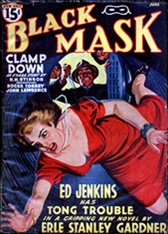
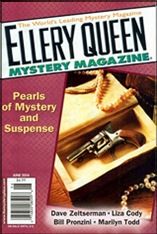
ANTHONY BOUCHER “The Numbers Man.” Short story. Reprinted in Ellery Queen’s Mystery Magazine. First published in Black Mask, July 1945 as “The Catalyst.”

   Both of two titles given this story are appropriate. Gregor Stolz is a catalyst, all right. The kind of guy who just happens to be around as a murder or strange death is about to happen, or even as a witness to the event itself. He is also a man fascinated by numbers, and it will do no harm if I were to tell you that the particular chapter in elementary mathematics is the one about the theory of the decimal system, or the use of using other bases other than ten to describe a number.

   The police detective who is invited to a dinner party knows Stolz well, or at least he knows the man’s reputation, and so when he learns that Stolz will be there, he knows exactly what is going to happen before the night is over. But can he prove anything ahead of time? No, not a thing.

   And sure enough another death happens. Is there enough evidence now? Can the killer be caught? Boucher was a clear, precise writer, one who always chose his words carefully, and all the way through the first half of the story, the story flows exceedingly well. It’s not until the solution is reached that the tale devolves into a leisurely but quite scholarly lecture. Lots of elementary math is involved, I can tell you that.

   What’s the big surprise is that the story first appeared in Black Mask magazine, the epitome of hardboiled mystery fiction, which this story is definitely not, even as a filler, as I am sure it was. It’s a minor tale, truth be told, but a much better fit for a story you could more easily expect to be reading in EQMM, any month of the year.

REVIEWED BY MIKE TOONEY:


   Just a short note to Mystery*File fans who might not have heard of a couple of high-quality websites. While they reproduce literature of many genres, both of them also have substantial collections of mystery and science fiction books, and, as noted, the quality is very high indeed.

Roy Glashan’s Library doesn’t just copy the originals but also improves on them, adding copious numbers of illustrations from various sources whenever feasible. The link:

         https://freeread.de/

   It’s obvious that the folks who run Standard Ebooks are rabid bibliophiles (for which there is still no cure), and it shows in how carefully they reformat, proofread, and correct classic works, giving them a professional upgrade. The link:

          https://standardebooks.org/

   Both sites are worth a look.

ROBERT RAY – Bloody Murdock. Matt Murdock #1. St.Martin’s Press, hardcover, 1986. Penguin, paperback, 1987.

   Reference to a “salvage fee” on page 16 suggests that Southern California PI Matt Murdock intends to follow in the footsteps of JDM’s character Travis McGee, In his own words, Murdock is idealistic and a romantic. Here, the death of a young girl arouses his noblest instincts.

   A vivid writing style is vitiated by muddy motivations. Hired [also] as a bodyguard by a nervous man who saw the “accident” [which will cause his death], Murdock is fired when his client opts for blackmail on his own. His second client behaves strangely too, and she gets into a real mess.

— Reprinted from Mystery.File.5, May 1988.


The Matt Murdock series —

1. Bloody Murdock (1986)
2. Murdock for Hire (1987)
3. Dial ‘m’ For Murdock (1988)
4. Merry Christmas, Murdock (1989)
5. Murdock Cracks Ice (1992)
6. Murdock Tackles Taos (2013)
7. Murdock Rocks Sedona (2015)

   Just in case anyone is interested, yes, I’m OK. Doing fine, all things considered. The lack of regular posting by me here is a lot simpler than that. The last month or so, I’ve just been very very busy. Busier now than when I was working for living. The second half of the month should be a lot better here than the first, I promise you that. Will be doing my best, anyway!

A 1001 MIDNIGHTS Review
by Bill Pronzini


JOE GORES – Hammett. Putnam’s, hardcover, 1975. Ballantine, paperback, 1976.

   Gores is a lifelong aficionado and student of the works of Dashiell Hammett, and Hammett’s influence is clearly evident in Gores’s own fiction. Hammett is his personal monument to the man he believes was the greatest of all crime writers — part thriller, part fictionalized history, part biography set in the San Francisco of 1928, “a corrupt city. owned by its politicians, its cops, its district attorney. A city where anything is for sale.”

   When an old friend from his Pinkerton days. Vic Atkinson, is murdered after Hammett refuses to help him, the former op-turned-Black Mask writer once again finds himself in the role of detective and man hunter. But as the dust-jacket blurb says, “During his search through the teeming alleys of Chinatown, through the cathouses and speakeasies and gambling helJs of the city, Hammett discovers that the years of writing have dulled his hunter’s instincts, have made him fear death — and that failure to resharpen his long-unused skills as a private detective could end … his life.”

   The blurb goes on to say, “Gores’  dialogue crackles and sparks with the wry, tough humor of the twenties. His characters are thinly disguised portraits of the men and women who shook and shaped this most fascinating of American cities.

   His plot, drawn from actual events in San Francisco’s corrupt political past. casts harsh light on a stark and bloody era.” All of which is true enough, at least up to a point. Hammett is considered by some to be Gores’ best book, and in many ways it is. But it also has its share of flaws, among them some overly melodramatic scenes and a  disinclination on Gores’ part to even mention Hammett’s left-wing politics.

   All things considered, it is certainly a good novel — one that should be read by anyone interested in  Hammett, San Francisco circa 1928, and/or fast-action mysteries of the Black Mask school — but it is not the great novel it has occasionally been called.

   The 1982 film version produced by Francis Ford Coppola, on the other hand, is pure claptrap. Frederick Forrest is fine as Hammett,  and the script by Ross Thomas is faithful to the novel,  but the direction (by Wim Wenders) is so arty and stylized that all the grittiness and power  is lost. Some of the scenes, in fact, are so bad they’re almost painful to watch.

   Gores’ other non-series novels, A Time for Predators (which received an Edgar for Best First Novel of 1969) and Interfaces (1974) are also excellent. The latter is one of the toughest, most brutal novels published since the days of Black Mask — so hard-boiled that some readers. women especially, find it upsetting, But its power is undeniable; and its surprise ending is both plausible and certain to come as a shock to most readers.

———
   Reprinted with permission from 1001 Midnights, edited by Bill Pronzini & Marcia Muller and published by The Battered Silicon Dispatch Box, 2007.   Copyright © 1986, 2007 by the Pronzini-Muller Family Trust.

NORMAN SPINRAD – Bug Jack Barron. Avon M206; paperback, June 1969. Cover art by Alex Gnidziejko, Hardcover edition published simultaneously by Walker. An abbreviated version appeared earlier in New Worlds SF, December 1967 through October 1968.

   From the back cover: POWER PLAY. The lines of power are tangled in a future America threatened by a conspiracy of evil. Politics, communication, sex, love – all are sources of power, all are tools for the maniacal ambitions of one man of vast wealth, Benedict Howards. Opposing Howards is Jack Barron, who has incalculable power of his own – but who first must learn how to use it,,, Combines the soaring imagination of science fiction with uncompromising realism.

   The issue if immortality (is there anything so rank you wouldn’t do for immortality?)

   The language is necessary.

Rating: *****

– May-June 1969.

Next Page »