Pulp Fiction


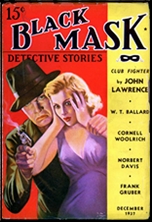
FRANK GRUBER “Death on Eagle’s Crag.” Oliver Quade #8. First published in Black Mask, December 1937. Reprinted in The Hardboiled Dicks, edited by Ron Goulart (Sherbourne Press, 1965).

   At the beginning of this fanciful, not to mention far-fetched tale, Oliver Quade, also known as The Human Encyclopedia, has somehow found his way to an isolated resort located at the top of a mountain, doing what he does best: trying to sell the owner a set of encyclopedias. She may be better at resisting, though, than he isat selling them when one of the guests is found dead along a walking path.

   Remains of a bashed-up rattlesnake are found beside him, with vicious bite marks on his leg, but Quade quickly deduces it was a well-planned murder. The resort’s handyman is about to head down to notify the authorities when a car full of gangsters, escapees from a local prison, comes driving up the hill. Coincidences pile up quickly. The dead man, as it turns out, was a thief,and once the gang of crooks realize he must have hidden eighty grand worth of stolen cash on the grounds, they decide to stick around and keep all of the real guests hostage while they look for it.

   Even while it incorporates a small token of goofiness, making the story is quite a bit of fun to read, it is amazing how Gruber manages to turn the story around on itself as he does, making it perhaps the most violent one in The Hardboiled Dicks, the anthology of stories from the detective pulps Ron Goulart put together in the mid-sixties. There’s nothing very deep to this one, but somehow I’ve managed to remember the basic plot, all these many years later.

   Oliver Quade, who manages to find the money while under a lot duress in this one, was in 15 stories in the pulps. He wasn’t quite as inventive as MacGyver was in using his head to get out of jams, but selling encyclopedias for a living obviously gave him a decided edge over a lot of tough bad guys in his day.

Note: I first wrote a review of this story in 1967, and I posted it on this blog a few weeks ago. Follow the link and you can read it here.

WINDY CITY PULP CONVENTION 2022 REPORT
by Walker Martin

   A few years ago, one of my best friends attended Pulpcon, despite knowing he had a terminal illness. Hardcore collectors will survive just about anything except death. My health problems lately have not involved a terminal illness, but I suffer from claustrophobia, and I had to undergo two cataract operations in April. Despite being disappointed in these procedures, I somehow managed to, go with four other collectors in our usual van.
   Fortunately, this convention managed to cheer me up and here are my comments on the Windy City Pulp Convention. There have been over 20 of these shows and this was the 15th year at the Westin Hotel in Lombard, Illinois, which is about a half hour outside Chicago. Doug Ellis stated that there were about 500 attendees and 180 dealer tables.

   No masks were required, but many collectors wore them just to be safe. As usual the dealer’s room was very busy and set up was allowed on Thursday evening from 8 pm to about 11 pm. There were thousands of books, pulps, vintage paperbacks, original art, new pulp novels, movies on DVDs and comics.

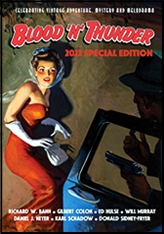
   Some excellent books made their debut at the show. Ed Hulse of Murania Press had what looked like his biggest magazine on the pulps, Blood n Thunder 2022 Special Edition:336 pages, over 100,000 words, and over 100 illustrations. There are 10 essays in the book with the most important being the 120 pages devoted to the Doubleday Crime Club Golden Age, 1928-1940. Ed also had a preview copy of his new book, an updated edition of Wild West in Fiction and Film.
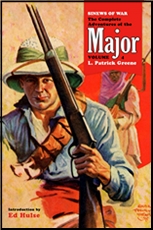
   Matt Moring of Steeger Press had several new books for sale on Mike Chomko’s table: Unremembered Murder by Carroll John Daly, volume 7 of the Race Williams series, all from 1944-1955, The Major by L. Patrick Greene, volume 4, The Life of Pinky Jenkins by H. Bedford Jones, volume 3, and the best one of all, The Complete Exploits of the Notorious Sea Fox by James K. Waterman. This last collects several stories from Frontier in the 1920’s and deals with the infamous slave trade before the Civil War. Steeger Books has passed the 600 book mark I believe. Amazing and quite an accomplishment.

   Also available was the new edition of the Windy City Pulp Stories, #21. 130 pages, all devoted to Fiction House. The best article was Will Murray’s “The Rise and Fall of Fiction House”. Also of note are articles dealing with Arthur J. Burks, the pulp magazine, Black Aces, and other Fiction House items of interest.

   The art show had several original cover paintings and illustrations from Fiction House magazines and I was really impressed by the excellent display. Ed Hulse ran the usual film show which showed serials and B-movies during the day and after the evening auction.

   Speaking of the auction, John Gunnison did his usual fine job as auctioneer. Friday night had 200 lots from the Robert Weinberg Estate and Saturday night had almost 200 lots from the Glenn Lord Estate. An entire set of Planet Stories was auctioned in several lots, many Weird Tales, including the Anniversary large issue from 1924 ($8000), and all sorts of correspondence. The Gent From Bear Creek by Robert Howard sold for several thousand.

   There were the usual panels and I attended the Fiction House discussion given by Roger Hill. On Saturday night David Saunders did his usual excellent job discussing such Fiction House artists as George Gross, Allan Anderson, and Norman Saunders. I’m looking forward to his Pulpfest presentation on Nick Eggenhofer this August.

   I’ve been collecting now for over 65 years and I don’t need much anymore, but I always find something. This year I’m rebuilding some of my sets such as All Western and Dime Detective. I found several copies of each that I need plus an Ace High from 1926 that I’ve been looking for.

   One of the problems of collecting for a long time is that you start to run out of things to collect. Most of my wants are very odd and hard to find, such as the five Sea Stories I lack. There were 118 and I have 113, so it’s not too likely that I’ll find issues I need. Same thing with Western Story and Detective Story. I only need a few issues of each for complete sets, but I’ll probably never find them. But you never know. I never thought I’d find all 444 All Story either but I did.

   Pulpfest is up next in August 4-7, 2022, in Pittsburgh. The 50th Anniversary of Pulpcon/Pulpfest! I never thought I’d see such a long run of conventions when I attended the first one in 1972. But here we are. See you there!

   

                  Note: Part two of this three-part review can be found here.

FRANK GRUBER “Death on Eagle’s Crag.” Oliver Quade #8. First published in Black Mask, December 1937. There is a tremendous contrast between the mild-mannered encyclopedia salesman Oliver Quade, and the extreme amount of violence that occurs as escaped convicts take over a secluded resort. (4)


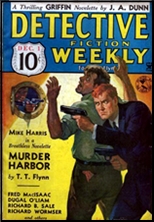
RICHARD SALE “A Nose for News.” Daffy Dill #2. First published in Detective Fiction Weekly, December 1, 1934. Unlikely circumstances cause Daffy Dill to be fired from his newspaper job, and he becomes involved in a kidnapping plot while hunting up a story to regain it. Did not seem too believable even while reading it. (2)


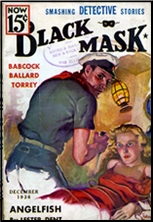
LESTER DENT “Angelfish.” Oscar Sail #2. First published in Black Mask, December 1936. Private eye Oscar Sail is hired to steal aerial photos of oil fields and risks his life in a hurricane to save a girl. Vivid picture of the storm’s violence at sea saves the story. (3)


ERLE STANLEY GARDNER “Bird in the Hand.” Lester Leith #33. First published in Detective Fiction Weekly, April 5, 1932. Lester Leith manages to steal stolen jewels under the watchful eyes of the police. Quite entertaining and amusing except for weak beginning. Gardner’s style is very noticeable; less emphasis on violence. (3)


–December 1967

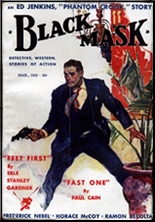
RAOUL WHITFIELD “China Man.” Jo Gar #18. Published under the name Ramon Decolta in Black Mask, March 1932. Reprinted in The Hardboiled Dicks, edited by Ron Goulart (Sherbourne Press, 1965). Collected in West of Guam: The Complete Cases of Jo Gar (Altus Press, 2013).

   Jo Gar is attacked in his office by someone who appears to be a Chinese coolie, but strangely enough the knife thrower misses his mark, even at close range. Gar tries to follow him, but loses him in the crowds in the streets of Manila under the stress of an approaching hurricane.

   Returning to his small cramped office, he finds a note from his client slipped under the door. The man, an importer of valuable jade, had come early and left. The note accuses a “China man” as the person who has been stealing from him.

   Then his client turns up murdered, knifed to death, and his body dumped into a river.

   This may sound like a complicated case, but in spite of what also seems like a story with a lot of action, neither is true. What makes the story work as well as it does is the setting, that of what had to have been a really exotic, foreign land to most readers of Black Mask in 1932, the streets and other sights of the Philippines. And to tell you the truth, it probably still is to most people living in the US today.

Note: I first wrote a review of this story in 1967, and I posted it on this blog a few weeks ago. Follow the link and you can read it here.

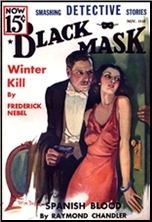
FREDERICK NEBEL “Winter Kill.” Kennedy of the Free Press & Captain Steve MacBride #32. Novelette. First published in Black Mask, November 1935. Reprinted in The Hardboiled Dicks, edited by Ron Goulart. (Sherbourne Press, 1965). Collected in Winter Kill: The Complete Cases of MacBride & Kennedy, Volume 4: 1935-36 (Altus Press, 2014).

   Russ Parcell is a cad, no way to get around that. A rich father’s son who drinks a lot, gambles a lot, and although married, runs around with cheap floozies a lot. He owes one gambling boss over $8500, which in 1935 would have been considered a lot of money, and the gambling boss is anxious to collect. It doesn’t make sense, then, for him to have killed Parcell, does it? The latter was found in the street,hid body frozen to death and covered with snow.

   It is Kennedy of Free Press who figures out it was murder. Someone had poured water on him and sent him wandering out in the cold in a drunken stupor. It is also Kennedy who does most of the investigative work on the case, although Captain Steve MacBride is there for police backup whenever he’s needed.

   It is also Kennedy who shows any personality in this particular story. He’s short and thin, and at times he can be almost invisible in a room, almost a shadow on the wall so that others also in the room can easily forget he’s there. He also drinks a lot, but whether he’s ever actually drunk is not easy to tell. He often learns a lot by pretending he’s had few too many.

   MacBride, on the other hand, could just as well be another generic cop. Luckily for Kennedy, he doesn’t mind putting up with the latter’s various foibles.

   The case, unfortunately, while long and involved, is not a particularly gripping one, and most of Kennedy’s legwork is done off screen, or with the motives for what he does do not revealed to the reader. The Kennedy-MacBride series was both a long one and very popular with the readers at the time. This particular story may not show them at their best.

Note: I first wrote a review of this story in 1967, and I posted it on this blog a few weeks ago. Follow the link and you can read it here.

      Note: Part one of this three-part review can be found here.

FREDERICK NEBEL “Winter Kill.” Kennedy of the Free Press & Captain Steve MacBride #32, Novelette. First published in Black Mask, November 1935. Collected in Winter Kill: The Complete Cases of MacBride & Kennedy, Volume 4: 1935-36 (Altus Press, 2014).

   Newspaperman Kennedy of the Free Press gets beaten up quite a bit but manages to capture a murderer whose victim is found frozen to death on the streets. Complicated story, with lots of characters to keep straight. Not really as satisfying [as the first two stories in this anthology]. (2)
   

RAOUL WHITFIELD “China Man.” Jo Gar #18. Published under the name Ramon Decolta in Black Mask, March 1932. Collected in West of Guam: The Complete Cases of Jo Gar (Altus Press, 2013).

   The servant of a Philippines importer is suspected of killing him, but Jo Gar has difficulty in obtaining proof. The flavor of the Orient comes through clearly. (3)

–December 1967

RON GOULART, Editor – The Hardboiled Dicks. Sherbourne Press, hardcover, 1965. Pocket, paperback, 1967.

   Eight stories from the pulp-age detective magazines, when violence and action were the keywords. The question is, are these stories merely representative, or were they chosen to be among the best of each author’s work? If the majority of pulp stories were below these in quality, they deserve obscurity, but if these are indeed only meant as typical examples, future digging might be quite rewarding. Overall rating: 3 stars.

[Note: Rather than reprint the entirety of the eight stories in one fell swoop, what I’ve decided to do is post them on this blog two at a time, over the next few weeks.]

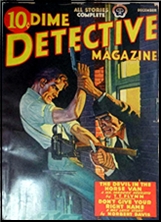
  NORBERT DAVIS “Don’t Give Your Right Name.” PI Max Latin #2. Novelette. First published in Dime Detective Magazine, December 1941. Reprinted in The Complete Cases of Max Latin (Steeger Books, 2013). Max Latin, not-so-honest private eye, solves the murder of another detective working on a case connected with a job of Latin’s. Too many coincidences when thought about afterward, but is effectively done. Characterization is complete, but ending comes fast. (3)

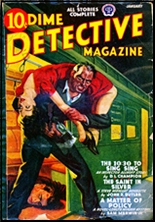
  JOHN K. BUTLER “The Saint in Silver.” Steve Midnight #4. Novelette. First published in Dime Detective Magazine, January 1941. Collected in The Complete Cases of Steve Midnight, Volume 1 (Steeger Books, 2016). Steve Midnight, a cab driver, takes a fare on part of a treasure hunt and becomes involved in the narcotics habit of a religionist’s wife. Well told story, in Southern California surroundings. (3)

               — November 1967.

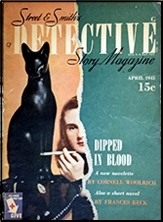
CORNELL WOOLRICH. “Dipped in Blood.” Novelette. First published in Detective Story Magazine, April 1945. Reprinted in Ellery Queen’s Mystery Magazine, October 1964, as “Adventures of a Fountain Pen.” Collected in The Ten Faces of Cornell Woolrich (Simon & Schuster, hardcover, 1965) also as “Adventures of a Fountain Pen.” Film: US title, Oh, Bomb! (Japan, 1964, directed by Kihachi Okamoto).

   There is a small but significant subgenre of both fiction and the movies in which the story follows an object of some importance is followed through its lifetime as it’s passed from hand to hand in small vignettes. It may be a gun, an automobile, almost anything, including a similar chain connecting people in all walks of lives. (If there’s a name to such a subgenre, I don’t know what it is. Maybe someone reading this can help.)

   The object in this richly ironic story by Woolrich is a fountain pen, manufactured to order as a means of assassination by one gangster meant for another. Things go awry, however, as they always do in a Woolrich story, with one final twist at the end, about which I will tell you only that it’s there but nothing more. There are things best to be discovered on one’s own.

   I don’t believe this is one of Woolrich’s better known stories, but what it has is both an ending worth waiting for and people in it who are described to perfection in just a few words or lines. This is why, when back in the 1970s when I first started to seriously read mysteries, if I was asked who my favorite mystery writer was, it was always a tossup between Erle Stanley Gardner, Rex Stout, or Cornell Woolrich, in alphabetical order. That still holds true today.

DAY KEENE “Nothing to Worry About.” Short story. First published in Detective Tales, August 1945. Collected in League of the Grateful Dead and Other Stories (Ramble House, 2010). Reprinted in Best American Noir of the Century, edited by James Ellroy & Otto Penzler (Houghton Mifflin Harcourt, 2010).

   There is a long tradition of stories such as this one. It is a prime example of tales in which one half of a married couple plans to kill the other one, but even though the planning is perfect, things do not work out as well as the guilty person had in mind.

   In this one – and far from the very first one in its subgenre – an Assistant State’s Attorney named Sorrell, and someone who should know better but who’s arrogant enough to think he can get away with it, decides to kill his wife, a woman he now hates and who, he is convinced, is holding his career back. But even more, he has another woman in mind already to replace her.

   It doesn’t work out, of course, but in addition to than the well-timed twist in the end, author Day Keene fleshes out the other characters, too, ones that other writers might even have omitted, or at best glossed over. And yet I demur. There’s nothing really new in this one. It’s a good story, but why (I wonder) was it recently selected as one of the “Best American Noir of the Century”?

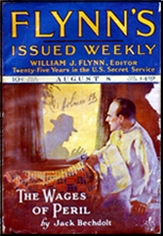
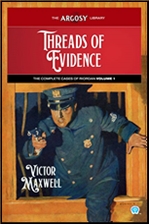
VICTOR MAXWELL “The Plainly Marked Track.” Sgt. Reardon #1. Novelette. First published in Flynn’s, 8 August 1925. Collected in Threads of Evidence: The Complete Cases of Riordan, Volume 1 (Steeger Books, 2021; introduction by Terry Sanford).

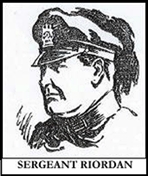
   The genesis of the Steeger collection is both straightforward and complicated. It began with an essay on the primary Mystery*File website by Terry Sanford, a former bookstore owner and present day dedicated pulp magazine collector. In that short piece he discussed several of the series characters who filled the pages of [Flynn’s] Detective Fiction Weekly in the 1920s, 1930s, and into the early 1940s. One of these was a Detective Sergeant named Riordan who appeared in exactly 100 stories over the years.

   The byline on these stories was Victor Maxwell, but it was generally suspected that that was a pen name. Who the real author was was unknown. But then something unsuspected happened. I was contacted by Don Wilde, who told me that he was the step-grandson of the author of the Riordan stories, whose real name was Maxwell Vietor.

   I immediately got Don in touch with Terry, and I’ll let Terry tell the tale from here. Or in fact he already has. (Follow the link, and you will learn all.)

   It may suffice to say, however, that Terry received a load of information and other documents about “Victor Maxwell” and his long life, and he decided to see if some enterprising young publisher might be interested in reprinting some of the stories. Matt Moring of Steeger Books agreed. It’s now ten years later, and the first volume of the first nine Riordan stories has just been published.

   Based on the first story only, you can’t judge the growth and other changes in a series that may take place over a span of some fifteen years, so any description I make of it here, please don’t take it any further than that. Riordan is mentored in this one by a Captain Brady, his boss, who often seems to wonder about how slow he   is on the uptake. When the safe at Ladd’s Emporium is robbed on a Saturday night, the tightwad owner thinks his son is responsible. A plaster cast of a tire track discovered at the scene helps prove otherwise.

   What’s most noticeable about the story is how cool and calm the policemen on the job go about their business. They may have have had all of the CSI stuff cops have today, but working with what they had – and knowing people – goes a long way in cracking the case. I’ll see about tackling the other eight stories in this volume as soon as I can. I’m also hoping that enough people buy this one so that it doesn’t take another ten years before we see the second!

« Previous PageNext Page »