Pulp Fiction


ADVENTURES IN COLLECTING:
My Favorite Magazines
by Walker Martin


   I collect and read quite a few other types of magazines besides the pulps. A couple of members of FictionMags, an online Yahoo discussion group, asked me about my favorite magazines, so I thought I’d take this opportunity to discuss the subject.

       Slicks —
WALKER MARTIN

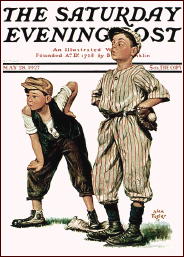
   This is easy for me to answer. My favorite slick magazine without a doubt is The Saturday Evening Post. They used the best authors and the best artists. It was weekly and some issues in the 1920’s were 200 pages.

   Usually collectors of the Post concentrate on certain authors or artists. Since thousands of issues were published you do not find many people trying to collect the entire run. However, I was one of the completists and at one point I had over 3,000 issues during the 1900-1970 period.

   The last time I moved not only could I not pick up the yearly boxes of the magazine (each box had 52 issues), but the movers had trouble also because of the weight. Eventually I sold much of the collection but I still have a complete run of 1940-1970.

   Another slick I liked a lot was American Magazine, mainly because of the mystery short novels they published. Jon Breen edited a collection of these novellas called American Murders.

       Digests —

   This is a far more difficult category for me to choose a favorite but I’ll go with Galaxy for the SF genre and Manhunt for the crime genre.

WALKER MARTIN

   Galaxy was the first magazine I bought off the newsstand in 1956 and it led to my present collection of many different titles. But my reason for picking Galaxy is not just nostalgic. I really feel that it was the best of the SF digests especially under the editorship of H.L. Gold and Fred Pohl.

   Pohl was smart enough to offer Robert Silverberg a deal to buy all of his stories submitted to Galaxy in the 1965-1972 period or thereabouts. Some of the best SF ever written appeared during this period and I’ve read many of Silverberg’s stories and serials more than once.

   Has there ever been a greater or higher quality number of novels in any SF magazine? I mean, think of it: The World Inside, Tower of Glass, Downward to Earth, Dying Inside, all in about two years.

   Alfred Bester wrote two great novels but they were in 1952 and 1956. J.G. Ballard wrote some great novels but they all did not appear in the SF magazines. Maybe Philip K. Dick comes closest but again, he did not write all of them for the SF magazines. Sturgeon had some great work in Galaxy but it was all novelette length.

   Can anyone show me a comparable run of novels in the SF magazines?

   Manhunt lasted 114 issues during 1953-1967 and during the fifties started the hardboiled crime digest craze. At one time there seemed to be dozens of Manhunt imitators but none of them could match the quality of the magazine that started it all.

   Unfortunately by the sixties it was all downhill and the hardboiled crime era was just about over. Two crime digest still exist, though they are not really hardboiled like Manhunt: Ellery Queen Mystery Magazine and Alfred Hitchcock Mystery Magazine.

   Circulations are dropping fast and in these days of the e-book revolution, we will probably see the end of the digest magazines.

       Literary Magazines —
WALKER MARTIN

   By literary I mean such magazines as the Hudson Review, T. S. Eliot’s Criterion, Scrutiny, Kenyon Review, and so on.

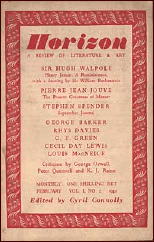
   I have just about all the back issues of many of the quarterlies and I love the Hudson Review, but my favorite is Horizon, not the hardbound art magazine but the monthly British magazine edited by Cyril Connolly during 1940-1949. It lasted 120 issues and I like it so much that I have two sets, one of loose issues and one bound set.

   There are other magazines that I have in two sets, loose and bound and you know you have to love a magazine to have it in bound and loose sets! Let’s face it, collecting books and magazines can be an addiction like alcohol, smoking, gambling, and drugs. But at least we get something to read and sometimes the books are even worth money. Not to mention that collecting old magazines won’t harm your health.

       Men’s Adventure Magazines

   This is a sore point with me and maybe some of you can help me out. I have hundreds of issues from the 1950’s and 1960’s, most showing sensationalistic covers like Nazis partying with half nude girls, while GI’s wait to gun them down. I have yet to find a title that ran decent fiction other than maybe Cavalier in the fifties.

WALKER MARTIN

   I’m not talking about Playboy which actually ran high quality fiction, but the titles like Men’s Adventure, True Men and so on. The only redeeming value to these magazines are the crazy covers but I’m hoping someone here can convince me otherwise.

   Phil Stephensen-Payne has a great link to many titles of men’s adventure magazines published in the 1950’s and 1960’s http://www.philsp.com/mfi2.html

   Please someone show me something else about these magazine that is readable! I’ve just about given up. The covers are stunning and very eye catching but that’s all I see about these magazines. I guess the WW II vets loved these things but I can’t see anything other than the covers worth collecting.

   Check out the link to menspulpmags.com. It’s a real laugh.

   At one time I had a great cover painting from one of the men’s adventure magazines. It show Nazis turning girls into gold ingots. No wonder they lost the war.

          PULP MAGAZINES:

   I haven’t even touched the pulps which are such a big subject they deserve their own section separated by genre:

       General Fiction Pulps —
WALKER MARTIN

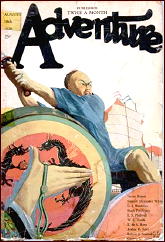
   These pulps are often called adventure pulps by collectors but I prefer the label General Fiction. The best ones lasted for very long periods and were very popular with male readers. All Story, Argosy, Short Stories, Blue Book, Adventure, and Popular Magazine were the main titles and I’ve collected them all:

   Adventure Magazine is my favorite and the pulp years lasted from 1910-1953, for 753 issues. The best period was during the 1920’s when editor Arthur Sullivant Hoffman managed to obtain the very best action and adventure fiction. Richard Bleiler wrote the standard history of the magazine in his Adventure Index. Also Blood n Thunder Magazine devoted a special issue to Adventure a couple issues ago. I had an article picking my favorite stories.

   All Story lasted for over 400 issues, 1905-1920, when it was absorbed by Argosy. Famous for providing Edgar Rice Burroughs with a market for his Tarzan and Mars novels. Sam Moskowitz wrote an interesting history of the magazine in Under the Moons of Mars.

   Argosy became the first pulp in 1896 and lasted into the 1940’s when it became a man’s adventure magazine.
WALKER MARTIN

   Short Stories began in 1890 and lasted into the 1960’s. For much of that period it came out every two weeks like clockwork and printed the best action adventure. Blood n Thunder had a long two part article covering the 1920’s and 1930’s.

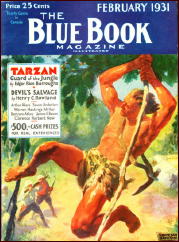
   Blue Book was known for quality fiction and Mike Ashley wrote a long history of the magazine which appears in Pulp Vault 14. This is the best single issue of a pulp fanzine and can be ordered on Amazon.

   Popular Magazine lasted over 600 issues, 1903-1931 and was called the training ground for the Saturday Evening Post. Another high quality pulp that had a two part article in Blood n Thunder.

       Detective and Mystery Pulps —

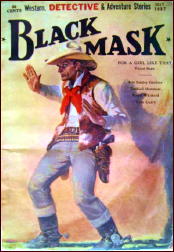
   This is easy because of what collectors call “The Big Three”: Black Mask, Dime Detective, and Detective Fiction Weekly. Hammett started in Black Mask and Chandler wrote for all three.

       Western Pulps —

   Western Story lasted over 1200 issues and is my favorite. But West during the Doubleday years of 1926-1935 was also quite good. So was Star Western and Dime Western, both published by Popular Publications.

       Hero Pulps —
WALKER MARTIN

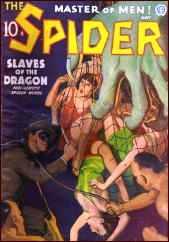
   Most were aimed at the teenage boy market but at least two stand out: The Spider because of the crazy, fast moving plots and weird menace elements and Secret Agent X because it was not as childish as the others.

   I have to admit that I have a problem with many of the hero pulps because of the silly and sometimes stupid sidekicks. I know they were in there because someone figured the teenage boys would like them. Sort of like the childish sidekick humor in the B-westerns of the 1940’s.

   Some of the pulp sidekicks make the western sidekicks look brilliant. In Doc Savage we have Monk and Ham, for instance and their dialog and attempts at humor are enough to make me stop reading. Same thing with G-8 and His Battle Aces. Nippy and Bull have made me consider ripping up a $100 G-8 pulp.

       SF and Supernatural Pulps —

WALKER MARTIN

   Astounding definitely was the best SF pulp. Weird Tales and Unknown Worlds, the best supernatural. Strange Tales, if it had lasted longer than seven issues, it would have been as good or better than the other two.

   Famous Fantastic Mysteries and the companion magazine, Fantastic Novels, are beautiful pulps. It is still possible to get a set without breaking the bank, and these magazines are another example of sets that I have in two formats: bound and unbound. I admit it’s crazy to have two sets, but who said love is logical?

       Sport Pulps —

   Street and Smith’s Sport Story was by far the best sport pulp.

       Love Pulps —

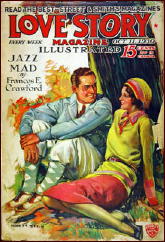
   These were the best sellers of the pulps because teenage girls and young women bought them. Love Story was the best with a circulation that reached 500,000 a week. Edited by the great Daisy Bacon.

   I’d appreciate any feedback on the above that you would care to provide. Do you disagree or have other favorites?

ADDED LATER:

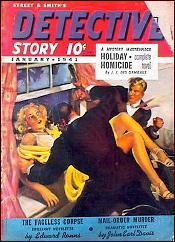
   Todd Mason mentioned that the Daisy Bacon years where she edited Detective Story are underrated. This is certainly true especially the digest period in the 1940’s.
WALKER MARTIN

   In 1943 Street & Smith changed the format of their entire pulp line of magazines from the standard pulp size of 7×10 inches to the smaller digest size. The paper shortages during WW II probably drove this decision. Then the publishers saw that the future looked bleak for pulps and killed every digest title except for Astounding.

   But to get back to Daisy Bacon, she was the guiding force behind Love Story for two decades and then she took over Detective Story and actually introduced a more hardboiled story to the sedate magazine.

   Detective Story had started in 1915 and for most of the next 25 years steered clear of the hardboiled type of story. But Daisy managed to get some of the Black Mask writers to write for her, for instance Roger Torrey and William Campbell Gault. Fred Brown also. I cover the history and many of the authors of Detective Story in an article which can be seen here on the Mystery*File blog.

   When I say Love Story was the best of the love pulps, I’m speaking compared to each other. Since I try to collect every fiction magazine under the sun, I made an attempt, more than once, to read Love Story and some of the competition.
WALKER MARTIN

   I would not advise anyone to try this experiment. Despite being the best sellers among all the pulps, the love genre was very restrictive to say the least. The young ladies and teenage girls of the 20’s, 30’s, and 40’s, only wanted to read the same formula over and over, and the love pulps gave it to them, over and over.

   I’m speaking of the girl meets boy, they have some problems, and everything is resolved at the end. Ranch Romances was different from the others, but I see it as mainly a western title with some romance elements.

   The love genre may have been the big sellers among pulps (and even slicks since the readership was mostly women), but nowadays collectors mainly ignore them and copies can be had very cheaply. I can count very few people who collect them.

   When I bid on some copies at a recent pulp convention, several of my collector friends burst out laughing or were just stunned speechless. I could only explain my seemingly insane actions as an attempt to collect something new, since I’ve collected everything else.

Previously in this series:   The FRANK M. ROBINSON Collection Auction.
ADVENTURES IN COLLECTING:
The FRANK M. ROBINSON Collection Auction
by Walker Martin


   Recently I was disturbed to notice that a pulp discussion group that I contribute to seemed to be ignoring or unaware of the fact that a major pulp collecting event had just occurred. In fact, I call it The Pulp Auction of the Century.

   I am of course referring to the auction of the collection of Frank M. Robinson, science fiction author, Hollywood screen writer, movie actor (he appears in Milk), and world class collector of high condition pulp magazines. I stress the “high condition” part of the last statement. Frank has been written up many times because of his famous “wall of pulps,” all in fine or very fine condition.

   First, what qualifies me to be making such a claim that this was The Pulp Auction of the Century? I’ve been a collector of magazines since February 1956, when as a child, I bought my first issue of Galaxy, a science fiction digest magazine.

   I still have that very same issue that seemed to be on every newsstand and in every drugstore in the Trenton, NJ area. Not only does Galaxy no longer exist but most newsstands and drugstores no longer carry SF or crime fiction magazines. There are only five digest fiction magazines left and they all have decreasing circulations in this era of the electronic gadget and the e-book. We might soon live to see the end of an era, the death of the digest fiction magazines.

   As the years progressed, I started to collect not only back issues of the SF and crime digests, but I also started to collect the pulp magazines, which ruled the newsstands during the 1900-1955 period.

   First I collected complete runs of the SF and fantasy pulps and then I went on to collect all the major detective and adventure titles. Some of my articles concerning these activities have appeared on Mystery*File under the headings of “Memoirs of a Pulp Collector” and “Adventures in Collecting.” I am frankly a lover of old magazines and my collection includes not only pulp and digest, but also slick, men’s adventure, literary magazines and film journals.

   So though I live in a house full of thousands of magazines and books, I never really became a “condition collector” like Frank Robinson. I wanted to compile complete runs of magazines and read them but this would be very difficult if I limited myself to only fine condition copies, not to mention the fact that readers are often very reluctant to read high quality magazines for fear of downgrading the nice condition.

   This is not to say that I never obtained magazines in beautiful shape; I just did not limit myself to collecting them.

   During this 55 year period of collecting I was witness to many pulp sales and auctions. I attended just about every Pulpcon since the first one in 1972. I bought pulps by the thousands and consider myself a serious collector.

   So when the rumors started to circulate that Frank Robinson was going to sell his collection of 10,000 magazines, most of which were in beautiful condition, this was major news. No one had a collection of such fine condition magazines that could compare to the Robinson collection. Recently John Gunnison, who runs Adventure House, published a full color, 500 page book showing the complete collection in all its glory.

   I first became aware of Frank Robinson when I was a kid and read one of his early stories in a 1951 back issue of Galaxy. Several years later I read his novel, The Power and then saw the movie that supplied him with the funds to amass such an astounding collection, The Towering Inferno.

   In the 1980’s Frank and I started trading pulps back and forth and I noticed he was extremely fussy about condition. Later in the 1980’s, he started to attend Pulpcon on a regular basis and I got to actually meet and talk to Frank. He would actually sit at his table in the dealer’s room with two stacks of pulps, carefully comparing copies and choosing the better condition.

   Condition was everything and like most such collectors, I don’t believe Frank actually read the magazines. At one time in his younger days he did read them, but now they were like beautiful works of art, to be admired and looked at. I know many collectors who love the covers and the condition but they don’t read the magazines.

   Frank has a long article in the 500 page book titled “On Collecting”, where he explains his love of SF and how he got started collecting.

   You might wonder why he decided to sell his collection. He says, “The collecting bug waned…” but I’ve seen many collectors who when they reach a certain age decide to find a younger home for their collection. Also, I think he reached the point that all collectors fear, the time when they realize that they have achieved all their major wants and goals.

   So on February 25, 2012, at 7:00 pm began the first of 12 scheduled auctions which Adventure House will run the next few months. This first one I considered the most important because it would put complete sets of pulps and digest up for bids. Some major pulp titles were sold and I’ll list some of the results, though these figures may not be final since the dust has not settled yet.

   I watched the entire auction online, minute by minute, and lot by lot. I also bid on some items but most of the sets I either have or at one time had and then disposed of after reading all that I wanted:

       Doc Savage (complete set) — $50,000

       Astounding SF (these are the pulps, bedsheets, and digests) — $30,000

       Startling Stories (complete set in fine condition) — almost $5,000

       Adventure Magazine (complete set of over 700 issues)— $40,000

       Blue Book (not complete but an extensive run) — $48,000

       Weird Tales (the crown jewel of Frank’s collection and the best condition set in existence) — $250,000

       Planet Stories (all 71 issues in very fine condition, also probably the best set in the world) — $14,000

   Also up for bids were such sets as Wu Fang, Thrilling Wonder, Golden Fleece, Magic Carpet, Oriental Stories, etc. In addition to the above prices there was also a 10% buyer’s premium.

   According to John Gunnison who ran the auction, sales almost hit the $500,000 mark and he considers this to be the most successful sale he has ever been involved in.

   Now looking at the above prices you might consider them high. But you have to remember, these are not your usual good condition pulps with the usual browned paper, spine and cover flaws. These mainly are fine to very fine condition and thus bring much higher prices than the standard condition magazine.

   Think of it this way, most of us have bought cars, sometimes paying over $25,000 and ten years later we have nothing to show for our hard earned money. To a collector, it is just as important to have a nice collection, so the prices may not be as out of line as you think.

   In addition, where else are you going to find such important and significant titles as Adventure and Blue Book? During the period of around 1910-1950 these magazine carried the best adventure fiction written by the best authors.

   And of course Weird Tales is in a class by itself. Can anyone really argue that it was not the best fantasy and supernatural magazine ever published? Well maybe Unknown Worlds, but it only lasted 39 issues.

   So I would like to thank Frank Robinson and John Gunnison for providing a great and noteworthy pulp auction. After all these years, I thought I’d seen it all but this auction proved once again to me that collecting books and pulps is the grandest game in the world.

Previously in this series:   Is Completism Fatal?.

THE SERIES CHARACTERS FROM
DETECTIVE FICTION WEEKLY
by Monte Herridge


        #11. INSPECTOR FRAYNE, by Harold de Polo.

   Harold de Polo created a short-lived series about a dandy police inspector named Frayne. Frayne prides himself on being the best-dressed man in the police department and one of the best in the city.

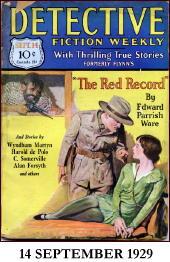
   His personal assistant is a red-haired detective named Don Haggerty, who was known in the department as Frayne’s right-hand man. He did many of the basic detective chores required in investigations, such as looking over the crime scene for any interesting signs or clues. He was also known as “a bulldog on the trail, too.” (The Small Glass Eye, DFW, 14 Sept 1929)

INSPECTOR FRAYNE DFW

   Haggerty was indispensable to Inspector Frayne in his cases. Frayne considered him a man-hunter in training, and his personal protégé. However, Frayne noted that Haggerty was “still young enough to have likes and dislikes. Inspector Frayne called them intolerances, stumbling blocks in the path of efficient police duty.” (The Small Glass Eye)

   This view of Frayne gives a clue to his personality, showing that he believed that efficiency and unemotional attitudes were the key to better detective work. In the previously mentioned case he had an innocent person arrested for a murder so that the real murderer would believe he was free of suspicion.

   Frayne often used psychological tricks to get suspects and witnesses to respond in the way he wished. Haggerty knew that the “manhunter never assumed an attitude, never made a gesture, never uttered a word, that didn’t mean something.” (La Linda Paloma) In this story Frayne “was simply getting his suspects more on edge.”

   One problem with some of the stories is that Frayne seems to operate as an intuitive detective, with not much in the way of clues to show his line of thinking. “La Linda Paloma” actually is much better than the usual stories in the series; he has definite clues and details how they affected his thinking.

   In the earliest of the stories in the series, “The Small Glass Eye,” Frayne investigates a crime out of his jurisdiction at a lake in the Adirondacks. The cause of his investigating this murder illustrates a facet of Frayne’s personality. His one interest, aside from his clothes, was in investigating murders. It was a hobby with him, and “He could sniff it a mile off, a thousand miles off, … ” After reading a couple of newspaper articles about the death of millionaire Gideon Whipple, Frayne was certain that it was not an accidental death but a purposeful murder.

   One of Frayne’s regular habits was his reading of all the morning newspapers in New York, as well as many papers from other cities including some foreign ones. He was noted as a speed reader, which was an advantage considering how many newspapers he read. He also had “a reading knowledge of seven or eight languages.” (La Linda Paloma) His greatest trait was that he had a photographic memory for all of the newspaper pieces he read, and could recite lines and paragraphs going back years.

   Frayne had seven telephones, some of them private and others for business. Six of his telephones were in his apartment in the East Fifties of New York City, and the seventh in his basement shooting gallery. One of his private lines was directly connected to Don Haggerty’s office at police headquarters. When he wanted to summon Haggerty, Frayne picked up the telephone and clicked his message by moving the receiver up and down. Haggerty responded similarly.

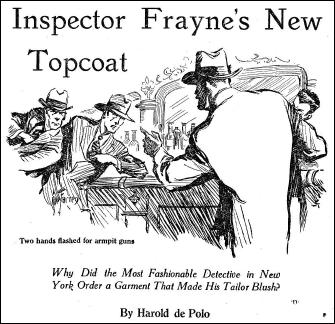
   Frayne lived close to police headquarters, because as noted in the stories it took Haggerty only twelve minutes to make the trip to Frayne’s residence. Frayne’s multistory home is well suited for him. Special closets for his clothes, for example. The basement has a special shooting range so that Frayne can keep in practice with his specially made and altered blunt-nose automatic. He has one his topcoats specially altered so he can draw his gun faster.

INSPECTOR FRAYNE DFW

   Frayne also had several automobiles, all well powered. One is a roadster. Frayne does not have to worry about his expenses based upon his detective’s pay; he can afford to own all of these things because he “possessed a sufficiently substantial private fortune to enable him to do this,” (The Missing Clew).

   Haggerty’s responsibilities change somewhat over the course of the series. He gradually was given more responsibility, and became the “buffer” for Frayne. In this position, Haggerty had to weed out the homicide cases for which Frayne was suited, and “to offer his chief only such problems as appeared to be impossible to unravel.” (Pelican Plot)

   In other words, common murder cases of no difficulty were refused by Haggerty. Haggerty at this point spoke to Frayne over a special wire connection to Frayne’s apartment, using a number known only to him.

   Other than Haggerty, there are only a couple of other recurring characters in the series. One is Grady, the coroner, who is also an expert on guns and a friend of Frayne’s. He “was one coroner who didn’t hanker to be a great detective.” (Mandarin Coat)

INSPECTOR FRAYNE DFW

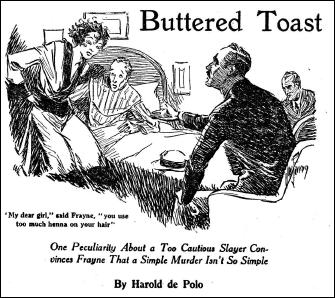
   There is a detective named Mullins, who “was a slim stoop-shouldered man in a pepper-and-salt suit far from new. His eyes looked tired…” (Buttered Toast) Mullins has dreams of solving murders. He also is able to identify criminals based on witness descriptions. He knows a considerable amount about the local criminals and their habits and hangouts. Frayne relies on him to help in some of his cases.

   In the story “Inspector Frayne’s New Topcoat” Frayne is after the gangsters who killed a homicide detective and “one of Frayne’s favored men.” In this story, too, Frayne has an innocent man arrested as a way to get at the guilty party. Seems to be one of his methods of operation.

   â€œThe Missing Clew” involves Frayne’s investigation of the murder of an eccentric rich man. Once more he intuits what really occurred, from the evidence of muddy dog footprints. A minor story in the series.

   â€œButtered Toast” is a much better story, as Frayne unravels the mystery of what seems to be a simple robbery and murder of a jewelry wholesaler. Frayne comes across many clues and uses them to deduce an unusual crime and the motives for it. In this story, Haggerty is noted as being an improving fingerprint expert.

INSPECTOR FRAYNE DFW

   â€œMandarin Coat” is an interesting story of an investigation by Frayne of a poisoning case. The puzzle is how was the poison administered to the victim, and who could have done it. The method of poisoning is a clever one. The story could have been a bit longer, to explain how Frayne learned some of the facts he disclosed late in the story.

   In “Pelican Plot” Frayne has to unravel the who and how of a murder case seemingly impossible. Mr. Kerfoot, a rich manufacturer, has a bronze figure of a pelican on his desk that is wired to follow certain instructions such as raising windows, opening a door, and pulling out chairs for guests. However, it turns out that someone has added an extra command for seemingly shooting a gun from a hidden place. Another case where Frayne seemingly intuits the solution with ease.

   In “La Linda Paloma”, the next story in the series, Frayne has to find the murderer of a personal maid to a world famous dancer named La Linda Paloma. Any of a number of people nearby could have stabbed the woman, so Frayne has to find small clues that point the way.

   The series as a whole is just an average detective series, with nothing particularly special about it. Harold de Polo had more success with his stories featuring hick country law enforcement officials. There were two series of these: Sheriff Ollie Bascomb, and another featuring Sheriff Whitcher Bemis. Both had elements of humor in them. Another outdoor series featuring Chan Buzzell was a bit more serious.

      The Inspector Frayne series, by Harold de Polo:

   In Detective Fiction Weekly:

The Small Glass Eye     September 14, 1929
Inspector Frayne’s New Topcoat     November 2, 1929
The Missing Clew     December 21, 1929
Buttered Toast     January 25, 1930
Murder in the Tower     March 1, 1930
Mandarin Coat     March 8, 1930
Pelican Plot     April 5, 1930
The Flying Corpse     July 12, 1930
The Little White Powder     July 26, 1930
La Linda Paloma     December 27, 1930
Peter Wenda, Beads     January 24, 1931

   In Complete Detective Novel Magazine:

Night Club Riddle     May, 1931

   In The Underworld Magazine:

Inspector Frayne Returns     July, 1933


    Previously in this series:

1. SHAMUS MAGUIRE, by Stanley Day.
2. HAPPY McGONIGLE, by Paul Allenby.
3. ARTY BEELE, by Ruth & Alexander Wilson.
4. COLIN HAIG, by H. Bedford-Jones.
5. SECRET AGENT GEORGE DEVRITE, by Tom Curry.
6. BATTLE McKIM, by Edward Parrish Ware.
7. TUG NORTON by Edward Parrish Ware.
8. CANDID JONES by Richard Sale.
9. THE PATENT LEATHER KID, by Erle Stanley Gardner.
10. OSCAR VAN DUYVEN & PIERRE LEMASSE, by Robert Brennan.

PulpFest 2012:
Thursday, August 9, 2012 – Sunday, August 12, 2012


   PulpFest 2012 continues the proud tradition of a summer pulp con, now entering its 41st year. PulpFest is the summertime destination for fans and collectors of vintage popular fiction and related materials. It will be held at a new venue, the Hyatt Regency in downtown Columbus, Ohio. It will begin on Thursday evening, August 9th and continue until Sunday afternoon, August 12th.

   PulpFest continued to grow in 2011 with more than 430 registrants. It was the largest crowd ever for a summertime pulp con. Reviews were generally very positive, from Walker Martin’s “…when the dealer’s room opened officially, it was obvious that this was another rousing success,” to Ron Fortiers’ “…a truly fun and exciting program with a little of something for all pulp enthusiasts,” and newcomer Sean Levins’ “This was, without a doubt, the best convention I’ve ever been to!”

   Sellers of pulp magazines, vintage paperbacks, and other paper collectibles and related items are already filling up our exhibit space. There will be more than 100 tables of pulps, books, vintage comics, original art, B-movies and serials, and similar items available for sale, daily from 9 AM until 5 PM. The evening hours, from 7 PM until midnight, will see a variety of programming.

   2012 marks the 100th anniversary of the publication of Edgar Rice Burroughs’ “Under the Moons of Mars,” better known by its book title A Princess of Mars and, more recently, John Carter, a major motion picture from Disney. Robert E. Howard’s Conan the barbarian will also be 80 years old in 2012. PulpFest will be celebrating both of these occasions during their highly regarded evening programming. The award-winning science-fiction writer and noted Burroughs authority, Mike Resnick, will also be appearing as the convention’s guest of honor. Author readings and an art show featuring work by illustrators Jim and Ruth Keegan and, possibly, Mark Schultz, are also planned.

   For further information, please visit the convention’s website at https://www.pulpfest.com/ or write to David J. Cullers, 1272 Cheatham Way, Bellbrook, OH 45305 or via email at jack@pulpfest.com.

   The contact phone number for the hotel is 1-614-463-1234. Be sure to mention PulpFest 2012 when booking a room to get the convention rate. Hotel reservations can also be through the convention’s website through a dedicated link to the Hyatt Regency Columbus.

Price: $15.00 – $35.00

Member Discount: A three-day prepaid membership will cost $30. Send payment to David J. Cullers, 1272 Cheatham Way, Bellbrook, OH 45305. Payment at the door will be $35 for a three-day membership. Daily memberships will cost $15.

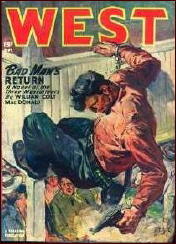
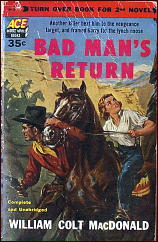
WILLIAM COLT MacDONALD – Bad Man’s Return. Ace Double D-2, paperback reprint, no date [1952]. (Published dos-à-dos with Bloody Hoofs, by J. Edward Leithead.) First published in West Magazine, September 1946. Hardcover edition: Doubleday, 1947.

WILLIAM COLT MacDONALD Bad Man's Revenge

   Over the years there have been a lot of mystery writers named MacDonald (or Macdonald, McDonald, or even Mcdonald), and some of them were quite well-known, and still are. But if you’re a mystery fan only, William Colt MacDonald may be one you don’t recognize. If I were to tell you that he wrote a lot of westerns, though, maybe you’d place the name.

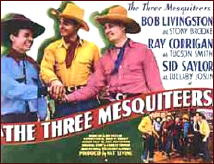
   He was the creator of “The Three Mesquiteers,” among others, intrepid cowpoke adventurers in a long line of B-western movies, and this is one of the novels they were in as well.

   Some of MacDonald’s western are listed in Hubin, although not this one. Most of the ones that are listed feature a western detective named Gregory Quist, but I have a feeling that more of them could easily be acceptable.

   The connection between between western fiction and detective stories is a solid one. My own feeling is that as many as 95% of all western stories contain crime, mystery or detective elements of one form or another. They come in various guises, and sometimes you have to look sharply, but if you look carefully, I think you’ll find that most westerns are nothing more (or less) than yesterday’s detective stories.

WILLIAM COLT MacDONALD Bad Man's Revenge

   And what’s more, not only should Al Hubin know about this one, but Bob Adey should, too. That’s right, this is a locked-room mystery, and it’s not in Adey’s book either.

   To tell you the truth, I haven’t really read as many westerns as I have mystery stories, so I can’t say that this is generally so, but it’s my impression that westerns have their own code of telling, their own sense of formal structure.

   Where I think the story is leading up to as the climax can often not be the case at all. Westerns seem to spread out plotwise in a good many directions, even more than spy or adventure thrillers do, and usually head off completely opposite from the one I think they ought to be taking.

WILLIAM COLT MacDONALD Bad Man's Revenge

   Sometimes it’s uncomfortable, but most of the time I give in and let the author lead me where I will.

   In this case, for example, I’d have thought the capture of the killer who frames Barry Hesman for the killing of Tucson Smith would be what the final chapter would be all about. But no, somehow that’s a matter that’s settled long before then. By that time the story has gone on to other things, most notably the saving of Anne Callister’s ranch for her. It seemed anti-climactic to me, but I guess it wasn’t for me to say.

   As for the locked room, it takes our heroes the full novel before they work it out, but no long-time reader of detective stories will be at all surprised by what [WARNING: Quickie Plot Alert] a piece of rawhide and some bear grease will do.

— Reprinted from Mystery*File 32, July 1991 (slightly revised).


[UPDATE] 01-15-12.   The last “Three Mesquiteers” movie appeared in 1943, and it’s easy to find a complete list of them online (here, for example). But I do not have a list of the books they appeared in, I’m sorry to say; the last one I have a record of is The Galloping Ghost, which was published in 1952.

   I also do not know what to make of my review above, where I say that Tucson Smith, one of the three original members of the group, was killed, and it was his murder that had to be solved. More than that, at this time it is a mystery to me.

[UPDATE] 01-18-12.   Thanks to David Smith, who reminded me that a list of Three Mesquiteer novels appeared in the WesternPulps group on Yahoo last June, and to Phil Stephensen-Payne for pointing out that two of the trio’s tales were serialized in the pulp magazines, as you’ll see below. (Taken from the online FictionMags Index.)

Restless Guns (with only Tucson and Stony) (1929)

Law Of The Forty-Fives (1933) aka Sunrise Guns

Powdersmoke Range (1934)

Riders of the Whistling Skull (1934)

The Singing Scorpion (1934) aka Ambush at Scorpion Valley

Ghost-Town Gold (1935) aka The Town That God Forgot

Bullets for Buckaroos (1936) aka Bullet Trail

The Three Mesquiteers (1944)

Bad Man’s Return (1947)

Powdersmoke Justice (1949)

Mesquiteer Mavericks (1950)

The Galloping Ghost (1955)

The Three Mesquiteers (serial) Street & Smith’s Western Story Magazine Jun 29 1935, etc.

Cactus Cavaliers (serial) Street & Smith’s Western Story Magazine Oct 26 1935, etc. [Name of hardcover edition, if any, unknown.]

[UPDATE] 01-20-12.   Thanks to “Alan in London” for providing the titles of four more appearances of the Mesquiteers, including the one from 1929 which featured only two of them. Besides adding them to the list above, I’ve changed the dates for a few others, based on the data I found in Twentieth Century Western Writers. When I get the chance, I’ll do some original research on this and make sure sure everything’s as correct as it can be.

THE SERIES CHARACTERS FROM
DETECTIVE FICTION WEEKLY

by MONTE HERRIDGE


        #10. OSCAR VAN DUYVEN & PIERRE LEMASSE, by Robert Brennan.

   Oscar van Duyven & Pierre Lemasse appeared in a short series of ten stories by Robert Brennan that were published in Flynn’s Weekly Detective Fiction between 1926 and 1927. The series involves the adventures of a pair of men who wander the French countryside looking for matters of interest. They usually find mysteries to solve.

   Oscar van Duyven is an American millionaire from New York, owner of an electric fan corporation. Pierre Lemasse is from Paris, France, and is the companion to the millionaire. Lemasse is younger than van Duyven and is the more mystery oriented person. He has a knack of finding clues and matters of interest in the various cases the two are involved in.

   Van Duyven usually goes along with what Lemasse wants, although Lemasse is described as his assistant and is the driver of van Duyven’s automobile.

   In the first story in the series, “The Maltese Cross,” the pair are on the French coast doing nothing in particular when a mystery arises. From an island just off the coast a man escapes from the prison on it, and from a French coast town opposite a wife disappeared the same day. Lemasse finds all sorts of interesting facts and clues about the events, and ties the two disappearances together. Still, a somewhat disappointing debut.

   The second story in the series, “Pierre Rides the Storm,” is a direct sequel of the first story and continues the story of the escaped convict, Bruneau. He is caught in the severe storm that hit the French coast, and van Duyven and Lemasse endeavour to rescue him from the stranded ship in which he tried to make his escape.

   The third story, “A Murderer’s Refuge,” continues the story of Bruneau the escaped convict. This time van Duyven and Lemasse are in Spain, and have brought Bruneau with them in order to ask the local church for sanctuary for him.

   The two men then go to Avignon in France to investigate the crime Bruneau supposedly committed. While there Lemasse quickly solves the case and clears Bruneau. A bit of an anti-climax with the solution literally falling into their laps.

OSCAR van DUYVEN & PIERRE LEMASSE

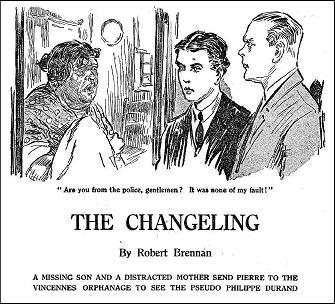
   The fourth story, “The Changeling,” is a new story and self contained without any continuations. The two “investigators” are appealed to for help in locating a missing child. The child not only is missing, but a different child was substituted in his place. Lemasse tracks down the missing child and restores him to his mother.

   The following story is “Blind Lanneau,” which concerns the murder of a blind peddler. The two investigators are still in France. This story is anticlimactic, because Lemasse discovers the murderer early in the story, and a lot of space is taken up by the murderer telling his own story (which includes what happened years before).

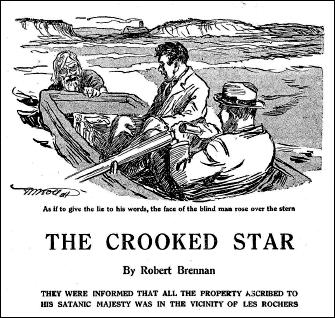
   The next story, “The Crooked Star” is a sequel to the previous one. This one involves the two investigators looking for a hidden treasure using a cipher the murderer from the previous story had given them before he died.

OSCAR van DUYVEN & PIERRE LEMASSE

   Blind Lanneau, who was mentioned and discussed in the previous story but not seen, shows up in this story to compete with them for the treasure. Some deductions and deciphering of the cipher sheet is performed by the two as the story progresses.

   â€œThe Highwayman” comes next, and is a sequel to the previous one. Having lost the treasure when their boat sank, the two investigators suddenly find themselves the target of a criminal who wants the treasure and thinks they have access to it. Suddenly Blind Lanneau pops up who also wants the treasure and is searching for it.

   â€œThe Little Angels” refers to a French street gang who are extremely vicious. When a newspaper editor named Maurice Duverne writes an editorial against the gang and is immediately attacked, there is public outrage against the gang. The police move in to the district and clean out the gangsters. However, Lemasse is not convinced the gang committed the attack, and induces van Duyven to help him investigate.

   â€œThe Fugitive Footman” is probably the best story in the series. The two investigators come across a man in distress. They agree to help him, learning that the man is Bernard, a footman at the Deauville mansion. Deauville has just been murdered, and the footman is running away because he is accused of the crime.

   The two investigators go to the Deauville mansion, where they find an inspector named Croissart in charge of the case. Croissart is an old friend of theirs, and relates the facts of the case. Lemasse sees more than meets the eye, and deduces the real murderer and the motive.

   â€œTwo Chests of Gold” is a direct sequel to the previous story, and involves the chests that were a part of that story. Now there is a search on for the missing chests, also involving a Scotland Yard man who asks van Duyven and Lemasse for their assistance.

   This is an average series, with some good stories, but mostly average. There is no element of humor in the stories. The series is of interest to those interested in simple detective stories.

   The problem I have with this series is that Lemasse makes all of his deductions and discoveries and clues seem overly simple. There is very little complexity to the series. The closest it comes is the cipher in “The Crooked Star.”

      The Oscar van Duyven & Pierre Lemasse series, by Robert Brennan:

The Maltese Cross     July 31, 1926
Pierre Rides the Storm     August 7, 1926
A Murderer’s Refuge     August 14, 1926
The Changeling     August 21, 1926
Blind Lanneau     September 4, 1926
The Crooked Star     September 11, 1926
The Highwayman     September 18, 1926
The Little Angels     December 18, 1926
The Fugitive Footman     January 1, 1927
Two Chests of Gold     January 15, 1927

    Previously in this series:

1. SHAMUS MAGUIRE, by Stanley Day.
2. HAPPY McGONIGLE, by Paul Allenby.
3. ARTY BEELE, by Ruth & Alexander Wilson.
4. COLIN HAIG, by H. Bedford-Jones.
5. SECRET AGENT GEORGE DEVRITE, by Tom Curry.
6. BATTLE McKIM, by Edward Parrish Ware.
7. TUG NORTON by Edward Parrish Ware.
8. CANDID JONES by Richard Sale.
9. THE PATENT LEATHER KID, by Erle Stanley Gardner.

1. INQUIRY: From Bill Pronzini: Just for the heck of it, here’s a quiz question for you and M*F readers: Can you name at least one mystery novel narrated by a chauffeur, or in which a chauffeur is the investigating detective? I can supply the title and author of one and am wondering if there are others.

2. A New OTR Website. It might not be correct to call the CBS RADIO MYSTERY THEATER “Old Time Radio,” but given that the program ran for eight years beginning in 1974, it means that it’s been nearly 30 years since its last broadcast. There is a website that not only lists all 1399 episodes, but it also includes cross-listings for all of the performers and writers. And not only that, you can download or listen to each and every one. How many months would that take, if you did it non-stop? Pull out your calculators! Check it out at http://www.cbsrmt.com/

3. Pulp fiction writer Charles Boeckman is 91 and no longer writing, but his jazz band is still going strong. Check out a photo gallery of his latest gig here.

4. Headline in a local paper: Police were called to a day care center where a three-year-old was resisting a rest.

UPDATE. 01-06-12. My description of Charles Boeckman as a pulp fiction writer was challenged on a Yahoo group where I also posted the link to the photo gallery above. I was advised that Boeckman was a writer of hard-boiled fiction but not published in pulp magazines.

   I shouldn’t have been so short and brief in my post there, nor in the one above. I should (and could) have supplied more of a résumé for Boeckman, and I’m sorry I didn’t.

   It was Walker Martin who came to my rescue on that Yahoo list, and I hope he doesn’t mind my repeating some of the credentials for Boeckman I should have provided:

    “Charles Boeckman under the name Charles A. Beckman started writing for the Popular Publication line of pulps in the late 1940’s and continued until the pulps bit the dust. Such titles as Fifteen Western Tales and Detective Tales carried much of his short fiction. He also made the switch to the digests. I recently noticed his name in Manhunt.”

   Boeckman is one of the very few authors who wrote for the pulps still living — a survivor — and he should be recognized as such. I’m wondering whether he might be a suitable guest for one of the two annual pulp conventions sometime soon. Playing in a jazz band at the age of 91 seems to suggest that his health may be good enough to attend.

ADVENTURES IN COLLECTING:
Is Completism Fatal?
by Walker Martin


Dear Walker:

   My own collection is all but complete — meaning that I’ve almost acquired all of the items on my want list. Of course I’ll always be out there keeping my eye open for serendipitous books and magazines, but I only have a very few more such items that I’m actually looking for. Once I find those I’m essentially done. Then I’ll just give them all away to the Salvation Army thrift store and start over… Your advice, please!

— C.P.


Dear C.P.

   You have touched on a dangerous subject that all serious collectors must beware. I’ve seen many collectors fall into the dreaded trap of completing their collection. Usually once the collection is completed then many collectors lose interest and start thinking what next?

   This results in the selling off of many collections because the enthusiasm of the chase and the drive to collect is now finished. Collectors that limit themselves to a favorite author or magazine are prone to losing interest once their goal of completion has been achieved.

   Since collecting can be so much fun, how do we avoid falling into the abyss and losing interest in our collections after completion? The answer I have found is very simple, you do not allow yourself to complete your collection. You have to keep expanding your interests.

   For instance, in your case, if you are close to completing your SF wants, then you have to develop an interest in another genre, another subject, other magazines. Maybe detective fiction or adventure pulps or original art to go along with your SF collection. Something else!

   For instance in my own case, I started off in 1956, at the age of 13 collecting SF. This continued for around 10 years until I discovered detective pulps thanks to Ron Goulart’s Hardboiled Dicks anthology. This led me to collecting all sorts of mystery fiction like Raymond Chandler, Dashiell Hammett, Ross Macdonald. It led me to completing sets of such great magazines like Black Mask and Dime Detective.

   But then around 1980, I was faced again with the horrifying realization that I was nearing completion of the detective and mystery wants. I quickly expanded to adventure and western fiction and started to work on extensive sets of Western Story, West, Short Stories, Adventure, All Story, Argosy, Blue Book, Popular, Sea Stories and many others.

   As I started to complete these magazines and run out of reading matter, I decided my job was taking up too much of my time and interfering with my reading and collecting activities. So in 2000 I retired to concentrate on building up what may be the world’s largest collection of literary magazines.

   I’ve yet to meet another collector that is interested in these artifacts, but I love them, and I can fall into a trance looking and smelling the scent of rows and rows of literary quarterlies like the Hudson Review, The Criterion, Scrutiny, The London Magazine, Kenyon Review, Paris Review, and The Virginia Quarterly. I could go on and on forever but I’m sure you are all disgusted and fatigued reading about someone else’s collecting addictions. Hell, I actually read these things.

   But the end may be near, even for me. I’ve mentioned before about almost being crushed by the collapsing of one of my basement bookcases due to overloading. Then a year or so later several bookcases fell on top of me and my son. Then last month a bookcase of literary magazines showered me with more than a hundred issues of the Sewanee Review.

   It was heavenly. I just stood there as the magazines rained down on me and I felt at peace. Then I had to go to work picking them up off the floor and stacking them before my wife came to investigate the noise. She’s heard the sound of collapsing shelves and stacks falling, so she never asked me until a couple days later about the crashing noise that she chose to ignore.

   Probably, she was hoping that I had tempted fate once too often and had been pounded flat as a pancake by the old magazines that she now hates with a passion. But no, I survived once again, just like some pulp super hero!

   So I say to you, C.P., don’t stop collecting. There are unknown fields still to conquer. Don’t spend all your salary on your bills, your family, college fees for your children. You work hard for your money; spend some of it on collecting!

   Now I have to go back to a discussion I’ve been having with myself for 50 years. What is the greatest fiction magazine ever? Is it Adventure in the 1920’s, All Story in the teens, Black Mask and Weird Tales in the 1930’s, Astounding and Unknown in the 1940’s, Galaxy in the 1950’s and 1960’s?

   How about The Magazine of Fantasy and Science Fiction, which has to fit somewhere. How about the SF fiction in Playboy and Omni, or the mystery fiction in Manhunt or EQMM?

   Maybe I better fix up these bookcases so they don’t collapse; I need answers to the above questions!

Previously in this series:   Collecting Manhunt.

THE SERIES CHARACTERS FROM
DETECTIVE FICTION WEEKLY

by MONTE HERRIDGE


        #9. THE PATENT LEATHER KID, by Erle Stanley Gardner.

   The Patent Leather Kid is another leading character created by Erle Stanley Gardner. Someone with that identity first appeared in “The Gems of Tai Lee,” a story in the March 25, 1930, issue of Clues, but when the Kid showed up again, in the May 28, 1932, issue of Detective Fiction Weekly, he was a new character, the star of the first of a series of adventures that ended two years later.

THE PATENT LEATHER KID Erle Stanley Gardner

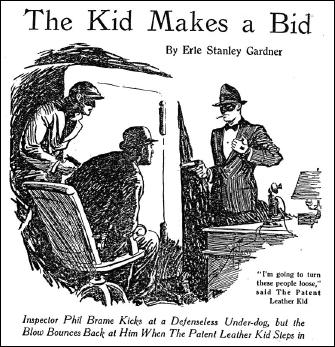
   He had a dual identity in the DFW stories – normally rich Dan Seller most of the time, and The Patent Leather Kid when he is ready for one of his somewhat illegal adventures. The patent leather in the name comes from his wearing not only patent leather shoes but also a patent leather face mask to hide his identity.

   The Patent Leather Kid “was always on the lookout for adventure, and anything sufficiently out of the usual called him with an irresistible attraction.” (The Kid Stacks a Deck)

   There is a cast of regular characters for each of his identities. The stories usually start out with a scene of Dan Seller and his fellows at their club, discussing the latest criminal event or activity. The other club members are firstly Police Inspector Phil Brame, then Renfroe the bank president, and Bill Pope the explorer.

   Brame usually brings up a criminal event, which causes disagreement among the others and ends with Seller or Bill Pope often betting on the outcome with him. Brame always loses these bets, but that does not keep him from trying again. Renfroe agrees with the Inspector much of the time, but also tries to avoid antagonizing Seller because he is a large depositor in his bank. It is not revealed how well off Dan Seller is, or where his money comes from.

   In his identity of the Patent Leather Kid, he has another group of people. There is Bill Brakey, The Kid’s bodyguard and assistant. He is also called “A walking encyclopedia of the underworld,” and this comes in handy for The Kid’s adventures. Brakey usually knows the answer to any question about the underworld, or can get the information easily.

   Another person in this group is Gertie, the telephone operator in his apartment house. She keeps track of his messages and also keeps an eye on The Kid’s special elevator which was constructed for his own use. She also knows his identity as Dan Seller. Interestingly, Gertie is also the name of Perry Mason’s telephone operator.

   There are only three people in the apartment house hotel who know Dan Seller’s dual identity: Bill Brakey, Gertie, and the desk clerk who is never named.

   The Patent Leather Kid lived in an apartment house hotel penthouse, with his special security extras such as a steel door and alarms systems. According to one story (The Kid Clips a Coupon), with these security arrangements: “no one could get through the roof without a warning coming over the telephone, without an automatic alarm shrilling a strident warning should the only elevator which communicated with the penthouse start on its way without The Kid’s having first unlocked an electrical contact.”

THE PATENT LEATHER KID Erle Stanley Gardner

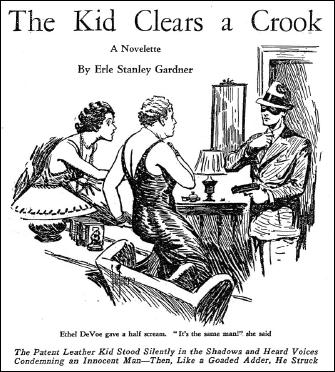
   The stories involve various kinds of adventures. In “The Kid Clears a Crook,” a reformed criminal trying to go straight is framed and taken advantage of by underworld crooks, and the police don’t care. The Kid sets out to clear the ex-crook and set the blame where it belongs, thereby infuriating both the underworld and the police.

   Neither group likes interference from The Kid in their affairs, and try repeatedly to eliminate him. The police even (according to Inspector Brame) give the underworld the green light to eliminate The Kid, but this never happens. Brame even states that if they catch the Kid, they will frame criminal charges on him in order to keep him in jail for a long time.

   The Kid enjoys this, in his words: “In this game of matching wits with the law, The Patent Leather Kid found his most fascinating recreation. He gambled with life and liberty, and enjoyed the game.” (The Kid Stacks a Deck) So the acquisition of money or property gained illegally is definitely not the goal of The Kid.

   The first story to appear in DFW, “The Kid Stacks a Deck,” is a bit different than the others in the series. Bill Brakey does not appear in this story, and Gertie is present but not named. Inspector Brame is given the title of Commissioner, which he loses in later stories. Possibly the author thought the stories more effective with a lower ranking policeman.

   In the story, The Kid finds out that a criminal gang is out to kill him, so he sets a trap for them. He breaks into a jewelry store, steals a few items and mails them to Brame and his family. The gang is waiting outside to shoot and rob him as he leaves. However, The Kid alerts the police who attack and wipe out the gang as The Kid escapes.

THE PATENT LEATHER KID Erle Stanley Gardner

   The story presents the image of The Kid as a master burglar without peer in the underworld and with a high reputation for those talents. However, he seems to have gained nothing from his burglary of the jewelry store. In fact, a point is made throughout the series that “The police had never been able to brand him specifically as a crook. He was a big shot, and his ways were the ways of the underworld, but they had never as yet pinned any definite crime upon him.” (The Kid Wins a Wager)

   Inspector Brame’s chief complaint about The Patent Leather Kid was that his activities damaged the dignity of the police and made them look bad and caused people (and The Kid) to laugh at them. That was a terrible offense to Brame. He seems to have cared more about the dignity of the police department than anything else.

   In “The Kid Throws a Stone,” The Kid is involved in a case where someone is impersonating him. The impersonator has already pulled one robbery before the real Patent Leather Kid starts his complex counter-offensive.

   In another case of impersonation told in “The Kid Wins a Wager”, a criminal burglarizes a jewelry story and leave a note supposedly signed by The Patent Leather Kid. Fortunately, The Kid catches him in the act and clears that up.

   One of The Kid’s favorite tactics was to get criminals, who are after him, into confrontations with the police, where they invariably wind up shot. Rarely does The Kid have to use a gun on the criminals themselves, but this does occur in the story “The Kid Cooks a Goose,” where he and Bill Brakey are trying to protect a woman from a gang of killers. They shoot it out with the three killers and wipe out the gang.

   This is a fun series, and Gardner is obviously enjoying himself writing these improbable situations. On a “Writer’s Almanac” episode on NPR (National Public Radio), Garrison Keillor quotes Gardner as saying about his pulp work: “I write to make money, and I write to give the reader sheer fun.”

      The Patent Leather Kid series by Erle Stanley Gardner:

The Gems of Tai Lee     Clues, 25 March 25 1930     [This story features a different “Patent Leather Kid,” as it turns out. See comment #12.]

   The Patent Leather Kid discussed above appeared as a character only in Detective Fiction Weekly:

THE PATENT LEATHER KID Erle Stanley Gardner

The Kid Stacks a Deck     May 28, 1932
The Kid Passes the Sugar     July 16, 1932
The Kid Wins a Wager     September 10, 1932
The Kid Throws a Stone     October 22, 1932
The Kid Makes a Bid     February 18, 1933
The Kid Muscles In     April 15, 1933
The Kid Takes a Cut     May 20, 1933
The Kid Beats the Gun     August 5, 1933
The Kid Covers a Kill     November 4, 1933
The Kid Clears a Crook     February 3, 1934
The Kid Clips a Coupon     April 21, 1934
The Kid Cooks a Goose     July 14, 1934
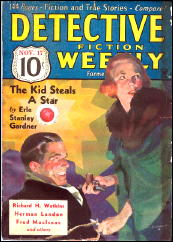
The Kid Steals a Star     November 17, 1934

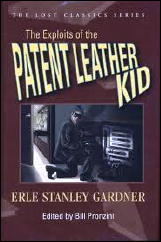
NOTE: The 13 stories that appeared in Detective Fiction Weekly have been collected in The Exploits of the Patent Leather Kid, edited by Bill Pronzini (Crippen & Landru, 2011).

    Previously in this series:

1. SHAMUS MAGUIRE, by Stanley Day.
2. HAPPY McGONIGLE, by Paul Allenby.
3. ARTY BEELE, by Ruth & Alexander Wilson.
4. COLIN HAIG, by H. Bedford-Jones.
5. SECRET AGENT GEORGE DEVRITE, by Tom Curry.
6. BATTLE McKIM, by Edward Parrish Ware.
7. TUG NORTON by Edward Parrish Ware.
8. CANDID JONES by Richard Sale.

A REVIEW BY RAY O’LEARY:
   

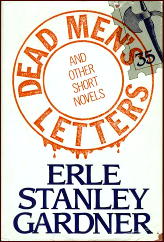
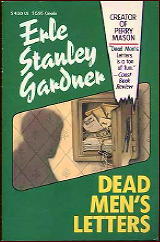
ERLE STANLEY GARDNER – Dead Men’s Letters. Carroll & Graf, hardcover, March 1990; softcover, July 1991.

ERLE STANLEY GARDNER Dead Man's Letters

   A collection of six Black Mask novelettes featuring one of Gardner’s early series characters, Ed Jenkins, known as the “Phantom Crook.”

   Jenkins, though wanted in six states, cannot be extradited from California due to a legal technicality and this makes him a target of Police anxious to send him to Jail and other criminals who know that if they commit a crime with Jenkins in the area, he will get the blame.

   The last three stories in the collection detail Jenkins’ duel with the crime boss of a California city and are sequels to “Laugh That Off,” the best story in the set. They center around Jenkins’ efforts to retrieve papers that would incriminate the dead father of a woman whom Jenkins loves but is unworthy of, which reminded me of an earlier “crook,” Hamilton Cleek, and his relationship with the woman he fell for.

ERLE STANLEY GARDNER Dead Man's Letters

   As with most Gardner, Characterization and Dialogue are second-rate at best, but his deft way of turning a plot keeps one reading anyway.

   One thing: I read someplace that Gardner first made his reputation as a Lawyer by championing the Chinese community, yet quite often here, he passes casually racist remarks towards Asians. Which raises the question, did a Black Mask writer, in order to be considered “hard boiled” have to espouse racist views?

   Presumably, these sentiments couldn’t really be Gardner’s own. Or could they?

      Contents:

Dead Man’s Letters. Black Mask, December 1926.
Laugh That Off. Black Mask, September 1926.
The Cat-Woman. Black Mask, February 1927.
This Way Out. Black Mask, March 1927.
Come and Get It. Black Mask, April 1927.
In Full of Account. Black Mask, May 1927.

ERLE STANLEY GARDNER Dead Man's Letters

« Previous PageNext Page »