Pulp Fiction


   A brief introduction from me seems to be in order. What follows below was originally a comment left by Keith Chapman (in his alter ego guise as Chap O’Keefe) following my recent review of Edgar Wallace’s The India-Rubber Men. I thought what he had to say informative and interesting enough for me to create a brand new post out of it. And so here it is.

— Steve


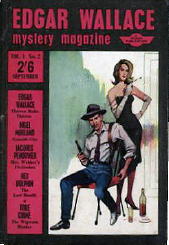
EDGAR WALLACE MYSTERY MAGAZINE

   A fascinating thread! As has been observed, Edgar Wallace was a very big name in thriller fiction in the 1920s and ’30s, but he was not, of course, part of the Golden Age of Detection, which makes comparisons with Christie — even Symons — in many ways inappropriate. Wallace was still a big name after the Second World War and right up to the 1960s, when I founded and edited the Edgar Wallace Mystery Magazine. At that time, his books and stories were already regarded as having a quaint flavor, which a daughter, Penelope Wallace, was largely responsible for trying to remove by supplying publishers with revised versions.

   Such revisions are, of course, an ultimately futile exercise and may even remove future points of appeal — something I realized even then though I was only 21 years of age. For the short time I ran the magazine, I concentrated on the “action” end of the mystery field, running the kind of stories Americans would have called “pulp fiction” and which I believe were written by authors who were worthy successors of Wallace himself. I also used full-color, vigorous pictorial covers that reflected this content.

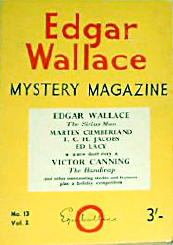
EDGAR WALLACE MYSTERY MAGAZINE

   Ultimately, the publishing company running the magazine — and employing me as the editor of it and a raft of digest-size “pocket libraries” — ran into financial difficulties and the Wallace family took over the magazine. I was replaced by a “more experienced” editor: elderly writer Nigel Morland who was said to be a family friend, and as a contributor to the magazine had previously flattered me with consistently favorable comment on my editorial work and policies.

   The illustrated covers were replaced by wholly typographical, two-color covers that at best were a poor imitation of Ellery Queen’s. The content changed, too, certainly abandoning what I considered the true Wallace tradition in preference for material that had more of a “whodunit,” intellectual slant.

   From the online FictionMags Index:

Edgar Wallace Mystery Magazine

Publishers
      Aug-1964 – Nov-1964: Micron Publications, Micron House, Gorringe Park Avenue, Mitcham
      Dec-1964 – Jun-1967: Edgar Wallace Magazines Ltd., 4 Bradmore Road, Oxford
      1969? – 1970?: Edgar Wallace Magazines Ltd., 50 Alexandra Road, London SW19

Editors
      Aug-1964 – Nov-1964: Keith Chapman
      Dec-1964 – Jun-1967: Nigel Morland
      1969? – 1970?: Leonard Holdsworth, Kurt Mueller & James Hughes

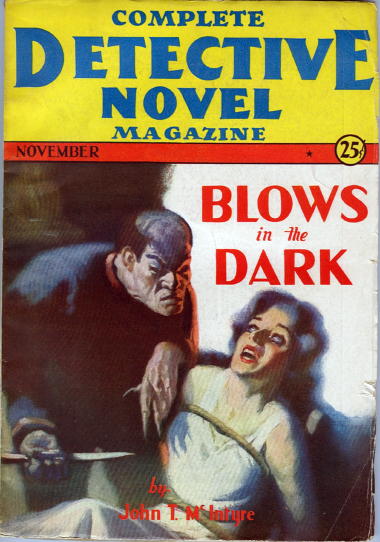
   As a brief introduction to this piece, I’ll begin by saying that mystery writer John T. McIntyre was the subject of a post you saw here last Saturday, albeit somewhat accidentally so: he was the author of “Blows in the Dark,” the lead story in Complete Detective Novel Magazine for November 1931.

   Thanks go first to Mike Grost for the comments he left after that preceding post, during the course of which in part he reviewed Ashton-Kirk: Secret Agent. According to Mike, it starts out as a pure imitation of the Sherlock Holmes stories, then dissipates its early promise into becoming a cliched and routine espionage novel. Not a surprising report, I suppose, given the lack of name recognition that McIntyre has a writer today, but still a disappointing one.

   But here is some news. I’ve conferred with Al Hubin, and in the next installment of the online Addenda to the Revised Crime Fiction IV, the books in the following separate entry will be merged with those of John T. McIntyre. (Note the previous misspelling of the author’s name.)

MacINTYRE, JOHN THOMAS. 1871-1951. Pseudonym Kerry O?Neil, q.v.

O?NEIL, KERRY. Pseudonym of John MacIntyre, 1871-1951, q.v.

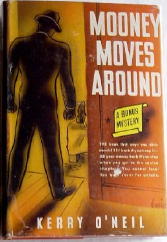
      Mooney Moves Around (n.) Reynal 1939 [Jerry Mooney; Philadelphia, PA] “Private detective murder mystery surrounding the fashion industry.” NOTE: This novel was a SEALED Bonus Mystery. The last chapter of the book, containing the solution to the murder, was tightly sealed in a paper wraparound with printed bonus certificate. The reader would have to break the seal to finish the book. If unbroken, the book could be returned for a full refund; otherwise the purchaser could redeem the coupon for 35 cents.

KERRY O'NEIL Mooney Moves Around

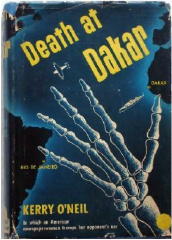
      Death at Dakar (n.) Doubleday 1942 [Senegal] “In which an American newspaperwoman [Patricia Cornell] trumps her opponent?s ace.” Add to setting: Rio de Janeiro, Brazil.

KERRY O'NEIL Death at Dakar

      Ninth Floor: Middle City Tower (n.) Farrar, 1943 [Jerry Mooney; Philadelphia, PA] “Jerry Mooney, a cop turned private detective, investigates the disappearance of an expensive ruby and the murder that follows.”

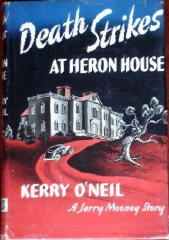
      Death Strikes at Heron House (n.) Farrar, 1944 [Jerry Mooney; Philadelphia, PA]

KERRY O'NEIL Death at Heron House

   At the moment I don’t know much more about Jerry Mooney. He’s not included in Kevin Burton Smith online directory of private eyes, and what I do know (see above), I’ll pass along to him.

   Checking out the pulp fiction written by Kerry O’Neil, I’ve discovered a story written as by him in the October 10,1948, issue of Short Stories, a work called “A Short Shot at Purdy.” Given that John McIntyre’s first entry in CFIV was In the Toils, a criminous play published by Penn in 1898, it certainly makes for a long if not entirely illustrious career.

[UPDATE.] Later the same day. Google is wonderful. I’ve found a long, meaty profile of John McIntyre online here. It’s entitled “Noir Town: The hard life of John McIntyre, the legendary Philly novelist nobody’s heard of,” by Kevin Plunkett (2006). I’d love to reprint it here on the blog, but I’ll remain content to have you follow the link and read it for yourself. Highly recommended!

   Here are the last couple of paragraphs:

    “At his death, John McIntyre was already fading into obscurity. The intervening decades took care of the rest.

    “Today his hard-edged Philadelphia novels are forgotten and ‘only hard core mystery buffs’ are aware of the gutsy writer from Northern Liberties, notes Thomas Whitehead [manager of Temple University’s Special Collections Department]. And hardly a soul peruses the John T. McIntyre Papers. And that’s a shame. Because McIntyre rendered Philadelphia’s darker edges into some of the toughest and finest fiction this city has ever seen. ‘He was the Philadelphia writer who captured the realistic parts of city life: the street life, the politics, the ethnic groups in the city, all the relationships,’ Whitehead says. ‘I think he did it well.'”

   Another copy of COMPLETE DETECTIVE NOVEL MAGAZINE from my collection. It’s been a while, so please go back to this previous post for more information about the project this is a part of.

COMPLETE DETECTIVE NOVEL MAGAZINE November 1931

November 1931. Number 41. Total pages: 144, not including covers.

      * 8 * John T. McIntyre * Blows in the Dark * novel * illustrated by Leo Morey

      * 85 * Ward Andrus Scranton * The Almost Perfect Crime * short story (reporter Jimmie Reed)

      * 95 * Jack Martin * The Subway Murders * short story (reporter Hemming Byrd)

      * 114 * Ray Torr * The Doctor Crippen Case * true crime article * continued on page 116

      * 115 * Samuel Davenport * Final Extra! * short short story

      * 117 * James W. Poling * Steps of Death * short story

      * 132 * James Moynahan * Rat Poison * short story

Comments: Reporters seem to have been quite the rage, as far as the short fiction in this issue is concerned. The leading character in “Blows in the Dark,” which does not seem to ever have been published anywhere else, is Bob Craige, an adventurer recently returned from Mexico and Central America, only to find waiting for him in New York City a dying man, a beautiful girl, and a Chinese gentleman (I believe I am using the term lightly) named Hong Yo.

   As for John T. McIntyre, here is his entry in Crime Fiction IV, by Allen J. Hubin. I’m quite positive that this is the same author as the one who wrote “Blows in the Dark.”

McINTYRE, JOHN (Thomas)

* In the Toils (play) Penn 1898
* -The Ragged Edge (n.) McClure 1902
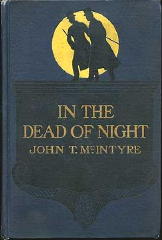
* In the Dead of Night (n.) Lippincott 1908 [New York City, NY]

JOHN T. McINTYRE In the Dead of the Night

* -The Street Singer (n.) Penn 1908
* Ashton-Kirk: Investigator (n.) Penn 1910 [Ashton Kirk; New York City, NY]
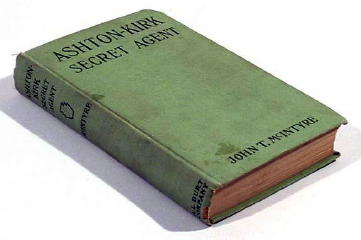
* Ashton-Kirk: Secret Agent (n.) Penn 1912 [Ashton Kirk]

JOHN T. McINTYRE Ashton-Kirk

* Ashton-Kirk: Special Detective (n.) Penn 1912 [Ashton Kirk; New York City, NY]
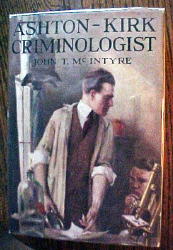
* Ashton-Kirk: Criminologist (n.) Penn 1918 [Ashton Kirk; New York City, NY]

JOHN T. McINTYRE Ashton-Kirk

* “Slag” (n.) Scribner 1927
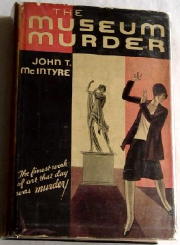
* The Museum Murder (n.) Doubleday 1929 [New York City, NY]

JOHN T. McINTYRE The Museum Murder

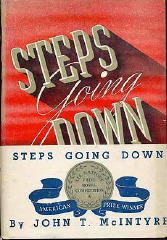
* Steps Going Down (n.) Farrar 1936 [Philadelphia, PA]

JOHN T. McINTYRE Steps Going Down

* -Signing Off (n.) Farrar 1938

   One of the books is available online. Follow the link above. About Ashton-Kirk, I’ve found a blogger who has said:

    “Until you read the Conan Doyle imitators who were roughly his contemporaries, you can’t understand how reasonable, comparatively, Sherlock Holmes is. Ashton-Kirk is clearly based on Holmes, and yet —

    “He’s one of those young, aristocratic cultured gentlemen. And yes, his eyes are piercing, and his fabulous house is in a bad neighborhood, and he’s irritatingly cryptic, but it’s all part of the formula.”

   This observation is corroborated by Jess Nevins on his Pulp and Adventure Heroes website, where he says in part:

    “Ashton-Kirk, one of the more obvious Holmes homages, was created by John T. McIntyre and appeared in The Popular Magazine and in four collections starting in 1910. Ashton-Kirk is much younger than Holmes, being only in his mid-twenties, the scion of wealth and an ancient line. He has an excellent physique and mind, capable of feats of deduction quite similar to Holmes’ own. Like Holmes, he has a talent for disguise and amateur theatrics, and has a Watson-like assistant.”

[UPDATE.]   Regarding the previous entry in this series, the lead novel for which was “The Murders at Hillside,” by Virginia Anne Roth, Bill Pronzini had this to say about the author, after I mentioned to him that I had all of her novels, but I haven’t read one yet:

    “I think you’ll enjoy the Rath novels. Good, solid Golden Age plotting, background, and characterization. A suggestion: Start with Death at Dayton’s Folly, her first for Crime Club and one of her best.”

   Another copy of COMPLETE DETECTIVE NOVEL MAGAZINE from my collection. See this previous post for more information about the project this is a part of.

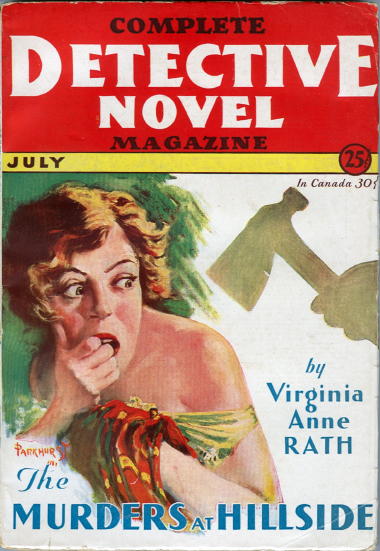
COMPLETE DETECTIVE NOVEL MAGAZINE July 1931

July 1931. Number 37. Total pages: 144, not including covers. Cover artist (signed): Parkhurst. Cover price: 25¢.

      * 8 * Virginia Anne Rath * The Murders at Hillside * novel * illustrated by Parkhurst

      * 105 * Jonathan Eddy * A Vacant Lieutenancy * short story

      * 113 * Karl Nemmel * The Human Vampire * fact article

      * 118 * Leonard A. Hopkins * Jake Gets a Break * short story

      * 122 * Eddy Orcutt * Shots from Nowhere * short story (impossible crime)

      * 134 * Mark Mellen * Ivory O’Toole, Wise Hombre * short story

      * 142 * U. V. Wilcox * Police Problems * true crime feature

Comments: While Virginia Rath went on to have a long career writing hardcover mysteries, this early novel appears to have never been published in book form. Neither of her two primary series characters, Sheriff Rocky Allan or Michael Dundas appears in “The Murders at Hillside.” For more on Mrs. Rath, see her profile here as one of the authors who wrote for Ziff-Davis’s line of Fingerprint Mysteries.

   The blurb on the first page of “The Murders at Hillside” reads as follows: “Death strikes in the night and a gay house party becomes the scene of a series of baffling crimes. From the first murder to the startling solution of the last you will follow breathlessly this brand new book-length novel, complete in this issue.” It is not clear, but I believe the story takes place in the West Coast, probably California.

   Not a “cozy” as the term is used in today’s terminology, but most definitely neither a typical pulp story of gangsters and cops. What this novel is instead is one of those traditional murder mysteries very common in the 1930s, not only in England (manor houses and all), but in the US as well. Also note that the author was only 26 when she wrote it.

   From Crime Fiction IV:

RATH, VIRGINIA (Anne McVay) (1905-1950); see pseudonym Theo Durrant

* Death at Dayton’s Folly (n.) Doubleday 1935 [Sheriff Rocky Allan; California]
* Murder on the Day of Judgment (n.) Doubleday 1936 [Sheriff Rocky Allan; California]
* Ferryman, Carry Him Across! (n.) Doubleday 1936 [Sheriff Rocky Allan; California; Academia]
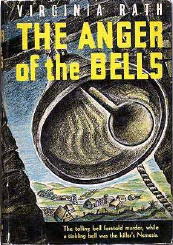
* The Anger of the Bells (n.) Doubleday 1937 [Sheriff Rocky Allan; California]

VIRGINIA RATH The Anger of the Bells

* An Excellent Night for Murder (n.) Doubleday 1937 [Sheriff Rocky Allan; California]
* The Dark Cavalier (n.) Doubleday 1938 [Michael Dundas; San Francisco, CA]
* Murder with a Theme Song (n.) Doubleday 1939 [Sheriff Rocky Allan; Michael Dundas; California]
* Death of a Lucky Lady (n.) Doubleday 1940 [Michael Dundas; San Francisco, CA]
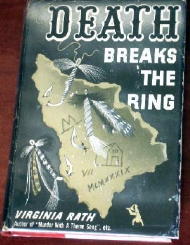
* Death Breaks the Ring (n.) Doubleday 1941 [Michael Dundas; California]

VIRGINIA RATH Death Breaks the Ring

* Epitaph for Lydia (n.) Doubleday 1942 [Michael Dundas; San Francisco, CA]
* Posted for Murder (n.) Doubleday 1942 [Michael Dundas; San Francisco, CA]
* A Dirge for Her (n.) Ziff-Davis 1947 [Michael Dundas; San Francisco, CA]
* A Shroud for Rowena (n.) Ziff-Davis 1947 [Michael Dundas; San Francisco, CA]

DURRANT, THEO; pseudonym of William A. P. White, Terry Adler, Eunice Mays Boyd, Florence Ostern Faulkner, Allen Hymson, Cary Lucas, Dana Lyon, Lenore Glen Offord, Virginia Rath, Richard Shattuck, Darwin L. Teilhet & William Worley.

      * The Marble Forest (n.) Knopf 1951 [California]
      * The Big Fear (n.) Popular Library 1953; See: The Marble Forest (Knopf 1951)

   Over the next few weeks I’ll be posting the covers and contents of all of the issues of a pulp called COMPLETE DETECTIVE NOVEL MAGAZINE that are in my collection. This is in conjunction with a far more reaching project called the Crime Fiction Index, which is being compiled under the direction of Phil Stephensen-Payne.

   Its intent is to index all of the crime fiction magazines ever published in English, expanding upon two previous such checklists, now both long out of print:

      1. Mystery, Detective, and Espionage Fiction: A Checklist of Fiction in U.S. Pulp Magazines, 1915-1974, compiled by Michael L. Cook and Stephen T. Miller.

      2. Monthly Murders: A Checklist and Chronological Listing Of Fiction In The Digest-Size Mystery Magazines In The United States And England, compiled by Michael L. Cook.

   Follow the link above for more information.

   As for COMPLETE DETECTIVE NOVEL MAGAZINE, Phil also has a checklist of all the issues, most with covers, online here.

   Some of the data is has for the magazine is missing or incomplete, nor does he have all the covers. As I have quite a few of the run, I’ve been promising to give him an assist on these for quite a while. To motivate me – sharp sticks haven’t seemed to work – I’ve decided to post the information here on the M*F blog before sending it along to Phil.

   There will be quite a bit of information that will duplicate his, but even if so it will serve as a check, and while he has quite a few of the covers, some I imagine will be upgrades, as the copies I have are in rather nice condition.

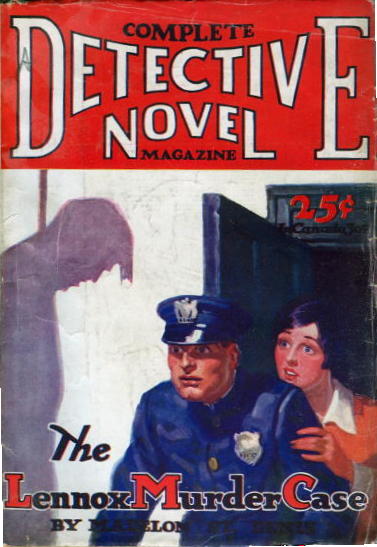
   As the title suggests, each issue contained a full-length novel, along with whatever short stories or other features were needed to fill out the magazine. I’ve estimated the content of the “The Lennox Murder” in the issue below to be 98,000 words, so I feel justified, as did the editors of the magazine, to call the lead story a novel.

   Some of these novels in CDNM can be found in hardcover form. Whether the pulp magazine versions were published before or after the hardcover appeared, I’m not sure, as I don’t have any of these in my collection. As far as I know, the novels in the issues I have were never published anywhere else, although some of the author’s other work may indeed have been. I’ll try to point out instances like this as I go along.

   But what this means to readers and collectors of 1920s and 1930s detective fiction, here’s a source of crime novels you may not have heard about before. Since they appeared in magazine form only, they aren’t included in Al Hubin’s Crime Fiction IV, for example, which cites only book appearances, although in either hardcover or paperback form.

   I won’t be presenting these in any particular order. I’m not organized well enough to do that. If I were to wait until anything like that happened, I would never get anything done.

COMPLETE DETECTIVE NOVEL MAGAZINE 0929

September 1929. Number 15. Total pages: 144, not including covers. Cover price: 25¢.

      * 4 * Madelon St. Dennis * The Lennox Murder Case * novel * illustrated by J. Fleming Gould

      * 110 * Harry Van Demark * “The World’s Most Dangerous Woman” * true crime feature

      * 114 * Henry Leverage * The Prize Sucker * short story

      * 118 * Harold de Polo * “Tough Guy” Mahoney * short story

      * 125 * Mark Mellen & John Forbes * Held for Ransom * short story

      * 140 * Anonymous * Headquarters, Where the Readers Get Together * letter column

   Comment: The leading character is a female private eye named Tam O’Brien. The daughter of Ex-Chief of Detectives Rance O’Brien, she’s better known as Tam o’ Shanter, Inquirer. Female PI’s were still fairly scarce in 1929, and I don’t believe I’ve seen her name come up before. Historians of the genre are going to have to add her name to the short list of early ones. (On page 66 there is some discussion of some of the previous cases she’s handled, and they’ll probably come up again, as I start posting some of the earlier issues of CDMN.)

   From Crime Fiction IV:

ST. DENNIS, MADELON

       * The Death Kiss (Fiction League, 1932, hc) [Sydney Treherne; New York City, NY] Film: World Wide, 1933 (scw: Barry Barringer, Gordon Kahn; dir: Edward L. Marin).

       * The Perfumed Lure (Clode, 1932, hc) [Sydney Treherne; New York City, NY]

FIRST YOU READ, THEN YOU WRITE
by Francis M. Nevins

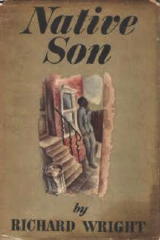
   Richard Wright (1908-1960) was perhaps the best-known and most written-about black novelist of the 20th century, but as far as I know no one except myself has ever pointed out the debt he owes to Cornell Woolrich. During the late Thirties when Wright was working on his first and finest novel, Native Son (1940), he is known to have been a voracious reader of the pulp mystery magazines like Black Mask to which Woolrich contributed dozens of stories.

WRIGHT Native Son

   Native Son’s basic storyline of a young man wrongly accused of murder and running headlong through “streets dark with something more than night” was clearly inspired by Woolrich’s powerful suspense thriller “Dusk to Dawn” (Black Mask, December 1937; collected in Nightwebs, 1971).

   During the last months of his life Wright was working on another crime novel, recently published in unfinished form as A Father’s Law, and it seems equally clear that here too he took his point of departure from Woolrich. In “Charlie Won’t Be Home Tonight” (Dime Detective, July 1939; collected in Eyes That Watch You, 1952) a middle-aged cop slowly becomes convinced that the criminal he’s seeking is his son. Woolrich’s cop of course is white. A Father’s Law deals with a middle-aged black cop who also becomes convinced that his son is a criminal.

   If this is simply a double coincidence, it’s one that even Woolrich (who was prone to stretch coincidence to the outer limits) would have rejected. Any student of African-American literature who’s in need of an unexplored topic could do worse than to investigate the Woolrich-Wright interface in depth.

***

   Silly mistakes in mystery fiction are not confined to nonentities like John B. Ethan, whose fond delusion that Zen Buddha was a person I discussed in my last column. Some of the biggest names have perpetrated howlers no less ridiculous.

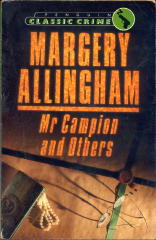
ALLINGHAM Mr. Campion and Others

   Take, for instance, Margery Allingham. “The Definite Article” (The Strand, October 1937; collected in Mr. Campion and Others, 1950) finds Albert Campion called in by his friend Superintendent Oates when Scotland Yard is asked by the “Federal Police” of the U.S. (by which I presume she means the FBI) to arrest and deport a “society blackmailer” whose extortion drove a young woman in New York to suicide.

   Excuse me? Where’s the Federal crime? Where’s the Federal jurisdiction? Any doubts that Allingham knew nothing about the American legal system should be allayed a little further in the story when Campion asks Oates why the Feds got in touch with Scotland Yard instead of, say, “the Sheriff of Nevada.” Since when do states have sheriffs?

***

   Richard Fleischer (1916-2006) directed some of the worst big-budget movies ever to issue from Hollywood but started out helming several excellent little specimens of film noir, perhaps the best known being The Narrow Margin (1952) and Violent Saturday (1955).

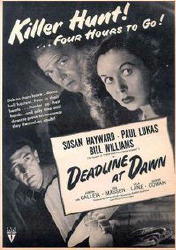
DEADLINE AT DAWN

   His memoir Just Tell Me When to Cry (1993) says very little about most of his noirs but includes a neat anecdote about a similar film he had nothing to do with. In 1946, as a novice at RKO, he sat in on a production meeting with tough-as-nails executive producer Sid Rogell and the well-known theatrical director Harold Clurman, who was helming his first movie. Fleischer doesn’t name the picture but, since Clurman made only one movie in his life, it has to be Deadline at Dawn, loosely based on Cornell Woolrich’s novel of the same name.

   As Fleischer remembered the meeting, the first thing Rogell told Clurman was: “You don’t have forty days to shoot the picture. You’ve got thirty.” Then Rogell picked up the script, noticed that the first scene took place at night and called for rain (in film noir, what else?) and asked Clurman: “Rain? You know how much fucking rain costs?….What do you want rain for?” “For the mood,” Clurman told him. “Fuck the mood. No rain.”

   Rogell was about to order Clurman to cut back on the number of people who appeared in the scene when the director interrupted: “How about dust? Lots of dust blowing everywhere. Can we afford dust?”

   In the finished film the first scene takes place indoors – the confrontation between the blind pianist (Marvin Miller) and his predatory ex (Lola Lane) – and neither rain nor dust appears in the second scene, which is set outdoors but was clearly shot on a soundstage.

***

   So many people have told me that I absolutely must see Infernal Affairs (2002), the Hong Kong movie which Martin Scorsese remade with Leonardo di Caprio and Matt Damon as The Departed, that I finally did it earlier this month.

INFERNAL AFFAIRS

   The Asian film tells the same story as its U.S. counterpart – the duel between two moles, one planted in the mob years ago by the PD, the other planted in the PD by the mob – but much more tightly and cynically and without the graphic in-your-face violence that seems to have become a Scorsese trademark.

If    you’ve hesitated because you’re unfamiliar with Asian action films and are afraid you won’t be able to tell the characters apart, I can assure you that this is not a problem. The wispy-mustached police mole in the mob (Tony Leung) could never be confused with the clean-shaven mob mole on the force (Andy Lau), and the only cop whose knows his mole’s identity (Anthony Wong) could no more be mistaken for the only mobster who knows his mole’s identity (Eric Tsang) than could Martin Sheen for Jack Nicholson in Scorsese’s version.

   I do recommend, however, that Infernal Affairs be seen in letterbox. The panned-and-scanned version I got from Netflix eliminates far too much of each image from an intensely visual film – and one that goes far towards proving that noir has become a universal language.

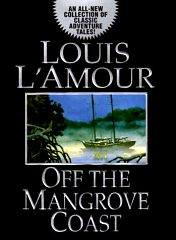
LOUIS L’AMOUR – Off the Mangrove Coast.

Bantam hardcover; First Edition, May 2000. [Paperback reprint: Bantam, May 2001.]

   Louis L’Amour is likely to be one of the three most well-known western writers of all time. I’d place Zane Grey and Max Brand ahead of him, but you could argue with me. Of the nine stories brought together in this latest collection, however, only one takes place in the old West, and it’s perhaps the only one that could safely be considered “historical.”

LOUIS L'AMOUR Off the Mangrove Coast

   There are two boxing stories, one about a private eye, and another about an insurance investigator in a tight spot. None of these, including the western, are worthy of more note than this. A better one is a short little tale about a longshoreman who meets his match at checkers, and a good one is an interesting vignette that takes place in a French café after World War II.

   The two best stories are the title story, about diving for treasure in the South China Sea, and a longer one about hunting for diamonds in the jungles of Borneo, infested with headhunters.

   The time these stories take place is unclear, perhaps in the 1940s, perhaps as early as the 1920s. L’Amour pulpy, rough-hewn writing style is uneven, sometimes full of cliches and worn-out plot devices, sometime lyrical and imbued with a strong sense of what it takes to be a man. But if he hadn’t written these particular works, they’d have never been published again, I regret to say. The old pulp magazines are filled with stories just like these, gone and mostly forgotten, remembered only by a handful of enthusiasts who still collect them.

POSTSCRIPT: As one of those selfsame enthusiasts, I really would have liked to known where these stories first appeared. There is no bibliographical information provided at all.

       — June 2000. This review first appeared in The Historical Novels Review. It may have been very slightly revised since then.

[UPDATE] 02-20-08.    The final tagline explains why the emphasis in the review is on the “historical” content, and not so much on the detective stories that happen to be in the collection.

   The book is included in Crime Fiction IV, by Allen J. Hubin, though, and here’s a list of the stories which (for reasons of space) I didn’t include when I first wrote the review. A couple of the magazines where the stories first appeared are given, and I’ll repeat them here:

      The Cross and the Candle
      The Diamond of Jeru
      Fighters Should Be Hungry, Popular Sports Magazine, February 1949
      * It’s Your Move, The Tanager, February 1939
      Off the Mangrove Coast
      The Rounds Don’t Matter
      Secret of Silver Springs
      Time of Terror
      The Unexpected Corpse, G-Men Detective, November 1948

   * This story is not one of those for which CFIV lists the original source. I just came across this one somewhere else myself. My copy of The Louis L’Amour Companion is not handy, I’m sorry to say, and in fact is nowhere to be found. It’s been almost eight years since I wrote this review, so obviously I haven’t been suffering from any unrequited urgency, but if you can fill in the details, I’d certainly appreciate it.

   If I were able to rewrite the review for the blog right now, I’d make sure to identify the stories more clearly with the contents, but I didn’t at the time, and I can’t. All I can tell you about the book is what you’ve already just read. L’Amour is not one of my favorite western writers, but in case it wasn’t entirely clear, I enjoyed this collection.

[UPDATE #2] 02-21-08. Robert Teague of the WesternPulps Yahoo group has supplied me with a couple of story sources:

    “The Rounds Don’t Matter” was first printed in Thrilling Adventures Feb 42

    “Secret of Silver Springs” Range Rider Western Nov 49

   Four more to go, keeping in mind, as others have pointed out, that titles may have been changed, and some of the stories may have appeared for the first time in this (much) later collection.

[UPDATE #3] 03-03-08. Excerpted from a pair of email messages sent me by Juri Nummelin:

Hi Steve,

   I finally pulled out my copy of Weinberg’s L’Amour Companion, and it does seem that the four stories have been previously unpublished. I can’t find them on the checklist Weinberg provides. Well, of course the titles may have been altered. There are short descriptions of the short stories in Weinberg’s book, so if you have synopses of the stories in the book, I can compare them to Weinberg’s.

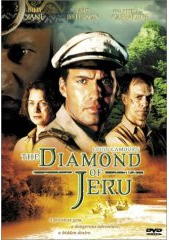
   I seem to remember that “The Diamond of Jeru” was made into a film in the early 2000’s. Yes, I was right.

   From IMDB: http://akas.imdb.com/title/tt0282441/

   It says that the film is based on L’Amour’s novel, but you can’t really be sure about what Imdb says. It says however that the screen story was written by Beau L’Amour. Maybe this was an unproduced treatment Beau has found in his father’s archives. In that case it would be only sensible and polite to provide that info on a foreword or some such.

   You can add to the info Robert Teague already provided you with: “Secret of Silver Springs,” Range Riders Magazine, as by Jim Mayo, January 1950

   By the way, Robert Sampson has a pretty good article on L’Amour’s detective stories in Weinberg’s book. He makes the stories sound good.

                — Juri

       >>> My reply:

   Thanks, Juri, even if Weinberg’s book didn’t supply a lot more information. When I come across my copy of Off the Mangrove Coast again, I’ll see if I can’t supply the synopses you suggested.

The Diamonds of Jeru

   I was totally unaware that “The Diamond of Jeru” had been made into a movie. It was made for cable (USA Network) and is available on DVD. So far, though, all of the copies I’ve seen offered online have been very expensive, but I’ll keep looking. The movie starred Billy Zane, Paris Jefferson, and Keith Carradine, with Jackson Raine and Khoa Do. According to IMBD, it’s “the story of an American scientist and his wife who hire an ex-pat war veteran to act as a guide on a journey up an unchartered Borneo river in search of diamonds.” Reviewers on IMDB have mixed opinions about the movie, to say the least.

   By the way, there’s one synopsis right there.

   As for L’Amour’s detective stories, I enjoyed the one collection of them that I read quite a bit. On the other hand, once again there was nothing in them that knocked my socks off. I’m sure any reader of the detective pulps could come up with a selection of stories from any other pulp writer equally as good, if not better.

FIRST YOU READ, THEN YOU WRITE
by Francis M. Nevins

   More than seventy years ago the English writer Peter Cheyney, who knew the U.S. about as well as a toad knows existentialism, launched a series of thrillers starring two-fisted FBI agent Lemmy Caution, whose first-person narrative in Cheyney’s version of American English is of a unique eyeball-popping awfulness.

   At least I thought it was unique until I stumbled upon Michael C. Peacock’s “Bait” (Clues, May 10, 1931) and its protagonist Whisper Timkins, a good-hearted pickpocket who narrates not only in first person present tense like a Damon Runyon street character but also in dialect like a Harry Stephen Keeler ethnic. “I lowers me hands and flops back onta the chair. Everythin’ is as plain as me Aunt Maggie’s face.” He also uses nouns for verbs and all sorts of other silly said substitutes as if, as he might have put it, there wuz no tomorrah.

       “Rule me out,” I lips.

       “You’re ruled in…,” he menaces.

       “This way,” chills a icy voice.

       “As for you, Garvin,” he threats.

       “Now use your ears!” he grits….

       “Mr. Wade,” Hope yodels, fondlin’ the gat, “have you ever been to Coney Island?”

       He…oaths, “We’re leaving for there right away!”

       “Terrible,” I throats, mournful.

       “Sorta mixed up,” I warbles.

   More than half a century after the tale got published for the first and only time, I met the author, a Canadian who had lived in the States only a few years before perpetrating this collage of howlers. I got to like him and he’s dead now so I’ll leave his real name unmentioned. No, he didn’t become a professional mystery writer.

***

   Last month I discovered the finest film music I’ve heard in many a year. The Philip Glass score for THE ILLUSIONIST is full of the hypnotic repetitions that are the Glass trademark but it’s also hauntingly evocative of my beloved Bernard Herrmann. If you love Herrmann’s score for Hitchcock’s VERTIGO, you’ll love this one too, and probably play the CD again and again as I’ve been doing.    [The link will lead to a trailer for the film. —Steve.]

The Illusionist

***

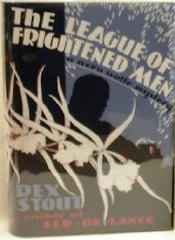
   In our Poetry Corner this month is THE LEAGUE OF FRIGHTENED MEN (1935), the second of Rex Stout’s Nero Wolfe novels. Wolfe’s adversary in this one is Paul Chapin, who was crippled and apparently emasculated in a fraternity hazing incident at Harvard in 1909 that went horribly wrong. A quarter century later Chapin has attained something of a literary reputation. As members of the group that maimed him begin dying off, the survivors receive anonymous poems that send them scurrying to Wolfe in fright. The first, following the apparently accidental death of a judge in a fall over a cliff, begins:

      Ye should have killed me, watched the last mean sigh
      Sneak through my nostril like a fugitive slave
      Slinking from bondage.
      Ye should have killed me.
      Ye killed the man,
      Ye should have killed me!

The League of Frightened Gentlemen

   Wolfe, who admits that he “cannot qualify as an expert in prosody” but claims to be “not without an ear,” calls the poem “verbose, bombastic, and decidedly spotty.” Suspecting that a few lines were influenced by Edmund Spenser, he has Archie Goodwin pull down the collected works of that poet: “dark blue, tooled…. A fine example of bookmaking… Printed of course in London, but bound in this city by a Swedish boy who will probably starve to death during the coming winter.” The hunt for parallel passages fails but in any event, says Wolfe, “it was pleasant to meet Spenser again, even for so brief a nod.” The second death, the apparent poison suicide of an art dealer, triggers a second poem:

      Two.
      Ye should have killed me.
      Two;
      And with no ready cliff, rocks waiting below
      To rub the soul out;…
      I found the time, the safe way to his throat….
      Ye should have killed me.

   Then comes the mysterious vanishing of a Columbia psychology professor and yet another effusion:

      One. Two. Three.
      Ye cannot see what I see;
      His bloody head, his misery, his eyes….
      One. Two. Three.

   We occasionally find Wolfe savoring a volume of poetry but in none of the full-length or short novels is poetry as central as in this longest and perhaps finest exploit of the obese and infuriating genius of West Thirty-Fifth Street.

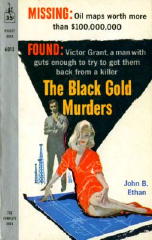
ETHAN Black Gold Murders

***

   Of all the silly lines in mystery fiction, one in particular has clung like a barnacle to the underside of my memory for more decades than I care to count. It’s in THE BLACK GOLD MURDERS (1959), a long-forgotten novel by a long-forgotten author — John B. Ethan, if you must know — in which a woman introducing the narrator to two beatniks says: “The one on the right thinks he’s Zen Buddha.” You remember Zen from World Religions 101, right? Wasn’t he Prince Gautama’s kid brother?


   At the tail end of a previous posting on pulp writer Carl Buchanan, aka James Robert Peery, including a long bibliography, I closed with the following:

    “In addition, James Robert Peery had a letter published in the July 1939 issue of Clues, which neither Victor nor I have seen. If anyone has a copy of the magazine, we’d love to know what he had to say.”

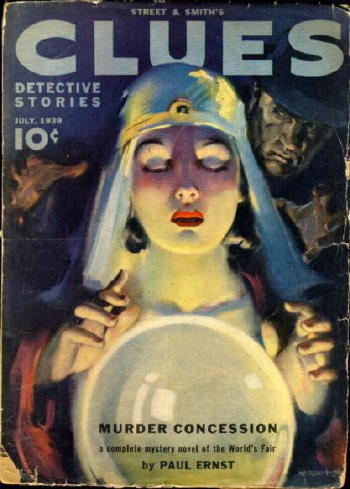
   Thanks to the assistance of pulp collector Paul Herman, I now have a copy of that issue. Not only did Peery have a letter quoted, but some of the others who write in had interesting things to say as well.

CLUES July 1939

H. L. Melleney:

    “I got a kick out of ‘The Drums Drone Death,’ by J. Allan Dunn, in the last issue of Clues. This fellow Dunn certainly knows his locale, and the character, John Carter, is swell. I would like to read some more John Carter yarns, with the New Hebrides background.”

Editor: “Mr. Dunn is now writing a John Carter complete novel for Clues.”

Ray Robinson:

    “Your all-star authors for Clues are a splendid choice. I want to compliment you especially on J. Allan Dunn.

    “His ‘The Drums Drone Death’ makes the New Hebrides really there for us. His character is alive and human. Let us have more of these interesting stories.

Editor: “Mr. Peery, whose new book is a sensation, used to be our ‘Carl Buchanan.'”

James Robert Peery:

    “Heap long time I have been a reader of Clues — from ’way back when I sold the former editors an occasional short or novelette under my Carl Buchanan pseudonym. The Donald Wandrei yarn [“The Painted Nudes”] in the current issue is good. Also liked the short story [“ Murder Is a Pipe”] by [Otis Adelbert] Kline — but the best yarn in the April issue was by J. Allan Dunn. Note that you asked for reader comment on this one. I believe a John Carter series would go over in a big way. Of course, I read from the point of view of a writer — can’t quite relax and enjoy a story for admiring or criticizing technique of the author.

    “I think your readers appreciate authenticity. Personally I’d like to see John Carter in action again. I get bored with these super-detectives. The change to a human, red-headed young fellow feeling his way is quite a relief. The locale should provide Dunn with plenty good ideas for plots.

    “You’re doing a swell job of editing. Keep up the good work!”

Sincerely yours,

      James Robert Peery
         Eupora, Mississippi


   Unfortunately, in spite of this groundswell of support from readers for another story about John Carter, about whom I know nothing more than this, it never happened. I could have missed it in my search through the Cook index, true, but “The Drums Drone Death” appears to have been the only story that J. Allan Dunn ever had published in Clues. If the novel was ever written, it was published elsewhere.

LES SAVAGE, JR. – The Shadow in Renegade Basin. Leisure Books; paperback reprint, July 2001. Hardcover edition: Five Star, March 2000.

   For those of you who may have come in late, yes, I do do reviews of westerns on this blog. I know I don’t have to explain myself, but it has been a while since one has appeared here, so what I’m going to do is to repeat the following paragraph from the last one I did, which was of Edge of the Desert by Matt Stuart (L. P. Holmes):

    “… and whether or not they’re included in Al Hubin’s Crime Fiction IV – Al generally says no unless there’s a leading character who’s actually a detective and involved in solving a case – I have no compunction about reviewing them [westerns] here. Almost every western has a crime component of some kind, and if they don’t, I probably don’t read them. Rustling, gunfighting, horse thievery, burning out homesteaders, it’s all against the law, and therefore – when written up in book form – crime fiction.”

LES SAVAGE The Shadow in Renegade Basin

   But no more self-indulgent justification! Let me begin by giving you the titles of the three short novels (or long novelettes) included in this particular group of western tales, and the issues of the pulp magazines they first appeared in:

       “Plunder Trail.” Frontier Stories, Summer 1944. Savage’s original title: “Oregon Traitor Trail.”
       “Brand of Penasco.” Action Stories, Winter 1945, as “Brand of the Gallows Ghost.”
       “The Shadow in Renegade Basin.” Frontier Stories, Summer 1950, as “Tombstones for Gringos.”

   Savage had a short but prolific career as a western writer. He died in 1958 only 35 years old, but in the short time he had to live, he wrote 25 novels, the last one, Gun Shy, finished by Dudley Dean McGaughey after his death. This does not include a long list of short stories which Jon Tuska has been packaging into collections like this. (Savage’s first published short story was written when he was a mere 17.)

   Enough facts. If I’ve read anything by Savage besides this one, it would have been over 50 years ago, and opinions when one is 15 old, plus or minus a couple of years, simply do not count. Which assumes that I’d remember, which I don’t, but I’m sure I did – read one, that is.

   Let’s take the two earliest ones first. I appreciate the fact the three stories were published in chronological order. It does help in putting a writer’s career in perspective. Of the first two, I’d say that at time, when Savage would have been in his early 20s, he was absolutely terrific in describing western landscapes and capturing moods, but only so-so in connecting with connecting with his characters and convincing them to come to life.

   Something else he was very good at was writing action scenes, the parts of the stories where violence kicks in, delineated blow by blow, and….

    … in “Plunder Trail,” that is exactly where the story stops dead in its tracks, at least it did for me. It’s the story of a gambler at loose ends who finds himself part of a wagon train full of homesteaders headed west. Ed Manton also finds himself getting caught up in their hopes and new lives. And when Georges Arvada and his gang strike, as is totally anticipated, it is Manton whose abilities as a leader and with a gun are needed the most.

   The last 15 pages need only be skimmed. The fight seems to go on forever, and the last page, in which Manton and Leah are finally reunited, comes both as a relief and as no surprise at all.

   Story number two, “Brand of Penasco,” is one of seven short novels Les Savage wrote about Elgera Douglas, familiarly known as Senorita Scorpion, one of the most popular characters to appear in Action Stories, says Jon Tuska in his introduction.

Senorita Scorpion

   Elgera is blonde and quite a pistol-packing lady, just the right combination to win the hearts of every adolescent boy and young man who might have read the magazine back in 1945. More of her background than this, however, is not given in the story itself.

   Truth in advertising. The cover shown to the right is from the Winter 1949 issue, not the one in which the story in this book appeared. Nor is the lady masked in this tale, as she is in most (if not all) of the covers she was featured on. (I just happen to think that she’s shown to her best advantage on this one.)

   I think a mistake has been made in terms of not putting all of her adventures into two volumes, say, instead of of scattering them around one at a time in other collections. The impact that she made would have been far greater, I’m sure, with her exploits being able to be read in the order they occurred, as well as the romances she had.

   It’s still a good story, but after her friend Chisos is shot and left for dead, the story seems to sag a little, caught up in too much action without enough motivation. The capture of a fellow named Penasco, an outlaw known to have been hanged many years ago but rumored to still be alive and on the loose again, is the primary focus, but the tale, populated by people named Tequila, Bighead and El Cojo, seems to go off in too many directions from there.

   It is the title story, “The Shadow in Renegade Basin,” that Jon Tuska, in his introduction to it, seems the proudest of to present. He compares it to Greek tragedy, and describes it as filled with “fratricide and incest.” No kidding. The story had to be rewritten considerably before it could be published in a pulp magazine in 1950. The restored text is supplied.

   Unfortunately I do not relate to Greek drama very well, a failure that no teacher of great literature was able to cure. The shadow in the title is that which is supplied by a sinister-looking mountain called El Renegado, and the legends that are told about it. In the rich, fertile valley at its foot, there are no farms, no ranches, no people, until the arrival of two brothers and their mother, hoping there to settle down and prosper.

   Enter Christina Velasco, who is beautiful, of course, lives alone somewhere in the area, and equally of course both brothers fall in love with her. There is also a Mexican peddler of rare birds named Pajarero and an hombre named Nacho, both of whom are also, in their differing ways, under Christina’s spell.

   As was mentioned earlier, it is no surprise that the ending was changed. And as it was originally written, the story is filled with tantalizing wisps of beautifully described countryside and fragmentary glimpses of fascinating characters who seem to have no control over the events they are in.

   It is like no pulp story I have read before, and I have no way of explaining exactly why, other than I’ve done so far.

   I also apologize for allowing this review to go on so long. Paraphrasing what I remember someone else much more famous than I having once said, I have not taken the time to make it shorter.
« Previous PageNext Page »