Bibliographies, Lists & Checklists


   This profile appears also in Part 21 of the Addenda to the Revised Crime Fiction IV, by Allen J. Hubin. Some of the dates of the Australian editions of Afford’s book were revised and reported on in Part 5, then Fender Tucker (of Ramble House fame) came along and added the first US editions of most of the titles.

   So much new data to include, in other words, that it necessitated a complete revamp of his entry, and here it is.

AFFORD, MAX. Working name of Malcom R. Afford, 1906-1954. Born in Adelaide, noted playwright and radio producer with a biennial award given in his name to young Australian dramatists. Author of more than sixty radio and stage plays, with six crime novels and two books of plays included in the (Revised) Crime Fiction IV; see below. This now constitutes the author’s complete entry. Series character: Jeffery Blackburn (JB). Blackburn is a freelance sleuth who continually offers his services to Chief Inspector William Read on some very interesting cases.

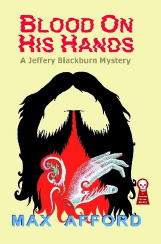
      Blood on His Hands! John Long, UK, hc, 1936. (JB) Setting: Melbourne, Australia. Add US edition: Ramble House, pb, 2006. Also published as: An Ear for Murder, Johnson (Sydney, Australia), ca. 1947. Correction of tentative publication date of Australian edition. “A thriller with ‘impossible’ overtones, including a locked room murder.”

MAX AFFORD - Blood on His Hands

      The Dead Are Blind. John Long, UK, hc, 1937. (JB) Add US edition: Ramble House, pb, 2007. [A locked room murder takes place in a radio studo while a mystery play is being broadcast.]

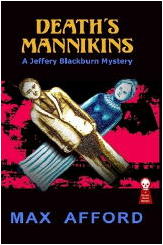
      Death’s Mannikins. John Long, UK, hc, 1937. (JB) Also published as: The Dolls of Death, Johnson, Australia, 1947. Correction of publication date of Australian edition. Add US edition: Ramble House, pb, 2006. “ … about a country manor where every member of the family has a mannikin that looks like him. When one turns up, the person dies, horribly.”

MAX AFFORD - Death's Mannikins

       _The Dolls of Death. Sydney, Australia: Johnson, pb, 1947. Correction of publication date. Previously published as Death’s Mannikins (Long, 1937).

      _An Ear to Murder. Sydney, Australia: Johnson, pb, ca.1947. Correction of publication date. Previously published as Blood on His Hands! (Long, 1936).

      Fly by Night. John Long, UK, hc, 1942. (JB) Also published as: Owl of Darkness (Angus, 1942; Ramble House, 2006). Add the latter as the first US edition.

      Lady in Danger. Sydney, Australia: Mulga, pb, 1944. [This edition with Afford alone.] Later edition in collaboration with Alexander Kirkland and some variations in text: French, 1946. [3-act play]

      _Lady in Danger [with Alexander Kirkland]. French, pb, 1946. Revised from 1944 Mulga edition written by Afford alone.

      Mischief in the Air. Australia: University of Queensland Press, pb, 1974. Collection of plays. Add complete listing, below. Those criminous are indicated with an asterisk (*).
         Consulting Room
         *Lady in Danger
         Lazy in the Sun
         *Mischief in the Air
         William Light–The Founder

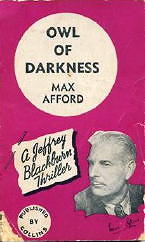
      _Owl of Darkness. Angus, Australia, hc, 1942. Previously published as Fly by Night (Long, 1942). Add US edition: Ramble House, pb, 2006. “A classic impossible crime novel about a villain dressed as an owl terrorizing a quaint village.” Shown is the cover of a Collins paperback reprint with a photograph of the author on the front.

MAX AFFORD - Owl of Darkness

      The Sheep and the Wolves. Sydney, Australia: Johnson, pb, 1947. (JB) Setting: Australia. Correction of publication date.

      Sinners in Paradise. Sydney, Australia: Johnson, pb, 1946. Setting: Australia. Correction of publication date.

   First — this is Steve — some background information and a bit of an introduction. If you were to look Thorne Lee up in either print or CD version of Crime Fiction IV, by Allen J. Hubin, his entry would look like this:

LEE, THORNE; pseudonym of Thornton Shiveley; Born in Nebraska; in 1950s living in California and instructing in English and speech at a junior college; actor; writer under another name.
       The Monster of Lazy Hook (Duell, 1949, hc) [California]
       Summer Shock (Abelard-Schuman, 1956, hc) [Oregon]

or at least that’s how it appeared until Al sent me an update for him in Part 9 of the Revised CFIV. Not much, but at least an approximate year of birth for him:

LEE, THORNE.
Thornton P. Shiveley, ca.1874- .

   Following this, several months later, Al sent me an update correcting the spelling of the author’s last name, saying “There’s a Thornton P. Shively in the Mormon site with the right birth date, so I assume it’s he.”

   If he was born in 1874 would have made him a little old to be teaching in the 1950s, but that’s hardly impossible.

   But while doing a search for Lee on the Internet, I found an eBay seller who was offering a signed copy of The Monster of Lazy Hook. As part of the description she said, “Inscribed and signed on copyright page by author both as ‘Thorne Lee’ and Thornton T Shiveley.”

   So we’re back to Shiveley, but where did the middle initial “T” come from?

   We asked Victor Berch, who replied with the definitive answer. Al, this time, had the wrong fellow. Said Victor, “From what I can determine, Thornton T. Shively was the son of Thornton P. Shively. In the 1930 Census, he was listed as 17 years old, born in Nebraska.. His father Thornton Pickenpaugh Shively was an accountant, born in Virginia. Thornton T. was born Feb. 26 1913 in Nebraska and died June 21, 1980 in Santa Cruz, CA.

   And as an immediate consequence, the basic online entry for Lee/Shively now looks like this:

LEE, THORNE. Pseudonym of Thornton T. Shively, 1913-1980.

   In the meantime I’d discovered that Lee had written extensively for the pulp magazines, so I sent this information on to Bill Pronzini. At the same time I asked if had copies of both of Lee’s books, and whether he’d read either of them. Indeed he had, and I’ll let him take over from here:

THE COMPLEAT THORNE LEE, by Bill Pronzini
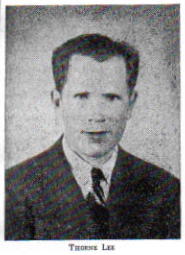
   Thorne Lee
   He began writing during WW II. His first novel, The Fox and the Hound, about an amnesiac trying to find out who he is and whether or not he committed murder, was published complete and unabridged in the August 1944 issue of Mammoth Detective (from whence came the author’s bio below). Unlike some of other full-length novels which first appeared in the Mammoth mags, it was never published in book form. From 1944 to 1949 he contributed more than 30 tales to Black Mask, Dime Detective, New Detective, Doc Savage, The Shadow, S&S Detective Story, Ten Detective Aces, and other pulps. He also wrote a few stories for the sf mags of the period.

———

      In Thorne Lee’s own words:

   Peering into the remote and shady past of a mystery writer, you might expect to find a witches’ brew of dangerous living and dark adventure, but my own life story reads more like an afternoon recital at a ladies’ garden party. Any resemblance to excitement in my tales is purely accidental — or I should say, purely imaginary. I have yet to look down the wrong end of a gun barrel — which is probably true of a lot of fire-breathing yarn-spinners. Well, we can’t all be Jack Londons.

    “Born in Nebraska, married in Montana, and a daddy in Southern California” covers the high spots for me. I think my first interest in words began with a story called the The Enchanted Isle of Yew. That was all I read — just the one book, over and over. So far I haven’t been accused of writing the same story over and over, but I suppose that will come in time.

   I first looked on writing with professional intent while editing a college weekly. About that time I wrote a musical comedy (book and lyrics) and was ruined for life. The show was one of those “local boy” affairs with a fat part for myself. On the road it ran four solid nights. I think the lyrics are funny, but for a different reason.

   That brief fling as a Main Street Noel Coward plus an after-dinner speaking contest gave me the quaint idea that I should be a magazine humorist. Ha! ha!

   … I topped off college graduation with a year in university theatre, where I almost flunked in playwriting. For a brief time I wavered between acting and free-lance writing. The choice was easy; chances were that either career I chose would be the wrong one.

   Since then I’ve worked as everything from chauffeur to night clerk, to florist, to meter reader. So far I’ve managed to leave all jobs under my own power. A brief career as a school teacher was soon abandoned. The last straw was the day a tenth grader mistook me for a fellow pupil.

   I write mystery stories for three reasons: (1) I like to read them; (2) a good share of the better writing being done (setting my own stuff tenderly aside) can be credited to mystery writers; (3) my first stories sold were mysteries.

   My own reading tastes vary widely from Hilton to Hammett. I like my share of realism, but I don’t favor the theory that the supernatural and abnormal are out-of-date in mystery writing, or ever have been since Poe.
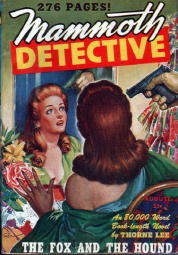
Thorne Lee: The Fox and the Hound

   The Fox and the Hound is my first novel. I use a pseudonym for the reason that my own name is invariably misspelled or mispronounced, or both. Thorne Lee is an abbreviation based on the first and last syllables of my name.

   I like to work in old, ragged clothes. As a writer I have found that desire easy to satisfy. My wife, Betty, says I am probably the only scarecrow to write a novel.

   I’ve been falsely accused of favoring red-headed heroines because my four-year-old daughter, Susan Leigh, has golden red hair.

   Our home is that place they write songs about, the San Fernando valley. I am working in an essential industry until the end of the war gives me “time to retire,” or until Uncle Sam looks with favor upon my bony physique. Even now I think I hear the old gentleman mumbling my name. Perhaps I’ll have that real-life adventure after all. If so, I know there will be a lot of good fellows with good intentions sharing that adventure.

———

   The series of stories featuring the detective duo of crippled Julian Renard and his Watson, Roger Bannister, appeared solely in Doc Savage, 1945-47. Here’s the complete list, with issue dates

       “The Shock Punch” — June 1945
       “The Britannica Sock” — January 1946
       “Who Rides a Tiger…” — April 1946
       “The Man Who Got Away With It” — August 1946
       “The Monster of Lazy Hook” — December 1946
       “There Was an Old Shoe” — May-June 1947
       “The Woman in the Attic” — July-August 1947
       “The Ghost Hangs High” — September-October 1947

    Thorne Lee also wrote a couple of pretty good hardcover mysteries:

THE MONSTER OF LAZY HOOK (Duell, Sloan & Pearce, Inc.: A Bloodhound Mystery; 1949) is a much altered expansion of the short story of the same title and features Renard and Bannister.

      From the blurb on the inside jacket flap:
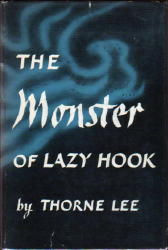
Thorne Lee: The Monster of Lazy Hook    In swift succession, three men — all leading citizens of the little California coastal town of Lazy Hook — vanished without a trace. All three had been connected with the late Spencer Van Dyke, eccentric millionaire, who though he died of natural causes had managed to surround his death with many-sided mystery. What had Spencer Van Dyke done with the huge sum of cash withdrawn from his bank shortly before his death? What was the meaning of the fantastic poem he caused to be engraved on his marble gravestone? Why had he bequeathed the vast and dilapidated Van Dyke mansion to his hermit butler? Had he come from beyond the grave to spirit away Lyman Hobbs, his undertaker, Henri Picard, his lawyer, and Peter Ramsey, the local editor?

   These were the questions that were thrust at the strange pair of detectives who set out to solve the apparently insoluble. The two, crippled Julian Renard, mostly brains, and Robert Bannister, mostly brawn, found themselves in a peculiar and dangerous setup, and only their assorted but well-balanced gifts, together with a certain bit of luck, brought them through alive and entitled to the rewards they had been promised.

   Thorne Lee’s is a fast-paced puzzler, with enough easy humor and unexpected romance to balance the grim and inevitable drama that envelops Lazy Hook and its citizens.

      SUMMER SHOCK (Abelard-Schuman Ltd., 1956) is a good, unusual suspense novel that takes place at the Ashland, Oregon Shakespeare Festival (which is still being held annually and draws huge crowds). According to the author’s bio on the jacket, Shively acted in numerous plays put on at the festival, among them Richard II and King Lear. At the time the book was published he was living in Visalia, CA. and teaching at College of the Sequoias.

      Once again, from the blurb from the inside jacket flap:
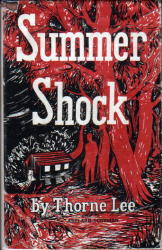
Thorne Lee: Summer Stock    The very first reader of this book, when it was in manuscript form, started his report with this sentence: “This is a book that I don’t think you should get away from you.” We feel that the readers of the finished book will feel the same way about it.

   The Pacific Northwest is the setting, and the author’s description of the natural scenery and his use of it in the story, add much to the special flavor of the novel. The characters are all member of a semi-professional group of actors engaged in putting on a Summer Shakespearean festival. The theatrical background is completely authentic and the details of casting for the various plays are cleverly woven into the plot. (The theatrical material is completely fascinating in itself, but never gets in the way of the swiftly moving story which is full of suspense.)

   It is impossible to summarize the plot without detracting considerably from the reader’s enjoyment — except to say that it is a psychological-suspense story. There are several murders, but this is not a murder-mystery. The reader can be fairly sure, from the very beginning, as to the identity of the murderer. It is the development of the murderer’s mental processes, and the effect this has on all the people around him, that holds our interest.

———

      ADDITIONAL BIBLIOGRAPHY: PULP FICTION —

   From the Cook-Miller index to Detective Pulps, along with Science Fiction, Fantasy, & Weird Fiction Magazine Index (1890-2006) by Stephen T. Miller and William G. Contento for the SF, plus a big assist from Victor Berch:

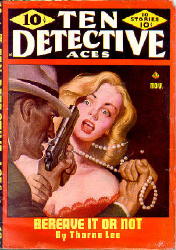
Bereave It or Not, Ten Detective Aces, Nov 1945

Ten Detective Aces, November 1945

The Blood Runs Cold, Doc Savage, Sep 1948
The Britannica Sock [Bannister & Renard], Doc Savage, Jan 1946
A Corpse Slept Here, Dime Detective, Dec 1947
The Crooked House, Weird Tales, Nov 1942    [not by Thorne Lee; see the comments]
Dance Macabre, Ten Detective Aces, Mar 1948
Dead to the World, Ten Detective Aces, Nov 1947
Deadbeat, Doc Savage, Nov 1946
Death in the Groove, Dime Detective, Mar 1946
Dragnet for a Spy, FBI Detective Stories, Oct 1950
Dying to Kill, New Detective Magazine, Sept 1946
The Face of Fear, New Detective Magazine, July 1947
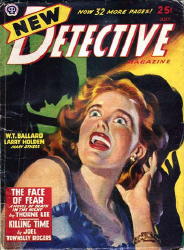
New Detective Magazine, July 1947

The Flesh Is Willing, Doc Savage, July 1946
The Fox and the Hound, Mammoth Detective, Aug 1944
The Ghost Hangs High [Bannister & Renard], Doc Savage, Sep-Oct 1947
Ghost Planet, Startling Stories, June 1943     [probably not by Thorne Lee; see the comments]
The Hanging Sisters, Chief Detective, Winter 1946
Headless Horseman, The Shadow, Aug 1945
I Thought I’d Die, New Detective Magazine, Mar 1946
If Anything Happens to Julia, Shadow Magazine, Feb-Mar 1948
It’s Been a Long, Long Crime, New Detective Magazine, July 1946
It’s in the Bag!, Dime Mystery, Mar 1947
Laughing on the Outside, Detective Story Magazine, Aug 1947
The Mad Dog of Lame Creek, Black Mask, Mar 1946
The Man Who Got Away with It [Bannister & Renard], Doc Savage, Aug 1946
The Man Who Lost His Shadow, Fantastic Adventures, June 1944
Married to Murder, Dime Detective, May 1947
The Merry Men of Mayhem, Detective Tales, Dec 1946
The Merry Widow Murder, Detective Book Magazine, Fall 1949
The Monster of Lazy Hook [Bannister & Renard], Doc Savage, Dec 1946
Murder on My Shoulders, New Detective Magazine, Mar 1947
The Mutilator, Detective Book Magazine, Sum 1949
No Body But Me!, New Detective Magazine, Jan 1947
Possession, Shadow Mystery, Fall 1948
The Reluctant Leopard, Doc Savage, May 1945
The Shock Punch [Bannister & Renard], Doc Savage, June 1945
Some Call It Murder, Detective Story Magazine, Aug 1946
Stairway Going Down, Dime Detective, Sept 1945
There Was an Old Shoe [Bannister & Renard], Doc Savage, May-June 1947
The Whisperer, Dime Detective, Mar 1945
The Whispering Wine, Weird Tales, Mar 1943     [not by Thorne Lee; see the comments]
The Will to Die!, Dime Detective, Apr 1951
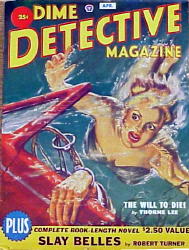
Dime Detective, April 1951

Who Rides a Tiger… [Bannister & Renard], Doc Savage, Apr 1946
The Woman in the Attic [Bannister & Renard], Doc Savage, July-Aug 1947
   You’ll have to go to the main Mystery*File website to find the checklist, I’m sorry to say, but on the other hand, it’s only a link away. Just click on the one provided.

   Here’s Victor’s introduction, along with a cover image or two —

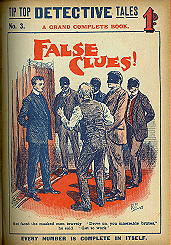
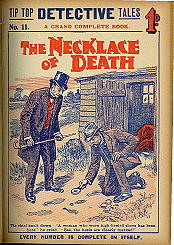
   Tip Top Detective Tales was one of the Aldine Publishing Company’s many library series produced to capture the fancy of the youth of Great Britain. This particular one ran from 1910 through 1912 when it morphed into just Tip Top Tales, produced to include stories of adventure, as well as those of criminal content. With one exception, all of the novels included in the series were published anonymously.

   For a short history of the trials and tribulations of the Aldine Publishing Company, which was founded by Charles Perry Brown (1834-1916), see the excellent article by John Springhall, “Disseminating impure literature: the ‘penny dreadful’ publishing business since 1860” in ECONOMIC HISTORY REVIEW, XLVII, 3 (1994), especially pages 578-584.

         Tip Top Detective Tales

      Tip Top Detective Tales

   Last week on his blog, Pulpetti, Juri Nummelin discussed the career of Gold Medal paperback writer Frank Castle, prompted by his (Juri’s) discovery of one of Castle’s books that was published in Finland but never in this country.

   This turns out, as Juri explains, not to have been an uncommon event. Several other American authors apparently had some of their books published in Finnish but never in English, including Dean Owen, Bruce Cassiday and Robert Sidney Bowen. Here’s the cover of the Castle book, the title of which, roughly translated, means “The Sowers of the Doom.”

Frank Castle: Sowers of Doom

   If you’re interested, Juri does the obliging thing and translates the first few paragraphs back into English.

   The post prompted several comments about Castle’s career, and just a few minutes ago, I chipped in with the following:

   Not much seems to be known about Frank Castle. You and the other commenters seem to have covered almost everything he did, unless you count his role as The Punisher for Marvel Comics beginning sometime around 1974. But maybe that was a different Frank Castle. And like the comic book guy, maybe our Frank Castle wasn’t his real name either.

   For his mystery fiction, here’s what appears in Al Hubin’s Crime Fiction IV:

   FRANK CASTLE. Born in New Mexico; graduate of University of Oklahoma; magazine and book writer. Pseudonym: Steve Thurman.
      Move Along, Stranger (n.) Gold Medal 1954
      Dead–and Kicking (n.) Gold Medal 1956 [California]

Dead and Kicking

      The Violent Hours (n.) Gold Medal 1956 [Los Angeles, CA]

The Violent Hours

      Lovely and Lethal (n.) Gold Medal 1957 [California]

Lovely and Lethal

      Murder in Red (n.) Gold Medal 1957 [New Mexico]

Murder in Red

      Vengeance Under Law (n.) Gold Medal 1957 [New Mexico; Past]
      Hawaiian Eye (n.) Dell 1962 [Hawaii]

Murder in Red

   STEVE THURMAN
      Night After Night (n.) Monarch 1959 [Ship]

Steve Thurman

      “Mad Dog” Coll (n.) Monarch 1961 [New York City, NY; 1932] Novelization of film: Columbia, 1961.

      I haven’t put together a list of the westerns Castle wrote under both names, but at a quick glance, he may have written more of those than he did crime novels. (And I’ve only realized this just now, but there’s at least one book overlap between his western novels and the crime fiction that’s already been listed.)

      I’ve read some of his Gold Medals, but since that was when they first came out, I couldn’t tell you anything about them. I do remember a few of the covers, though. (See above.)

   The death of Denny Martin Flinn, a rather unique contributor to the realm of detective fiction, does not seem to have been widely noted in the world of mystery fandom. The fact appears in Part 19 of the Addenda of the Revised Crime Fiction IV, which I’m working on now. Otherwise only Jiro Kimura’s Gumshoe Site seems to have mentioned it.

   Obituaries have appeared in several entertainment-oriented news sources, however, including Variety and Broadway World. A man of talent in many fields, Mr. Flynn died of complications of cancer on August 24th of this year. He was 59.

   Here are his credits in CFIV, by Allen J. Hubin, slightly updated and amended. I’ll get back to the books in a minute.

      FLINN, DENNY MARTIN (1947- 2007)
           San Francisco Kills (Bantam, 1991, pb)  [Spencer Holmes; San Francisco, CA]
           Killer Finish (Bantam, 1991, pb)  [Spencer Holmes; San Francisco, CA]

   But first, here are some of Mr. Flinn’s non-mystery writing accomplishments. For more information on any of these, you may follow the links above.

   ● He performed on Broadway in Sugar and the revivals of Pal Joey and the Pearl Bailey company of Hello, Dolly!

   ● He choreographed Charles Strouse’s off-Broadway musical Six and he restaged Sugar for its West Coast premiere.

   ● As a performer, he appeared in the national companies of Fiddler on the Roof, starring Jan Peerce and Theodore Bikel as well as two-and-a-half years in one of the national tours of A Chorus Line.

   ● Flinn wrote and directed the musical Groucho, starring Lewis J. Stadlen, which played off-Broadway and toured the country for two years.

   ● As a writer, his first book was What They Did for Love, the story of the making of the Broadway musical A Chorus Line.

   ● He co-authored with Nicholas Meyer the screenplay for Star Trek VI: The Undiscovered Country.

      THE MYSTERY NOVELS:

San Francisco Kills. Bantam, pb, January 1991.

San Francisco Kills

      From the front cover:    “He bears the family name and has a talent for detection. Just call him Holmes … Spencer Holmes.”

      From the back cover:   … If there be any here present who knows just cause why they may not be lawfully be joined in marriage, I require him now make it known …

   Following the priest’s request, a shot rang out and the groom fell dead.

   What kind of killer was clever enough to get away with murder in front of hundreds of witnesses? That is just the sort of question that appeals to Spencer Holmes, a San Francisco detective who has inherited a fascination for foul play, a talent for deduction, good looks, and hoards of money from his illustrious grandfather, the immortal super sleuth Sherlock Holmes.

   In a case as complicated as they come, Spencer Holmes, assisted by his inscrutable companion, Sowhat Dihje, must use his formidable intelligence to follow a faint trail that leads from the mansions of the well-to-do into the not-so-distant past – to ferret out a remakable affair of friendship, love … and murder.

Killer Finish. Bantam, pb, August 1991.

Killer Finish

   From the front cover:   “When it comes to solving crimes, he was born to it. … He’s Spencer Holmes, San Francisco sleuth.”

   From the back cover:    “It does appear that the Great Gandolfo has suffered an irreversible mistake in an otherwise well-conducted act!”

   And in this case, appearances were not deceiving. The Great Gandolfo was run through with his own sword, and it didn’t take a Sherlock Holmes to see that the erstwhile magician had died on stage – literally.

   What it did take was Spencer Holmes, Sherlock’s equally talented grandson, who happened to be attending Gandolfo’s final performance. And what the master sleuth, along with his sidekick, Sowhat Dihje, finds upon investigation, is a twisted trail of colorful suspects, grand illusions, missing persons, and voices from the dead. And that is only the beginning. For in the city by the bay, the mixture of magic and murder is potent – so potent that even the most pedigreed of detectives will be astounded by a … KILLER FINISH.

   In a short author’s biography on the final page of Killer Finish, it was announced that Mr. Flinn was working on a third novel, one called Lady Killer. For whatever reason, it was never published.

   Searching the Internet, it appears that Irene Adler is the lady in question, if you are asking the one I think you are, and on another site it is stated that “Spencer’s mansion in Frisco has a Nero Wolfe Room, which perhaps hints at his parentage, since it has already been well-established that Wolfe is Sherlock Holmes’ son.”

   On page 14 of San Francisco Kills, the plaque attached to the door of Holmes’ mansion door reads:

SPENCER HOLMES
Consulting Detective
2210 Baker Street

which I believe entitles him to be called a Private Detective. One who does not do divorce or “keyhole” work, but one who takes only the cases that intrigue him the most.

   One other site briefly describes the books are humorous pastiches. Here, for example, from page 194 of the same book cited above, is the following passage. Spencer Holmes is speaking to a fellow who has just finished a game of tennis:

    “How was your game today?” Spencer inquired.

    “Fine. And yours?”

    “Afoot.”

    “I don’t think I understand.”

    “I’m sorry. It is a colloquial expression. Before your time, I think.”

    “Ah.”

   Over the past six weeks or so I’ve been working with John Pugmire, a long-time “locked room” aficionado, and the English translator of Paul Halter, the French writer who specializes in the genre, on an article about guess what? Locked room mysteries, of course.

   To tell you the truth, John’s article has been done for most, if not all, of these same past six weeks. What’s been holding up the works has been me. The major part of the piece is a list of well over 100 locked room mysteries. What I’ve been doing in my spare time in the evening is adding cover images to something like 90% of them.

   For more on what this is all about and where the list of books and authors came from, here’s John:

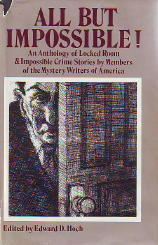
Hoch: All But Impossible.

    “Over twenty five years ago, Ed Hoch asked seventeen authors and critics to rank the best locked room mysteries of all time. The results were published as an introduction to the anthology All But Impossible (Ticknor & Fields, 1981).

    “Early in 2007, Roland Lacourbe, the eminent French expert on impossible crime fiction, decided to ask a group of fellow anthologists and translators to name 99 novels worthy of inclusion in the library of a hypothetical locked room aficionado. The results can be found in this article Steve has just told you about. Also in the piece I offer some thoughts on French Golden Age crime fiction and how it was influenced by the criminal justice system.

    “Monsieur Lacourbe is French and so the original list of 99 was confined to books published in French. However, the article also lists a further 14 noteworthy novels not yet available in French, for a grand total of 113. A surprisingly high proportion – nearly 40% – of the 99 novels are French in origin and have never been translated into English: a great pity and possibly an opportunity for an enterprising publisher. Whether that happens or not, Monsieur Lacourbe will have performed the valuable service of listing, for the first time, the 70 or so best locked room mysteries in the English language.”

   One small but perhaps not so incidental nugget of information that came from the research into the books is that Repos de Bacchus, by French author Pierre Boileau, was used as the basis for a book in English, The Sleeping Bacchus, as by Hilary St.George Saunders. (This was only book under Saunders’ own name. He may be more familiar to mystery fans as Francis Beeding, one of several pen names that he used.)

   Not all of the entries have covers to go with them, but John and I are proud to have come up with as many as we did. Here’s the link to the page:

          https://mysteryfile.com/Locked_Rooms/Library.html

   If you’re a fan of classical mystery fiction, harking back to the Golden Age of Detection, I think you’ll like what you see. In fact, I guarantee it.

   It was well over a year ago that Victor Berch, Bill Pronzini and I put together our annotated bibliography of Dutton’s line of Guilt Edged hardcover mysteries, and luckily we haven’t had to make very many corrections.

   The Guilt Edged line lasted from 1947 to 1956, with the two most highly collectible authors in the group arguably being Mickey Spillane and Fredric Brown. There were lots of unknowns as well, but William Campbell Gault was a Guilt Edged author, and so were Lionel White, Stewart Sterling and Sam S. Taylor.
   If you know all of those names, congratulate yourself. If you know all but the last one, give yourself only half a pat on the back. It was in Sam S. Taylor’s entry in which we recently discovered that we were in error. According to all of the sources we consulted at the time, Taylor was supposed have died in 1958, soon after his last book. Not so, and I’ll get to the correct date in a minute.

   First, though, is Taylor’s complete entry in Crime Fiction IV, by Allen J. Hubin, as it stood until a few weeks ago, slightly edited and expanded.

   TAYLOR, SAM(UEL) S. (1895-1958); see pseudonym Lehi Zane; Radio and film scriptwriter, short story writer. Series Character: Neal Cotten, in all titles.

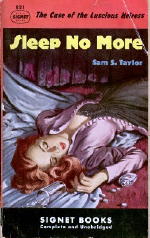
       * Sleep No More. Dutton, hc, 1949. Signet 821, pb, 1950. Boardman, UK, 1951.
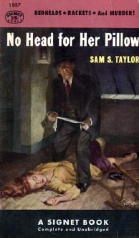
       * No Head for Her Pillow. Dutton, hc, 1952. Signet 1057, pb, 1953. Foulsham, UK, 1954.
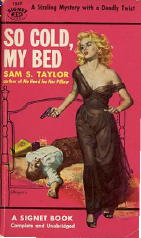
       * So Cold, My Bed. Dutton, hc,1953. Signet 1247, pb, 1955. Foulsham, UK, 1955.

   ZANE, LEHI; pseudonym of Sam(uel) S. Taylor

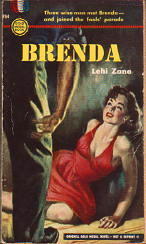
       * Brenda. Gold Medal 264, pbo, 1952. Red Seal, UK, 1957.

   It turns out that both dates for Mr. Taylor were wrong. After reading our first efforts, one of his sons emailed me, stating that his father died in 1994, not 1958. This was enough to go on. Victor then did a search in Social Security records and came up with a Samuel S. Taylor who was born October 11, 1903 and died February 1994 in California.

   Having a ready-made excuse for compiling a compleat profile, we did, and here is the result. Jackets of the hardcovers in the Bill Pronzini collection provided the blurbs and other information. The paperback covers came from various other sources. I still can’t get to my own accumulation of books.

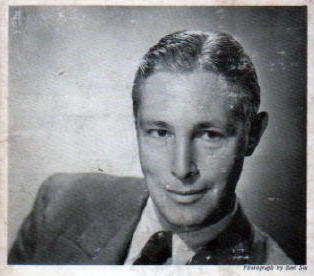
   First a photograph of Mr. Taylor, found on the back cover of his second book, along with a short biography underneath it:

Sam S. Taylor

      ABOUT THE AUTHOR:

   Sam S. Taylor, author of No Head for Her Pillow, is the author of one other mystery story, Sleep No More, published by E. P. Dutton & Company in 1949. Innumerable radio scripts, and a good many magazine stories round out a full writing career.

   Upon receiving a medical discharge from the U. S. Coast Guard in 1943, Mr. Taylor affiliated himself with the Army Signal Corps as expert consultant on training films, where he also wrote many scripts for Army posts.

   His personal interest in crime (from the observer’s seat) stems from that time when, as a member of the New York City special panel of jurors, he was called to serve on the famous Jimmy Hines case, prosecuted by Gov. Thomas E. Dewey.

   When Mr. Taylor first married his beautiful French Canadian bride, she spoke no English; Mr. Taylor now has a French accent after three years of marriage.

   Mr. Taylor makes his home in Tarzana, California, with his wife and baby.

      SLEEP NO MORE.

Sam S. Taylor

   From the hardcover front dust jacket flap:

   Delving into the private life of a luscious copper heiress, especially one with a tangle of soft red hair and a roving eye, was going to be a pleasure

   Or so thought Neal Cotten, head of the brand-new Cotten Bureau of Investigation. That was before a simple case of blackmail developed into a hunt for a desperate killer … a grim hunt that led from a luxurious mansion in Pacific Crest to a shoddy flop-house on Skid Row; from a remote ranch in Nevada to a crooked gambling house in Angel Gardens.

   The chase uncovered a secret rendezvous high up in Clearwater Canyon, a will with some startling changes, a fat bankbook hidden under a filmy negligee, a muscle-bound extra who didn’t go to Reno — and a handsome movie idol who played with fire once too often

   But none of it made sense. Not until Neal took Jennie, the Polish waitress, to see Madame Butterfly … and Jennie innocently gave him the lead that cracked the case wide open.

   A swift-paced tale of homicide and passion, of violence and corruption, set against the vivid background of Los Angeles, Sleep No More will be devoured by mystery fans in one breathless sitting.

Sam S. Taylor

      NO HEAD FOR HER PILLOW.

    From the hardcover front jacket flap:

   It may be an everyday occurrence among artists and art dealers to mutter vindictively, “Oh, I could kill him!” as it is among the brotherhood of almost any other business.

   No Head for Her Pillow has a couple of artists, an art dealer, some racketeers, some newspaper people, and Neal Cotten, director of the Cotten Bureau of Investigation and his own chief operative. It was a good thing for California art circles that Neal was hired by Colonel Millard Baldwin, publisher of the San Vincente Sun, to aid in the Sun‘s campaign against the slot-machine racket in the city.

   It happens that Col. Baldwin’s two daughters, Sharon and Diana, were on intimate terms with the others of the San Vicente art world, one being a painter, the other a sculptress. Diana, the sculptress, appeals mightily to Neal Cotten who sees her as a “king-size dame with a mass of sunset hair.”

   Investigations, of whatever kind, often lead to murder, as well as vice versa, and slot machines sometimes turn up more than merely lemons. The proof of these adages is offered, with dividends, in No Head for Her Pillow, a fast exciting mystery that is almost as tough as a forty-cent steak.

      SO COLD, MY BED.

Sam S. Taylor

    From the hardcover front jacket flap:

   Private eye Neal Cotten has a visit from a beautiful doll who commissions him to trace her aunt, an oldtime actress. Her story sounds phony but she pays cash so he takes the job. His first link to her whereabouts is a thug who offers to sell him information, but the deal is never closed. The thug is murdered.

   Neal stays with it and finds the old actress who spends most of her time in a specially made coffin. Then Neal gets a new client — the governor’s wife, no less, who thinks her stepdaughter is running in bad company. There is a link between the murdered thug and his pals, the beautiful client, the lady in the coffin and the governor’s family, but it is one murder and many near misses later that Neal gets the pitch and solves the case, with a night club singer in distress slowing up the process considerably.

   Sam Taylor is already known for his original and fast-paced mysteries through his earlier books Sleep No More and No Head For Her Pillow. His new one, So Cold, My Bed spells top entertainment for the mystery fan as it again features Neal Cotten, the hard-boiled but likeable private eye who has a way with the ladies and an affinity for easy money and screwy cases.

           BRENDA.

Sam S. Taylor

      From the front cover:

      Three wise men met Brenda — and joined the fools’ parade

      From the back cover:

                BRENDA

   There was the simple, pious valley town.

   And there was luscious, lustful Brenda.

   The hard-handed farmers knew work — and prayer.

   Brenda knew pleasure — and conquest.

   Tragedy rode on the wings of passion when good and evil clashed.


   Sam S. Taylor also published five criminous short stories in the early 50s:

       “Summer is a Bad Time” — Manhunt, October 1953.
       “A Clear Picture” — Manhunt, May 1954.
       “State Line” — Manhunt, September 1954.
       “The General Slept Here” — Manhunt, April 1955 (with Neal Cotten).
       “Dig It, Brother” — The Saint, May 1956.

   This profile came as the result of an inquiry from Donna Frey, who asked —

    Steve, Thanks again for your help with identifying the real “Theresa Charles” . May I impose on you again? I think you might be more into true mystery and suspense writing than I am, but I can’t find an answer anywhere to another “gothic” mystery writer. This is a real puzzle. Janet Louise Roberts, a prolific writer who was billed as “the mistress of romantic mystery,” also wrote under the names Janet Radcliffe, Rebecca Danton, and Louisa Bronte. I think she lived 1925-1984, maybe. But I can’t find one other fact about this woman. Where did she live? Was she American? What was her life like? She had a distinctive style, so I don’t think the publisher was paying different writers to create under that name. Can you, or your interested readers, help? Thanks. Donna

   Some questions are more easily answered than others. Not only does Contemporary Authors (CA) have an entry on her, but their essay quotes liberally from yet another source. It’s highly unlikely that I should not do the same.

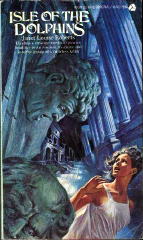
Isle of the Dolphins

   According to CA, Janet Louise Roberts was born January 20, 1925, in New Britain CT, the town next to the one where I live, and died June 11, 1982, in Dayton Ohio, where she was a reference librarian for the Dayton and Montgomery County Public Library between 1966 and 1978.

   Quoting CA here and there, not only did she write contemporary, historical,and gothic romances, but “she even ventured into occult territory with The Devil’s Own, Isle of the Dolphins, Lord Satan, and Her Demon Lover — stories in which the devil or other demon fills in for the traditional romantic hero.”

   In an interview with Publishers Weekly, again according to CA, she explained “that she began using pseudonyms to avoid embarrassing her father, a missionary in a rather conservative church.”

   In Twentieth-Century Romance and Historical Writers, essayist Barbara E. Kemp is quoted as saying: “One of the most prominent features of her novels is the portrayal of women as ineffectual beings, subject to much degradation. Men, on the other hand, are “rough and overbearing. […] It is not uncommon for the heroine to be raped by the hero at least once in the story. Sexual details are not very explicit, but the lack of tenderness and the idea of sex as punishment are apparent.”

   In spite of Roberts’ failings, Kemp goes on to conclude that she “remains one of the most popular of the romance novelists. Her view of women as pretty dolls to be used and manipulated by men certainly must cause feminists to gnash their teeth, but she obviously strikes a responsive chord among her readers.”

   The following list of her crime-related fiction is taken from Crime Fiction IV, by Allen J. Hubin. It may not include all of her romance fiction that may qualify, and some of the books listed perhaps should not be there. We’ll save these two obviously related problems and solve them another day.


ROBERTS, JANET LOUISE (1925-1984). See pseudonyms Louisa Bronte, Rebecca Danton & Janette Radcliffe. Some of the listed titles are more straight romance than romantic suspense. ** = reprints not previously known to Al.

* The Jewels of Terror (n.) Lancer 1970
* Dark Rose (n.) Lancer 1971 [U.S. South; 1860s]
* Love Song (n.) Pinnacle 1971
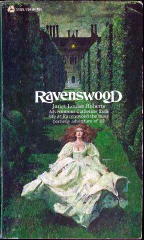
* Ravenswood (n.) Avon 1971 [England; 1800s]

Ravenswood

* The Weeping Lady (n.) Lancer 1971
* The Curse of Kenton (n.) Avon 1972 [England]
* The Devil’s Own (n.) Avon 1972
* A Marriage of Inconvenience (n.) Dell 1972 [England; 1800s]
* Rivertown (n.) Avon 1972
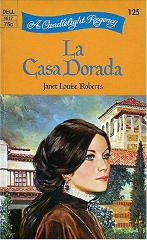
* La Casa Dorada (n.) Dell 1973

La Casa Dorada

* The Dancing Doll (n.) Dell 1973 [England; 1800s]
* The Dornstein Ikon (n.) Avon 1973 [Austria]
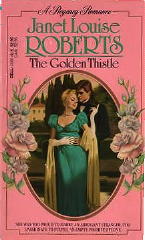
* The Golden Thistle (n.) Dell 1973 [Rome; 1800s]

Golden Thistle

* Isle of the Dolphins (n.) Avon 1973 [Greece]
* My Lady Mischief (n.) Dell 1973 [England; 1800s]
* The Cardross Luck (n.) Dell 1974 [England; 1800s]
* The First Waltz (n.) Dell 1974 [Vienna; 1814]
* Castlereagh (n.) Pocket Books 1975 [England; 1819]
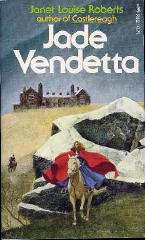
* Jade Vendetta (n.) Pocket Books 1976 [England; 1894]

Jade Vendetta

* Wilderness Inn (n.) Pocket Books 1976 [U.S. West; 1795]
* Island of Desire (n.) Ballantine 1977
* Her Demon Lover (n.) Pocket Books 1978; See: Avon 1973, as by Louisa Bronte.
* Black Pearls (n.) Ballantine 1979 [Hawaii; 1880s]
* Golden Lotus (n.) Warner 1979
** Lord Satan (n.) Pocket Books, 1979. See: Avon 1972, as by Louisa Bronte.
** Black Horse Tavern (n.) Pocket Books, 1980. See: Popular Library 1972, as by Rebecca Danton.
* The Sign of the Golden Goose (n.) Pocket Books 1980; See: Popular Library 1972, as by Rebecca Danton.

BRONTE, LOUISA; pseudonym of Janet Louise Roberts

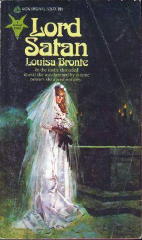
* Lord Satan (n.) Avon 1972 [England; 1815] [Reprinted as by JLR, Pocket, 1979]

Lord Satan

* Her Demon Lover (n.) Avon 1973 [Balkans] [Reprinted as by JLR, Pocket, 1978]
* Greystone Tavern (n.) Ballantine 1975 [Connecticut; 1776]
* Casino Greystone (n.) Ballantine 1976 [Connecticut; 1896]
* Freedom Trail to Greystone (n.) Ballantine 1976 [Connecticut; 1860]
* Gathering at Greystone (n.) Ballantine 1976 [Connecticut; 1812]
* Greystone Heritage (n.) Ballantine 1976 [Connecticut; 1948]
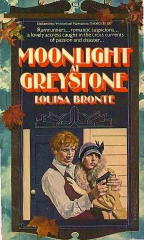
* Moonlight at Greystone (n.) Ballantine 1976 [Connecticut; 1924]

Moonlight at Greystone

* The Vallette Heritage (n.) Jove 1978
* The Van Rhyne Heritage (n.) Jove 1979
* -The Gunther Heritage (n.) Jove 1981

DANTON, REBECCA; pseudonym of Janet Louise Roberts

* Black Horse Tavern (n.) Popular Library 1972 [Reprinted as by JLR, Pocket, 1980]

* The Sign of the Golden Goose (n.) Popular Library 1972 [Reprinted as by JLR, Pocket, 1980]
* -Fire Opals (n.) Crest 1977 [England; 1800s]
* Ship of Hate (n.) Dell 1977 [Ship]

RADCLIFFE, JANETTE; pseudonym of Janet Louise Roberts

* -The Blue-Eyed Gypsy (n.) Dell 1974 [England; 1800s]

* -The Gentleman Pirate (n.) Dell 1975 [England; 1800s]
* -The Moonlight Gondola (n.) Dell 1975 [England; 1800s]

   This post has been prompted by an entry on another blog by Jess Nevins, author of the soon-to-be forthcoming The Encyclopedia of Pulp Heroes (MonkeyBrain Books, November 2008).

   The subject of Jess’s posting is the fleeting and inevitable passing of literary fame, although we don’t have to like it, and his prime example is mystery writer T. Arthur Plummer. You should probably go read it. If you’re like me, you will read and agree with everything he has to say.

   You may be saying, who’s T. Arthur Plummer? And that’s precisely the point. Let me quote Jess:

    “Mr. Plummer wrote over seventy novels. Fifty of them were about his series character, Detective-Inspector Andrew Frampton of Scotland Yard’s Criminal Investigation Department. The first was Shadowed by the C.I.D. (1932), the last was Murder at Brownhill (1962). Fifty novels about the same character, over thirty years.

    “A total of 57 copies of Mr. Plummer’s books exist in libraries in the US and UK. A Google search for the phrase “T. Arthur Plummer” comes up with 118 hits. (In comparison, “Godzilla bukkake” yields 415, and “Harry Stephen Keeler” gives 39,800.) […] A Google Image search for Mr. Plummer’s work gives only one image ….

    “The man wrote seventy novels in his lifetime. Fifty of them about one character. […] The stores would have been full of [his] books. (Abebooks only lists 116 copies of Plummer’s novels for sale. Harry Stephen Keeler has 519.) […]

    “All but a lucky few writers are doomed to oblivion. It’s up to us to prevent that from happening.”

   Me again. I was thinking about this very same thing this afternoon while browsing through the mystery section of Borders. John Gardner, author of a long list of spy and espionage thrillers, including more James Bond novels than Ian Fleming wrote, died earlier this month. Not a single book of his was there to be found.

   Ed McBain died last year. The famous, extremely popular author of the 87th Precinct books? If you’re reading this, you have to know who he is. He’s represented by six books at Borders. Not six different titles. Six books. By this time next year, there probably won’t be any.

   The number of Plummer’s books on ABE has gone up since Jess looked. I found 130. It’s still a mere handful for an author who wrote seventy of them.

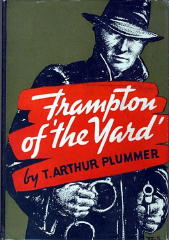
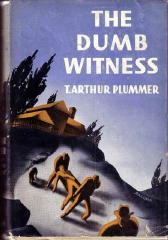
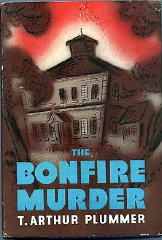
   I also found more covers than Jess did, though, and assuming that you’d like to see them, here they are, mixed in with a list of all of Plummer’s detective and mystery fiction, adapted from Crime Fiction IV, by Allen J. Hubin:

  PLUMMER, T(homas) ARTHUR. 1883-1961.

* The Broken Trust (n.) Thomson 1929 [England]
* The Ace of Death (n.) Paul 1930 [England]
* The Murder House (n.) Paul 1930 [England]
* Death on Danger Hill (n.) Paul 1931 [England]
* The House in Sinister Lane (n.) Paul 1931 [England]
* -The Girl in a Hurry (n.) Thomson 1932 [England]
* Haunting Lights (n.) Paul 1932 [England]
* Shadowed by the C.I.D. (n.) Paul 1932 [Det. Insp. Andrew Frampton; England]
* Alias-The Crimson Snake (n.) Paul 1933 [England]
* Lonely Hollow Mystery (n.) Paul 1933 [England]
* Creaking Gallows (n.) Paul 1934 [England]
* Death Takes a Hand (n.) Paul 1934 [England]
* -Margaret Benson’s View (n.) Leng 1934 [England]
* Shot at Night (n.) Paul 1934 [Det. Insp. Andrew Frampton; England]
* Frampton—of the “Yard”! (n.) Paul 1935 [Det. Insp. Andrew Frampton; England]

Barush Mystery

* Staring Eyes! (n.) Paul 1935 [England]
* The Dumb Witness (n.) Paul 1936 [Det. Insp. Andrew Frampton; England]

Barush Mystery

* Was the Mayor Murdered? (n.) Paul 1936 [Det. Insp. Andrew Frampton; England]
* The Bonfire Murder (n.) Macaulay 1937; See: Was the Mayor Murdered? (Paul, 1936).

Barush Mystery

* The Death Symbol (n.) Paul 1937 [Det. Insp. Andrew Frampton; England]
* The Man They Feared (n.) Paul 1937 [Det. Insp. Andrew Frampton; England]
* Cornered (n.) Leng 1938 [England]
* Five Were Murdered (n.) Paul 1938 [Det. Insp. Andrew Frampton; England]
* -Lying Lips (n.) Leng 1938 [England]
* The Man They Put Away (n.) Paul 1938 [Det. Insp. Andrew Frampton; England]
* -Her Own Affair (n.) Leng 1939 [England]
* The Muse Theatre Murder (n.) Paul 1939 [Det. Insp. Andrew Frampton; England; Theatre]
* Two Men from the East (n.) Paul 1939 [Det. Insp. Andrew Frampton; England]
* The Black Ribbon Murders (n.) Paul 1940 [Det. Insp. Andrew Frampton; England]
* Melody of Death (n.) Paul 1940 [Det. Insp. Andrew Frampton; England]
* Crime at Crooked Gables (n.) Paul 1941 [Det. Insp. Andrew Frampton; England]
* The Devil’s Tea-Party (n.) Paul 1942 [Det. Insp. Andrew Frampton; England]
* The Fool of the “Yard” (n.) Paul 1942 [Det. Insp. Andrew Frampton; England]
* The Man Who Changed His Face (n.) Paul 1943 [Det. Insp. Andrew Frampton; England]
* Murder Limps By (n.) Paul 1943 [Det. Insp. Andrew Frampton; England]
* Murder-by an Idiot (n.) Paul 1944 [Det. Insp. Andrew Frampton; England]
* Simon Takes “the Rap” (n.) Paul 1944 [Det. Insp. Andrew Frampton; England]
* The “J for Jennie” Murders (n.) Paul 1945 [Det. Insp. Andrew Frampton; England]
* The Man with the Crooked Arm (n.) Paul 1945 [Det. Insp. Andrew Frampton; England]
* Murder in the Village (n.) Paul 1945 [Det. Insp. Andrew Frampton; England]
* The Strangler (n.) Paul 1945 [Det. Insp. Andrew Frampton; England]
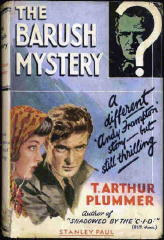
* The Barush Mystery (n.) Paul 1946 [Det. Insp. Andrew Frampton; England]

Barush Mystery

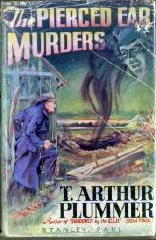
* The Pierced Ear Murders (n.) Paul 1947 [Det. Insp. Andrew Frampton; England]
Pierced Ear Murders

* The Silent Four (n.) Paul 1947 [Det. Insp. Andrew Frampton; England]
* Who Fired the Factory? (n.) Paul 1947 [Det. Insp. Andrew Frampton; England]
* “Brent”-of Bleak House (n.) Paul 1948 [England]
* Hunted! (n.) Paul 1948 [Det. Insp. Andrew Frampton; England]
* Strychnine for One (n.) Paul 1949 [Det. Insp. Andrew Frampton; England]
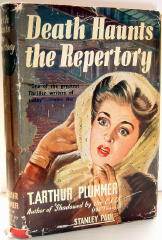
* Death Haunts the Repertory (n.) Paul 1950 [Det. Insp. Andrew Frampton; Theatre; England]

Death Haunts the Repertory

* The Murder of Doctor Grey (n.) Paul 1950 [Det. Insp. Andrew Frampton; England]
* The Yellow Disc Murders (n.) Paul 1950 [Det. Insp. Andrew Frampton; England]
* The Death Letter (n.) Paul 1951 [England]
* Murder at Marlington (n.) Paul 1951 [Det. Insp. Andrew Frampton; England]
* Murder Through Room 45 (n.) Paul 1952 [Det. Insp. Andrew Frampton; England]
* The Starry Eyed Murder (n.) Paul 1952 [England]
* Frampton Sees Red (n.) Paul 1953 [Det. Insp. Andrew Frampton; England]
* The Westlade Murders (n.) Paul 1953 [Det. Insp. Andrew Frampton; England]
* Murder in Windy Coppice (n.) Paul 1954 [Det. Insp. Andrew Frampton; England]
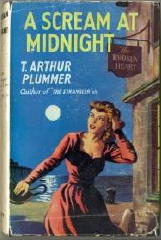
* A Scream at Midnight (n.) Paul 1954 [Det. Insp. Andrew Frampton; England]

Barush Mystery

* The Black Rat (n.) Paul 1955 [Det. Insp. Andrew Frampton; England]
* Murder in the Surgery (n.) Paul 1955 [Det. Insp. Andrew Frampton; England]
* Pagan Joe (n.) Paul 1956 [Det. Insp. Andrew Frampton; England]
* Where Was Trail Murdered? (n.) Paul 1956 [Det. Insp. Andrew Frampton; England]
* Condemned to Live (n.) Paul 1957 [Det. Insp. Andrew Frampton; England]
* Murder at Lantern Corner (n.) Long 1957 [Det. Insp. Andrew Frampton; England]
* The Elusive Killer (n.) Long 1958 [Det. Insp. Andrew Frampton; England]
* The Hospital Thief (n.) Long 1959 [Det. Insp. Andrew Frampton; England]
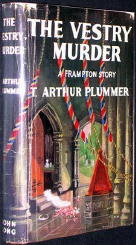
* The Vestry Murder (n.) Long 1959 [Det. Insp. Andrew Frampton; England]

Barush Mystery

* The Spider Man (n.) Long 1961 [Det. Insp. Andrew Frampton; England]
* Murder at Brownhill (n.) Long 1962 [Det. Insp. Andrew Frampton; England]
* -The Judas Girl (n.) Leng n.d.
* -A Woman’s Weapon (n.) Newnes n.d.


[UPDATE] 08-30-07. Thanks to Jamie Sturgeon, who supplied it, one additional cover image is now included. He also pointed out one important typographical error, which was immediately repaired. Some other minor formatting changes have taken place, but more than that, you need not know.

[UPDATE] 09-06-07. Jamie is continuing to investigate the life of T. Arthur Plummer, and one interesting piece of information has already turned up. Its turns out that both Plummer’s wife and daughter were also writers. Steve Holland has the details over on his research-intensive Bear Alley blog.

   Both women wrote British romantic fiction, a subject matter which has not come up before on this blog, except for gothic suspense novels, with dozens of books between them. His wife, Coralie Marie Plummer, wrote under the name of Cora Linda; his daughter, Clare Emsley Plummer, used as bylines both Clare Plummer and Clare Emsley. For a remarkably complete list of titles, follow the link above.

   Morton Wolson, 1913-2003, or Peter Paige, as he was known when he was writing for the detective pulps, has come up for discussion several times in these pages. The first time was a review I did of his only full-length novel, Nightmare Blonde (Pocket, 1988). In the course of the review I included everything I knew about the author at the time.

   The second time came soon thereafter, when Morton’s son Peter spotted the review and sent me an email that provided quite a bit more information about him.

   After reading both of these entries on the blog, pulp enthusiast and collector Walker Martin emailed me to tell the story of how he tracked down Morton Wolson in the 1980s and had a long afternoon’s conversation with him about his days in the pulps.

   Peter has kept in touch with me in the weeks since, and he recently sent me a couple of photos of his father, which of course I’m very pleased to be able to show you here.

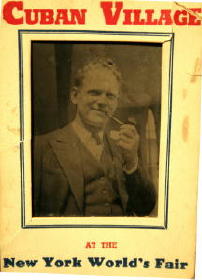
   This first one was taken when he was a bouncer at the Cuban Village in the New York 1939 World’s Fair, as he looked when he wrote his first piece for Black Mask, “I Guard Nudes.”

Peter Paige

   Peter adds that this occurred shortly after he returned from fighting against Franco in the Spanish Civil war, in which he was a member of the Lincoln Brigade, had been appointed Chief Cadre officer, and then was a partisan fighter in the Basque country, blowing bridges and trains, as depicted in Hemingway’s For Whom the Bell Tolls.

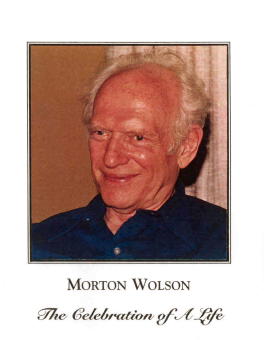
   This next one is the one used at his memorial services at the time of his death.

Peter Paige

   If you follow the links back to the previous entries, you’ll find that Morton’s stories under his own name have been discussed previously. This time around you’ll find a complete list of all of the pulp fiction that he wrote as Peter Paige, beginning with the previously mentioned “I Guard Nudes,” (Black Mask, Sept 1939) a story about security measures at a NY World’s Fair sideshow featuring scantily clad exotic dancers.

   Paige’s primary series character was Cash Wale, a hardboiled New York City private eye in the Race Williams vein. His sidekick, Sailor Duffy, is an ex-pug with “scrambled brains” whom Wale watches out for. Lots of violent action, tough talk, and wisecracks, says Bill Pronzini, when I asked him what he recalled about the pair. Dime Detective was the primary venue for the Cash Wale series, but Wale’s very first appearance was in the January 1940 issue of Black Mask, the only time he showed up in that magazine.

   The primary source of the data below is the two volume index Mystery, Detective, and Espionage Fiction, by Michael L. Cook and Stephen T. Miller. (Garland, 1988). Additional input came from Bill Pronzini, who provided much of the story information above and assistance when Cook-Miller produced questions I could not answer.

Peter Paige


      THE PETER PAIGE STORIES —

“I Guard Nudes,” Black Mask, September 1939.
     Reprinted in Big Double Feature Magazine, 1#1, circa 1940 as “I Guard Dudes”
         FOOTNOTE #1.
“Swastika Scorge,” Black Mask, December 1939.
“Voodoo Frame,” Black Mask, January 1940. CW = Cash Wale.
“The Fatherland of Otto Bloch,” Detective Fiction Weekly, Jan 27 1940.
“Blackout!” Black Mask, February 1940.
“Counterfeit Citizen,” Black Mask, March 1940.
“The Friends of Papa Valdes,” Black Mask, April 1940.
“The Corpse Promoter,” Detective Tales, April 1940.
“My Pop, the Cop,” Detective Fiction Weekly, Apr 27 1940.
“And God Won’t Tell,” Black Mask, July 1940.
“Pick’s Last Crime,” Detective Fiction Weekly, Aug 10 1940.
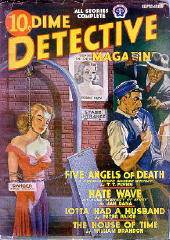
“Lotta Had a Husband,” Dime Detective, September 1940. CW.

Dime Detective Sept 1940

“Pick’s Last Crime,” Detective Fiction Weekly, Oct 26 1940.    FOOTNOTE #2.
“Blitzkrieg Bankroll,” Fifth Column Stories, November, 1940.
“They Refuse to Understand,” Detective Fiction Weekly, Dec 7 1940.
“Dopey and theDevil,” Detective Fiction Weekley, Dec 21 1940.
“Treachery Goes to School,” Fifth Column Stories, January, 1941.
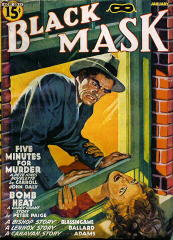
“Bomb Heat,” Black Mask, January 1941.

Black Mask Jan 1941

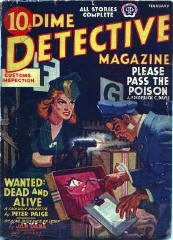
“Wanted: Dead and Alive” Dime Detective, February 1941. CW.

Dime Detective Feb 1941

“The Bullet from Nowhere,” Dime Detective, April 1941. CW.
“Lady, Can You Spare a Corpse?” Dime Detective, June 1941. CW.
“Picture Me Dead!” Black Mask, November 1941.
“Local Corpse Makes Good,” Dime Detective, November 1941. CW.
“The Night You Shot Hitler,” Black Mask, February 1942.
“Death Is from Hunger,” Dime Detective, April 1942. CW.
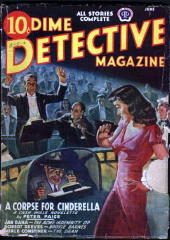
“A Corpse for Cinderella,” Dime Detective, June, 1942. CW.

Dime Detective June 1942

“Death Is a Souvenir,” Black Mask, August 1942.
“Berlin Papers, Please Copy,” Black Mask, September 1942.
“Joe Is Dead,” New Detective, January 1943.
“Death Stands By,” Dime Detective, February 1943. CW.
“Just a Sample,” Short Stories, May 1943.
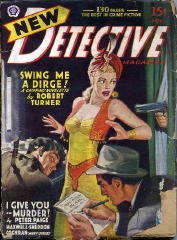
“I Give You – Murder!” New Detective, November 1943.

New Detective Nov 1943

“The Riddle of Papa Rio,” Dime Detective, August 1945. CW.
“Twelve Dead Mice,” Dime Detective, January 1946.
“Guilt-Edged Frame,” Dime Detective, September 1946.
“A Little Corpse Who Wasn’t There,” Dime Detective, December 1946. CW
“Cash in the Chips,” Dime Detective, January 1947. CW
“When a Man Murders,” Dime Detective, March 1947. CW
“Meet Me in Death Alley,” Detective Tales, May 1947. CW
“Death – on the House,” Dime Detective, June 1947. CW
“Softly Creep and Softly Kill!” Detective Tales, August 1947.
    Reprinted in Triple Detective, Summer 1953
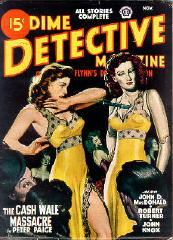
“The Cash Wale Massacre,” Dime Detective, November, 1947. CW

Dime Detective Nov 1947

“The Merry Wives of Murder,” Detective Tales, February 1948.
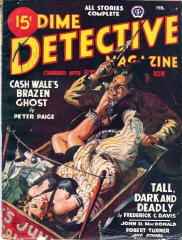
“Cash Wale’s Brazen Ghost,” Dime Detective, February 1948. CW

Dime Detective Feb 1948

“Die, Little Lady,” Detective Tales, March 1948.
“The Sweetest Corpse in Town!” Detective Tales, April 1948
    Reprinted in Triple Detective, Fall 1953.
“House in Silence,” Dime Detective, June 1948.
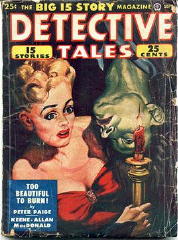
“Too Beautiful to Burn,” Detective Tales, September 1948.

Detective Tales Sept 1948

“Cash Wale’s Lethal Lulu,” Dime Detective, October 1948. CW
“The Corpse and I,” Dime Detective, January 1949.
“That Mad, Mean Murder Man,” Detective Tales, March 1949.
“Cash Wale’s Carnival Kill,” Dime Detective, May 1949. CW
“Coffin Cure,” Dime Detective, July 1949.
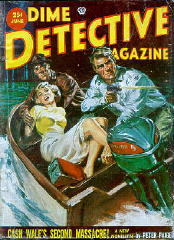
“Cash Wale’s Second Massacre!” Dime Detective, June 1953. CW

Dime Detective June 1953

“Adam and Evil!” Detective Tales, August 1953.
“The Watcher” Manhunt, November 1953.

   Stories as by MORTON WOLSON:     [FOOTNOTE #3]

“The Attacker” Ellery Queen’s MM, January 1954.
“The Glass Room” Ellery Queen’s MM, September 1957.
Nightmare Blonde, novel, Pocket, 1988.

FOOTNOTE #1. Bill Pronzini and I suspect that the altered title is a slip of the finger on the part of Cook-Miller. The single issue of Big Double Feature Magazine consisted of nothing but reprint stories, the westerns from Ranch Romances, the mysteries from Black Mask.

FOOTNOTE #2. The title of this story is the same as that for the August 10, 1940, issue of Detective Fiction Weekly. Neither Bill nor I have either magazine, but one possibility that he suggests is that Paige’s “You’re the Jury” in the November 16, 1940 issue of DFW is listed as #3 in a series of true stories. It could be that “Pick’s Last Crime” was both #1 and #2, a two-parter despite the two-month gap or maybe a followup piece.

   [UPDATE] 08-27-08. In the comment he left early this morning after checking his set of DFW, Walker Martin reports that, surprisingly enough, what the magazine did was to publish two separate stories by Paige having the very same title.

FOOTNOTE #3. The first version of this list included only the stories written by Morton Wolson as Peter Paige for the pulp magazines, and somehow the story he did for Manhunt, a digest, was missed. Thanks to Jiro Kimura for catching this. See his comment that follows. Having added the one missing story, I decided to include the three other stories he did under his own name. Compleatness is the goal, after all!

« Previous PageNext Page »