Authors


   Mystery author Rosemary Kutak has two books to credit, both written in the 1940s. Up until today, her entry in Crime Fiction IV, by Allen J. Hubin, has looked like this :

KUTAK, ROSEMARY (1908- )

      * Darkness of Slumber (Lippincott, 1944, hc) [Dr. Marc Castleman]
      * I Am the Cat (n.) Farrar, 1948, hc. [Dr. Marc Castleman; Long Island, NY]
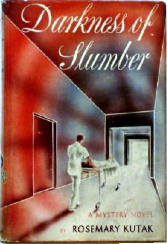
Kutak Darkness

   At some point in her life, as it turns out, Mrs. Kutak seems to have subtracted a few years from her age. Victor Berch has learned that — well, wait, I’ll let him tell it:

   “She and her husband had taken a European ocean trip and were returning on the SS Olympic, which sailed from Cherbourg, France, on Aug. 21, 1933 and arrived in NY on Sep. 6, 1933. Her birth information (apparently from her passport) gave her birth date as May 8, 1905, born in Anderson, Indiana.”

   In a later email, Victor reported further that “Rosemary shows up as Margaret Rosemary Norris in the 1910 Census. Daughter of Samuel C. and Luella Norris.”

   This investigation began when Al Hubin had discovered earlier that:

    “The Library of Congress gives a 1908 birth date to her, which I’ve used. But I can’t trace anyone alive with that name and birth year, and I’m rather wondering if the Rosemary N. Kutak (with the N probably standing for Norris) in the social security records isn’t the author. Her dates are [born] 5/8/1905 [and died] 7/8/1999 (in Louisville, KY).”

   Al was right and the Library of Congress, as Victor has shown, was wrong. The heading for Mrs. Kutak in the online Addenda for CFIV will look like this

KUTAK, (MARGARET) ROSEMARY (NORRIS). 1905-1999.

   A blurb for Darkness of Slumber, which was reprinted as Pocket #402 in 1946, described the story thusly: “A young doctor investigates the sudden madness of a beautiful woman.” Another dealer quotes from the Canadian hardcover: “We got murder, we got a madhouse, and we got a beautiful woman — add to that a doctor with a reputation he wants to clear, and you’ve got a book the New York Times Book Review said was one of the ‘Ten Best.'”
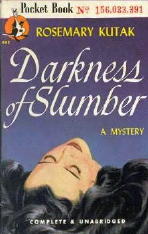
Kutak Pocket

   I Am the Cat was reprinted twice in paperback, first as a digest-sized softcover in abridged form as Mercury Mystery #130 (December 1948), then by Collier in 1966 with an introduction by Anthony Boucher.

   My apologies for the lack of a cover image, but one online seller says: “Great old plot here, a Long Island mansion, six guest/suspects, mysterious events, all the typical players in a suspenseful story. […] The dust jacket is dark green, with foreboding picture of a stairway leading to where?”

***

   Author Freda Kreitzman is difficult to locate in CFIV. The book she was in part responsible for is entitled Eighteen by Thirteen (1998), a group-effort novel published as by The Writer’s Workshop. The entry looks like this:

WRITER’s WORKSHOP

      * Eighteen by Thirteen (Connecticut: Rutledge, 1998, pb) Round-robin novel by Molly Bartel, Doris Bissette, John Fisher, Orel Friedman, 1913- , Charlotte Hartman, Frieda Kreitzman, Erwin Lissau, Grace Marks, Julia Nyfield, Leon Robinson, Ruth Robinson, Betty Webster, and Gertrude Welt.

   She was one of the thirteen writers. Neither she nor any of the other twelve participants have another credit in CFIV. Using social security records, however, Al Hubin has come up with the following dates for Ms. Kreitzman: She was born November 28, 1917, and died December 9, 2006.
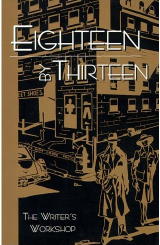
18 x 13

   A website page for the Southern Adirondack Library System no longer functioning, but entitled New York State Regional Authors, says of one of the book’s participating writers:

    “Orel Friedman was born in Glens Falls 85 years ago and practiced medicine here until retirement in 1980. A widower with three children and eleven grandchildren, his interests include gerontology, golf, bridge, travel and writing. He is a member of The Writer’s Workshop at his winter residence in Florida where he co-authored Eighteen By Thirteen.”

   Freda Kreitzman was 80 or 81 years old when the book was published. Further investigation has revealed that the The Writer’s Workshop met at the Forum, a Marriott Senior Center Living Community in Deerfield Beach, Florida.

[UPDATE] 04-27-07.  Excerpted from an email from Victor Berch, who did some investigation into the other members of The Writer’s Workshop:

   I have the dates of some more of those writers. The hard part is finding the women authors’ maiden names. Some of their obituaries were in local Sun-Sentinel newspaper for Broward county, but [they are not generally available online]. At any rate, here are some of the dates from the SSDI   [Social Security Death Index]:

   Bartel, Molly (or Mollie) [H], May 2, 1911 – Nov. 11, 2003

   Bissette, Doris [W], Aug. 2,1923 – Nov. 28, 2005

   Hartman, Charlotte, Nov. 17, 1923 – Nov. 8, 2005

   Nyfield, Julia [S], May 4, 1909 – Nov. 24, 2003

   Robinson, Leon, Dec. 26, 1910 – Aug. 21, 2001

   Webster, Betty [i.e. Elizabeth J], May 2, 1927 – June 23, 1999

   Erwin Lissau was an interesting one. He was born in Vienna, Austria on Feb. 17, 1916. He and his younger brother were living as students in Zagreb, Yugoslavia after Hitler had taken over Austria. They came to the US in 1939. Erwin joined the Army in 1941 and more than likely obtained his citizenship because of that. He died Aug. 10, 2001.
MARGUERITE SILVERMAN – The Vet It Was That Died. Nicholson & Watson; UK hardcover. First edition: 1945. No US edition.

   Of the three mystery novels written by this author, this one is the most common among those found offered for sale online: there are six copies available at the time I am writing this. Of Silverman’s second (Who Should Have Died?, Nicholson, 1948) there are none, and of her third (9 Had No Alibi, Nicholson, 1951) there is but one.

   According to Al Hubin’s Crime Fiction IV, the primary detective in each is Chief Inspector Christopher Adrian. Coming to his assistance in this one, at least, a relatively minor affair, is a newly graduated veterinarian surgeon by the name of Helena Goodwin.

    Helena’s involvement with the mystery is due only to this, her first job, however, and in fact she’s one of those immediately on the scene when her body of her veterinarian employer is found. (Hence the title.) And yet, even though both the inspector and his wife are old friends of her family, it doesn’t seem as though there?s enough of a connection there to warrant her presence in any of Adrian?s other cases. I could be wrong. It will also be difficult to find out, but if and when I do, I will be sure to tell you.

    It comes as no surprise that “the vet it was that died,” as both Mr. Thorpe and his wife are two of the most terrifically unlikable people that one can imagine. They are hated by their niece Carol, who lives with them; Dora, the other girl who works for them; their neighbors, and even their clientele, believe it or not. That the couple were not especially fond of each other is also an understatement, to put it mildly. When Mr. Thorpe is found poisoned to death, what Adrian and Helena quickly realize is that they have a lengthy list of suspects to work with. There is no need at all to start looking under rocks or for tramps passing by.

    By page 92, however, the list has been narrowed down to five: the only ones who had access to the brandy to which the strychnine was added, but with 100 pages yet to go, it takes quite a bit of time (and false leads) to whittle the list down any further.

    I called this mystery a “minor affair” a short while back, and truthfully that is all it is. The dialogue on occasion is rather juvenile in tone, and on other occasions one gets the unsettling feeling that the author is making up facts as she is going along. Neither of these are necessarily fatal flaws, mind you, but neither of them allows for much in the way of recommendation, either.

— October 2006

   Two more recently discovered deaths, the first in this post being that of spy fiction writer Owen John. Born in Wales in 1918, he passed away there in January 1995. Added also to his entry in Crime Fiction IV, by Allen J. Hubin, is his first name, Leonard, unused in his byline for the following crime novels, the last three marginal (as usual, so indicated by a dash in front of the title):

JOHN, (Leonard) OWEN (1918-1995)

      * Thirty Days Hath September (n.) Joseph 1966 [Haggai Godin; Italy] Dutton, 1967; Paperback Library 63-127, pb, 1969.

      * The Disinformer (n.) Joseph 1967 [Haggai Godin; Canada] Paperback Library 53-773, pb, 1968.

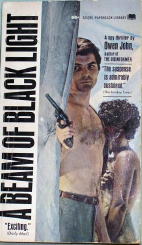
      * A Beam of Black Light (n.) Joseph 1968 [Haggai Godin; Russia] Paperback Library 63-085, pb, 1969. “The story of a young British civil servant planted in a fantastic Russian secret laboratory in the wildest terrain in the world, is insidiously terrifying.”

Beam

      * Dead on Time (n.) Joseph 1969 [Haggai Godin; Middle East] Paperback Library, pb, 1969. “The Arab-Isaeli conflict is the setting for a tale full of action and tension … reality is blended with fiction, with great skill and dash.”

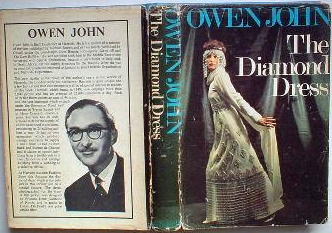
      * The Diamond Dress (n.) Cassell 1970

Diamond Dress

      * The Shadow in the Sea (n.) Cassell 1972 [Haggai Godin; Russia] Dutton, 1972. Fawcett Crest M1928, pb, 1973. “A mysterious Russian submarine is discovered patrolling off the coast of England — Haggai Godin was the one man who could stop it.”

      * Sabotage (n.) Cassell 1973 [Haggai Godin; Wales] Dutton, 1973. Fawcett Crest M2097, pb, 1974. “Two men meet at night on a dark road in Carreg Wales. In London, Roge Platt, Chief of Special Operations, and his agent, Haggai Godin, discover that a nuclear power plant somewhere in England may be sabotaged.”

      * Getaway (n.) Coronet 1976 [Haggai Godin]

      * -The Controller (n.) Hale 1978

      * -Festival (n.) Hale 1978

      * -McGregor’s Island (n.) Hale 1979 [Hebrides]

   Haggai Godin, presumably the young man pictured without a shirt in the paperback cover above, is the agent whose adventures took him all over the world.

*

   Another writer whose death Al Hubin has recently found out about is Henry Kolarz, who died in 2001. He was the author of one book included in CFIV:

KOLARZ, HENRY
(1927-2001)

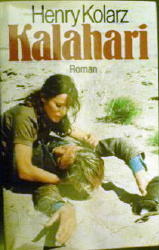
      * Kalahari (Fawcett Popular Library, 1979, pb) [Africa] Translation of “Kalahari” from the German. Frankfort, 1977. Reprinted in a Reader’s Digest hardcover collection of condensed novels, 1980.

Kalahari

   Kalahari is one of a extremely small number of crime novels to have taken place in Botswana. A description of the book, as provided by the Reader’s Digest edition:

   “The shot had come without warning. As if the arid wastes of Kalahari were not enemy enough, somewhere in the darkness there lurked a merciless gunman.

   “There had been no doubt in Dieter Hahn’s mind, when the shabby African had appeared out of the bush, that he should give him a lift in the VSO truck. It was common humanity, nothing more.

   “Even now he did not regret his decision. For there was more at stake than just his own life. There was everything he stood for: equality, justice, freedom itself.”

   Kolarz was the author of at least one other work of crime fiction that was never translated from German into English, Nachts um 4 wird nicht geklingelt (1961), a novel based on an actual event, that of the escape of 19 prisoners from a North Carolina security prison in 1959.

   The following correspondence came about after Mike Braham saw that I had one of his father’s books for sale and bought it from me. Seeing the name of the purchaser, I asked the obvious question. I was right.   – Steve


   Hal Braham was my father. I stumbled onto the list of his books still out there by mistake the other night, and saw there are a few I don’t have, so I’ve been rounding them up.

   My father wrote extensively in the 1950s, and published a great deal in the old pulp detective magazines (of which I have a collection). He supported us by working as a technical writer by day. The rhythmic sound of his typing on his old Underwood upright lulled me to sleep many a night during my childhood. He also worked as a private investigator and took police science courses. He captures the color and character of Los Angeles and San Pedro of the post-war years extremely well in Call Me Deadly. He also co-wrote a screenplay, Tramp, Tramp, Tramp, which starred Jackie Gleason. It was one of Gleason’s earliest films.

   He belonged to a group of L.A. writers called the Fictioneers. Among them were Ray Bradbury, Richard Matheson (Duel and other screenplays), Charles Beaumont (Twilight Zone), William Campbell Gault (murder mysteries and juveniles), Les Savage (westerns) and Bill Cox. I remember some of their parties at our house with great affection.

   I have followed my father into the writing profession. I am a journalist, currently working at The Fresno Bee. I’ve not published any books as all my work has been newspaper related. Writing seems to be in the family genes. Nelson Algren (Walk on the Wild Side, Man With the Golden Arm) was a cousin and grew up with my father in Chicago.

      From a later email:

   You might add that my father had a passion for writing, and it was a passion of joy. He never agonized; he wrote with pure enjoyment and when he talked about the process of writing there was a twinkle in his eyes. I’ve never been comfortable writing fiction because I can’t be as good as he was. I feel he is looking over my shoulder. He never did, of course. He always encouraged and supported me, and was never critical. But I held him in such high esteem that all my efforts seemed to fall short.

   I’ve always been intrigued by the cover illustrations. They stood out all right, but they never really had anything to do with the novel, and I always tried to imagine a plot based on the drawings. But if they sold more books, who can complain?

   One of my father’s best friends, the author William Campbell Gault (now deceased, sadly), told the story of how his juveniles used to be stolen from the libraries in Santa Barbara, where he lived. The librarians were livid, with the appropriate priggish indignation of how bad the youth of our day have become. Bill thought it was great. “It just meant they had to replace my books, which meant more money for me,” he said.


BIBLIOGRAPHY. Expanded from an updated entry for Hal Braham in the Revised Crime Fiction IV, by Allen J. Hubin:

BRAHAM, HAL [i.e., Harold Braham] (1910-1993); see pseudonyms Mel Colton & Merrill Trask

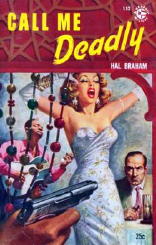
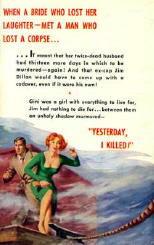
* Call Me Deadly (n.) Graphic #152, pbo, 1957. [Los Angeles, CA] “When a bride who lost her laughter – met a man who lost a corpse …”

Braham


Back Cover

COLTON, MEL; pseudonym of Hal Braham, (1910-1993); other pseudonym Merrill Trask

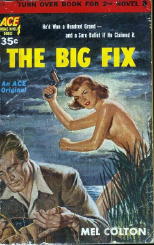
* The Big Fix (n.) Ace Double D-3, pbo, 1952. “He’d won a hundred grand – and a sure bullet if he claimed it.”

Big Fix

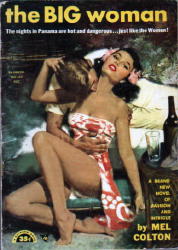
* Big Woman (n.) Rainbow 1953 [Panama] “The nights in Panama are hot and dangerous — just like the women!”

Big Woman

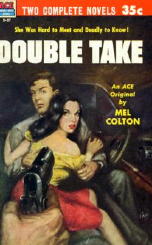
* Double Take (n.) Ace Double D-27, pbo, 1953 [Los Angeles, CA]. “She was hard to meet and deadly to know.”

Double Take

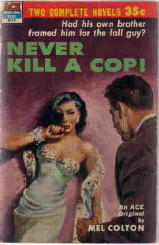
* Never Kill a Cop! (n.) Ace Double D-19, pbo, 1953. “Had his own brother framed him for the fall guy?”

Never Kill a Cop

* Point of No Escape (n.) Ace Double D-101, pbo, 1955

TRASK, MERRILL; pseudonym of Hal Braham, (1910-1993); other pseudonym Mel Colton

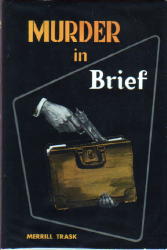
* Murder in Brief (n.) Mystery House 1956 [Los Angeles, CA]

Trask

SHORT FICTION: All stories as by Mel Colton.

“Dead Men Can’t Welsh” — Black Mask, November 1948
“No Time to Burn” — Dime Detective, July 1949
“Dreamer with a Gun” — Dime Detective, December 1949
“Death Insurance” — F.B.I. Detective Stories, April 1950
“Corpse-Gathering Cutie” — Dime Detective, June 1950
“Hot-Scotch Polka” — F.B.I. Detective Stories, October 1950
“Kill and Make Up” — Dime Detective, October 1950
“Her Perfect Frame” — Dime Detective, December 1950
“Win, Lose–or Kill” — Black Mask Detective, March 1951
“Something to Shoot About” — Dime Detective, October 1952
“Murder Pays Double” — Pursuit, July 1954
“Ring Around a Murder” — Hunted, April 1955
“Murder on Account” — Pursuit, May 1955
“The Vicious Ones” — Hunted, August 1955
“Don’t Wait for Me” — Pursuit, September 1955
“Justice on the Death Prowl” — Short Stories, November 1956
“Second Guess” — ­Pursuit, November 1956
“Red Death” — Short Stories, June 1957

FILMS:

Hal Braham wrote the story which was the basis for Tramp, Tramp, Tramp (Columbia, 1942), starring Jackie Gleason, Jack Durant and Florence Rice.

Synopsis: A pair of barbers are driven out of business because most of the men in their small town are being drafted into the army. When they attempt to enlist and are turned down, they decide to form a Home Defense Force, getting them involved with a gang of crooks.

Thanks to Bill Pronzini for providing several of the cover images and the big assist in putting together the list of Hal Braham’s short fiction.

   I’ve been falling behind in terms of pointing out the deaths of a number of mystery authors that Al Hubin has been uncovering recently. Sources that he uses to come up with the dates they died include Contemporary Authors and various sites on the Internet. Eventually the information will appear in the online (and ongoing) Addenda to his Revised Crime Fiction IV, but it’s my intention to post them here on the M*F blog as well, adding to their profiles as I’m able.

   There’s such a backlog now that it no longer makes sense to try to do them all at once. If I do only two or three at a time the task won’t seem so overwhelming, and even so, I’d better not put it off any longer.

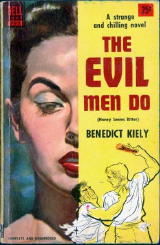
   First in this particular post is Benedict Kiely, born August 15, 1919 in Ireland, author of two titles in CFIV, one marginally crime-related. He died on February 8th earlier this year.

KIELY, BENEDICT (1919-2007)
      * -The Cards of the Gambler (Methuen, 1953, hc)
      * Honey Seems Bitter (Methuen, 1954, hc) Dutton, 1952. Also published as: The Evil Men Do; Dell, 1954.

   Mr. Keily was a Irish journalist, writer and critic, and literary editor of the Irish Press beginning in 1950, overcoming the banning of three early novels, including Honey Seems Bitter. Under Ireland’s censorship laws at the time, the books were deemed to be “in general tendency indecent or obscene.”

   Moving to the US in 1964, he was the writer-in-residence and/or visiting professors at three different universities, returning the Ireland in 1968, later receiving the Award for Literature from the Irish Academy of Letters, and was awarded honorary doctorates by the National University of Ireland and the Queen’s University, Belfast.

   In 1996 he received the highest honour of Aosdána, the Irish artists’ body, when he was elected a Saoi, in recognition of his contribution to literature, his work displaying both “a deep affection for and exasperation with Ireland.” At the time of his death Benedict Kiely had become one of Ireland’s best-known broadcasters, storytellers and short story writers.

   The theme of Honey Seems Bitter is murder and in essence is a psychological study of the dark side of humanity bordering on existentialism. Without seeing the book itself, the blurb for the Dell paperback edition seems shallow in comparison: “Beautiful Lily Morgan had been murdered and defiled, yet even in death she held two men in an unnatural grip.”

Kiely

   Mavis Eileen Underwood, learned to have died in January, 1987, was born 1916 in Guernsey, Channel Islands. She wrote one novel included in CFIV, a Crime Club mystery published under the byline of Sarah Kilpatrick:

KILPATRICK, SARAH; pseudonym of Mavis Eileen Underwood, (1916-1987 )
      * Wake All the Dead (Doubleday, 1970, hc) [England] White Lion, 1974.

      Again as Sarah Kilpatrick, she wrote a small handful of other books, one of which, Fanny Burney (David & Charles, UK, 1980), was a biography of the 18th century novelist of the same name. The blurb of Ladies’ Close (Gollancz, UK, 1967), one of three works of fiction, compares the novel to the work of Jane Austen except, as one bookseller puts it, “this is more sexual.”

      As for Wake All the Dead, it has to do with Rose Tallis, a newcomer to a small English village, a local pub, hippies, an ancient cemetery, drugs, and an old verger’s death.

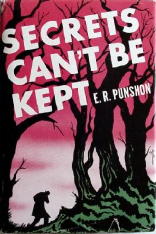
   Not many writers have had a career lasting as long as the 56 years that British mystery writer E. R. Punshon happened to have. Even so, Nick Fuller, on the pages of his website devoted to Punshon’s detective fiction, calls him “one of the most shamefully neglected writers of detective fiction,” with plots “rivaled only by [those of] John Dickson Carr.”

   He had, Nick goes on to say, the same “gift of conveying atmosphere and setting [and with the same adeptness] at devising clues and situations.” His work are also studies of character, of “the catalyst that drives an ordinary human being to commit the ultimate crime.”

Secrets

   A complete list of Punshon’s mystery fiction in book form will follow Mary’s review of The Bittermeads Mystery, taken from Crime Fiction IV, by Allen J. Hubin. The detective twosome of Inspector Carter and Sergeant Bell appears in some his early books, but the series character who appears most often is Bobby Owen, who, according to Nick, “rises from the rank of police constable (in Information Received, 1933) to Commander of Scotland Yard by the later books.”

   The Bittermeads Mystery is a stand-alone, however. Robert Dunn appeared in this book and no other.        – Steve


E. R. PUNSHON – The Bittermeads Mystery

Knopf, hc, 1922. [No British edition?]

   The Bittermeads Mystery gets off to a lively start with protagonist Robert Dunn eluding pursuit after a donnybrook (or should I say a Dunnybrook?) with a man he was following through a wood.

   Dunn continues his nocturnal activities by sloping along to Bittermeads, the titular house, where he finds a burglary in progress. Seizing the day, or rather the night, Dunn knocks the burglar out and after exchanging clothing with the unconscious man (subsequently concealed on the village common opposite the house) he enters the dwelling hoping to be discovered.

   An unusual ambition, you may say, but since a burglar is a shady sort he hopes to be invited to join the murky band associated with Bittermeads. His reasoning is he will not be turned him over to the police as the residents don’t want attention drawn to the house. In this way he hopes to find out what has happened to his old chum Charley Wright, who was romantically involved with Ella Cayley, the daughter of the house, but has disappeared. (He has another reason for his interest in joining the enemy camp, but it is not revealed until some way into the narrative.)

   The only people at home are Ella and her ailing mother and after tying Ella up and promising not to disturb her mother, Dunn explores the house – only to find the murdered Charley in a packing case in an attic.

   Ella’s stepfather, Deede Dawson, returns home and nabs Dunn but decides to employ him as chauffeur and gardener – not an action one would expect of an honest man. Dunn’s first task is to finish nailing down the lid of the packing case without revealing he knows what is in it. But then Ella takes the packing case away in a car, thus removing the only evidence he can produce to launch a police investigation.

   Then there is another murder as the plot thickens up in satisfactory fashion.

   My verdict: The two matters Dunn is investigating have no immediate apparent link but ultimately are shown to be intertwined. Although the close reader may well deduce a certain hidden identity and the name of the person masterminding the mayhem, it will likely not be until fairly late in the book.

   The action gallops along and we have an unusual look at the romantic agony of a male protagonist as well as his internal musings as the plot develops. Although it is a fast, light read there are noir underpinnings and the whole is resolved with a satisfactory comeuppance for the egregious villain of the piece.

   Etext: http://www.geocities.com/hacklehorn/punshon/index.html

         Mary R
http//home.epix.net/~maywrite/


BIBLIOGRAPHY [British editions only, unless retitled in the US; all covers shown are those of the US editions, however.] —

PUNSHON, E(rnest) R(obertson) (1872-1956); see pseudonym Robertson Halket

* Earth’s Great Lord (n.) Ward 1901 [Australia]
* -Constance West (n.) Lane 1905 [England]
* The Mystery of Lady Isobel (n.) Hurst 1907 [England]
* The Choice (n.) Ward 1908 [England]
* The Spin of the Coin (n.) Hurst 1908 [England]
* The Glittering Desire (n.) Ward 1910 [England]
* Hidden Lives (n.) Ward 1913 [England]
* -The Crowning Glory (n.) Hodder 1914 [England]
* Arrows of Chance (n.) Ward 1917 [England]
* The Miser Earl (n.) Newnes 1917
* The Solitary House (n.) Ward 1919 [England]
* The Woman’s Footprint (n.) Hodder 1919 [England]
* The Ruby Bracelet (n.) Newnes 1920 [England]
* The Bittermeads Mystery (n.) Knopf 1922 [England]
* Dunslow (n.) Ward 1922 [England]
* The Blue John Diamond (n.) Clode 1929 [England]
* The Unexpected Legacy (n.) Benn 1929 [Insp. Carter; Sgt. Bell; England]
* The Cottage Murder (n.) Benn 1931 [Insp. Carter; Sgt. Bell; England]
* Proof, Counter Proof (n.) Benn 1931 [Insp. Carter; Sgt. Bell; England]
* Genius in Murder (n.) Benn 1932 [Insp. Carter; Sgt. Bell; England]
* Truth Came Out (n.) Benn 1932 [Insp. Carter; Sgt. Bell; England]
* Information Received (n.) Benn 1933 [Det. Sgt. Bobby Owen; England]
* The Crossword Murder (n.) Knopf 1934; See: Crossword Mystery (Gollancz 1934).
* Crossword Mystery (n.) Gollancz 1934 [Det. Sgt. Bobby Owen; England]
* Death Among the Sunbathers (n.) Benn 1934 [Det. Sgt. Bobby Owen; England]
* Mystery Villa (n.) Gollancz 1934 [Det. Sgt. Bobby Owen; England]
* Death Comes to Cambers (n.) Gollancz 1935 [Det. Sgt. Bobby Owen; England]
* Death of a Beauty Queen (n.) Gollancz 1935 [Det. Sgt. Bobby Owen; England]
* The Bath Mysteries (n.) Gollancz 1936 [Det. Sgt. Bobby Owen; London]
* The Dusky Hour (n.) Gollancz 1937 [Det. Sgt. Bobby Owen; England]
* Mystery of Mr. Jessop (n.) Gollancz 1937 [Det. Sgt. Bobby Owen; England]
* Comes a Stranger (n.) Gollancz 1938 [Det. Sgt. Bobby Owen; England]
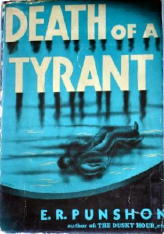
* Death of a Tyrant (n.) Hillman-Curl 1938; See: Dictator’s Way (Gollancz 1938).

Tyrant

* Dictator’s Way (n.) Gollancz 1938 [Det. Sgt. Bobby Owen; England]
* Murder Abroad (n.) Gollancz 1939 [Det. Sgt. Bobby Owen; France]
* Suspects-Nine (n.) Gollancz 1939 [Det. Sgt. Bobby Owen; England]
* Four Strange Women (n.) Gollancz 1940 [Det. Sgt. Bobby Owen; England]
* The Dark Garden (n.) Gollancz 1941 [Det. Sgt. Bobby Owen; England]
* Death in the Chalkpits (n.) Mystery Novel of the Month 1941; See: The Dusky Hour (Gollancz 1937).
* Ten Star Clues (n.) Gollancz 1941 [Det. Sgt. Bobby Owen; England]
* The Bathtub Murder Case (n.) Detective Novel Classics 1942; See: The Bath Mysteries (Gollancz 1936).
* Diabolic Candelabra (n.) Gollancz 1942 [Det. Sgt. Bobby Owen; England]
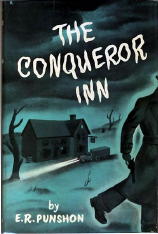
* The Conqueror Inn (n.) Gollancz 1943 [Det. Sgt. Bobby Owen; England]

Inn

* Night’s Cloak (n.) Gollancz 1944 [Det. Sgt. Bobby Owen; England]
* Secrets Can’t Be Kept (n.) Gollancz 1944 [Det. Sgt. Bobby Owen; England]
* There’s a Reason for Everything (n.) Gollancz 1945 [Det. Sgt. Bobby Owen; England]
* It Might Lead Anywhere (n.) Gollancz 1946 [Det. Sgt. Bobby Owen; England]
* Helen Passes By (n.) Gollancz 1947 [Det. Sgt. Bobby Owen; England]
* The House of Godwinsson (n.) Gollancz 1948 [Det. Sgt. Bobby Owen; England]
* Music Tells All (n.) Gollancz 1948 [Det. Sgt. Bobby Owen; Sgt. Bell; England]
* So Many Doors (n.) Gollancz 1949 [Det. Sgt. Bobby Owen; England]
* Everybody Always Tells (n.) Gollancz 1950 [Det. Sgt. Bobby Owen; England]
* The Golden Dagger (n.) Gollancz 1951 [Det. Sgt. Bobby Owen; England]
* The Secret Search (n.) Gollancz 1951 [Det. Sgt. Bobby Owen; England]
* The Attending Truth (n.) Gollancz 1952 [Det. Sgt. Bobby Owen; England]
* Strange Ending (n.) Gollancz 1953 [Det. Sgt. Bobby Owen; England]
* Brought to Light (n.) Gollancz 1954 [Det. Sgt. Bobby Owen; England]
* Dark Is the Clue (n.) Gollancz 1955 [Det. Sgt. Bobby Owen; England]
* Triple Quest (n.) Gollancz 1955 [Det. Sgt. Bobby Owen; England]
* Six Were Present (n.) Gollancz 1956 [Det. Sgt. Bobby Owen; England]

HALKET, ROBERTSON; pseudonym of E. R. Punshon, (1872-1956)

* Where Every Prospect Pleases (Benn, 1933, hc) [France]
* Documentary Evidence (Nicholson, 1936, hc) [England]


      —

   Mary Reed and Eric Mayer are in the process of compiling an online directory of all freely available etexts of mystery fiction published during the Golden Age of Detection. If you know of any they’ve missed, additions are extremely welcome.

   In an email to Al Hubin, subsequently forwarded on to me, mystery bookseller Jamie Sturgeon recently pointed out the existence of a website devoted to British spy and crime thriller writer Desmond Cory.

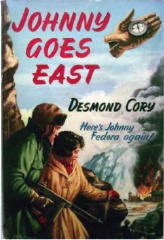
East

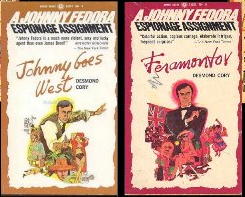
   Many of Cory’s “Johnny Fedora” novels of espionage and adventure were published as paperback originals in the US by Award in the 1960s during the height of the boom for James Bond and his many imitators — only Johnny Fedora had been there first. Walker published a number of others in hardcover around the same time, and many of these were reprinted in softcover by Signet.

   As available as his books were at one time, the fact remains that Desmond Cory’s fiction is now all but unknown in the US — and perhaps in the UK as well — even though the introduction to the previously mentioned website can arguably proclaim that –

   Some 50 years ago, Desmond Cory wrote the first of a series of thrillers that helped spawn one of Britain’s most popular fictional genres — the 20th Century “Spy Novel.”

   Sometimes referred to as “Brit Grit,” this phenomenon comprised several well-known characters such as Ian Fleming’s James Bond, and Len Deighton’s Harry Palmer. At its peak, the genre sold several million books across the world, and was watched by even greater numbers on the Big Screen, due to the immense popularity of James Bond, as incarnated by the incomparable Sean Connery. Preceding the now legendary 007 was Desmond Cory’s Johnny Fedora, “the thinking man’s James Bond.”

   Here, with one addition, the year of his death, not known until now, is the complete dossier on author Desmond Cory as found in Crime Fiction IV, by Allen J. Hubin. British editions only are given, unless published in the US under new titles:

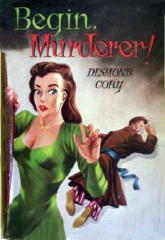
Begin

CORY, DESMOND; pseudonym of Shaun McCarthy, (1928-2001); other pseudonym Theo Callas.

* Begin, Murderer! (n.) Muller 1951 [Lindy Grey; England]
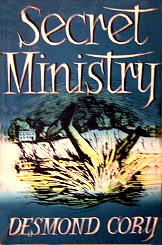
* Secret Ministry (n.) Muller 1951 [Johnny Fedora]
* This Is Jezebel (n.) Muller 1952 [Lindy Grey; England]
* This Traitor, Death (n.) Muller 1952 [Johnny Fedora; Paris]
* Dead Man Falling (n.) Muller 1953 [Johnny Fedora; Austria]
* Lady Lost (n.) Muller 1953 [Lindy Grey; England]
* Intrigue (n.) Muller 1954 [Johnny Fedora; Italy]
* The Shaken Leaf (n.) Shakespeare Head 1954 [Lindy Grey; England]
* Height of Day (n.) Muller 1955 [Johnny Fedora; Africa]
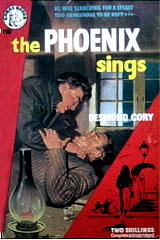
* The Phoenix Sings (n.) Muller 1955 [England]

Phoenix

* High Requiem (n.) Muller 1956 [Johnny Fedora; Africa]
* Johnny Goes North (n.) Muller 1956 [Johnny Fedora; Sweden]
* Pilgrim at the Gate (n.) Muller 1957 [Mr. Pilgrim; England]
* Johnny Goes East (n.) Muller 1958 [Johnny Fedora; Tibet]
* Johnny Goes South (n.) Muller 1959 [Johnny Fedora; Argentina]
* Johnny Goes West (n.) Muller 1959 [Johnny Fedora; South America]
* Pilgrim on the Island (n.) Muller 1959 [Mr. Pilgrim; Germany]
* The Head (n.) Muller 1960 [Johnny Fedora; Spain]
* Stranglehold (n.) Muller 1961 [Mr. Dee; England]
* Undertow (n.) Muller 1962 [Johnny Fedora; Spain]
* Hammerhead (n.) Muller 1963 [Johnny Fedora; Madrid]
* The Name of the Game (n.) Muller 1964 [Mr. Dee; England]
* Shockwave (n.) Walker 1964; See: Hammerhead (Muller 1963).
* Deadfall (n.) Muller 1965 [Spain]
* Feramontov (n.) Muller 1966 [Johnny Fedora; Spain]

Award

* Overload (n.) NEL 1966; See: Johnny Goes South (Muller 1959).
* Timelock (n.) Muller 1967 [Johnny Fedora; Spain]
* Mountainhead (n.) Award 1968; See: Johnny Goes East (Muller 1958).
* Trieste (n.) Award 1968; See: Intrigue (Muller 1954).
* Dead Men Alive (n.) Award 1969; See: Height of Day (Muller 1955).
* The Hitler Diamonds (n.) Award 1969; See: Dead Man Falling (Muller 1953).
* The Night Hawk (n.) Hodder 1969 [Spain]
* The Swastika Hunt (n.) Award 1969; See: Johnny Goes North (Muller 1956).
* The Nazi Assassins (n.) Award 1970; See: Secret Ministry (Muller 1951).
* The Gestapo File (n.) Award 1971; See: This Traitor, Death (Muller 1952).
* Sunburst (n.) Hodder 1971 [Johnny Fedora; Spain]
* Take My Drum to England (n.) Hodder 1971 [Spain]
* Even If You Run (n.) Doubleday 1972; See: Take My Drum to England (Hodder 1971).
* A Bit of a Shunt Up the River (n.) Doubleday 1974 [England]
* The Circle Complex (n.) Macmillan 1975 [Wales]
* Bennett (n.) Macmillan 1977 [Spain]
* The Catalyst (n.) St. Martin’s 1991; See: The Strange Attractor (Macmillan (London) 1991).
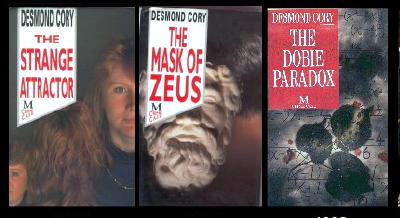
* The Strange Attractor (n.) Macmillan 1991 [Prof. John Dobie; Dr. Kate Coyle; Wales]
* The Mask of Zeus (n.) Macmillan 1992 [Prof. John Dobie; Dr. Kate Coyle; Cyprus; Academia]
* The Dobie Paradox (n.) Macmillan 1993 [Prof. John Dobie; Dr. Kate Coyle; Scotland]

McCARTHY, SHAUN (Lloyd) (1928-2001); see pseudonyms Theo Callas & Desmond Cory

* Lucky Ham (London: Macmillan, 1977, hc) [Oxford; Academia]

CALLAS, THEO; pseudonym of Shaun McCarthy, (1928-2001); other pseudonym Desmond Cory

* The City of Kites (Muller, 1955, hc) [Vienna]

   Quoting from the website —

   The Johnny Fedora series consists of 16 novels written over a period of twenty years, all taking place in exotic locations.

Secret

   In the first novel, Secret Ministry, Johnny Fedora is introduced as a secret agent whose forte is the ability to outshoot, outwit, and outmaneuver his Cold War opponents. In subsequent novels, he is often teamed up with Sebastian Trout from the Foreign Office. Johnny’s connection with British intelligence is unofficial, but is hired by them for specific assignments.

   Written at the same time as the early Fedora novels, the Lindy Grey series were entertaining private-detective thrillers, comprising over 4 titles.

   In Begin, Murderer! Lindsay Grey starts as an urbane man-about-town who solves murders that baffle the Oxford police. Self-described as “a one-time private detective of one-time private means”, Lindy (as he likes to be called) is not ashamed of living a dissolute life.

   In 1991, after a decade of dedicating his writing efforts to academic works, Cory returned to writing mystery novels, introducing a new series character, Professor John Dobie.

   The first Dobie novel, The Strange Attractor, introduces us to an absent-minded maths professor who stumbles into the world of computer hacking, high-tech thievery, and multiple murder. Through wit and a clever plot, Cory takes Dobie through an intriguing sequence of events where he is drugged, tied up and made to witness a murder. New characters such as his girl-friend Dr. Kate Boyle, and Detective Inspector Michael Jackson (Wacko Jacko) add further spice to this clever mystery novel.

Dobie

   One novel, Deadfall, was made into a film starring Michael Caine as cat burglar Henry Clarke, who with his accomplices attempts to steal diamonds from the chateau of a Spanish millionaire.

   Chock full of other information about the author and his other standalone thrillers, the website is certainly worth a visit. Lots of great cover art, too, of which I’ve provided you with only a small sampling.

  Hello,

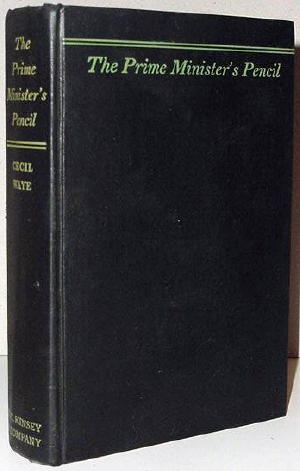
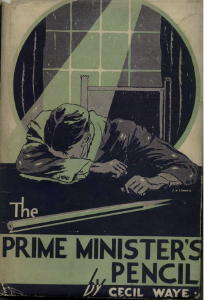
   I’m a small book dealer in Canada. I stock 50% lit. and 50% mystery with an emphasis on bibliomysteries. I recently acquired a 1st US ed. of The Prime Minister’s Pencil by Cecil Waye (John Rhode, Miles Burton, etc.) published by H.C. Kinsey.

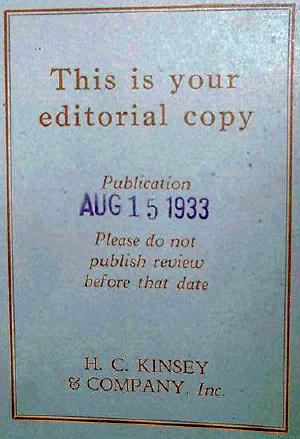
   It is a review (advance) copy or as the slip states “This is your editorial copy, Publication AUG.15 , 1933. Please do not publish review before that date. H.C. Kinsey & Company,Inc.”

   I noticed on your Mystery*File web site that [in his article on Cecil Waye] Tony Medawar supplied a picture of the jacket for this Cecil Waye title, and it was from the US edition.

   [My copy does not have a jacket but] I’d be happy to send a picture of the review slip (tipped on to front free endpaper) if you’re interested.

Best regards,

  Jeff Coopman
  THE USUAL SUSPECTS
  2 Barbican Gate
  St. Catharines, ON
  L2T 3Z8  CANADA
  905-227-4897
  suspect (at) iaw.on.ca

   >>   My reaction? Of course I said yes. What a remarkable find. The books that “John Rhode” wrote as Cecil Waye’s are as scarce as anything, and to find a copy with review copy practically makes it a one-of-a-kind item. Here are the scans that Jeff sent me. — Steve

Pencil


Review Slip

[UPDATE] Later the same day:

 Steve,

Just noticed a pencil notation on the last page following THE END

WOW! good stuff 3 aug 1933

Obviously some reviewer liked it!

    Jeff

   An interesting email arrived this morning from Vince Keenan, who obviously keeps up with current film news much more than I do. (Since that’s not at all, it isn’t hard.)

  Hi Steve —

   I’m sure Bill Pronzini’s recent M*F piece on Elliot Chaze had nothing to do with this. All a big coincidence, no doubt. Riiight …

http//www.hollywoodreporter.com/hr/content_display/film/news/e3i24b21916578451e52e9d905fd230d4fa

   Actually, the involvement of Barry Gifford is a positive sign. Who knows? Maybe something will come of it.

Best,

      Vince

   You can follow the link to read the full article, but here are the salient facts and a little more:

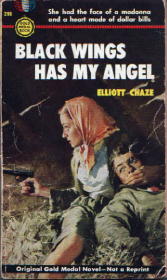
   Elijah Wood is making his first foray into producing, teaming with Anthony Moody and Rob Malkani’s Indalo Prods. to bring to the big screen an adaptation of Elliott Chaze’s legendary noir novel Black Wings Has My Angel.

   The script is being penned by Barry Gifford (Wild at Heart, Lost Highway) and writer-producer-director Christopher Peditto.

   … Angel, published in 1953, is considered one of the shining lights of the Fawcett Gold Medal paperback line and a pulp classic.

Chaze

   “It’s the material,” said Wood, summing up why he decided to dip his foot into producing waters. “I’ve always been intrigued by noir novels and noir films. I love that style. And to unearth something from that era that hasn’t been made into a film or is not a remake is really exciting. It’s a lost classic.”

   Bill Pronzini’s reaction, after I’d forwarded Vince’s email on to him:

  Steve:

   Well, well, well. And about time, too. If Gifford plays the screenplay straight, rather than drifting off into David Lynch territory, and remains faithful to the novel, it should be one hell of a good film.

Best,

      Bill

   Double ditto. My sentiments exactly. — Steve

   My review of the film Murder at Glen Athol not too long ago mentioned that it was based on a Doubleday Crime Club mystery of the same title, a book written by Norman Lippincott. It turns out that this is the only work of detective fiction that Lippincott wrote, and that otherwise he was more or less a man of mystery.

   Here’s his current listing in Crime Fiction IV, by Allen J. Hubin:

LIPPINCOTT, NORMAN (1894?-1982?)
      * * Murder at Glen Athol (Doubleday, 1935, hc) [Pennsylvania] World’s Work, 1935. Film: Invincible, 1935; also released as Criminal Within (scw: John W. Krafft; dir: Frank R. Strayer).

   I’d love to be able to show you a cover scan of the dust jacket, but none of my usual sources seems to have one. No one on the Internet even seems to have a copy for sale, as I indicated before, either with or without a dust jacket.

   A few days ago Victor Berch sent me a couple of emails about Norman Lippincott, telling me everything he’d been able to discover about him, which was considerable. I’ve combined the two messages into one, as follows:

   Steve

   Over the past weekend, I spent some time looking for Norman Lippincott, author of Murder at Glen Athol. I had a bit of luck in tracking him down in a roundabout way.

   First, I found an obituary for his son, Franklyn M. Lippincott, who died rather young in New York City in 1941. The son was described as an editor of Screen Fun and other magazines, plus he was identified as the son of Norman Lippincott, the writer. So I knew I was on the
right track.

   Franklyn’s age at the time of his death was given as 46, so he must have been born ca. 1895. This meant that I could possibly track him (and his father) through the 1900, 1910, 1920 census records, which I proceeded to do.

   The 1900 Census found Franklyn (sometimes spelled Franklin) and his father, Norman R. Lippincott living in Bellevue, PA. His father’s (Norman’s) occupation was listed as a salesman for a cash register company.

   I next figured that Franklyn would have been just about the right age to be drafted into the US Army during WW I, but he didn’t show up at all. That could be due to the fact that he had already enlisted in some branch of the service.

   But, much to my surprise, his father’s (Norman R. Lippincott) showed up. His full name was given as Norman Roger Lippincott, born December 23 of 1870 in Pennsylvania. His occupation at the time was a salesman for the Burroughs Adding Machine Co. in Pittsburgh, PA.

   I could not establish a death date for Norman R. Lippincott. It leads me to believe that he died before 1964 and would hardly be in the Social Security records, since that information kicks in about that time. The Norman Lippincott who died in 1982 [as tentatively identified in CFIV] was Norman William Lippincott, born 1894.

   Whatever Norman Lippincott may have written otherwise is probably buried in some magazines or newspapers that have not been indexed as yet. Or, had the fame of his book being made into a motion picture been enough to describe him as “Norman Lippincott, the writer”?

Best,

   Victor

   Al Hubin will correct the vital stats for Mr. Lippincott in the next installment of his Addenda to the Revised CFIV. Since the book itself is missing and still at large, I thought I’d supply instead the blurb for the book from the inside dust jacket flap, as provided by Ellen Nehr’s Doubleday Crime Club Companion: 1928-1991. It’s not possible to say from this, but the book sounds much more serious than the movie. My opinion of the film was that even with a noticeably lighter tone, it’s one of the better detective stories on film made around the same time and on the same budget.

Leading character: Holt (no other name)

Setting: Small western Pennsylvania town

Subject: Interfamily animosity.

Blurb: The Randels of Glen Athol were a strange clan, a group of people torn by inner stress and hatred. The focal point of their trouble was the ruthless, predatory Muriel Randel, a woman with a distorted and warped nature. Within her were those traits which must inevitably lead to an outbreak of violence in the family – an outbreak of sudden death which comes to an end only when Holt penetrates behind the veil of false clues unconsciously planted to deceive him.

   After that grotesque dinner party when the two murdered bodies were discovered, it was obvious to Holt that it was an inside job, but he found a family united against him – a family which hindered rather than helped the investigation.

   In the end he overcame even their opposition and was able to determine why a beautiful wanton has been murdered because a man had carelessly hung his coat on an accessible nail, and to explain what the selection of a Boston debutante’s gown had to do with the murder of a man and woman in western Pennsylvania.

« Previous PageNext Page »