Authors


   I stumbled onto Dan J. Marlowe a few years ago and have become a big fan. I have 20 of his books. I have searched the web for pictures of Marlowe, but with no luck. Do you have a picture of him, or could you direct me to a website that does?

   Thank you very much.

         Oscar Hightower

>> I’m sure I’ve seen a photo of Mr. Marlowe, but at the moment I can’t remember where, nor can I find one online. Can anyone help? –Steve

[The following essay was written by Curt Evans and first appeared as a post
on the Yahoo Golden Age of Detection group.]

   The two-man team of “Francis Beeding” primarily seems remembered today for three things:

   1. They wrote The House of Dr. Edwardes (1927), a Gothic, woman-in-peril which was the basis (though not much actual detail is shared) for the Alfred Hitchcock film Spellbound.

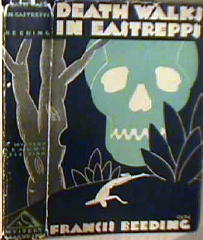
   2. They wrote Death Walks in Eastrepps (1931), a crime novel highly praised by Vincent Starrett and reprinted in Dover’s fine mystery reprint series as late as 1980.

Walks

   3. They wrote a lot of spy novels few people today have read.

   Indeed they primarily wrote spy thrillers, many with their series character, spymaster Colonel Granby. But they also wrote other crime novels (novels deriving their interest from “regular” murders, not involving spies or criminal gangs) besides Eastrepps. These would be:

   1. Murder Intended (1932) (inverted mystery with multiple victims)

   2. The Emerald Clasp (1933) (appears to be another inverted, Before the Fact style mystery, have not yet read)

   3. The Norwich Victims (1935) (along with Eastrepps, their closest approach to a formal mystery novel, it appears)

   4. No Fury (1937) (another multiple murder story, imitative of Murder Intended, reprinted by rather distressingly literal-minded American publishers as Murdered: One by One)

   Also, Mr. Bobadil (1934) is a lost treasure chase novel and Pretty Sinister (1929), though it has ace spymaster Colonel Granby, involves a kidnapping gang. I’m not sure whether there are any others that can be taken out of the spy realm, possibly He Could Not Have Slipped (1939)?

   Anyway, I thought Murder Intended and The Norwich Victims were quite good and would be well worth reprinting. The latter was reprinted by Hodder in 1950, as well as made into an Emlyn Williams film, Dead Men Tell No Tales, in 1939, and is mentioned in the Catalogue of Crime (with less enthusiasm than I have for the book!).

   Does anyone have any familiarity with these presumably more obscure books, and any opinions on them? Or on any of the other Beeding books, for that matter. Beeding seems to me a good genre writer, and I wish “he” had dabbled more in the murder mystery field.

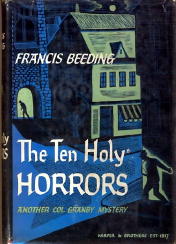
Ten


   From Crime Fiction IV, by Allen J. Hubin:        [British editions only]

BEEDING, FRANCIS Pseudonym of Hilary St. George Saunders & John Palmer; other pseudonyms Barum Browne, Cornelius Cofyn, Christopher Haddon, David Pilgrim & John Somers. PK = Professor Kreutzemark; AG = Colonel (General) Alistair Granby; IW = Inspector Wilkins; RB = Ronald Briercliffe; GM = Insp. George Martin.

* The Seven Sleepers. Hutchinson 1925. PK
* The Little White Hag. Hutchinson 1926
* The Hidden Kingdom. Hodder 1927. PK
* The House of Dr. Edwardes. Hodder 1927
* The Six Proud Walkers. Hodder 1928. AG
* The Five Flamboys. Hodder 1929. AG
* Pretty Sinister.Hodder 1929. AG
* The Four Armourers. Hodder 1930. AG
* The League of Discontent. Hodder 1930. AG
* Death Walks in Eastrepps. Hodder 1931. IW
* The Three Fishers. Hodder 1931. RB
* Murder Intended. Hodder 1932. IW
* Take It Crooked. Hodder 1932. AG
* The Emerald Clasp. Hodder 1933.
* The Two Undertakers. Hodder 1933. AG, RB
* Mr. Bobadil. Hodder 1934.
* The One Sane Man. Hodder 1934. AG
* Death in Four Letters. Hodder 1935.
* The Norwich Victims. Hodder 1935. GM
* The Eight Crooked Trenches. Hodder 1936. AG
* The Nine Waxed Faces. Hodder 1936. AG
* The Erring Under-Secretary. Hodder, pb, 1937. AG. A separately published pb novelet, in the same series with Allingham’s “The Case of the Late Pig” and Carr’s “The Third Bullet.”
* Hell Let Loose. Hodder 1937. AG
* No Fury. Hodder 1937. GM
* The Big Fish. Hodder 1938
* The Black Arrows. Hodder 1938. AG
* He Could Not Have Slipped. Hodder 1939. GM
* The Ten Holy Horrors. Hodder 1939. AG
* Eleven Were Brave. Hodder 1940. AG
* Not a Bad Show. Hodder 1940. AG
* The Twelve Disguises. Hodder 1942. AG
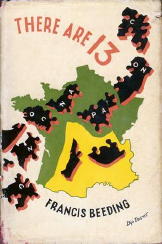
* There Are Thirteen. Hodder 1946. AG

13


BROWNE, BARUM
Pseudonym of Geoffrey Dennis & Hilary St. George Saunders.

* The Devil and X.Y.Z. Gollancz 1931.

COFYN, CORNELIUS Pseudonym of Hilary St. George Saunders & John deVere Loder

* The Death-Riders. Gollancz 1935.

HADDON, CHRISTOPHER Pseudonym of John Palmer.

* Under the Long Barrow. Gollancz 1939.

PILGRIM, DAVID Pseudonym of John Palmer & Hilary St. George Saunders.

* -No Common Glory. Macmillan 1941 [James de la Cloche; 1600s]
* -The Grand Design. Macmillan 1944 [James de la Cloche; 1600s]
* The Emperor’s Servant. Macmillan 1946 [collection].

SOMERS, JOHN Pseudonym of John Palmer & Hilary St. George Saunders.

* The Brethren of the Axe. Murray 1926.

   Excerpted from a recent email from Bill Pronzini:

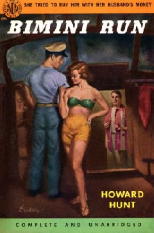
   The Howard Hunt bibliography and commentary on your blog recently was of particular interest, since I’ve always had a soft spot for his fiction (if not for his politics). Among my personal favorites are two first-rate suspense novels written early in his career, MAELSTROM and BIMINI RUN, his first three Gold Medals, and the Steve Bentley series. The Bentleys are pure potboilers, but done with a style and flair that make them compulsive reading.

Bimini

   And from one a few days later:

   The man could write when he put his mind to it, as in BIMINI RUN. Farrar Strauss published the hardcover, Avon a reprint edition. It’s well worth reading. May be in his best novel, in fact. MAELSTROM is very good, though flawed, and the same is true of THE VIOLENT ONES and his other early Gold Medal originals.

   My reaction? More books to track down and read!

         —

   The online Phoenix Press project Bill and I are working on and which I mentioned a few weeks ago stalled out this past week for a few days while I got caught up on other matters, but the pace has quickened again. The covers for the Phoenix Press mysteries are now complete through 1942. We hope that you’ll keep checking out the site, as we plan to continue uploading covers as quickly as we can.

   The following email inquiry came from David Karschner:

   Enjoy reading your blog, thanks! Have a question you can hopefully help with concerning Alan Hynd and the supposedly true stories he wrote for True Detective Mysteries etc. Am doing research on a distant relative named William Watts who worked as an engraver in the Count Lustig counterfeiting ring circa 1930-1935. Hynd authored a six part series in TDM in 1937 about Lustig and Watts. While the major facts jibe with historical data the personal story regarding the two outlaws seems quite fanciful. How much truth can one rely on coming from these types of stories? Believe it or not two of the TDM episodes were found in Watts’ Secret Service file.

   Also do you have any idea on a method for contacting his son Noel Hynd?

   Any input would be appreciated.

               Thanks, David

   If anything, true crime is a category about which I can safely say that I know less than nothing, if it could be possible, so anyone who knows more than I do, or have been able to uncover so far, please chuck a life preserver my way. I’m in over my head, in other words.

   But checking with Allen Hubin’s Crime Fiction IV, emphasis on the “fiction,” I was mildly surprised to discover that there is an entry there for Alan Hynd:

HYND, ALAN (1903-1974)

* * Alan Hynd’s Murder (Duell, 1952, hc) Collection. Somewhat dramatized true crime.
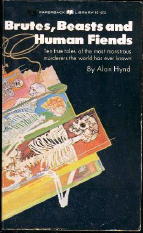
* * Brutes, Beasts and Human Fiends (Paperback Library, 1964, pb) Collection. Dramatized true crime.

Hynd-1

* * The Case of the Lady Who Took a Bath (Berkley, 1957, pb) Collection. Dramatized true crime.
* * Great Crime Busters (Putnam, 1967, hc) Collection. Dramatized true crime, intended for younger readers.
* * Great True Detective Mysteries (Grosset, 1968, hc) Collection. Dramatized true crime.
* * In Pursuit: The Cases of William J. Burns (New York: Nelson, 1968, hc) [Series Character] William J. Burns] Collection. Dramatized true crime.
* * Murder! Great True Crime Cases (Penguin, 1947, pb) Collection. Dramatized true crime.
* * The Pinkerton Case Book (Signet, 1948, pb) Collection. Dramatized true crime.
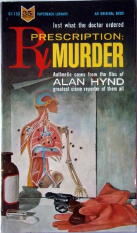
* * Prescription: Murder (Paperback Library, 1962, pb) Collection. Dramatized true crime.

Hynd 2

* * ’Til Death Do Us Part (Paperback Library, 1962, pb) Collection. Dramatized true crime.
* * Violence in the Night (Gold Medal, 1955, pb) Collection. Somewhat dramatized true crime.

   Perhaps the question asks itself. Does “dramatized” equate to “fictionalized?” I haven’t asked Al yet what his standards or definitions are in this somewhat borderline category, but when I do, I’ll add his reply as an update.

   Dave’s reply:

   Dramatized is the correct word, thanks. My problem is separating fact from fiction. For example: As Hynd writes in his articles of an important connection between Al Capone,Count Lustig and my relative William Watts I just wonder what his sources for information were? I am hoping since some of Alan Hynd’s articles were in Watts’ Secret Service files (ones I uncovered thru the FOIA) that he had some great contacts. Who knows?

   As for Noel Hynd, whom (since I never thought about it) I never realized until now is Alan Hynd’s son, he has an entry in CFIV as well. These I’ll put in chronological order:

HYND, NOEL (1947- ); Born in New York City, the son of Alan Hynd, 1908-1974, q.v.; raised in Connecticut, educated at University of Pennsylvania; crime reporter.

# Revenge. Dial 1976
# The Sandler Inquiry. Dial 1977
# False Flags. Dial 1979
# Flowers from Berlin. Dial 1985
# The Krushchev Objective [with Christopher Creighton]. Doubleday 1987
# Truman’s Spy. Zebra 1990
# Zigzag. Zebra 1992
# -Ghosts. Zebra 1993
# A Room for the Dead. Kensington 1994
# Cemetery of Angels. Kensington 1995
# Rage of Spirits. Kensington 1997
# The Lost Boy. Pinnacle 1999

   Doing some quick Googling, this list does not include, within the proper time frame of 2000 and before, The Prodigy (1997), which appears to be a supernatural horror story only.

   There are some interviews with Noel Hynd which you can easily find online, but they all seem to taken place in the late 1990s. A rather complete biography can be found at IMDB, and this led me to his most recent book, The Enemy Within, which was published by Tor/Forge in 2006. [But with nothing published between 1999 and 2006.]

   Dave is now attempting to reach Mr. Hynd through Forge.

         —

UPDATE [02-11-07]   I’ve just heard from Al Hubin, who says:

   Steve,

   By “dramatized” and “fictionalized” I generally mean to imply that material was added (usually dialogue) to enhance the story, which is based on true events. The degree of “dramatization” and “fictionalization” may vary widely, and the Revised CFIV will include a good deal more of Alan Hynd’s work. (I bought copies of a number of his books in order to see what sort of thing he wrote and to be able to list the story titles.)

   All very imprecise, I’m afraid!

               Best,

                  Al

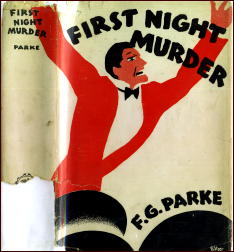
F. G. PARKE – First Night Murder A. L. Burt & Co.; hardcover reprint; no date. First Edition: Dial Press, hc, 1931.

   The bad news first, perhaps, if you happen to read this review and if I happen to convince you that you might want to read the book for yourself. There are three copies on ABE at the present time, one the Dial Press edition for $35, one in French for under $20, and one the British hardcover (Stanley Paul, 1932) for over $40. (The one from Dial Press has a jacket, and I think it’s worth the money.)

   But what the heck, keep reading. I may not convince you anyway. And who is F. G. Parke, you ask, and well you may. No one seems to know, and it’s not even his (or as it has suddenly occurred to me) her name. It’s a pseudonym. I think the author is male, however, thinking about it even as I sit at the keyboard. It’s not a woman’s tale, what with the many-faceted male point of view which so generally obvious if not blatant — and maybe so obvious that I could very well be wrong.

   But as I was reading this — and enjoying it, for the most part — and don’t worry, I will be sure to let you know at which point I stopped enjoying it — I pretended in my mind (and where else) that this was an unknown work of the cousins known as Ellery Queen, who needed some money at this point of their career, which would have been, roughly, between The French Powder Mystery (Stokes, 1930) and The Dutch Shoe Mystery (Stokes, 1931), perhaps.

   Or perhaps not, but it was fun to pretend — and who knows, I could very well be wrong, and they actually did write it. What got me thinking this way, though, was the locale where the first murder was committed: in a theater during the actual performance of a play, the New York City Police Commissioner in attendance, among many other notables, it being first night, of course. A mystery drama is about to reach its denouement, the lights go out, a woman’s wild scream rings out, the lights come back on, the villain (of the play) is in handcuffs — and a noted Broadway producer is found stabbed to death in his seat near the front of the theater, the space next to him unused.

   Fifteen seconds of darkness — hardly time enough for the killer to make a getaway — but no knife is found (everyone is searched) and no one heard anything, no one saw anything. There is no lack of potential murderers, for as if by pre-arrangement, motives for everyone seated in seats within a small vicinity are soon revealed. But once again, no one heard, saw or felt anyone move or pass by them, and — this is the key — there is no murder weapon anywhere in the theater.

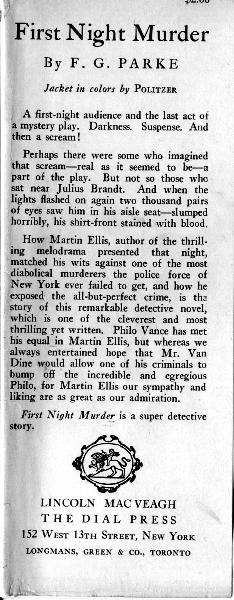
   Doing the honors as the detective at hand is Martin Ellis, the author of the play, the first step of what he had hoped to be a long career as a playwright. The inner flap of the dust jacket (the only piece of the jacket I happen to have) compares him favorably with Philo Vance, but on the other hand, you know how the people who write story descriptions on the flaps of dust jackets often seem to exaggerate.

   No, it was Ellery Queen I kept thinking of (Ellis = Ellery?). The Roman Hat Mystery? And yes, I know that it was death by poison in that first novel the Queens wrote, but still, it was a during a play that the victim in that book, an unliked/unlikable lawyer, was killed.

   But Martin Ellis on his own, and as a writer of mystery fiction himself, seems to be amiable enough and competent enough to solve this case, even though he is in love with the girl, the actress on stage, whom the dead man married earlier the same day, which in most books would make him the number one suspect. (I did suggest that there are motives galore — what’s lacking are means and opportunity.) Both Lt. John B. Gradey of Homicide and District Attorney Moore eliminate him quickly as a suspect, however, as he was seen by two witnesses just before and after the lights went out, and nowhere near the scene of the crime.

   To help demonstrate Ellis’s prowess as a detective, along either Queenian lines, or Vancian, you choose, here’s a quote from page 98:

   Considering that he [Ellis] had during the past few years conducted theoretical investigations strictly along scientific lines, it would do him no harm, he thought, to borrow a leaf out of one of his own books. All the best detectives sported a fine flair for calm, unbiased reasoning. They analyzed. They synthesized. They equipped themselves with a supply of cold, hard facts and from these they made unfailing deductions with mathematical precision. The hundred per cent sleuth of fiction, in short, did everything but beat his breast passionately with both fists and gather himself for a leap at the most obvious conclusion in his maiden chapter.

   As I say, you choose. More deaths occur, with plenty of influence on the thinking processes of Martin Ellis, but as it occurred to me, with very little emotional impact. As for the solution, as I skip over in this short essay anything more about all of the suspects and the all of the suspicious activity that goes on in this book, it is the solution that tells the tale, and to tell you the truth, while I was ready for it, already having made a note to myself about the paragraph I quoted to you above, I really wasn’t ready for it. Don’t know as I still am, as a matter of fact, but I guess that means that I should take my hat off to Mr. Parke, whoever he was.

   The gentlemen behind Ellery Queen could never have been quite this melodramatic — could they?

UPDATE [02-10-07]   I emailed the seller of the Dial first edition of this book a couple of days ago, asking if there was anything helpful that was said about the author on either the back panel of the dust jacket or its flaps. Perhaps asking for too much, I also inquired if a scan of the cover might be possible. I’m still hoping, but to this date, I have not heard back.

UPDATE [02-24-09]    Over two years later — have I been doing this that long? — and I finally have a cover image to show you. A big thank you goes to Luca Conti, who emailed me with it as an attachment a couple of days ago:

F. G. PARKE First Night Murder

    I’m not sure how well this additional scan of the blurb from inside the dust jacket will show up, but I since I mentioned it in my review, Luca sent it along. I think it’s worth the try:

F. G. PARKE First Night Murder

   Some background information first. Every so often on the Yahoo Golden Age of Detection discussion group, a British mystery writer who wrote a long list of books in the 20s and 30s under the pseudonym of A. Fielding comes up for discussion, the primary question being: Who was she? What was her real name?

   The current listing in Crime Fiction IV, by Allen J. Hubin, reads thusly:

FIELDING, A. Pseudonym of Dorothy Feilding, (1884-?) Series character: P = Chief Inspector Pointer

* Deep Currents. Collins, 1924
* The Eames-Erskine Case. Collins, 1924 (P)
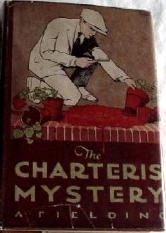
* The Charteris Mystery. Collins, 1925 (P)
* The Footsteps That Stopped. Collins, 1926 (P)
* The Clifford Affair. Collins, 1927 (P)
* The Cluny Problem. Collins, 1928 (P)
* The Net Around Joan Ingilby. Collins, 1928 (P)
* Murder at the Nook. Collins, 1929 (P)
* The Mysterious Partner. Collins, 1929 (P)
* The Craig Poisoning Mystery. Collins, 1930 (P)
* The Wedding-Chest Mystery. Collins, 1930 (P)
* The Upfold Farm Mystery. Collins, 1931 (P)
* Death of John Tait. Collins, 1932 (P)
* The Westwood Mystery. Collins, 1932 (P)
* The Tall House Mystery. Collins, 1933 (P)
* The Cautley Conundrum. Collins, 1934 (P)
* The Paper-Chase. Collins, 1934 (P)
* The Case of the Missing Diary. Collins, 1935 (P)
* Tragedy at Beechcroft. Collins, 1935 (P)
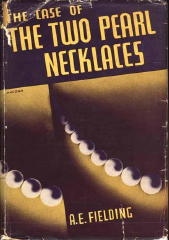
* The Case of the Two Pearl Necklaces. Collins, 1936 (P)
* Mystery at the Rectory. Collins, 1936 (P)
* Black Cats Are Lucky. Collins, 1937 (P)
* Scarecrow. Collins, 1937 (P)
* Murder in Suffolk. Collins, 1938
* Pointer to a Crime. Collins, 1944 (P )

   Note: Many of these books were also published in the US, under sometimes slightly different titles, not noted here. In the US the byline was often A. E. Fielding.

Fielding 1

   John Herrington has looked into this case of unknown identity on several occasions, and this is his response to the most recent flurry of emails posted on the GAD group. I’ll step back at this juncture and allow him to take over. [This is a composite of two emails he sent me earlier today as we were discussing who Dorothy Feilding might be.]

Hi Steve,

   I assume that you have come across the recent identification of the 1920’s/1930s pseudonymous crime writer A. (sometimes A.E.) Fielding as one Lady Dorothy Mary Evelyn Moore (nee Feilding), 1889-1935.

   I am wondering if it is worth mentioning her in your blog as I feel this incorrect — that the attribution seems to have been done on the basis that she is the only Dorothy Feilding that has been traced. I cannot see any evidence that says she ever wrote a book, let alone a series of 27 crime novels — six of them after she died!

   What the subscribers to this attribution do not mention is that Lady Dorothy was seriously ill for several years before dying in 1935. Would she have been in a state to write around dozen books in her last five years (not including any notes etc on the supposedly posthumous ones?).

   Another thing which says the attribution is incorrect is the comment by her American publisher in Kurnitz and Haycraft’s Twentieth Century Authors (1942). In the entry for A. E. Fielding:

    “The editors of … are assured by the American publishers of the Fielding books, H.C.Kinsey Co of New York, that the author behind the initials is really a middle-aged English woman by the name of Dorothy Feilding whose peacetime address is Sheffield Terrace, Kensington, London, and who enjoys gardening.”

   I assume that this must be the original source of the identification on a Dorothy Feilding as the author (though no one seems to have checked the address before?), after the early assumption that it was one Archibald Fielding was dislodged. Now Lady Dorothy is described (in both her Dictionary of National Biography entry and her obituary in The Times) as living in Moorcroft, Tipperary after her marriage where she helped run the estate — and where she died. May I add, that both articles carry no other information on her life after her marriage.

   However there is a problem with the London Dorothy Feilding. I have checked the electoral roll for Sheffield Terrace for the mid 1930s and there is no Dorothy Feilding listed. Although, interestingly, there are various Dorothy’s (or variations) amongst the women living in the Terrace. Of course, there are possibilities — Feilding was her married name, and was registered, for some reason, under her maiden name which is unknown. To me, a more likely scenario than a dying lady Dorothy writing them in Ireland. Also would a person dying in Ireland disappear to London to write?

   I believe there must be some truth in what H C Kinsey says. I assume there information came originally from Collins, the UK publisher — and I cannot believe they would create a false identity, especially naming a specific address. I have spoken to the Collins archivist who tells me that no records remain on A. Fielding, that presumably they were lost in WW2. (Conspiracy theory!)

   The other curious bit of information is the date of birth of 1884 which is given in the entry in Twentieth Century Crime and Mystery Writers (1st edition, 1980) — and which Allen Hubin uses. Where did this come from? Though, like Lady Dorothy’s 1889, it would fit ‘a middle-aged Englishwoman’ in the 1930s.

Fielding 2

   Reading the GAD posts, I am wondering if Dorothy Feilding is being considered as a maiden or married name. Okay, Lady Dorothy Feilding is a maiden name, but the lady was well known and easily traceable. But what if Dorothy Feilding was her married name? The chances of finding her on something like Freembd would be slim unless we knew her maiden name.

   And what if Dorothy was not her first name? What if there was another name first, which she did not like to use (like my late aunt who was Dorothy Nancy, but was always known as Nancy)?

   After all this, I do not know who “A. Fielding” was. But I am fairly certain that it was not Lady Dorothy. To me, these last two questions alone make it a bit dubious to simply pick on Lady Moore, nee Feilding. Too much unanswered I think.

   Sadly I think the probable answer might lie in the UK census records for 1921 or 1932 — which will not be available for a while yet. And I wish I could trace the book I read over twenty years ago, the book in which the author talks about a Dorothy Feilding deciding the best pseudonym would be to invert letters in her own name.

   My peers in the world of crime fiction may have passed sentence on Lady Dorothy being A Fielding, but I reckon an appeal will be lodged.

                  Regards

                     John

          —

UPDATE [02-09-07]  For those wishing a quick sampling of Fielding, the text of Tragedy at Beechcroft can be found online at Gutenberg Australia. The authorship there is attributed to one Archibald Fielding, a theory apparently once held but now discarded. –Steve

   This entry began life as a comment by Juri Nummelin to the obituary I did last weekend for Tige Andrews of “Mod Squad” fame, followed by a reply of my own. The combination grew lengthy enough that I decided both comment and reply deserved a post of their own. Juri goes first:

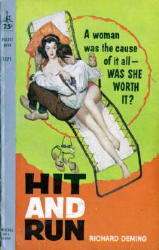
   Wonder how the [Mod Squad] books by Richard Deming compare to his earlier. I’ve liked several of his late fifties crime paperbacks, especially HIT AND RUN (1960).

Deming

   My reply:

   That’s a good question, Juri, but it’s been way too long since I’ve read anything by Richard Deming to be able to say. I remember enjoying his early 50s PI novels with Manville Moon, and I did read one of the Mod Squad paperbacks when it came out, but you have to realize how long ago this was.

   I also remember even writing a review one of the Charlie’s Angels paperbacks he wrote as Max Franklin (and the late Ellen Nehr asking me why I was wasting my time reading crap like that).

   If you were to try to pin me down, what I recall of the Mod Squad book was that it followed the story line and the characters very well. Don’t know if I did any kind of comparison with anything else Deming had written, even at the time. I rather doubt it.

   In general, though, I think that when already established writers do media tie-in’s like these, their basic styles usually work their way through, even with the groovy language and the glitter and glamor of Angels’ hair they have to work with.

   It’s probably why Deming was hired so often to do them. (He did a couple of Dragnet adaptations, too.) He was able to capture the characters and the essence of the shows, but he also made sure there was a backbone of a story in whatever he wrote as well.

ROMILLY & KATHERINE JOHN – Death by Request. Hogarth Crime; trade paperback. 1984. Also published as a Hogarth hardcover. Offset from the original [hardcover] Faber & Faber edition, 1933. Vintage/Ebury, US, hardcover and paperback, 1984.
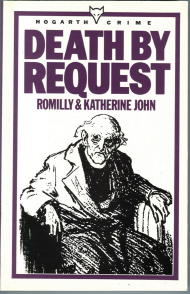
   Quite surprisingly, given the fact that it’s been reprinted several times, this is the only mystery that the married couple of Romilly and Katherine John wrote. Who were they, is one question, and how did it happen that Hogarth reprinted it some 50 years later?

   For at least a partial answer, one must read the new introduction to the Hogarth edition, written by Patricia Craig and Mary Cadogan, as part a series of Hogarth Crime reprints of classic detective fiction. Romilly, born in 1906, was in the RAF, was briefly a civil servant, then a poet and an amateur physicist before dying in 1986. Katherine was a reviewer as well as a translator of Scandinavian books. She died two years before her husband, in 1984.

   The gap between 1933 and 1984 between editions may be one of the longest on record for any mystery novel. The fact remains that Hogarth Press considered it significant enough to reprint in a series of classic crime fiction. In that regard, the book is a locked-room mystery; and in its own inimitable way, a minor tour de force of one form or another, the details of which I most sincerely will do my best to avoid telling or revealing to you.

   The dead man is found in his bedroom at one of those old English manor residences so commonly found in works of mystery fiction, especially the English ones. He is found gassed to death in a heap on the floor, still dressed as he was the evening before, the window shut tightly, and (of course) the door was locked. It had to be broken down in order to enter in the morning. Could it have been suicide? No, Lord Malvern seems to have been well enough off, and he was off to visit his fiancée in London on the very same day as his death.

   Telling the story is the local vicar, an elderly man by the name of John Colchester, a long-time friend of Matthew Barry, the master of the house. Also staying over are various friends and relatives, including a comic-relief colonel who harrumphs all over the place; a weepy young girl; a recent widow only slightly older; the slightly deaf sister of Matthew; assorted staff, mostly female, save for a slightly villainous butler named Frampton.

   And to tell the truth Frampton is more than only slightly villainous. He’s a socialist, a seducer of young maids in the area, and — as the truth comes out — a blackmailer. Many letters which threaten to reveal secrets which others might wish kept unrevealed are found, some sent by Frampton, others perhaps not. Obviously, as these have a great deal to do with the plot, the letters — their contents, who received them, who sent them, and who may have intercepted them — must be given, as the book goes on, a exhaustive and thorough going over.

   And to tell you another truth, the going-over of the letters is probably too thorough and exhaustive. One is tempted, I must admit, to throw up one’s hands whenever another letter appears and must be discussed and put into the context of the previous ones.

   I see that I have neglected to mention the detective on the case. Nominally that would be Inspector Lockitt, but that particular gentleman seems content to do his work off-camera, as it were. Almost all of his activity is related to the vicar second-hand, and then of course the vicar must relay his impressions of the good Inspector Lockitt on to us, the reader. It seems a strange way to tell a mystery, but one must always get accustomed, eventually, to things we expect to occur in the usual way, but which do not, do we not?

   The bulk of the detective work is rather more accomplished, in fact, by an unusual twosome: (a) Mr. Nicholas Hatton, a friend of the dead man’s fiancée, one of those amateur detectives who are as common in British mystery fiction in the 1930s as damp old manor houses with murders committed within them, and (b) the aforementioned widow, Mrs. Fairfax, who proves to be a most tenacious (and efficacious) individual when it comes to solving mysteries.

   There are secrets galore that must come out before the solving is done, including at least two that should correctly be considered “bombshells” when they are revealed. There is, of course another secret at the end, which I promised not to tell or reveal to you, and looking back at what I have written, I do not believe that I have.

   So, is the book a classic? You may well ask, and you should. No, I say, but with a small hedge in the back of my mind. For today’s audiences, large portions of this exercise in murder-solving will be dreary and dull to the extreme. For those of you who like puzzles, well, the puzzle is there, and without a doubt, a double delight it is. The problem is that it’s, well, unskillfully told, when measured by more modern standards, say of five or so years later.

   That the door was locked on the inside, for example, is not revealed until page 50, whereas the body itself was found on page 24. Nor, surprisingly enough, is the locked room aspect very much — if at all — the focus of the tale. This may in part be due to the telling (see above) or the fact that (as is often the case) the solution (to the locked room aspect) is rather simple when explained, and therefore not very worthy of much dwelling upon.

   If you were to read this book — and if you are still with me, I would at least suggest that you should, for this must be the kind of mystery you prefer to read, not so? — you will also need to know what a geyser is, at least a geyser that one would find in the bathroom of a country house in England in the early 1930s. Readers of Dorothy L. Sayers’ Unnatural Death, for example, will have already come across one, I believe, if they were to think back upon it.
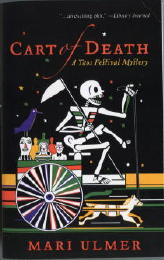
MARI ULMER – Cart of Death

Worldwide; paperback reprint, September 2006. Hardcover edition, as Carreta de la Muerte (Cart of Death): Poisoned Pen Press, April 2001.

    Subtitled “A Taos Festival Mystery,” this second adventure in which Christina Garcia y Grant finds herself involved takes place shortly before and during the celebration of the local Las Fiestas holiday. The first book in which Christy appeared was Midnight at the Camposanto (April 2000), which took place on a previous Good Friday through the following Easter Sunday.

    According to the Poisoned Pen website, the latter was to have been “the first novel in a series planned to follow the sacred and secular calendar through its annual cycle,” but thus far, only the two books have been published. (Also on the PP website is an announcement that “Mari is now working on More than Mischief at San Geronimo,” but since on that same page is a link to her 2002 author’s tour, along with the fact Ms. Ulmer is now 74 years old, I have a feeling that the chances that it will appear are diminishing quickly.)

Cart

    Which is shame, for I rather enjoyed this book, in spite of some rather uncomplimentary comments some readers have left on Amazon. Christy is a former lawyer who now runs a bed-and-breakfast in a small town south of Taos while she attempts to begin a writing career. This means that there are numerous tenants whose humorous antics keep her hopping while she is trying to keep them happy. Her mother lives by, and when the festival begins, the guests are displaced by all of her relatives who come swarming in.

    One particular tenant is a permanent resident, a retired surgeon from Florida named McCloud, or Mac for short, and an attraction between Mac and Christy seems to be growing. At least enough so that when other men look at Christy longer than he thinks they should, Mac feels the pangs of jealousy.

    Especially gnawing at Mac is that the suave Evelyn Bottoms (male) would make such an ideal candidate for the murder of a young worker at a local art gallery. Missing is Bobby’s female assistant, Cindy, a close friend of Christy’s mournful friend Iggy (short for Ignacio), a young lawyer she has been mentoring.

    The mystery is strangely gruesome, with at point (page 140-141) three more deaths occurring within the span of two pages. The detective work? Well, it’s as satisfying as it is in most present-day cozies. The star attraction for this book, though, overshadowing everything else, is the locale, its history, its inhabitants, and the overall spirit of enthusiasm and joy that’s on continuous display for all of the above.

    Not quite so satisfying, given the lack of another tale to continue the series, is that the semi-romance between Christy and Mac, which is left badly hanging. All readers are would-be authors, though, are we not? Anyone who reads this rather charming look at contemporary New Mexico culture (plus mystery) will know exactly how that will come out, or already has.

UPDATE: This review was written in November of 2006. A representative of Poisoned Pen Press promised to pass on to Ms. Ulmer an email of inquiry I’d sent them, suggesting that perhaps she would respond to me directly. That was several weeks ago, and she has not. More, the information I quoted from the PP website is no longer there, or at least I am unable to find it again. I wish I had better news than this.

   As you will have read in every newspaper in the country today, author, screenwriter and playwright Sidney Sheldon died yesterday at the age of 89.

   In all likelihood, the average person (not you), having glanced at the headlines and the first few paragraphs without reading further, will think of Mr. Sheldon as an author of powerful blockbuster bestsellers a lot more than they’ll remember him as a writer of crime fiction.

      If that is the case — and who knows, I may be wrong — I suspect it’s because that same hypothetical average person, when confronted with the phrase “crime fiction,” thinks primarily of “detective fiction,” and of Agatha Christie, Perry Mason and Spenser: For Hire, for example, but none of which (or whom) were Mr. Sheldon’s model, style or forte.

    No matter. Sidney Sheldon was a crime fiction writer. Most of his novels were strongly based on criminous activities of all sorts, including (and especially) murder and its aftermath, often dealing with the rich and famous, beginning with his very first novel, The Naked Face, which earned him the Edgar for that year’s Best First Novel from the Mystery Writers of America.

   From the wikipedia website is a synopsis of the story line:

    “Judd Stevens is a psychoanalyst faced with the most critical case of his life. If he does not penetrate the mind of a murderer he will find himself arrested for murder or murdered himself…

    “Two people closely involved with Dr. Stevens have already been killed. Is one of his patients responsible? Someone overwhelmed by his problems? A neurotic driven by compulsion? A madman? Before the murderer strikes again, Judd must strip away the mask of innocence the criminal wears, uncover his inner emotions, fears, and desires-expose the naked face beneath…”

Naked Face

   From Allen J. Hubin’s Crime Fiction IV is a list of Mr. Sheldon’s work that correctly belongs to our field, ignoring all of the work he did as a screenwriter. (The hyphen before two titles indicates marginal crime content.)

SHELDON, SIDNEY (1917- )

* Redhead [with Herbert Fields, Dorothy Fields & David Shaw] (play) Chappell 1960 [London; 1905 ca.]
* The Naked Face (n.) Morrow 1970 [New York City, NY]
* The Other Side of Midnight (n.) Morrow 1974 [Catherine Douglas]
* Bloodline (n.) Morrow 1978
* Rage of Angels (n.) Morrow 1980 [New York City, NY]
* If Tomorrow Comes (n.) Morrow 1985
* Windmills of the Gods (n.) Morrow 1987
* The Sands of Time (n.) Morrow 1988 [Spain]
* Memories of Midnight (n.) Morrow 1990 [Catherine Douglas]
* The Doomsday Conspiracy (n.) Morrow 1991
* -The Stars Shine Down (n.) Morrow 1992
* Nothing Lasts Forever (n.) Morrow 1994 [San Francisco, CA]
* Morning, Noon and Night (n.) Morrow 1995
* -The Best Laid Plans (n.) Morrow 1997 [Dana Evans]
* Tell Me Your Dreams (n.) Morrow 1998 [California]
* The Sky Is Falling (n.) Morrow 2000 [Dana Evans]

   To which I can add the following books published after the year 2000:

* The Sky is Falling (2001) [Washington anchorwoman Dana Evans]
* Are You Afraid of the Dark? (2004)

   Two books, Catoplus Terror (a novel about a former spy attempting to apprehend Carlos the Jackal) and The Pavid Pavillion, are not written by Sidney Sheldon but are said to have been done by someone else who published them under his name. (Someone will have to enlighten me on these two books, as I cannot find copies of either of them offered for sale on the Internet.)

   From today’s obituary for Mr. Sheldon in the New York Times, I offer this excerpt about his writing:

   Sheldon’s books, with titles such as Rage of Angels, The Other Side of Midnight, Master of the Game and If Tomorrow Comes, provided his greatest fame. They were cleverly plotted, with a high degree of suspense and sensuality and a device to keep the reader turning pages.

    “I try to write my books so the reader can’t put them down,” he explained in a 1982 interview. “I try to construct them so when the reader gets to the end of a chapter, he or she has to read just one more chapter. It’s the technique of the old Saturday afternoon serial: leave the guy hanging on the edge of the cliff at the end of the chapter.”

   Analyzing why so many women bought his books, he commented: “I like to write about women who are talented and capable, but most important, retain their femininity. Women have tremendous power — their femininity, because men can’t do without it.”

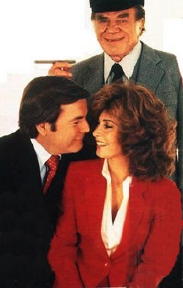
   For Mr. Sheldon’s credits in the world of TV and movie entertainment, I will send you to IMDB. Of the various series and films he worked on, the one for which I’d remember him most is Hart to Hart (1979-1984)the TV series he created starring Robert Wagner and Stefanie Powers, with made-for-TV movies continuing on through 1996. Fluff, perhaps, but high-powered (and highly enjoyable) fluff, and they did solve crimes.

Hart to Hart

   For even more on Mr. Sheldon’s long career, you could not do better than to start with his own website, then head to a February 2006 interview with him by Kacey Kowars from which the following excerpts are taken:

KK: You were not pleased when THE NAKED FACE, your first novel, sold 17,000 copies. Could you explain that for your readers?

SS: I thought it was a failure. The publishers were pleased. It won The Edgar Award for best first novel. But my television shows [I Dream of Jeannie], were being watched by 20 million people every week.

   but later:

KK: Looking back over your career it seems you found the greatest satisfaction in writing novels.

SS: Yes, no question. When you write a screenplay you write in shorthand. You don’t say that your hero is tall, lanky, and laid-back. You might be thinking of giving the script to John Wayne and they give it to Dustin Hoffman. So you generally characterize it. In a novel it’s just the opposite. If you don’t put those things down your reader won’t know what you’re talking about.

KK: Is there one thing you’re proudest of as a writer?

SS: Finishing a novel when I was certain I didn’t have the talent to be a novelist. That was THE NAKED FACE.

UPDATE [02-01-07] On his blog, which you should visit every day, Ed Gorman gives a blunt but hugely accurate assessment of Mr. Sheldon’s career, then compares the comments he’s received on his death with those given Harold Robbins. Two writers whose fictional work took place in the same strata of society, two wholly different reactions to their passing.

« Previous PageNext Page »