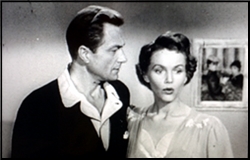
NEVER LET GO. Rank Film Distributors Ltd., UK, 1960. Richard Todd, Peter Sellers, Elizabeth Sellars, Adam Faith, Carol White, Mervyn Johns. Co-screenwriter/director: John Guillermin. Currently available on YouTube here.
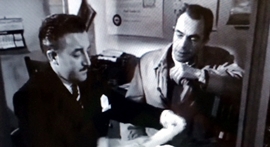
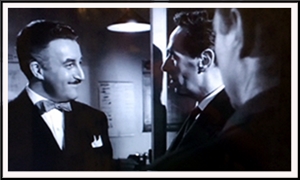
You’d hardly believe it was Peter Sellers. Well, that’s not quite true. It’s just that one doesn’t necessarily think of Sellers when one thinks of a cinematic villain. Indeed, Sellers almost never played completely straight roles, let alone villainous ones. That, above all else, is what makes Never Let Go worth watching. For here one gets to see how much of a range Sellers had and how incredibly captivating a performance he was capable of when presented with the opportunity.
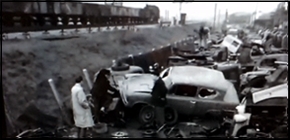
Directed by John Guillerman, this late British noir exudes a somewhat sleazy, definitively downmarket atmosphere boosted by a jazzy John Barry score. This is not posh London, but the London of juvenile delinquents and the lower middle class struggling to get by. Among them is perfume salesman John Cummings (Richard Todd), a perpetual dreamer who thinks success is just over the horizon. When his recently purchased 1959 Ford Anglia is stolen, he sets out on a frenzied quest – think Moby Dick – to get his beloved car back.
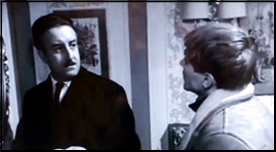
This puts him at odds with both the police and the leader of a vehicular theft ring by the name of Lionel Meadows (Peter Sellers). Meadows is a brute of a man. Cruel and vindictive, he isn’t above hitting women, killing animals (note: there is a particularly disturbing scene where a real fish is left flopping on the ground), and forcing a lonely, elderly man into taking his own life.
As much as Meadows is cruel, Cummings is determined. He will get his car back, even if it costs him his marriage or his life. This obsessive desire can be best understood as reflective of the perilous economic status of England’s middle class. It’s not so much the car that he wants, as it is what the car represents; namely, the post-war dream for societal and economic advancement in a rigidly stratified society.
Even though Cummings is the titular hero in his psychodrama, it is Meadows who is the most memorable character. Richard Todd simply can’t compete with Peter Sellers in holding the audience’s attention. It’s a downright chilling performance from a legendary actor most associated with his comedic roles.
CODE 7: VICTIM 5. British Lion Film Corp., UK, 1964. Columbia Pictures, US, 1965. Lex Barker, Ann Smyrner, Ronald Fraser, Walter Rilla. Co-producer (uncredited): Harry Alan Towers. Director: Robert Lynn.
Code 7: Victim 5 has the distinction (?) of being one of the first films to try and cash in on the post-Goldfinger James Bond craze. This was marketed as a spy thriller (The original title was simply Victim 5) but it’s actually … well, what is it exactly? Something about a New York Private Eye named Steve Martin (is he meant to be the same character Raymond Burr played in Godzilla? Could this be the basis of future academic discussion?) called to Cape Town South Africa to find out who killed a millionaire’s butler, and learning this is simply one in a series of murders involving former POWs from World War II who … who … zzzzz.
Steve (played here by Lex Barker) Martin’s investigative technique consists of going from one tourist spot to another – any place where there’s scenery, really — looking for clues or something and getting in fights, shoot-outs and car chases, all of which, the background music Insists, must be very exciting, but they seemed sort of blah to me.
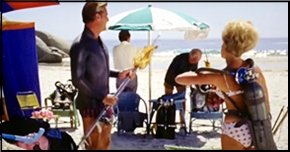
There’s a bit of imagination In one sequence involving Death by Ostrich Stampede, and late in the film we get to see the former Tarzan once again stalking lions through the jungle, but mostly this is the kind of film that is usually (and charitably) dismissed as “routine.” The smutty-sub-Bond double-entendres and the plethora of girls In Beach Party bikinis, sporting 1960s hairdo’s maybe made the movie look hip back in ’65, but now it just looks quaint — it doesn’t have a quaint charm, it’s merely quaint.
— Reprinted from The Hound of Dr. Johnson #44, March 2006.
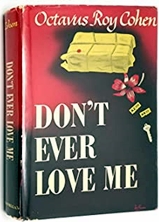
OCTAVUS ROY COHEN – Don’t Ever Love Me. Macmillan, hardcover, 1946. Popular Library #332, paperback, 1951.
Octavus Roy Cohen’s mysteries are slick and entertaining, smoothly written in a style that no doubt appealed to the readers of the Saturday Evening Post and other publications where many of his stories. appeared. Don’t Ever Love Me is a good example of his novel-length work, a light romantic mystery featuring a fairly liberated heroine, at least by the standards of 1946.
To say much more about the plot would be unfair, but it involves two more murders and a goodly number of suspects. Cohen manages some adroit misdirection before Gordon, to the astonishment of the homicide detective on the case, manages to figure out just exactly what has been going on. And of course, it’s fun to consider the detective’s final words on the case in light of today’s methods of law enforcement: “The confession is what counts – not how you get it.”
Paperback collectors will find the cover of the 1951 Popular Library edition of Don’t Ever Love Me irresistible, even though the beautiful blonde with the dark eyebrows and the automatic pistol has nothing at all to do with the story.
Jim Hanvey, Detective ( 1923) is a collection of short stories that demonstrates Cohen’s ability in that form. And Cohen came up with the title Scrambled Yeggs (1934) years before Richard S. Prather.
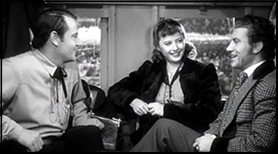
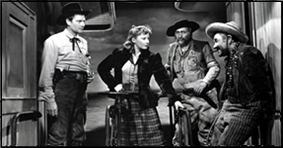
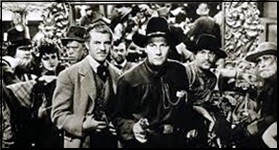
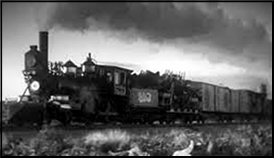
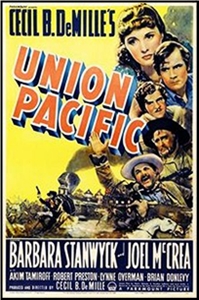
UNION PACIFIC. Paramount Pictures, 1939. Barbara Stanwyck, Joel McCrea, Robert Preston, Brian Donlevy, Akim Tamiroff, Lynne Overman, Robert Barrat, Henry Kolker, Anthony Quinn, Lon Chaney Jr., Stanley Ridges, Evelyn Keyes, Regis Toomey, Joe Sawyer, J. M. Kerrigan, Richard Lane, Fuzzy Knight. Screenplay by Walter DeLeon, C. Gardner Sullivan, and Jessie Lasky Jr.; adapted by Jack Cunningham from a story Ernest Haycox (also uncredited on the screenplay, along with Frederick Hazlitt Brennan). Directed by Cecil B. DeMille.
One of Cecil B. DeMille’s better epics, and probably his best Western, the story of the race to Ogden, Utah, by the Central Pacific and Union Pacific Railroad centers on the efforts of trouble-shooter Jeff Butler (Joel McCrea) in the employee of General Dodge (Francis McDonald) to prevent murderous gambler Syd Campeau (Brian Donlevy) from sabotaging the advance of the title railroad for crooked Chicago businessman A. M. Barrows (Henry Kolker), who plans to fund the Union Pacific, buy Central Pacific stock and make a fortune selling the former short when it fails by his machinations.
It’s based on a tight well written story by Ernest Haycox, ironically whose story “The Last Stage to Lordsburg†was filmed as Stagecoach the same year. Cecil B.DeMille and John Ford both using your work as a source the same year was a pretty heady place for a pulpster to be, and it showed when Haycox, already in the slick, soon graduated to the Book Club circuit and best seller list too.
Complicating things is the three-way romance between Irish postmistress Molly Monahan (Barbara Stanwyck, beautiful, though you can take some issue with her Irish accent), daughter of engineer Monahan (J. M. Kerrigan) who drives the General McPherson, charming rogue Dick Allen (Robert Preston), Butler’s former wartime friend and Campeau’s partner, and Jeff.
As usual the history in any DeMille epic is only there to back up a good deal of myth and legend and a certain amount of flag-waving and or Bible-thumping, but it is pretty good corn here with lots of riding, shooting (a memorable shootout between McCrea and Anthony Quinn, “It’s a good thing you keep that mirror clean.â€), fighting (a good fight between McCrea and Robert Barratt), and romance between Stanwyck and charming Preston and reticent stalwart McCrea (“I loved him from the first time I hit him.â€).
When Allen steals the railroad payroll Molly covers for him, but forces him to return the loot in exchange for marrying him which puts him on the wrong side of Campeau.
“You know what there is in that sack, champagne, carriages, and enough money to live well the rest of our lives,†Dick tries to explain to her.
Akim Tamiroff is Fiesta and Lynne Overman, Leach Overmile, Butler’s seedy comedic companions. They were similarly teamed, only on opposite sides, in Northwest Mounted Police. Preston played similar rogues in the former and in Reap the Wild Wind (also with Overman). Virtually everyone in the film from son-in-law Quinn to the least bit part is from a DeMille regular (Monte Blue, Elmo Lincoln, Frank Lacteen, and Iron Eyes Cody all are uncredited and look for a young Richard Denning).
There is an old saw about the basic kinds of Western, and this one fits clearly in the Empire building category of silent classics like The Iron Horse and Covered Wagon. It’s a bit old fashioned even for 1939, considering it competes with Stagecoach.
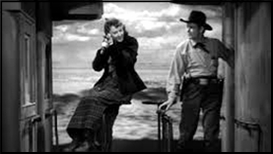
Molly marries Dick to save Jeff, but Campeau talks and Jeff arrests him the day of their wedding. She helps him escape, but when Dick hides out on Molly’s car on the way to Laramie he discovers she really loves Jeff just before they are attacked by a Sioux war party stirred up by Campeau.
However you view the whitewashing of Western history or the exploitation of Native Americans it is a splendid sequence visually with DeMille at his best right down to the cavalry coming on another train.
There is some sympathy for Native Americans expressed here, more than in Stagecoach where Ford uses them only as a force of nature.
That rescue train crossing a burning trestle is beautifully shot, right down to the comic relief when Tamiroff’s mustache is burned off (Overman: “I never liked it in the first place.â€)
There are a number of scenes like that in the film including Irish track layer Regis Toomey murdered by Anthony Quinn speaking of the light as a shadow passes over his dying face and a weeping Stanwyck holds him in her arms on the saloon floor.
Another nice set piece features Jeff and Monahan pushing the General MacPherson across a snow bridge to cut around a tunnel they can’t complete in time. “’Tis the first time for an engine to run on snow, and if he don’t like it, I’ll put snowshoes on him.â€
Yes, it is corny, right down to the use of “My Darlin’ Clementine†as a running theme throughout the film even as a funeral dirge for Monahan when the first attempt at crossing the snow proves fatal, but it still has cinematic power in the old Hollywood tradition. It may be model work, and obvious to us today, but it was state of the art in 1939.
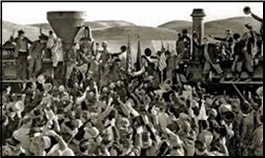
Finally at Promontory Point Jeff, Molly, and Dick are reunited as the golden spike is driven in with Campeau planning revenge.
Molly: Where’s Dick?â€
Jeff: He’ll be waiting for us Molly — at the end of track.
Just before the vintage railroad becomes a gleaming modern engine cutting across America as the music swells.
I’ll grant some of you have grown too sophisticated for this to work, some will find a million reasons to find offense at something or other, and I don’t fault you if you do, but even recognizing its flaws, it is splendid film making, a classic Hollywood cast and creative talents working at the top of their form, and Western mythologizing in the epic mode at its best. I still think there is something to be said for the lost arts that made it possible that is worth recognizing and applauding whatever the social flaws or the lack of modern sophistication.
I hope I never reach the point I can’t still respond to this kind of film a little like the kid lying on the living room floor looking up at a twenty-seven inch black and white screen, eating popcorn, and watching this unfold between commercials. I hope every one of you still has some films that bring back something like that for you.
There was a reason Hollywood was called the Dream Factory.
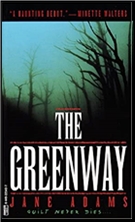
JANE ADAMS – The Greenway. Det. Inspector Mike Croft #1. Macmillan, UK, hardcover, 1995. Fawcett Gold Medal, US, paperback, 1997. Setting: Contemporary England.
Cassie Maltham’s cousin disappeared while they were taking a short-cut home through the Greenway, an ancient passageway in Norfolk. Cassie couldn’t remember what had happened, but has suffered from depression and nightmares ever since. Now, 20 years later, Cassie has returned to Norfolk trying to let go of the past. But when another young girl disappears, it draws Cassie back into her nightmares. Detective Inspector Mike Croft, through the urging of Sergeant Bill Enfield, elicits the help of John Tynan, the retired detective who investigated the disappearance of Cassie’s cousin.
Ms. Adams has written a haunting, yet very human book about guilt and loss. Cassie suffers survivor’s guilt; why did her cousin disappear rather than she. Croft knows the anguish of losing a child, although his son had been killed in a hit-and-run. The story was absorbing with good twists along the way and touches of the supernatural. I shall definitely read more of Ms. Adams’ work.
Rating: Good Plus
— Reprinted from the primary Mystery*File website, January 2006.
The Det. Inspector Mike Croft series –
1. The Greenway (1995)
2. Cast the First Stone (1996) aka The Secrets
3. Fade to Grey (1998) aka Their Final Moments / Final Frame
4. The Liar (2019)
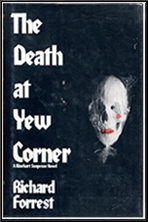
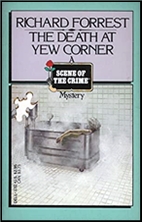
RICHARD FORREST – The Death at Yew Corner. Bea & Lyon Wentworth #5. Holt, Rinehart & Winston, hardcover, 1980. Dell / Scene of the Crime #76, paperback, 1984.
Connecticut’s own amateur sleuthing team of Bea and Lyon Wentworth are back at it again. This is the fifth case they’ve tackled in tandem, which doesn’t yet put them into the superstar category of a Mr. and Mrs. North, but it is enough to start attracting them some attention.
In this one Bea, who has just lost her bid for a state congressional seat, finds a place to vent her energies when an old friend dies in a mysterious nursing home accident. Joining her in her investigation is her husband, Lyon, author of all those marvelous children’s stories about the Wobblies.
Murphysville, which may or may not be Middletown in disguise, is also the scene of an ugly ongoing confrontation between the management of the convalescent home and its angry, militant employees. There is a connection, as Bea soon discovers.
A surprising number of other bizarre deaths follow, culminating in the fascinating puzzle of a murder committed in a locked bathroom. Just as you begin to think that the book has gone off the deep end completely, however, author Richard Forrest suddenly snaps everything into place, and what’s more he makes it look easy.
Bea Wentworth, as the star of the show, may remind you a bit of TV’s ultra-liberal Maude, from the series of the same name. Bea, however, is not nearly as prone to loud histrionics to make her point. In spite of various and sundry temptations, she manages to stay her level-headed best in this outing, and she helps pull it off rather nicely.
Rating: B
–Reprinted from The MYSTERY FANcier, Vol. 5, No. 2, March/April 1981. This review also appeared earlier in the Hartford Courant.
The Lyon and Bea Wentworth series —
1. A Child’s Garden of Death (1975)
2. The Wizard of Death (1977)
3. Death Through the Looking Glass (1978)
4. The Death in the Willows (1979)
5. The Death At Yew Corner (1980)
6. Death Under the Lilacs (1985)
7. Death On the Mississippi (1989)
8. The Pied Piper of Death (1997)
9. Death in the Secret Garden (2004)
10. Death At King Arthur’s Court (2005)
BILLY TWO HATS. United Artists, 1974. Gregory Peck, Desi Arnaz Jr, Jack Warden, David Hudddleston, and Sian Barbara Allen. Written by Alan Sharp. Directed by Ted Kotcheff. Currently available for viewing online here.
An unjustly neglected western well worth your time.
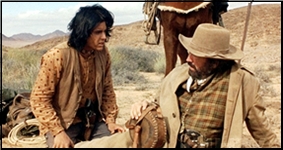
Gregory Peck, portly, bearded, and sporting a Scots accent, charms the screen as a principled outlaw on the run, partnered with Desi Arnaz Jr (don’t laugh; he’s not bad at all here as the eponymous mixed-race youth.) and, briefly, Vic Armstrong, an actor-stuntman blasted into a hotel wall early on by lawman Jack Warden.
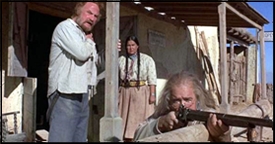
Warden captures Desi, Peck escapes, then rescues Desi at a lonely wayside stop on the edge of the desert, wounding Warden in the process. But Warden’s old buffalo-hunting pal (a surprisingly grizzled Huddleston) shoots Peck’s horse out from under him, breaking Greg’s leg.
The ensuing chase — wounded lawman & fat buddy, riding after crippled bad guy & partner sharing a horse — feels not so much leisurely as repressed. Every time one party or the other starts to make progress, something stops them dead, sometimes literally.
Fortunately, Alan Sharp’s witty script and Ted Kotcheff’s nimble direction keep things from getting dull. The sparse action scenes are well-handled, and the characters consistently engaging, particularly Sian Barbara Allen as a pioneer woman whose speech impediment provides a thematic bond with the disabled antagonists.
And I found a cute sidelight on IMDb: Billy Two-Hats was filmed in Israel, standing in for the rugged terrain of Arizona. Years earlier, when Gregory Peck starred in David and Bathsheba, Arizona stood in for Israel. That means something, but I don’t know what.
MR. & MRS. NORTH “Weekend Murder.†CBS, 03 October, 1952 (Season 1, Episode 1.) Barbara Britton (Pamela North), Richard Denning (Jerry North), Francis De Sales (Lt. Bill Weigand). Guest Cast: Margo Wood, Rita Johnson, Paul Cavanagh, James Kirkwood. Writer: DeWitt Bodeen, based on the characters created by Frances & Richard Lockridge. Director: Ralph Murphy.
The TV version of Mr. & Mrs. North lasted for two seasons, the first on CBS from 1952-53, and the second, only 18 episodes long, on NBC in 1954. They were also on the radio from 1942 to 1954. Alice Frost and Joseph Curtin had the title roles for most of the run. And of course before that, there were the books, 26 of them, before Frances Lockridge’s death in 1963. After her passing, her husband Richard continued writing, but he never produced a Norths novel on his own.
It surely must have helped that so many people knew who the Norths were, because this, the first TV episode jumps right into the story without so much of an introduction. (I think this was common, however, back in the early days of television.) In any case, it is Jerry, a book publisher who has to be persuaded by his wife Pam to take a weekend off and spend it at a famous actress’s country home, somewhere outside Manhattan and their usual city environs.
But as chance would have it, when they all arrive, the housekeeper is missing and there is a dead man in the kitchen closet. As in all the books and their other adventures, it is Pam who decides that she needs to solve the case. Jerry would just as soon let the police handle it. I don’t know whether (or how many) other married sleuths tackled their cases in this same particular way, but this was the usual Norths’ modus operandi, with Pam always sticking her neck out a little too far along the way. And so it is here.
I don’t think that most readers of the books had too much to complain about in terms of the casting. Richard Denning does ham up the comedy a little too much for my tastes, but that’s just me. As for the case itself, the clue to the killer is way too obvious, although the writer does try to gloss it over as it happens. Not enough so for a long-time TV crimesolver such as myself, though.
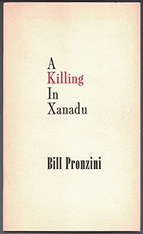
BILL PRONZINI – A Killing in Xanadu. “Nameless†PI. Waves Press, hardcover [?]; softcover, 1980. Frontispiece by John Exley. 21 pages; limited to 150 copies signed by the author.
The recent publishing silence from Ross Macdonald may indicate that he has laid down the Hammett-Chandler crown of private eyedom. There is no shortage of claimants to the succession. One the one hand there are the Chandler Lookalikes who adopt Chandler’s view of the world and, less happily, his loose approach to plot construction; in short, many detectives walk down pale imitations of Chandler’s Mean Streets. On the other hand are the Violent Voyeurs who confuse sex with social comment and violence with action.
It seems to me, however, that there is one obvious candidate. In powers of characterization, sense of pace, compassion and stylistic excellence, the crown ought to belong to Bill Pronzini and his “Nameless” detective.
Pronzini’s Nameless series may be most noteworthy in its relative lack of violence and explicit sex. Unlike other authors who try to hide a lack of invention by tossing in gratuitous killings and irrelevant beddings, Pronzini lets his plot and characters create the interest. Part of Pronzini’s ability is, of course, that he is inventive His plots move well, and they contain good detection. He gives the reader the same clues that Nameless has, and he revels in twists and turns leading to a final unexpected conclusion. In some ways, the Nameless series connects the private-eye tale with its emphasis on realistic description, and the classical detective tale with its emphasis on plot. (Most other claimants to the crown provide plenty of realistic detail but a rather predictable story,)
Above all Nameless is vividly depicted; in his mid-50s, the moody, self-consciously sloppy, slightly paunchy private detective is a most sympathetic character. Unlike more pretentious authors, however, Pronzini does not have Nameless represent Everyman or summarize the human condition. But in many ways, Nameless’s weaknesses are ours as well, and we identify with him – as obviously Pronzini identifies with him. (We now know that Nameless’s first name is “Bill” and that his last name has a “z” in. the middle.)
It is a sign of Pronzini’s stature that he is one of the few mystery writers to have a privately printed, limited edition to his credit. A Killing in Xanadu is a miniature summation of the strengths of the Nameless series. It begins with a deftly drawn portrait of a posh resort called Xanadu, made up of “a whole series of pleasure domes.” Nameless is there to deliver a subpoena: “No rich client, no smoky-hot liaison with a beautiful woman, no fat fee.”
This is followed by a quick but precise characterization of a black attendant: “His eyes said that I would never make it up that hill over yonder … but then neither would he and the hell with it.” Nameless tracks down the cottage of the alcoholic recipient of the subpoena, but as he heads towards it he hears a single shot. After breaking down the door he sees a woman bending over a body. With the door locked and under observation, and all the windows locked, it seems obvious that he has located both the victim and the murderer.
But based on the clue of a photographic negative (the subject of the negative makes no difference), Nameless discovers a particularly clever plot and quickly resolves the locked-room crime. Indeed, the plot is strong enough for a full-length novel (since Pronzini sometimes bases his novels on earlier short stories, it may eventually become a novel). The Solution to the locked room is as far as I know, new in fiction. Some may object to the fact that Nameless’s reconstruction of the murder takes 5½ pages, but – if it makes any difference – I approve. Pronzini’s narrative skill stops the explanation from dragging.
This limited edition is. of high quality. It is typeset, rather than photo offset, and it is printed on slightly offwhite paper. The version in paper wrappers (which is the only one I’ve seen) comes with a dust jacket printed on much too white paper which will quickly show any signs of reading. Whether the pamphlet will eventually command a premium on the rare-book market, I don’t know, But how much would a limited edition of Hammett or Chandler or Macdonald from early in their careers go for now?
– Reprinted from The Poison Pen, Volume 4, Number 2 (April, 1981). Permission granted by Doug Greene.
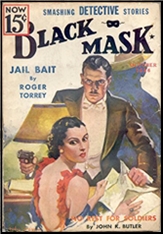
After reading Steve’s recent review of “No Rest for Soldiers,” the first story in the October 1936 issue of Black Mask, I pulled out my copy and just finished reading it cover to cover. Not a stinker in this issue. Giving a rating of four stars for the highest, I rate them as follows:
“No Rest For Soldiers†– John K. Butler – 4.
“Jail Bait†– Roger Torrey – 3. Although a complete rip-off of the The Maltese Falcon without the “Falcon†to look for (main tec’s partner is killed and he’s going to find the killer, though they didn’t like each other), this is still a pretty good story. I’m not a great Torrey fan but this story works for me.
“Heat Target†— Russell Bender — 4. Really well written! I don’t think I’ve ever read a story by Bender. I’ll now go see what else I can find that he wrote for Mask.
“Sail†— Lester Dent — 4. I can’t count the times I’ve read this story over the years. I still wish that he had written more than two stories for Mask before Shaw got the boot. As good as it gets!!
“A Ride In The Rain†— W.T.Ballard — 4. One of my favorite Mask writers. If anyone out there has not read Ballard, do yourself a favor and try him. Holds up continuously, time after time!
I really think this is a top issue of Mask from beginning to end. Steve, let us know how you feel after you finish your copy.
Added later: Just checked on Russell Bender. He only wrote two others for Mask, though lots more for other titles: October 1938 and July 1940. I have both and will be checking them out soon.