Reviews


E. X. FERRARS – Frog in the Throat. Doubleday/Crime Club, US, hardcover, 1980. Bantam, US, paperback, 1981. Published earlier in the UK by Collins, hardcover, 1980.
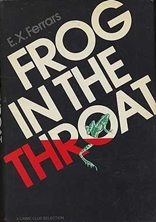
   Although E. X. Ferrars has been writing mysteries for over forty years, she’s nowhere as well-known as she should be. One big reason I can see for that is that since her first five books, until very recently has she not used a series character of any kind. (And of Toby Dyke, who has not been heard from since 1942, I know nothing at all.)

   Where would Christie have been without Poirot or Miss Marple? Ingenious mystery plots may be totally fine in the abstract, but unfortunately they just don’t grab the reader’s attention in the bookstore.

   There is a bare chance – but don’t count on it – that Virginia Freer’s errant ex-husband Felix, who has appeared at least one time before, may return again and “solve” another case. He slips in and out of her life with such casualness that it is not a foregone conclusion that he will. Nor is his idea of finding a killer a very useful one for the police.
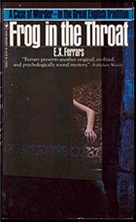
   Dead is a writer of historical novels, on the night of her engagement party to poet Basil Deering, who is the murderer’s next target. Or are there two murderers? A bigamous marriage some years in the past seems to be the crux of the matter, as well as some other more recent romantic entanglements, and a bit of injudicious blackmail.

   The ending is vaguely unsatisfying. Perhaps just a bit of a letdown. I think it’s because it’s clear that the police this time are perfectly capable of solving the murders by themselves, without the odd couple assistance of Mr. and Mrs. Freer.

   On the other hand, while the fuss they generate may not have been wholly necessary, it is nonetheless a fascinating and wholly absorbing sort of fuss. (And why else do we read mysteries?)

Rating: B

–Very slightly revised from The MYSTERY FANcier, Vol. 5, No. 2, March/April 1981.


      The Virginia (& Felix?) Freer series –

Last Will and Testament (n.) Collins 1978.
Frog in the Throat (n.) Collins 1980.
Thinner Than Water (n.) Collins 1981.
Death of a Minor Character (n.) Collins 1983.
I Met Murder (n.) Collins 1985.
Woman Slaughter (n.) Collins 1989.
Sleep of the Unjust (n.) Collins 1990.
Beware of the Dog (n.) Collins 1992.
REVIEWED BY DAN STUMPF:


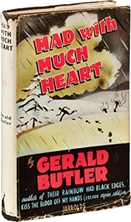
GERALD BUTLER – Mad with Much Heart. Rinehart & Co., hardcover, 1946. Originally published in the UK by Jarrolds, hardcover, 1945.

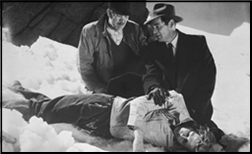
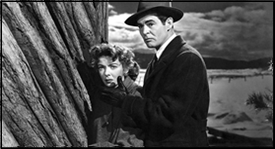
ON DANGEROUS GROUND. RKO, 1952. Robert Ryan, Ida Lupino, Ward Bond, Sumner Williams, Charles Kemper, Ed Begley, Ian Wolfe, Cleo Moore and Olive Carey. Screenplay by A.I. Bezzerides and Nicholas Ray. Directed by Nicholas Ray. Currently available for streaming on TCM.

    I was much impressed with Butler’s first novel, Kiss the Blood Off My Hands, and While Mad with Much Heart isn’t quite as well-built, there’s still much to be glad of. It’s a terse chase story, set in the snow-bound English countryside, with Inspector James Wilson detailed from Scotland Yard to help the locals pursue a mad killer who has attacked two schoolgirls. As the story spins out, though, Wilson has less trouble with the killer than he has dealing with the vengeance-crazed father of one of the girls, with the killer’s blind sister, and with his own loneliness and self-doubt.

   This isn’t really enough to carry a story successfully (asked for his opinion, Raymond Chandler advised against filming it), but Butler does a very nice job conveying the physical effort of running and driving through deep snow, the slippery suspense of a slow-motion car-chase over icy country lanes, and the sheer exhaustion of mind and body brought on by the cold. Somehow the visceral quality of the story and his prose keeps one turning the pages.

   The film that John Houseman and Nicholas Ray made out of this despite Chandler’s advice is an oddly moving affair, rather disjointed (like many RKO films under Howard Hughes’ regime) and all the better for it. It opens with twenty minutes of sheer Big City noir, with Robert Ryan as a psychotic cop on the verge of murder, then shifts neatly to the snowbound countryside, where Ryan sees his own violence mirrored in the rampaging father (a fine performance by Ward Bond) setting up one of those narrative metaphors that Ray did so well: If Ryan can keep the berserk parent from blasting the frightened fugitive, then maybe (?) he can control his own sickness.

   This is the sort of film on which Nicholas Ray built his reputation. The early city-set scenes are purest noir, with George E. Diskant’s camera sliding fluidly through seedy bars, sleazy apartment houses, and shadowy alleys, punctuated by short bursts of jerky hand-held shots to accentuate the violence. And when we move out into the country, Ray and Diskant impart the feel of icy snowscapes, jagged rocks, and rustic farms just as vividly.

   Then there’s the plu-perfect playing, from the sleazy bit players, to Robert Ryan at the edge of violence, Ward Bond well over the top, charging through a landscape that barely holds him, and in the midst of this Ida Lupino serenely dominating the screen, while Sumner Williams as her disturbed brother darts about like some dangerously wounded animal.

   In short, this is a totally unique film, done with consummate artistry, and if you’ve been a good little boy-or-girl this year, you owe yourself a viewing.

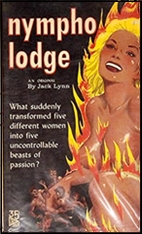
JACK LYNN – Nympho Lodge. Tokey Wedge #1. Grizzly Pulp, paperback, 2020. New cover art by Jim Silke. Originally published by Novel Books, paperback, 1959; 2nd printing, 1962.

   Well, here’s some good news. Tokey Wedge is back, and a new publishing company is planning on publishing at least the first six of his original novels. As I understand it, though, you won’t be able to find them on Amazon or any other of your usual book buying sources, only directly from the publisher. I’ll add the link to the Grizzly Pulp website at the end of this review.

   Now take a look at the cover, over there to the right, and the title. You should be abundantly clear from either one that you shouldn’t expect to be reading the likes of Leo Tolstoy or Charles Dickens when you read a Tokey Wedge book. And even if you’re a fond reader of Richard Prather, say, or Carter Brown, you’re thinking in the right direction, but when “Jack Lynn” wrote the Tokey books, he was, too, thinking in the right direction, that is.

   While he wasn’t quite as good as either one, he was a contender, though, no doubt about it, in a slightly scuzzier vein, and even so what he produced, in Nympho Lodge, at least was a detective story that was a fair play detective story. To particulars, though. Tokey was a private eye, somewhat handicapped by being only 5 foot 5 or so, but even so, women are uniformly attracted to him. Beautiful sexy women, and does Tokey mind? No sir, and he shows how much he doesn’t mind, over and over in this tale.

   He’s hired in this case by a woman (beautiful and sexy, of course) in the midst of an upcoming divorce case, and afraid of what her soon-to-be ex-husband might do, she needs a bodyguard. I won’t go into more details than that, but besides many other women finding Tokey extremely manly  (no details provided in the story itself), in spite his height, a lot of deaths occur, and I mean a lot. So many so, that Tokey nearly runs out of suspects.

   Jack Lynn has come up before on this blog, almost entirely in the comments to another post, which you will find here. His real name was Max van derVeer, and there were about 20 in the series.

   As to where you can buy a copy of this one, here’s the link:

               https://www.grizzlypulp.com/#/

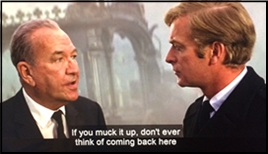
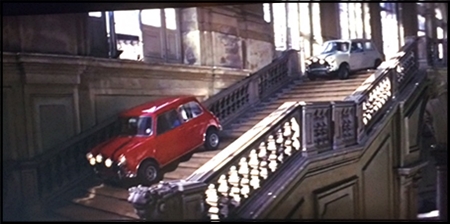
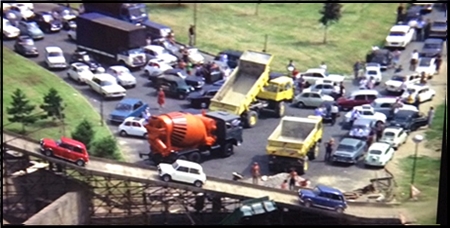
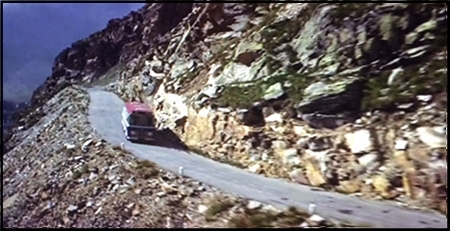
THE ITALIAN JOB. Paramount Pictures, UK/US, 1969. Michael Caine, Noël Coward, Benny Hill, Maggie Blye, Rossano Brazzi. Screenwriter: Troy Kennedy-Martin. Director: Peter Collinson. Currently streaming on several platforms, including Amazon Prime Video (but ending there tomorrow).

   When I spotted this movie on Amazon Prime on Monday, but that it was ending there soon, I thought I’d better finally see it while I could, and I’m glad I did. I saw the remake when it came out, but how I’d let this one get by me for so long, I have no explanation.

   It is a heist film, of course, and as usual, heist films take a long time getting around to the heist itself: the planning, the gathering together of the people to pull it off, the obstacles they face while doing so. (In this case, since this particular heist is being pulled off in Italy by a high level gang of British drivers and miscellaneous thugs under the leadership of Michael Caine’s character, and the overall backing, moneywise, of criminal mastermind Noël Coward, safely ensconced in penitentiary, it is the Mafia).

   But in all heist films, or 99.5 percent of them, as meticulously planned as the are, and this one absolutely is, something has to go wrong. A hitch in timing somewhere along the way, a slip-up in timing, a brief bit of conversation overheard by someone who shouldn’t have been there. The audience, expecting exactly this, even while watching events take place like clockwork, even if improvised when need be, only needs to sit back and wait. Second halves of heist films are always the best.

   And the combination of Michael Caine (movie), Noël Coward (stage), and Benny Hill (TV star) may seem to have pulled out of a hat at random, but each in their own way were at the top of their artistic fields at the time, and they’re the glue at the core that holds the film together (some more than others).

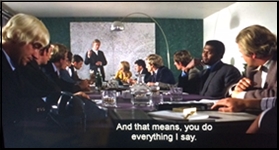
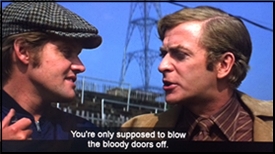
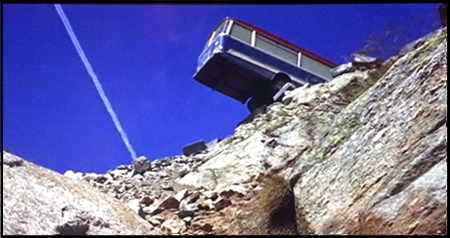
   Once the heist gets underway in earnest, some of the storylines get dropped completely. Michael Caine’s girl friend for one, and the Mafia, surprisingly, for another. What I think I’ll do, though, is stop here, rather than analyze the movie any longer (many others have) and amuse you with some photos I took along the way. And by the way, I loved the last line of dialogue: “Hang on a minute lads, I’ve got a great idea.”


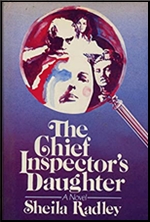
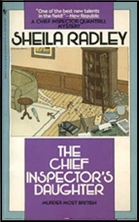
SHEILA RADLEY – The Chief Inspector’s Daughter. Inspector Quantrill #2. Scribner’s, US, hardcover, 1980. Constable, UK, hardcover 1981. Dell / Murder Ink, paperback, 1981. Bantam, paperback, 1987. Felony & Mayhem, trade paperback, 2007.

   The inspector’s name is Quantrill, and you may have met him before in Death in the Morning. That one I haven’t read myself, but I’m going to. This one’s a good one.

   To tell you the truth, though, I wasn’t so sure it was going to be when I started. The first couple of chapters are not all that promising. Stories involving British policemen and their dreary home lives I find more-or-less depressing. A little bit of it, at least, usually goes a long way.

   Apparently, vital communications between Quantrill and his wife have been gradually breaking down over the years, and to compound the problem, their younger daughter has just arrived home from London after a break-up with her lover. Nothing like a good case of murder to bring a family together, hmmm?

   But that’s just what it does. Daughter Alison takes a job as an assistant to Jasmine Woods, a well-known writer of romantic fiction. When Alison finds her employer brutally murdered one morning, she goes into shock, and then she disappears before revealing the important clue she knows.

   Some of the best clues in this story are provided by the simple expedient of omission, however, and you as reader are going to have to stay on your toes to stay ahead of the game. The plotting is rather cleverly done, but Sheila Radley does play fair. And you really do have good chance of beating Quantrill to the killer.

   I liked the ending. While it has nothing to do with the mystery, per se, I think by story’s end the characters have indeed become reasonable facsimiles of human beings for it to considered on of the better cliffhanger finales I’ve read in quite some time.

Rating: B plus.

–Very slightly revised from The MYSTERY FANcier, Vol. 5, No. 2, March/April 1981.


      The Chief Inspector Douglas Quantrill series —

Death and the Maiden (n.) H. Hamilton 1978.
The Chief Inspector’s Daughter (n.) Constable 1981.
A Talent for Destruction (n.) Constable 1982.
Blood on the Happy Highway (n.) Constable 1983.
Fate Worse Than Death (n.) Constable 1985.
Who Saw Him Die? (n.) Constable 1987.
This Way Out (n.) Constable 1989.
Cross My Heart and Hope to Die (n.) Constable 1992.
Fair Game (n.) Constable 1994.

REVIEWED BY DOUG GREENE:


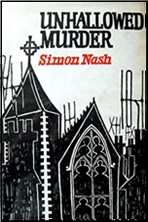
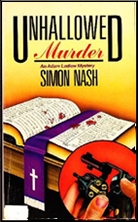
SIMON NASH – Unhallowed Murder. Adam Ludlow #5. Geoffrey Bles, UK, hardcover, 1966. Roy Publishers, US, hardcover, 1966. Perennial P758, US, paperback, 1985.

   In 1951, Edmund Crispin and his detective don, Gervase Fen, disappeared from the scene (except for an occasional short story) for more than 25 years. But at least for the early 1960S, their places were more than adequately filled by Simon Nash, a pseudonym of Raymond Chapman, and his detective don Adam Ludlow.

   Indeed, Ludlow is basically a new incarnation of Fen, with the same curiosity, the same humor, the same fund of miscellaneous (but literate) information. But imitation is not necessarily bad, especially when it’s done by a fine stylist and plotmonger like Nash. In short, this, the fifth and apparently final book by Nash, is very good indeed. As the title indicates, the setting is a church, whose vicar proceeds to get murdered. There are plenty of possible motives:

   Is someone after the vicar’s accumulation of rare books (which he absentmindedly hid?) Is it significant that the parish council is planning to throw a working family out of a house to be occupied by the curate? Are the desecrations of the altar the responsibility of a group of Satanists.? Did low churchmen, fearing that the parish is “going over to Rome” commit the murder?

   Much of the book is filled with humorous descriptions of parish life, including the high churchmen of the Guild of Saint Cyprian and Severus (“Ah my friend, when will the sweet savour of incense again be sent up in every parish church throughout the land”) opposed by the League for Confuting and Suppressing the Errors of the Tractarians (“Things haven’t been the same since the Roman hierarchy was restored”).

   The detective problem itself is well-handled, but whether the “Romanizers” or the “zealous heretics” would be more pleased with the solution is a moot point.

– Reprinted from The Poison Pen, Volume 4, Number 2 (April, 1981). Permission granted by Doug Greene.


      The Adam Ludlow series —

Dead of a Counterplot (n.) Bles 1962.
Killed by Scandal (n.) Bles 1962 .
Death Over Deep Water (n.) Bles 1963.
Dead Woman’s Ditch (n.) Bles 1964.
Unhallowed Murder (n.) Bles 1966.

REVIEWED BY JONATHAN LEWIS:

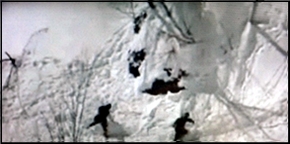
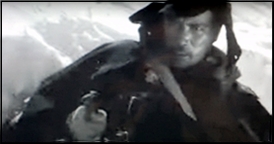
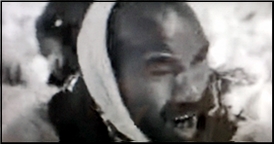
SNOW TRAIL. Toho Company, Japan, 1947. Original title: Ginrei no hate. Toshirô Mifune, Takashi Shimura, Yoshio Kosugi. Director: Senkichi Taniguchi. Currently streaming on the Criterion Channel.

   Fairly early on in Snow Trail, the viewer learns that there are three escaped bank robbers and that they’re hiding out somewhere in remote, cold mountainous terrain. Enter what appears to be an urban police detective who is working with local authorities to apprehend the men.

   And then the movie shifts to a resort where two employees, who heard on the radio that one of the fugitives is missing several fingers, are seen scheming as to how they can get one of the resort’s guests to remove the glove he wears all the time.

   At this point, it’s not clear whether the movie is going to be a police procedural, a film noir, or something else entirely. Indeed, it takes about another thirty or forty minutes for the central story of the movie to come into its own and by that time, you’re hooked.

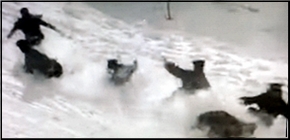
   After one of the three fugitives purportedly dies, the remaining two men must struggle to survive amidst the cold, desolate landscape. Luckily for them, they find shelter in a mountain cabin inhabited by an old man, his granddaughter, and a mountaineer who is literally weathering an oncoming storm with them.

   It’s then when the two men, portrayed by Japanese film legends Takashi Shimura and Toshiro Mifune, begin to clash. The older of the two criminals, Nojiro (Shimura) becomes wistful and introspective. Although it’s never made absolutely explicit, one senses that he is beginning to have deep, painful regrets about his life choices.

   Eijima (Mifune), on the other hand, grows more cold, more divorced from humanity, and increasingly willing to utilize violence. There’s a chillingly effective scene in which Ejima barks at his erstwhile colleague for merely enjoying listening to music. He’s the character who has gone spiraling downward into darkness.

   In many ways, Snow Trail has all the hallmarks of film noir and was clearly influenced by American crime films. But it’s also an existentialist work and a redemption story. The movie is fundamentally about one man, alone against a giant landscape of mountains and sky, who realizes too late that he has fundamentally wasted his life on crime rather than on family and connection to nature.

   Compared to Japanese crime films of the 1960s and 1970s, this little-known film may not be particularly compelling cinematically. But it’s a solidly constructed work of Japanese postwar cinema that deserves a look.

REVIEWED BY DAN STUMPF:


THE CREATION OF THE HUMANOIDS. Genie Productions, 1960/ Emerson Film Enterprises, 1962. Don Megowan, Erica Elliott, Frances McCann and Don Doolittle. Written by Jay Simms. Directed by Wesley E, Barry.

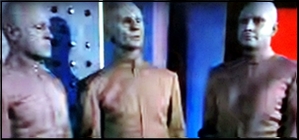
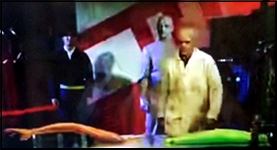
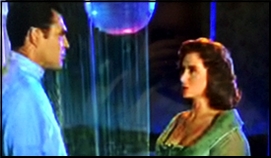
   A Truly Strange item, made in eye-searing color the same year as Dr. No, for peanuts and it looks it. It’s about the eventual replacement of human beings by Robots, but unlike most films of this genre, it depicts the robots sympathetically, the humans as boors, and the whole process as genetically inevitable, which evinces a feel for the SF genre surprising in a film so tawdry.

   Having said this, I have to add that it’s incredibly dull.

   It has that terrific title, neat sets, and even implies kinky sex between humans and robots, but it’s all presented in an astoundingly static fashion. You may find it hard to credit this next sentence, but I assure you I do not exaggerate here for dramatic effect. Nothing happens for the whole run of the film.

   I mean NOTHING. Aught. Naught. Bugger-all. Bupkis. Diddly. Goose Egg. Nihility. Nil. Scratch. Squat. Void. Zip. Nada. Zero. Non-existence. What Sartre was fond of calling “nothingness.” People stand around and talk, then say they’re going someplace else. The scene shifts there, and they stand around and talk some more. I say “talk”, but actually they Explicate, conveying all the background and plot development (as in a Harry Stephen Keeler novel) by means of endless conversations in stilted language between actors of very limited range.

   It’s quite possible, of course, that the filmmakers were doing this intentionally to convey the sense of a sterile society, in which the substitution of machines for men will be a mere formality, and if so, I must admit they certainly succeeded. Unfortunately, they forgot to make it Watchable. What they ended up with was a movie that merits some attention on an intellectual level, as a curiosity, but fails totally to convey any conviction at all.

   I admit that it stays in the memory, but so does an irritating commercial jingle. And commercials, unlike The Creation of the Humanoids, are mercifully brief.


REVIEWED BY RAY O’LEARY:

   
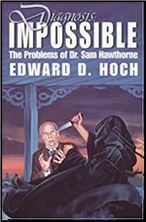
EDWARD D. HOCH – Diagnosis: Impossible. Sam Hawthorne; collection #1. Crippen & Landru, hardcover/paperback, 1996.

   I’m a great fan of locked room/ impossible-situation crime fiction, and it’s always a pleasure to come across some enjoyable examples of same. This is a collection of the first dozen stories in the Dr. Sam Hawthorne series, set in the 1920ss. Hawthorne is a country doctor practicing in the town of Northmost Connecticut, where he encounters vanishing buggies, murderous ghosts, escaping prisoners, murder in a voting booth and killer trees – among other things.

   The one I enjoyed most had a time capsule, about to be buried qt the county fair, found to have a body in it…. this despite the fact that it was in plain sight and empty when the various articles were deposited in it a few hours before.

   Since the stories run about 15 pages or so, there isn’t such room for character development, though recurring characters do round out in reading twelve in a row. It’s the ingenuity of the stunts and their explanation that matter most, and here Mr. Hoch is quite clever.

   At the end Marv Lachman (to whom this volume is dedicated along with his wife) provides a checklist of 59 stories (through July 2000) with their dates of publication in Ellery Queen’s Mystery Magazine and the time in which the story is set. Since I didn’t read the stories when they appeared in the magazine, I can only hope that further volumes will be published.

— Reprinted from The Hound of Dr. Johnson #17, January 2002.

REVIEWED BY BOB ADEY:


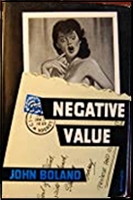
JOHN BOLAND – Negative Value. Boardman, UK, hardcover, 1960. No US edition.

   The Earl of Staves is being blackmailed on account of some compromising photographs of his daughter. She commits suicide and he gives the job of investigating the matter to an employee, John Poynder. Poynder, although not a professional sleuth, soon discovers that other members of the debutante set have also been blackmailed and with the help of attractive Druscilla Lane, he eventually unmasks the criminals.

   The first part of the book is by far the best and the author paints a convincing, if unattractive, picture of the deb scene, But the investigation itself is a little disappointing and rather fortuitous (though Poynder is of course only an amateur). The Earl himself came over as rather an unsympathetic character and one might have hoped for a twist in the tail [sic] that gave him something of his desserts. There isn’t any.

   Light, undemanding, relatively uncomplicated.

– Reprinted from The Poison Pen, Volume 4, Number 2 (April, 1981). Permission granted by publisher/editor Jeff Meyerson.

   
UPDATE: John Boland, who died in 1976, and who is not the John [C.] Boland still active today, has over two dozen crime novels in Hubin under his own name and two as James Trevor. Practically unknown in the US, he was the author of The League of Gentlemen (1958), which was filmed in the UK the next year. If ever John Poynder appeared in another novel with a case to solve, Hubin does not know about it.

« Previous PageNext Page »