Reviews


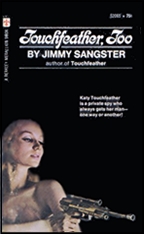
JIMMY SANGSTER – Touchfeather. Triton Books, UK, hardcover, 1968. W. W. Norton, US, hardcover, 1968. Berkley S1789, US, paperback, 1970. Brash Books, US, paperback, 2018.
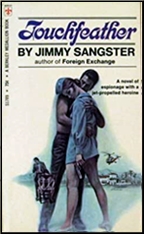
   I would like to assure SAS, United, Quantas, American, Lufthansa and all other member companies of IATA that I make no suggestion that any of their employees could, or should, do the things Katy does — despite some recent airline advertisements which may have given their readers ideas to the contrary, e.g., ‘Save Friday night for Ingeborg Bechtel. She puts the fun in flying’. Or ‘Sometimes our hostesses take young men home with them’. Katy Touchfeather is to be regarded entirely as fiction.

   Despite that rather jaunty foreword by screenwriter and novelist Jimmy Sangster to his first of two novels featuring air hostess Katy Touchfeather, British agent in the mysterious Mr. Blaser’s department, the books are both far better and tougher than they sound or than the paperback covers made out.

   Sangster’s name is no doubt familiar to most readers of the blog as the man behind many of the classic line of films coming out of Hammer Studios. His credits include The Curse of Frankenstein, Horror of Dracula, Jack the Ripper, Brides of Dracula, The Mummy, The Hellfire Club, and Deadlier Than the Male. In addition he penned two spy novels about Katy Touchfeather and two about down trodden ex-agent turned spy John Smith (one of which was filmed with Robert Horton as Smith).

   Before going further we might as well deal with the elephant in the room. The two Touchfeather books are inherently sexist as only late Sixties spy fiction could be. In an age well before the term Flight Attendant was coined and still well within the era of books and films like Coffee Tea and Me, the stewardess or air hostess, as the British called them. was a staple fantasy figure. That they also represented a rare opportunity for young women to have a rewarding career and adventure was often lost in a fantasy of airlines as Playboy Clubs in the sky for pilots and traveling businessmen, something not lost to Sangster in his introduction.

   As someone who traveled widely and often in that era, I would like to point out that simply was not the case, certainly in the Seventies when international flights included the danger of hi-jacking. Flight Attendants then and now had tough demanding jobs that required quite a bit more than looking good in a short skirt and tight blouse.

   But that image was often encouraged by the airlines and popular media in an age when flying was still rather exotic and women were still considered chiefly interested in finding husbands.

   Despite her jaunty suggestive name Katy Touchfeather is anything but a flying Bunny.
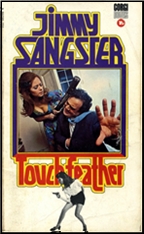
   Katy Touchfeather. I mean, what sort of a name is that to hand a girl? The Katy is all right, or Katherine as my parents put on my birth certificate. But Touchfeather! It doesn’t sound any better in French either, nor for that matter in Spanish, German or Italian. I know, because I speak all of them to some extent. Still, that’s just one of the crosses I have to bear. The other is Mr. Blaser.

   Blaser, “he thinks of me as a Fred. But then I suppose he’s on the right track; if he thought of me as a Katy, he’d never ask me to do some of the extraordinary things he does …” is C. W. Blaser, CBE and used to be something in the Royal Navy, but now he runs one of those departments in the intelligence service no one likes to mention or admit exists.

   After her husband, who worked for Blaser, was assassinated, Katy found herself recruited and ended up a sort of freelance air hostess flying whatever route and airline Blaser needed her on as a roving agent of the most secret kind. A sort of Our Girl Any Where We Need Her.

   This time out Gerastan Industries is in aviation and have a small key research unit in England they would like to move to the United States. Now a corpse has been found in Bombay (this was well before anyone outside of India called it Mumbai) with information on his body that came from that research unit. The effluence has hit the fan and Professor Partman who runs that research unit has booked a flight for Bombay.

   Katy has to cut short her leave and be the hostess on that flight posing as an Indian air hostess.

   It’s not an unpleasant assignment either as Professor Partman, Bill, as she is soon calling him, looks like a cross between Prince Philip and Gregory Peck. Things are going swimmingly until a second flight to Rome is hi-jacked and two American air pirates kidnap Bill to Egypt.

   Then Katy gets kidnapped and tortured by the same two American hoods because Bill might have given her something and the action really starts to move, leading Katy to the heart of the matter, Roger Gerastan, “… he had the lightest blue eyes I had ever seen, like pieces of chipped ice… the eyes that both fascinated and repelled at the same time; they had a near-hypnotic quality which made one forget that the man behind them was only five feet eight inches tall, and not at all attractive.”

   Touchfeather moves, and not just in terms of plot. Rather like its heroine’s cover, the plot finds Katy crisscrossing the ocean and in constant movement until she follows the plot to its surprisingly tough minded conclusion, when we get a real glimpse of the steel beneath Katy Touchfeather’s tough facade (There had been no alternative, I’m afraid, and it is something I shall regret to the day I die.).

   Not a great spy novel by any means, but much better than the general line of Bondian imitations of the period with Sangster and Katy Touchfeather good company, and ultimately far less the kind of sexy romp readers might have expected and far more a well written exercise in intrigue, adventure, and suspense — with more than enough sexy romp for lovers of that sort of thing.

   Sadly there was only one other adventure for Katy, Touchfeather Too, but the two books do make a nice set, well enough, and cleverly enough, written that their heroine becomes much more than what seemingly meets the eye, attractive as that may be. It wouldn’t take all that much to retool Katy for today, which is more that could be said of some of her male counterparts, and by the time you reach the end of the book you’ll likely agree she is as smart, independent, and tough as any agent you’ve met in the pages of fiction, then or now.
REVIEWED BY JONATHAN LEWIS:


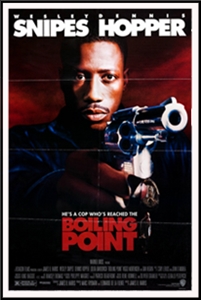
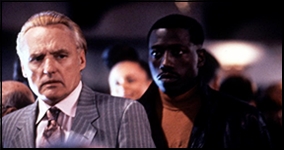
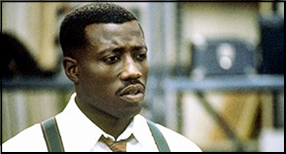
BOILING POINT. Warner Brothers, 1993. Wesley Snipes, Dennis Hopper, Lolita Davidovich, Viggo Mortensen, Seymour Cassel, Jonathan Banks, Dan Hedaya. Screenplay: James B. Harris, based on the novel Money Men by Gerald Petievich. Director: James B. Harris. Currently streaming on Starz & Amazon Prime.

   The first thing you should know about Boiling Point is that it was written and directed by veteran Hollywood producer James B. Harris, who is still perhaps best known in some circles for producing Stanley Kubrick’s iconic noir film The Killing (1956). I say that’s the first thing you should know because, in many ways, Boiling Point is a 1950s film noir embellished in bright neon 1990s colors. It’s got a lean screenplay, a coterie of great character actors, a seedy Hollywood setting, and a plot that features a cop and a criminal both involved with the same call girl.

   Based on the book Money Men by Gerald Petievich (whose novel To Live and Die in L.A. was brought to the big screen by William Friedkin), the film stars Wesley Snipes as Jimmy Mercer, a tired and jaded Secret Service Agent obsessed with tracking down the man who killed one of his colleagues. Snipes is an actor that I like very much, but his performance here is neither exceptional nor mediocre. It’s just solid. Nothing more, nothing less. Dan Hedaya, one of the most familiar faces for those immersed in 1990s film and television, portrays Mercer’s partner. He’s good here. As he always is.

   The real star of the movie is Dennis Hopper who really sinks his teeth into the role. He portrays Red Diamond, a perpetual loser and down on his luck criminal always developing his next scheme. Released from prison and in debt to a mafia sort, Diamond teams up with the amoral enforcer Ronnie (Viggo Mortensen) to get into the “paper” (counterfeit dollars) game. There’s a bunch of subplots, all involving various criminal sorts. These include the old timer Virgil Leach (played to the hilt by Seymour Cassell); crooked lawyer Max Waxman (a perfectly cast Jonathan Banks); and a bag man (Paul Gleason) who conducts his dirty deals in a parking lot. Diamond, who has a special fondness for big band music, also begins an affair of sorts call girl Vikki Dunbar (Lolita Davidovich).

   As it turns out, Jimmy Mercer – now estranged from his wife – is in love with Vikki. Unfortunately, the woman that ties these two men together is not a well-developed character. In addition, the film never really explores this ill-fated love triangle aside from showing us that it exists. Part of this, I suppose, is due to the relative short running time (92 minutes).

   I don’t know that there’s too much more than I can say about this film other than that it exudes atmosphere and never condescends to the audience. It’s a solid crime film. One that, with a few changes here and there, could just have easily been a moderately successful 82 minute black and white Columbia Pictures film from the 1950s.


FIRST YOU READ, THEN YOU WRITE
by Francis M. Nevins

   
   I had already decided that the subject of this column would be Erle Stanley Gardner when I learned about the new incarnation of Perry Mason in an 8-part mini-series on HBO. I don’t have cable or satellite but from conversations with a few friends who do, plus the write-up in the New York Times and in the June/July issue of the AARP magazine, I get the distinct impression that poor old ESG is whirling in his grave.

   It’s the early 1930s and Mason (Matthew Rhys) is a World War I veteran, an alcoholic, and suffering from what we now call PTSD. He’s not (or at least not yet) a lawyer but a sleazy private eye working for and studying law under an established criminal attorney. In effect he’s morphed into a squalid avatar of Paul Drake. When his mentor dies just before he’s to try a big murder case, Mason completes his apprenticeship, sits for and passes the bar, and takes over the defense.

   Sound crazy? But the premise does touch base with Gardner more than you might think. ESG never went to law school but apprenticed himself until he felt he was ready to take the bar. The new Mason’s mentor (John Lithgow) is named E.B. Jonathan, which is precisely the name of the crusty and ethically challenged lawyer who served as mentor to Pete Wennick in a short-lived series Gardner wrote for Black Mask in the late Thirties.

   The portrait of Mason’s city seems to come straight out of the city, modeled on Poisonville in Hammett’s RED HARVEST, where Ken Corning practiced in another of Gardner’s Black Mask series: crooked cops, corrupt pols, the whole nine yards. Perhaps I’ll catch up with this version of Mason someday.

***


   Gardner and I go back a long way. I discovered him in my teens, and over the generations I’ve read all of the Mason novels, some of them three or four times, and most of the A.A. Fairs, very few of them more than once. Not re-reading the exploits of Bertha Cool and Donald Lam, at least the early ones, may have been a mistake. Last year I discussed THE BIGGER THEY COME (1939), with which the long-running series kicked off, and THE KNIFE SLIPPED, which was probably also written in 1939 but didn’t get published until just a few years ago.

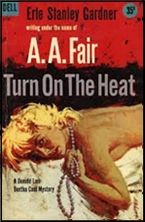
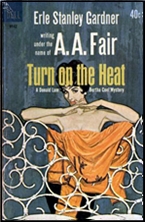
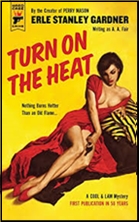
   In TURN ON THE HEAT (1940), which until recently was considered second in the series, we learn what we would have learned from THE KNIFE SLIPPED had it not been rejected 80-odd years ago: that Donald was not just suspended for a year from the California bar for dreaming up a legal way to commit murder, as he’d told Bertha in THE BIGGER THEY COME, but permanently kicked out of the profession.

   In any event he’s working for Cool as a PI but not yet her partner when the firm is hired by a man calling himself Smith. The job is to locate a young doctor’s wife who, after the failure of her marriage, had vanished almost twenty years earlier (meaning soon after the end of World War I) from the then thriving small town of Oakview, several hours’ drive from LA.

   The young doctor had also vanished, apparently along with his attractive nurse, but Smith insists he has no interest in either of them. Donald drives to Oakview to research public records and the back files of the local newspaper, where he learns from the editor’s niece, a bright young lady desperate to leave the now dying town, that he’s the third person to be hunting for information on the vanished couple.

   At the end of his first day on the job he’s given a black eye and run out of town by a tough guy who might be a cop. Undeterred, Donald soon learns that the elusive doctor has changed his name and set up practice in thriving Santa Carlotta, which is much closer to LA and seems to be Gardner’s name for Santa Barbara. A few days later a telegram from the Oakview editor’s niece tells him that the doctor’s wife has come back and, posing as a reporter for the paper, he revisits the town to interview the now middle-aged woman.

   Another lead takes him to the second of his two predecessors on the trail of the doctor’s wife. Soon he reaches the core of the mystery: the doctor is now running for mayor of Santa Carlotta and the corrupt politicos in office are trying to create a scandal around him. Eventually there’s a murder, and it seems that, like so many characters in Perry Mason novels, both the medico and the ambitious newspaper gal discovered the body and kept mum about it. As Mason would have done but without benefit of legal gimmicks, Donald sets out to clear the innocent.

   Considering the family resemblances between Gardner and Fair novels, it’s amazing that it took years before the two authors were recognized as one. As in so many Mason cases, a few questions remain unanswered at the end of GOLD COMES IN BRICKS. How did the bent cop Harbet learn of Donald’s involvement so quickly? Why was the photograph of a character who never appears in the book removed from the dead woman’s apartment? But Gardner keeps things moving at warp speed, creates a network of deceptions within deceptions (including a couple of scenes where Donald scams Bertha), and even offers a dollop of fair-play detection. If you wonder why some readers prefer the C&Ls over the Perry Masons, read this novel.

***


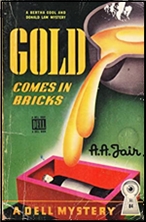
   GOLD COMES IN BRICKS (1940) resembles the earlier C&Ls in that the murder is a relatively trivial event buried under a mountain of scams. Passing himself off as, of all things, a physical fitness instructor, Donald enters the household of prosperous businessman Henry Ashbury, who’s hired the firm to investigate a pair of $10,000 checks to cash recently signed by his daughter Alta, and quickly learns that her father’s suspicions are on the mark: she’s been paying gambler Jed Ringold to get back some stolen love letters written to her by a married man about to go on trial for the murder of his wife—letters which the man’s sleazy defense attorney is desperate not to let fall into the hands of the prosecution.

   All hell breaks loose when Ringold is shot to death in his hotel room a few minutes after being given a third check by Alta. Donald, spying on the situation from the room next door, takes the check out of Ringold’s pocket before slipping away. For a few chapters his maneuvers to protect himself and Alta and confuse the witnesses who saw him on the scene take a back seat as he heads for northern California to look into a scheme to sell stock in a gold-dredging venture and, with the help of a tough old prospector who might be a Gardner self-portrait, launches a plot to scam the scammers.

   The frantic pace and abundant insights into securities fraud and gold-claim salting hold our attention despite having little to do with the murder. Donald falls in love as usual but this time does not get beaten up. As customary in these early outings, it’s his show all the way. Bertha curses and grouses about money but doesn’t contribute a great deal. So much for the claim that the C&Ls are variations on what Rex Stout had initiated five years before THE BIGGER THEY COME. Perhaps Donald is a bit like Archie Goodwin (although he could never take orders or narrate as engagingly as Archie does), but at the thought of Bertha as another Nero Wolfe, the mind turns cartwheels.

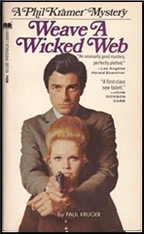
PAUL KRUGER – Weave a Wicked Web. Phil Kramer #2. Simon & Schuster, hardcover, 1967. Paperback Library 63-180, paperback; 1st printing, December 1969.

   There’s a little reviewer’s license going on there in the line up above. Phil Kramer’s not a licensed PI. What he is instead is a practicing attorney, but what he’s hired to do in this, his second appearance, is definitely a PI’s job, and the way he tackles it is exactly how a PI would. A PI in other colors is still a PI, no matter how you may look at it. Or him, as the shoe may fit.

   It all begins when a beautiful blonde walks into his office to have a woman called Kitty Bates found. She also has a description of her, but nothing about her background or anything else. She also will not say why she wants her found. There’s not much for Kramer to go on, but when he sees a story in a newspaper about a woman’s otherwise unidentified body having been found, the wheels in the case finally get going.

   And what a case it is. It turns out that Kitty Bates – yes, it is she – has been blackmailing someone in his client’s family for a long time, and that possibly even before she was killed, someone else had impersonated her to obtain $50,000 in cash from someone else in the family. And then two, maybe three, other deaths occur, Kramer is knocked out from behind at least once, and all of the alibis of those who may have responsible are leaking like sieves.

   This, in other words, is a detective story with a capital D. Do not expect any more character development than there is in your average Perry Mason novel, for there is none. There are twists galore in the telling, culminating in a long scene at the end, over ten pages long, in which all of the suspects have been gathered together while Kramer explains all – naming two killers in succession before finally implicating the real one.

   All fine and good, but even if this sound fine and good to you (and I freely admit that some may not), the telling is awfully dry, with lots of repetition as Kramer continually goes over the facts with everyone he speaks to. It’s a good mystery, no doubt about it, but with only a minimum amount of  juice in it to speak of, it’s not a great one.


      The Phil Kramer series –

Weep for Willow Green. Simon 1966
Weave a Wicked Web. Simon 1967
If the Shroud Fits. Simon 1969
The Bronze Claws. Simon 1972
The Cold Ones. Simon 1972

   Besides her five Phil Kramer novels, “Paul Kruger,” a pen name of Roberta Elizabeth Sebenthall,   (1917-1979), has five other works of crime fiction included in Al Hubin’s Crime Fiction IV.

UNIVERSAL’S CREEPER SERIES:
Three Movie Reviews by Dan Stumpf.


THE PEARL OF DEATH. Universal, 1944. Basil Rathbone (Sherlock Holmes), Nigel Bruce (Doctor Watson), Dennis Hoey (Inspector Lestrade), Evelyn Ankers, Rondo Hatton.
Based on the characters created by Sir Arthur Conan Doyle. Director: Roy William Neill.

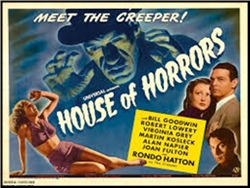
HOUSE OF HORRORS . Universal, 1946. Robert Lowery, Virginia Grey, Bill Goodwin, Martin Kosleck, Alan Napier, Virginia Christine, Howard Freeman, Joan Shawlee and Rondo Hatton. Screenplay by George Bricker & Dwight V. Babcock. Directed by Jean Yarborough.

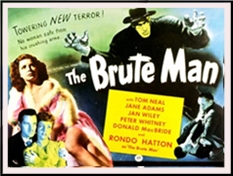
THE BRUTE MAN. Universal/PRC, 1946. Rondo Hatton, Tom Neal, Jan Wiley, Jane Adams. Screenplay by George Bricker and M Coates Webster, from a story by Dwight V Babcock. Directed by Jean Yarbrough.

   Universal is fondly remembered as the home of Frankenstein, Dracula, the Wolfman, and other classic horrors, but they had their share of misfires too. Kharis was more wet blanket than monster, no one could decide what Paula the Ape Woman looked like, the Mad Ghoul stalled out early…

   And then there was The Creeper.

THE PEARL OF DEATH

   A certain amount of controversy has attached to Rondo Hatton, some seeing him as a victim of crass exploitation, others as a man who willingly used his misfortune as best he could. Scott Gallinghouse’s perceptive biography (RONDO HATTON: Beauty Within the Brute, Bear Manor, 2019) paints a picture of a man who enjoyed his brief and tenuous stardom, was celebrated in his home town, and played it up, entertaining guests, and visiting wounded GIs in Army Hospitals.

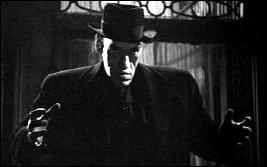
   Hatton played bits and extras in Hollywood for years until someone spotted him for a choice part in PEARL OF DEATH (1944: reviewed here ) a superior entry in the Sherlock Holmes series which used Hatton sparingly and to eerie effect as “The Hoxton Creeper” a hulking, silent, spine-snapping killer.

   Finding a new Horror Star dropped in their laps, Universal slipped him into JUNGLE CAPTIVE (1945) and THE SPIDER WOMAN STRIKES BACK (1946, a spin-off from the Sherlock Holmes series, with Gale Sondergaard) then somebody looked back at PEARL OF DEATH and decided it was impressive enough for Universal to launch a series, produced by Ben Pivar (of the Mummy movies) who brought his own working-class perspective and lack of interest to bear, with the usual tepid results.

   Pivar’s series kicked off with HOUSE OF HORRORS and a better-than-average cast. Alan Napier does a dead-on Waldo Lydecker impression as an art critic, and Howard Freeman is even better as his effeminate replacement. Top honors, however, must go to Martin Kosleckd sculptor.

   Kosleck occupied a niche in horror movies somewhere between Peter Lorre and Dwight Frye, and his greatest moment came in HOUSE OF HORRORS, as a demented sculptor at odds with the Art World, who sends the Creeper out to murder his critics — an idea that recalls various versions of THE GOLEM. Kosleck’s art isn’t much good, but it is sort of interesting, and I’d like to see how his style might have developed… but any semblance of atmosphere is dispelled as soon as Rondo Hatton opens his mouth to speak and there is just No Talent here. It wouldn’t have taken much brains to write a script where the Creeper stays silent – just some interest and maybe a little imagination – but that was obviously more than Pivar wanted to invest.

   THE BRUTE MAN, released later the same year, is even tackier and less interesting. Hatton died soon after it wrapped, and Universal, with tastefulness rare for them, decided not to release it. Instead, they sold it to PRC (an even cheaper studio) who put it out as part of their steady trickle of sub-B flicks. Historians of both studios (and there are some) usually use this as an excuse not to discuss BRUTE MAN, which is probably the kindest cut of all.

   I have to say, though, that BRUTE and HORRORS set their monster loose amid flophouses, tenements and seedy second-hand stores, bad as they are (and maybe because of Ben Pivar’s penny-squeezing) these movies evoke that seamy background kind of effectively; it’s like David Goodis wrote a monster movie.

   Strictly as an aside, imagine my surprise when I saw Rondo Hatton and Elena Verdugo, the campy Gypsy Girl in HOUSE OF FRANKENSTEIN, in a classy movie like THE MOON AND SIXPENCE (1942) which just goes to show what a many-splendored thing The Movies is.
   

REVIEWED BY MIKE TOONEY:


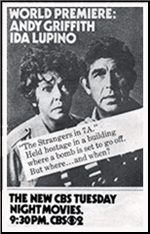
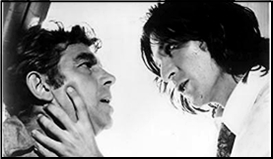
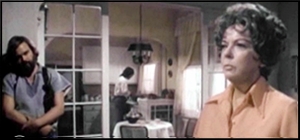
THE STRANGERS IN 7A. Made for TV film. CBS, 14 November 1972. Running time: 74 minutes. Cast: Andy Griffith (Artie Sawyer), Ida Lupino (Iris Sawyer), Michael Brandon (Billy), James A. Watson, Jr. (Riff), Tim McIntire (Virgil), Susanne Benton (Claudine; billed as Susanne Hildur), Connie Sawyer (Mrs. Layton), Virginia Vincent (woman in bank). Writers: Eric Roth, based on the novel by Fielden Farrington. Music: Morton Stevens. Producers: Mark Carliner Productions and Palomar Pictures International. Director: Paul Wendkos.

   Artie Sawyer is the superintendent of an apartment house. The marriage between him and his wife Iris has taken a downturn, so when she leaves town to visit her sister, Artie moseys down to the local bar to “relax.” It isn’t long, however, before his relaxed mood is dissipated when he encounters Claudine, a pretty young thing who uses every available (and some not readily available) feminine wile to coax Artie into letting her spend the night in one of his apartments — at which she is predictably successful, since it’s plainly obvious what’s on Artie’s mind.

   It’s while she and Arnie are experiencing a really close encounter with each other that three men (with, we soon learn, brief cases containing sawed-off shotguns and something even more explosive) barge in and spoil the mood; the only thing these three have on their minds is that $800,000 in the vault of the bank that just happens to be next door to Artie’s apartment house . . .

   And that’s the first third of this movie, which takes its time to get moving. Like John Payne and Dick Powell before him, Andy Griffith must have been anxious to change his well-established small-town persona to something a little more adult and cashable; this one succeeds in doing that by having Griffith’s character engage in an extra-marital affair — although, to be clear, there isn’t enough time for it to go anywhere. Griffith would later do a few more made for TV films like this one before landing the plum role of Matlock.

   The most impressive cast member isn’t Ida Lupino, ordinarily a splendid actress and director, who surprisingly doesn’t have much to do here. The standout is Michael Brandon, who almost steals the show as the passive-aggressive ring leader; what happens to his character is fitting but comes off as anticlimactic considering what has gone before.

   All in all, The Strangers in 7A is a fairly standard but efficient low budget caper movie; no plot surprises, of course, but well acted and definitely not a waste of time. It’s available on video from Synergy Entertainment and, for now, YouTube’s Cult Cinema Classics channel.

THREE FROM THE BEEB:
A British Dramatic Radio Review
by David Vineyard.


         1. Dead Man’s Bay by P. M. Hubbard. BBC Saturday Night Theater.
         2. Fire, Burn by John Dickson Carr. BBC Saturday Night Theater.
         3. The Silver Mistress by Peter O’ Donnell. 15 Minute Serial in 5 Parts

   Radio drama lasted far longer outside the US in most countries with the BBC keeping up the tradition even today with adaptations of Ian Fleming’s James Bond novels and recently Raymond Chandler’s Philip Marlowe (both starring Toby Stephens who replaced Ed Bishop as the BBC’s Marlowe) among others and even the Saint in adaptations of Leslie Charteris’s novels.

   The great thing is many of these shows both modern and from the past are available to listen to on YouTube and at Internet Archive presenting a rich mixture varying from classic mystery, romance, adventure, science fiction, horror, and mainstream plays and books, sometimes with unknown cast and others more familiar names.

   BBC’s Saturday Night Theater was a rich series producing original and adapted radio dramas from a variety of sources including many outstanding mystery writers.

   P. M. Hubbard (Philip Maitland Hubbard) was a successful mystery writer whose career, though short (1963 to 1979) included numerous highly regarded suspense and adventure novels such as Kill Claudio, High Tide, The Dancing Men, and Causeway Bay, varying from international intrigue, to straight adventure, to some decidedly left hand turns into near Gothic or horror fiction along the way.

   Dead Man’s Bay is an original play written  by Hubbard for the BBC about Peter Robinson, an ordinary fellow who falls in with Joe Benson, a bad sort, who convinces Peter, against the wishes of his wife Letty, that his beloved sail boat and knowledge of local waters means he could pick up some much needed money with a little side of smuggling.

   Avoiding the excise man is an old British tradition practiced less as crime than a sort of game played for centuries by British smugglers and subject of many a classic tale from Daphne DuMaurier’s Jamaica Inn to Graham Greene’s The Man Within, Russell Thorndyke’s Dr. Syn books, and Geoffrey Household’s comedic “Brandy for the Parson.”

   Also along the rugged coast where Peter plies his game with the Inland Revenue is a top secret British installation referred to only as The Establishment. Peter and Letty’s close friend Jim Hardwicke is in charge of security there and Peter’s wastrel brother Ricky, who knew and loved Letty before she met Peter, a Naval officer under him.

   But when Joe Benson reveals to Peter he has really been smuggling dope in from France and threatens blackmail to force Peter to make one last run and something occurs at the Establishment that has police roadblocks up all over the area Peter confronts something more sinister than even dope smuggling and a heartbreaking choice.

   There are no surprises in the story. You will likely be well ahead of the cast in figuring where it is going, but the story is told in bright smart dialogue and the atmosphere and storytelling make for an entertaining and vivid drama.

   Fire, Burn, John Dickson Carr’s classic historical mystery comes with a strong adaptation by John Kier Cross (author of, among others, a fine collection of his own weird fiction), and explores once again Carr’s fascination with the Berkeley Square (after the classic play and films) plot device of a romantic minded man thrown back in time through little but sheer will and his adventures there.

   This time the gentleman is Scotland Yard’s John Cheviot who gets in a taxi in 1960’s (the date of the radio play) London and after a bump on the head finds himself in 1829 London just appointed to the newly formed Police under Robert Peel as Superintendent of the Detective Force, and for his first case assigned to solve the mystery of who stole the bird seed from an influential dowager.

   Almost before you or Cheviot can digest this humiliation, he finds himself witness to an impossible crime, the murder of one Margaret Renfield (a witcherly type of whom Edmund Kean, the actor, once quipped ‘Fire burn and cauldron bubble’ in reference to), concealing evidence to protect his mistress, dueling with the most dangerous man in London, and determined to use modern methods to solve the crime, even though he is rapidly forgetting the John Cheviot from the 1960’s.

   Cross manages to hit all the right notes from the novel in a quickly paced hour and eighty six minutes, replete with a raid and brawl in a London gaming house, and a classic impossible crime solution. There is even an epilogue from the book explaining who was real in the story and the real life crime Carr based the book’s solution on.

   You can almost feel the fog in your chest and see the gaslit streets of 1829 London.

   There have been five books in the Modesty Blaise series adapted for the fifteen minute daily serial, a BBC feature that tends toward lighter popular fare, but with no letup in quality. These are faithful adaptations of the popular books with Modesty and Willie Garvin and the other characters from the books brought vividly to life.

   The Silver Mistress came about midway in the book series and features Modesty and Willie’s friend and sometime boss Sir Gerald Tarrant kidnapped and held prisoner in the haunted mountainous region of France. Along with Tarrant’s aide Fraser they set out to find Tarrant and rescue him leading to one of Modesty’s most deadly fights in the darkness of an underground cave system with a freezing cold river running through it.

   As you can imagine the radio drama plays that scene for full blooded fun.

   All the Blaise adaptations have been good and faithful, but this one works particularly well as radio drama.

   Radio drama differs from audiobook versions of the same material in that it moves at a much faster pace (it can take up to eleven hours or more to listen to many audiobooks), and because a good radio play choreographs not only the dramatic highlights, but also allows for a varied cast of talented voice actors to bring the material to life.

   Entertaining as it can be for an author or actor to perform an audiobook well (Stacy Keach reading Mike Hammer or Kevin Conroy Travis McGee come to mind), it can’t rival a cast of talented actors and sound crew giving full performances.

   There are many other examples to sample easily found at the two sources I mentioned including books by Mary Stewart, Margery Allingham, Agatha Christie, Andrew Garve, Michael Gilbert, Joyce Porter, C. S. Forester, and many other names familiar to this blog. It’s a particularly attractive way to revisit an old favorite you might not want to reread, but one you don’t want to forget either and often adds a new dimension to the original.

ROUTE 66. “Black November.” CBS, 60m, 07 Oct 1960 (Season 1, Episode 1). Martin Milner (Tod Stiles), George Maharis (Buz Murdock). Guest Cast: Everett Sloane, Patty McCormack, Keir Dullea, Whit Bissell, George Kennedy. Musical theme: Nelson Riddle. Screenwriter: Stirling Silliphant. Director: Philip Leacock. Currently streaming on Amazon Prime Video.

   Chronicling the adventures of two roving buddies making their way across the width and breath of the United States, this was arguably the iconic TV shows of the early 1960s. Of its kind, while I personally missed it entirely, it was certainly the most successful. I was off in college at the time, and I think I had time to watch television at most two or three, with the choice limited to one TV channel.

   I knew about it, of course, even without access to our family’s subscription to TV Guide, which I was addicted to all though high school. (Who in the early 60s did not?) So when I learned that Amazon Prime was streaming it free to subscribers, I thought it high past time to catch up on a serious lack in my cultural heritage.

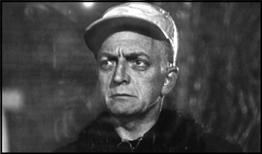
   I’m glad I did. This first episode’s a good one. The two buddies with a brand new car and two pair of restless feet to drive it find themselves in quite a predicament – at one time with ropes around their necks waiting to be lynched. This is not anything the Mississippi Tourist Bureau would want anyone to see! I suppose that in 1960, backward places such as the small town of Garth might exist, just like the most secluded rural parts of England, where strangers never come, and when they do, they are looked on by residents as Demons from Hell.

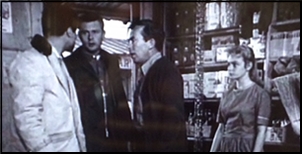
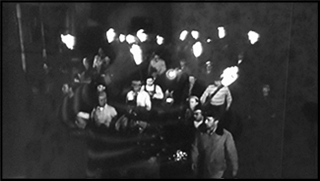
   One man rules the town with a iron thumb, and his name is Garth (Everett Sloane). The town also has a secret, but absolutely no one will talk about it. The daughter (Patty McCormack) of the local storekeeper is the only one who offers them a timid, shy smile. Everyone else has dark sullen faces, constantly staring at the pair with dark hostility. There is also, of all things, but it fits in perfectly, a creepy scene in which the townsfolk storm the grocery store with torches blazing away in the darkness.

   As the pilot episode, this certainly is an effective one. It starts, however, after they’ve already been on the road for a while, and it’s only in their conversation that we get hints of who they are and what set them on their way. If you are puzzled why they were heading for Biloxi before they got lost, a town nowhere near Route 66, I have often wondered that about the series myself. They ended up all over the US during the four years the program was on the air. I have finally assumed that the cross-country Route 66 was only a metaphor for anyone traveling here and there at whim and will, with no particular destination in mind.

IT IS PURELY MY OPINION
Reviews by L. J. Roberts


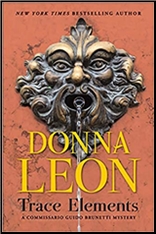
DONNA LEON – Trace Elements. Commissario Guido Brunetti #29. Atlantic Monthly Press, hardcover, March 2020. Setting: Contemporary Venice.

First Sentence: A man and a woman deep in conversation approached the steps of Pone dei Lustraferi, both looking hot and uncomfortable on this late July afternoon.

   Benedetta Toso, a dying hospice patient who asks to speak with the police, claims her husband, Vittorio Fadalto, was murdered over “bad money.” Commissario Brunetti and his colleague, Claudia Griffoni, promise to investigate the matter, but was it murder or an accident? Suspicions mount as they learn more about Vittorio’s job, that of collecting samples of water to be tested for contamination. Piecing together the tangled threads, Brunetti comes to realize the perilous meaning in the woman’s accusation and the threat it reveals to the health of the entire region.

   With an excellent beginning, one learns that being a Neapolitan in Venice is a “far greater handicap than being a woman.”— and that one may not want to visit Venice during the summer. Leon’s voice is always a pleasure. When talking about the heat, she conveys the sense of it without referencing it directly– “Brunetti realized only then how hot he was. He tried to lift his right leg, but it was glued to the chair by sweat.” It is these touches that bring Venice to life by allowing us to see the city as those who live there do.

   There is a second plot thread of two Romany pickpockets. It is interesting to learn the differences between how crimes are handled in Italy versus the United States. The secondary plot does raise interesting points. Leon’s descriptions, from the route to an address Brunetti takes that only a resident would know, to his description of a room badly decorated, to food, are a delight and bring the city to life. Even a plate of sandwiches at a bar sound good– “From the sides of the sandwiches spilled ham, egg tomato, tuna salad, radicchio, rucola, shrimp, artichokes, asparagus, and olives.”

   Leon is wonderful at injecting verbal exchanges to make one chuckle. When called into his boss’s office, Signorina Elettra remarks– “If you aren’t out in fifteen minutes, I’ll call the police.” However, she is also very good at making one pause and consider, as with Bruno’s conversation with a nurse– “But if you work with death, you have to become spiritual, or you can’t do it any more. … when they get close to the end, you can sense their spirit, or you sense that it’s there. They do, too. And it helps them. And us.” She knows how to touch one’s emotions– “Griffoni…raised a hand and threw open her palm, as if to release the dead woman’s spirit into the air. The three of them remained silent for enough time to allow that spirit to escape the room…”

   There is something wonderful about a policeman who reads Lysistrata for pleasure and describes Agamemnon as a “windbag commander.” The relationship between Brunetti and his wife Paoli adds normality. It is one of a couple who have been married a long time and still love one another. An interesting characteristic of Leon is that when her characters are in a professional setting, she references them by their surnames, yet when in a personal setting, or amongst one another as friends, she uses their first names.

   Leon is incredibly good at building a story. She takes one along with her through the steps with an amazing subtlety to the clues. Trace Elements is a police procedural without car chases or gunplay, but with a somewhat political theme. It is a very contemporary mystery with a contemporary crime. It reflects on the degradation of true justice in our time and on compromise. For some, the ending may not seem satisfactory, but upon reflection, there is some small justice amidst justice that cannot be achieved.

Rating: Very Good.

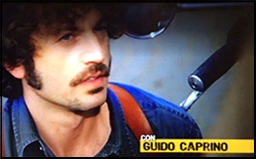
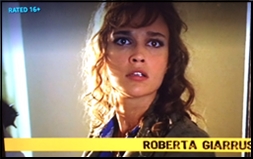
COMMISSIONER MANARA. “The Perfect Crime (Un delitto perfetto).” Rai 1, Italy, as Il commissario Manara. 08 January 2009 (Season 1, Episode 1.) Guido Caprino (Luca Manara), Roberta Giarrusso (Lara Rubino), and a large ensemble cast. Currently streaming on Amazon Prime as Inspector Manara.

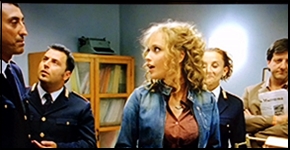
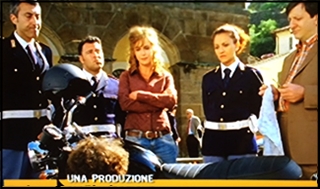
   Commissioner Manara, a delightful combination of comedy and sentimental police work, appeared on Italian TV for two seasons of twelve episodes each. In this, the first episode, Luca Manara has been sent down from the big city to take over as Commissioner in a small provincial town where his arrival is looked on with considerable suspicion, especially since one of the officers still there had expected to be offered the job.

   Luca is, as it turns out, something of a playboy and a womanizer. He reputedly had to leave his previous position for romancing the wife of his superior there. Young, dressed rather informally, with a carefully maintained stubble of a beard, plus a propensity for riding a motorcycle everywhere, he is often taken for a delivery person. When his new inspector sees him, she immediately slaps him in the face. It seems that they have had a past together, back in inspector school.

   The first case they have to work on together is that of a death that is at first assumed to have been a suicide, but between Luca’s good instincts and even better forensic work, it is soon discovered that it was murder instead, much to the local superintendent’s displeasure.

   I really enjoyed this one. There is both laugh-out-loud comedy and excellent detective work involved, plus a sentimental ending that shows everyone that Luca Manara also has the proverbial heart of gold. Add in lots of beautiful scenery and even more beautiful women, what’s not to like?

« Previous PageNext Page »