Reviews


JOHN JAY CHICHESTER – The Bigamist. Jimmy “Wiggly” Price #2. Serialized in seven parts in Detective Story Magazine between February 7 and March 14, 1925. Published in hardcover by Chelsea House, 1925. Reprinted by A. L. Burt, hardcover, 1927.

   You shouldn’t expect a detective story published in 1925 to be a modern day mystery, especially one published in Detective Story Magazine, a pulp that didn’t realize that hardboiled detective fiction was coming into play until the very late 1930s, some fifteen years after the fact.

   And yet … and yet … the opening of The Bigamist reminded me of a noirish novel I recently read by Day Keene, I believe, in which the protagonist was mixed up with two women, one in the city and the other, much more innocent, living on a farm (figuratively speaking, if not literally). The bigamist in The Bigamist, is no amoral character however, just a weak one who forsakes the women who loves him (and has waited over ten years for him) and marries a rich women he quickly finds he really doesn’t love.

   Learning that his first love is dying, he hurries home, and so that she can die in peace, still loving him, he goes through a phony marriage ceremony with her — only to have her miraculously recover. Enter a blackmailer, then a killer.

   The detective on the case is not the clown of a cop in the village where Dora lives, but a newspaper reporter from the city by the name of Jimmy “Wiggly” Price, first met in The Porcelain Mask (Chelsea House, 1924). His nickname comes from the fact that when he gets excited, his ears begin to wiggle uncontrollably. (No, I’m not joking. It can be done, but it takes practice.)

   Any hint of this being a noir novel has quickly disappeared by this time, obviously, and the dialogue between the participants is often antiquated at best. Since the number of these participants is strictly limited, if the killer isn’t the obvious one, there’s only one other person it could be. And yet .. and yet … the book is surprisingly readable, and only because the author, I submit, was a natural storyteller, fact that outweighs any other deficiencies he may have had. I have no other explanation.

        —

Bibliographic Notes:   John Jay Chichester was a pen name of Christopher B. Booth, noted in some circles as the author of the Mt. Clackworthy stories, discussed at length on this blog here and here. The third and final Jimmy Price novel was The House of the Moving Room (Chelsea House, 1926).

REVIEWED BY DAVID VINEYARD:


GERALD KERSH – Prelude to a Certain Midnight. Heinemann, UK, hardcover, 1947. Doubleday, US, hardcover, 1947. Reprint editions include: Lion #98, paperback, 1952. Dover, US, paperback, 1983.

   Some books defy easy classification. Anything by Gerald Kersh defies easy classification. If you are an American you may know him for his short stories, for his tales of the impossible con man Karmesin, or Fleet Street editor Bo Raymond, or maybe his collections of distinctly off beat tales, On An Odd Note. You might know him for his best known American novel, Night and the City, an icon of noir film in two different adaptations.

   But suffice it to say. you don’t really know Kersh if you haven’t read books like Fowler’s End, The Secret Masters, or Prelude to a Certain Midnight.

    Prelude is the story of a murderer, but it isn’t the story of a suspenseful police hunt or a courageous individual who digs into the truth.

   It is as much the story of the death of a small segment of a community as of an innocent child, and the death of what was a very different England and Europe in the years before the war. “It is all the same sort of thing. Maidanek, Belsen, Auschwitz, Sonia Sabbatani… The difference is only a matter of scale and legality.”

   It is a novel about the effect such a killer has on a community, on the patrons of a pub, a microcosm, and how destructive such violence is on everyone touched by it. It is about what turns men from sick to murderer what pushes a certain kind of weakling to believe he is a superman.

   The atmosphere of a place is the soul of that place, and when it departs the place dies. One may make equations: A New Manager, plus the New Managers Friends, minus certain Old Familiar Faces, plus a Strange Barman, plus the Tension that goes with Unfamiliar Voices, minus Intimacy, equals a Change of Atmosphere. But this is not satisfactory. One might as well describe an oppressive quiet in terms of decibels, or explain a grief in cubic centimeters of salt tears. One might as well expect an oceanographer to draw up the loneliness and the darkness of the Mindanao Deep on a plumb line.

   The Bar Bacchus died. The virtue went out of it. Its soul drifted away so that now, although nothing about the place has visibly changed, it is nothing but a shell that once enclosed a character and an individual heartbeat.

   How the Bacchus lost its soul, its virtue, is told in terms of its patrons; of Asta Thunderley, a force of life who sees the indifference of police when a child dies in a poor neighborhood in Pre War London, and chooses to organize a hunt for the killer among the patrons of the pub; of Tobit Osbert, the gentle man loved by children who harbors a dark secret and loves to see pain; Sam Sabbatani the tailor whose life is destroyed by the murder of his daughter; of Tiger Fitzpatrick Asta Thunderley’s ex prizefighter butler; Conger the barman; Ember the novelist; of Thea Olivia “Tot” who knows Osbert is the killer but no one will listen; and of Amy “Catchy” Dory, the poor soul who was once beautiful who “The weaker you were, the more submissive she became. The more foolish and indecisive you were, the more she looked up to you…” Catchy, who more than Tobit Osbert is the monster at the center of the novel

   Kersh captures all these people with perfect phrasing and well tuned voices.

   Of Catchy: She knew how to make people happy when she was beautiful, and when the Bar Bacchus was a place with an atmosphere.

   Of Sabbatani who hid his great heart behind a scowl: The, heart of Sabbatani chuckled in quiet triumph. His head growled impotently. His face scowled.

   Of the petty banality of the murderer: He had sent his suit to be cleaned by Sam Sabbatani, who gave his dyeing and cleaning to the great Goldberg Dye Works, which takes in half the dirty clothes in London every morning at nine o’clock. The firm of Goldberg makes a specialty of what they call “mourning orders” and will dye anything funereally black within twenty-four hours.

   Tobit Osbert found a certain refined pleasure in the contemplation of the fact that Sam Sabbatani, still red-eyed and thunderstruck with grief, was washing away evidence which might possibly have convicted the murderer of his daughter for three and sixpence—on the slate, at that.

   Colorful a lot as the characters in the novel are it is their mere humanity that again and again keeps you turning pages in the novel. Osbert the child murderer beloved by his nieces who he takes to the circus or the shooting gallery, Astra who tries disastrously to play Miss Marple even down to a gathering of the suspects at her dinner table, Thea who must live with the knowledge Osbert is the murderer and can do nothing about it.

   Kersh offers no easy answers. Only his wit and command of style save this from being a depressing book and instead create a kind of black Ealing comedy atmosphere as if Passport to Pimlico had been written by Robert Bloch.

   And there is savagery here too, Kersh’s anger at the lot of these people, at their weaknesses and strengths, at the indifference toward small “unimportant” lives, and the ways dark truth’s hidden behind beauty can create monsters of little frightened men.

   Once read, Prelude will stay with you, maybe even if you wish at times it would not. It is not really a mystery, it’s far too wise and human simply to be noir (though ironically it is one of the great noir novels), its heart too great, its anger too visceral.

   Reading this you may get the wrong idea about Kersh and the idea he writes as a misogynist. He does not. His portrait of Catchy particularly is a full one, and only after he has laid out his carefully presented case against her does his tone towards her change from sympathetic to accusatory.

   I can only say I wish they had filmed this. What a role Catchy would be for some lucky actress. She is no femme fatale or spider luring men to their doom, but her love is just as destructive because of where it comes from. She is victim, too willing to be one, and monster, too blind to see what she creates out of “love.”

   Blanche Du Bois has nothing on Catchy.

   You may disagree about the degree of her guilt, but I think her comeuppance from Astra Thunderley will still be the cathartic moment Kersh means.

   I don’t usually quote last lines in reviews, but this one sums up much of what you will find in Prelude, and sums up the somewhat shopworn Catchy and the harm her kind can do neatly.

   …and about her there clings, always, an atmosphere of guilt, of maudlin grief, stale liquor, and decay that makes you long for a good high wind to blow her and her kind from the face of the earth, the flyblown face of the exhausted earth.

REVIEWED BY DAN STUMPF:


SWING YOUR LADY. Warner Brothers, 1938. Humphrey Bogart, Frank McHugh, Louise Fazenda, Nat Pendleton, Penny Singleton, Allen Jenkins, the Weaver Brothers and Elviry, Ronald Reagan, and Daniel Boone Savage. Screenplay by Joseph Schenk and Maurice Leo, from the play by Kenyon Nicholson and Charles Robinson. Directed by Ray Enright.

   A film that once seen is never forgotten—no matter how hard I try.

   At this stage in his career, Humphrey Bogart had been with Warners for two years and seven films, with noteworthy performances in three of them: THE PETRIFIED FOREST, BLACK LEGION and DEAD END. The star quality was definitely there, but somebody kept shunting him off into nothing parts in big films like VIRGINIA CITY and DARK VICTORY, or leads in things like SWING YOUR LADY.

   Bogart plays a seedy fight promoter, sort of like Adolphe Menjou in GOLDEN BOY, minus Barbara Stanwyck and William Holden. What he’s got is Penny “Blondie” Singleton and lunk-headed wrestler Nat Pendleton, touring the sticks trying to drum up a fight that will draw a crowd and get him noticed.

   Bogie eventually sets up a match between his boy and the local blacksmith (Louise Fazenda) but has to resort to chicanery, first to keep Nat from finding out he has to wrestle a woman, then to break up a romance when they meet and fall in love.

   Help of sorts comes in the form of Fazenda’s rejected beau Noah (Daniel Boone Savage, a professional wrestler using his Hillbilly Bruiser persona here in his only screen appearance.) Bogie arranges for him to fight Pendleton, then true to sleazy form, tells Louise that Nat already has a wife and four kids, then orders Nat to throw the match because the Winner is supposed to marry Ms Fazenda.

   Did you get all that? And did it put you on tenterhooks, wondering how it all comes out?

   Me neither.

   Obviously this is not a film for Bogart fans or those with a taste for sophisticated comedy. SWING YOUR LADY was sold as a Hillbilly Musical, and the story, such as it is, stops for long stretches to showcase the Weaver Brothers and Elviry, who seem to spend all their time singing on the porch at the General Store while Bogie hustles and everyone else tells hillbilly jokes.

   Easy as it is to dump on LADY, I should add that some of the musical interludes aren’t bad at all.

   Penny Singleton (having just changed her name from Dorothy McNulty) had a real talent for dancing — in a showy, Gene Kelley style — and she shows it off here in a couple of novelty numbers choreographed by Bobby Connolly, who worked on the dances in THE WIZARD OF OZ.

   As for the Weavers Brothers and Elviry… well, taken in the proper spirit, one can view them as authentic folk artists leaving a filmed record of their art.

   It helps. But not enough to redeem a movie that belittles its characters and demeans itself. Or as Bogart himself put it, “If you want to see the worst picture I ever made, get them to screen SWING YOUR LADY.”

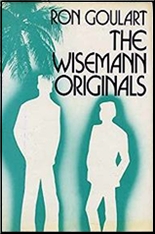
RON GOULART – The Wiseman Originals. Rudy Navarro #1. Walker, hardcover, 1989.

   Rudy Navarro is a PI, I guess you’d say, working for an agency called the Ajax Novelty Company. (No kidding.) In this case he once again needs the help of Jack Briggs, a former advertising art director, ten times over, and an expert on the works of Wiseman, a German artist of the 20s and 30s who died in Dachau.

   But some of his drawings, which were confiscated by the Nazis and had been missing since the end of WW II, have suddenly turned up at a Florida comic book convention, and Navarro’s client is not the only one who wants the rest of them. Not much mystery, but lots of humor, always a definite part of Goulart’s repertoire. The resulting story reminded me of a vulgar Craig Rice and had me laughing all the way.

   BTW: It was someone else who said it, but can you think of a commercial operation, other than a comic book shop, i which the proprietor dresses worse than the average customer? Ron Goulart, who goes to some of the same comic book conventions that I do, doesn’t miss on this one, either. This takes into consideration, and quoting the lady watching the store on page 58, “You ought to see the assholes who come in to buy this crap.”

–Reprinted from Mystery*File #15, September 1989, considerably revised and expanded upon.

Bibliographic Update:  This appears to have been Rudy Navarro’s only recorded case.

REVIEWED BY MIKE TOONEY:

(Give Me That) OLD-TIME DETECTION. Summer 2019. Issue #51. Editor: Arthur Vidro. Old-Time Detection Special Interest Group of American Mensa, Ltd. 36 pages (including covers). Cover image: Whodunit? Houdini?

   ONCE AGAIN Arthur Vidro has brought forth a publication worth your attention, with a satisfying variety of articles about Golden Age of Detection (GAD) authors and their works, some from yesteryear and some contemporary. In case you haven’t noticed it, the GAD “renaissance” continues apace, and every issue of Old-Time Detection (OTD) serves as a fine compendium of information for both the experienced GADer (yes, it’s now a word) and the newcomer to this era of the “mystery” genre.

   If you’re a Edward D. Hoch fan like us, you’ll appreciate a new series in OTD, “The Non-Fiction World of Ed Hoch,” featuring “a run of reprint pieces penned by” the latter-day master of the impossible crime short story, compiled by Dan Magnuson, Charles Shibuk, and Marvin Lachman. Hoch’s knowledge of the “mystery” field was practically unbounded, and what he had to say about it is always worth your notice.

   Between the two World Wars the “mystery” story underwent a sea change from genteel drawing room bafflers to the hardboiled outlook, signaling the “death” of the formal whodunit as it was then known—or so people have been told. Jon L. Breen begs to differ; in “Whodunit? We’ll Never Tell but the Mystery Novel Is Alive and Well” he gives us just the facts, ma’am.

   J. Randolph Cox focuses the Author Spotlight on Craig Rice (Georgiana Ann Randolph), known to most readers for her wild and woolly mysteries featuring lawyer John J. Malone, saloon owner Jake Justus, and Justus’s wealthy and beautiful wife Helene. Rice took the relatively understated screwball social dynamics of Hammett’s The Thin Man and pushed them to the limit: “In a genre in which death can be a game of men walking down mean streets unafraid to meet their doom,” writes Cox, “she wrote of men whose fearlessness came from a bottle—from several bottles, in fact—and made it seem comical.” However, “The drinking which she made amusing in print was not amusing in her own life.”

   Thanks to a veritable explosion of paperback reprints of classic detective and mystery stories in the 1960s and ’70s, as well as the works of newer authors, the world of GAD-style fiction was kept from total extinction in the face of the hardboiled onslaught, as Charles Shibuk told us in his Armchair Detective reviews of the period.

   Among the writers who enjoyed this attention from the publishers: Margery Allingham (“I’m convinced that Allingham’s best shorts are of greater value than her novels”), Eric Ambler (“The decline of this writer’s skills during the 1960s has been sad to contemplate . . .”), Nicholas Blake (“Here is another writer whose recent efforts are best left unmentioned, with one notable exception . . .”), John Dickson Carr (“This author’s best work was published between 1935 and 1938 . . .”), Agatha Christie (“If you have not read it, do not on any account miss Cards on the Table“), S. H. Courtier (“. . . obviously the logical successor to the late Arthur W. Upfield”), Amanda Cross (“. . . has only produced three novels in seven years . . .”), Andrew Garve (“. . . prolific and usually reliable . . .”), Frank Gruber, Ngaio Marsh (“Like fine wine, this author improves with age”), Stuart Palmer (“. . . his work was highly competent and always entertaining”), Ellery Queen (“. . . The Spanish Cape Mystery, which represents the last chapter in Queen’s first and best period”), Julian Symons (“Recent work has shown an attempt to return to form . . .”), Josephine Tey (“. . . I don’t think this is ultimately the stuff of which detective stories are really made”), and Raoul Whitfield (“. . . here is a rare opportunity to examine the work of an unjustly forgotten contemporary of Dashiell Hammett”).

   Next, Marvin Lachman offers an affectionate memento of Lianne Carlin who, as a fanzine editor-publisher, was one of the major forces responsible for nurturing mystery fandom and keeping interest in the genre alive and well.

   Dr. John Curran covers the world of Agatha Christie as no one else can: a seldom-seen and different play version of Towards Zero from 1945 (“The plot of both stage versions is, essentially, the same as the novel, as twisty a plot as any that Christie every devised”); Tony Medawar’s impending Murder She Said; The Agatha Christie Festival (“. . . in keeping with the last few years, is disappointing”); and Christie Mystery Day (“. . . no one knows what to expect until it begins”).

   In “Zero Nero . . . Well, Almost”, George H. Madison offers a good summary of the finer points of Rex Stout’s popular series (46 books!) but ruefully explains why “our Nero will not be revived on screen this generation.”

   As we mentioned earlier, a new feature of OTD reprises “feature articles and introductions written by Edward D. Hoch,” the first one being his preamble to the Index to Crime and Mystery Anthologies from 1990. “Here is a book,” says Hoch, “to make an addict out of any reader of short fiction.”

   Amnon Kabatchnik’s summary article about Maurice Leblanc’s Arsene Lupin promises to tell us about “Lupin on Stage, the Screen, and Television,” and delivers nicely. It’s ironic that Leblanc, however, fell into the same trap that the creator of Sherlock Holmes did: “After the unexpected blockbuster popularity of Lupin, he found, as Conan Doyle had before him, that the public wanted him to produce stories and novels only about his most famous character and nothing else.”

   The fiction offering in this issue is William Brittain’s “The Last Word” (EQMM, June 1968), with the author using the “James Knox” alias to signal that it won’t be one of his popular Mr. Strang adventures.

   One of the best anthologies from the ’70s is Whodunit? Houdini? Thirteen Tales of Magic, Murder, Mystery (1976), which, despite its title, is not a collection of fantasy stories but mystery and detective adventures by Clayton Rawson, Rudyard Kipling, John Collier, Carter Dickson, Manuel Peyrou, Frederick Irving Anderson, Rafael Sabatini, William Irish, Walter B. Gibson, Ben Hecht, Stanley Ellin, and Erle Stanley Gardner, seasoned authors who knew how to write engrossing fiction.

   Perceptive as always, in “Allure of Classic Whodunits” Michael Dirda tells us about the “distinct sense of well-being and contentment” he feels at what modern critics would regard as a defect, the artificiality that has become a “welcome attraction in many vintage who-and-howdunits,” stories which “deliberately leave out the messiness of real life, of real emotions, thus allowing the reader to mentally just amble along, mildly intrigued, feeling comfortable and even, yes, cozy,” putting the reader “a long way from deranged fantatics armed with semiautomatic weapons,” and, thus, engaging the mind rather the emotions, which is where the detective story had its beginnings (thanks, Edgar).

   To wrap up this issue there are letters to the editor and a puzzle page that isn’t as easy as some. If you don’t already have a subscription to Old-Time Detection, here’s how to get one: It’s published three times a year: spring, summer, and autumn. A sample copy is $6.00 in the U.S. and $10.00 anywhere else. A one-year subscription in the U.S. is $18.00 ($15.00 for Mensans) and overseas is $40.00 (or 25 pounds sterling or 30 euros). You can pay by check; make it payable to Arthur Vidro; or you can use cash from any nation, or U.S. postage stamps, or PayPal. The mailing address: Arthur Vidro, editor, Old-Time Detection, 2 Ellery Street, Claremont, New Hampshire 03743. Arthur’s Web address is vidro@myfairpoint.net.
IT IS PURELY MY OPINION
Reviews by L. J. Roberts


DELIA OWENS – Where the Crawdad Sings. Author’s first book. G.P. Putnam’s Sons, hardcover, August 2018.

First Sentence: Marsh is not swamp.

   Kya Clark, aka Marsh Girl, virtually raised herself. Her ability to watch and learn, and to depend on her North Carolina marsh allowed her to survive. When the handsome son of a prominent family is found dead, Kya is accused of his murder. But was it an accident? Did she kill him? Only with the help of others might Kya survive this, too.

   An author who paints pictures with words is one to be savored. Owens does just that and does it beautifully. There is a strong, lyrical quality to the writing— “Kya laid her hand upon the breathing, wet earth, and the marsh became her mother.”

   The author does employ devices that one may find annoying: multiple POVs and time fluctuations. Give it a chance, however. Before long, one may find oneself thoroughly captivated and willing to overlook those things. Instead, one becomes immersed in a wonderful story filled with interesting characters, a setting which engages all the senses and emotions, and a desire for some real Southern cooking— “The aroma of sausage and biscuits, boiled turnip greens, and fried chicken thankfully overtook the high smell of fish barrels lining the dock. … Behind the counter, owner-cook Jim Bo Sweeny darted from flipping crab cakes on the griddle to stirring a pot of creamed corn on the burner to poking chicken thighs in the deep fryer…”

   Owens’ descriptions are magnetic. She knows how to engage the reader— “There are some who can live without wild things, and some who cannot.” It is not all description. The author creates interesting, strong secondary characters, including Jumpin’, his wife Mabel, and particularly Tate—”His dad had told him many times that the definition of a real man is one who cries without shame, reads poetry with his heart, feels opera in his soul, and does what’s necessary to defend a woman.” One also learns the meaning of the title, and celebrate Kya’s successes— “I wadn’t aware that words could hold so much. I didn’t know a sentence could be so full.” Wouldn’t one love to remember when one had made that discovery?

   Although there is a slight sense of fantasy about the plot, one can’t help but be entranced by Kya’s strength, courage, and perseverance— “I have to do life alone. But I knew this.” But it’s not all misty light. Owen’s takes us into Kya’s feelings of being confined and through the trial, which was well done.

   The book isn’t perfect. The actions of one character don’t always ring true, and one may start to feel a bit manipulated. However, there is no question but that one’s emotions become completely engaged to the point of possibly shedding tears at the finale; not a sad cry, but a lovely-ending cry.

    Where the Crawdads Sing is a very good book. It may not be the best book ever written or that one has ever read, but it is one of those rare books which will stay with one a long time. It will be interesting to see what Owens writes next.

Rating: Very Good.

DAVID WILLIAMS – Wedding Treasure. Mark Treasure #8. Macmillan, UK, hardcover, 1985. St. Martin’s, US, hardcover, 1985. Avon, US, paperback, 1987.

   Mark Treasure is a London-based investment banker, but over the years, he and his actress wife Molly found themselves involved in 17 cases of murder that needed solving. In Wedding Treasure it is the death of a would-be bride’s father, a loutish cad of a man, who is murdered, apparently by being hit in the head by an errant golf ball.

   The killer’s intention was to have his victim’s death put down as a most unfortunate accident, but as Treasure quickly realizes, no golf ball in the ordinary course of events can do as much damage as this one is supposed to have done. There is no shortage of suspects. If the dead man had formally objected to the wedding, the bride would have had to wait ten more years before she could collect a sizable inheritance.

   It does not help that the groom-to-be is a little too slick to be the person he pretends to be. There are a lot of characters in the story, some more important than others, and as I said earlier, there are more than enough motives to go around.

   The telling is both bright and witty, in the finest British tradition, and many, many mostly obvious red herrings. The ending, unfortunately, is the weakest part of the book. I had to skip over all of the financial matters; all I wanted and needed was whodunit, not necessarily why. That’s what detectives who are also financial bankers are for, and Mark Treasure fits the bill perfectly

REVIEWED BY BARRY GARDNER:


ANDREW VACHSS – Down in the Zero. Burke #7. Knopf, hardcover, 1994. Vintage Crime/Black Lizard, paperback, 1995.

   Vachss’s tales of the alienated and disconnected Burke and his group of misfit and off-center allies are very much a specialized taste, I think. I’ve liked them anywhere from somewhat to considerably over the course of the series.

   Burke is locked into a spiral of depression that threatens to take him down into the “Zero. or oblivion. He killed a child, and it may destroy him. Then a young man appears who is afraid that a mounting number of suicides among his rich acquaintances may hide a common dark secret, and asks Burke to help him.

   Burke wouldn’t, but the young man plays a trump — his mother told him to seek out Burke if he ever felt threatened, and to remind him of a favor he owed her. It’s an invoice a long time in the presenting, but Burke feels he must honor it.

   Vachss’s fiction has always struck me as a curious mixture of the romantic and the perverse. Sexual deviance, child abuse, and bloody violence exist side by side with relationships among the characters that are oddly idealized and romanticized. There’s little real about the stories, either, which are very grim fairy tales.

   In this one there are strong echoes of Robert Parker’s Early Autumn, on that Burke transforms a fearful wimp of a young man into a macho budding race-driver in an astonishingly period of time. The plot is half-assed and half-hearted, and this is another case, I’m afraid, of an author just going through the motions with a successful series. There’s not a great deal here even for confirmed Vachss-ites, and even less for anyone else.

— Reprinted from Ah Sweet Mysteries #18, February-March 1995.
REVIEWED BY DAVID VINEYARD:


ERIC AMBLER – A Kind of Anger. Bodley Head, UK, hardcover, 1964. Atheneum, S, hardcover, 1964. Bantam, US, paperback, 1965. Reprinted many times.

   I had been the editor and part-owner of Ethos, an experimental international news review which had gone bankrupt, and that I had spent several months in a French mental hospital following a suicide attempt. The investigators, a Paris firm of private detectives, had even managed to worm out of the hospital authorities the fact that I had received shock treatments.

   The narrator is Piet Maas, a Dutch-born English-speaking reporter for the news magazine World Reporter. He’s also a typical Ambler hero, walking-wounded, no one’s hero, but a surprising survivor.

   Mr. Cust, Piet’s employer, wants rid of Piet because he is none to fond of people with mental problems, but he is also incredibly cheap and Piet has five months to go on his contract, so when a story comes up, a humdinger, and there is no one else available, the result is inevitable: “Pete, you shake the long hair out of your eyes, get your ass out of there and find that bikini girl…”

   â€œThat bikini girl,” is related to a story Mr. Cust wants his Paris editor to assign Piet to breaking, a story Piet has little interest in, “ …a man named Arbil had been murdered in Switzerland and the police were trying to find some woman who wore a bikini and had witnessed the crime.” Said girl has been missing some time now, and Mr. Cust doesn’t want to be scooped by Time or Newsweek.

   Piet, like many an Eric Ambler hero before him, is in over his head before he even starts.

   After the War, Ambler seemed to lose track a little. Admittedly he was busy with new-found fame and a career as a screenwriter, but the post-war Ambler books just don’t measure up to his pre-war classics. They aren’t bad books, from anyone else they would be outstanding books, but they just aren’t Ambler at his best.

   That changed with The Light of Day, which Jules Dassin made into the classic film Topkapi. The book introduced a new wry humor into the mix, and Ambler fans waited with some trepidation to see what he would do next. What he did was A Kind of Anger.

   Sales and reviews said he was back on track and they were both right.

   Piet soon finds why everyone wants the girl in the bikini. Her name is Lucia Bernardi and she was the mistress of a wealthy man in Zurich fleeing his chateau there where he had been tortured then murdered. The man in question is “Ahmed Fathir Arbil, and he was an Iraqi. He was also a refugee.” Worse, he is a former Iraqi police chief, a Colonel who knows where bodies are buried and money hidden, and there are people who would like to find Lucia Bernardi for both reasons — to question her, or silence her. Complicating things more is the fact Lucia met Abril while in the company of an American named Patrick Chase, a suspected con man.

   Chase is actually named Philip Sanger, born in Lyon, France, and what he has to do with everything is where much of the plot comes in.

   Piet, though, is pretty good at what he does, and it is Piet who gets to Lucia first.

   And as luck would have it, Piet finds himself falling for Lucia, and suddenly faced with a choice. He can have the girl or the headline. Solidify his job at World Reporter, get an international by-line, and make his career, rebuilding his life in one stroke; or with Lucia, and Philip Sanger and his wife, Piet can gamble everything on the neatest little bit of international blackmail ever conceived.

   This being an Eric Ambler novel, you only get one guess which path he takes discovering things about himself, falling in love, and of course very nearly ending up dead a few times along the way before Piet, his love, his friends, and justice all get more or less well served.

   Sanger is another example of Ambler’s favorite kind of shadowy figure, the able criminal, one who may be suspected, but can never quite be caught, a smarter and more capable version of Graham Greene’s Harry Lime. In his earlier novels they were men like the murderous Dimitrios, but as the years passed, Ambler developed a kind of admiration for them until in Send No More Roses the able criminal was the hero of the book.

   Ambler remained uneven for the rest of his career, but he also wrote some of the best books of his career like Levanter and Dr. Frigo, not just thrillers, but novels that had something to say, often with a dark sense of humor. There are three distinct eras in Ambler’s work, the early years ending with Cause For Alarm, the post-War years where his books under his own name and in collaboration with Charles Rodda seemed to have lost something they once had, and the era beginning with The Light of Day where Ambler turned back to books walked away from cinema and produced some of his best works.

    A Kind of Anger is prime Ambler, modern in tone, complex, and about people you might actually meet if you hung out in the Europe Eric Ambler types hang out in where the double cross and dark alley always seem more appealing than the straight and narrow. The wry humor added to the mix of intrigue and irony proved a tonic for Ambler and his fans.
.

LAWRENCE BLOCK – Tanner’s Tiger. Evan Tanner #5. Gold Medal D1940, paperback original; 1st printing, 1968. Reprinted in paperback by Jove (1985) and Harper (2007). Subterranean, hardcover reprint, 2001.

   The gimmick in Lawrence Block’s Tanner stories is actually twofold: (1) that a piece of shrapnel in his brain during the Korean War has not allowed him to get a moment’s sleep ever since, and (2) he somehow is given assignments by someone in the CIA who he doesn’t know and who doesn’t know that Tanner doesn’t work for him. (If I have any details of either (1) or (2) wrong, you can easily let me know.)

   In Tanner’s Tiger he’s handed the task of checking out the Cuban pavilion at the ’67 Montreal Expo; something wrong is going on there, but no one knows what. Refused entry at the border, however, Tanner and his young ward (semi-adopted daughter) Minna (putative queen of Lithuania) have to sneak across from Buffalo.

   And to complete his assignment he must join up with several members of the local chapter of the MNQ (Le Mouvement national des Québécoises et Québécois), who besides coming to Tanner’s aid, are planning to assassinate Queen Elizabeth while she also attends the Expo. (Tanner is a champion of all sort of Lost Causes.)

   Which is were the “tiger” of the tale comes in. Not only is Arlette a fervent member of the cause, but she also has a lusty outlook on both love and life. Throw in the mysterious disappearance of Minna while she and Tanner are visiting the Cuban pavilion, followed soon after by the discovery of a small fortune of smuggled heroin, and you have quite a multi-fold predicament for Tanner.

   Which he decides to handle as only one problem at a time, and he does, but unfortunately only in a most perfunctory way. Getting Tanner into trouble turns out to be a lot more fun than getting him out of it. But of course with author Lawrence Block at the helm, the books is filled from top to bottom with enough witty observations and laugh-out-loud scenes of pure comedy to make this an entertaining romp from beginning to end.

   For example, from page 105, a mysterious man has just swapped a small attaché case he had for a bag of belongings that Arlette and Tanner had been carrying:

    “Evan?”

    “Yes?”

    “This satchel.”

    “Do you know what is in it?”

    “No.”

    “Neither do I. Why did he take our sandwiched?”

    “Perhaps he was hungry.”

   In the case that the man left them are several packages of white powder. Three kilos’ worth. You may or may not find this funny, but I did. This particular adventure for Evan Tanner may be too uneven to be the best of the series, but if you don’t take it all that seriously, I think you’ll enjoy it as much as I did.


       The Evan Tanner series —

The Thief Who Couldn’t Sleep (1966)
The Canceled Czech (1966)

Tanner’s Twelve Swingers (1967)
The Scoreless Thai (a.k.a. Two for Tanner) (1968)
Tanner’s Tiger (1968)
Here Comes a Hero (1968) (a.k.a. Tanner’s Virgin)
Me Tanner, You Jane (1970)
Tanner on Ice (1998)

« Previous PageNext Page »