Reviews


REVIEWED BY WALTER ALBERT:


BROADWAY BILL. Columbia Pictures, 1934. Warner Baxter, Myrna Loy, Walter Connolly, Helen Vinson, Douglass Dumbrille, Raymond Walburn, Lynne Overman, Clarence Muse, Margaret Hamilton, Frankie Darro. Director: Frank Capra. Shown at Cinevent 22, Columbus OH, May 1990.

   What a wonderful cast. A racetrack comedy/drama, not a genre I am particularly fond of, but easy to take here. The climax astonished us and broke our hearts. Even the upbeat ending didn’t do much to improve the mood of the audience that quietly filed out.

   [PLOT WARNING.] I don’t want to tease you, so I am going to reveal the climax. The film is about a race horse that is trained by Baxter to win the big race against all odds. The horse, running valiantly wins, and then drops dead; its generous heart, weakened by an earlier bout with a virus, burst.


REVIEWED BY DAN STUMPF:         


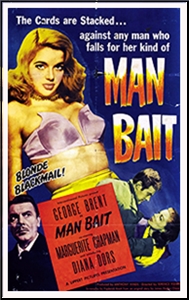
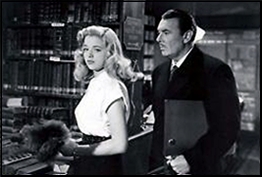
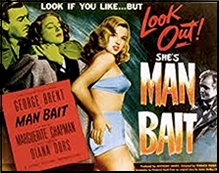
MAN BAIT. Hammer Films-UK / Lippert Pictures-US, 1952. George Brent, Marguerite Chapman, Diana Dors, Raymond Huntley. Peter Reynolds, and Meredith Edwards. Screenplay by Frederick Knott, based on The Last Page, a play by James Hadley Chase. Directed by Terence Fisher.

   A Pleasant surprise with the unlikely title Man Bait showed up on the bottom half of a double bill DVD billed as “Hammer Noir,” one of a series of co-productions between Hammer Studios and producer Robert Lippert.

BORING BACKGROUND – SKIP THIS PART: Robert Lippert was a producer of legendary cheapness and dubious ethics who churned out a slew of low-budget movies in the 1950s & 60s, mostly aimed at rural audiences and double bills. His favorite actors were Sid Melton, who didn’t need a script, and Margia Dean, whom he was sleeping with. When he hired bigger “name” actors (heavyweights like Cesar Romero or Rod Cameron) it was usually on a profit-sharing deal where the profits never materialized. As far as I can tell, the only ones who ever got a fair shake from Lippert were Sam Fuller, who carried a gun, and George Raft, who had Mob connections.

   In the early 50s, Lippert discovered that the British government was subsidizing film production in England, and he could actually make movies cheaper there in partnership with a British studio. He hit upon the ploy of casting fading second-rank Hollywood “stars” (Raft, Romero, Scott Brady, Zachary Scott, and the like) for dubious box office power in the states, and a whole new sub-genre was born: the Anglo-American B-movie, which flourished, after a fashion, until the moguls at Hammer got a grasp on Lippert’s slippery bookkeeping.

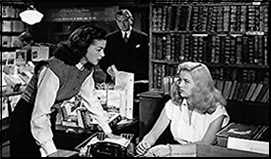
AND NOW BACK TO THE MOVIE: This one stars audience-magnet George Brent and a very capable cast of Brits, including Raymond Huntley, playing his usual nasty martinet, Diana Dors as a sensuous not-quite-innocent, and Peter Reynolds, perfectly slimy as the small-time spiv who tempts our Diana into blackmail and murder — in a bookstore.

   The plot has some surprising twists in it, but the strength of Man Bait is in the characterizations and atmosphere. Director Terence Fisher perfectly evokes the feel of a little book shop — all nooks and crannies and crowded shelves — and the writers people it with real bookstore-types if you know what I mean.

   Which leads me to speculate on where they came from. I have read some of James Hadley Chase’s novels, and I’ll be charitable by saying characterization is not his strong suit. Man Bait is based on a stage play apparently by Chase, The Last Page. I can find no more about it, but the presence of Frederick Knott, just before he hit it big with Dial M for Murder leads me to suspect he played a strong hand in fashioning this film, and perhaps the play as well.

   Whatever the case, Man Bait zips along suspensefully, with Brent framed for murder and the police oh-so-slowly figuring things out as another killing looms just ahead. Terence Fisher makes an impressive directorial debut, and even George Brent, never terribly exciting, lends a surprising inner strength to his quiet role. This one’s a winner.


KIERAN ABBEY – Beyond the Dark. Dell #93, mapback edition, no date stated [1945]. First published by Charles Scribner’s Sons, hardcover, 1944.

   This one begins at Inspiration Point, overlooking the Hudson River at the uppermost tip of the island of Manhattan. A man and a woman, strangers to each other, are watching the boats on the water below. He offers her a cigarette. She accepts. Three men come walking up from the parkway below, deep in conversation. When they see the pair of them at the top, they stop talking and pull out their guns. Shots ring out.

   The couple, still strangers, flee together, making their way downtown by means of a police car they steal, having found it left unmanned nearby. Thus begins one of the most Woolrichian tale of constant capture. escape and chase — up and down and across the entire city — that I’ve had the pleasure of reading in a good long while. Not only are the police after them, but the FBI, and of course the gang of conspirators the men who shot at them are a part of.

   Both of them has a reason, not revealed, for not wanting to go to the police. Neither has anyone in the entire city they can turn to for help. Worse, when they return to the apartment the girl has borrowed for the duration of her stay, they find the body of one of then men who shot at them, recently and definitely deceased.

   If you could stop reading at this point, you’re a better person than I. Of course the explanation of how these two people got into a fix like this is not nearly as interesting as the story of how they find their way out of it. No matter. This one was a pleasure to read.

   Kieran Abbey was a pseudonym for Helen Reilly, who was, as you may already know, the author of several dozen Inspector McKee police procedural novels. This is the third of only three she wrote under this name, all during the 40s. It’s a book filled with the sights and sounds of late wartime New York City, showing another side of the author I wasn’t aware of before.

SPY TRAIN. Monogram, 1943. Richard Travis, Catherine Craig, Chick Chandler, Thelma White, Evelyn Brent. Director: Harold Young.

   An overall (and honest) assessment of this dopey low-budget anti-Nazi film from the 1940s is that it’s just another dopey low-budget anti-Nazi film from the 1940s. And yet, once past the opening premise — that thanks to a boneheaded error by one of the bad guys — there’s a bomb in a suitcase on a train and it’s set to go off at 10 PM or if anyone tries to open it — it’s actually a lot of fun to watch.

   The setting — mostly confined to two or three cars on a speeding train — and the name recognition of the various players — are modest. Richard Travis plays an author who’s trying to visit his rclsive newspaper publisher to find out why his articles on Nazis hard at work in this country have such an become suppressed. Luckily the man’s daughter (Catherine Craig) is on board the train, and he does his best to cozy up to her.

   And here are a couple of lines that I thought funny that I hadn’t heard before. She discovers who he is from seeing his photo on the back cover of his latest book:

   Jane: “Pretty good book — who wrote it for you?”

   Bruce: “I’m glad you liked it — who read it to you?”

   Bruce’s companion. a photographer played by Chick Chandler, also has some funny lines as he constantly complains about being stuck with Jane’s maid (Thelma White).

   In the end the Nazis get their just desserts. That plus a speeding train. What more could you want?

FRANK PARRISH – Snare in the Dark. Constable, UK, hardcover, 1982. Dodd Mead, US, hardcover, 1981. Perennial, US, paperback, 1983.

   Dan Mallett is a poacher by profession — he once was a banker and didn’t like it — so he went back to the way of his father — to his now aged mother’s dismay.

   Caught in the open while setting up snares for a forest filled with plump pheasants, a shot rings out (in all honesty, not quite — it’s an arrow from a crossbow) and his gamekeeper nemesis is dead. Mallett has to spend the rest of the book with the police on his trail. The only way to clear himself is to find the real killer.

   It doesn’t seem like a lot to base a full length novel on, but Parrish somehow finds a way to fill the pages and keep them turning at the same time. What’s amusing about this case is how women are attracted to Mallett, a short and not very handsome man. But obviously not one without some charm, and in its own quiet bucolic way, so is this, his third of eight adventures. If you like books about the rustic side of English life as it was in the 1970s and 80s, don’t miss this one.


      The Dan Mallett series —

Fire in the Barley. Constable, 1977.
Sting of the Honeybee. Constable, 1978.
Snare in the Dark. Constable, 1982.
Bait on the Hook. Constable, 1983.
Face at the Window. Constable, 1984.
Fly in the Cobweb. Constable, 1986.
Caught in the Birdlime. Constable, 1987.
Voices from the Dark. Constable, 1993.

MARGARET YORKE – Dead in the Morning. Dr. Patrick Grant #1. Bantam, paperback; 1st US printing, October 1982. First published in the UK by Geoffrey Bles, hardcover, 1970.

   I read and reviewed Cast for Death, the fifth and last of Margaret Yorke’s Patrick Grant books, earlier this year and found it somewhat of a muddle as a detective novel, but I did find Dr. Grant’s struggle with love and romance quite enjoyable.

   Dead in the Morning, the first of the series, is a total opposite: no romance in sight for Dr. Grant, and the detective story is both engaging and fun to read. He is not a medical doctor, by the way, but an Oxford don with a (very) inquisitive mind.

   As a twist to what we come to expect in stories like one — an aged, invalid matriarch of a dysfunctional family who also keeps a close tight watch on her pursestrings — it is not she who is the murder victim, but surprisingly enough, it is the cook instead. Could she have known more about someone in the family than she should have? Someone who did not want that something known?

   I liked this one, and it only goes to show that when you read the books in a series out of order — or in this case, last one first — you ought not to give up on the earlier ones as well.


NOTE:   A previous review by me was posted here last year, but my comments themselves were written in 1980.

REVIEWED BY DAVID VINEYARD:


MAURICE LEBLANC – Countess Cagliosto. Arsène Lupin #12. First published in France as La Comtesse de Cagliostro (1924). First translated into English in 2010 and included in Arsene Lupin vs Countess Cagliostro, edited by Jean-Marc & Randy Lofficier (Black Coast Press, trade paperback). Also included in this latter edition are the 1935 novel Countess Cagliostro’s Revenge, also never before translated. The book also includes the short story “The Queen’s Necklace,” and the all-new The Death of Countess Cagliostro, written by Jean-Marc & Randy Lofficier. Film: Arsène Lupin (2004).

   Maurice Leblanc, a forty-one year old journalist, created the French rival to Sherlock Holmes in 1905 in the short “l’aresstation de Arsene Lupin”. It was a bright and clever tale (foreshadowing Agatha Christie’s Roger Ackroyd) introducing the world to the gentleman thief and romantic adventurer whose lust for life was almost as great as his lust for other people’s things.

   Not unnaturally over time Lupin evolved, showing as great a skill at solving crime as committing it, taking on Sherlock Holmes (Holmlock Shears) in two adventures, and appearing in classics of the genre like 813 and The Hollow Needle.

   And like Sherlock Holmes, Lupin’s creator grew tired of his hero, and with the end of the Great War increasingly sidelined Lupin under various guises, in short appearances, and as a deus ex machina when a complex plot needed one. Individual stories were worthwhile, but nothing as great as his heyday. Readers must have wondered if Lupin would ever see his great days again

   But again as with Sherlock Holmes and The Hound of the Baskervilles, Leblanc had one last trick up his sleeve — one last great adventure to recount. That adventure would be nothing less that the origin of Arsene Lupin, and of his greatest foe and implacable enemy, Josephine Balsamo, the possibly immortal daughter of Joseph Balsamo, Count Cagliostro, in the 1924 novel that bore her name.

   Lupin fans must have celebrated, Leblanc and his hero were back in fine form.

   After a brief forward explaining Lupin had forbid him to tell the story of the Countess for twenty-five years, Leblanc plunges right in as young Raoul d’Andrésy breaks into the home of the Baron d’Etigues, father of Clarisse, the young woman he loves, and finds among his papers an order to execute a mysterious unnamed woman.

   Being French, he of course wakes and seduces Clarisse and then reveals to her that her father and his cronies “…Marquis de Rolleville, Mathieu de la Vaupalière, Comte Oscar de Bennetot, Roux d’Estiers… All these noblemen from the beautiful Pays de Caux are involved in some kind of fantastic conspiracy!” D’Andrésy soon reveals he is really Arsene Lupin, the son of a footman and fencing and boxing instructor, something that her father would never accept as a son-in-law. But as he assures her with typical bravado, he has a bright future:

   â€œEvery fortune-teller I’ve ever met has predicted I will have a great future and worldwide fame. Raoul d’Andrésy will become a General, a Minister, or an Ambassador… unless it’s Arsène Lupin! It’s a pact I’ve made with Destiny, agreed and signed by both parties. I’m ready! I’ve got muscles of steel and a sharp mind. Would you like to see me walk on my hands, or lift you at arms’ length? Or would you prefer that I remove your watch without you noticing? Or shall I recite Homer in Greek or Milton in English from memory? My God, how sweet life is! Raoul d’Andrésy… Arsène Lupin… A monument with two faces—which one will be illuminated by Glory, the brightest star in all the Heavens?”

   Fate has a different kind of fame in store for him though.

   Intercepting the would-be executioners, Lupin is present when they bring in their victim and reveal her face:

   … a voice rose above the murmurs of surprise. It was that of Prince d’Arcole, who had stepped forward to look at the prisoner.

   â€œIt’s her! It’s her!” he stammered, his eyes wide in horror, his face twitching.

   â€œI recognize her! It’s terrifying!”

   â€œWhat’s terrifying?” asked the Baron. “Please, explain yourself.” And the Prince uttered this incredible statement:

   â€œShe is no older than she was 24 years ago!”

   Of course Lupin will save her, become her lover and student, be drawn into and obsessed with the conspiracy surrounding the treasures of the Kings of France she and the conspirators all covet, he will learn her incredible claim to be the immortal daughter of the infamous Joseph Balsamo. Count Cagliostro.

   Lupin doesn’t buy that for a moment:

   â€œYou’re your mother’s daughter,” repeated Raoul, “which means that there was a first Countess Cagliostro. At 25 or 30, she dazzled all of Paris in the last days of the Second Empire and piqued the curiosity of the Court of Emperor Napoleon III. With the help of her alleged brother—who may actually have been her lover — she laid out the tale of her connection to Cagliostro and Joséphine de Beauharnais and manufactured the forged documents which the Emperor’s secret police found later when they checked her background. Expelled from France, she fled to Italy, then Germany, then vanished without a trace… Except that she returned 24 years later in the person of an adorable daughter with virtually identical features, the second Countess Cagliostro, hereby present. Do we agree so far?”

   Lupin goes one for several paragraphs before recognizing he has overplayed his hand:

   â€œI’m right, aren’t I?” he said.

   â€œMy past is my business,” she said, not answering him, “and so is my age. You can believe whatever you like about them.”

   He took her in his arms and kissed her passionately.

   â€œThen I will choose to believe that you’re 104-years-old, Joséphine, and that there is nothing more delicious.”

   Lupin will eventually become her rival (“…what is impossible is that I could continue to see you under that fog of mystery in which you’ve deliberately wrapped yourself; for now, I see you for what you truly are: a murderess and a criminal.”), learn secrets of his own family, marry Clarisse (like James Bond, Lupin’s lovers don’t last long) and have his son kidnapped by Josephine to take revenge on him twenty five years later (recounted in Countess Cagliostro’s Revenge published here for the first time in English).

   This particular Black Coat Press edition includes a short by editors Jean-Marc and Randy Loffcier recounting the final days of the Countess, and a short story, “The Queen’s Necklace” telling of Lupin’s first crime. It also comes with an informative introduction for anyone not already familiar with Lupin’s exploits.

   I grant I am a sucker for any tale in which the hero meets his Moriarty, his true nemesis, and this one lives up to both its hero and its epic theme, full of bravado, style, action, and lively twists as well as a fairly melancholy ending. It’s a good introduction to Lupin for those new to his adventures, and a grand addition to them for fans already familiar with him.

   American readers may find it hard to take the very French brio of Lupin at first, but staying with it will reveal some of the cleverest mysteries and adventures of any classic hero done in high style.
REVIEWED BY MICHAEL SHONK:

THE GREAT MERLINI “The Transparent Man.” Syndicated by United Artist Television, 1951. G&W Television Production Inc. Cast: Jerome Thor as the Great Merlini, Barbara Cook as Julie, Robert Noe as Inspector Gavigan, Howard Smith as Belmont, E.G. Marshall as Comell and Michaele Myers as Josephine. Original Story and Adapted by Clayton Rawson. Produced by Felix Greenfield and Robert Whiteman. Filmed at Fletcher Smith Studio, New York. Directed by Ted Post.

   Question, who was the first Fictional Magician Detective to appear on television? Really, if you know tell me.

   It may be the Great Merlini who made his TV debut in the episode “The Great Merlini” for the NBC-TV series CAMEO THEATRE (May 23, 1950). The thirty-minute anthology series featured plays performed live in the round. Chester Morris (film’s Boston Blackie) was the Great Merlini. From the plot as described and with author Clayton Rawson credited as one of the writers, the episode was probably an adaption of Rawson’s book FOOTPRINTS ON THE CEILING.

   As far as I know, no copy of this episode of CAMEO THEATRE exists. However the second and maybe the last TV appearance of the Great Merlini is available to watch. A pilot film for a proposed TV series THE GREAT MERLINI, the episode was entitled “The Transparent Man” and was written by Clayton Rawson.

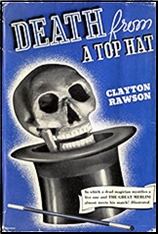
   Created by Rawson for a series of books and short stories, the first, DEATH FROM A TOP HAT, was published in 1938. Two movies were adapted from the books, MIRACLES FOR SALE (1939; directed by Tod Browning, based on DEATH FROM A TOP HAT) and Michael Shayne film THE MAN WHO WOULDN’T DIE (1942) starring Lloyd Nolan based on the book NO COFFIN FOR THE CORPSE.

   Clayton Rawson is considered one of the greatest writers of locked room mysteries and includes John Dickson Carr and Fred Dannay among his greatest fans. He would help found the Mystery Writers of America (MWA) and served for many year as managing editor for the Ellery Queen Mystery Magazine (1963-71).

“The Transparent Man.” When a famous thief announces his plans to steal a priceless necklace, it is a crime for the police, but when the thief has been dead since 1798 it becomes a job for The Great Merlini. He must solve how an invisible thief opened a locked door and stole the necklace from a room full of people.

   For TV viewers “The Transparent Man” is an entertaining but flawed TV show, however fans of the books may find this TV episode disappointing. It is more an “impossible crime” story than a locked room mystery.

   Rawson’s books and short stories even today are considered among the best of the locked mystery genre. Arguably the greatest flaw in Rawson’s books is the slow pace and the enormous amount of pages it takes to develop the locked room mystery. With time limited the TV version settled on a weak solution, faster pace, and more attention to the character Great Merlini.

   Jerome Thor (FOREIGN INTRIGUE) played the Great Merlini with the confident flare one expects from a stage magician. The eccentric Merlini enjoys the challenge of solving impossible mysteries, and he is amused that his talent to deal with crime is in more demand than his stage act as a magician. There is no mention of owning a magic store.

   Ross Harte, the Watson to the Great Merlini, was not in the TV pilot. Replacing him was Julie, Merlini’s talented Magician’s Assistant girlfriend with a wry wit. Barbara Cook played the role well, so it is a surprise that the IMDb claim this was her only role in television or film.

   Director Ted Post would go on to a long successful career directing a variety of TV series including PERRY MASON, GUNSMOKE, TWILIGHT ZONE, and COLUMBO. He also directed films such as BENEATH THE PLANET OF THE APES and MAGNUM FORCE.

   But this was one of his first attempts at directing television and it shows. The direction here is awkward, a clumsy mix of close-ups and medium shots with a missed shot or so. But much of the awkwardness could have been covered with a background soundtrack.

   Robert Noe captured the essence of Inspector Gavigan. The suspects included two actors still remembered today. Howard Smith, who had a successful career from vaudeville to films and may be best remembered for his TV work (HAZEL), looked uncomfortable and lost. E. G. Marshall, a successful actor on Broadway and film (12 ANGRY MEN) is also best remembered for his work in TV (THE DEFENDERS), did only an adequate job with his small role.

   Felix Greenfield and Robert Whiteman produced this pilot for a GREAT MERLINI TV series. I can find nothing about Robert Whiteman, but Felix Greenfield was best remembered as a publicist for Warner Brothers for over 30 years.

   Greenfield was also a stage magician (mentalist) who starred in his own radio shows in New York during the 40s. His only other TV producer credit in IMDb was for the “Great Merlini” episode of CAMEO THEATRE, but according to his obit in the New York Times, he also was a technical consultant on magic for several TV series including THE DEFENDERS.

   This show was filmed in 1951 and near the end of the wild days of television. The networks were still young. NBC and DuMont began in 1946 and CBS and ABC would join in 1948. Independent TV stations many doing their own programming were growing all over the country and everyone needed programs to fill the time.

   How crazy and forgotten was that time for television? Wikipedia does not even mention United Artist Television existed between 1948 and 1952 instead claiming it began in 1958.

   From Broadcast (March 19, 1951) UA’s TV Director John Mitchell announced, “United Artist Television, New York has been appointed national distributer of the GREAT MERLINI, new half-hour TV film series produced by G&W Productions and filmed at Fletcher Smith Studios, New York. Ted Post of CBS is director of the show. The program is to be distributed on the basis of local and regional sponsorships.”

   John Mitchell was an early pioneer of television in how companies marketed TV programs to early television stations and networks. In 1952 he became one of the first three employees of Screen Gems.

   Among the joys of watching old television shows are the many stories and questions behind the making of the program. Is the Great Merlini TV’s first Magician/Detective? Where did this attempt for a GREAT MERLINI TV series air? Why couldn’t I find an American TV series to feature a Magician/Detective before THE MAGICIAN (CBS, 1973-74)? And was “Transparent Man” the last TV appearance of the Great Merlini?

BONUS FROM YOUTUBE:

Clayton Rawson as the Great Merlini performing the “Floating Lady” trick with family and friends.

GEORGE BAGBY – The Golden Creep. George Bagby/Inspector Schmidt #48. Doubleday Crime Club, hardcover, 1982. Detective Book Club, hardcover, 3-in-1 edition. No paperback edition.

   At one time in my life, I think you could say that Aaron Marc Stein (aka George Bagby) was my favorite mystery writer. Emphasis on writer. He had a fluid, smooth style of putting words on paper that I’ve never been able to describe to my own satisfaction, much less anyone else’s, and his dialogue may have been even better. When two people are having conversations in his books, you always know who’s speaking, even when all you have are the words they are saying to judge by.

   There were 49 books in his George Bagby series — Bagby is the fellow who tags along with New York City police inspector Schmidt on his many many cases– and this one is number 48, and I don’t even remember seeing the title before. Stein was in his late 70s when he wrote it, and while the writing is as good as ever, the plot itself is one of his weaker ones.

   It starts out in semi-salacious fashion, with Bagby visiting a girlie joint on his own and ending up in an alley behind the place afterward next to a dead body. The dead man is the character the book is titled after — he made himself rather obnoxious with the Amazonian-built girls who are the main attraction — referred to, surprisingly, as “tit elation” — and Bagby, having been slipped a mickey, as he supposes, is the main suspect.

   And Inspector Schmidt — I don’t know if he ever had a first name — has to play it carefully, as the press knows full well how close the two of them are. But rather than concentrate on the doings leading up to the murder, the two of them focus instead on the murder weapon — the tail of a huge stone dragon that someone carted to the roof of the place and dropped down on the dead man.

   You have the feeling that when the appropriate number of pages have gone by, Stein/Bagby decided it was time to close things up and get back to the people in and around the strip joing itself, and sure enough, that’s all it takes to solve the case.

   I found the book enjoyable, but if you aren’t a fan of Bagby’s from before, or worse yet, you’ve never heard of him, this one won’t be the one to convince you that you ought to read more of him.

REVIEWED BY DAN STUMPF:         


BORDEN CHASE Diamonds of Death

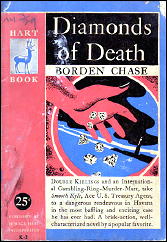
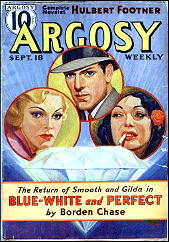
  BORDEN CHASE – Diamonds of Death. Hart, paperback original, 1947. First serialized as “Blue-White and Perfect,” Argosy, 18 Sept-23 Oct, 1937. Filmed as Blue, White and Perfect, 1941.

   A while back, I read and reviewed Borden Chase’s novel Red River and found it surprisingly hammy from a writer known for his laconic screenplays. So I decided to give him another try and fished out Diamonds of Death, the first novel edition of Chase’s pulp novelette, “Blue-White and Perfect.”

   This is that rarity, a dumb mystery that doesn’t insult one’s intelligence. The “surprise” criminal may be obvious early on, but Chase speeds his story through so many curves one hasn’t time to carp, as hero Smooth Kyle (I guess some folks don’t care what they name their kids) chases diamond smugglers from Broadway to Havana and back again.

BORDEN CHASE Diamonds of Death

   Chase provides his hero with a wise-cracking girlfriend, buddies in the Customs Office, and enough bad guys to felonize a dozen books like this, ranging from cheap hoods to smooth operators, phony dowagers, fake cops… I could go on, but readers of this sort of thing have met them before, and those who haven’t probably couldn’t appreciate the pulpy splendor of the piece, as Chase fills his story with glittering diamonds, luxury liners, exploding airplanes and elegant mansions, all of which impart a feel of extravagance without actually costing anything to write about.

   I’ll just add that the original pulp novel was bought by Fox for their “Michael Shayne” series back in the 40s, movies notable for pace, casting, and for the fact that the producers used only one Mike Shayne novel in the whole series, apparently preferring to impose their hero into stories by other authors, including Clayton Rawson, Frederick Nebel and even Raymond Chandler!

   Anyway, Borden Chase’s story suits the character quite well, and reading this one can almost hear Lloyd Nolan’s snappy banter as he stalks through the studio back lot.

« Previous PageNext Page »