Reviews


THE BACKWARD REVIEWER
William F. Deeck


GEORGE GOODCHILD – McLean Investigates. Inspector McLean #3. Hodder & Stoughton, UK, 1930. No US edition.

   This is a collection of short stories featuring the investigations of Inspector McLean of Scotland Yard, who, unless I missed it somewhere, seems to lack a first name.

   A few of the stories have some rather good detection, but for the most part McLean relies on “narks” — much as do the real police — and extraordinary coincidence. In one case an informer tells him he might find someone he is looking in a certain nightclub. McLean goes there and observes four men working over a map; fortuitously, the men are plotting the assassination that McLean is trying to prevent.

   Nevertheless, as I said, there is also good detection. McLean in one case discovers the guilty party by testing how difficult it was to crank start a car. (Remember the publication date, dear reader! And for those whose memory of cars with cranks doesn’t exist, that was the way car motors were started before the self-starter was invented. Think of how for example, the typical gasoline lawnmower is started, and you will have some, but not much, idea of how a car was started by a crank.)

   Of course, the car had been immersed in a pool in a disused quarry for more than a month, and this might have had something to do with the difficulty — indeed, I am astonished that McLean got it started, no matter how much effort he put into it — but McLean is above such petty details.

   McLean is also extremely lucky. In his investigation of someone who arranges assassinations, McLean approaches the person, and how he is still with us only the author knows:

   â€œThere was a lightning movement and the flash of a fire-arm. A bullet whistled past his [McLean’s] head. He held his fire but advanced on her with a chair extended in his left hand. A second shot ripped through the wooden bottom. He pinned her to the wall between the four legs….”

   Lots of things happel1 in the stories “like lightning,” though I think Goodchild means “rapidly.” My favorite description, however, is the one of the chap who moves around a lot; he is described as “illusive.”

   The driving of McClean’s Sergeant, Brook, who also appears not to have been Christened anything in particular, can raise some thrills, at least in those whose grasp of English isn’t all that it should be:

   â€œHe took bends and corners at a rate that should have spelt suicide, but always he managed to get the car right after hair-breadth skids.”

   Ah, those nasty hair-breadth skids!

— Reprinted from CADS 17, October 1991. Email Geoff Bradley for subscription information.


Bibliographic Notes:   This was the third of over 60 novels and story collections featuring Inspector McLean in a career extending from 1929 to 1967. He seems to have been referred to as “Dandy” McLean at times, but otherwise Bill appears to have been correct in surmising that the character had no known first name.

   As for the author himself, here is an edited version of the first paragraph of his Wikipedia page:

    “George Goodchild (1888–1969) aka Alan Dare, Wallace Q. Reid, and Jesse Templeton, was a prolific and successful British writer of popular books, short stories, plays, and movies, who published over 200 works in his 60-year career, and beyond his lifetime. Featured characters include Inspector McLean, spy catcher Q33 Trelawney, Nigel Rix, and Trooper O’Neill.”

JACKSON GILLIS – Chain Saw. St. Martin’s Press, hardcover, 1988; paperback, August 1990.

   Sometimes I think a writer spends so much time polishing up Chapter One of his or her book that it ends up so overwritten as to be almost unreadable. I exaggerate, but it did happen again here, and I almost quit reading, which would have been a serious mistake, as I very much liked a lot of what came later.

   Former LA policeman Jonas Duncan is hired in this book to discover if a young orphan making a claim on an elderly lumberwoman’s fortune is for real or not. I’m not sure why this was published by St. Martin’s in paperback under their “Mean Streets” imprint. The phrase implies “urban streets” to me, and this particular tale, which also includes an authentic portrayal of a lumber industry which is slowly dying out, is as rural and outdoorsy as they come.

   There is also a decent mystery involved, with plenty of twists and false trails. Skip Twin Peaks and read this instead.

— Reprinted from Mystery*File #23,, July 1990. (Considerably shortened and revised.)


Bio-Bibliograhic Notes:   This was Jonas Duncan’s only appearance in printed form. Author Jackson Gillis wrote one other detective novel included in Hubin: The Killers of Starfish (Lippincott, 1977) which also took place in Washington State, but that is the only connection between the two.

   His name may, however, be more familiar to some of you for a couple of other reasons. According to his Wikipedia page, Gillis was “an American radio and television scriptwriter whose career spanned more than 40 years and encompassed a wide range of genres.”

   Some of the radio shows he wrote for: The Whistler and Let George Do It. For TV: Perry Mason, Lost in Space, and Hawaii Five-O. He died in 2010 athe age of 93.

REVIEWED BY JONATHAN LEWIS:


CRIME OF PASSION. United Artists, 1957. Barbara Stanwyck, Sterling Hayden, Raymond Burr, Fay Wray, Virginia Grey, Royal Dano. Original story and screenplay: Jo Eisinger. Director: Gerd Oswald.

   Call it what you will: a crime film, a film noir, or a proto-feminist melodrama. But make no mistake about it. Crime of Passion is most definitely a Barbara Stanwyck vehicle. So much so that one could say that Stanwyck, who is front and center throughout the proceedings, is the auteur of this United Artists release. Directed by craftsman Gerd Oswald, this somewhat average black and white thriller also benefits from the presence of co-stars and supporting cast members including Sterling Hayden, Raymond Burr, and a young Robert Quarry as a newsroom worker.

   Stanwyck portrays Kathy Ferguson, a tough as nails San Francisco newspaper columnist. She’s a career woman with no desire to marry and settle down. Not until she meets visiting Los Angeles detective Lieutenant Bill Doyle (Hayden), who is up north searching for a Southern California woman accused of killing her husband. Soon enough, Kathy and Bill are married and living a seemingly idyllic suburban existence in the San Fernando Valley. But soon suburban dinner parties and boredom get to Kathy. It’s clear that she wants more in life. Both for herself and for Bill, whom she thinks is deserving of a better position in the police force.

   Enter Bill’s superior at the LAPD. When Kathy meets Inspector Tony Pope (Burr), she takes an immediate interest in his passion for solving difficult cases. Soon, however, the passion between the two takes a more sordid turn, with Kathy and Tony sharing a night together. When Tony decides that it was all a mistake, Kathy is despondent. And never underestimate a character portrayed by Barbara Stanwyck, especially when she has access to a gun.

   Despite Stanwyck’s formidable screen presence, Crime of Passion never quite gels as a movie. Yes, there are a few plot holes and implausibilities. But those aren’t what end up making this movie an interesting but not particularly memorable affair. No. It’s the fact that, while the plot may have worked well enough on paper, the movie’s story — the radical transformation of Kathy from a tough single newspaperwoman into a helplessly in love housewife and then into a scheming and impassioned killer — feels too forced. It’s this artificiality that makes this particular Stanwyck film a pale imitation of so many of her other works.

REVIEWED BY BARRY GARDNER:


PAUL HARDING – Red Slayer. Brother Athelstan #2. William Morrow, US, hardcover, 1994. Avon, US, paperback, 1995. First published in the UK as The House of the Red Slayer (Headline, hardcover, 1992).

   Unless I’m mistaken, Harding writes historical mysteries under a number of different names, P. C. Doherty among them. However, when I tried to find something to substantiate all this, I couldn’t put my hands on anything, so I may be wrong. I don’t think so, though.

   Brother Athelstan (a friar, not a monk) is parosh priest of Saint Erconwald’s, a church in Southwick in London of the mid-fourteenth century. He is also cleric to the City Coroner (a very important person in that time and place), Sir John Cranston. Just before Christmas in the fierce winter of 1377 they are called to the Tower of London, where the Constable of the Tower has been found in a locked bedroom in the Tower’s upper reaches, throat cut from ear to ear.

   It develops that while the Constable was not a well-liked person at all in the present, his past (he was once a mercenary knight in Egypt) might hold the secret to the murder. To round out the story, Sir John has wife problems and someone is robbing corpses from the cemetery at Brother Athlestan’s church.

   One book from so prolific a writer is far too small a sample from which to generalize, so I won’t I’ll just say that I didn’t find this particular book quite up to the level of, say, the historical mysteries of Peters, Marston, Tourney, et al. Which isn’t to say that I didn’t enjoy it. Harding is at pains to provide a vivid historical background, and tells his story well enough.

   I suppose my reservations were in the natter of the leads. Sir John in particular seemed to be somewhat of a one-note character with his constant wine-bibbing and bellowing, and Athelstan never came quite to life for me. I also got tired of reading “he slurred” every time one of the drinking characters spoke. Nevertheless, I’ll try Harding again.

— Reprinted from Ah Sweet Mysteries #13, June 1994.


BIBLIOGRAPHIC UPDATE:  Barry was quite correct in stating that Paul Harding was one of several pen names of P. C. (Paul) Doherty. Other bylines he has used are Vanessa Alexander, Anna Apostolou, Michael Clynes, Ann Dukthas, and C L Grace. To this date (2017) there are 18 books in his Brother Athelstan series, the last eleven of them under his own name.

BOILEAU-NARCEJAC – She Who Was No More. Pushkin Vertigo, trade paperback, 2015. Translation by Geoffrey Sainsbury. First published by Éditions Denoël (France) in 1952 as Celle qui n’était plus. Reprinted by Rinehart, US, hardcover, 1954. Hutchinson, UK, hardcover, as The Woman Who Was, 1954. Films: Diaboliques (France, 1955; director: Henri-Georges Clouzot); House of Secrets (US, 1993; made for TV); Diabolique (US, 1996).

   The collaboration between French authors Pierre Boileau and Thomas Narcejac is perhaps most famous for producing, among several other works of well-regarded crime fiction, The Living and the Dead (D’entre les Morts, 1954), the basis for the movie Vertigo, considered by many to be the best of Alfred Hitchcock’s many films.

   Unfortunately, of the the ten titles included in Hubin, only three have been published in the US. She Who Was No More is one of them, and it’s good to have it back in print again, after a long wait of over 60 years. The story is both easy and not so easy to describe. A man’s mistress helps a man kill his wife. They do it in such a way as to make it seem to be an accident which happened while both have solid alibis. Yet when the husband goes to “discover” her body, it has vanished. Disappeared.

   Worse, he begins to find notes from her saying that she’s gone away but will be home again soon. More. His brother-in-law in Paris claims that she has stopped by to see him, even after she is supposed to be dead.

   What is difficult to explain is what a feverish nightmare of a novel this is, a pure noir fantasy, if you will. A combination of a guilty conscience with a belief in ghosts floods Ferdnand Ravinel’s very being — and perhaps the reader’s, too. What is also difficult is to write a review without saying more, or even without a hint of saying more.

   So I won’t. I will say that I enjoyed this oe immensely — but more than that, no. But it is frustrating!

REVIEWED BY JONATHAN LEWIS:


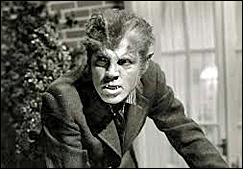
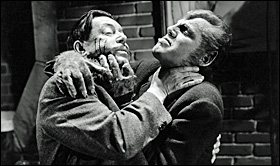
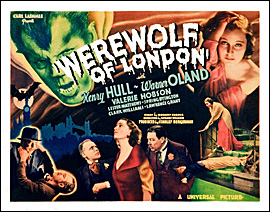
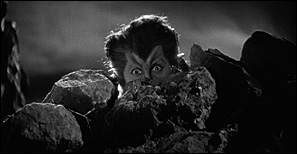
WEREWOLF OF LONDON. Universal Pictures, 1935. Henry Hull, Warner Oland, Valerie Hobson, Lester Matthews, Lawrence Grant, Spring Byington. Director: Stuart Walker.

   Warner Oland gives the overall rather dated Werewolf of London a welcome exotic, mystical flair that makes the otherwise somewhat staid film an enjoyable viewing experience. As the first mainstream werewolf movie ever produced by a major American studio, this Universal Pictures release is also notable for its makeup effects by Jack Pierce. A Hollywood legend in his own right, Pierce would go onto do similar work for the much better known (and better movie) The Wolf Man (1941) starring Lon Chaney, Jr.

   Henry Hull stars as the titular werewolf, a botanist named Wilfred Glendon. He has recently returned from an expedition in the Himalayas where he had a frightening encounter with a strange beast. That beast, as it turns out, was one Dr. Yogami (Oland), who himself is suffering from lycanthropy.

   Yogami arrives in London to tell Glendon that the botanist is about to turn into a werewolf and that a specific plant, one in the latter’s possession, can serve as an antidote. Glendon finds this preposterous, but he has his doubts. These are only strengthened when Glendon notices his hands are getting unusually hairy.

   As in The Wolf Man, which was released six years later, Werewolf of London is fundamentally a tragedy. Glendon’s story is a tragic one. His refusal to take seriously his condition, as well as his persistent neglect of his lovely wife Lisa (Valerie Hobson), lead him down a dark and foreboding path that includes murder and ultimately, his own tragic demise at the hands of a Scotland Yard inspector.

   But unlike Larry Talbot (Chaney) in The Wolf Man, who appeared as a character in several follow up feature films and became a Universal Monsters icon who is still beloved today, Wilfred Glendon was a character that appeared once and was never heard from again. That is unless there is a remake that could give some fresh life into this somewhat dated feature, something that would give it a little more of a bite for contemporary audiences. Now that’s an idea that would make some fans of classic fans howl at the moon!

IT IS PURELY MY OPINION
Reviews by L. J. Roberts

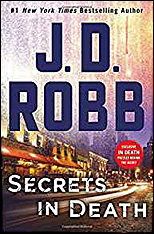
J. D. ROBB – Secrets in Death. Lt. Eve Dallas #45. St. Martin’s Press, hardcover, September 2017.

First Sentence:   It wouldn’t kill her.

   Lt. Eve Dallas investigates homicides, but the victims don’t usually drop dead at her feet. Larinda Mars is a “social information reporter”; i.e., a gossip columnist who clearly has an enemy since someone slashed one of her major arteries causing her to bleed out in the middle of an upscale bar. Eve, and her team, are determined to find the killer.

   Some readers have an issue with the bedroom scenes in this series. “Outlander” author, Diana Gabaldon, provided an excellent perspective with her reminder to readers that sex is a normal part of an adult relationship and that “it is much more about emotion than the exchange of bodily fluids.” That said, the scenes are easy to skip over without losing the thread of the plot.

   The slightly futuristic world in which one finds oneself is just enough to provide for fun imaging, yet not so removed from our reality that it seems implausible. As with much of science fiction, it is not impossible that some of the gadgets and technologies will ultimately be realized.

   The primary attraction to the series are the characters, particularly Eve. She is an interesting dichotomy between the tough, smart cop who is dedicated to standing in for the dead even when they may not have been good people themselves, and the woman who is completely indifferent to her appearance, and is unaware of many things outside her job. But she does know baseball.

   Secrets in Death is an enjoyable read with a couple of well-executed twists. It is more of a straight police procedural than some in the series.

— For more of LJ’s reviews, check out her blog at : https://booksaremagic.blogspot.com/.

THE GHOSTS OF OLD MOVIES
by Dan Stumpf


(Note: This was written in 1981, the early days of Cable Satellite TV, before there were on-screen video guides or anything like that; when cable stations bloomed and vanished daily, and they ran anything — anything — in the small hours of the night just to sell advertising. I was working Third Watch in those days, and on my nights off I sometimes flipped around the dial…)

        “There are strange things done ’neath the midnight sun…”
                   –Robert W. Service

   Service would feel right at home with Cable TV. They do things late at night on television that no one ever talks about.

   In those bleary hours after the bars close and before the doughnut shops open. Strange images flit across the screen, interspersed more or less at random between ads for Country Music and Diet Pills, and the black-and-white phantoms, transfixed for a moment on a flickering screen that is often the sole illumination in a sleeping house, are apt to go anywhere, do anything: murder, make love, or burst into song. Pictures of people long dead strut and fret their fearful ninety minutes or so at the whims of writers and directors who are mostly dust now.

   These are the Ghosts of Old Movies, roaming the night, and the restless, channel-changing viewer who stumbles across them, be he insomniac, inebriate or both, may witness tales that he will relate at peril of disbelief.

   It was at such a time that I, wide-awake, sober, and no higher than one can get from a glass of Diet Pepsi, chanced upon one of those works that re-define Surrealism; a fragment of one of those films that must have seemed so impressive to post-war French cinéastes and philosophers. Let me try to describe it to you as I saw it, coming in somewhere in the middle and thus caught unawares by the wonder of it all.

   As the screen kindles into life, we see a jungle village, somewhere in Africa. A crowd of dark-skinned natives and a mustached Cowboy (?) are genuflecting in front of the Chief’s hut.

   Inside the hut, a white man in a leopard-skin and top hat (??) is ministering to the Chief’s son. They are alone. The white man gives the black man a shot from a hip flask that knocks him stiff as a board, whereupon whitey blacks his face with soot, dons the son’s clothing, and passes as him, walking through the kneeling natives to where a mule is tethered on the outskirts of the village.

   En route, the soot mysteriously vanishes from his face. He mounts the mule anyway and gallops off with the natives and the Cowboy, who have tumbled to him, in hot pursuit. The white man/witchdoctor rides past some potted palms, is thrown from his mount, and suddenly gasps in horror.

   The scene shifts suddenly to a completely different-looking jungle where a lion is walking off in an entirely irrelevant direction. Cut back to the white witch doctor, who can apparently see the lion (wherever it is) and is frightened by it. He climbs a tree, the lion makes a few half-hearted jumps at some other tree, and wanders off.

   Then a gorilla swings through the branches, lands next to our hero and starts making amorous eyes at him. The white man leaps from the tree and lands among the natives who have gathered beneath it. The mustached Cowboy has apparently wandered off unnoticed. Cut to commercial.

   When we get back, the natives have escorted the captive honky back to their jungle village. Suddenly a group of Mounties (???) rides up. The head Mountie halts his men, turns to the captive and demands, “Where’s Gene Autry?”

   I turn up the sound, wondering if I could have heard correctly and how the hell did Mounties ever get into Africa anyway. But the scene shifts to a trading post elsewhere in the jungle, where none other than Gene Autry himself is trying to convince a winsome heroine that he did not kill her father. Suddenly the mustached Cowboy enters and gets the drop on Gene, who is quickly escorted to a heavily-guarded hut and locked up with an old man whose function in the story seems somewhat indeterminate.

   We now cut back and forth between the mustached Heavy, who is trying to get the heroine to sign something, and Autry in Durance Vile. Gene quickly subdues his native guards (by getting them to reach through the barred windows for beads and trinkets, then tying their hands together) and runs from the hut, which turns out not to have been locked after all.

   Then a bunch of other stuff happens and before long Autry and his stuntman have freed the white slaves from the diamond mine (????) and the Heavy, seeing that the jig is clearly up, leaps into a covered wagon with the heroine and rides off, vigorously pursued by Autry’s stuntman.

   The ensuing chase, however, is set not in Africa, but among the oversize boulders and dusty trails of Gower Gulch, California, a landscape familiar and overly-familiar to every viewer of B-Westerns. The Heavy wrecks the wagon, the stuntman rescues the girl, and the Mounties, who have apparently been following at a respectful distance, ride up with Smiley Burnette (for it was he, it turns out, who was the white witch doctor in leopard-skin and topper) having somehow learned of Autry’s innocence en route to this appointment in Samara.

   The scene shifts again to the deck of a westbound boat. Gene Autry, Smiley Burnette and some miscellaneous Cowboys are serenading the heroine. The Mounties are gone, but the Native Chief and his children are aboard, dressed in western garb and singing Harlem tunes.

   As “The End” settles across the screen, we fade out, and — seconds ahead of an appeal for Lee’s Press-on Nails — the title of this Jungle Epic dances across the screen. It is Round-Up Time in Texas (Texas?????)

   Somehow it seems to fit.

   I love this film and all films like it. There is an unconscious audacity operating in films as cheap as this one. I mean, when you watch a good movie, or even most bad ones, you generally have some inkling of what is going to happen next. Or at least you know it won’t be something totally off the wall. But there are moments in some books and movies that defy rationalization. They simply exist. And they restore to me that sense of childlike wonder that should always be present in one’s critical faculties. As long as there are films like this to be discovered I shall never grow old.

ROUND-UP TIME IN TEXAS. Republic Pictures, 1937. Gene Autry, Smiley Burnette, Maxine Doyle, The Cabin Kids, Champion. Director: Joseph Kane.

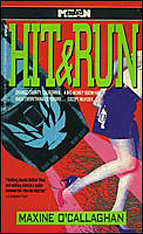
MAXINE O’CALLAGHAN – Hit and Run. Delilah West #3. St. Martin’s, hardcover, 1989; paperback, January 1991. Brash Books, trade paperback, February 2015.

   The count above of Delilah West’s does not include the short story “A Change of Clients,” which appeared in the November 1974 issue of Alfred Hitchcock’s Mystery Magazine, The date is worth pointing out because what it means that as a modern day female PI, Delilah West came along several years before all of the more famous ones, who showed up later: Sharon McCone (1977), Kinsey Millhone (1982), or V. I. Warshawsky (also 1982).

   In spite of the lack of fame for Mrs. West, the good news is, according to the Thrilling Detective website, “in July 1999, at the Eyecon, held in St. Louis, the Private Eye Writers of America righted that wrong, and very deservedly bestowed The Eye, its Lifetime Achievement Award.”

   Hit and Run was published in paperback by St. Martin’s as part of their “Mean Streets” line of books they were promoting at the time, but I think that’s only because Delilah was a private detective in general, not because she traveled down streets any meaner than any of those the mostly sunny town of Santa Ana in southern California.

   The case begins with her living in her office, business being so bad, and being nearly run down by a young half-Hispanic kid who leaves another man dead in street before speeding off. Thanks to Delilah’s ID of the car he was driving, he is soon arrested for the man’s death.

   Surprisingly enough, hiring Delilah to prove the boy’s innocence is his mother. Demurring greatly, she agrees to investigate and soon begins to suspect that the mean was already dead before he was left in the street to become the responsibility of the next car that drove over him.

   The book is pleasant read for PI fans, and maybe even cozy fans who like just a little more grit in the mysteries they read, but that’s all there is, just a little more grit. The ending is more of the thriller variety than it is a gather-the-suspects-around-the-room sort of detective novel, not that there’s anything wrong with that.

   All in all, a fairly ordinary case for Delilah, and except perhaps for the killer’s identity, not a particularly memorable one. It nonetheless proved to be a most satisfactory way to spend a couple of hours while flying cross country a week or so ago.

      The Delilah West series —

            Novels:

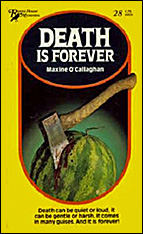
Death Is Forever (1981)

Run From the Nightmare (1982)
Hit and Run (1989)
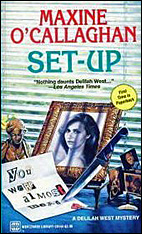
Set-Up (1991)

Trade-Off (1996)
Down For the Count (1997) .

         Collections:

A Change of Clients and Death Is Forever (1999)
   == Short story “A Change of Clients” [+} novel above.

Bad News and Trouble: The Delilah West Stories (2014)
   == Possibly including the following short stories:
“A Change of Clients”
“Bad News”
“Deal with the Devil”
“Diamonds Are For Never”
“Somewhere South of Melrose”
“Going to the Dogs”
“Belling the Cat”

REVIEWED BY DAVID VINEYARD:


THE UNSEEN. Paramount Pictures, 1944. Joel McCrea, Gail Russell, Herbert Marshall. Screenplay by Hagar Wilde and Raymond Chandler, based on the novel by Ethel Lina White. Directed by Lewis Allen.

   The sum total of this film adds up to much more than the film itself does.

   To begin with, it is the follow-up to director Lewis Allen’s major surprise hit, the classic ghost story, The Uninvited (reviewed here ), even down to casting perpetual lost waif Gail Russell as the heroine, here a governess in one of those mysterious households dear to the Gothic formula ever since Jane Eyre.

   Then there is the screenplay co-written by none other than Raymond Chandler and based on a novel by Ethel Lina White, who among others wrote the novels which Hitchcock’s The Lady Vanishes and Siodmak’s The Spiral Staircase were based on.

   Then too, there is a cast lead by Joel McCrea and Herbert Marshall, along with such steadfast character actors such as Norman Lloyd and Tom Tully. Even the children playing McCrea’s daughter and wayward son are good actors.

   The plot is that an old dark abandoned mansion sits next to McCrea’s in the city. McCrea once worked for the late owner, known as the Commodore. Deserted now, McCrea’s children insist they see mysterious lights in the house but no one believes them.

   As the film opens, the children spy an old woman walking by the house one night. She sees lights and a figure in the house, and is chased down by the figure. The next day headlines reveal an old woman was killed in an alley nearby. Meanwhile McCrea’s son finds the old lady’s gold watch outside the old house and conceals it so the police don’t know the connection.

   Governess Gail Russell arrives to the cold McCrea household where he questions her qualifications and motives and tells her his children are impossible. McCrea is bitter over his wife’s death and the suspicion that hangs over him because of it, as his close friend, doctor Herbert Marshall explains.

   Add to the mix the conniving ex-governess who has an almost hypnotic hold on the boy and the Commodore’s nosy widow (or is she), plus a few red herrings, and you should have the makings of at least a competent little Gothic outing.

   Alas, not so. The Unseen is flat, unconvincing, indifferently acted and directed, and the screenplay has little to say that will hold much interest. The motive for all the goings on is absurd, and the finale unconvincing as the sudden romance between McCrea and Russell.

   It is currently available on YouTube in six parts in a rather poor print. Unless you are a completest or a Masochist, I suggest you leave it there.

« Previous PageNext Page »