Reviews


Reviewed by DAVID VINEYARD:          


JOHN McPARTLAND – The Face of Evil. Gold Medal #393, paperback original, 1954. BlackMask.com, softcover, 2006.
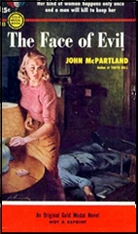
   There’s always a little trouble. Some lad from New York’s midtown or Chicago decides to make himself a score for ten thousand or so with a touch of blackmail or extortion. “Call Bill Oxford. He’ll handle it. The kid’s tough and smart and he knows everybody.”


   Bill Oxford is tough as nails and not very nice. He used to be a hot shot newsman during the war, worked on the legendary military paper Yank with people like Marion Hargrove (See Here Private Hargrove, well known screen and television writer), then, still young, he went to the city, got a job as a ‘sharpshooter’ on a big paper, the kind of guy who knew people and things, the kind of guy who would put a blackmailer or extortionist in their place for you, fix a scandal, break a few skulls. Then he went to work in advertising for the Agency, for Roger Mooney …With Roger Mooney you say, ‘Sure, Roger,’ and jump through whatever hoops he’s holding.

   Roger Mooney has a client running for office in Balboa, California. He’s not a very good candidate, in fact he’s a very bad one, and he has some problems, namely an honest lawyer named Ringling Black, who has the goods on the client and is about to broadcast them. All Bill Oxford has to do is fix things.

   â€œYou go down to Balboa. Frame this Black. Frame him hard and fast. Maybe with a woman. Something like that, something plenty nasty.”

   You don’t have to be all that clever to figure out this is a paperback original from Gold Medal by the underrated John MacPartland, whose books like Big Red’s Daughter, The Kingdom of Johnny Cool, and Tokyo Doll were hardboiled in the vein of John D. MacDonald or Charles Williams — not just a rehash of Hammett, Chandler, and Cain, but a new vision of the hard-boiled nineteen fifties, suburban rather than urban, small town or small city politics instead of Chi town or NYC.

   MacPartland’s mean streets were often in such settings. His prose was hard and tight with flourishes of dark beauty, but never showy:

   Two women called to me, “Bill!” Nile’s voice and Ann’s. I walked along the night-black street alone.

   Outside it was cool and dark with a fresh wind from the bay. I left the car in the parking lot and walked toward the couple of blocks that were downtown Balboa.

   Downstairs for a drink at the bar. It was crowded now, and there was the laughter of women, the low voices of men. A good bunch — the women all beautiful or close to it, the men rich-man brown and with good clothes.

   I went to her, quietly, and put my arms around her, hunted her mouth with mine. She pushed at me with her hands, tried to say something, and then I found her. It was stepping out of reality into something I had never known before. This was the whirlpool.

   Sometimes I would try to say something, a fragment of a word, a quick whisper of “Nile!” Nothing else. The drunkenness burned away, and I forgot everything but Nile.

   There was no exhaustion, no satiety. In time, a long time, there was a gray light on the long row of windows, a rim of light over the roundness of the hills.

   There are two women, Nile Lisbon, widow of well loved John Lisbon, friend of Ringling Black, girlfriend of tough sadistic King McCarthy, and Balboa’s assistant district attorney, a woman too dangerous to be with and too beautiful to ignore. In anyone else’s hands Nile would be a femme fatale, in MacPartland’s she is bruised and lost and hard to resist, good and bad, sweet and sour. You would know Nile if you saw her, be attracted, but unless you were Bill Oxford you would likely back away:

   She was the kind of woman a man noticed, mostly because of her eyes. Dark, almost black pools, they had a warmth that I felt could turn to fire. She had turned her head, looking over the shoulder of the man she was with, and we looked at each other. The third or fourth time it happened he noticed it and I paid some attention to what he was like.

   Nile gets Oxford in a fight with King the first thing. It doesn’t seem to bother him much. Then there is Ann Field. Six years earlier there at been a thing between them:

   Yeah, sure, Ann. Cute and trim as a palomino colt, that girl.

   Not now though. Ann has changed and how she feels about Bill has changed:

   Now she was sleek, a jungle animal who’d been caught and caged in a filthy zoo too long, the kind of girl who describes herself as a model but who does no modeling. Her eyes weren’t wide, nor was the world new and good to her. Any man could see all that.

   Ann doesn’t have good memories of Bill: “Don’t hello me, you son-of-a-bitch. I’ll kill you and spit on your corpse.”

   Then to round things out there are the hard drunk kids in town for spring break and Mooney’s enforcer Whitey D’Arcy, who owns a car dealership and owns more than a few cops. Mooney and D’Arcy play hard:

   Mooney had used hired killers where it had been necessary years ago. California had been a rough state in the late 1930’s. The chips were down for Mooney today.

   Whitey D’Arcy was not an idiot. We both knew what it was about. If I gave him trouble I’d pay for it, hard, but not here and not now. Likely I’d get my kidneys broken; it was the number-one big payoff for trouble guys.

   Bill finds himself suddenly with a conscious and a need to pay back for his sins. Redemption could get him killed when Ringling Black is shot and the evidence against Mooney’s client goes missing. The cops work for D’Arcy and want Bill, and his only allies are the seductive Nile and the wounded Ann.

   Maybe the ending is a little sentimental. Maybe it should have been harder and with less hope, more Woolrich’s doomed fate haunted heroes or one of David Goodis hopeless losers, Jim Thompson’s amoral heroes would have handled things differently.

   I like how MacPartland ends it. He writes hard-boiled movie prose and writes well. You can hear the music rise and see John Payne or Robert Mitchum and maybe Liz Scott or Gloria Grahame walk away, a little less hard, a bit wiser, a touch more human than they began:

   Ann and I left the Hut and walked toward the ocean. We could hear the music and the young voices of the nine days of Easter through the night.

   The roar of the long combers breaking into the surf was loud and the moon was rising in silver over the sea blackness. “This is what I wanted to do with you six years ago, Bill. Walk along the dunes and wait for the night to end.”

   â€œWe can do it now, Ann. It’s not too late for us.”

   Maybe it is, maybe not, MacPartland clearly likes the idea they can be saved, but he hasn’t sugar coated who Ann is or what Bill was. He has portrayed them as who they were, shown us what they could do and did do. He’s taken us down darker and meaner streets than the romantic private knights of Chandler or the tough birds Hammett gave us. These streets are inhabited by people we know and people we saw in the towns we lived in. Those of us who worked on newspapers or advertising knew the Bill Oxfords of the world. Some of us have known Nile Lisbon and Ann Field in one guise or another.

   If you worked in advertising you knew Roger Mooney, maybe not quite so lethal, and you surely knew of Whitey D’Arcy if you never knew him personally if you grew up in a certain size city.

   The Face of Evil, sometimes it is in a mirror, sometimes it is someone we know, a power broker like Mooney, a big fish in a small pool like D’Arcy, sometimes a bully like King. Sometimes it is just the corruption of small town America. John MacPartland captures the loss of innocence, the yearning for something that never really was, the hope of redemption, and the cost of making a stand finally.

   This isn’t a great book, but it’s a very good one. It will keep you up to finish in a single reading and leave you satisfied. It’s one of those Gold Medal novels that you recall with real fondness and if you write yourself a touch of awe. Maybe he isn’t in the very first rank, but he isn’t far off it either. It’s nice to read a book once in a while that just reaffirms why you started reading in this genre in the first place. There are times you don’t want a masterpiece, just a master at his best.
Reviewed by JONATHAN LEWIS:         


THE LAST OUTPOST. Paramount Pictures, 1935. Cary Grant, Claude Rains, Gertrude Michael, Kathleen Burke, Colin Tapley, Margaret Swope. Based on the novel The Drum by F. Britten Austin. Directors: Charles Barton & Louis J. Gasnier.

   As much as I like Cary Grant and as much as I appreciate Claude Rains, I still couldn’t find much to truly admire in The Last Outpost, a meandering romance-during-wartime melodrama.

   Grant portrays Michael Andrews, a British officer captured by the Turks during the First World War. A British intelligence officer, a mysterious man who calls himself “Smith” (Rains), comes to Andrews’ rescue and frees him from Ottoman captivity.

   The two men make their way through Mesopotamia, Kurdish tribesmen hot on their trail. Andrews ends up injured and back in a British hospital in Cairo, where he falls for his nurse, Rosemary Haydon (Gertrude Michael). But all is not as it seems, for Haydon is actually married to a British intelligence officer who she hasn’t seen for three long years.

   By now, I’m sure you’ve figured out who that intelligence officer must be.

   Based on F. Britten Austin’s novel, The Drum, the movie would probably have been all but forgotten had Grant and Rains not appeared in it. The plot is formulaic, there’s a whole lot of stock footage, and the cinematography is nothing special. If you’re looking for a World War I film to watch, you can do a lot better than this mediocre programmer.

THE BACKWARD REVIEWER
William F. Deeck


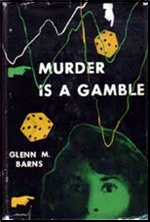
GLENN M. BARNS – Murder Is a Gamble. Phoenix Press, hardcover, 1952. Bestseller Mystery #162, digest-sized paperback, no date [1953]. Wildside Press, softcover, 2010.

   This is a most surprising entry from the legendary Phoenix Press. It is a reasonably literate, reasonably entertaining private-eye novel with a sort of locked-room murder.

   Jonathan (Jonny) Marks is assigned by the agency he works for to be a bodyguard to Col. Alexander Smallwood. Part of the deal that the Colonel arranges with the agency is that, should he be murdered, the agency will make sure that the Colonel’s killer is apprehended and brought to justice.

   The Colonel, it turns out, is a card player of some ability and not a great deal of honesty. He has enemies because of this talent, but these apparently are not the people about whom he is worried.

   For reasons known only to himself, the Colonel dismisses Marks, and then is found dead in his hotel room, an apparent suicide. Marks, of course, is convinced that the Colonel was murdered, although no one came up on the elevator to the Colonel’s floor, the doors to the stairs are locked automatically each night, and the few other people on the floor appear to be innocent, at least of murder.

   The police sergeant, surprisingly intelligent in a novel of this type, is sure that it was suicide, but says he is willing to change his mind if Marks can come up with some proof.

   Marks’s investigation is somewhat haphazard, the motive of the murderer is somewhat untenable, and the solution to the “locked room” is a bit disappointing. Still, Marks is a rather interesting character, and the writing is way, way above average for a Phoenix Press book.

— Reprinted from The MYSTERY FANcier, Vol. 9, No. 4, July-August 1987.

Bibliographic Note:   Of the seven criminous titles under Barns’s byline in Al Hubin’s Crime Fiction IV, one other is a case solved by Jonathan Marks, that being Murder Is Insane (Lippincott, 1956). I know nothing about this second book, but I cannot resist pointing out that Lippincott was ranked much more highly in publishing circles than Phoenix Press was, then and now.

FLIRTING WITH DANGER. Monogram, 1934. Robert Armstrong, Edgar Kennedy, William Cagney, Maria Alba, Marion Burns. Director: Vin Moore.

   Titles can be deceiving, and this one is one of them. When it comes to old movies such as this one, I try to know as little as possible about them when I pick one out to watch, and this one fooled me, but good. I thought it might be a relatively unknown crime film with a good-looking female participant or two, but it turned out to be an almost totally unknown comedy film about the happy-go-lucky adventures of three powder mixers for a dynamite factory.

   And that’s about all the plot there is, mixed in with a little girl chasing and explosions going off at funny times, leaving Edgar Kennedy, mostly, with blackened face or hanging from the highest branch of a handy nearby tree.

   But when “Lucky” Davis (William Cagney, of yes that Cagney family) gets serious about one of the girls he finds charming, and vice versa, the two other fellows concoct a plan to keep them apart. So off to South America they all go, cheerfully wondering in passing when the next revolution will start.

   The story line is so negligible I probably wouldn’t bothered writing up this review but for the fact that the film has only one user comment on IMDb and no external ones.

   The fact that it has enough charm to it to have kept me watching all the way through has to mean something, however. The three male stars are also no slouches in the acting field, even if William Cagney’s career eventually went off in other directions.

   Bonus piece of trivia: Carol Tevis, the girl with the high-pitched voice and stutter who was briefly romanced by Robert Armstrong’s character is said to have provided the voice at one time for Walt Disney’s Minnie Mouse, not to mention one of the Munchkins.

PAINTED LADY. Joint production of Granada Television (UK) and PBS (US). Broadcast in the UK, December 1997. Two-part mini-series, approximately 3 1/2 hours without commercials. Broadcast in US on Masterpiece Theatre, April-May 1998. Helen Mirren, Iain Glen, Franco Nero, Michael Maloney, Lesley Manville, Iain Cuthbertson, Barry Barnes, Michael Liebmann, John Kavanagh. Writer: Allan Cubitt. Director: Julian Jarrold.

   From what I’ve read about this particular production, this was designed to be a showcase for Helen Mirren’s acting talents after she’d finished five years of playing DCI/Supt. Jane Tennison on Prime Suspect.

   And display them she does, with Mirren first appearing as Maggie Sullivan, a more-or-less involuntarily retired folk-rock singer staying in Ireland in the lodge house of her benefactor, Charles Stafford, then after his murder, transforming herself into a (supposedly) wealthy Polish countess Magdelena Kreschinskaá in order to enter the fast-paced world of fine art in London.

   Her objective: to track down the only painting that was stolen in the aborted robbery that turned tragically to Stafford’s death. Supporting her with the funds to begin the masquerade are her half-sister and her husband, both notables in London’s art circles, and agreeing to her plan only with amusing doubts. Her purpose: to obtain the money Stafford’s son owes a local Irish gangster, and the reason the robbery was staged in the first place.

   The actors, the photography and the setting are all top notch — a statement that includes Franco Nero as a Italian art dealer whose path crosses that of the countess in more ways than one — a fact that accounts for the rave reviews this TV mini-series has gained from most, but not all sources.

   And therein I also am in the minority. Those of us who prefer stories that make sense, that aren’t wrapped up in five minutes at the end after watching a slow and deliberately paced work of television for well over three hours, and yes, dare I say it, more bloody violence than I expected to see in a very elegant tale of high art and sophisticated people.

   The latter could be forgiven, though, if some effort had been into making a coherent whole out of a lot of very nice pieces, and I do mean mean nice. Some scenes are extremely well done. I wish I could be more positive about this, but in all honesty, I can’t.

REVIEWED BY BARRY GARDNER:


WILLIAM G. TAPPLY – Tight Lines. Brady Coyne #11. Delacorte Press, hardcover, 1992. Dell, paperback, 1993.

   I like the Brady Coyne books. This isn’t bis best, but it isn’t bad, either. One of Coyne’s wealthy clients (for those of you not familiar with the series, he’s a lawyer whose specialty is ministering the needs of the very wealthy) is dying of cancer, and hires him to find her estranged daughter.

   She hasn’t seen or heard from her in a decade or more (for reasons she doesn’t understand) and wants both to be reconciled, if possible, and to take care of some complicated estate matters. Coy Coyne tries to avoid the chore, but eventually acquiesces.

   He locates her residence, but she is not there. The girl is a card-carrying neurotic, Coyne discovers, with several past and present older lovers to her credit, plus a psychiatrist. Shortly thereafter her body is discovered in a New Hampshire pond under ambiguous circumstances. The rest is a fairly standard excursion into her past and charader, with the identity of the doer of the deed eventually discovered, and justice sort of served.

   As usual Coyne is likeable and Tapply does a good job of pacing the story. I think he’s a very competent writer, but for some reason I wasn’t able to get involved with this set of players; perhaps my mood, perhaps not. I saw the ending coming, and thought it weak and not well enough set up, but so-so. Tapply is still worth reading. Recommended, though not strongly.

— Reprinted from Fireman, Fireman, Save My Books #2, July 1992.


Reviewed by DAN STUMPF:         


JAMES JONES – Some Came Running. Scribner’s, hardcover, 1957. Signet, paperback, abridged edition, 1958.

SOME CAME RUNNING. MGM, 1958. Frank Sinatra, Dean Martin, Shirley MacLaine, Martha Hyer, Arthur Kennedy, Nancy Gates, Franklyn Farnum, Denny Miller, James Jones. George E. Stone . Written by John Patrick and Arthur Sheekman. Directed by Vincente Minnelli.

   As I read this I kept wondering if it was indeed a Great American Novel — on the order of Look Homeward Angel or Sometimes a Great Notion — and when I finished I had to conclude: Not quite, but you can see it from there.

   I was prompted to read the original full-length edition by George Kelley’s article which I recommend to your attention. Running covers a few post-war years in small-town mid-America (1947 to 1950 to be exact) and it captures a sense of ordinary people struggling to come to terms with their lives in the midst of the post-war boom — and mostly failing.

   The center of the novel is Dave Hirsch, a late-arriving veteran home from the wars, failed writer and a perennial ne’er-do-well. Inadvertently returning to his home town of Parkman Illinois, he quickly manages to become the center of local gossip by insulting his respectable brother Frank (who sent him away years ago with five bucks to make his start in life) and hooking up with ’Bama Dillert, a local gambler and all-around low-life, who is also one of the greatest creations in 20th century fiction.

   There are in fact, quite a few all-around low-lifes in Running: easy women, feckless young men, town tramps and unredeemed bums, all observed by Jones with a passionate objectivity that makes them real and poignant on the page. There’s also Parkman’s “better element”: the upwardly mobile Frank and his family, a minor poet and his college professor daughter, local politicos and landed gentry—not merely background characters, but vital parts of a vivid and complex story.

   In fact there are no minor characters in Some Came Running, or damn few, anyway, and this is the novel’s greatest strength. When Jones brings someone on stage, he brings on a person, not a character. His people are complex, ambitious, troubled, and all too prone to screw up their lives. And when they converse, it’s a real conversation: rambling, lengthy, and real-sounding.

   Which may be one reason why the novel flopped; all that depth and realism takes a lot of ink to put across: 1266 pages of it in fact, a daunting prospect for any but the most avid reader. The main problem with the book though, is that it’s a bit of a downer; without giving away too much, let me just say that most of the characters manage to mess up their lives pretty thoroughly, and by the end Jones’ gloomy outlook actually starts to seem somewhat gratuitous — as if he were trying for Melancholy and overshot the mark rather badly.

   Along the way though, there’s some damn fine writing: a searing love story, a compelling look into the mind of a writer and the creative process, a road trip to make Kerouac envious, and an overall structure that keeps the reader hooked and wanting more. Despite its flaws and overall despondency, Some Came Running has a lot to reward the patient reader willing to risk a bout of clinical depression at book’s end.

   MGM filmed this in 1958 and, scenting profit but wary of a bespoke flop, Signet put out an abridged edition with pictures of the movie stars on the back cover. Writing in the Wall Street Journal, Lee Sandlin described the paperback as “brutally abridged” but it ain’t that bad. And at 620-some pages, it’s hardly a negligible read. I found that it cut a lot of the depth from Jones’ novel, but it added a certain momentum and focus. You needn’t be ashamed of reading it, if you don’t feel like mortgaging your summer with the unabridged text.

   I suspect MGM bought the book sight unseen after the success of From Here to Eternity and only belatedly realized they had Moby Dick on their hands. Nothing daunted, producer Sol C. Siegel (whose credits range from the 1930s Lone Ranger serial to Ben-Hur) hired a Pulitzer-winning writer and a gagman for the Marx Brothers to wrest something commercially acceptable out of it, ensured box-office returns by casting Sinatra, Martin and MacLaine, then wisely hired Vincente Minnelli to balance the artistry and melodrama as only he could—and oh yes: they slathered a wonderful Elmer Bernstein score all over it to accentuate the moody quality of the thing.

   Any film based on a book like this is bound to cut something out, and this one cuts more than its share. The result is a fine drama, with here and there a line or two from the book. Writers Patrick and Sheekman change the ending with a cavalier attitude, but more than that, they make subtle but important changes to the characters and overall tone of the tale. Dave Hirsch in the book is fat, awkward and a born follower. In the film, he’s “Ladies and gentlemen…. Frank Sinatra!” cool, self-assured, with a stacked deck of smooth lines he deals out with the assurance of a Big Star. Dean Martin is ideal as “Bama Dillert — one of the best bits of casting Hollywood ever did — but the biggest change comes in the character of Ginnie Morehead.

   In the book, Ginnie is… well, instead of me doing all the work, why don’t you pick up a thesaurus and look up “dull”, “bland”, “repellent”, and maybe “loathsome.” You got it. Shapeless, shallow and intellectually lazy, she garners some sympathy at first as we see her, obviously starved for affection, sadly giving out sex for a few minutes of something that looks a little like love. As the book progresses though, she becomes less of a waif and more of a shrike. By novel’s end, you may actually hate her.

   But that’s in the book. In the Movie, she’s Shirley MacLaine at her best: vibrant, vulnerable, and carrying the greatest purse ever in the Movies. This is more than just a Star Performance; it’s a concept that radically transforms the story.

   To say they changed the ending here, is a bit like saying Custer had a bad day, but the alterations are completely in keeping with the moody tone of the film itself. Where the folks in Jones’ novel seek acceptance and find alienation, the characters in the movie seek love and find acceptance. Important characters in the book die alone, but in the film death brings them together.

   I don’t know how Jones felt about the movie (he has a bit part in it.) Maybe he felt betrayed, maybe he was just glad to get the money. But Some Came Running is an easy film to enjoy.

THE LADY VANISHES. BBC, UK, made-for-TV movie. First broadcast: 17 March 2013. Tuppence Middleton, Keeley Hawes, Julian Rhind-Tutt, Sandy McDade, Pip Torrens, Stephanie Cole, Gemma Jones, Benedikte Hansen, Jesper Christensen, Selina Cadell, Tom Hughes, Alex Jennings. Screenplay: Fiona Seres, based on the novel The Wheel Spins, by Ethel Lina White. Director: Diarmuid Lawrence.

   The original version of this film, the one done by Alfred Hitchcock back in 1938, is generally considered to be a classic, and with one or two reservations, I think rightly so. There was an earlier remake of the movie in 1979 with Cybill Shepherd, Elliott Gould and Angela Lansbury, but I’ve never seen it. (I’ve been tempted, but should I?)

   The basic story is this, in both the Hitchcock version and this most recent one. A young girl gets on a train somewhere in eastern Europe, having been hit on the head before boarding. With her as a companion is a lady she’s just met who’s also heading back to England, after having worked as a governess for a wealthy family in that country for several years.

   After having tea together, they go back to their compartment, the girl falls asleep, and when she awakens, the lady is gone. She has vanished completely, without a trace.

   The other passengers in the compartment claim they have never seen her, including a sinister looking baroness. Even worse, no one else on the train says they saw her either. What comes next is the crux of the tale, including a good-looking young man who comes to the assistance of the even better-looking young woman, and eventually even comes to believe her.

   The Hitchcock version is often described as a comedy-mystery, and I’ve never felt all that comfortable with many of the scenes that that are meant to be amusing. In contrast, this latest made-for-TV version is fairly serious all the way through. No Charters and Caldicott, for example, the two potty British gentlemen who claim not to have seen the missing woman on the grounds that if there is a delay, they will not get home in time for some important soccer matches.

   In their place this later version does have two dotty ladies who need to get home to attend to their roses, but their later role in the movie is negligible, unlike Charters and Caldicott.

   The underlying plot, the reason for this elaborate charade, is slightly different in the two films, and I think the later one is the better one. In neither movie does the conspiracy make sense, however. How could the perpetrators be sure that everyone else on the train would have reasons to say the had never seen the lady?

   The landscapes in the second film are more lovely (Croatia, supposedly), the scenes on the train are better filmed, as the protagonists make their way up and down the corridor. Truth be told, though, the movie may rely a little too often on visuals, leaving the viewer (at least this one) wondering on one or two occasions what happened, or why.

   The ending epilogue is a bit lame in both, so in that regard the two stories come out even. I’m glad to have seen the second. The players are all fine, although none were known to me at all before a watching. I hope this isn’t out-and-out heresy, but when it comes down to a final summing up, I enjoyed this film more than I did Alfred Hitchcock’s version, mostly because of the sinister, less humorous approach, which I suspect is closer to the book. (I’ve not read it. I wonder how many people actually have?)

Reviewed by DAVID VINEYARD:          


PETER HOPKIRK – Quest for Kim: In Search of Kipling’s Great Game. University of Michigan Press, softcover, October 1999. John Murray, UK, 1996.

   This is an adventure story, a history lesson, auto-biography, biography, a journal of a journey, and a literary detective story about one of the masterpieces of English literature and world literature, Rudyard Kipling’s Kim. Like the author I will not debate the political or racial implications of the novel that takes place in the heyday of the British Raj. This is about the beloved adventure story and its origins, and the India and Northwestern Frontier where they take place, from the hold city of Benares to the Afghan border, the land of the Great Game.

   For anyone who doesn’t know, the war between the Russian and British Empire in India for Afghanistan and the riches of the Grand Trunk road and the gateway to the Far East was fought with actual battles and in the shadowy realm of espionage, dubbed by Rudyard Kipling as the Great Game.

   Kim, Kipling’s novel of half Indian Kim O’Hara, a child of the streets and back alleys of Benares; the strange Lama whose chela or student and servant he becomes and to whom he is wholly devoted; the rascally Mahbub Ali his friend and guardian, a red haired horse trader and secret agent; Colonel Creighton the mysterious head of the British Secret Service on the Indian continent, and all the rest of the motley crew young Kim O’Hara encounters is one of the most beloved books of all time.

   It has been read and influenced writers: John Buchan, Talbot Mundy, T. M. Murari, Frederic Wakeman, M.M. Kaye, T.S. Eliot, Philip Knightley, Mark Twain, …; adventurers, Wilfrid Theisger, T.E. Lawrence, Fitzroy Maclean (a model for James Bond), Patrick Leigh Fermor (the poet and wartime hero of the SOE who kidnaped a German General on Crete); and countless other boys grown to men with a taste for adventure and romance on the Grand Trunk road including a boy nicknamed for him, Harold “Kim” Philby.

   The Great Game, India, and the Raj all form the grand theme of the works of historian Peter Hopkirk, whose bestselling non-fiction recounts the exotic truth of that world with titles as evocative as Foreign Devils on the Silk Road, Trespassers on the Roof of the World, and Setting the East Ablaze knows Central Asia, Russia, China, India, Pakistan, and the Middle East like the back of his hand.

   As one who loved Kim early on, Hopkirk’s paean to the book is a joy to read. He follows Kim’s trail from the relative peace of Benares to the still hazardous and dangerous borderlands of Simla as he tracks down the true locations, and the real people Kipling used in his narrative of life and adventure in 18th century India.

   The result is not only a tribute to the book, but a detective story as he unravels history, legend, and local mythology to bring new life to a living book many of us still turn to for lessons and wisdom. Most of all it is a tribute to a land and people. As Hopkirk concludes: “… the real hero of Kipling’s masgterpiece is neither Kim nor the Lama. It is India …”

   Read this and enjoy a real detective story full of history and adventure, and the wisdom of a young boy who lived in a world so vivid we still seek to visit and recreate, a world no film can do true justice to, a world that once captivated us, and still calls to us across our lives and across time and distance.

Reviewed by JONATHAN LEWIS:         


RED BALL EXPRESS. Universal International, 1952. Jeff Chandler, Alex Nicol, Charles Drake, Judith Braun, Sidney Poitier, Jacqueline Duval, Hugh O’Brian. Director: Budd Boetticher.

   Although it has a running time just over eighty minutes, Red Ball Express nevertheless manages to pack in many of the familiar tropes of World War II films. There’s the initial backstory setting the film into its proper historical context, a demanding company leader who needs to whip a diverse group of men into a fighting shape, the against-all-odds mission. In Red Ball Express, the mission, however, isn’t so much about combating the Nazis directly as it is supplying the American troops doing the fighting.

   Directed by Budd Boetticher, this Universal-International film is a fictionalized account of the eponymous Red Ball Express, the vast truck convoy network which delivered supplies to the Allies in France after the successful landing on D-Day. The movie is in homage to those soldiers who may not have experienced much in the way of direct combat, but loaded and unloaded supplies and drove trucks through inhospitable terrain. Red Ball Express was intended to assure that these unsung heroes’ sacrifices are not forgotten.

   Jeff Chandler, in a role quite different from some of the escapist, costumer fare he starred in around the same time, portrays the tough, demanding Lt. Campbell. He’s a hard-nosed, not particularly sentimental truck driver originally from Colorado tasked with leading a unit of diverse men.

   These men, some who are experienced in trucking and some who are not, are tasked with a difficult mission. They are to drive trucks to the front lines and deliver much needed supplies to fighting units. Their battle isn’t so much directly against the Germans as against the elements, exhaustion, and their own competing desires, needs, and prejudices.

   Not only is there bad blood between Lt. Campbell (Chandler) and the unit’s second in command, Sergeant Kallek (Alex Nicol), there’s also racial tension, both real and perceived, in the unit. We this through the eyes of the sensitive Cpl. Robertson (Sidney Poitier), who believes he is the target of racial discrimination.

   All told, Red Ball Express remains a significantly above average war film. Even though it’s a short film, the primary characters are all fairly well developed, each with their own personalities and idiosyncrasies. Although the film itself fits squarely into the War in Europe genre, none of the characters are mere archetypes or cardboard cutouts. They’re much better fleshed out than that, providing the viewer the feeling that, under different circumstances, these guys could have been your friends. It’s a war film with heart that doesn’t mask the horrors of war or shy away from difficult issues, quite an accomplishment in any era, but ever more so in 1952.

« Previous PageNext Page »