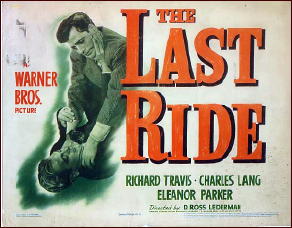
Reviews


REVIEWED BY DAN STUMPF:         


THINGS TO DO IN DENVER WHEN YOU’RE DEAD. Miramax Films, 1995. Andy Garcia, Christopher Lloyd, William Forsythe, Bill Nunn, Treat Williams, Jack Warden, Steve Buscemi, Fairuza Balk, Gabrielle Anwar, Christopher Walken. Director: Gary Fleder.

   Things to Do in Denver When You’re Dead is a good film, perhaps very good, if a bit too firmly mired in its own neo-noir ambiance. Andy Garcia plays a character on the fringe of the underworld pressured by mob boss James Woods into settling his debts by beating up a romantic rival of Woods’ younger brother.

   Andy recruits a team of other needy-seedy types to help out, including Treat Williams and Christopher Lloyd, and when the plan goes spectacularly awry, he’s given 48 hours to get out of town… while his henchmen get Steve Buscemi as the deliveryman for slow, painful death.

   Motivated by quirky loyalty, Garcia decides to spend his last 48 hours trying to save the inept buddies who screwed things up in the first place, bringing on a nice, pre-doomed search for some meaning in one’s own death: a perfect noir conundrum.

   Most reviewers found this too clever by half, but I thought it very deeply-felt, well-played and intelligent. Someone told Andy Garcia to “do Cary Grant,” and he makes a nice job of it. Even better is Treat Williams, whose brilliant, portrayal of a sub-normal Strong-arm should be held up as a textbook model to show every actor how to lose himself in a part, a powerful bit of acting which should have won him an Oscar.

   Of course, some elements of his character may be in questionable taste, but it’s still a dandy performance in a film good enough that I wish they hadn’t felt it necessary to underline Garcia’s dilemma by having someone watch DOA in the background.

Reviewed by JONATHAN LEWIS:         


MASTERSON OF KANSAS. Columbia Pictures, 1954. George Montgomery, Nancy Gates, James Griffith, Jean Wille, Benny Rubin, William Henry, David Bruce, Bruce Cowling. Story and screenplay: Douglas Heyes. Director: William Castle.

   Masterson of Kansas is, in many ways, a much better movie than it deserves to be. Let me explain. This Sam Katzman-produced film has little in the way of beautiful Western scenery, not all that much in the way of character development, and, with the exception of the final ten minutes or so, very little creative or unique cinematography or direction. Even so, I found myself thoroughly enjoying this highly fictionalized Bat Masterson lawman story.

   Directed by William Castle, who is now best known for his schlocky and gimmicky horror films, Masterson of Kansas is economical both with plot and time. It’s a short, fun-filled little film that benefits strongly from its casting of George Montgomery as Bat Masterson and veteran character actor James Griffith as Doc Holliday.

   Although Montgomery is definitely a presence in this film, it’s Griffith who steals the show as Holliday, depicted in this movie as a sickly, vengeful gambler who hates – I mean hates! – Masterson with a passion. Griffith simply shines as the irritable Holliday, a man torn between loving cards and loathing Masterson.

   The plot revolves around Masterson’s attempt to clear the name of a man falsely accused and convicted of murder. He does this primarily to help keep the peace between Kansas settlers and the local Indian tribes, one of which is lead by Yellow Hawk (Jay Silverheels). Bat may not be completely altruistic. Along the way, he seems to develop an interest the convicted man’s lovely daughter (Nancy Gates). Their supposed romance is more of a cliché than anything else.

   Truth be told, the storyline isn’t all that much. But there is enough action to keep the viewer engaged. The sequence in which Masterson, Holliday, and Wyatt Earp (Bruce Cowling) walk down the street together as comrades in arms is beautifully filmed, as is the scene of the hangman’s noose waiting for the falsely accused man.

   Masterson of Kansas is no brooding psychological weapon, nor is it an epic tale. But that doesn’t stop it from being fun. As escapist entertainment, this movie has a lot to recommend it.

JOYCE HOLMS – Payment Deferred. Headline, UK, hardcover, 1996; paperback, 1997. Bloody Brits Press, US, softcover, 2007.

   The cover bills this as “A Fizz & Buchanan Mystery,” which was intriguing right then and there, because (a) I admit that Joyce Holms was a new name to me, and (b) what’s (who’s) a Fizz? Doing some investigation on my own, it was not difficult to discover that Payment Deferred is the first of [nine] in a series, and why I’d happened to have never heard of the author is that [at the time I read this book] none of them have been published in this country.

   I’ll get back to that particular point later, I think. Of the pair of sleuths working out of Ms. Holms’ books, let’s take Tam Buchanan first, as it’s much simpler that way. The town is Edinburgh, and Tam (male) is a lawyer who donates a morning a week to a free legal clinic, a more-or-less straight-and-narrow sort of fellow. As for “Fizz,” I think I’ll do some quoting from pages 7 and 8:

   Tam arrives late to find “a plump girl of about seventeen” waiting for him.

    “You’re waiting to see me, are you?”

    She had a sweet, dimpled face and an expression of unassailable innocence. “Well,” she said with a hesitant smile, “that rather depends on who you are.”

    The discrepancy between what his eyes saw and what his ears heard was so great that Buchanan was momentarily at a loss. It was like being savaged by a day-old chick, which was clearly impossible, so that he had to assume that she had not intended the put-down but was merely trying to sound sophisticated, or some such rubbish.

    “I do beg your pardon,” he said, with exaggerated politeness, and then regretted it. She was, after all, just a kid, and besides, he should have had the common decency to introduce himself before barking at her. “I’m Tam Buchanan, Legal Advice.”

    She gave him a shy nod and offered a small but surprisingly strong hand. “In that case I am waiting to see you. I’m your new assistant. The name’s Fitzpatrick.”

   And so from here the relationship begins, full of sparks and brief bursts of annoyance and vexation (on both sides, but mostly Tam’s). Here’s another long quote from much toward the end of the book (page 291):

    Bloody Fizz!

    Buchanan was equally disgusted at himself for (a) ever letting her into his life, and (b) being markedly less than enthusiastic to be rid of her.

    She was a pain in the neck. Let’s face it, she was horrendous. She was an inveterate liar, a manipulator, selfish, opinionated, miserly, and didn’t give a hoot in hell about anyone but herself. Her philosophy, as propounded by herself, was: everything I have is yours and everything you have is mine. Which was fair enough till you remembered that she didn’t have anything you’d want.

    On the other hand, when she was in a good mood – which, okay, was almost always – she was quite nice to be around. She was different. She made you see things in ways you hadn’t seen them before. Also, she had a strange kind of innocence about her, even though you couldn’t trust her with the gold fillings in Grandma’s teeth. But she was honest. That was the funny thing. Way down deep, where it counted, she was as honest a person as he’d ever met.

    However, be that as it may, he was rid of her now, and he wasn’t about to change that, regrets or no regrets. Common sense dictated that he learn his lesson and steer clear of her from now on.

   Obviously the man is hooked on her. And, no, all first impressions aside, she’s not seventeen, either. More like twenty-six. She’s starting law school in the fall, and working for Tam is to get her foot in the door, and she has no intentions of being a mere secretary. She begins assisting on Tam’s next case almost before he knows there is one.

   Which consists of trying to clear the name of an old (and rather dull) friend of Tam’s, Murray Kingston, who has just been released from prison after being convicted of molesting his young daughter.

   Who had anything to gain from the false conviction – who could have wanted Murray out of the way for any reason – and who could have faked all of the evidence that put him into prison for three years?

   Well, yawn. This is not the most gripping of tales – there’s a heaping abundance of legwork and around page 120 the book gets really talky. Even though (of course) there’s eventually a murder to solve, the real fun is watching the free-spirited Fizz walk loops around the laid-back Buchanan. For the edgiest of relationships since Maddy and David — back before they jumped the shark and “did it” – this is the book you’ll want to read next.

JOYCE HOLMS – Foreign Body. Headline, UK, hardcover, 1997; paperback, 1997. Bloody Brits Press, US, softcover, 2008.

   Authors, on occasion and for various reasons, go in their own direction, and that is not always where the reader is going, or wants to, and he or she (the reader) is left leaning the wrong way, and sometimes in the most awkward of positions.

   Which is to say, strangely enough, in this the second adventure of Fizz and Buchanan, the edge is gone. Vanished. Only the slightest sense of sexual tension between the two mystery solvers remains, showing itself only now and then, and mostly then.

   There’s also a sizable gap in time between the previous book and this one. Fizz, having gotten fired from Tam’s legal clinic, has somehow attached herself to his legal firm itself – and there’s got to be a story there that’s (apparently) never going to be told.

   What we do get, as a rather inadequate substitute – I’m being Uncle Grumpy here – is a intimate look into Fizz’s background – the small Scottish village where she grew up, orphaned at an early age, and raised her elderly grandfather.

   Persuading Tam to recuperate from an inconvenient gall bladder operation in Perthshire, around Am Bealach where Fizz’s grampa lives, Fizz also has an ulterior motive – persuading Tam to also take an interest in the strange disappearance of Old Bessie, an elderly villager Fizz was fond of. In the meantime, another mystery is encountered – that of a strangely behaving camper with a tent full of weird objects including a blonde wig and a mannequin’s hand.

   Can the two cases be connected? Have you not read enough crime fiction to know the answer without asking? You realize of course that the twist might be that they are not – and I’ll never tell.

   Once the reader (that’s me) rights himself (or herself, if it’s you, and the pronoun is appropriate) this pair of semi-dueling detectives does do themselves a fair amount of justice on the pair of mysteries with which they’re confronted.

   Once again the book plods a little in the middle, but the pieces of the puzzle are painstakingly shaped and given time to develop – perhaps a little too painstakingly – but do stay with them. What better reading experience can there be when all sorts of mysterious occurrences are eventually explained and slide into place?

— May 2004

       The Fizz and Buchanan series —

1. Payment Deferred (1996)
2. Foreign Body (1997)
3. Bad Vibes (1998)

4. Thin Ice (1999)
5. Mr Big (2000)
6. Bitter End (2001)

7. Hot Potato (2003)
8. Hidden Depths (2004)
9. Missing Link (2006)
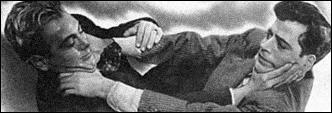
THE LAST RIDE. Warner Brothers, 1944. Richard Travis, Charles Lang, Eleanor Parker, Jack La Rue, Cy Kendall, Wade Boteler, Mary Gordon. Director: D. Ross Lederman.

   One of the players in this film was later nominated for three Oscars, and it wasn’t either the leading player, Richard Travis, whose career never got out of first gear, nor was it Cy Kendall, even though he was always, as he is in this film, the best villain around, and always worth watching — the oiliest, the most conniving, and in a good old-fashioned way, a wonderful toad of a fellow with a eye always on whatever money he can make in whatever scheme seems the most profitable at the time.

   And in The Last Ride, made in 1944 — war time, in other words, when rubber was scarce — that’s where the money is. In spite of the patriotic message this movie was intended to send, supporting the war effort, Mr Kendall is not only a captain in the police department, but he’s also the secret head of a gang of black marketeers in the tire business.

   Problem is, the tires are shoddy, and as a result a couple of kids on a joy ride end up dead in a ditch. Travis plays Pat Harrigan, a detective on one side of the law, while his brother Mike is on the other and one of the members of the gang. They both have their eye on a girl named Kitty Kelly (Eleanor Parker), but her part in the story all but disappears after 30 minutes into the story, not much over the halfway point.

   Travis tries to pull of the oldest gambits in the books, from the police department’s point of view, and the tale peters out from there. The beginning’s not bad, and some money was put into the production, but when a key point in the tale is covered in a letter to the police captain, one that has to read by the audience on the screen, instead of a short two minute scene that could have shown the same thing, you have to know that corners had to be cut somewhere, and it shows.
   

A 1001 MIDNIGHTS Review
by Ellen Nehr


MARGOT ARNOLD – Exit Actors, Dying. Playboy Press, paperback original, 1979. W. W. Norton / Countryman Press, softcover, 1988.

   This paperback original is the first of the adventures of Penelope Spring, American anthropologist, and Toby Glendower, Welsh archaeologist. We meet the pair in Turkey on sabbatical from Oxford. The action begins when Penny is seated in an amphitheater and sees a body lying on the grassy stage below. By the time she returns with the police, however, the body has disappeared.

   Next, a member of a film crew staying at the same hotel as the academicians turns up missing. Toby finds the man`s purloined body, and he and Penny decide to investigate. (Toby has a less-than-altruistic reason: He needs to be back in England in ten days, but the police won’t let him leave until the murder is solved.)

   Using talents developed over the years in their academic specialties, the two middle-aged professors become involved with the personnel of the motion-picture crew and their dependents, as well as study the Turkish countryside, to uncover the criminal and his. motives. This is a nice portrayal of two endearing characters and their warm, nonsexual relationship.

   Among Arnold’s other paperback originals are The Cape Cod Caper (1980), Zadok’s Treasure (1980), and Lament for a Lady Laird (1982). These allow the reader to explore the cranberry bogs of Massachusetts, an archaeological dig in Israel, and a Scottish estate.

         ———
   Reprinted with permission from 1001 Midnights, edited by Bill Pronzini & Marcia Muller and published by The Battered Silicon Dispatch Box, 2007.   Copyright © 1986, 2007 by the Pronzini-Muller Family Trust.

      The Penny Spring annd Sir Toby Glendower series —

1. Exit Actors, Dying (1979)

2. Zadok’s Treasure (1980)
3. The Cape Cod Caper (1982)
4. Death of a Voodoo Doll (1982)
5. Death on the Dragon’s Tongue (1982)
6. Lament for a Lady Laird (1982)

7. The Menehune Murders (1989)
8. Toby’s Folly (1990)
9. The Catacomb Conspiracy (1992)

10. The Cape Cod Conundrum (1992)
11. Dirge for a Dorset Druid (1994)
12. The Midas Murders (1995)

DASHIELL HAMMETT – The Maltese Falcon. Alfred A. Knopf, hardcover, 1930. Originally published in Black Mask magazine as a five part serial from September 1929 through January 1930. Reprinted many times, in both hardcover and paperback. Film: Warner Bros., 1931; also released as Dangerous Female (Ricardo Cortez). Also: Warner Bros., 1936, as Satan Met a Lady (Warren William as Ted Shane). Also: Warner Bros., 1941 (Humphrey Bogart).

   I don’t suppose I have to convince you to read this book, do I? If you haven’t read it yet, I don’t suppose you will. Maybe I’m wrong. Maybe you’ve never gotten around to it. It would be easy to do. But remember, nobody lives forever. You’ve only got one life to live, and that’s all you’ve got.

COMMENTS:

1. The part of Sam Spade was made for Humphrey Bogart.
2. John Huston was wise to write the part of Rhea Gutman out of the screenplay.
3. Spade’s mind always seems to be several jumps ahead of the story, but Barzun and Taylor call him “repeatedly stupid.” Why?
4. Likeable, I’m not so sure he is.

— Reprinted from The MYSTERY FANcier, Vol. 5, No. 3, May/June 1981.

Reviewed by JONATHAN LEWIS:         


JUKE GIRL. Warner Brothers, 1942. Ann Sheridan, Ronald Reagan, Richard Whorf, George Tobias, Gene Lockhart, Alan Hale, Betty Brewer, Howard Da Silva, Faye Emerson, Willie Best. Screenplay by A. I. Bezzerides, based on a story by Theodore Pratt. Director: Curtis Bernhardt.

   Although it may not have the most compelling plot or the best action sequences, the Warner Brothers melodrama Juke Girl benefits strongly from Ann Sheridan in a starring role. She portrays a tough, streets smart juke joint dance girl in a bustling Florida farming and packing plant town. Her commitment to the smoke filled music hall life is tested when she encounters Steve Talbot (Ronald Reagan), a charming itinerant farmhand with a strong commitment to the plight of the common man.

   The plot, which occasionally seems to deviate sharply from where one expects it to be heading, follows the story of two friends, Steve Talbot (Reagan) and Danny Frazier (Richard Whorf) as they arrive in Cat Tail, Florida looking for work. They soon come to learn that the small town is all but run by packing magnate Henry Madden (Gene Lockhart) and his strong man, Cully (Henry Da Silva).

   Soon after arriving in town, Steve falls for Lola Mears (Ann Sheridan’s character) who is working at the town’s smoke filled juke joint. But he doesn’t fall as hard for the tyrannical Madden. In fact, he decides he’d rather work for small time tomato farmer Nick Garcos the Greek (George Tobias) than the packing plant owner.

   This strains his relationship with Danny (Whorf) who wants to work for Madden. Along for the ride and trying to keep the peace is character actor Alan Hale, who portrays Yippee, one of the locals with a strong conscience.

   For a time, things go okay for Steve and Lola. They help Nick ship tomatoes to market in Atlanta, and there’s even talk of their settling down together. But Lola abruptly skips out on Steve. She still doesn’t think of herself as the settling down type. Things then get even worse for poor Steve when there’s a warehouse murder, which the townsfolk blame on him.

   The movie abruptly veers from a melodrama to something of a crime film. But even so the crime aspect remains a mere sideshow to the story about the relationship between Steve and Lola, two rural working class lovebirds trying to make their way in a rough and tumble world.

   That said, aside from championing honest work, the film really isn’t very political. There’s no heavy-handed message here. Reagan’s character isn’t as much a labor leader as he is a guy originally from the wheat fields of Kansas who wants hardworking farmers to get a fair deal.

   Juke Girl isn’t the type of film that will likely stick with you for days and weeks after you’ve watched it. But it is nevertheless an enjoyable film, far less gritty than the films noir of the late 1940s, but one that hints strongly at a world where the greedy and the unscrupulous would gladly prey on the weak.

Reviewed by DAVID VINEYARD:         


THE SMALL BACK ROOM. The Archers / British Lion Film Corporation, UK, 1949. Released in the US as Hour of Glory (1952). David Farrar, Kathleen Byron, Jack Hawkins, Michael Gough, Cyril Cusak, Leslie Banks, Sidney James, Robert Morley, Geoffrey Keen, Anthony Bushell, Renee Asherson. Based on the novel by Nigel Balchin. Cinematography: Christopher Challis. Written and directed by Michael Powell and Emeric Pressberger

   The small back room of the title is in a once tony Park Lane building where myriad agencies including Professor Mair’s Research Section are situated. It’s just one of dozens of similar wartime sections belonging to no one in particular and answering to no one save a handful of civil service bureaucrats, politicians, and ministry officials, all maneuvering for influence, power, and glory. It’s 1943, and amidst the war petty politics and back stabbing still go on.

   Boffin Sammy Rice (David Farrar, Black Narcissus, 300 Spartans, Meet Sexton Blake), is above all this. All he wants is to do his job, contribute, romance his girl Suzy (Kathleen Byron), and find some way to dull the pain and the shame caused by his tin leg.

   He’s content to run his section and use Suzy as a vent for the anger his constant pain causes, which only makes him feel guilty and more useless. An expensive bottle of Scotch he keeps in his apartment in plain view is the one escape, not to kill the pain — neither it nor the dope the doctors give him will do that — but to make him forget. He has sworn not to touch it, though he does get drunk in a local pub owned by ex-boxer Knucksie (Sidney James). That bottle is a symbol of more than his pain, it also symbolizes the life he has bottled up in its smoky depths as well.

   As the film opens Lt. Stewart (a young Michael Gough) of the bomb disposal unit arrives at Professor Mair’s section with a top secret problem soon assigned to Sammy; a booby trapped device being dropped by the Germans that has so far killed three boys and one man. It may be aimed at children to demoralize the British populace, but so far they haven’t found a live one to study, and when they do they need a man like Sammy to tell them how to handle it.

   Meanwhile everything is complicated by Sammy’s problems, political back-fighting led by R. B. Waring (Jack Hawkins), the glad handing minister whose purview the section falls under, Mair’s incompetence, a soldier tech with a problematic wife (Cyril Cusak), and Suzy’s growing anger that Sammy will not stand up and fight for what he knows is right but hides behind his pain and that unopened bottle of Scotch.

   The Archers of course were directors, producers, and screenwriters Michael Powell and Emeric Pressberger (The 49th Parallel, Black Narcissus, A Matter of Life and Death, The Red Shoes, to name a few classics) who adapted this version of the novel by Nigel Balchin (Mine Own Executioner and the screenplay for The Man Who Never Was), a British novelist whose works in the manner of Nevil Shute were both suspense novels as well as serious mainstream novels. This is one of his best remembered novels and a fine example of his abilities.

   There’s an exceptional cast for this one, even in bit roles: Robert Morley, Geoffrey Keen, even Patrick Macnee gets a closeup if no dialogue, and Farrar, Byron, Gough, Hawkins, Cussak as a stuttering technician, Anthony Bushell as a bomb disposal officer, and Renee Asherson as a corporal assigned as stenographer to a bomb disposal unit are all outstanding. Asherson has a fine scene where she reads the last instructions dictated from the site where an officer was killed trying to defuse the bomb to Farrar who will be the next man to attempt it. It’s a thousand times more effective than filming the scene itself could have been.

   Christopher Challis’s cinematography must be mentioned as well; the location shots capture much of the wildness of some of the remote regions the booby-trapped devices carry Sammy and Stewart to, as well as the claustrophobia of crowded pubs and nightclubs with blacked out lights, tiny labs in the small back rooms of the title, and without the usual scenes in bomb shelters or footage of burning London, sketching in the aura of wartime England subtly. As it likely was for most ordinary people in London and the rest of the country, the war is always a presence even when it isn’t at the forefront.

   One outstanding sequence in the film is a surrealistic waking nightmare as Sammy waits for Suzy, the only person who can distract him from his pain, and must battle not only his pain, but the attraction of the bottle. As the clock ticks maddeningly, his pills fail him, and the bottle looms larger and larger until he even sees its outline in the pattern of the wallpaper, he breaks down.

   It’s a nerve-wracking scene, and wrenching to watch the otherwise taciturn and stoic Farrar deteriorate before your eyes. It’s as uncomfortable as anything in The Lost Weekend and as surreal as the famous Salvador Dali sequence in Hitchcock’s Spellbound, and the shadows and light interplaying on that craggy face make some memorable impressions. There is a moment when in his pain he stamps down on the tin leg to crush the pills and the agony on his face is palpable.

   It won’t take much imagination or provide much of a challenge to know Sammy will end up defusing one of the booby trapped devices, the twin of one that has already killed, and with a hell of a hangover, in a climactic scene of tension, or that doing so will decide his future and the fate of his relationship with Suzy, but that is dramatic structure and there is no way around it in book or film, even if anyone was silly enough to want one. It’s a tense scene and all involved wring every sweaty drop of fear out of it.

   Neither the film nor the book is as well known here as it was in England, but if you can find the trade paperback edition I recommend both it and Balchin’s Mine Own Executioner (also an excellent film with Burgess Meredith and Kieron Moore) highly. And if you know the work of the Archers, especially of director Michael Powell, then that alone is enough to recommend the film.

   And for what it’s worth Farrar was a cousin of mine, and we share the family nose, no small connection, so forgive me if I think it is one hell of a performance for an actor who a few years before was playing Sexton Blake in B films.

THE BACKWARD REVIEWER
William F. Deeck


VALENTINE WILLIAMS and DOROTHY RICE SIMS – Fog. Houghton Mifflin, hardcover, 1933; Popular Librar #76, paperback, n. d. [1946]. Film: Columbia, 1933 (starring Mary Brian, Donald Cook and Reginald Denny).

   The S. S. Barbaric lives up to its name as three of its passengers are strangled en route from New York to England. The first is the irascible millionaire Alonzo Holt, who wouldn’t have sailed if he had known that the son he never knew, his estranged second wife, and the charlatan who used to conduct seances for him were aboard.

   While there is an occasional good sentence — for example, “The curious delusion that the ability to amass wealth implies a disposition to distribute it in charity, deserving or undeserving, attracts shoals of beggars to the millionaire’s door” — the authors have overwritten throughout. Worse, none of the characters ring true, except for the bridge fanatic, nicknamed Sitting Bull. Still worse, the hero spots the murderer through a clue provided by the heroine, who could not possibly have been in possession of the information she gave him.

   Skip this one unless you’re a real nostalgia buff.

— Reprinted from The MYSTERY FANcier, Vol. 11, No. 3, Summer 1989.


BIBLIOGRAPHIC NOTES:   This is co-author Dorothy Rice Sims only entry in Hubin’s Crime Fiction IV. Valentine Williams was a far more prolific writer of crime ad detective fiction. There is a very extensive article about him on Mike Grost’s Classic Mystery and Detection website. Highly recommended!

PostScript.   It belatedly occurred to me that I had been lazy, and that I should have tried harder find out more about Mrs. Sims, if I could. It turns out that there is quite a bit more to say.

   From a website dedicated to famous contract bridge players, there is a short biography of her, along with a photo. Excerpting from the first couple of paragraphs:

    “Dorothy Rice Sims was born June 24, 1889 at Asbury Park NJ. From her teens, Dorothy was active in competition, holding the motorcycle speed championship for women (1911) and becoming one of the first U.S. aviatrixes, in which capacity she met and married ACBL Hall of Fame Member P. Hal Sims.

    “She was a noted sculptress, painter and author in fields other than bridge, though she wrote several bridge books. She is widely credited with inventing the psychic bid, but probably initiated only the popular name for it. However, she wrote her first book on the subject, Psychic Bidding, 1932.”

   Note that one of the characters that Bill mentions is a fanatic bridge player.

THE POWELL TOUCH
by Walter Albert


   In 1935 and 1936, William Powell followed his 1934 starring role in MGM’s The Thin Man with two RKO comedy-mysteries, Star of Midnight and The Ex-Mrs. Bradford, both of them directed by Stephen Roberts.

   In Bradford Jean Arthur is the ex-Mrs. Bradford who turns up at the beginning of the film to have physician Bradford (Powell) served a subpoena for non-payment of alimony; in Star, Ginger Rogers is Donna Manton, a social butterfly in love with lawyer Powell who claims to have more fun solving cases than trying them and whose friends consider him to be a combination of Charlie Chan, Philo Vance and the Sphinx.

   Bradford is a racetrack mystery and Star a Broadway mystery, both versions of the classic form of amateur detective considered by less-than-bright homicide detectives to be a prime suspect in a murder case.

   Bradford has the more original conclusion with the suspects invited to a meeting at which a film reveals the murderer’s identity, but Star is better paced and has some more polished acting in secondary roles, particularly by Vivian Oakland as a former girlfriend of Powell’s and Gene Lockhart as a somewhat unconventional butler who didn’t do it but is drafted for some ironic sleuthing.

   Arthur and Rogers, both fine actress/comediennes, are delightful foils for Powell’s stylish drollery and each has at least one scene that is a standout: Arthur in a brilliant closing sequence and Rogers in a comic tum as she foils Oakland’s play for Powell.

   Powell’s earliest appearance as an urbane amateur detective was in The Canary Murder Case, in which Jean Arthur also appeared, and by 1935 there was no more adept player of drawing-room comedy-mysteries.

   The actor is probably no less accomplished in Bradford and Star than he is in The Thin Man, but it is certainly debatable whether, as William Everson maintains in The Detective in Film (Citadel, 1972), The Thin Man is “almost” equaled by the two lesser known movies.

   The level of craftsmanship in all three of the films is very high, but I think that the decisive elements in the superiority of The Thin Man — and in its continuing popularity — are the inspired pairing of Myrna Loy, who matches Powell’s arch style with her own elegant delivery and movement, and first-rate scripting by Albert Goodrich and Frances Hackett, and directing by W.S. Van Dyck.

   Script, direction, and performance come together in an extraordinary tour-de-force that climaxes the film. The wrapup party sequence in The Thin Man still dazzles as Powell delivers what is in effect an extended monologue and it is this perfectly timed scene, a classic example of the “cosy” mystery denouement, that, for me, makes The Thin Man the success that Bradford and Star achieve only in part.

   Both actresses were on the verge of major stardom when they appeared with Powell. Loy would, of course, continue the role of Nora Charles in five sequels, and also appear in films like The Great Ziegfield, The Rains Came, The Best Years of Our Lives, and Mr. Blandings Builds His Dream House.

   The Thin Man is usually seen as the one in which Loy escaped type casting as an Oriental temptress — most notably as the daughter of Fu Manchu in The Mask of Fu Manchu (1932) — but non-Oriental roles in films like Love Me Tonight (1932), Topaze (1933) and Manhattan Melodrama (1934) suggest that her film roles were far more varied than they are usually thought to have been.

   An oddity in the casting of Arthur is that she had played in three Fu Manchu films (in 1929 and 1930) and in the early thirties was better known as an actress in melodramas than as the star of comedy/dramas as she was subsequently to be.

   By an equally ironic reversal, Rogers, after her dizzying success with Fred Astaire, would establish herself as a dramatic actress in the late thirties and forties, but with Astaire and with Powell she demonstrates an apparently natural comedic talent and a freshness that makes her performances with them among her most engaging.

   [Almost eighty years] after their original release dates, The Thin Man and the two “forgotten” films, Star and Bradford, are entertainments that largely defy the passage of time. In addition, all three films — and one must add to the list James Whale’s brilliant 1935 baroque send-up of the drawing-room mystery, Remember Last Night? — are a tribute to the popularity of the amateur sleuth mystery in the 1930s and to the professional and artistic integrity of this genre.

   The Thin Man gains some lustre in the context of related films but also should remind us that it operated out of a tradition that still gives pleasure for its wit and invention and, in particular, celebrates the career of one of the screen’s most distinguished player of amateur detectives, William Powell.

— Reprinted from The MYSTERY FANcier, Vol. 8, No. 5, Sept-Oct 1986.


« Previous PageNext Page »