Reviews


Reviewed by DAVID VINEYARD:         


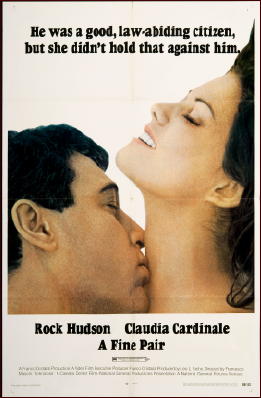
A FINE PAIR. National General Pictures, 1969. First released in Italy as Ruba al prossimo tuo (1968). Rock Hudson, Claudia Cardinale, Leon Askin, Ellen Corby. Tony Lo Bianco. Score by Ennio Morricone. Directed by Francesco Masselli.
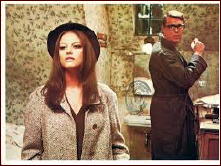
   Taxi driver carrying Esmerelda Marini (Claudia Cardinale) into New York: Over there is the United Nations building.

   Esmerelda: I can see they aren’t getting anything done from here.

   Sadly that is the best line in this rather strained caper comedy that never quite lives up to the jaunty Ennio Morricone score.

   Rock Hudson is dour police Captain Mike Harmon, a pain in everyone’s ass, who was close to Esmerelda’s policeman father with young Esmerelda having a schoolgirl crush on him that has carried over to the present day.

   It’s not a match made in heaven though, Esmerelda is a rebel and jewel thief.

   She wants Hudson to help her return the jewels she stole in Austria from a wealthy American’s villa and he reluctantly agrees (all too easily).

   Of course she is breezy, fun, amoral, smart, sexy, and only half clothed most of the time so it is natural the stiff cold Captain is going to melt — almost literally when he has to get the villa they are robbing to 194 degrees to disable the alarm and she holds the place up in nothing but wet bra and panties.

   Nor does he suspect he returned paste jewels while she stole the real ones — again.

   By the time he finds out she has to return more jewels in Rome, he is hooked on her and crime, and they have a big row when she decides to turn hones,t so Mike pulls off the heist and frames her having her own uncle arrest her so she can’t leave.

   After a narrow squeak the two end up happily together.

   And it just ends.

   One thing, with Rock in black framed glasses you now know how he would look as Clark Kent or Rip Kirby.

   This light film would like to be something along the lines of A Man and A Woman, with an infectious score, flashy photography, and a naturalistic look. The problem is Francesco Masselli is a heavy-handed and unimaginative director, Hudson doesn’t seem comfortable with his character for the first half of the film, and while Cardinale is gorgeous and fun, she makes no sense as a character.

   Had they done this a few years earlier as one of those slick Universal films Hudson was so ubiquitous in from the late fifties through the mid-sixties, it might have been the light playful romantic comedy caper it was meant to be, but this is just a bore.

   Cardinale is beautiful, funny, sexy, and screwball, the scenery is lovely, and the two actors have some chemistry once Hudson is able to move into a more familiar mode, but it’s a highly unsatisfying film otherwise.

   I missed it the on its initial release and it has taken until now to see it. I wish now I had waited another couple of decades.

   Not bad so much as ho, hum.
THE BACKWARD REVIEWER
William F. Deeck


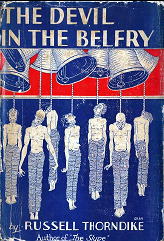
RUSSELL THORNDYKE – The Devil in the Belfry. Dial Press, UK, hardcover, 1932. First published in the UK: Butterworth, hardcover, 1931, as Herod’s Peal.

   It’s bad enough that Brigadier-General Sir Lionel Hansaw has received a threatening letter from someone he claims is a Hindu. In the mistaken belief that he is a good judge of men, he hires former Captain John Carfax as his bodyguard. While Carfax is neglecting his duty and viewing and listening to a bell-ringing session with the general’s niece, the general is shot dead in his study by a tall Hindu.

   The peal being rung as the general died was Herod’s Peal, banned by the Roman Catholic Church many years before. Ringing the peal were the Bede Bell-ringers, nine erstwhile convicts led by the Reverend Lord Upnor, a fanatic on campanology. As Lord Upnor’s group travels about, they continue to employ Herod’s Peal, and each time it is rung, someone is murdered.

   Carfax, wishing to find the general’s murderer since he did nothing to prevent the crime, aids Scotland Yard detective Macready in the investigation, if it can be called that, of the various deaths.

   In my review of Thorndike’s The Slype, which you can find here, I criticized the plot. I can’t in this novel, for it is a good one. But the characterization and description that made The Slype so enjoyable is totally missing here, though the setting is the same. That marvelous policeman, Sergeant Wurren, appears only briefly, a total waste of a wonderful character. Thorndike tries to do something with Winning, the bell-ringers’ advance man, but it’s not enough.

   For campanology addicts like Lord Upnor.

— From The MYSTERY FANcier, Vol. 13, No. 2, Spring 1991.

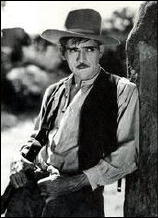
THE UTAH KID. Tiffany Productions, 1930. Rex Lease, Dorothy Sebastian, Tom Santschi, Mary Carr, Walter Miller, Lafe McKee, Boris Karloff. Director: Richard Thorpe.

   The movie begins with a sheriff’s posse hard on the trail of a single man on horseback. He’s young and clean-cut, a good looking fellow with a smart horse, so how could he be an outlaw? The young fellow is Cal Reynolds (Rex Lease), and looks to the contrary, he’s definitely on the wrong side of the law, since as it turns out, the safe haven he’s heading for is a place called Robbers’ Roost.

   Thanks to the overall dull minds of the posse after him, he makes it safely. Now Robbers’ Roost is exactly the kind of place you’d expect it to be, given the name, and the fellow in charge is called Butch (Tom Santschi) and the one who appears to be the second-in-command is Baxter (Boris Karloff, and the only reason this old western movie is in any kind of demand today; rumor has it that there may be only one surviving print).

   Also on hand is Parson Joe (Lafe McKee), an elderly gentleman who is not allowed to leave, else he may reveal the outlaws’ hideout to the authorities, so he has decided to stay on willingly. Where else could he find so many sinners whose souls he might save? Found by Baxter wandering around the vicinity (no other explanation given) is a young girl named Jennie Lee (Dorothy Sebastian). To save her from being killed, or worse, young Cal claims that she is his fiancée, and (gulp) is forced to marry her on the spot, thanks to the presence of Pastor Joe.

   What young Cal does not know is that Jennie is engaged to the local sheriff (Walter Miller), which puts him in quite a predicament – and she as well, as it is clear that she is falling for young Cal, and hence the rationale for quite an entertaining western, believe it or not. There are no singing cowboys, no stupid sidekicks, only a small but incisive love story that probably needn’t have taken place in the West, only this one did.

   As for Boris Karloff, although his role is brief, he is a joy to watch and listen to. His voice is as mellifluous as you’d expect it to be, even in this very early talkie, and his body language is certainly more expressive than it needed to be, in this otherwise undemanding role of the second in command of a fourth rate gang of robbers and thieves.

   He was an actor with a future (second sight is wonderful), while Rex Lease, as it turned out, as young and handsome as he was, ended up with far less of a career than Mr. Karloff’s.

Reviewed by JONATHAN LEWIS:         


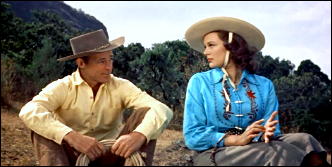
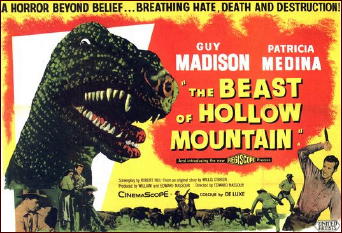
THE BEAST OF HOLLOW MOUNTAIN. United Artists, 1956. Guy Madison, Patricia Medina, Carlos Rivas, Mario Navarro, Pascual García Peña, Eduardo Noriega, Julio Villarreal, Lupe Carriles. Directors: Edward Nassour & Ismael Rodríguez.

   Imagine you’re watching an average B-Western about a goodhearted rancher from Texas in both a business and romantic rivalry with a mean-spirited rancher from Mexico. The movie is in color; the acting by Guy Madison and Patricia Medina isn’t all that bad; and the foreboding Mexican landscape is well integrated into the storyline.

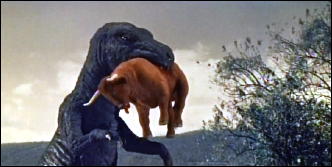
   So you keep watching. Somewhat entertained, somewhat bored, and now and again remembering the film was billed as a creature feature. Then nearly an hour into the film, a giant, deeply angry stop-motion T-Rex (a fairly impressive special effects achievement considering the film is from 1956) makes its way out of the local swamp and wreaks all sorts of havoc on cows and humans alike.

   That’s The Beast of Hollow Mountain for you. Based on a story idea by King Kong special effects innovator, Willis O’Brien, it’s all good fun. While not a particularly great film, the mid-fifties movie is actually quite entertaining provided you go into it with the right mindset.

   The last twenty minutes or so, when the T. Rex finally emerges from its mountain hideaway, make up for the fact that you had to wait an entire hour to see the creature. This too long a delay really does make the film significantly less compelling than it could have been.

   But getting back to the dinosaur. What a creature! The giant feet making an impression in the mud, the giant teeth and red tongue, and eyes that convey anger. It’s a far more impressive movie dinosaur than the one that appeared in The Giant Behemoth, which I reviewed here. That said, at least in that particular film, we actually got an impressive political backstory as to why the dinosaur decided to stomp all over London. In The Beast of Hollow Mountain, all we really know is that local legend held that there is a – you guessed it, a monster – in the mountain.

   There are some fairly harrowing moments, such as when the dinosaur claws at — and peers into — the roof of a shack where two would-be victims are cowering, and when protagonist Jimmy Ryan (Madison) swings back and forth on a rope hanging from a limb of a tree, luring the dim-witted dinosaur to its swampy doom. And listen for the birdsongs. Whether they were deliberately recorded or whether they were merely picked up during filming doesn’t much matter. They really help establish an atmospheric setting for the world’s first, and dare I say, preeminent, dinosaur western film.

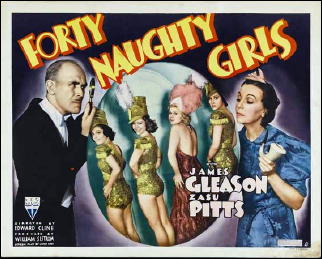
FORTY NAUGHTY GIRLS. RKO Radio Pictures, 1937. James Gleason, Zasu Pitts, Marjorie Lord, George Shelley, Joan Woodbury, Frank M. Thomas, Tom Kennedy, Edward Marr. Based on the story “The Riddle of the Forty Naughty Girls” by Stuart Palmer in Mystery, July 1934. Director: Edward F. Cline.

   I know some of you may like Tom Kennedy’s lowbrow comedy performances, especially as dumb cops in movies like this and the Torchy Blaine serie, among dozens of others, if not more, and so do I, in small doses. But in Forty Naughty Girls, reportedly a Hildegarde Withers and Inspector Piper detective mystery, he should get third billing, he has so many lines, rather than way down the list of credits where you will actually find him.

   The murder of a press agent for a Broadway musical who’s a man with too many ladies takes place during one of the performances of said play, with the solution coming just as the play is over for the evening. No thanks to Inspector Piper’s deductive techniques, however. His approach is to accuse someone of the crime only to discover (Miss Withers does a lot of whispering in his ear) that he’s way off base and his case just doesn’t hold up.

   Miss Withers, on the other hand, does a lot of sniffing around on her own — literally, as she is on the scent of a perfume she smells on the dead man’s clothing. She also finds herself in the prop room under the stage, to much would-be hilarity, but not from me, and of course, with Tom Kennedy’s character around to pull the wrong lever, she finds herself on stage during a dance number, much to her surprise, but lose her aplomb, does she? In a word, no.

   This is the last movie of six adventures of Miss Withers recorded on film, and the second of two with Miss Pitts, she of the fluttering hands and the quavering voice. She was also in the preceding one, The Plot Thickens, reviewed here. Compared to this one, the preceding one was not bad. This one? Abysmal.

Reviewed by DAVID VINEYARD:         


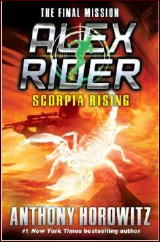
ANTHONY HOROWITZ – Scorpia Rising: The Final Mission. Philomel, hardcover, 2011. Puffin, softcover, March 2012.

    “Somehow you are going to persuade MI6 to send Alex Rider on a mission. You’re going to make sure the mission goes wrong and the boy gets killed … Then you’re going to blackmail them.”

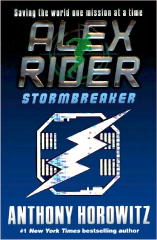
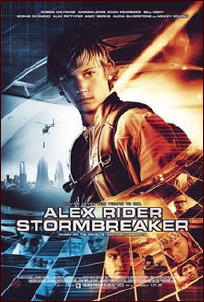
   That sums up the plot of Scorpia Rising, the ninth and final book (a prequel of sorts was published earlier this year) in Anthony Horowitz’s series about fourteen year old reluctant British agent Alex Rider, who finds when his secret agent uncle dies in the first book, Stormbreaker, that he has been trained all his life a be a spy, and indeed his father was an agent as well.

   Stormbreaker was a clever entertaining semi send up of the genre much in the Ian Fleming tradition of tongue definitely in cheek, what with Alex’s souped up bike and a lethal yoyo and chewing gum, but what Horowitz also took from Fleming was the knowledge that you must always play it straight, and the hero is everything. The series works because of Alex Rider, because ridiculous as the idea sounds, Horowitz makes it work. This is no Cody Banks. Alex is not only a character you cheer for, but he is one you learn to understand a bit more each book.

   The books grew darker as Alex was drawn deeper into the world of spies and secret agents. All nine books take place in a single crowded year, but it becomes at least plausible as long as the novels compel you along with relentless action and one twist after another, revealing the secrets behind Alex Rider.

   Alex lives with Jack Starbright, a young American woman hired as a sort of babysitter, who ends up as his guardian. Other regulars include Mr. Blunt, the cold blooded head of MI6 Special Operations; Mrs. Jones, who has a jaundiced eye to the exploitation of Alex; Smithers, the head of Covert Weapons, Q to Alex’s 007; and Sabina Pleasure (Fleming would love it), a classmate involved in his first adventure and Alex’s girlfriend.

   In Scorpia Rising Alex is drawn into a trap, and faces an old enemy, Julius Grief, a clone given plastic surgery to be Alex’s twin and dark doppelganger being used by Scorpia, SPECTRE to Alex’s Bond, a ruthless terrorist organization that has been at the heart of Alex problems from the beginning.

    “I will not agree to take on this child one more time. Twice was enough. I will not risk a third humiliation.”

   But of course they do. There wouldn’t be a book if they didn’t. I suppose that must be very limiting for master criminals and super villains. You can imagine Moriarty complaining that once in a while it couldn’t be Martin Hewitt or Dr. Thorndyke instead of Holmes.

   Scorpia Rising is the longest of the books to that point, and a fine climax for a series that turned out to be a dark look at the excesses of intelligence, and far more accessible than any of John Le Carre’s adult novels. Horowitz (of Poirot, Foyle’s War fame, and author of numerous other young adult novels — notably here the Diamond Brothers and their best known case, The Falcon’s Malteser) is clever, inventive, playful as his model Fleming was, but unlike Fleming there is a more serious theme underlying the Alex Rider books (more serious than Fleming’s ennui anyway), and the effects of his ordeal show on what is, after all, a fourteen year old. That he keeps Alex a believable fourteen year old and not an angst-ridden mini-adult is no mean feat.

   There is a stunner at the end of this one, and Alex graduates to what he has been on the way to becoming all along. At the end he escapes Scorpia and Mr. Blunt, but at a price he was not willing to pay. Despite the upbeat ending, Horowitz never suggests Alex is going to simply forget what he has seen and done, or that the can go back and be a normal teenage boy now, not entirely. Everything is nicely sewed up and closed, but you won’t buy it for a moment. Alex’s new happy life in San Francisco with Sabina’s family is presented as the finale to his adventures, but you know heroes like Alex Rider stumble on massive criminal conspiracies the way the rest of us find pennies on the ground.

   You leave the series fairly certain that Alex’s days with MI6 Special Operations are only suspended until he is older.

   If you like spy thrillers or James Bond, this series will be hugely entertaining. The villains are properly larger than life, the action beautifully choreographed, and the set pieces big and well drawn. Above all, without ever imitating Fleming, Horowitz manages to mine what was properly called the Fleming Effect, that ineffable voice no one has been able to echo since. Like Fleming, the writing is deceptively simple, full of short sentences and with a page-turning rhythm that easily explains why young audiences devoured these.

   Alex Rider inspired graphic novels, audiobooks, and a somewhat disappointing movie, Stormbreaker, that was none the less perfectly cast. If you haven’t read these, find a young adult you can buy them for, and then read them yourself before giving them to him or her. Though you may have to buy a second set because you are reluctant to let them go. They really are intelligent and playful novels with a dark and serious message hidden among the lightning action.

      The Alex Rider series —

1. Stormbreaker (2000)
2. Point Blanc (2001)
3. Skeleton Key (2002)
4. Eagle Strike (2003)
5. Scorpia (2004)
6. Ark Angel (2005)
7. Snakehead (2007)
8. Crocodile Tears (2009)
9. Scorpia Rising (2011)
10. Russian Roulette (2013)

Reviewed by JONATHAN LEWIS:         


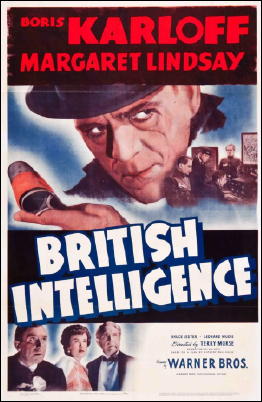
BRITISH INTELLIGENCE. Warner Brothers, 1940. Boris Karloff, Margaret Lindsay, Bruce Lester, Leonard Mudie, Holmes Herbert, Austin Fairman. Director: Terry O. Morse.

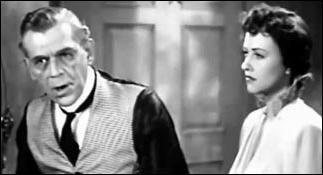
   British Intelligence is a spy film/thriller starring Boris Karloff. He portrays a mysterious, facially scarred, government agent who, under the name Valdar, poses as a French butler in the home of Arthur Bennett, a high-ranking British official.

   Based on Three Faces East, a play from 1918 by Anthony Paul Kelly, it’s a fun, albeit not overly sophisticated, spy film with a copious array of characters and a particularly a compelling performance by Karloff. There’s some rather good use of shadow and lighting and enough plot twists condensed into an hour’s running time to keep you guessing what’s going to happen next.

   Although released toward the beginning of what was to become the Second World War, British Intelligence is actually set during the First World War. Britain is at war with a bellicose, expansionist Germany which seems to be as much Hitler’s Germany as the Kaiser’s.

   But that’s not all that important. What’s significant is that there are spies — many of them, it would appear — afoot and up to no good in England’s capital city. And it’s up to Britain’s intelligence services that are tasked with rooting them out to protect war plans from falling into the hands of the enemy.

   Although the plot takes several turns before coming to its resolution, the set up is as follows: British aviator Frank Bennett (portrayed by the South African-born Bruce Lester) is shot down over France. Recovering in a British field hospital, he is tended to by an affectionate nurse (Margaret Lindsay) who, just a scene later, is seen in the company of particularly Prussian-looking German army officers.

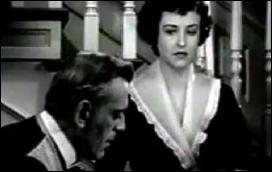
   Apparently, the good nurse is actually a German spy by the name of Helene Von Lorbeer. Her mission is to go to London and serve in the household of Arthur Bennett (Holmes Herbert), father of the aforementioned wounded Frank. The characters portrayed by two leads — Karloff and Lindsay — of course meet up in the Bennett household. For a while at least, it seems as if Valdar is a German spy as well. As you might imagine, Frank Bennett eventually returns home to London only to find his supposed nurse living in his family home, precipitating a series of events which eventually culminate in the destruction of the local Germany spy ring.

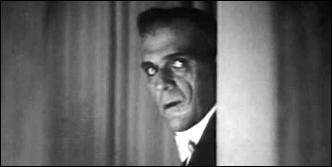
   Although Lindsay is good, it’s Karloff who really steals the show in this one. It’s a much better role for him than as the genial scientist in Night Key, for instance, reviewed here. There’s a great scene (around the 24-25 minute mark) in which we see the shadowy face of Valdar (Karloff) while he’s snooping through Arthur Bennett’s office. It’s a reminder of how much an exceptional actor can convey with a facial expression and what good directors and cinematographers can do with lighting.

   Although British Intelligence may not be ranked among the best spy movies, it is still a quite good film. There are no major plot holes, the acting is above average, and the story is fairly solid. More importantly, it gives the contemporary viewer a brief window into the mindset of Englishmen who, in 1940, were once again faced with a mortal strategic foe in Germany. In the film’s final scene, Colonel James Yates (Leonard Mudie) sums up the likely attitude of many of Britain’s citizens at the time: “We fight wars only because we crave peace so ardently. But always in the strange scheme of things, some maniac with a lust for power arises . . .”

   Who in the audience wouldn’t have gotten the reference? If the message needed to be clearer, Yates ends the film in dialogue with Arthur Bennett, telling him that when war comes, England will of course fight. It’s worth watching.

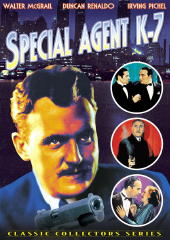
SPECIAL AGENT K-7. C.C.Burr Productions/Puritan Pictures, 1936. Walter McGrail, Queenie Smith, Irving Pichel, Donald Reed, Willy Castello, Duncan Renaldo, Joy Hodges. Director: Bernard B. Ray, as Raymond K. Johnson.

   As the story goes, and forgive me if I have this wrong, this rather obscure B-movie of the detective mystery variety was to be the first of several films that were to be made featuring its star, Walter McGrail in the role of Vincent ‘Lanny’ Landers, otherwise known as Special Agent K-7, but none of the others were ever made. The film was also supposed be based on a well-known radio program of the day, according to PR releases at the time, but no one today knows what radio show they had in mind, if any.

   The mystery itself isn’t all that bad. A night club owner (crooked, of course) is killed in his office soon after being the beneficiary of a hung jury (paid for, again of course). There are plenty of possible suspects, including the newly married husband of tough-as-nails female reporter Olive O’Day (with polish). Immediately on hand to offer assistance are Lanny Landers and Lester Owens (Irving Pichel) , the noted attorney who had just gotten the dead man his illicit hung jury verdict.

   But even though there are any number of possible other killers, including Duncan Renaldo’s character before his Cisco Kid days, I don’t think that anyone reading this will fail to spot the real culprit long before any of the characters in the story do.

   Other than that small disappointment, the movie was also hampered by a distinct lack of star power, although most of the players had long careers in making movies, and the lack of facial recognition on my part made it difficult to keep track of which player was which. Only Queenie Smith, who was still in movies as late as 1978, stands out amongst the faceless men in suits, ties and hats, even though some had mustaches and some not.

REVIEWED BY DAN STUMPF:         


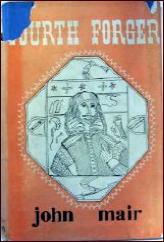
JOHN MAIR – The Fourth Forger. Cobden Sanderson, UK, hardcover, 1938. The Macmillan Company,US, hardcover, 1939.

   Several years ago on this blog I reviewed John Mair’s witty, off-beat thriller Never Come Back. Subsequent to that, I learned that Mair had written only one other book before his untimely death in WWII, this non-fiction study of a young gent named William Ireland and a controversy over “newly discovered” writings by William Shakespeare — a controversy that became a scandal that stirred London in the 1790s.

   William Ireland was the son of Samuel Ireland, a prosperous collector and dealer in antiquities, and an avid Shakespeare enthusiast — he named his first son William, didn’t he? Every evening Samuel read to his children from the Bard, and this undoubtedly had an influence on William, but not so much as his father’s near-total indifference to him.

   Samuel casually dismissed his son as dull and stupid (which for a long time supported the case for the Shakespeare Forgeries, as William was considered totally incapable of writing them) and placed him as apprentice to a legal office where William found himself with little to do but sit in an office, surrounded all day by musty old parchments. Very old parchments.

   Here’s where Mair’s genius as a writer comes to the fore: Without disparagement or bathos, he evokes young William’s frustration and (probable) desperate need for his father’s approval, a need that drove him to seek out a suitably old scrap of parchment, draft a minor legal document in suitably antiquarian ink, and forge Shakespeare’s signature on it. When he presented this to Dad, William finally got a morsel of parental approbation — which left him hungry for more.

   You can probably anticipate the rest. William worked up a convincing (to his dad) cover story about a wealthy and conveniently anonymous benefactor who kept a steady trickle of “treasures” that grew ever more fabulous. There were other documents. Then letters. Then a Profession of Faith that “proved” Shakespeare was not Catholic. And on and on.

   William’s father Samuel began showing these to friends, then to authorities on the Bard, and they met with acceptance and even adulation, particularly the Profession of Faith, because it seemed to say what everyone wanted to hear.

   Flushed with success and his father’s long-withheld esteem, and convinced of his own genius, William went to the next step: An original manuscript of King Lear in the author’s own hand, differing from the original only in being more attuned to contemporary tastes.

   Needless to say, it was met by a public overjoyed to see that the writer they idolized actually catered to their own standards, and that anything objectionable must have been put there by later, inferior hands. Heady with success, William rushed into his next “discovery”: a lost play titled Vortigern.

   All this while of course, there were doubters. And William’s success/excess only made his work a larger target for analysis and debunking. Again, Mair does a fine job evoking the characters of the men who were actually right about the spurious nature of William Ireland’s Shakespeare Papers, but who were also mostly motivated by their own self-interest or idiosyncrasies. At the same time, he tells an intriguing and often poignant story of his father’s growing desperation as friends, fans and a fortune slipped from his grasp — all because of a son he publicly scorned.

   This story could have been duller than ditchwater, but author Mair imparts his own fluid narrative style and smart-ass sense of humor to liven it up delightfully. To take just on example, at one point the Poet Laureate of England enters the picture, a poet-magistrate named Henry James Pye, who had been of some service to the crown, whom Mair describes: “…the verse that he wrote in his leisure hours could not detract from his numerous public services…. [as Poet Laureate] Pye did his poetic duty to the public with the same remorseless competence as he administered justice to criminals. From his appointment in 1790 to his death twenty years later he never ceased to write verse and never began to write poetry.”

   Writing like this makes The Fourth Forger a pleasure to read, and I followed this account of scandal and hurt feelings avidly to the end. You may too.

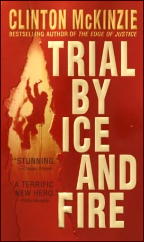
CLINTON McKINZIE – Trial by Ice and Fire. Delacorte, hardcover, July 2003. Dell, paperback, March 2004.

   This is the third recorded appearance of Antonio Burns, who’s a special agent for Wyoming’s Division of Criminal Investigation, and while I may be wrong, I think I have the first two of them sorted out.

   First came The Edge of Justice (Delacorte, hc, 2002), followed by Point of Law (Dell, pb, April 2003). What’s confusing is that there was no hardcover edition of the second book, as far as I’ve been able to discern, and that the second book is described as the prequel to the first book.

   In any case, if you’re a fan of mysteries that take place in the wide open country and clear blue skies of the Rocky Mountain states, my hunch is that these are all books meant especially for you.

   Some backstory first. At a previous point in his past, Burns survived a shootout set-up by three bad guys, all of whom perished, gaining his nickname of QuickDraw as a consequence, not to mention plenty of unwanted notoriety. This incident has not endeared him with many of the higher echelons of the DCI.

   His drug-addicted brother Roberto is currently on the run, an escapee from a Colorado prison, trying to decide if he should make a deal with the authorities and give himself up. And Antonio’s girl friend from Denver is suddenly not talking to him, all the while he’s trying to protect a prosecutor with the Teton County Attorney’s office (young, pretty, female) from a stalker who may prove to be deadly.

   Antonio Burns’ own addiction seems to be mountain climbing, and while he seems to have superhuman powers of recovery and recuperation from days filled with snow-packed action and danger, I will settle for the armchair variety, thank you very very much.

   McKinzie tells the story in First Person, Present Tense, which to me sounds stilted and awkward, but (on the other hand) while I haven’t taken the time to analyze it fully, the narrative, jam-packed with the (aforementioned) action and danger, is intense enough to keep one up well past one’s bedtime several times over, and the format of the telling must have had something to do with it.

   There are several WOW’s that came up in the telling – a surprise or two or three that come along the way. Here’s a quote that I liked, not necessarily linked to any of the surprises, but I liked it anyway. From page 317:

   â€œMy god.” The words slip out of my mouth in a tone of awe and reverence.

   The flames are gigantic. They claw and writhe hundreds of feet into the night sky. They fill the entire western horizon. And even though the fire is still a couple of miles away, across the summit and beyond a small valley, I can feel its hot, stinking breath on my face. It sucks then blows at me, respirating deeply like a bellows in its need for fuel. Suddenly this idea of Wokowski’s that we’ll ride it out in a paper-thin aluminum shelter is more than ludicrous – it’s suicidal. We are going to die.

   In terms of a detective story, if anyone is truly reading this one with that in mind, here’s where you might be judgmental and where any weakness might lie. Burns is only semi-dependable as to a judge of character. Perhaps there’s too much going on in his life at the time, and perhaps there are simply too few suspects, which is more than I should tell you right now, if you were to call me on it. But for a keener sense of place against a backdrop of inner turmoil and personal self-doubt, I do not believe you can find much better than this.

— May 2004

      The Antonio Burns series —

1. The Edge of Justice (2002)
2. Point of Law (2003)
3. Trial by Ice and Fire (2003)
4. Crossing the Line (2004)
5. Badwater (2005)

« Previous PageNext Page »