Reviews


THE BACKWARD REVIEWER
William F. Deeck


JAMES RONALD Murder in the Family

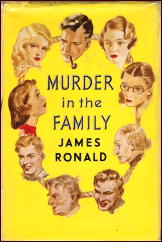
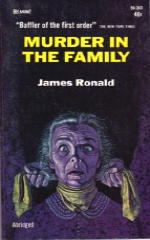
JAMES RONALD – Murder in the Family. Lippincott, US, hardcover, 1940; Mercury Mystery #172, digest-sized paperback, abridged, 1952, as The Murder in Gay Ladies. Belmont Books 90-303, paperback, abridged, 1964. First published in the UK: Lane, hardcover, 1936. Hodder & Stoughton, UK, hardcover, 1949. Film: Fox British, 1938.

   Stephen Osborne has just lost his job, not a good one and not one he particularly enjoyed. But at 50-some years of age in the Depression era and with no savings, he doesn’t know how he’s going to provide for his large family except by asking his sister, a wealthy woman, to help him financially.

   Unfortunately, Octavia Osborne is a most unpleasant person. During her annual visit to Stephen’s home, she not only refuses to help but tells the family that she is writing all of them out of her will.

JAMES RONALD Murder in the Family

   Bad timing on her part, for while she is sitting in a room with her niece, who is engrossed in a book, someone comes in and chokes her, causing death by heart failure.

   One of the family, or the family’s loyal and loving housekeeper, must have done it. The only other occupant of the house, Octavia’s companion, who was to be left £1,000 a year in the new will, wouldn’t have done it and, since she was locked in her room, couldn’t have done it. There are a couple of other suspects, but they aren’t taken seriously.

   The mystery is a good one, solved by the family’s ne’er-do-well uncle. But the primary focus is on a close, caring. family being torn asunder by a voracious press, local busybodies, and ghoulish gawkers. Of course, such a thing couldn’t happen today; the family members would be stumbling over themselves giving interviews to television and the press, airing their own soiled linen.

— From The MYSTERY FANcier, Vol. 12, No. 4, Fall 1990.


Editorial Comment: Except for one novel published in 1949, James Ronald’s mystery-writing career extended from 1932 to 1941, including six books in the 1930s as by Michael Crombie. Many of his books never appeared in the US, and when they were, they were often published by such second-tier outfits such as Mystery House and Phoenix Press. One then wonders why this particular book was reprinted so often.

A TV Review by Michael Shonk.


BROKEN BADGES

“Chucky.” An episode of Broken Badges (1990-91). Season 1, Episode 2. CBS. December 22, 1990. Created and Executive Produced by: Stephen J. Cannell and Randall Wallace. Written by Stephen J. Cannell. Directed by Kim Manners.

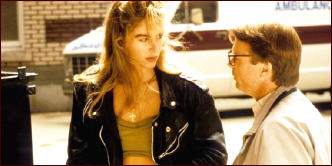
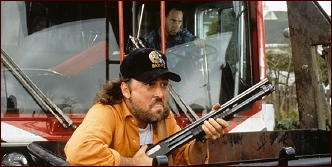
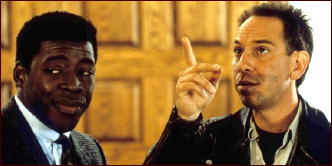
Cast: Miquel Ferrer as Beau Jack Bowman, Ernie Hudson as Toby Baker, Eileen Davidson as J. J. “Bullet” Tingreedes, Jay Johnson as Stanley Jones, Charlotte Lewis as Priscilla Mather. Guest Cast: Dietrich Bader as Chucky, Clint Carmichael as Joe, Lyle Alzado as Tommy Moran.

   In the voiceover opening, Chief Sterling (Don S. Davis) asks, “What do you do with a bunch of cops like these? One is a kleptomaniac. One is a compulsively violent ventriloquist. One is addicted to danger. And their leader is a transplanted Cajun who makes up his own rules as he goes along. What do you do with a bunch of cops like these?”

   If you answered, fire them or suspend them or give them desk jobs and take away their guns, you have a fine grasp of reality and would have had no chance of writing for Broken Badges.

   Instead the Captain answers, “Give them a psychiatrist and pray.”

BROKEN BADGES

   The episode “Chucky” tells the story of the naïve son of dirty ex-cop turned crime boss Tommy Moran. Chucky is more interested in Shakespearean theatre than his father’s business. Despite being a bad guy, Tommy is loved by his many friends on the police force. Of course our group has a different opinion of Tommy.

   Toby, the kleptomaniac cop, was responsible for Tommy getting kicked off the force. After Toby taunts Tommy to fight, in the middle of the police station, Tommy walks away and Toby threatens that he might be the one to put Tommy in the ground. I will pause here for you to regain consciousness from being hit over the head with foreshadowing.

   Joe, Tommy’s second in command, guns down Tommy and frames Toby (what a twist). Cops happily arrest their fellow cop. The next day there is a hearing and the Judge orders Toby to jail awaiting trail for murder.

BROKEN BADGES

   Our heroes bond and use their assignment of catching parking meter vandals as an excuse to roam the city, go undercover, and plant expensive surveillance equipment, all without any authorization. Now BFF with Chucky, who inherited Dad’s business, our group takes on the bad guys whose response is threatening to kill our heroes. Does that work? Yes. Until Beau puts a great gris gris on the bad guys. Spoiler – good guys win!

   If you can accept the premise that three cops on “psychological restriction” and a renegade Cajun (the best kind) are allowed to roam the streets solving crimes while armed, then your suspension of disbelief has been strengthen to Superman levels from years of watching mindless TV shows such as this one.

   Maybe you will find this funny. Maybe you will laugh instead of wince when ventriloquist Stanley has a violent fight with his dummy Officer Danny for half a minute of screen time and Danny knocks Stanley “out.”

BROKEN BADGES

   Miguel Ferrer as Beau the group’s Cajun leader and Ernie Hudson as the manic-depressive kleptomaniac Toby turn in fine performances, while the rest of the cast were unable to rise above the limitations of their characters and the series’ premise.

   Stephen J. Cannell is rightfully remembered as one of TV’s best producer/writer (Rockford Files, Wiseguy), but he often pushed the genre towards the odd (Greatest American Hero, Tenspeed and Brownshoe, A-Team).

   Sadly, Broken Badges was just one of a string of losers Cannell produced in the 1990s (his two success of the 90s were The Commish and the Rockford Files TV Movies). In the decade of Homicide: Life in the Street, NYPD Blue, and Law and Order, Cannell held on to the cheesiness of the 70s and 80s and produced such failures as The Hat Squad, Palace Guard, and Broken Badges.

   Granted, perhaps wisely, CBS never gave Broken Badges a real chance. The first episode (pilot) aired on the Saturday after Thanksgiving, three more episodes aired during the Holidays in December (“Chucky” ran the Saturday before Christmas), and the final three ran in June long after it had been cancelled.

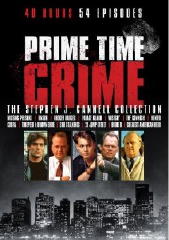
   The series is available on a DVD called Prime Time Crime: The Stephen J Cannell Collection. You can currently watch this episode (and others of the series) on YouTube in four parts, starting here.

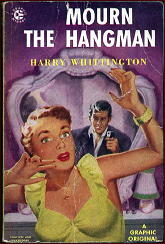
HARRY WHITTINGTON – Mourn the Hangman. Graphic #46, paperback original, 1952. Never reprinted.

HARRY WHITTINGTON Mourn the Hangman

   Throughout the 1950s into the mid-1960s, Harry Whittington was one of the most prolific paperback writers around, producing dozens of tough guy mysteries, westerns and noirish fiction in a period of time that was surprisingly short, when you look back upon it.

   When that line of work began to peter out, he switched to writing a total of nearly 200 semi-sleazy novels under a host of pen names. Ashley Carter was one of the better known of these, one which he used as a byline for a series of historical “plantation” novels in the 1970s.

   Mourn the Hangman was published early in his career, and while there is a strong overall narrative drive to the tale, the plot isn’t particularly well developed, crammed as it is with fast nonstop action, bursts of sudden violence, undeveloped characters and marred by occasional threadbare coincidences.

   It’s as if the story were packed in too tightly, so that it’s bursting at the seams and all but out of control. At nearly 190 pages of small print, it’s too long to be read in one sitting, but if you can manage it, that’s how I’d recommend you proceed, with your thought processes tampered down, perhaps, and your adrenaline cranked up high.

   Steve Blake is the leading character, a private eye whose estranged wife who’s returning to him is murdered early on, leaving the rest of the book little more than a catalog and travelogue of his trail of revenge.

   Not only is he caught between two powerful government contractors each accusing the other of industrial espionage, but the cops are hard on his trail, his partner in the PI business has sold him out, and a good-looking girl in the shabby hotel room next door, burdened with her own sadness, looks wistfully after him, not that he has time for her, because that’s not the kind of novel this is.

   If only he’d called the cops at the beginning, you might say, and I’d certainly echo that thought – but that’s not how novels like this work. Guys like Blake are largely muscle and guts and little grey matter upstairs.

   From the description you may have already decided whether or not you might enjoy this novel more than I did. My opinion is that Mourn the Hangman is part of a career in progress, a book written toward the beginning of his, flawed but with flashes of something better to come.

A Review by MIKE TOONEY:
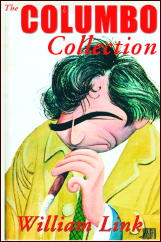

THE COLUMBO COLLECTION

WILLIAM LINK – The Columbo Collection. Crippen & Landru, hardcover/softcover, May 2010.

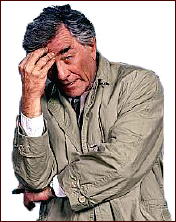
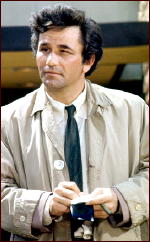
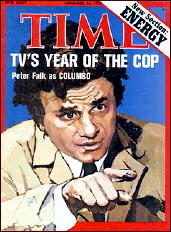
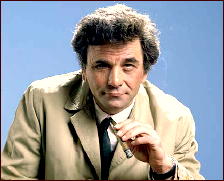
   Few television detectives are as iconic as Lieutenant Columbo of the Los Angeles Police Department. His mannerisms, his appearance, his methods — once you’ve seen him on TV, you’re not likely to forget Columbo.

   Those wonderful folks at Crippen & Landru — particularly Douglas Greene — over the years have been retrieving mystery ephemera that have been unjustly consigned to oblivion, as, for example, old radio scripts and short stories that often appeared only once and were inexplicably forgotten with their authors’ demise.

   With The Columbo Collection, however, C&L has persuaded a very much alive mystery master — William Link — to produce 12 new adventures featuring the always underestimated LAPD detective.

   For fans of the TV series, it’s like seeing a dozen new shows. (As with C&L’s reprints of Ellery Queen stories, in which you can’t help “hearing” and “seeing” Jim Hutton and David Wayne in your mind’s eye, so it is you’ll be “hearing” and “seeing” the peerless Peter Falk going through his paces.) But these “shows” can be “viewed” in 15 or 20 minutes, a mere fraction of the time the original series took.
THE COLUMBO COLLECTION

   Although the emphasis is always on the plot — a good thing in its own right — William Link does add the occasional literary flourish that shows he’s not entirely bound to the telegraphic style of TV. No, The Columbo Collection isn’t “Great Art,” but it is an awful lot of fun.

1. “The Criminal Criminal Attorney.”   A hotshot lawyer gets his client acquitted of a rape charge only to turn right around and murder him. Lieutenant Columbo must break the killer’s alibi and track down some incriminating physical evidence, as well as figure out the motive for the slaying, before he can close this case.

2. “Grief.”   A retired physician is out walking his dog when he is struck by a car and killed. Circumstantial evidence would seem to support the obvious conclusion that it was a simple hit-and-run, but Lieutenant Columbo’s “instincts” (his word) tell him otherwise. By the time he resolves this case, he will have grown to appreciate all the more the ancient expression, Cave canem.

3. “A Dish Best Served Cold.”   An Iraq War veteran apparently commits suicide, but Lieutenant Columbo has “second thoughts” (again, his words), especially about the missing fingerprints and gunpowder residue. As he says, “Sometimes you can be too careful when you plan and carry out murder.”
THE COLUMBO COLLECTION

4. “Ricochet.”   Columbo must overcome his fear of flying in the only way he knows how in order to visit New York City to follow up on a murder case. The problem is the prime suspect has an airtight alibi that places him 3,000 miles from the crime scene. Of course, people have been known to lie to protect others, but bullets drilled into a tree can only tell the truth.

5. “Scout’s Honor.”   In this one, the killer tries to help someone he loves by committing murder; but the irony is that he does too good a job of it and inadvertently ends up putting the person he wants to help squarely in the frame. Everything points to the wrong person being the killer, and from long experience Lieutenant Columbo knows that the physical evidence alone doesn’t tell the whole story.

6. “Sucker Punch.”   While they’re out jogging one morning, a professional boxer and his sparring partner are shot; one dies and the other is left in a coma. Columbo is called to Santa Clara to help with the investigation and discovers that his prime suspect lacks sufficient motive. If only he had dropped a bad habit, the real killer just might have gotten away with it. Even with 21st century forensics, it’s Columbo’s doggedness that nails the perp.

7. “The Blackest Mail.”   When a Hollywood starlet shoots a celebrity stalker to death, it looks like a case of self-defense — after all, he was carrying a knife. But Lieutenant Columbo senses there’s more to it, with little things that don’t quite compute, such as some missing money, a full tank of gas, that bullet in the garage door, and a few other discrepancies that point to blackmail rather than perverted love.
THE COLUMBO COLLECTION

8. “The Gun That Wasn’t.”   A police detective is executed, Mafia-style, in his own house. Another detective sets out in hot pursuit but fails to catch, or even see, the killer(s). Columbo is on the case from the start; gradually he uncovers evidence that leads him away from the Mob and straight to someone with whom he’s been on a first name basis for years. What tips him off are missing candlesticks, andirons, and a widescreen TV.

9. “Requiem for a Hitman.”   It’s all so simple: Hire a hitman to kill the old judge and then in a surprise ambush shoot the hitman just after he’s done the deed. Neat. Tidy. Economical. But there’s an unexpected kink in the plan: The hitman has a relative — and it’s really a shame because this person is one of the very few people in Lieutenant Columbo’s universe who doesn’t mind it when he lights up a cigar.

10. “Trance.”   Lieutenant Columbo and his niece are attending a police charity event and witness an amusing act featuring a hypnotist having fun mesmerizing two policemen. Later that evening, however, things take a serious turn when the hypnotist’s estranged wife is found dead in her apartment, and one of the officers who’d been hypnotized is discovered, dazed and confused, at the scene, making him the prime suspect. The noose tightens when it’s learned this particular cop had an ongoing, illicit relationship with the victim. But for Columbo this open-and-shut case isn’t so airtight, especially when he comes to consider the importance of that one little bead he finds in the closet….
THE COLUMBO COLLECTION

11. “Murder Allegro.”   A young and talented concert violinist is strangled in her hotel suite. From long experience Columbo is inclined to suspect the husband, but he has an ironclad alibi as well as no discernible motive to kill her. Columbo soon discovers that the husband was far from faithful to his wife.

   What finally clinches the case, however, is that charming Japanese custom of removing one’s footwear in indoor living spaces — and that seemingly trivial matter of a room key left inside a shoe.

12. “Photo Finish.”   When a woman discovers her husband has been having an affair with his “personal” secretary, she decides to issue a thirty-eight-caliber divorce decree. This woman scorned is quite intelligent, and it looks as if she just might get away with it — except for that flaky little cop who keeps asking uncomfortable questions — and that nosy next door neighbor — and that neglected copy of Business Week — and, most importantly, the fact that the camera does not lie. (This story — like several others in the collection — filters events through the consciousness of the killer, thereby slightly distancing the reader from Columbo and his thoughts.)
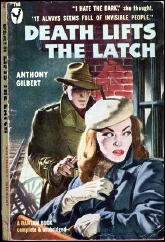
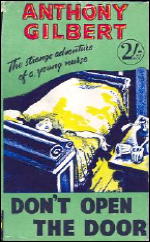
ANTHONY GILBERT – Death Lifts the Latch. Smith & Durrell, US, hardcover, 1946. Detective Book Club, hardcover reprint, 3-in-1 edition, March 1946. Bantam #768, paperback, April 1950. First published in the UK by Collins Crime Club as Don’t Open the Door, hardcover, 1945.

ANTHONY GILBERT Death Lifts the Latch

   Even though the war seems to be over when this Arthur Crook mystery novel takes place, it wasn’t long over; and even so, the tale has a tangible Victorian feel to it, beginning with the Chapter One, as nurse Nora Deane makes her way in the fog to her next assignment, that of a woman bedridden in her home.

   Helping her make her way through the gloom is a man with a friendly voice but a hidden face, who after leaving her at length at the doorstep, asks if he may stop by the next day and take her to lunch. The date is not to be, however, as during the night her patient dies, under strange circumstances, she confesses to the doctor who arrives too late.

   It is the husband, in cases like this, who is the most obvious suspect, an fact which takes Nurse Deane to the dead woman’s brother at the dead woman’s request the night before. I shall do something a reviewer should not do, and state right out that Nurse Deane is correct. The husband did it.

   But where does the story go from here? Well, go it does, and in directions that caught me flatfooted each step of the way. First the body of the husband is found in a deserted quarry, then the brother disappears. The man in the fog – whom we haven’t forgotten about, have we? – does his best to find Nurse Deane, who by this time has disappeared herself. Enter the notorious criminal lawyer Arthur Crook.

   I enjoyed this book. I enjoy being caught flat-footed, and I enjoy clever writing – a combo you don’t always get, even when start reading relics of books like this one. I was caught so flat-footed that what I thought was a serious flaw in the plot itself was a trap (of sorts) deliberately put in place by the author, whom I give full credit to as being more clever than I.

ANTHONY GILBERT Death Lifts the Latch

   And with that, I think I’ll conclude my comments here by quoting liberally from page 200. Nurse Deane’s second patient, a redoubtable Mrs. Trentham, whose son is a reporter who has a sizable role in solving the case (sort of, since Mr. Crook, who has no Mr. Watson to confide in as the case goes along, confides in no one, but who has all the answers) says to the replacement nurse:

   â€œ…the police and that extraordinary Mr. Crook are sitting by her [Miss Deane’s] bed night and day.”

   The new nurse sniffed. “Funny sort of hospital if they allow those goings-on.”

   â€œHe reminds me rather of Bulldog Drummond – Mr. Crook, I mean,” mused Miss Trentham.

   â€œI wouldn’t know,” said the nurse, proceeding on an assumption common to her kind that all people over seventy are senile and should be treated as such. “Before my time.”

   â€œI can’t imagine why you young women are so proud of being born so late,” said Mrs. Trentham sharply. “You missed a great deal.”

   â€œGoing to a better world than yours was,” said the nurse.

   â€œAnd you have us to thank for that….”

REVIEWED BY WALTER ALBERT:         


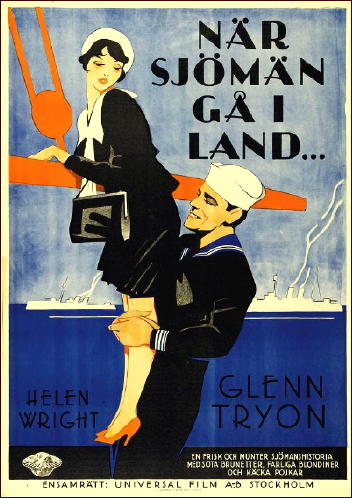
DAMES AHOY. Universal, 1930. Glenn Tryon, Helen Wright, Otis Harlan, Eddie Gribbon, Gertrude Astor. Director: William James Craft. Shown at Cinecon 39, Hollywood CA, Aug-Sept 2003.

   An early version of a situation so memorably later treated by Leonard Bernstein, Betty Comden and Adolph Green in On the Town (the effervescent stage musical, somewhat diminished in the MGM film).

   Tryon, Harlan and Gribbon are three sailors on weekend shore leave. Tryon and Gribbon promise to help Harlan find the conniving blonde who has swindled Harlan out of half his monthly pay as his wife and go to a dance hall where Harlan had met her.

   The problem is that he can only remember a distinctive tattoo and the boys spend much of the film trying to get into position to sneak a peek at the tattoo. During the search, Tryon is maneuvered into a short engagement and quick marriage in a dance contest, but he finds true love, Harlan locates his duplicitous blonde, and all three sailors seem headed toward domestic bliss at the end.

   A pleasant, low-keyed comedy.

DAMES AHOY


Editorial Comments:   Helen Wright’s movie career was a short one. According to one online source, she was an operatically trained singer with blue eyes and auburn hair. She made only one other film, Spurs, a western starring Hoot Gibson that was also released in 1930.

   And in case you were wondering, the tattoo (or birthmark; sources vary) was on her knee.

IT IS PURELY MY OPINION
Reviews by L. J. Roberts


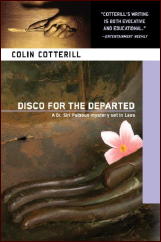
COLIN COTTERILL – Disco for the Departed. Quercus, UK, hardcover, 2006. Soho Crime, US, softcover, August 2007.

Genre:   Licensed Investigator/Paranormal. Leading character:  Dr. Siri Paiboun; 3rd in series. Setting:   Laos, 1977.

COLIN COTTERILL - Disco for the Departed

First Sentence:   Dr. Siri lay beneath the grimy mesh of the mosquito net watching the lizard’s third attempt.

   Dr. Siri and his associate, Nurse Dturi, have been sent to a “guest house” at revolutionary headquarters in the mountains of Huaphan province to attend a seminar intended to provide them with an “enlightened” understanding of the Marxist-Leninist system.

   What they did not expect was for an arm to be discovered rising out of a concrete path. The arm was attached to the body of a man who’d been encased in the concrete while still alive.

   Siri also did not expect, at 73, to find himself dancing to disco music only he could hear, nor for the Russian to whom Siri and Dturi reported back in Vientiane to ship their mortuary assistant, Geung off to Xieng Ngeim without their knowing.

   It is always a pleasure to be back with Dr. Siri and friends. They truly are some of my favorite characters and it was particularly nice to learn more of mortuary assistant Geung’s background.

   Cotterill works in an interesting point through Siri’s friend, Dr. Santiago who believes in shamans and the spirit world, that some form of shamanism is common to most cultures of the world outside those of European origin. Points such as that remind us the world is one filled with diverse philosophies and beliefs beyond our own; one of the gifts of reading.

   Cotterill’s writing is filled with wonderful dialogue and humor, yet he also makes me think. The supernatural element [Siri’s gift for conversing with the dead] is not present only for the sake of fantasy; Coterill uses it to serious purpose — to make a point such as the impact of war on its innocent victims; those who just happen to live in the wrong place. He also makes us aware that bigotry exists in every country.

   The story is one of relationships and loyalty. The mystery is an intriguing blend of the mystical and the plain, old ferreting-out of information. The book is an absolutely wonderful read.

BLACK MEMORY. Ambassador Bushey, UK, 1947. Michael Atkinson, Michael Medwin, Frank Hawkins, Winifred Melville, Jane Arden, Moyra O’Connell, Sydney James, Arthur Brander. Story, screenplay, assistant director: John Gilling. Director: Oswald Mitchell.

   I’ll go out on a short limb here and say that most of the names in the cast are as unknown to you as they were to me, unless you live in the UK. For several, it was one of their earliest appearances on film.

   It’s a very minor film, a crime drama, but on the other hand, what was the movie industry like in the UK in 1947? You will have to tell me, I’m sorry to say, but maybe making films this soon after the war was low on the list of the country’s priorities.

   The beginning is rather confusing. This is one of the movies in which the explanations come only as the film goes along, and good luck with that if you live in the US and British accents are sometimes decipherable and sometimes you don’t fare so well. A bigger problem, though, is that the copy I have of this rare film is not the best; the picture is somewhat faded and the sound had to be cranked up to ten.

   But given the luxury of watching the first 20 minutes or so of this film again, I took advantage of the chance I had, and I’m fairly certain I can tell you something about the story line.

   During a local disturbance of some sort (drunken louts egged on, perhaps) a man is killed, and another man who is actually innocent is arrested for the crime, tried, found guilty and hung. This takes up all of five minutes or so of running time.

   The son of the man found guilty, perhaps ten or twelve years old, is faced with a dying mother and a gang of local boys his own age who pick on him before they follow him off to a sort of orphanage/reform school, from which he quickly decamps through a open window. Another five minutes has passed.

   Ten years later, story time: The boy (now a young man) returns, takes a room with the family of his mother’s best friend. Of the two adopted daughters, one takes a shine to Danny (that’s his name), but the other, running with a tough crowd, takes up with Danny’s former tormenter, Johnnie Fletcher (Michael Medwin).

   To complicate matters, Johnnie has plans to rob the sewing factory where the two girls work. Assisting him – willingly or not – is one of the men on or near the scene where the murder took place ten years earlier.

   This was billed as a “noir” film when my copy was sold to me on DVD, and if the production values could only have been higher, it may have been a very effective vehicle in showing what life was like in postwar England for the lower classes.

   Unfortunately, it’s only in bits and pieces and occasional places that the plot rises above the purely pedestrian. If I were Leonard Maltin, the best I could give this movie would be 1½ stars out of five and I still think I’d be just a little bit generous if I did. Nonetheless, its historical significance is high, so I was glad to have had the opportunity to have seen it, and you may too.

THE BACKWARD REVIEWER
William F. Deeck


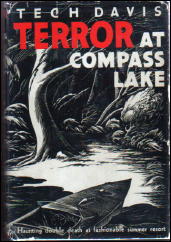
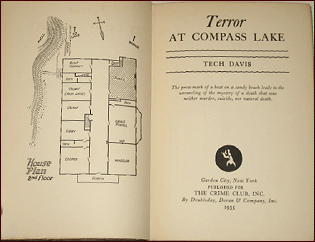
TECH DAVIS – Terror at Compass Lake. Doubleday Crime Club, hardcover, 1935.

TECH DAVIS

   Occasionally when I am on the fringes of a group of diehard mystery fans — which is about as close as they’ll let me get — the name Tech Davis is mentioned. Then when I am spotted, the subject is immediately changed.

   Why this happens I do not know. Oh, I know why I’m allowed only on the fringes; it’s their not wanting me to hear about Davis that baffles me. While Davis is not a good author; he isn’t an exceptionally bad one.

   His prose doesn’t elevate, indeed may be said to enervate. His detective, Aubrey Nash, is so bland that I wish he’d been given the one or two idiosyncrasies that I usually deplore in other fictional detectives whose creators can’t seem to make come alive. But he does plot well.

   In this novel, the first of three by Davis, Aubrey Nash is asked to come to the wilds of upstate New York to investigate the apparent suicide of a chauffeur — it must be suicide since everyone has a perfect alibi — and the later stabbing death of his employer in a locked room. Nash isn’t interested until he receives a telegram telling him the crime is insoluble and he shouldn’t waste his time with it.

   Recommended for locked-room fanciers, and other problem solvers.

— From The MYSTERY FANcier, Vol. 12, No. 4, Fall 1990.


TECH DAVIS Compass Lake


BIBLIOGRAPHY: Mystery fiction by TECH DAVIS, pen name of Edgar Davis (1890-1974). Series character: Aubrey Nash in all.

      Terror at Compass Lake. Doubleday, 1935.
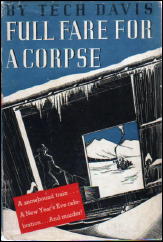
      Full Fare for a Corpse. Doubleday, 1937.

TECH DAVIS

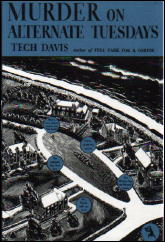
      Murder on Alternate Tuesdays. Doubleday, 1938.

TECH DAVIS


Editorial Comment:   Just in case anyone is tempted by Bill’s last line into putting together a complete set of all three Tech Davis mysteries, there are five copies of his books currently listed on ABE. Four of them are of Compass Lake, available at $75 and up, and there’s one of Full Fare, the latter having an asking price of a fairly solid $250.

   And not a single copy of Alternate Tuesdays.

UPDATE. 01-08-12.   Thanks to Bill Pronzini, I can now show you cover images for all three Tech Davis mysteries, in jacket.

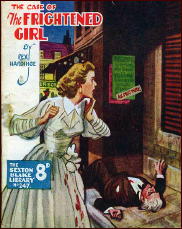
REX HARDINGE – The Case of the Frightened Girl. Sexton Blake Library #247. Paperback original. [Amalgamated Press, UK, 3rd series, September 1951.]

   The basic premise of this short novel, 64 pages of small type in a double-column format, was promising – in fact, more than promising, if “impossible crimes” are meat if not potatoes in your regular diet of detective fiction reading.

THE CASE OF THE FRIGHTENED GIRL Sexton Blake

   The girl in the title is Moira Leonard, a girl with a fabulous singing voice, but with a overbearing Svengali of a manager and singing instructor. After her public vocal debut, she cracks under the strain she’s been under and flees the music hall. Max Rosen follows her, argues with her, and ends up dead, stabbed in the back, with plenty of witnesses to say there she was the only one near their final (and fatal) confrontation.

   But when the body is examined there is no murder weapon to be found. The girl must have done it and taken the knife with her. Sexton Blake does not believe she did the deed, however, nor does his young assistant Tinker, especially the latter, even though she has disappeared, and into literal thin air.

   This takes us through the first eight or nine pages. We also learn that Ron Pearce, a would-be lover of Moira – they grew up together in the same orphanage – would have also had a motive, but the absence of the weapon clears him.

   So as I say, a promising premise, but once we learn that Pearce is the one responsible for kidnapping Moira, there is little more I need to tell you about the story.

   Rather than a detective story – until the end when the “how” is revealed – this is a thriller novel, and not a very good one. There is too much padding, too much recapitulation of the plot, and too much chase and too little suspense to give me little reason to recommend this to you, unless you’re curious about knowing what a Sexton Blake novel was like in the early 1950s. Or at least what this one was like, as I was.

   And oh, as for the “impossible crime” aspect? Totally mundane and not very believable at that. [See Comment #1 for more!]

« Previous PageNext Page »