Reviews


WE ARE ALL SENTIMENTALISTS NOW:
Leonard Cassuto’s Hard-Boiled Sentimentality:
The Secret History of American Crime Stories

by Curt J. Evans


   Over the last twenty years feminist literary scholars have leaped into the field of mystery criticism with great energy and enthusiasm; and they have had a remarkable impact on it. In Great Britain, such academic authorities as Gill Plain, Susan Rowland and Merja Makinen have written perceptive revisionist studies on British Golden Age “Crime Queens” (Agatha Christie, Dorothy L. Sayers, Margery Allingham and Ngaio Marsh), defending them from the traditional (usually male) criticism, dating back to Raymond Chandler and Edmund Wilson in the 1940s and prevalent through the early Marxist-influenced academic monographs of the 1970s, that their work is insipid, reactionary drivel, in contrast with the admirable, socially progressive and genre transcending American hard-boiled fiction most famously associated with Dashiell Hammett and Raymond Chandler himself.
CASSUTO Hard-Boiled Sentimentality

   This scholarly feminist emphasis on the Crime Queens, while important in revising earlier masculinist views of these authors, has led to the elevation of an increasingly commonplace view within academia, namely that the mystery genre in Britain during the Golden Age was essentially feminine, representing a purportedly distinct and uniquely female set of values, such as the privileging of feelings and intuitions over material detail (i.e., psychology over footprints and timetables), a preference for cerebration over fisticuffs as the way of reaching solutions to problems and an emphasis on domestic detail and the inter-connectedness of individuals. “All in all,” emphatically concludes Susan Rowland in a representative statement from a recent essay, “the golden age form is a feminized one.”

[Susan Rowland, “The ‘Classical’ Model of the Golden Age,” in Lee Horsley and Charles A. Rzepka, eds., A Companion to Crime Fiction (Wiley-Blackwell, 2010), 122.]

   Thus portrayed, “feminine” English Golden Age detective fiction starkly contrasts with the “masculine” hardboiled form that frequently has been taken to represent American detective fiction during this period (roughly 1920 to 1939) — though the critical estimation of English Golden Age detective fiction (or, to be more precise, the four women authors often portrayed as nearly entirely representing it) has been considerably raised.

   However, another feminist literary scholar — this time an American, Catherine Ross Nickerson — has pointed out in an important 1998 study, The Web of Iniquity: Early Detective Fiction by American Women, that detective fiction in the United States was not actually a strictly masculine preserve, a playground for the tough guys. Rather, Nickerson has shown, an indigenous American tradition of female-authored crime fiction existed well back into the nineteenth century.

   One of the writers she discusses, Mary Roberts Rinehart, was active and extremely popular in the United States all though the Golden Age (indeed, she was much more significant at this time than Raymond Chandler, who only published his first novel in 1939, at the very tail-end of the Golden Age, confining himself before that to pulp short stories).

   But although Professor Nickerson helped remind her academic colleagues that women mystery writers with their own narrative style and literary concerns not only existed but were much read in the United States in the 1920s and 1930s, it remained for Professor Leonard Cassuto to do something that no other academic had yet done: perceive the American hardboiled detective novel itself as feminized.

[Academic scholars continue to mostly overlook detective novelists in both the United States and Great Britain who did not write in the hardboiled style and were not women, but that is the subject for another essay!]

   Leonard Cassuto’s Hard-Boiled Sentimentality: The Secret History of American Crime Stories (Columbia University Press, 2008) is one of the most highly praised academic crime literature monographs of the last decade. “Superb…fresh insights on every page,” declares Alan Trachtenberg of Yale University.

   Not to be outdone is crime writer Julia Spencer-Fleming, who provides a blurb that is surely one to die for: “Hard-Boiled Sentimentality is a nonfiction epic that reads like the best genre fiction, tracing the bloodlines of crime fiction from Sam Spade to Hannibal Lecter. Cassuto’s scholarship is impeccable; his narrative voice magnetic. A must-read for every student of genre fiction and the go-to source for the evolutionary history of the genre.”

   Whew! Is it really as good as all that? In my view, not quite; though Cassuto makes an interesting (if not invariably persuasive) argument and his writing is comprehensible and refreshingly jargon-light, not something that can be said for many of the academic monographs in this field. Hard-Boiled Sentimentality often is quite insightful and for those interested in hardboiled fiction it should make rewarding reading.

[Despite the zealous claim that Hard-Boiled Sentimentality reads as grippingly as the best crime novels, sentences like “this refusal to speculate aligns Spade with some of the reformist political positions of the Progressive era” do not trip off the tongue. To be fair to Cassuto, however, I cannot recall any academic monograph that reads just like a crime novel.]

   Leonard Cassuto contends that rather than being “masculinist” tales of unfeeling lone tigers prowling in the asphalt jungle, hard-boiled novels in reality are closely related to women’s sentimental domestic fiction of the nineteenth century, which “celebrates the reliable and nourishing social ties that result when people extend their sympathy to others around them.”

   In Cassuto’s view, hard-boiled tales “engage with a domestic sentimentalism born of a specific historical period” and it is this “engagement with the nineteenth-century sentimental” that “shapes the history and evolution of the hard-boiled from its inception to the present day.” “Inside every crime story is a sentimental narrative that’s trying to come out,” declares Cassuto provocatively. “Sentimentalism invented the American crime novel.”

   Over the course of his study, which extends from the 1920s to the present day, Cassuto explicates the key role he sees sentimentalism as having played in the shaping of the American crime tale. Chapter One deals with the influence exercised on the hard-boiled school of crime writing by mainstream novelists Theodore Dreiser and Ernest Hemingway.

   Chapter Two looks at Dashiell Hammett. Relying on his reading of The Maltese Falcon (and to a lesser extent Red Harvest and The Dain Curse), Cassuto argues that Hammett portrays “sentimentalism in ruins: a world of self-interested individuals cut loose from family ties and family obligations, who have abandoned sympathy to chase the dollar.”

   However he emphasizes that in The Maltese Falcon tough-as-nails detective Sam Spade struggles between “self-interest and sympathy” and that in The Dain Curse the Continental Op “shows genuine concern for his young charge [Gabrielle Leggett].”

   Chapter Three sees Cassuto taking on “Depression Domesticity,” primarily through James M. Cain’s Mildred Pierce and Raymond Chandler’s The Big Sleep and The High Window.

   With its family saga of a deluded mother and her deceiving daughter, writes Cassuto, Mildred Pierce allows James M. Cain to bring “the sentimental and the hard-boiled into the same house.” It offers readers “the key to the hard-boiled engine-room.”

   Chandler’s detective Philip Marlowe, for his part, is in Cassuto’s view driven primarily by a need to put broken houses back together, restoring families to that portion of harmony still possible in 1930s America. As an author, asserts Cassuto, Chandler was “in quixotic pursuit of a family ideal that was being threatened during the Depression, when financial hardship broke many families apart.”

   Chapter Four, which takes us past World War Two and into the 1950s and the Cold War, sees Cassuto considerably expanding his analytical net, taking in a wider range of novels, including those by Chandler, Mickey Spillane, David Goodis, John D. MacDonald, William P. McGivern, Wade Miller, “John Evans” (Howard Browne), Gil Brewer and Cornell Woolrich.

   â€œWorking from the model provided by Raymond Chandler,” explains Cassuto, “postwar crimefighters become passionate and involved defenders of home and hearth.” Cold War paranoia and the desire to restore traditional gender roles after global conflagration had menaced world order combined to create the fetching but fearsome femme fatale, a creature in Cassuto’s view that is most notable for her refusal to accept what was seen as her natural role in the social order, that of domesticated wife and mother.

   â€œA veritable army of unpredictable femmes fatales, armed and dangerous and set to destroy home and community, swarms out of the crime stories of the 1950s,” Cassuto writes colorfully. He is especially interesting here on the hard-boiled novel’s treatment of lesbians and transsexuals, who represented the ultimate in “female” transgression.

   Even Cassuto’s creativity at finding sentimentality in every hard-boiled cavity he searches is stymied by those deviant and demented darlings of modern critics, Patricia Highsmith and Jim Thompson, however; and in Chapter Five, “Sentimental Perversion,” he shows how these compellingly idiosyncratic authors subversively undermined sentimentalism at every opportunity.

   To be sure, sentimentality makes a considerable comeback in Chapter Six, where Cassuto looks at the work of Ross Macdonald, John D. MacDonald and (to a much lesser extent) Robert B. Parker. Anyone familiar with Ross Macdonald’s novels knows they changed over time, as Macdonald shook off the influence of Chandler (who was quite cutting in his appraisal of the younger man’s work) and allowed his own personal preoccupations to take hold of his narratives.

   Making use of Tom Nolan’s fine biography of Macdonald, Cassuto is able to show how the author’s family problems meshed with the therapeutic culture of the 1960s to lead Macdonald to produce book after book on household dysfunction and the generation gap, with Macdonald’s series detective, Lew Archer, acting as a sort of family therapist (or as Cassuto writes, “a kind of walking vessel for collective guilt” and “an everyman of sympathy”).

   For Cassuto Ross Macdonald “stands as perhaps the most sentimental of all hard-boiled novelists because he understands family ties in the same way the sentimental writers did a century before him.” Similarly, Cassuto believes the robust if offbeat home life (aboard a Fort Lauderdale houseboat called the Busted Flush) of John D. MacDonald’s detective Travis McGee firmly affiliates this author’s work with the sentimental side of life, since his detective is not office-centered like Sam Spade and Philip Marlowe.

   Dealing with, respectively, female private eyes and race in the hard-boiled novel, Chapter Seven and Eight feel somewhat tacked on, but Cassuto returns in full force with a discussion of the serial killer and the crime novel in his monograph’s final chapter. Contrary to what we might think, serial killer novels also reflect sentimentalist hegemony, according to Cassuto. The serial killer should be understood as “an anti-family man,” Cassuto declares. “He is purely anti-sympathy, anti-domesticity, anti-sentimentality.” And opposing him is the increasingly sensitive and domesticated detective.

   At one point in his book, Cassuto forcefully criticizes scholars’ “static and stereotyped conception of hard-boiled masculinity.” He rightly notes that this conception has arisen to a great extent from ingenuous readings of Raymond Chandler’s polemical 1946 essay, “The Simple Art of Murder,” which stridently emphasizes the tough masculinity of hard-boiled heroes by “feminizing the genteel detective story tradition.”

   To be sure, other critics before Cassuto have discerned a certain amount of hollow chest-beating bravado in Chandler’s essay. The great centenarian scholar Jacques Barzun, for example, noted forty years ago in the introduction to his and Wendell Hertig Taylor’s A Catalogue of Crime (Harper & Row, 1971) that Chandler in notable ways was himself a “sentimental [emphasis added] tale spinner” (p.11), whatever claims he made to the contrary in “The Simple Art of Murder.”

   Still, in forcefully challenging the “static and stereotyped conception of hard-boiled masculinity” with his lengthy study Cassuto deserves our praise. Nevertheless, I think that his admirable zeal to revise error sometimes pushes Cassuto to overstate his case, rendering an over-sentimentalized (or overly-feminized) interpretation of the hard-boiled crime novel.

   Cassuto’s coverage of hard-boiled fiction in the 1920s, 1930s and 1940s is sparser than I would have expected from an author advancing such an ambitious, overarching thesis. A number of significant tough crime writers of the period are short-shrifted (Raoul Whitfield) or ignored entirely (Jonathan Latimer).

   Despite his fine discussion of Mildred Pierce, never does Cassuto convince me that James M. Cain’s admired novel truly is “the key to the hard-boiled engine room” (on the other hand, it is the work that most strongly supports his thesis). Does Mildred Pierce unlock Jonathan’s Latimer scabrously humorous The Lady in the Morgue (its repertoire includes necrophilia jokes about the lady missing from the morgue), for example?

   While Cassuto provides some analysis of how James M. Cain’s The Postman Always Rings Twice and Double Indemnity (as well as Horace McCoy’s They Shoot Horses, Don’t They?) fit into his thematic structure, he largely omits consideration of the short stories of Hammett and Chandler, as well as Hammett’s novels The Glass Key and The Thin Man and Chandler’s novels Farewell, My Lovely, The Lady in the Lake and The Little Sister. (Playback is not here either, but who can really complain about that.)

   These are significant omissions when one considers the small output of novels from the hard-boiled twin titans. In his entry on the novel in 1001 Midnights, Francis M. Nevins has written of The Glass Key that “its third-person narrative voice … is so objectively realistic and passionlessly impersonal that it seems to draw an impenetrable shield between character and reader.”

   Does Cassuto find sympathy in The Glass Key? In regard to Chandler, are his novels Farewell, My Lovely and The Lake in the Lake, published about the same time as The Big Sleep and The High Window, about Marlowe as a fixer of broken families? It would have been nice to see Cassuto’s thoughts on how these particular novels develop his themes.

[Bill Pronzini and Marcia Muller, eds., 1001 Midnights: The Aficionado’s Guide to Mystery and Detective Fiction (Arbor House, 1986), 335.
   In Hard-Boiled Sentimentality, Chandler’s The Big Sleep is discussed on a dozen pages, The High Window on a half-dozen and The Long Goodbye on three, while Farewell, My Lovely is mentioned once (and this only in reference to its 1940s sales) and The Lady in the Lake and The Little Sister no times at all.
   While doubtlessly The High Window better illustrates Cassuto’s sentimental domesticity thesis than, say, Farewell, My Lovely (where in my reading the strongest sentimental feelings are directed at single men), The High Window certainly is not inherently a more “important” book in the Chandler canon than Farewell, My Lovely. (Indeed, most critics clearly deem Farewell, My Lovely to be markedly superior to The High Window as a piece of literature.)
   Similarly, Cassuto discusses Hammett’s The Maltese Falcon on nearly thirty pages, Red Harvest on seven and The Dain Curse on six, while failing to mention the highly-praised The Glass Key. Certainly The Glass Key is considered a richer work than The Dain Curse, which is almost universally regarded as Hammett’s poorest novel.]

   Further, Cassuto’s attribution of causality for the way the narratives develop in the Hammett and Chandler novels he does write about sometimes is debatable. For example, Hammett’s vivid fictional world of grasping, self-interested and self-regarding individuals may owe more to the author’s engagement with Karl Marx than with Harriet Beecher Stowe.

   Similarly, it seems to me that much of the thematic content in Chandler’s novels is derived from his marked resentment (personal, not ideological) of the idly wealthy and his deep sense of masculine honor. In my view, Marlowe’s sympathy in The Big Sleep is reserved for old General Sternwood, not his corrupted daughters.

   Any repairing of the General’s home necessarily involves driving the insanely murderous and nymphomaniacal Carmen Sternwood from its precincts. (It is important to recall here the famous image of the stained-glass window in the Sternwood home depicting the knight battling the dragon, i.e., serpent — the serpent in the Sternwood home is Carmen, who even hisses at one point.)
   As the critic Clive James has perceptively noted, “Carmen is the first in a long line of little witches that runs right through the [Chandler] novels, just as her big sister, Vivian, is the first in a long line of rich bitches who find that Marlowe is the only thing money can’t buy.”

[Clive James, “Raymond Chandler,” in As of this Writing: The Essential Essays, 1968-2002 (W. W. Norton, 2003), 204.]

   Marlowe (who assuredly represents his creator) does not expend a lot of sentiment or sympathy either on the little witches or the rich bitches, those fallen temptresses and potential destroyers of men.

   Certainly Chandler’s little witches are those les belle dames sans merci of hardboiled mystery, the femmes fatales (they appear — quite memorably — in Farewell, My Lovely and The Lady in the Lake as well, novels Cassuto does not discuss).

   This fact alone leads me to question Cassuto’s assessment of the femme fatale primarily as a 1950s phenomenon. Cassuto himself admits that The Maltese Falcon offers a prominent example of the femme fatale, but the willful creature also rears her lovely head, as indicated above, numerous times in the works of Raymond Chandler, not to mention forties film noir, as well as other hard-boiled tales by the many 1940s writers not discussed by Cassuto.

   Surely the explosion of the femme fatale phenomenon in this period was set off in part simply by the paperback revolution and the dramatic discovery that more explicit sexualization of women helped sell hardboiled books to male readers. In his book Hard-Boiled America, Geoffrey O’Brien perceptively highlights the impact of World War 2 in this context:

   Wars in America have generally led to a relaxation of sexual censorship; for instance, the public acceptance of Penthouse and Hustler can probably be traced to the Vietnam War. Likewise the returning GIs of the 1940s craved stronger stuff than Betty Grable pinups…. With all the energy of an industry undergoing rapid development, the paperbacks — free of the constraints that hampered movies and radio — resolutely pushed the limits…. Encouraged by rising sales figures, [paperbacks] were no longer playing by the same rules (An illustrator whose career began in the postwar period recalls, “The word went out — get sex into it somehow.”)

[Geoffrey O’Brien, Hard-Boiled America (Da Capo Press, 1997) (expanded edition; originally published 1981).]

   In short, sometimes hardboiled fiction surely engaged more directly with sexuality than sentimentality. (Certainly the lurid paperback covers did.) In Chandler’s case, the continual resort to the device of the femme fatale appears to have arisen more out of personal issues than national social and economic concerns (as does the distaste for homosexuals Chandler expresses though Marlowe in The Big Sleep), so once again Cassuto’s approach (e.g., traditional family rhetoric and the Cold War made them do it) seems overly mechanistic.

   It should be noted that where it supports his thesis that a given hardboiled author is sentimental (Ross Macdonald in this case), Cassuto does resort in part to personal biography for answers as to why the author wrote as he did. Doing so makes his argument more persuasive (indeed, the Ross Macdonald section is one of the strongest in the book).

   Sometimes Cassuto can be heavy-handed in his approach to causal factors. Could The Maltese Falcon or The Big Sleep have come into existence without Adam Smith’s The Wealth of Nations, which observed the role self-interest played in guiding human endeavor, or his The Theory of Moral Sentiments, which analyzed sympathy?

    Apparently they could not have, according to Cassuto. “Adam Smith may be considered the founding father of both sympathy and the hard-boiled attitude at the same time,” Cassuto rather breezily pronounces. “Smith published perhaps the foundational hard-boiled text, The Wealth of Nations, in 1776…. But Smith was already an expert on sympathy at the time he wrote his anatomy of capitalistic individualism; in 1759 he wrote The Theory of Moral Sentiments.”

   Such speculation led me idly to wonder how it is that Adam Smith never wrote a hardboiled crime novel. Had he done so, it inevitably would have been called, one imagines, The Invisible Hand.

[If Adam Smith is the “founding father” of sympathy, where does Jesus Christ fit into the picture?]

   Despite these criticisms on my part, I think Cassuto has a valuable thesis overall. Academic analysts have tended to overly polarize male hard-boiled authors and female crime fiction writers (as well as traditional male detective novelists).

   Thus I would recommend the perusal of Hard-Boiled Sentimentality by those interested in better understanding crime fiction. Yet I must also add a few more criticisms of the book that are of a different nature, stemming from Professor Cassuto’s evident lack of familiarity with the history of the mystery genre on certain points. (He is by no means alone among academic scholars in this regard.)

   First, although he references Catherine Ross Nickerson’s The Web of Iniquity, rarely does Cassuto mention women crime writers before 1970 (Patricia Highsmith is the notable exception). In her review of Hard-Boiled Sentimentality, Sarah Weinman criticized Cassuto’s omission of Dorothy B. Hughes’ In a Lonely Place (1947) as “particularly startling” because “this novel seems to prove Cassuto’s thesis conclusively.”

[Sarah Weinman, “Sentimental Tough Guys,” Los Angeles Times, 17 October 2008. Since in a footnote Cassuto briefly refers to the author’s handling of a serial killer in In a Lonely Place, his failure to integrate the novel into the main body of his study clearly is deliberate, not inadvertent.]

   I understand that Cassuto presumably wanted to focus on male hard-boiled writers rather than female ones, because the response to the inclusion of such a writer as Dorothy B. Hughes might well have provoked the response, “of course she wrote with sympathy, she was a woman!”

   Yet the omission of so many women writers does leave a sort of vacuum on those occasions when the author makes rather sweeping statements. When Cassuto writes that the “male heroes of most fifties crime novels … assume the protective role that women played in sentimental fiction of the previous century,” I could not help wondering what was going on in the fifties crime novels written by women. (In the works of women writers of 1950s “psychological suspense,” for example, one cannot always be sure of those “male heroes.”)

   Second, Cassuto, like most academic literary scholars, perpetuates the myth that Raymond Chandler cared nothing for plotting. In doing so he ironically relies mostly on Chandler’s “The Simple Art of Murder” essay, though elsewhere, as noted above, he chastises other scholars for unquestioningly accepting it. (He also digs up the old chestnut about Chandler not knowing who killed the chauffeur in The Big Sleep when questioned by Howard Hawks and William Faulkner, who were adapting the book to film).

   Chandler “rejects the puzzle-whodunit because it’s unrealistic” and “turned away from the intricate plots of the likes of Ellery Queen and S. S. Van Dine because they’re too intellectual to activate the power of sympathy,” asserts Cassuto.

   In a 2006 article in the Wall Street Journal, Cassuto is even blunter on this matter. “Raymond Chandler was the rare mystery writer who didn’t care whodunit,” Cassuto peremptorily pronounces in the first sentence of the article. Near the end of it, he asserts that “Chandler’s artistic impulse turns on his rejection of the puzzle mystery.”

   Though Cassuto is hardly alone in diminishing Chandler’s interest in the puzzle mystery (indeed, both Chandler’s biographers do it), he is wrong in doing so. Chandler read and enjoyed the traditionalist British detective novelists R. Austin Freeman and Freeman Wills Crofts (though he hated the debonair gentleman sleuths of the British Crime Queens and thought Agatha Christie was unfair to the reader), envied the plotting skill of Perry Mason creator Erle Stanley Gardner and composed, in the same decade as he wrote “The Simple Art of Murder,” a set of rules for writing mystery fiction that in many respects is as orthodox as those famously devised by Englishman Ronald Knox.

   Further, for someone who purportedly “didn’t care whodunit” and rejected the puzzle mystery, Chandler perversely composed several well-plotted detective novels — praised by the orthodox critic Jacques Barzun — including Farewell, My Lovely, The High Window and The Lady in the Lake.

   To be sure, The Big Sleep, his first mystery novel, does have, as scholars so often note, its share of plotting problems (I have never been too sure about that pesky chauffeur’s demise either); but that does not take away from the fact that several of his other novels are impeccably plotted. Chandler found plotting hard to do and groused about doing it, but he never rejected it and he often performed it admirably.

[Leonard Cassuto, “The Hero is Hard-Boiled,” Wall Street Journal, 26 August 2006. In his critical study Raymond Chandler (Twyane, 1986), William Marling observes that Chandler’s novels after The Big Sleep reveal the author’s “increased attention to plot.”
   He notes that Chandler “often came close to the ‘whodunit’ style of English mystery….than he cared to admit” (p. 104). For more on this subject see my forthcoming essay, “‘The Amateur Detective Just Won’t Do’: The Straight Dope on Raymond Chandler and British Detective Fiction.”]

   Third, Cassuto misunderstands the economics of book publishing in the years before the consummation of the paperback revolution. In Hard-Boiled Sentimentality, Cassuto describes The Big Sleep‘s selling of 12,500 copies as a “rocky debut.” (In his Wall Street Journal article, he earlier characterized such a sale as “meager.”)

   Riffing off this point, he concludes that the novel did not “find an audience” until 1943, when it was published in paperback and sold nearly a half-million copies. But in actuality, hardcover sales of a mystery novel title totaling to 12,500 copies was quite impressive in that era, a time when frugal people mostly borrowed mystery fiction (as opposed to “serious literature”) from rental libraries.

   Since presumably libraries purchased a great many of those 12,500 books sold, many thousands more than that number would have read the book in the four years that elapsed before The Big Sleep was published in paperback.

   Finally, Cassuto’s references to the classical, puzzle-oriented detective novels of the Golden Age tend to be slighting and misinformed. Cassuto, who so forcefully critiques stereotype in the portrayal of hard-boiled fiction, tends himself to reach for stereotypes when using traditional detective fiction as a foil for the tough (yet tender) stuff.

   â€œHammett’s detective novels departed from genre tradition by presenting a story — and a set of social problems — unenclosed by a drawing room, a country estate, or any other discrete space,” writes Cassuto, relying on the well-worn but overstated notion that the narratives in traditional detective novels of the Golden Age are invariably confined within what are essentially enclosed stable spaces, usually country houses or villages.

   Elsewhere, Cassuto passingly declares that hard-boiled novels “supplanted” puzzle-oriented Golden Age mysteries. While admittedly it is true that the rise of the hard-boiled school was one of the factors that helped break the puzzle’s hegemony over Golden Age crime literature, when (or even whether) hard-boiled tales “supplanted” puzzle mysteries is another question.

   To state the most obvious example, the puzzle mysteries of Agatha Christie retain immense global popularity even today. Further, as stated above, the plots of many hardboiled novels in fact feature complicated puzzles. Novels like Raymond Chandler’s The Lady in the Lake or Jonathan Latimer’s The Dead Don’t Care have at their hard-boiled hearts fiendishly clever puzzle plots that would have graced even the diabolically ingenious tales of Agatha Christie and Ellery Queen.

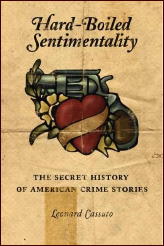
   All these matters aside, Cassuto has produced a worthwhile and interesting book. The splendid cover illustration of a steely gun and a beribboned red heart tells it all: the tough and the tender often manage to co-exist in the hardboiled novel.

   Although Cassuto at times over-tenderizes the tough crime tale and I am not convinced that his engagement-with-domestic-sentimentalism thesis is the master-key that unlocks the hardboiled engine room (however much it helps reveal to us Mildred Pierce), I personally found in Hard-Boiled Sentimentality many fascinating points to engage me.

REVIEWED BY DAN STUMPF:         


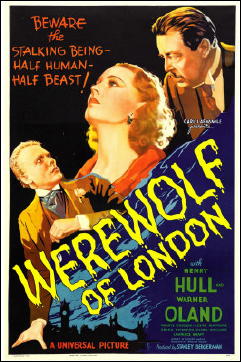
WEREWOLF OF LONDON

WEREWOLF OF LONDON. Universal Pictures, 1935. Henry Hull, Warner Oland, Valerie Hobson, Lester Matthews, Lawrence Grant, Spring Byington, Clark Williams. Director: Stuart Walker.

   The Wolf Man, one of Universal’s strongest monsters — probably the appeal to teenage boys of a conflicted being who finds his body changing and getting hairy as his emotions run wild — only got one film to himself, The Wolf Man (1941).

   For the rest of the run, he had to share the limelight with Frankenstein’s monster, Dracula and assorted mad doctors and hunchbacks, while second-string ghouls like the Creeper and Paula the Ape Woman got two or three films all to themselves and that lumbering bore Kharis got four. I guess there’s no justice for monsters.

   Actually, Universal kicked off the idea in ’35 with Werewolf of London, a flawed-but-interesting effort laboring under the weight of Henry Hull’s stodgy scientist-turned-boogey-man.

WEREWOLF OF LONDON

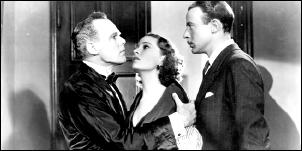
   Hull (to the left, on the left) was a dashing leading man on stage and played a fine string of crusty old-timers in the movies, but as a suffering monster he totally fails to grab our sympathy.

   That’s rare in a monster movie, because normally the monster is the most interesting character. Here, Hull is such a constipated dullard, we want something unpleasant to befall him, and lycanthropy seems like just the thing.

   Too bad, because this movie offers an interesting plot, some catchy dialogue, worthy special effects and camera work that lingers in the mind’s eye long after the silly story passes on.

WEREWOLF OF LONDON

GOING TO HELL IN A SAMPLES CASE:
JIM THOMPSON’S A HELL OF A WOMAN,
by Curt J. Evans


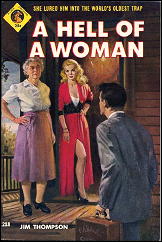
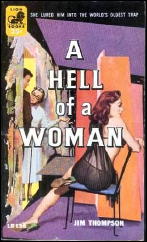
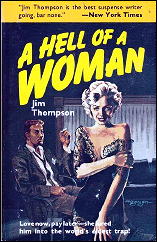
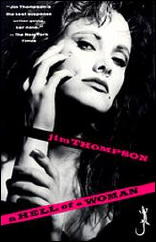
JIM THOMPSON – A Hell of a Woman. Lion #218, paperback original. Reprint editions include: Lion Library #138, pb, 1956; Black Lizard/Creative Arts #77, softcover, 1984; Vintage Books, softcover, 1990.

JIM THOMPSON Hell of a Woman

   In a comment following Dan Stumpf’s recent review of Jim Thompson’s Savage Night, I mentioned my dislike of Thompson’s influential novel (widely acknowledged as a genre masterpiece), The Killer Inside Me. I do not deny the artistry of this narrative of a deeply disturbed mind, but the brutality and viciousness of it all was quite off-putting to tenderhearted me.

   But I have persevered and finally read a second Thompson, another of his most-highly-regarded tales, A Hell of a Woman. And I am pleased to report that not only do I respect the artistry, I actually enjoyed the read this time — though the events described are nearly as lurid and depraved as those in The Killer Inside Me.

   Hell chronicles the fateful collision of salesman Frank “Dolly” Dillon with the household of a really quite nasty old lady and her niece, the sexy (and really quite stacked) Mona Farrell. The tight-fisted and not overly scrupulous aunt whores her daughter out to various men, you see, so that she need not pay cash to these men for services rendered.

JIM THOMPSON Hell of a Woman

   So if auntie wants some yard work done or hankers after a sparkly new set of flatware, say, the man who has such to offer is invited to visit Mona’s bedroom. If Mona doesn’t thereupon put out, Mona gets knocked about (auntie wields a mean cane at the age of about seventy).

   Dolly is married to Joyce, a woman he has tired of, and he is attracted to Mona, who he sees as essentially virginal and innocent and sweet, even though auntie has handed her over by now to the army, navy, air force and marines, figuratively speaking.

   Let’s let Dolly tell it in his own inimitable words:

    “I thought what a sweet kid that Mona was, and why I couldn’t have married her instead of a goddamn bag like Joyce.”

   Invited by such thoughts, murder comes to visit and makes itself at home….

   The plot, which also involves Dolly’s diddling of the accounts of the business for which he works, the Pay-E-Zee Stores (in its own way as nightmarish a concern as Old Lady Farrell’s house), is pleasingly intricate and actually took some twists and turns that surprised me.

JIM THOMPSON Hell of a Woman

   I came to realize A Hell of a Woman is less a crime story per se than a tale about the onset of criminal madness (which I think can be said about much of Thompson’s work). The progressive deterioration of Dolly’s mind, culminating in the famous split narrative conclusion, is fascinating, in its repugnant way (like the current Casey Anthony trial).

   I found Dolly less monstrous than the charming gentleman whose deeds are remorselessly chronicled by Thompson in The Killer Inside Me; yet Dolly, by golly, is no day at the beach or picnic on a Sunday afternoon. If you won a “Spend a Day with Dolly” contest, you’d be thinking twice about accepting the “prize,” if you get me.

   Here, for example, is Dolly as a restaurant critic:

    “I sat down in a booth, and the waitress shoved a menu in front of me. There wasn’t anything on it that sounded good, and anyway, one look at her and my stomach turned flipflops… Every goddamned restaurant I go to, it’s always the same way… They’ll have some old bag on the payroll — I figure they keep her locked up in the mop closet until they see me coming. And they’ll doll her up in the dirtiest goddamned apron they can find and smear that crappy red polish all over her fingernails, and everything about her is smeary and sloppy and smelly. And she’s the dame that always waits on me.”

JIM THOMPSON Hell of a Woman

   Dolly, one may come to realize, has women issues. In fact, though I never felt that the novel’s young women, Mona and Joyce, were as sufficiently-characterized as the men (some of the motivations seemed dubious or nebulous), this novel turns the whole noir femme fatale tradition on its pretty head, or so it seemed to me — though you would never guess this from the Vintage Crime/Black Lizard cover of the 1990 paperback edition.

   And the ending is something that has to be read to be believed. Freud would have loved to have been able to analyze it, I’m sure.

   The Black Lizard paperback edition also tells us that Hell is Thompson’s “homegrown version of Crime and Punishment.” I know Thompson has been called the “Dimestore Dostoevsky,” but it seems to me that he and the Russian are quite different personalities. Certainly it is difficult for me to glimpse redemption in the final hellish scene of Hell. Rather, it seems the grisly climax of the darkest nightmare.

   In short: Awfully impressive, but also impressively awful.

STORM IN A TEACUP Vivien Leigh

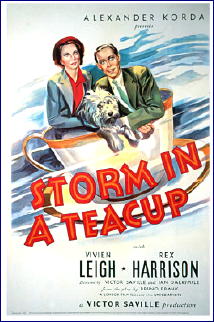
STORM IN A TEACUP. United Artists, UK/US, 1937. Vivien Leigh, Rex Harrison, Cecil Parker, Sara Allgood, Ursula Jeans, Gus McNaughton, Lee Strasberg. Based on the play Sturm im Wasserglas by Bruno Frank; author of the Anglo-Scottish version: James Bridie. Directors: Ian Dalrymple & Victor Saville.

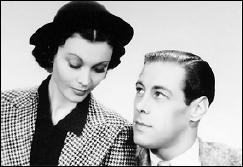
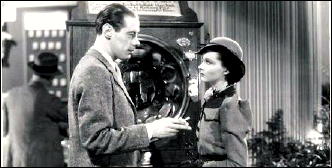
   Vivien Leigh is beautiful, almost exquisitely so, Rex Harrison is lean and lanky, with ever so often a wicked glint in his eyes. Other than Technicolor, what more could you possibly want in a movie?

   An English manor overflowing with dogs, you say, leashed as part of a protest against a Scottish provost who talks about the welfare of the little man but who sadly forgets when it is time to put it into practice – and hilariously so? ’Tis done, and more.

   Vivien Leigh is the good Provost’s daughter, and Rex Harrison is the roguish but idealistic young reporter from England who pokes a stick in the Provost’s spokes when the latter refuses to hear a plaintive plea from Mrs. Hegarty (Sara Allgood) for leniency.

STORM IN A TEACUP Vivien Leigh

   It seems the good lady has failed to pay a licensing fee for her mongrel dog Patsy, and it is off to the pound for the latter.

   Harrison’s subsequent newspaper story is the storm in a teacup that grows and grows from there. Complicating matters is that Harrison also has his eye on Vivien Leigh, and while she pretends otherwise, so does she, only vice versa.

   This is a good old-fashioned comedy, done English style, with plenty of wit, subtle and not so subtle – and not only that, but dignity under adversity and pressure: witness the Provost stalwartly leading his entourage straight through the mob of local townsfolk that was jeering him so rudely only moments before. This happens not very often in the US, where the back door is the more common way out.

STORM IN A TEACUP Vivien Leigh

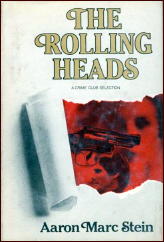
AARON MARC STEIN – The Rolling Heads. Doubleday Crime Club, hardcover, 1979. Hardcover reprint: Detective Book Club, 3-in-1 edition, July 1979.

AARON MARC STEIN The Rolling Heads

   It shouldn’t be revealing too much to say that the heads mentioned in the title are really of cabbages, but what they’re doing blocking a French highway will be left to stay part of the mystery.

   Matt Erridge, by occupation an engineer, finds a girl he’s delighted to take with him on a tour of French castles, but as it happens, she has a jealous boy friend, and the latter has kidnapping, if not murder, on his mind.

   Erridge knows his way around all parts of the world, and his adventures continue to keep Stein, his chronicler, busy at the typewriter. Even though a great deal of puzzled detective work takes place, this is still essentially an action story. No actual detection required.

Rating:   B minus.

— Reprinted from The MYSTERY FANcier, Vol. 3, No. 6, Nov/Dec 1979 (very slightly revised). This review also appeared earlier in the Hartford Courant.


[UPDATE] 06-05-11.   Besides being very prolific under his own name, Aaron Marc Stein also wrote many mysteries both as both George Bagby and Hampton Stone. Under any of the three names, he’s always been one of my favorite authors. If you use the search box somewhere here on the right, you’ll find many of his books already reviewed on this blog.

   I wish this particular review weren’t so short, but I was relatively new at the Courant at the time, and shorter reviews were all they wanted from me. Too bad. This review, well under 200 words, doesn’t remind me a whole lot about the book, just enough to make me want to read it again, the next time it surfaces.

THE CASES OF EDDIE DRAKE – PART ONE
A Review by Michael Shonk


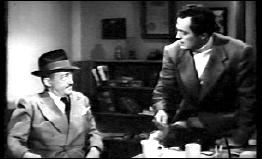
THE CASES OF EDDIE DRAKE. TV series. Thirteen 30 minute episodes. Created and written by Jason James (Jo Eisinger). Cast: Eddie Drake: Don Haggerty, Dr. Karen Gayle: Patricia Morison (nine episodes), Dr. Joan Wright: Lynne Roberts (four episodes), Lt. Walsh: Theodore Von Eltz. Produced by Harlan Thompson and Herbert L. Strock. Directed by Paul Garrison.

THE CASES OF EDDIE DRAKE

   Eddie Drake was your typical hardboiled PI of the time, from his attitude to his roving eye for anything in a skirt. Eddie shared the details of his cases with beautiful Dr. Karen Gayle, perhaps television’s first psychologist. She was writing a book about criminal behavior and wanted the point of view of a hardboiled PI. After nine episodes, Dr. Joan Wright replaced Dr. Gayle.

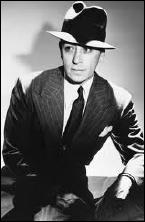
   The Cases of Eddie Drake began on radio as The Cases of Mr. Ace. George Raft was New York PI Eddie Ace who each week sat down and told Dr. Gayle about his latest case.

   Note that the film Mr. Ace (1946) starring George Raft as political kingmaker Eddie Ace had no connection to the radio series.

   The relationship between Ace/Drake and Doctor Gayle was different in the radio and television versions. On radio, Dr. Gayle makes it plain she is willing to get personal, while Ace has problems asking her out for dinner. On TV, Drake does everything but chase her around the desk.

   The body count was high for both Ace and Drake. Dr. Gayle once noted Eddie’s cases were full of “heaters and cadavers.” Of the three surviving radio stories, Eddie’s cases all ended in gunfire and nearly everyone dead.

   Behind both series was Jason James, Edgar award winner (with Bob Tallman for the radio series Adventures of Sam Spade in 1947). Heavily influenced by the writings of Dashiell Hammett, the scripts for Ace and Drake never came close to the quality of James’ work on Spade. But then, Raft and Haggerty were no Duff or Bogart.

——————————————————————————————————————————————————–

THE CASES OF EDDIE DRAKE

THE CASES OF MR. ACE. Radio. Syndicated. Aired June 4, 1947 through September 3, 1947 on WNEW-New York (*). Paragon Radio Production. 30 minutes. Cast: Eddie Ace: George Raft. Written, directed and produced by Jason James (Jo Eisinger).

“Key to a Booby Trap,” June 4, 1947 (aka “Key to Death”)
   Tough guy Ace meets Dr. Gayle and tells her about his latest case. A Frenchman confesses to Ace he killed a man who was bothering his wife. He pays Ace to give a key to his lawyer. The lawyer says the Frenchman is innocent, but his wife is eager to watch her husband die. When the key leads to more death, Ace wants to know why.

“Man Named Judas,” June 25, 1947 (aka “Lost Package”)
   Ace is hired to deliver a package but fails. When he returns, he finds the client dead. Then third-rate versions of Cairo and Gutman (Maltese Falcon) arrive wanting the last surviving Judas coin.

“Watch and the Music Box”
   Only the last half survives. Script was reused as the Eddie Drake episode, “Shoot The Works”.

——————————————————————————————————————————————————–

   One episode of Eddie Drake remains available to be viewed on the internet or DVD.

“Shoot the Works.” (First aired date unknown.)
   Drake tells Dr. Gayle about his recent case. A woman hires Drake to get her watch back. It had been stolen during a gambling club robbery where a man was killed. She had been with a man who was not her husband, and she is worried, if the police recover the watch, her husband will find out.
   Drake visits the club owner, a wild Russian “Prince” who is desperate for Drake to find the woman he loves, a woman he has only seen on a nickel peep show. The bodies begin to pile up when the thief arranges to sell the watch to Drake.
   After the story, Eddie takes the beautiful Doctor out for drinks. There the actors break character and tell the audience the episode’s credits.

   Much like other syndicated TV Film programs of the time, Eddie Drake was nothing special beyond mildly entertaining. Eddie was a character who was interchangeable with the countless other hardboiled PIs of the time.

THE CASES OF EDDIE DRAKE

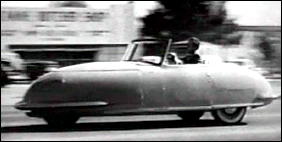
   The creative idea of a psychologist using the point of view of a hardboiled PI for a book about criminal behavior was wasted as a weak framing device to tell typical hardboiled mysteries. The acting was professional but average, never adding anything new or of depth to the characters or stories. The only truly unforgettable part of Eddie Drake was “Dave,” Eddie’s new car, a three-wheel 1948 Davis Divan.

   Which leads us to Part Two, coming soon: “The Mysteries of the Making of The Cases of Eddie Drake.”

   Common knowledge about the TV series today is that CBS filmed nine episodes in 1949 and then never aired it. DuMont is supposed to have filmed the final four episodes and broadcast all thirteen in the period from March 6 to May 29, 1952. Before that, according to one source, NBC aired the series between June 4, 1951 through August 27, 1951 (13 weeks).

   Did CBS shelve the series for three years? Why did Lynne Roberts replace Patricia Morison after nine episodes? Why would DuMont film the final four episodes then wait six months to show it? When did Eddie Drake first air, 1949 or 1951? How much of what is currently believed about this series wrong?

      SOURCES:

Billboard archives available for free reading at Google e-bookstore.

Episodes of The Cases of Eddie Ace are available to listen to at various sites on the internet. I did my listening at Internet Archives (archive.org)

(*) New York Times radio logs can be found at www.jjonz.us/RadioLogs

The television episode Shoot the Works is also available around the internet and on DVD, Best of TV Detectives – 150 episodes. I watched it at Internet Archives and Classic Television Archives (which also has an episode log).

http://www.archive.org/details/The CasesOf EddieDrake-ShootTheWorks1949

http://ctva.biz/US/Crime/EddieDrake.htm

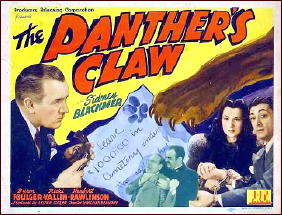
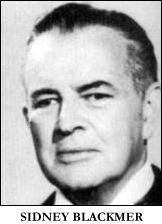
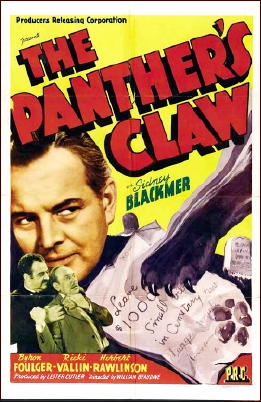
THE PANTHER’S CLAW. Producers Releasing Corp. (PRC), 1942. Sidney Blackmer (Police Commissioner Thatcher Colt), Ricki Vallin (Anthony “Tony” Abbot), Byron Foulger, Herbert Rawlinson, Barry Bernard, Gerta Rozan, Joaquin Edwards. Based on a story by Anthony Abbot (Fulton Oursler). Director: William Beaudine.

THE PANTHER'S CLAW Thatcher Colt

   Thatcher Colt was a character who appeared in a number of detective novels by Anthony Abbot in the 1930s and early 40s, beginning with About the Murder of Geraldine Foster in 1930. According to IMDB, though, The Panther’s Claw was based on the short story “The Perfect Crime of Mr. Digberry.”

   On the other hand, the American Film Institute says it was based on the story “Shake Hands with Murder.” But since Mr. Digberry is definitely a character in Panther’s Claw, and Shake Hands with Murder is a totally different (non-Thatcher Colt) film made by PRC in 1944, we’ll say IMDB has the advantage here.

   There were two earlier film adaptations of Thatcher Colt novels, both of them with Adolphe Menjou in the starring role: The Night Club Lady (1932) and The Circus Queen Lady (1933).

THE PANTHER'S CLAW Thatcher Colt

   I’ve seen neither of these, but I think the solid, mostly no-nonsense acting of Sidney Blackmer fits the role of the definitely hands-on police commissioner better. In fact AFI states that Panther’s Claw was intended to be the first in a series. If so, the plans did not work out, as there never was a follow-up.

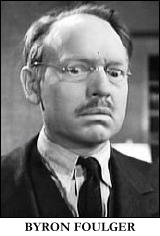
   Blackmer was the leading man, with top billing and all that goes with it, but believe it or not, it was Byron Foulger, the unlikeliest of movie stars, who gets the majority of the screen time. He plays Mr. Digberry, a mild, meek, milquetoast of a man (meaning that Foulger was perfect for the part) with a 180 pound wife and five daughters. (They’re out of town, though, throughout the movie. We only get to see Digberry’s reaction whenever he realizes that they’ll be back soon.)

THE PANTHER'S CLAW Thatcher Colt

   We see first meet Digberry as he’s being caught by the cops sneaking out of a city cemetery at night. It seems he’s received a note that requested he leave $1000 on a gravestone, signed by “The Panther” along with a paw print in ink at the bottom.

   The cops get a big chuckle out of this, as well as the audience, even though Digberry is not the only one to have received such a message. There is more to the case, though, as the “Panther” portion of which is quickly solved, and as it happens, there are more strings to the bow of the greatly bewildered and befuddled Mr. Digberry than first meets the eye.

   There is a murder to be solved, in other words, that of a female opera singer … and I won’t tell you more, but there is a lot more plot in this 70 minute movie than there is in a many a present-day double-the-running-time extravaganza with lots of action and special effects, none of which are present here. The Panther’s Claw was produced on what is obviously a bare-bones budget.

   While the movie’s still running, it is difficult to follow the business of the wigs and the rival wigmakers, or how important it is, but it all makes sense in the end. At least I think so. Overall this film makes for a very enjoyable viewing experience, in my moderately humble opinion. I also imagine there is more humor to be found in the movie than in the short story, based primarily on Foulger’s performance, but I suppose I could be wrong about that.

THE PANTHER'S CLAW Thatcher Colt

REVIEWED BY DAN STUMPF:         


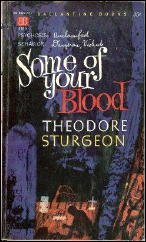
THEODORE STURGEON Some of Your Blood

THEODORE STURGEON – Some of Your Blood. Ballantine 458K, paperback original, 1961. Reprinted several times.

   Speaking of tough, fast and scary, following my review of Jim Thompson’s Savage Night, I revisited Theodore Sturgeon’s Some of Your Blood, which has all that and is also by way of being one of the most compassionate books I’ve ever read.

   The tale of a bloodsucking freak is told as a psychological detective story, with an overworked Army shrink trying to delve into the psyche of a likable but mysterious GI, “George” whose personal correspondence is the catalyst of the case. Along the way we uncover serial killings and some other things not suitable for a family show, but Sturgeon never loses sympathy for “George” and the result is a uniquely chilling and memorable story.

ROUND ROBIN MURDERS:
The Floating Admiral (1931) and Double Death (1939)
by Curt J. Evans


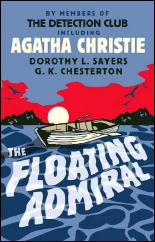
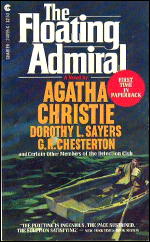
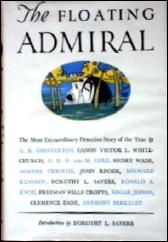
   In its ongoing attempt seemingly to wring every last pound of profit out of the Agatha Christie literary estate, HarperCollins has recently reprinted The Floating Admiral, the collaborative detective novel (originally published in 1931) by fourteen members of the then recently formed Detection Club (each writing a successive chapter).

THE FLOATING ADMIRAL

   Although Agatha Christie’s contribution is a chapter of eight pages (in my 1979 Gregg Press edition) — 3% of the book — she gets top billing, with only Dorothy L. Sayers and G. K. Chesterton (the latter of whom contributed, by his own admission, a strictly ornamental prologue of five pages) also being mentioned by name, in much smaller letters. Such are the publishing perks of fame and continued books sales!

   To my mind, the detective novel, requiring as it does the most scrupulous planning, is not really a form that is receptive to “round robin” treatment. Case in point: The Floating Admiral. Overloaded with complications from too many eager hands, the tale in my opinion begins to take on water and sink well before reaching its conclusion (tellingly entitled by Anthony Berkeley, “Cleaning Up the Mess”).

   Nevertheless, if one is interested in authors of Golden Age detective fiction, The Floating Admiral is in many ways quite interesting, whatever its artistic failings.

   Things go pretty well for the first five chapters (written by Canon Victor L. Whitechurch, G.D.H. and Margaret Cole, Henry Wade, Agatha Christie and John Rhode), with the authors refraining from over-elaboration. Unfortunately the calmly floating boat is upset by water violently churned by Milward Kennedy (his chapter, which follows Rhode’s “Inspector Rudge Begins to Form a Theory” is impertinently entitled “Inspector Rudge Thinks Better of It” — the good Inspector should not have).

   Dorothy L. Sayers tries to straighten everything out that had tangled with a thirty-seven page chapter but she only makes things worse.

THE FLOATING ADMIRAL

   Ronald A. Knox’s chapter, “Thirty-Nine Articles of Doubt” (Chapter Eight) warningly raises thirty-nine problematical points that have accumulated for the authors following him to consider and Freeman Wills Crofts in Chapter Nine politely notes that, among other things, the body (allegedly of the admiral of course) was never adequately identified or an inquest arranged. But all to little avail.

   Clemence Dane complains in her notes to her Chapter Eleven, the penultimate chapter, that the mystery has become “quite inexplicable to me” — and she likely has not been alone in that sentiment over the years.

   Anthony Berkeley’s conclusion has been praised heartily by over-generous critics. I deem more like the curate’ egg — good in spots but essentially rotten. But to be fair to the poor fellow, he was handed the devil of a job.

   The fun for me in reading The Floating Admiral is not in reading a cogently plotted detective novel (it simply isn’t one), but in seeing the narrative approach each author takes in his/her chapter:

    ●   G. K. Chesterton writes rich prose.

    ●   Canon Whitechurch introduces a charming vicar.

    ●   Henry Wade develops appealing and credible relationships among his policemen.

    ●   Out of the blue, Agatha Christie introduces a garrulous, gossipy lady innkeeper.

    ●   John Rhode discusses tidal movements (the admiral was floating after all) and sympathetically expands the role of the retired petty officer, Neddy Ware.

    ●   Milward Kennedy overcomplicates the story, as does Dorothy L. Sayers (the ingenious Sayers should have been given the opening chapter — she and Kennedy both clearly wanted it).

    ●   Ronald A. Knox makes a long list.

    ●   Freeman Wills Crofts checks alibis and has his inspector travel by train.

    ●   In his notes to his chapter, Knox amusingly declares, “I once laid it down that no Chinaman should appear in a detective story. I feel inclined to extend the rule so as to apply to residents in China. It appears that Admiral Penistone, Sir W. Denny, Walter Fitzgerald, Ware and Holland are all intimate with China, which seems overdoing it.”

THE FLOATING ADMIRAL

   In her recent Guardian review of the new edition of The Floating Admiral, Laura Wilson deems Agatha Christie proposed solution for the tale “as you would expect, the most ingenious” of all the solutions. Certainly it’s more tricksy than, say, the solution proffered by John Rhode (without a complicated murder means, Rhode is unable to play to his greatest strength here). It’s also absolutely absurd.

   Here’s how Christie envisioned the state of affairs in the Admiral’s household     (*** SPOILER *** to Christie’s proposed solution follows, obviously):

   The Admiral’s niece is really his Uncle’s nephew masquerading as the niece. He has been doing this in his Uncle’s household for weeks, and is able to get away with it because he “has been an actor at one time” (that Golden Age crutch for the unlikely accomplishment of great disguises) and because the Admiral has not seen the niece since she was a child (he has seen the nephew more recently, however). The servants are fooled as well, as are the various beaux of the neighborhood, whom the nephew “takes an artistic pleasure” in vamping.     (*** END SPOILER ***)

   Ingenious or rather ridiculous? You decide for yourself, but I know what I think.

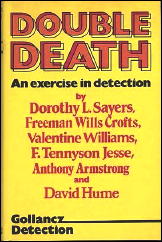
   On the whole, I much preferred Double Death, a round robin novel with chapters by Dorothy L. Sayers, Freeman Wills Crofts, Valentine Williams, F. Tennyson Jesse, Anthony Armstrong and David Hume that originally appeared in the Sunday Chronicle in (I believe) 1936 and was published in book form by Victor Gollancz.

   It is often stated to be a Detection Club production, but I do not see how this could be, since only two of the six writers, Sayers and Crofts, were members of the Detection Club.

   In her introductory chapter to Double Death, Sayers sets up a compelling possible domestic poisoning situation, followed by a death at a railway station, at the evocatively named town of Creepe.

THE FLOATING ADMIRAL

   Freeman Wills Crofts embroiders on this opening situation ably (he even provides a stunning map of Creepe and Creepe station), as does Valentine Williams, though the latter is more known for his “Clubfoot” thrillers than his (underrated) detective novels. Unfortunately the later authors are less concerned with cluing, so that as a fair play mystery the tale ends up rather a bust (especially if you read the silly prologue, added later).

   However, the writing and overall emotional situation remains compelling throughout Double Death, thus making the tale more of a success than the The Floating Admiral.

   It’s interesting to note that in Double Death, written in the mid-thirties, all the authors are concerned with maintaining love interest; whereas in The Floating Admiral all the characters are sticks in whom one could not be expected take the slightest interest (well, there’s the vamping transvestite nephew, as envisioned by Christie).

   As the 1930s progressed, the Golden Age detective novel began to put more emphasis on emotional situations and less on ratiocination. In the end, it is this shift in emphasis that makes Double Death more interesting than The Floating Admiral, in my view. Admiral depends for artistic success on detection and too many hands on deck sink the craft.

   Yet with less than half the people involved, Double Death might have managed to work as a true fair play detective novel. Certainly Sayers, Crofts and to a lesser extent Valentine Williams made an admirable start of it.

   I rather wish the novel could have been kept a collaboration simply of two: Sayers and Crofts. The two authors corresponded over the opening chapter of Double Death in the spring of 1936, with Sayers requesting and Crofts supplying pertinent points of railway station detail.

   Sayers had already written her railway timetable novel The Five Red Herrings (1931) as a sort of homage to Crofts’ Sir John Magill’s Last Journey (1930) — these two brilliant books continue to stand today as the ne plus ultra of railway timetable mysteries. Double Death in their hands might well have been a classic product of the Golden Age. As it is, it is still a good read.

REVIEWED BY WALTER ALBERT:         


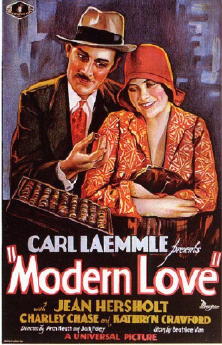
MODERN LOVE. Universal, 1929. Charley Chase, Kathryn Crawford, Jean Hersholt, Anita Garvin. Screenplay by Albert DeMond and Beatrice Van. Director: Arch Heath. Shown at Cinecon 44, Hollywood CA, Aug-Sept 2008.

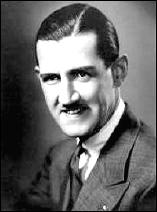
CHARLEY CHASE

   Long considered to be a lost film, but “recovered” by researchers at Universal, this Charley Chase feature was filmed during the transition from silent to sound and includes silent episodes with intertitles, interspersed with some talking sequences.

   In this modern comedy of manners, Charley’s young wife (Kathryn Crawford) is forced to keep her marriage a secret to hold on to her job. When a client (Jean Hersholt) arrives from France, Crawford is obliged to give a dinner party, with Charley serving the meal.

   This extended sequence is the comic highlight of the film, with Hersholt, unfamiliar with American table manners, willingly following Charley’s lead at using what he imagines to be proper etiquette. The other guests, not wanting to embarrass Hersholt, imitate his bizarre performance to Crawford’s consternation and Charley’s barely concealed delight.

   Charley gives a charming performance, nicely supported by Crawford, and if the film lacks the inspired playfulness of his best shorts, it’s still a very entertaining demonstration of Charley’s comic skills.

CHARLEY CHASE

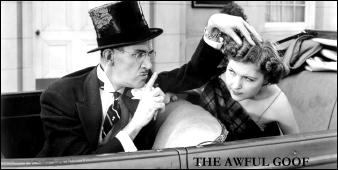
   Another rare Chase film was screened during the weekend, The Awful Goof (Columbia, 1939), the first of four shorts that completed Charley’s contract at Columbia.

   This is one of those marital comedies at which Charley excelled, which often consisted of two married couples involved in misunderstandings that put Charley on the receiving end of some unwelcome attentions from a husband who suspects him of playing around with his wife.

   This short was, in part, a remake of a classic short, Limousine Love (1928), and not a very successful one. The audience loved the short, while I found it a sad reflection of past glories.

CHARLEY CHASE

« Previous PageNext Page »