Reviews


THE BACKWARD REVIEWER
William F. Deeck


VALENTINE WILLIAMS Mr. Treadgold

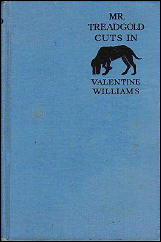
VALENTINE WILLIAMS – The Curiosity of Mr. Treadgold. Houghton Mifflin, US, hardcover, 1937; Grosset & Dunlap, US, hc reprint, no date stated. Hodder & Stoughton, UK, hc, 1937, as Mr. Treadgold Cuts In.

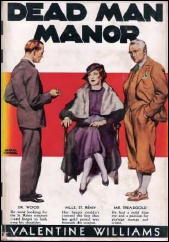
   Following up on his success in Quebec in investigating what were known as “the Saint Fiorentin murders,” chronicled in Williams’s Dead Man Manor, H. B. Treadgold, head of Bowl, Treadgold, and Flack, bespoke tailors of Savile Row, London, and East Fiftieth Street, New York, continues dabbling in crime investigation by solving ten cases of theft, blackmail, or murder.

    “In Tristram Shandy [from which Treadgold quotes on all occasions], as I’m sure you’ll recollect, it says that body and mind are like a jerkin and its lining: rumple one and you rumple the other. Ill-fitting clothes mean an ill-fitting mind: which is rather a roundabout way of saying that a tailor who takes any pride in his job has to be a bit of a psychologist.”

   The cases here are not fair play, by any means, but that does not make them any the less enjoyable. Treadgold is a capable detective and an interesting character.

— From The MYSTERY FANcier, Vol. 11, No. 4, Fall 1989.


  Editorial Comment:   Bill’s review is too short, alas, to learn very much about the stories themselves, but it’s certainly long enough to be intriguing. There’s no question that Valentine Williams falls into the category of a Forgotten Writer, but if you’d like to know more, there’s a long essay about him on Mike Grost’s Classic Mystery and Detection website. Recommended!

The Mr. Horace B. Threadgold books

      Dead Man Manor. Hodder 1936.    [novel]

VALENTINE WILLIAMS Mr. Treadgold

      Mr. Treadgold Cuts In. Hodder 1937; published in the US as The Curiosity of Mr. Treadgold.    [story collection]
      Skeleton Out of the Cupboard. Hodder 1946.   [novel; no US edition]

IT IS PURELY MY OPINION
Reviews by L. J. Roberts


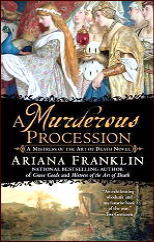
ARIANA FRANKLIN – A Murderous Procession. G. P. Putnam’s Sons, hardcover, April 2010. Published in the UK as The Assassin’s Prayer: Bantam Press, hardcover, July 2010.

Genre:   Historical mystery. Leading character:  Adelia Aguilar; 4th in series. Setting:   France/Italy; Middle Ages/1179.

ARIANA FRANKLIN

First Sentence:   Between the parishes of Shepfold and Martlake in Somerset existed an area of no-man’s-land and a lot of ill feeling.

    Dr. Adelia Aguilar is thrilled to learn Henry II wants to send her to accompany his daughter Joanna’s wedding procession to her home of Sicily. Her feelings change to anger when she learns Henry is keeping Adelia’s daughter in England to ensure Adelia’s return.

   With them, and well concealed, will be Arthur’s sword, Excalibur, as a gift to the bridegroom. Danger a rises from an old foe out to steal the sword and looking for revenge against Adelia.

   There was a different feel to this book than those previous. Whereas before, Adelia seemed very much in control and strong, here she was in situations completely beyond her control and, at times, in great peril.

   While some readers might not care for the change this wrought in the character, I liked that it showed her vulnerability and weaknesses, as well as the human failing that when the truth is too frightening to accept, it is denied.

   There is a progression in the lives of the characters with each book, which is important to me. Some readers have criticized the coup de foudre felt by the Irish sea captain O’Donnell for Adelia. Having personally experienced it — although it didn’t last — I didn’t find it unrealistic. I did enjoy that we meet Adelia’s parents in this book.

   As always with Franklin’s books, I learn so much history. Henry’s daughter, Joan, was known to me, but not in any detail nor her role in history. Of late, I’ve read more books that deal with the Cathers, and I find them fascinating. I certainly knew nothing of the history of Sicily and found it significant that she shows it to us at a turning point in its history.

   Perhaps I’m obtuse, but I did not figure out the identity taken by the villain until it was revealed. What I did not like was the ending. It seems more authors are doing cliff-hanger endings and it’s a trend I dearly hope will end almost immediately. Write a good book, I promise to read the next one without being tricked into so doing.

   I very much enjoyed the story and only the ending prevented my rating it as “excellent.” For readers new to the series, I recommend starting at the beginning. For me, I am ready for the next book.

Rating:   Very Good Plus.

      The “Mistress of the Art of Death” series:    [Adelia Aguilar is the world’s first female anatomist/medical examiner.]

1. The Mistress of the Art of Death (2007)
2. The Serpent’s Tale (2008) aka The Death Maze

ARIANA FRANKLIN

3. Relics of the Dead (2009) aka Grave Goods

ARIANA FRANKLIN

4. A Murderous Procession (2010) aka The Assassin’s Prayer

REVIEWED BY TINA KARELSON:         


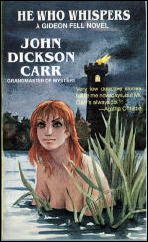
JOHN DICKSON CARR – He Who Whispers. Harper & Brothers, US, hardcover, 1946. UK edition: Hamish Hamilton, hc, 1946. Reprinted many times, in both hardcover and paperback, including International Polygonics, 1986. (Cover art: Roger Roth.)

JOHN DICKSON CARR He Who Whispers

   Gideon Fell is amusingly absent-minded in this eerily atmospheric novel set in London in the immediate aftermath of the Second World War:

    “Waterloo, its curving acre of iron-girdered roof still darkened over except where a few patches of glass remained after the shake of bombs, had got over most of the Saturday rush to Bournemouth.”

   This description of the iconic London railway station is the height of the book’s achievement. The solution to the murder, which took place in pre-war France, is also very clever, and there’s a well-made philosophical point to the story about how easily facts can be interpreted differently depending on how one wants — or has been influenced — to see them.

   Unfortunately, melodrama and coincidence dominate these finer points. And the psychological point of view is so absurd it must have been ridiculed even when in vogue. A ladylike female character’s fate is tragic because she “had to have men.”

   This continues on page 136 with, “In women so constituted — there are not a great number of them, but they do appear in consulting rooms —the result does not always end in actual disaster…” The murderer is neurotic and weak, dominated by his father, and at the same time terribly clever and cruel.

   Whatever the clinical facts of nymphomania and neurosis, they’re overblown here to a degree that undermines the narrative.

REVIEWED BY MICHAEL SHONK:


GREGORY MCDONALD Fletch

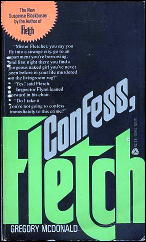
GREGORY MCDONALD – Confess, Fletch. Avon, paperback original, November 1976. Reprinted several times since, in both hardcover and soft. Reviewed in Kindle format.

   Fletch arrives in Boston in search of some missing paintings, only to find a naked murdered woman in his newly borrowed apartment. His attempt to find the paintings is complicated by two crazy, manipulative women, and Inspector Flynn who has a habit of showing up at the worst possible moment to ask Fletch if he is ready to confess to murder.

   Much like his characters, Gregory Mcdonald was fond of defying convention. When Mcdonald rejected releasing Confess, Fletch first in hardcover, and instead had it released as a paperback, many worried he was devaluing the mystery genre. His reported response was “I like to be read by people.”

   Confess, Fletch would win the 1977 Edgar award for Best Paperback Original. It would be the only time the first book of a series (Fletch) and its sequel won back-to-back Edgar awards.

GREGORY MCDONALD Fletch

   Most books in a series follow the characters in chronological order. Mcdonald ignored Fletch chronology. Confess, Fletch was the second book published in the series, but the sixth in Fletch time lime.

   Mcdonald’s fast, almost screenplay-like style, with its smart-ass humor and cynical characters was a perfect reflection of its time. Fletch existed in the time of Robert B. Parker’s Spenser and TV’s Jim Rockford, when characters were more the focus than the mystery and the twists more important than clues.

   The book’s greatest virtues are the characters of Irwin Maurice (aka Peter) Fletcher and Inspector Francis Xavier Flynn. With his laid back, irresponsible exterior hiding a strong moral center, Fletch was the stuff heroes were made of in that era. The brilliant, self-effacing sarcastic cop, Flynn was a delightful change from the average fictional cop.

   Mcdonald’s well deserved critically praised dialog with its natural shortness drives the pace of the story. Funny, real, misleading at times, Mcdonald often expects the reader to understand the true meaning hidden under what is said. This is especially true when Flynn and Fletch are together.

GREGORY MCDONALD Fletch

   Locations are described with just the minimum needed to set the scene and keep the story moving. Mcdonald avoids the details of mundane reality and speeds us along focused more on the characters than the mystery. Plot holes pass by like billboards on the freeway. Even should you notice them, you never care enough to slow down to consider them.

   Confess, Fletch was not meant to be a masterpiece of deduction, no trip to some exotic location, no dark noir, but instead it is a masterpiece of light mystery set in the world with characters you will never want to leave.

   A primary research source for this review was the website ThrillingDetective.com.

REVIEWED BY WALTER ALBERT:         


THE SINGING FOOL. Warner Brothers, 1928. Al Jolson, Betty Bronson, Josephine Dunn, Arthur Housman, Reed Howes, Davey Lee. Director: Lloyd Bacon. Shown at Cinefest 28, Syracuse NY, March 2008.

THE SINGING FOOL Al Jolson

   This enormous success (and Jolson’s second partially-talking film) is said to have been the biggest box-office grosser until Gone with the Wind, with a worldwide take of almost six million dollars.

   The song “Sonny Boy,” written by Jolson’s character for his son, was one of the performer’s major hits and there’s no gainsaying the fact that the song is tremendously effective in the film.

   Jolson’s over-the-top performance is a bit hard to take, with a sentimental plot (Jolson marries a gold-digger instead of the true-blue girl who loves him, and when his wife leaves him, taking their son with her, he falls apart) that has him on-screen for a recorded 106 minutes that somebody took the time to clock.

   That’s a lot of anybody and for such an over-the-top performer as Jolson, too much for one sitting. Or even two or three.

REVIEWED BY DAN STUMPF:         


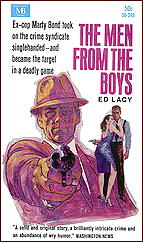
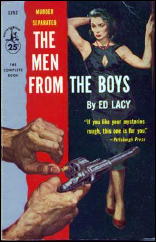
ED LACY – The Men from the Boys. Harper & Brothers, hardcover, 1956. Paperback reprints: Pocket #1152, 1957 (cover art by Lou Marchetti); Macfadden 50-249, 1967.

ED LACY The Men from the Boys

   One of the chief pleasures of going to PulpFest (aside from observing the antics of Steve and Walter from a safe distance…) is finding something I saw on a bookstand years ago and didn’t get for some reason — probably because I was broke at the time. This year it was The Men from the Boys (the Macfadden paperback you see to the left) and I’m glad I finally got back to it.

   This is the goods. Originally published in 1956, this fast, tough and faintly poetic tale is the first-person account of Marty Bond, a disgraced ex-cop living in a seedy hotel on his pension and whatever he can get as house detective, pimp, bouncer, and resident chiseler.

   As the story starts, he’s visited by his stepson Larry, a cop-wanna-be and Citizen On Patrol who answered a call for help from a neighborhood butcher claiming he was just robbed of fifty thousand dollars. Only when Larry got back with a real cop, the butcher decided he hadn’t been robbed at all.

ED LACY The Men from the Boys

   From this intriguing start, Lacy goes on to spin a tale of mobsters, prostitutes, patsies and fall guys, with an occasional mostly-honest cop and aspiring stripper thrown in, set against a backdrop of New York in a sweltering summer. And when Lacy swelter, you can feel your shirt stick to your back.

   The action scenes are plentiful and well-handled, the characters vivid and memorable, and if the central puzzle turns into something disappointingly impossible, well, it’s easy to forgive in an ending that surprised me with its off-the-wall poetry.

   I’ll be seeking out more by Lacy, and meantime, this one stays on my shelf for years to come.

Editorial Comment:   For a long overview and profile of Ed Lacy and his career, check out Ed Lynskey’s article here on the main Mystery*File website. It’s followed by a complete bibliography of his book-length fiction.

REVIEWED BY J. F. NORRIS:


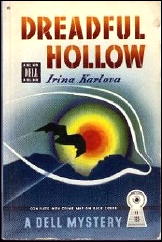
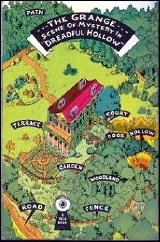
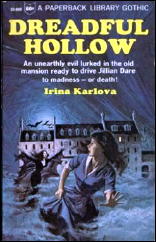
IRINA KARLOVA – Dreadful Hollow. Hurst & Blackett, UK, hardcover, 1942. Vanguard Press, US, hardcover, 1942. Reprint paperbacks include: Dell #125, 1946; Paperback Library 53-860, 1965; 2nd pr., 64-030, 1968.

   This gothic supernatural novel with detective novel elements wavers between genuinely creepy and outrageous self-parody. At the time I was reading it I wondered if Karlova is a pseudonym for some better known writer. The name seems influenced by Universal horror movie characters and actors. I later learned that I was correct.

IRINA KARLOVA Dreadful Hollow

   The author’s real name is Helen Mary Clamp (sometimes noted as H.M. Clamp), and she was extremely prolific throughout her lifetime. In addition to writing three supernatural novels using the Karlova pen name, she wrote over 60 novels from main stream to romance to adventure under her given name.

   Using yet another pseudonym (Olivia Leigh) she wrote a few more romances and eleven literary biographies on historical figures such as Nell Gwynn, Charles II of Spain and Louis XV. Her writing career lasted from 1925 to 1970.

   Dreadful Hollow seems to be influenced by those Universal monster movies I mentioned earlier. It certainly seems to be a bit of a coincidence that those films with all the Eastern European atmosphere and characters should share such a similarity with this book written several years after those films were popular.

   It is peopled with Hungarian gypsies, a mysterious countess of either Czech or Hungarian descent, and a stuffed werewolf, and the dread vampire legend looms large over the story.

IRINA KARLOVA Dreadful Hollow

   Although it does borrow a framework from the detective novel in that the two narrators do some digging up of clues and interview servants and neighbors, it really is nothing more than a pulpy, over-the-top horror novel with all the usual HIBK trappings of the neo-Gothic novel.

   The major difference is that whereas most of those books are pale imitations of a Gothic novel, Karlova’s book is indeed a true Gothic. She does very well with all the Radcliffian elements – emphasis on dreary landscapes and decaying households, a real femme fatale, a ninny of a heroine who suspects she is losing her mind, and genuine supernatural beings and activity.

   As I read I also noted that the structure of the novel was probably inspired by Stoker’s Dracula, with the first person narrative journal entries of young Dr. Clyde (who seems to have escaped from the pages of a pulp magazine like Speed Detective — he speaks in an entirely American wiseacre slang) interspersed with the third person limited sections focusing on Jillian Dare, the young girl hired to act as a companion to an ancient crone.

   The book is unintentionally funny and the mystery is, sadly, to a modern reader, rather obvious from the opening chapters. When young Countess Vera arrives on the scene, any reader who hasn’t instantly figured out the mystery has probably never seen a vampire movie in his or her lifetime.

IRINA KARLOVA Dreadful Hollow

   That isn’t to say the book is not without its deliciously gruesome surprises. There is a disappearance of a young boy that isn’t fully explained until the final pages, for instance. I have to confess that I was alternately raising my eyebrows, gasping and laughing in the final pages which really do get rather wild and bizarre for a book of this era.

   I am sure that even most jaded contemporary reader will find something thrilling in Dreadful Hollow. They certainly don’t write them like this anymore.

   A side note: Some additional research turned up several articles on the internet which mention the fairly recent discovery of William Faulkner’s screen adaptation of Dreadful Hollow.

   Apparently the find happened sometime in 2001 by his daughter who turned the script over to Lee Caplin, Faulkner’s literary executor. Caplin also happens to be a film producer and was toying with the idea of making the movie. Here’s a link to the news story I found from 2007.

   And there is also some mention of the discovery of the script in a article back in the March 2009 issue of The Faulkner Journal: “The Unsleeping Cabal: Faulkner’s fevered vampires and the other South.”

   But now in 2010 it seems the whole thing as been scrapped. There is no info on the movie on Lee Caplin’s website for his Picture Entertainment outfit and nothing noted on his page at IMDB — a source I find generally reliable about films in pre- and post-production.

Irina Karlova’s supernatural mysteries:

      Dreadful Hollow. Hurst & Blackett, 1942.
      The Empty House. Hurst & Blackett, 1944.
      Broomstick. Hurst & Blackett, 1946.

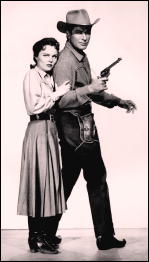
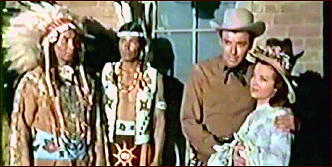
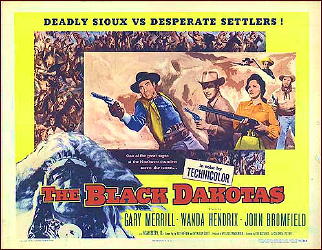
THE BLACK DAKOTAS. Columbia Pictures, 1954. Gary Merrill, Wanda Hendrix, John Bromfield, Noah Beery Jr., Howard Wendel, Robert Simon, Richard Webb, Peter Whitney, Jay Silverheels. Story & co-screenwriter: Ray Buffum. Director: Ray Nazarro.

THE BLACK DAKOTAS 1954

   One of the uncredited players of this rather short but compact technicolor western was Clayton Moore, marking The Black Dakotas one of the few movie team-ups between Moore and Jay Silverheels – other than as the Lone Ranger and Tonto, of course. (I didn’t include Moore in the credits above for one big reason: I never spotted him.)

   History being one of my poorer subjects in high school, I don’t know how valid the premise of this movie is, but it’s one I don’t remember reading about or seeing in a western movie before. During the War Between the States, the opening narrative reads, the South sent men to the west to provoke uprisings by the Indians, forcing the North to send troops there – and away from the war – to protect the settlers.

   Brock Marsh, who impersonates Zachary Paige in this movie as an emissary sent directly to the Dakota Territory, as played by Gary Merrill, is really the bad guy (through and through), and he definitely deserves the top billing.

   Wanda Hendryx plays the fiery daughter of a Southern sympathizer who is hanged early on, while John Bromfield, the owner of the local stage line and the man who loves her, sides with the North, as do most of the local townspeople, excluding Noah Beery, Jr., who’s Merrill’s local contact.

THE BLACK DAKOTAS 1954

   All of the above is made clear within the first five minutes of the movie. (I always do my best not to reveal more than you’d want to know.) The rest of the 65 minutes running time is filled with lots and lots of accusations, high-riding action, double crosses, a kidnapping, multiple deaths from gunfire, and at stake, a fortune in gold ready for the taking.

   The movie’s relatively hard to find on DVD, but it exists – I copied my copy on VHS from TNT back in 1991 — and you can even download a video of it from Amazon. If you were to ask me, though, you shouldn’t spend a lot of money to do so. It’s a perfectly adequate western movie — and maybe even more than that, given Merrill’s better than average performance as a bad guy — but an hour later even that’s as forgettable as the rest of the film.

THE BLACK DAKOTAS 1954

REVIEWED BY CURT J. EVANS:         


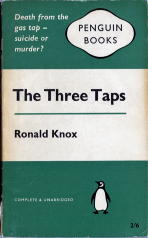
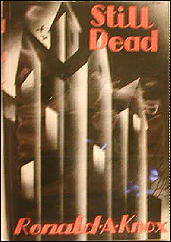
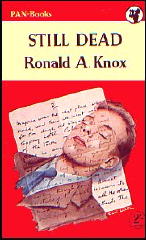
RONALD KNOX – Still Dead. Hodder & Stoughton, UK, hardcover, 1934, Pan #223, UK, paperback, 1952. US edition: E. P. Dutton, hardcover, 1934.

   Ronald Arbuthnott Knox typifies many British writers and readers of detective fiction in that period between the World Wars we call the Golden Age of detective fiction.
RONALD KNOX The Three Taps

   Although in her recent short genre survey, Talking About Detective Fiction (2009), mystery doyenne P. D. James has written that it was Dorothy L. Sayers in the middle 1930s who made detective fiction intellectually respectable (with such “manners” crime novels as The Nine Tailors and Gaudy Night), in fact intellectuals were attracted, both as readers and writers, to detective tales at the very beginning of the Golden Age (roughly 1920), because of those tales’ ratiocinative appeal as puzzles.

   For these individuals, the intellectual appeal of detective novels lay in the quality of their puzzles, not in any attempts on the part of their authors to ape the mainstream “straight” novel with compelling portrayals of social manners and/or emotional conflicts. Indeed, too much emphasis on such purely literary elements initially was often seen by common readers and more lofty genre theorists alike as detrimental in detective novels, because such an emphasis distracted readers’ minds from cold analyses of clues in their attempts to solve mystery puzzles.

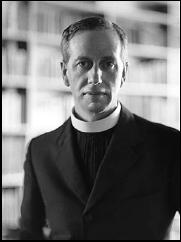
   One of the major literary standard-bearers for this now obsolescent view of the detective novel was an undoubtedly intellectual mystery fan and mystery writer, Ronald Knox.

   Knox, a son of the Bishop of Manchester and an Eton and Oxford educated classical scholar who converted to Catholicism in 1917 (soon becoming a priest and one of England’s most prominent and articulate Anglo-Catholics), published his first detective novel, The Viaduct Murder in 1925.
RONALD KNOX The Three Taps

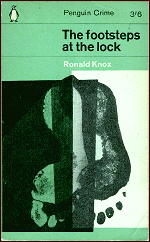
   Two more detective novels appeared in the 1920s (The Three Taps, 1927, and The Footsteps at the Lock, 1928), as well as Knox’s famous Detective Fiction Decalogue, wherein he laid down rules for the writing of detective fiction (all of which emphasized the puzzle aspect, or “fair play”).

   On the strength of these accomplishments, Father Knox was invited in 1930 to become a founding member of the Detection Club. Three more detective novels would follow — The Body in the Silo (1933), Still Dead (1934) and Double Cross Purposes (1937) — before Knox gave himself completely over to his religious scholarship.

   Less donnishly facetious than the 1920s tales, The Body in the Silo and Still Dead are commonly considered to be Father Know’s best detective novels, though oddly, they are two of the most difficult to find.

   (AbeBooks lists the following number of copies for each Knox mystery title: Viaduct Murder, 27; Three Taps, 20; Footsteps, 35; Silo, 7 — all in German or French; Still Dead, 17 — though 12 of these are Pan paperback editions ranging from thirty to fifty dollars; Double Cross Purposes, 12.)

   Both novels are worth reading for fans of the pure puzzle sort of detective novel, having rigorously fair play problems that even include numbered footnotes giving the pages where clues were earlier given. My preference goes to Still Dead, for its Scottish setting, over Silo, with its more hackneyed (but perennially popular) country house locale, though admittedly this is a purely literary consideration.
RONALD KNOX The Three Taps

   Still Dead concerns the death of Colin Reiver, the thoroughly undesirable heir to the Dorn estate in Scotland. Colin’s dead body was glimpsed by one of the estate’s employees, but had disappeared by the time he had left for help and returned to the spot with others.

   Two days later, however, the body reappears at the same spot (still dead, hence the title). Colin is pronounced to have died from exposure, but is that really true and, either way, why were morbid shenanigans played with the corpse?

   If Colin was murdered, there is no shortage of suspects. There is another employee, a gardener, whose child was run down by a drunken Colin (the latter was exonerated in court on the strength of false testimony from an Oxford friend). There are several family members, including Colin’s own father, Donald, as well as Colin’s sister, brother-in-law and cousin (truly, nobody liked Colin). There’s a family physician and also a leader of an odd religious sect to which Donald Reiver adheres.

   The police write off the case (all to the good, since Father Knox evidently knew nothing about police procedure), but insurance investigator Miles Bredon (Knox’s series detective in five novels and a single, classic, short story, “Solved by Inspection”) is called in, because the question of when Colin actually died bears directly on a crucial insurance settlement (the dissolute Colin was heavily insured in his father’s favor and the Dorn estate is sadly diminished).

   Still Dead starkly reveals both Father Knox’s strengths and weaknesses as a detective novelist. Positively, the fair play cluing is exemplary and reading the solution is quite enjoyable. Negatively, human interest is minimal and the plot moves very slowly.

   Aside from a gentrified old lady at a hotel, Colin Reiver’s military martinet-ish cousin and a eugenics-professing doctor, none of the characters has a semblance of interest. Even these three aforementioned characters don’t come to life as they might have, given the basic material.
RONALD KNOX The Three Taps

   To be sure, Knox provides a little lightly humorous verbal byplay, courtesy of Miles Bredon’s wife, Angela (she always seems to accompany him on his investigations, despite having a child — or children, Knox is inconsistent on this point — at home). Yet Miles and Angela are no Lord Peter and Harriet, despite having preceded them into print as a mystery genre male-female duo by three years.

   I found Still Dead rather more slow-moving than novels by Freeman Wills Crofts or John Rhode from this period, because Bredon’s investigation is peripatetic. Knox’s fictional works lack the relentless narrative investigative drive we see in mystery tales by those other, “humdrum”, authors, who focus so resolutely on the problem. Nor is Knox’s problem itself, though well-clued, as interesting as the alibi and murder means conundra presented by Crofts and Rhode, respectively.

   In the blurb for Still Dead, Father Knox’s English publisher, Hodder and Stoughton, called Knox “a master of the English language.” Indeed, Knox is a very good writer; yet his strength as a writer is that of an essayist, not a novelist. Scattered throughout Still Dead are some fine scenic descriptions, pithy observations on religion and interesting digressions on the fate of England’s aristocracy, the nature of English gardens, chess, books, caves, hotel, etc., but, while they are interesting in themselves, by themselves they do not sustain the dramatic situation desirable in a crime novel.

   Of course Knox would counter that he was merely trying to provide readers with a good puzzle, and this is a perfectly reasonable point. Admittedly, Still Dead is a good puzzle. Yet the basic material here — a dissolute gentry heir having killed a young child while driving inebriated — is interesting enough to have deserved a more serious treatment.
RONALD KNOX The Three Taps

   Knox’s handling of the material is too much on the dry side, even in the final chapter when the philosophical implications of the problem are discussed by the characters (though this is a good discussion).

   Indeed, just a few years later Nicholas Blake (the pen name of poet Cecil Day-Lewis) took a rather similar plot and injected it with real human pain and suffering, in The Beast Must Die (1938), a tale much better-remembered today than Still Dead.

   Even Agatha Christie, one feels, would have made a more compelling tale of Still Dead. There seems to me to have been an evident reluctance on the part of Father Knox to grapple with deeper emotions in his detective novels. (One sees this quirk as well in the half-dozen mild mystery tales by a Knox contemporary, Anglican minister Victor Whitechurch.)

   Despite these reservations on my part, Still Dead is well worth reading for admirers of classical British mystery. If you can find a hardcover copy (as least this is true of the British edition by Hodder and Stoughton), you also will find a beautiful endpaper drawing of the Dorn estate and a dramatic frontispiece of stark Dorn House, both by Bip Pares, as well as that footnoted clue page guide.

   The Pan paperback editions of Still Dead from 1952 that booksellers want thirty to eighty dollars for lack these graces, so charmingly redolent of the Golden Age detective novel, when many writers in their mystery tales unashamedly emphasized puzzles.

Editorial Comment:   In my review of Knox’s The Three Taps earlier on this blog, I included his list of the “Ten Commandments for Detective Fiction,” also referred to by Curt.
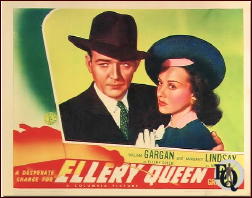
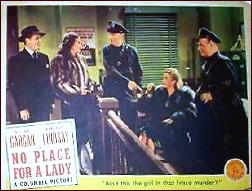
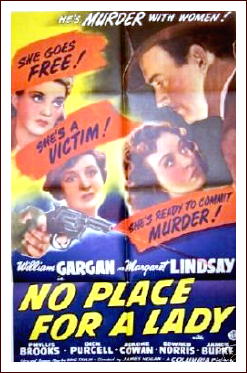
NO PLACE FOR A LADY. Columbia Pictures, 1943. William Gargan, Margaret Lindsay, Phyllis Brooks, Dick Purcell, Jerome Cowan, Edward Norris, Thomas Jackson. Screenwriter: Eric Taylor. Director: James P. Hogan.

NO PLACE FOR A LADY

   It’s worth pointing out, I’m sure, that the two leading stars of No Place for a Lady, William Gargan and Margaret Lindsay, had just finished appearing in the last three of seven early 1940s Ellery Queen movies – playing EQ himself and Nikki Porter, respectively. (Lindsay was actually in all seven. It was Ralph Bellamy who portrayed the master detective in the first four.)

   And digressing a little more before going any further, I can’t imagine either Bellamy or Gargan as the erudite Mr. Queen, but Hollywood license went a whole lot farther then than it does now.

   Since Eric Taylor was involved in the writing of all seven EQ films, and director James Hogan did the last six, when it came time for them to do No Place for a Lady, it’s natural, I think, to wonder if they simply reworked a leftover Ellery Queen script, but I don’t think so. If they did, it was one heck of a rewrite.

   William Gargan plays a high-powered PI named Jess Arno in this one, while Margaret Lindsay is a real estate agent June Terry, and his fiancée, She’s also the jealous type, which is important, and so is the fact that she’s a real estate agent.

NO PLACE FOR A LADY

   Egged on by a close reporter friend named Rand Brooke (Dick Purcell), who’d like to get closer, Terry stages a fake murder in a seashore cottage she has for rent, hoping to get Arno in trouble when he leaves his latest client there, a beautiful blonde (Phyllis Brook) whom he’s just gotten off on a murder rap.

   Unknown to everyone involved, a rat named Eddie Moore (Jerome Cowan) has already left his own very real murder victim there, a casualty of a scam involving a fire and hijacked tires.

   Which leads to an entire movie’s worth of strange coincidences, misunderstandings, missing bodies, false leads and blaring air raid alerts, complete with the dumbest pair of shoreside cops you will ever hope to meet – or not. The fact that Eddie Moore is also a nightclub singer means that a few minutes can be taken up with a song or two.

   Don’t expect any detective work to be done in this movie, and you’ll be all right. I imagine that in the movie theaters in 1943, the laughs came loud and often, but in all honesty, that wasn’t what I was watching for.

   I’m always happy to have a copy of any PI movie that comes along, but while the movie isn’t actually bad, neither is it very good. In spite of its magnificent pedigree, No Place for a Lady is more disappointment than not.

NO PLACE FOR A LADY

« Previous PageNext Page »