Reviews


THE BACKWARD REVIEWER
William F. Deeck


MARY PLUM Author

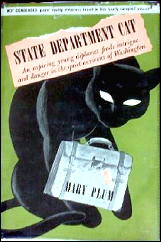
MARY PLUM – State Department Cat. Doubleday Crime Club, hardcover, 1945.

   Touch the cat, aptly named Trouble, that wanders the State Department halls, and bad luck ensues. The last Department employee who did so was assigned to Australia and was never heard from again.

   George Stair, about to take his oral exam for the Diplomatic Corps, touches the cat and fails the test. He also has secret papers stolen from him, is hit with the ever popular blunt instrument, and suffers various other unpleasantnesses while dealing with a would-be Latin-American dictator and a Nazi spy.

   An occasionally amusing thriller that will probably appeal only to those interested in the Washington, D.C., area, and maybe not to them. Still, it’s far better than Plum’s mysteries featuring John Smith.

— From The MYSTERY FANcier, Vol. 11, No. 4, Fall 1989.


MARY PLUM. 1904?-1991?    Series character: John Smith [JS].

      The Killing of Judge McFarlane (n.) Harper 1930 [JS]
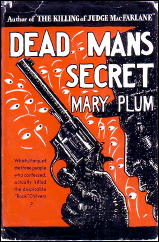
      Dead Man’s Secret (n.) Harper 1931 [JS]
MARY PLUM Author

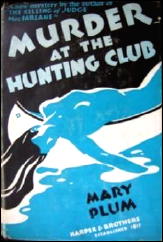
      Murder at the Hunting Club (n.) Harper 1932 [JS]
MARY PLUM Author

      Murder at the World’s Fair (n.) Harper 1933 [JS]
      State Department Cat (n.) Doubleday 1945
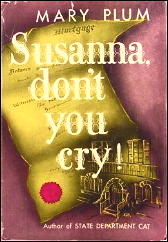
      Susanna, Don’t You Cry! (n.) Doubleday 1946
MARY PLUM Author

      Murder of a Redhaired Man (n.) Arcadia 1952

— The information above was adapted from the Revised Crime Fiction IV, by Allen J. Hubin.


Note:   The first four books are all also Harper Sealed Mysteries.   Of Dead Man’s Secret, an online list of novels taking place in Illinois says: “Most of the people at Gray Manner’s house party are glad to see Rook Chilvers get what’s coming to him, but no one is willing to admit the murder. As the case develops and evidence implicates first one guest then another, even the cool, logical John Smith, a professional Chicago detective, seems puzzled.”
REVIEWED BY WALTER ALBERT:         


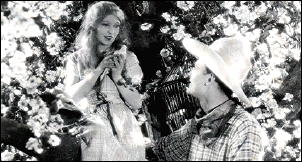
SHOOTING STARS. British Instructional, UK, 1927. Brian Aherne, Annette Benson, Chili Bouchier, David Brookes, Donald Calthrop. Director: A. V. Bramble, assisted by Anthony Asquith. Shown at Cinefest 28, Syracuse NY, March 2008.

SHOOTING STARS Annette Benson

   A stylish silent film, with Annette Benson as the wife of actor Brian Aherne and his co-star, who has a fling with film baggy-pants comedian Donald Calthrop.

   She wants to leave Aherne for her lover, but fears it will destroy her career. She substitutes real bullets for blanks in the gun that will be fired at Aherne in their thriller, but even though she decides not to go through with it, a series of misadventures results in the shooting of Calthrop and Benson’s withdrawal from films and her marriage.

   There’s a final sequence in which, several years later, she has a walk-on in a film directed by Aherne, unrecognized by him or anyone else in the crew, with a poignant fade-out as she appears to walk away walks away forever from her former husband and the movies.

   The behind-the-scenes look at the filming of silents, made this absorbing, ironic drama of unusual interest.

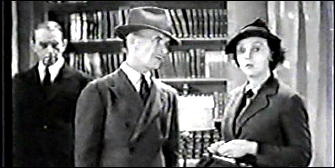
THE PLOT THICKENS. 1936. James Gleason, ZaSu Pitts, Louise Latimer, Owen Davis Jr., Richard Tucker. Based on a story and characters created by Stuart Palmer. Director: Ben Holmes.

   The role of Hildegarde Withers in this next-to-the-last movie based on her adventures with Inspector Piper was taken over from Edna May Oliver then Helen Broderick by ZaSu Pitts, whose fluttery hands and ways are best taken in small doses. She seems to fit the part, however, given Hollywood’s perspective on the stories.

THE PLOT THICKENS  Miss Withers.

   This has come up before, and in the meantime I’ve given this some small amount of thought to it — the business of detective stories being made into comedies when converted to the silver screen, especially during the 30s and 40s.

   Maybe it’s because the idea behind the traditional, cozy detective murder mystery is inherently ridiculous to begin with — the established routine of a victim, suspects, clues, questioning, locked rooms, alibis and so on.

   Could it be, when transferred into cinematic terms, the whole entire unlikelihood of the proceedings is amplified into the utterly absurd?

   That’s the question as I’ve reformulated it so far, and I haven’t answered it yet, but why else did so many favorite mystery characters turn into bumbling idiots when portrayed on the screen?

   Or why did their adventures need to “enlivened” by the presence of goofy chauffeurs, clown-like cops or (simply) funny friends? Hard-boiled operatives fared much better. I don’t think Hollywood had a very great opinion of the Ellery Queen’s or Hildegarde Withers(es) of the literary world.

   Which is not to say that I’m bitter — but wouldn’t it have been better to have had Jean Arthur play Pam North than Gracie Allen? Wouldn’t Sara Haden (Andy Hardy’s Aunt Millie) have made a better Hildegarde Withers? (It could have been worse — they might have used Marjorie Main.)

   This not being an ideal world, however, simply the best of all possible ones, we accept what we’re given. As the title indicates, there’s a lot of plot in this one: first of all a murder, with lots of suspects, including a butler and a jealous boy friend. There also turns out to be a stolen emerald in the dead man’s possession, and the whole affair ends up in a museum where the famous Cellini cup is the target of a gigantic gang of thieves.

   Simply terrific stuff!

   James Gleason, as Inspector Oscar Piper, is a pint-sized bantam with an irascible temper and even fouler-smelling cigars. As a detective, well, it’s no wonder he had Miss Withers along to do his thinking for him.

— Reprinted from Mystery*File #35, November 1993, slightly revised.


[UPDATE] 12-08-10.   When I wrote this review, I was unaware of a made-for-TV movie in which Miss Withers (Eve Arden) and Inspector Piper (James Gregory) were also the leading characters. It was A Very Missing Person, based on the novel Hildegarde Withers Makes the Scene by Stuart Palmer and Fletcher Flora. Shown on ABC, 4 March 1972, rumor has it that it was not as good as it might have been.

   And a fact that was totally unknown to me until just now, according to Wikipedia, there was a 1950s TV sitcom pilot entitled “Amazing Miss Withers” that starred Agnes Moorehead and Paul Kelly. It is apparently considered lost, probably forever.

IT IS PURELY MY OPINION
Reviews by L. J. Roberts


DICK FRANCIS and FELIX FRANCIS – Crossfire. Putnam, hardcover, August 2010. Paperback reprint: August 2011.

Genre:   Amateur sleuth. Leading character:  Tom Forsythe; Dick Francis’s 45th book. Setting:   England.

First Sentence:   Medic! Medic!

    Captain Thomas Forsythe has returned from fighting and being injured in Afghanistan, to a place called home in name only. He and his mother have never been close. She is a well-known, well-respected, successful trainer of racehorses and at risk of losing everything to a blackmailer and/or the Inland Revenue. For the first time ever, Tom can help his mother; if she would only let him.

DICK & FELIX FRANCIS Crossfire

    One thing on which you can always count with a Francis novel is a captivating opening and this book does not disappoint. It begins with a bang, literally, and is both current to our time and effective.

    After that, I must admit, the old charm wasn’t quite there. Tom is an effective character and classically Francis; he’s independent, a loner, self-reliant and determined. He was certainly the best of the characters in the story, and the most well developed.

    It may sound silly, but I enjoy that the author’s voice, particularly with both the author and the characters being British, sounds British without an attempt to Americanize it. There was a strong sense of place, I feel I’m coming to know the Lambourn region.

    Details make a difference. The inclusion of information on Tom’s life in the military, including what the infantry wears and carries with them, but also information on the tax system; these things add dimension to the story.

    Taking into account that I was reading an uncorrected proof, there was a good deal of redundancy. I hope that won’t be true with the finished edition. The plot was good, but lacked the suspense to which I’m accustomed and a number of the situations were strikingly, and rather uncomfortably, familiar from previous books.

    Remembering specifically which books definitely took me out of being involved in reading this one. One of the classic Francis elements was missing; the protagonist was never involved in a fight. Considering the occupation of the protagonist, this was one book in which he could really have held his own. Maybe that’s why it wasn’t included, but I certainly noticed the lack of it being there.

    What did work, however, was the climax. It was unexpected, somewhat shocking and one of the best from Francis in awhile. The epilogue was well done and it is always important to me to know justice is served.

    For all its faults, I don’t regret having read Crossfire. It will be interesting to see how the Francis name and style progresses from here.

Rating:   Good.

REVIEWED BY J. F. NORRIS:


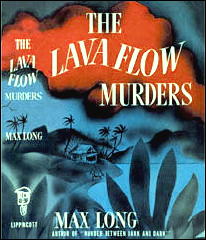
MAX LONG – The Lava Flow Murders. Series detective: Komako Koa #2. J. B. Lippincott, hardcover, 1940.

   After an expository overload in which the characters are introduced in quick succession, the first third of the book is spent on detailed descriptions of a volcanic eruption and the attempts of plantation policeman, Komako Koa, and the plantation owner, Tucker, in evacuating the visitors who have recently arrived from a yacht in the harbor.

MAX LONG The Lava Flow Murders

   They are also told to avoid a heiau (sacred Hawaiian shrine) to Pele. But two members of the party mock nearly everything to do with traditional Hawaiian beliefs and culture. One of those mockers, a brash woman, enters the heiau and is seen arguing with someone who the visitors believe is the embodiment of Hawaiian goddess Pele.

   The woman is almost immediately discovered dead — her head crushed by a coconut. For some reason the mainlanders actually believe that Pele is responsible and there is a lot of silly melodrama with people running around crying out to beware of Pele.

   None of this makes any sense. Koa takes advantage of this and rather than telling everyone that he knows the woman was murdered he lets them indulge themselves in superstitious gullibility. Irresponsible of a policeman and a bit contrived on the part of the author. But without that the rest of the story would not follow.

   Meanwhile, the volcano continues to erupt and encroaching lava flows continue to threaten the characters as well as the ranch house where they are staying. Then another person is hit on the head with a coconut and yet another person disappears.

   Soon it appears that a homicidal maniac is at work and the book takes on the atmosphere of And Then There Were None set in Hawaii with an active volcano as an added menace.

   Koa’s friend and the series narrator, Hastings Hardy, believes that a local Hawaiian has gone mad and is acting as a murderous nemesis for the offended Pele. There is a character called “the firewalker” who fits this bill. But Koa says no Hawaiian would enter a heiau and commit murder let alone do any of the other horrid things that the killer does (for example, a woman is thrown into the steaming, fomenting ocean where the lava flow ends and is basically boiled to death!).

   The book is not very well constructed and — believe it or not — is often dull. It’s a hodgepodge of a disaster adventure comprised of lots of scientific detail about volcanoes, lava flow, the different types of lava and how they behave, the types of rock and ash that accompany violent eruptions, etc. etc.

   The murder mystery is thrown in almost as an afterthought. The book could easily have been much shorter and the narrative handled less clumsily had the author focused on the story rather than focusing on the volcano and the lava.

   The only thing that holds one’s interest is the interspersing of Hawaiian lore and legends. The culprit, once one accepts Koa’s dismissal of anyone Hawaiian, is a bit obvious. The killer’s motive, set up also rather obviously way back in the first chapter when land rights and inheritances are discussed, and the denouement overall are less than satisfying.

LONG, MAX (Freedom). 1890-1971. SC: Komako Koa, in all.
      Murder Between Dark and Dark. Lippincott, 1939.
      The Lava Flow Murders. Lippincott, 1940.
      Death Goes Native. Lippincott, 1941.

     — Taken from the Revised Crime Fiction IV, by Allen J. Hubin. A short biographical article about the author may be found here on Wikipedia.

REVIEWED BY DAN STUMPF:         


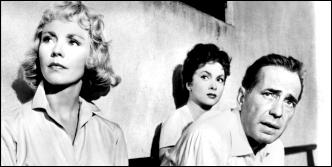
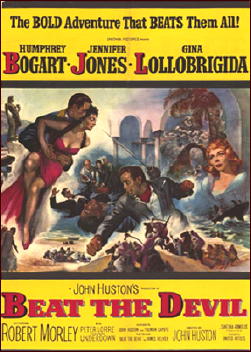
BEAT THE DEVIL

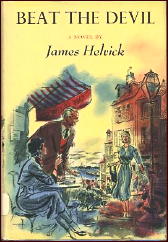
  JAMES HELVICK – Beat the Devil. J. B. Lippincott, hardcover, 1951. Penguin, UK paperback, 1971, under the author’s real name, Claud Cockburn. Film: United Artists, 1953. Screenplay: Truman Capote & John Huston; director: John Huston.

   I reviewed the film version of Beat the Devil earlier on this blog, but in a notable I’m-glad-I-read-it vein, there’s also the print version, an inexpensive copy of which I found thanks to the nice folks who hang out here. The Bogart film is a legendary mess, and I had fun seeing how the two of them compare.

   Truman Capote’s script for the movie stays remarkably faithful to the book, with the notable exception that the book offers a couple of action scenes, which are carefully leeched out of the movie, to be replaced with something they thought was funny.

BEAT THE DEVIL

   Thus an ambush on a lonely beach becomes a runaway jalopy, a tragedy at sea turns into a mere mishap, and one of the best bits in the book — a lengthy prison stay where the characters reveal some surprising facets of themselves — is replaced by a quick joke about Rita Hayworth.

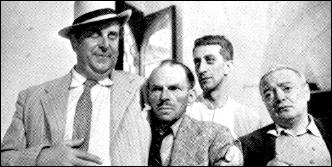
   Helvick/Cockburn’s book offers some engaging, often surprising characters (replaced in the movie by competent character actors given nothing to do) and off-hand moments of casual chivalry when they find themselves rising to occasions of their own making — again, replaced in the film with limp humor.

BEAT THE DEVIL

   More important, as the book ended I saw what must have drawn director John Huston to film it: a moment when fate seems to smile at the characters and their little dreams, only to break out laughing at them the next moment. It’s a well-done resolution that recalls bitter wrap-ups in The Maltese Falcon and Treasure of the Sierra Madre, which I find even more surprising since Huston and Capote replaced it in the film with a cheap joke. Oh well.

   At least the film offers one interesting variation, when the two female leads (played by Jennifer Jones and Gina Lollobrigida in the film) find themselves in competition for each other’s husbands. In the book, they go skinny-dipping to check out each other’s bodies. In the film, Jones simply finds an excuse to wave her butt repeatedly in Gina’s face, a moment of cheerful vulgarity so engaging one wishes the rest of the film offered more of it.

BEAT THE DEVIL

REVIEWED BY WALTER ALBERT:         


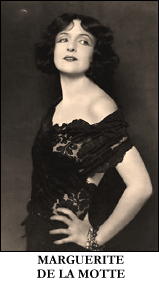
MARGUERITE DE LA MOTTE

THE FINAL EXTRA. Gotham Productions / Lumas Film Corp., 1927. Marguerite De La Motte, Grant Withers, John Miljan, Frank Beal, Joseph W. Girard, Billy “Red” Jones, Leon Holmes. Story and scenario by Herbert C. Clark; cinematography by Ray June. Director: James P. Hogan. Shown at Cinevent 42, Columbus OH, May 2010.

   Pat Riley (Grant Withers) greatly admires his senior colleague, reporter Tom Collins (Frank Beal) who is murdered when he’s about to reveal the name of the leader of a gang of bootleggers in an expose he’s writing for his newspaper.

   Riley, who’s sweet on Collins’ daughter Ruth (Marguerite de la Motte), vows to finish the story, a promise that leads to Ruth being trapped in a house with the murderer as Riley races to her rescue.

   Hogan would later direct entries in Paramount’s Bulldog Drummond and Columbia’s Ellery Queen series, while Grant Withers would have a career in sound films that included programmers, serials and, later in his career, several of John Ford’s features.

   The Final Extra was a fast-paced, exciting film that was expertly produced in all departments, and was a splendid conclusion to my 34th Cinevent.

REVIEWED BY BARRY GARDNER:


LINDA BARNES Carlotta Carlyle

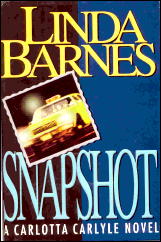
  LINDA BARNES – Snapshot. Carlotta Carlyle #5. Delacorte Press, hardcover, 1993. Dell, paperback, 1994. Reprinted several times since, in both hardcover and paperback.

   I don’t think there’s any doubt that Linda Barnes is in the top five female PI writers, and I may enjoy her more than any but Marcia Muller. Her ex-cop, part-time cabby PI, Carlotta Carlyle, is one of my favorites.

   Her latest case begins when a psychiatrist brings a woman to her office who is obsessed with the recent death of her child from a form of leukemia. The woman is not convinced that something didn’t go awry at the highly regarded hospital where the child died, and the psychiatrist thinks that having Carlyle lay her doubts to rest is good therapy.

LINDA BARNES Carlotta Carlyle

   He has no idea that her fears are well-founded; the child’s doctor was one of the country’s best. Carlotta takes the case, and begins her investigation.

   At the same time, she has other problems. Someone steals her trash cans in the middle of the night, trash and all, and her 11-year-old Hispanic Little Sister has run away from home, and has been seen regularly in the company of a grown man.

   Barnes continues to impress me. Carlyle is a believable human being, possessed of her fair share of problems but refreshingly free from the anger and/or angst of so many of today’s characters.

   The supporting cast is nicely drawn, and Barnes tells her story well in straightforward prose. The plot didn’t have me tearing my hair out, which considering my luck with the rest of the PI novels I’ve read lately was a major triumph. Good book.

— Reprinted from Ah, Sweet Mysteries #10, November 1993.


       The Carlotta Carlyle series —

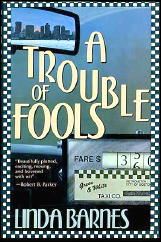
1. A Trouble Of Fools (1987)

LINDA BARNES Carlotta Carlyle

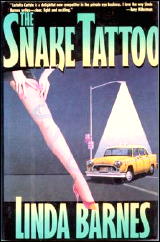
2. The Snake Tattoo (1989)

LINDA BARNES Carlotta Carlyle

3. Coyote (1990)
4. Steel Guitar (1991)
5. Snapshot (1993)
6. Hardware (1995)
7. Cold Case (1997)

LINDA BARNES Carlotta Carlyle

8. Flashpoint (1999)
9. The Big Dig (2000)
10. Deep Pockets (2004)
11. Heart of the World (2006)
12. Lie Down with the Devil (2008)

LINDA BARNES Carlotta Carlyle

LAST TRAIN TO BOMBAY

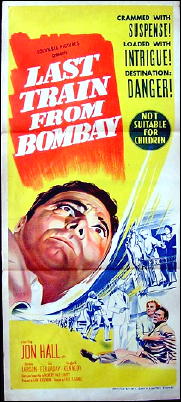
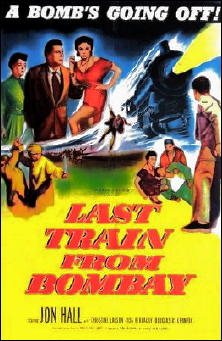
  LAST TRAIN FROM BOMBAY. Columbia Pictures, 1952. Jon Hall, Christine Larsen, Lisa Ferraday, Douglas Kennedy, Michael Fox, Donna Martell, Matthew Boulton, James Fairfax. Director: Fred F. Sears.

   With civil war about to break out in India, the first assignment of American diplomat Martin Viking there is a doozey.

   Viking, as played by Jon Hall just before he became Ramar of the Jungle, is a naive fellow, you’re led to believe at first, who nonetheless turns out to be top notch when it comes to killers and thuggees of all sorts (but mostly inept), as he proves over and over again in hand-to-hand combat.

   Blamed for the murder of his wartime friend who gets him into trouble from the very beginning all the way through to the end of this 72-minute adventure, Viking encounters an unfriendly Captain Tamil of the Bombay police (Michael Fox) and two women who prove to be both friendly and unfriendly (or vice versa):

   Christine Larsen plays the daughter of a retired British officer as they take a trip by auto together to see the Taj Mahal in the moonlight, while Lisa Ferraday is a French woman once married to an American who now lays in wait for unsuspecting travelers in a tavern where Viking seeks refuge.

   And believe it or not, I almost forgot to mention the train.

LAST TRAIN TO BOMBAY

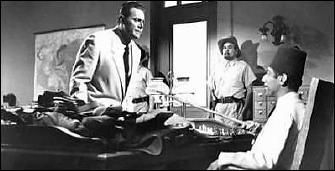
   Viking is on it for no more than five minutes during the entire movie, but nonetheless it’s the entire crux of the plot, which consists of his being able to stop an unknown band of conspirators from blowing it up as it makes its way across the subcontinent of India, among the passengers being a very important Indian ruler and his entire entourage.

   Filmed like an action-packed Columbia Pictures afternoon serial, there is little time to spend on subtleties. And like action-packed Columbia Pictures afternoon serials, there is a continual feeling of being cheated, what with death-defying escapes coming all too easily at the end of one chapter and the beginning of the next – especially the last one, wherein Viking and his fellow female captive at the time simply walk out of the dungeon where they’re being held captive.

   No self-respecting villain would ever be this inept – ever!

LAST TRAIN TO BOMBAY

RON ROSENBAUM – Murder at Elaine’s. Stonehill, hardcover, 1978. No paperback edition.

MURDER AT ELAINE'S

    Elaine’s is said to be the hottest literary hangout in Manhattan, lionized by all the most ultra-sophisticates of western society. The lights go out, except for a silencer a shot rings out, and there on the floor is the former publisher of Media Confidential.

    Motive: a literary feud? Or is it some ramification of the dope rackets?

    This old-fashioned murder mystery was previously serialized in High Times Magazine, and a more unlikely blend is difficult to imagine.

    Solved in passing is the well-known Dickens/Edwin Drood case, and revealed as well is the ending of a famous Agatha Christie novel.

    The “in” crowd will gobble this up, which hardly makes it an automatic must for the true mystery fan. Still, part of the plot are those missing eighteen minutes from an infamous White House tape. Wouldn’t you really like to know who done what to whom?

— Reprinted from The MYSTERY FANcier, Vol. 3, No. 5, Sept-Oct 1979. Very slightly revised. (This review appeared earlier in the Hartford Courant.)


RIP Elaine Kaufman:   This celebration of her life from the “Diner’s Journal” section of The New York Times says it all, certainly better than I, having never seen the outside of Elaine’s, much less the inside. From the obituary page:

    “Elaine Kaufman, who became something of a symbol of New York as the salty den mother of Elaine’s, one of the city’s best-known restaurants and a second home for almost half a century to writers, actors, athletes and other celebrities, died Friday in Manhattan. She was 81.”

« Previous PageNext Page »