Reviews


Reviewed by DAVID L. VINEYARD:         


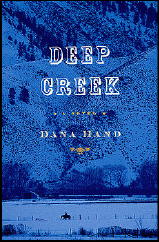
DANA HAND – Deep Creek. Houghton Mifflin Harcourt, hardcover, February 2010. Trade paperback: Mariner Books, March, 2011.

DANA HAND Deep Creek

   This dark tale of one of the byways of the history of the American Northwest begins with a particularly grim incident. Police Judge Joe Vincent, a one time marshal, is taking his daughter Nell fishing when they snag something big:

    He sat up and stared at her catch: an arm waving in the water. He foundered into the shadows to seize the small, bloated body by shoulder and thigh. Long black hair, unbound, trailed over his hands like riverweed… Nell had thrown in a line and caught a man.

   Not just one man either. More than thirty bodies are eventually recovered, all Chinese miners. It is June of 1887 in the Idaho territory and Joe Vincent has just been thrown into the case of his lifetime, one that will take him on a personal journey and across countryside and through cities and a sham trial in Oregon before he uncovers the truth.

   Deep Creek is based on a forgotten but true incident of Northwestern American history, and Joe Vincent based on Judge Joseph Vincent, the man who investigated the mass murder.

   Written in a simple but powerful style by a pair of writers, Will Howarth and Anne Matthews, who have written eighteen books of non-fiction, Deep Creek derives its power from a story of three good, if complex people, drawn into a mystery both deeper and darker than they can imagine.

DANA HAND Deep Creek

   As Vincent sets out to follow the trail of the bodies up river he is joined by Lee Loi, an ambitious investigator sent by the Sam Yu Company, and Grace Sundown, a half metis mountain guide with secrets of her own. Together they have to piece together how this brutal crime happened and why, while fighting their own demons and the inherent injustice of racial matters at the time.

   It might sound as if this is a particularly dark book, but that would be unfair. Above all, the book celebrates the simple goodness of three people who will not allow an injustice to go unmarked or strangers far from their home to go unavenged.

   Much of the novel has to do with those three investigators learning to trust each other as they encounter lies, deceit, and cover-ups at all levels and distrust from both those they want to help and those they hope to bring to bear for the crime. At times they face danger from unseen forces, and the violence of the brutal slaughter of the thirty Chinese is never far from the surface.

   The novel covers a time period from June of 1887 to August of 1892 but echoes the difficult history of the Asian immigrants to the American West through much of the 19th and the first half of the 20th Century.

   The ending of the book is a perfect touch of ironic justice, one that might have come from Jack London at his best. It echoes that and Traven’s Treasure of the Sierra Madre and brings a fine book to a perfect close.

DANA HAND Deep Creek

   As with real life the novel is not tied up neatly in a package, and justice is not so much served as attempted by three good people and others like them that they meet and ally with. And the writing … the writing is simply beautiful:

    On the Idaho shore the mare waited a while, then trotted east, reins loose. A full moon rose over the canyon of the Snake. In the dark waters a great fish swam upstream, trolling as it went, drifting sideways and dropping back, over and over. A promising eddy waited near Deep Creek. Long as a river dory, splendid as a dragon, no one and nothing would disturb it there.

   This one is something special, with some of the power of works by Ivan Doig and Jim Harrison as well as a compelling mystery and solid detective work by its three protagonists. It goes on a small shelf of powerful novels of the West such as those by Willa Cather, Mari Sandoz, Frederick Manfred, and Wallace Stegner. Once you read it, you won’t forget it.

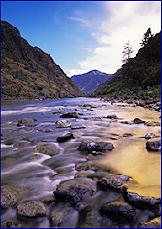
Note: In 2005 the site where the bodies were found was recognized as a significant American historical place and renamed Chinese Massacre Cove. Final recognition for a forgotten crime.

REVIEWED BY GEOFF BRADLEY:         


WAKING THE DEAD. BBC, UK, Series 8: 06-07, 13-14, 20-21, 27-28 Sept 2009. Trevor Eve (Detective Superintendent Peter Boyd), Sue Johnston (Dr. Grace Foley), Wil Johnson (DI Spencer Jordan), Félicité Du Jeu (DC Stella Goodman), Tara Fitzgerald (Dr. Eve Lockhart), Stacey Roca (DS Katrina Howard).

WAKING THE DEAD

   This long running series (back for four stories, each spread over two one-hour parts, no adverts) is as barmy as any that is currently being shown.

   Detective Supt. Peter Boyd, who runs a cold case squad, is so far over the top, irrational and prone to outbursts, that you wonder why anyone would work for him at all.

   However the stories are usually very watchable and often set up an intriguing premise. The problem is that the resolutions are always a complete letdown and never bother trying to explain who has done what and why.

   Boyd is never supervised and seems unbothered by his methods but this series went a step further and set Boyd up as some sort of avenger. Illogical and beyond reason but it can be entertaining.

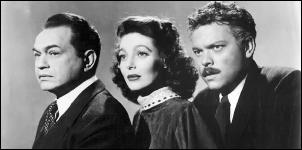
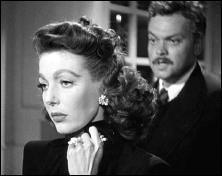
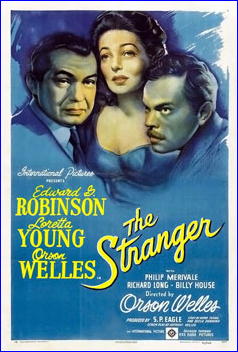
THE STRANGER. RKO Radio Pictures, 1946. Edward G. Robinson, Loretta Young, Orson Welles, Philip Merivale, Richard Long, Billy House. Screenplay: Anthony Veiller. Director: Orson Welles.

THE STRANGER Orson Welles

   The dark nature of this movie of course is what consigns it to the noir category, that plus the moody but still dazzling black-and-white photography, complete with unusual camera angles, especially during the many trips up and down the inside of the bell tower facing the green in a small one-horse town in Connecticut right after the war.

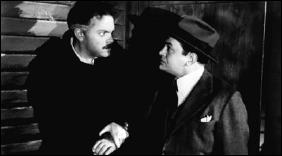
   But is it really a noir film? Not really by subject matter, that of a post-World War II manhunt. A former top member of Nazi party in Germany (Orson Welles) who by posing as a history teacher at a local academy, has somehow managed to infiltrate his way into local society so solidly enough that he is about to marry the daughter (Loretta Young) of a US Supreme Court justice who lives in town.

THE STRANGER Orson Welles

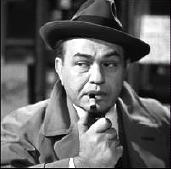
   On his trail is one man, a representative of the US government known only as Mr. Wilson (Edward G. Robinson). His problem? He does not know the face of the man he is after, a world-class criminal who managed to keep his identity a secret while the Nazis were in power, a man with vicious ideas who preferred to do his nasty work behind the scenes only.

   The noirish concept of an innocent man in over his head through his own weakness and/or the sheer vicissitudes of fate do not apply here. Professor Charles Rankin, as he is known now, is a bad man, and as a killer who senses he is about to be trapped, he needs to be caught. It is only the camera work and Welles’ direction that makes this movie qualify as noir, and then by only the slimmest of margins.

THE STRANGER Orson Welles

   Edward G. Robinson is as earnest as only Edgar G. Robinson could be, and Loretta Young I do not believe could look only lovelier. It is her predicament that is the most heartbreaking. In love with a man who is a monster, she cannot accept it, even as a mountain of facts begins to pile up against him.

   As for fierce-looking Mr. Orson Welles himself, he is dark, brooding and sullen throughout the movie. It is difficult to believe that the cheerful Loretta Young could fall in love with such a man, much less go on a honeymoon with him.

THE STRANGER Orson Welles

   It is also hard to believe, that even in simpler times, the credentials and background of the man to whom the daughter of a Supreme Court justice is married would not have been checked more thoroughly earlier on. Before enjoying this movie to the fullest, we in this more cynical age must accept that life (and politics) were easier then.

   Otherwise this well-meaning movie, the first to show footage of concentration camps in Germany, or so I am told, is only a well-designed and well-produced relic of the past, a magnificent artifact caught up in amber and preserved for us today, a different time altogether.

THE STRANGER Orson Welles

REVIEWED BY DAN STUMPF:         


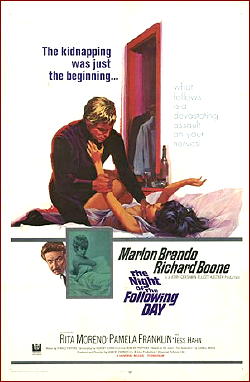
THE NIGHT OF THE FOLLOWING DAY

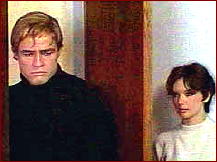
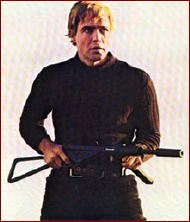
THE NIGHT OF THE FOLLOWING DAY. Universal, 1968. Marlon Brando, Richard Boone, Rita Moreno, Pamela Franklin, Jess Hahn. Based on a novel by Lionel White. Co-screenwriter & director: Hubert Cornfield. Co-director (uncredited): Richard Boone.

   After Gunn and P. J., this latest excursion back into my tawdry youth ended with The Night of the Following Day, co-written and directed, mostly, by Hubert Cornfield, based on The Snatchers, a Gold Medal paperback novel by Lionel White.

   The film was originally intended to star Richard Boone, but Marlon Brando, whose career was in eclipse at the time, owed Universal a movie, and Cornfield, who had done a few interesting B-films, jumped at the chance — only to have Brando bully him around the set and ultimately off the picture, which was finished by Richard Boone.

THE NIGHT OF THE FOLLOWING DAY

   Whoever’s responsible, this is a unique, moody and suspenseful piece, with sparse dialogue that sounds largely improvised around a plot that keeps falling apart. A young heiress is kidnapped by a very businesslike band of outsiders that includes Brando, Rita Moreno, Jess Hahn and Richard Boone.

   The professionalism quickly dissipates, though, when it develops that Moreno has a drug habit, Boone enjoys hurting their captive, and Hahn suffers from delusions of competence, leaving Brando to try to hold things together through a slow build-up to an impressively violent resolution.

   Slow-moving, I’ll grant you, but Night has an atmosphere of growing nastiness that keeps one watching. Performances are refreshingly natural throughout, and the plot twists itself nicely.

   All of which is very nearly spoiled by one of the lousiest endings ever committed on film, but like most endings, this one comes late in the film, after some very stylish action and a lot of suspense.

THE NIGHT OF THE FOLLOWING DAY

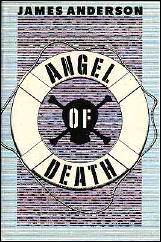
JAMES ANDERSON

JAMES ANDERSON – Angel of Death. Doubleday Crime Club, US, hardcover, April 1989. First published in the UK: Constable, hc, 1978.

   Six members of a yachting party are deliberately yet randomly poisoned while sailing in the Caribbean. The question is, how did the killer make sure that the six who died were exactly the ones he was aiming for?

   Alec Webster, recently resigned from Scotland Yard, is the investigator in this highly unlikely combination of Agatha Christie and Aristotle Onassis. The puzzle is a clever one, though, and it’s exactly why I love stories like this.

   On the other hand, plots of this type have to be given lots of room to breathe. The main scheme in this one is worked out in some detail, but both the setup and solution are crammed into only a few chapters somewhere soon after the middle. It’s never given a chance to show how good it really is.

***

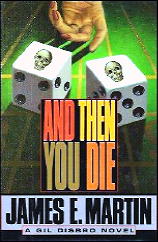
JAMES E. MARTIN

JAMES E. MARTIN – And Then You Die. William Morrow, hardcover, 1992. Reprint paperback: Avon, September 1993.

   In Cleveland PI Gil Disbro’s third case, he’s hired to find a missing wife, last seen in Nevada getting a divorce and gambling away a fortune.

   Things get complicated when his client is then found murdered, but Disbro, of course, stays on the job.

   The result is a fast-moving detective tale with good, sensitively macho dialogue and a tangled plot that somehow manages not to be spoiled by a twist that’s just two jots short of obvious.

***

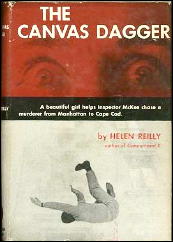
HELEN REILLY

HELEN REILLY – The Canvas Dagger. Random House, 1956. Hardcover reprint: Detective Book Club, 3-in-1 volume, April 1957. Paperback reprints: Bantam #1858, 1959; Ace Double #G-531, ca.1965, abridged, bound with Not Me, Inspector; Macfadden, 1970; Manor, 1974.

   A young woman in New York City witnesses a murder from a building across the street, and when the police don’t believe her, she and all the suspects in the case travel to Cape Cod, where more murders occur.

   Reilly’s prose varies from passably good to overwrought, but the ending is what does this one in, bringing in (hey?) Commies at the very last minute.

— Reprinted from Mystery*File #35, November 1993.


Previously reviewed on this blog:

    James Anderson: Assault and Matrimony.
    Helen Reilly: The Silver Leopard.

   Also, for an long essay on Helen Reilly’s mystery fiction by Michael Grost, go here on the main Mystery*File website. Included on that page is a complete bibliography for the author.

REVIEWED BY WALTER ALBERT:         


JEFFERY DEAVER Broken Window

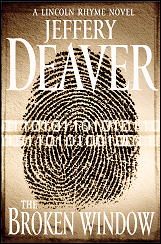
JEFFERY DEAVER – The Broken Window. Simon & Schuster, hardcover, June 2008. Reprint paperback: Pocket Star, April 2009.

   Lincoln Rhyme and Amelia Sachs are drawn into the net of a cyberspace genius who steals personal information and uses it to frame innocent people for murders he’s committed.

   Rhyme’s cousin Arthur is one of the victims, but it’s soon apparent that he’s only the latest in a series of brilliantly planned and executed frame-ups.

   Throw in the powerful and sinister Strategic Systems Datacorp, and you have a thriller that seems to be everybody’s worst fear: the takeover of our lives by a corporation that knows everything about us and is prepared to use that information without any concern for the lives that might be destroyed by it.

   Ultimately, the reader gets the feeling of being manipulated once too often by the ingenious Deaver, but up to that point it’s a hair-raising ride.

A REVIEW BY MARYELL CLEARY:
   

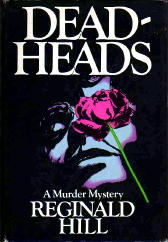
REGINALD HILL – Deadheads. Macmillan, US, hardcover, 1984. Collins Crime Club, UK, hc, 1983. Paperback reprint: Signet, US, 1985.

REGINALD HILL Deadheads

   Deadheads is a tour de force in more ways than one. Each chapter is named for a rose, whose characteristics make up the chapter heading; each is appropriate to the content, from “Mischief” for Chapter 1 to “F�licit� et Perpetu�” at the end.

   The title is a double entendre. Is it just coincidence that people die so conveniently for Patrick Aldermann, owner of the Rosemont estate and proud grower of roses? His employee, “Dandy Dick” Elgood, is suspicious and tells the police so, but then withdraws the complaint.

   But policemen are not so easily called off. Sergeant Pascoe is intrigued by another coincidence, his wife Elly and Aldermann’s wife Daphne meeting and becoming friends just as the investigation starts. Superintendent Dalziel, now being likened by his subordinates to a dinosaur, takes the opportunity of a conference in London to renew an old acquaintanceship with Aldermann’s mother, and thereby furthers the investigation.

   In collateral roles ugly Sergeant Wield, a secret but unrepentant homosexual, and police cadet Shaheen Singh, Yorkshire born and bred, are interesting additions to the police cast. Suspense is maintained right up to a smashing ending. A gripping story with well-realized characters — Hill gets better and better.

� Reprinted from The Poisoned Pen, Vol. 6, No. 4, Fall 1986.


Previously reviewed on this blog:

      Midnight Fugue (by Ray O’Leary)
      Ruling Passion (by Steve Lewis)

Reviewed by DAVID L. VINEYARD:         


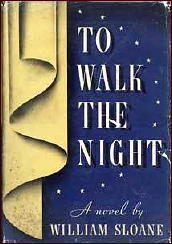
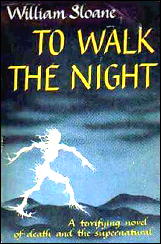
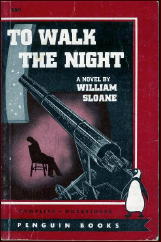
WILLIAM SLOANE – To Walk The Night. Farrar & Rinehart, hardcover, 1937. World/Tower, hc reprint, 1946. Paperback reprints include: Penguin-US #550, 1944; Dell #856, 1957; Bantam H3426, 1967; Del Rey, 1980.
WILLIAM SLOANE To Walk the Night

   There are books that are not only genuinely scary, but more importantly genuinely disturbing. The scream or the sudden start is less part of their impact, than the frisson, that deep chill that rises from the soul and is often described as feeling as if someone has walked over your grave.

   Most writers only manage one of these, however masterful their output: Cornell Woolrich’s Night Has 1000 Eyes (written as George Hopley), Shirley Jackson’s The Haunting of Hill House, Thomas Tryon’s The Other, Gordon Williams’ Neither the Sand Nor the Sea, Fritz Leiber’s Conjure Wife, Jack Williamson’s Darker Than You Think, and William Lindsey Gresham’s Nightmare Alley are a few examples of the form.

   William Sloane was unique in that he wrote two books that fit this category. They were the only two books he wrote in a long and distinguished literary career which included being a vice president at Holt, editorial director at Funk and Wagnalls, director of Rutgers University Press, and founder of William Sloane Associates. Indeed, writing two classics on top of all that seems like overkill.
WILLIAM SLOANE To Walk the Night

   But classics they are. By far the best known of the pair was The Edge of Running Water (aka The Unquiet Corpse and filmed as The Devil Commands (reviewed here )), an acknowledged classic of the Campbellian school of fiction represented by the pulp magazine Unknown (despite the fact Sloane’s novels predate the Unknown school) where science fiction, fantasy, horror, the thriller, and the genuine gothic all cross.

   But while Edge of Running Water is a genuine classic and a great work, by far the novel that held my imagination longest and still does was Sloane’s first novel, 1937’s To Walk the Night. It’s frights are more subtle than The Edge of Running Water, but no less disturbing.

   To Walk the Night unfolds like a mystery novel. Bark Jones has gone home to visit Dr. Lister, the father of his friend Jerry, and together they hope to lay the mystery that revolves around the deaths of Jerry, and before him Jerry’s mentor astronomer Professor LeNormand. The one key to both men’s deaths is LeNormand’s, and now Jerry’s widow, Selena.

   Selena.

   There aren’t many women in fiction like Selena. She could stand beside Rider Haggard’s Ayesha without so much as a blush. She makes her entrance after her husband’s death — seemingly by spontaneous combustion — and for Jerry it is love at first sight. For Bark it is something else. A mystery that is both fascinating and horrible in its implications.
WILLIAM SLOANE To Walk the Night

    The nearest I can come to a description of her is to say she was like one of the beggars on a city street whose faces are indifferent to life because they no longer have anything to hope from it. She was not tragic, or sorrowful, or frightened. She was simply indifferent.

   She is also stunningly beautiful though she dresses badly and seems equally indifferent to her beauty. Jerry woos her, and not two months after LeNormand’s death they marry and move to their new home in the American Southwest where Jerry plans to continue his mentors studies.

   Meanwhile Bark continues to probe and try to put together some sense from Selena’s manner. Who is she? She doesn’t seem to have existed before two years earlier, and yet she closely resembles a severely brain damaged girl who disappeared at the same time Selena showed up.

   At times she seems to actually have loved LeNormand and to love Jerry, and yet there is no passion in her, no humanity, and she is oddly and inexplicably ‘other.’ At one point she brakes a car before anyone could have known of the obstacle that appears before her.

   She is simply not quite human, based on the smallest of evidence — the way she out shines a nightclub magician, or her strange ignorance of the most common of things. And yet she is a superb dancer, a normal housewife, and in her own way seems to genuinely love her husband.
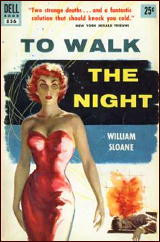
WILLIAM SLOANE To Walk the Night

   But Jerry will not abandon his research, and as he comes closer to the same revelations that drove his mentor, a crisis is approaching.

   The detail of incident is built slowly and Bark frequently apologizes to the reader for dwelling on the tiny incidents that comprise his story. But subtly and with increasing tension the reader begins to feel the very real dread that is building — much like a nightmare that one can’t be awakened from. Even Jerry feels it, something is not quite right:

    “I feel all the time as if she was holding something back. Sometimes it’s almost as if she felt I wasn’t old enough to know something. And I can’t find out what it is. What it is she knows that I don’t. There’s something in between us, that’s all.”

   Probably every married man has experienced that feeling at some point in his marriage, no matter how happy his marriage is overall, but with Selena the worry is real. It’s a mark of Sloane’s skill as a writer that he manages a moment of genuine frisson from a fairly normal moment between a man and a woman that in other hands might spark an episode of a sitcom.

   What that something is worries at Jerry’s mind. He knows if he can identify it he can lay not only the mystery of what or who killed LeNormand, but also put an end to that distance between he and Selena.
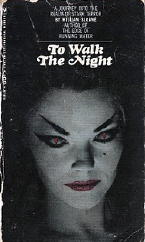
WILLIAM SLOANE To Walk the Night

   And in a way he is right, because LeNormand’s calculations are the key to everything; his death, Selena’s peculiar nature, and Jerry’s fate, and unraveling that final mystery will be a fatal mistake. Some things we aren’t meant to know …

   To Walk the Night (the title comes from Selena’s nocturnal walks in the high desert) does not disappoint. The solution veers into true science fiction, and yet I can’t honestly call this a science fiction novel. It reads much more like a suspense novel or a true gothic. In fact what genre, if any, it belongs to is a minor consideration. It transcends genre, and stands on its own as simply a stunningly good read.

   Sloane is a first rate writer and the novel is beautifully written. The ending is haunting, and yet understated with genuine power.

   Don’t finish this one right before bed. You are apt to have a restless night, not so much from fear exactly, but because you can’t quite let go of this, even when you want to.

   I’ll let Selena speak for herself. This speech is from Selena to Jerry’s father, Dr. Lister, near the very end of the novel:

    “Do you imagine that you are the ultimate product of creation? There is nothing unique about you.” Her tone was so level, so coldly insistent that even Dr. Lister seemed to shrink in upon himself. “Is there any reason why I must leave you alone? You do not own me and you have no power over me. Why,” she said, and there was an edge of blanket amusement in her tone, “when the earth has traveled around the sun a few more times, you will be dead.”

   Though she addresses herself to Jerry’s father, it is mankind she is speaking to, and mankind itself that will no longer exist when the world has ‘traveled around the sun a few more times.’
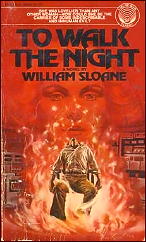
WILLIAM SLOANE To Walk the Night

   This would have been a remarkable novel to be written after the birth of the nuclear age and after the devastation of the Second World War. To be written before it is all the more remarkable.

   By all means read this one. But keep the light on. And for those of you married men, if you find yourself wondering about the ‘other’ in your life, blame Sloane, not me. To Walk the Night is a murder mystery, and it does have real clues, and an actual solution, but like Robert Louis Stevenson’s The Strange Case of Dr. Jekyll and Mr. Hyde, the solution may well be more horrible than the crime.

Note: There seems to be some confusion as to whether the 1963 British film Unearthly Stranger with John Neville is based on Sloane’s novel or not. The stories are similar, but not having seen the film I don’t know if Sloane is credited in the screen credits or not.

   IMDb does not mention Sloane as the source for the film, but I have seen it described elsewhere as being based on Sloane’s novel. Maybe someone out there can solve the mystery. No doubt it will be a less disturbing solution than the one to Sloane’s novel.
A TV Review by MIKE TOONEY:


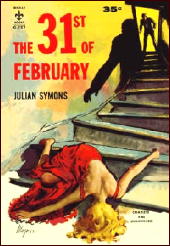
“The Thirty-First of February.” An episode of The Alfred Hitchcock Hour (Season 1, Episode 15). First air date: 4 January 1963. David Wayne, William Conrad, Elizabeth Allen, Staats Cotsworth, William Sargent, Bob Crane, King Calder, Bernadette Hale, Kathleen O’Malley, Robert Carson. Teleplay: Richard Matheson, based on the novel The Thirty-First of February (1950) by Julian Symons. Director: Alf Kjellin.

31ST OF FEBRUARY

   As the play opens, an inquest is being held into the death of Valerie Anderson (Kathleen O’Malley), who evidently tried to walk down a flight of steps to her cellar, despite a burned-out light bulb, stumbled, and broke her neck in the fall. Everything seems to point to accidental death, and the coroner rules it that way.

   Val’s husband Andrew (David Wayne) decides the best thing to do would be to go immediately back to work. But it’s there among his colleagues that things begin to deteriorate.

   Little items which would ordinarily be minor annoyances begin to crop up and incrementally erode Andrew’s sangfroid: a desk calendar marking the date of Val’s death, an unsigned poisoned pen letter implying Val was having an affair with someone at the firm, two interoffice memos that get mixed up and sent to the wrong people, a new employee who seems to be following Andrew around, another desk calendar with the nonsensical date of “February 31st” inscribed on it, and even having his house ransacked.

   And then there’s that police sergeant (William Conrad), who on every occasion they meet keeps insinuating that Andrew murdered Valerie but insists he isn’t implying any such thing.

   Not only is Andrew’s emotional composure slowly cracking, but his vulnerabilities are also becoming more obvious. You see, Andrew never loved Val; he admits as much to the woman he really loves, Molly O’Rourke (Elizabeth Allen) — but he does so just before he tries to choke her. He also comes to believe that several of his colleagues, as per the letter, were having an affair with Valerie and irrationally accuses them to their faces, making him look even more paranoid.

   One thing’s for sure: If Andrew did kill Val, then his guilty conscience is tearing him apart — but, if he didn’t kill her, then he’s in the crosshairs of a plot not just to put him in prison but also to drive him insane ….

   David Wayne’s criminous credits include Hell and High Water (1954), as The Mad Hatter on four episodes of TV’s Batman (1966-67), Arsenic and Old Lace (TVM, 1969), one Banacek (1973), as Inspector Richard Queen (sans moustache) in 23 episodes of Ellery Queen on TV (1975-76), and an appearance on Murder, She Wrote in a clever locked-room mystery, “Murder Takes the Bus” (1985).

   William Conrad was always playing heavies, both figuratively and literally. Credits include The Killers (1946), Body and Soul (1947), Sorry, Wrong Number (1948), Tension (1949), East Side, West Side (1949), One Way Street (1950), Dial 1119 (1950), Cry Danger (1951), The Racket (1951), Cry of the Hunted (1953), The Brotherhood of the Bell (TVM, 1970), as Nero Wolfe on TV (14 episodes, 1981), and in the series Jake and the Fatman (104 episodes, 1987-92).

Hulu: http://www.imdb.com/video/hulu/vi853016601/

AL CODY Bitter Creek

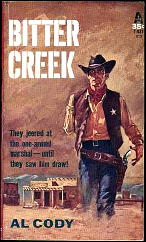
AL CODY – Bitter Creek. Avon T-431, paperback, no date [1960]. Hardcover edition: Dodd Mead, 1947. Earlier pb reprint: Pocket #769, December 1950.

   When a one-armed Civil War veteran comes home to his ranch and fiancee, he discovers that both his ranch and fiancee have been stolen from him by a long-time rival. This is my favorite type of western story, I think, and this one has some sharply pleasing twists of coincidence to go with it. Tightly plotted, with many of the characters a solid notch beyond cardboard.

BRIAN WYNNE GARFIELD – Vultures in the Sun. Ace F-300, paperback reprint, no date [1964?]. Hardcover edition: Macmillan, 1963. Later paperback reprint: Bantam, 1987.

   Another common theme in western novels is that of the gunfighter who would like to quit and settle down, but can’t. In this one, when Ethan Scott agrees to rid a town of outlaws, he knows full well that when the job is done, he won’t be wanted around much longer. The story is moody and introspective, and it often seems static and unmoving, but the characters are strong and memorable. Good stuff.

AL CODY Bitter Creek

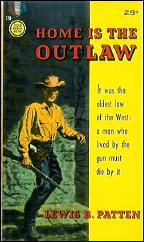
LEWIS B. PATTEN – Home Is the Outlaw. Gold Medal #778, paperback original, June 1958.

   An echo of the preceding book, developed in a much more obvious fashion, and punctuated instead by almost constant action. Gunfighter Morgan Orr returns to his home town to try to make a new life for himself, only to find the woman he remembers no longer available, and a guilty secret ready to burst the town wide open. This is a violent book, but one that’s tough to put down.

— Reprinted from Mystery*File #35,
      November 1993.


[UPDATE] 04-16-10.   A footnote to these three reviews at the time says that I’d just purchased a lot of 600 western paperbacks, of which I’d kept 450 for myself. As I recall, until I obtained this lot, I hadn’t been reading westerns as part of my regular diet for quite a while — ever since the mid-1960s — so I was devouring them quickly.

   Also note how short these reviews were. I was going through a kind of writer’s block at the time, and I was forcing myself out of it by making my reviews as brief and concise as I could.

« Previous PageNext Page »