Reviews


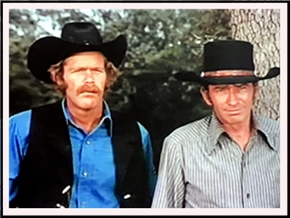
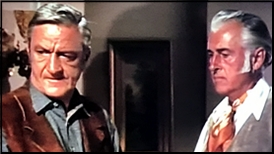
THE MEN FROM SHILOH. “The West vs. Colonel MacKenzie.” NBC, 16 September 1970. (Season 9, Episode 1, of The Virginian). Stewart Granger (Colonel Alan MacKenzie), Doug McClure (Trampas), James Drury (The Virginian), Lee Majors (screen credit only). Guest Cast: Elizabeth Ashley, Martha Hyer, Don DeFore, John Larch. Directors: Murray Golden & Jerry Hopper. Currently streaming on the Starz channel.

   When the TV series The Virginian began its ninth series, some changes were made, starting with the title. The new owner of the Shiloh ranch also showed up: Alan MacKenzie (Stewart Granger), a British army colonel, along with his former aide-de-camp, now a combination valet and butler. As the new owner, the intent was to give the show a new perspective, that of someone unfamiliar to the West, someone who must learn its new ways and how things are done. On the job training!

   When he arrives, both Trampas and the Virginian are ready to step aside, but by the end of this first episode, they have agreed to stay. Roy Tate, a new regular to be played by Lee Majors, does not yet appear.

   Col. MacKenzie does not have long to wait to get his first crisis under his belt, that of the hanging of a suspected rustler by a gang of vigilantes. His sister claims he was innocent, and MacKenzie is inclined to agree with her. This simple act puts him in direct opposition to the sheriff and the local Cattleman’s Association. Nothing like getting off on the wrong foot with the people in power in the country you’ve just moved into.

   Given the 90-minute format the series always had, there’s plenty of time to flesh out the story without feeling that there was padding to waste, at least this time around. While I found nothing amiss in having an Englishman in charge of the ranch, I did find Col. MacKenzie a little too kind and good to be true. But kindness and goodness sometimes win out, and not very surprisingly, they certainly do here.


REVIEWED BY JIM McCAHERY:


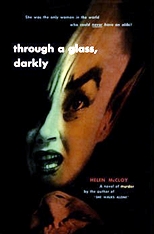
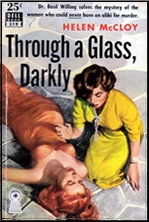
HELEN McCLOY – Through a Glass, Darkly. Basil Willing #8. Random House, hardcover, 1950. Dell #519, paperback, mapback edition, [1951]. Dell, paperback, date?

   This is  the eighth novel featuring psychiatrist-detective Dr. Basil Willing, recently returned from Japan after completing his military service. Willing is alerted by his soon-to-be fiancée and wife Gisela von Hohenems to the strange happenings surrounding Faustina Crayle at Brereton, a school for girls where they are both teachers — Gisela in German and Faustina in Art.

   It would appear that Faustina has been seen bilocating more than once. When she is finally released from her teaching contract, Willing decides to investigate these “supernatural” appearances which he is convinced have. their roots in reality.

   He soon learns that Faustina had been discharged from her first teaching position for the same reason. Further probing suggests that it  is  not just Faustina’s reputation that someone is out to destroy, and there are two deaths  before a final confrontation.

   This is probably the best use of the Doppelganger theme since Dorothy L. Sayers’ The Image in the Mirror. The title taken from Cor1nthians is very cleverly used here, but its significance does not become clear until the denouement.

   The novel is an expansion of Miss McCloy’s 1948 short story of the same name which appeared in the September issue of EQMM.

– Reprinted from The Poison Pen, Volume 3, Number 3 (May-June 1980).
REVIEWED BY MARYELL CLEARY:


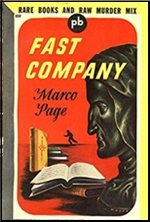
MARCO PAGE – Fast Company. Dodd Mead, hardcover, 1938. Pocket Books #222, paperback, 1943. Film: MGM, 1938, with Melvyn Douglas & Florence Rice as Joel & Garda Sloane.

   Dealers in rare books and manuscripts can be as crooked as anyone else; that’s the lesson Marco Page teaches. Joel Glass, book dealer himself, turns detective to find the murderer of a dealer who is as nasty a piece of work as anyone I’ve known killed off lately in books.

   A young man who recently got out of prison after serving a term for stealing some outstanding rarities from the dead man is the obvious suspect. He knows that he was framed. And Mr. Glass is sure that he was.

   The books have disappeared. Glass thinks the dead dealer had them stashed away some place. Since there are other possible murderers with a variety of motives, there is plenty of action. The solution is satisfying, but I’d hate to think that any of the book dealers I know are at all like the ones in this book.

– Reprinted from The Poison Pen, Volume 3, Number 3 (May-June 1980).

JOLT. Millennium, 2021. Kate Beckinsale, Bobby Cannavale, Laverne Cox, Stanley Tucci. Jai Courtney, David Bradley. Director: Tanya Wexler. Streaming on Amazon Prime.

   There is about half a good movie in this recent action-comedy thriller. The second half? Pure dreck. And not good dreck at that.

   Kate Beckinsale (last seen by me in The Widow, reviewed here )  plays Lindy Lewis (no relation), a woman who since she was a young girl has been afflicted with intermittent explosive disorder, which I have discovered is a real thing. Anyone having the problem is plagued by bouts of anger, rage and utter hostility toward others, expressed by outbreaks of uncontrollable violence.

   Lindy’s case is far worse than others. She barely has a life, cannot hold a job, and when it comes down to it, simply cannot get along with others. Finally, now grownup, she has found a doctor to help control the symptoms. It’s only in the experimental stages, but by wearing an intricate wire harness, Lindy can push a button and give herself a jolt of electricity to subdue her violent urges.

   Problem is, as soon as she finally meets the man of her dreams, he’s found murdered, even before they have their third date. The police are of no help. Solution: find the man responsible, and provide her own punishment.

   This first half of the movie is fun and even a little romantic and and funny. Enjoyable, even. Problem is, moviewise, from this point on, it seems that working intensively with her problem over the years, Lindy has developed what the comic books call superpowers, and there’s no way that anyone that gets in her way can stop her. Lots of action, violence, bad language and fighting ensue. All of which are boring. Even the villains of the piece are boring. Eh. Who cares? Not I, said this viewer.


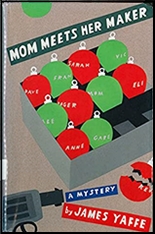
JAMES YAFFE – Mom Meets Her Maker. Mom (and son Dave) #2. St. Martin’s, hardcover, 1990. Worldwide, paperback, 1991.

   After appearing in eight short stories in EQMM between 1952 and 1968, Mom and her son Dave began a new career of sorts with a new series of full-length novels between 1988 and 1997. In these Dave has left his job as a NYPD police detective and moved to Mesa Grande, Colorado, to work as an investigator for the city’s public defender’s office.

   By book two (this one), Mom has decided that the big city has become too much to live in alone and has also moved to Mesa Grande. She still needs to be filled in on Dave’s cases, though, and as an armchair detective is quite a dedicated and quite welcome assistant.

   This one starts slowly. A Jewish couple have recently come under attack, if you will, by their next door neighbors, the Reverend Chuck Candy and his wife. Candy is the self-appointed pastor of Effulgent Apostles of Christ church, and for some reason this Christmas they have gone gonzo with flashing lights, brilliant decorations and carols booming from an outdoor loudspeakers. The Meyers, being Jewish, are not amused. Their son, trying to help out, goes over to see of some accommodations can be made, but instead he’s arrested for assault with a deadly weapon.

   As I say, a slow start. The first murder, that of Reverend Candy, does not occur until about seventy pages in, and for a devout reader of detective stories, the rest of the book is a doozy. Accused again is the Meyers’ son. Written on the rug where the minister’s body is found are the words “Gold, Frankincense and Myrrh.”

   A brief warning, should you ever pick this one up to read. You’ll have to read this one very, very carefully. It’s about the best example of a recently published mystery (well, thirty years ago), that’s also  a “fair play” mystery I’ve had the pleasure to read recently, written in prose that’s clear and continually to the point. I hesitate telling you more about the “dying message” because why should I spoil the pleasure for you?

   There are a couple of things I can express some unhappiness with, though. The villains of the piece are little more than straw men set up only to be disliked at once, if not outright hated. And you would think the bit of a “would-be informant refusing to tell what he knows until tomorrow” would have been retired a long time ago, but it never occurs to Dave or his boss that, well, you know.

   This one shouldn’t hard to find. Undue haste is probably not necessary, but if I’ve tempted you at all, that’s exactly what I think you should do.

PostScript: A Tip of the Hat to fellow blogger TomCat, whose rave review a week or so on his blog is what prompted me to track this one down myself.
   

      The Mom and Dave novels —

A Nice Murder for Mom (1988)
Mom Meets Her Maker (1990)
Mom Doth Murder Sleep (1991)
Mom Among the Liars (1992)
My Mother the Detective (1997)

IT IS PURELY MY OPINION
Reviews by L. J. Roberts


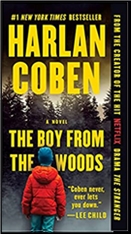
HARLAN COBEN – The Boy from the Woods. Wilde #1. Grand Central Publishing, hardcover, March 2020; paperback, June 2021. Setting: Contemporary New Jersey.

First Sentence: How does she survive?

   Thirty years ago, Wilde was found living nearly feral in the woods with no memory of his past or his family.

   This will be short. Harlan Coben’s early books were fun to read. Now, it seems, he is writing to be televised because that’s where the real money is made. They are filled with stereotypical television characters. We have the sad, outcast girl; the mixed-race teen who wants to do the right thing but isn’t strong or brave enough; the outspoken, older woman full of snarky quips; the outcast girl’s suspicious father…

    …the super-wealthy father protecting his super-bully, over-indulged kid; the nice cop who wants to help but doesn’t want to piss off the super-wealthy guy. Most importantly, we have the tall, strong, gorgeous, former ranger hero who can take on the bad guys with a pea while being desired by every woman. Did I miss anyone?

   The story is total escapism and requires a huge suspension of disbelief, including, as was pointed out by a fellow reader, Wilde having an iPhone with a data plan when he’s paranoid about security and privacy, and the ending makes no sense at all.

   The Boy from the Woods is an acceptable airplane book if one is into Jack Reacher-type superheroes, and desperate for something to read. It will hold one’s interest for the length of the flight but is then left on the plane, never to be thought of again. For pure entertainment, it’s fine, but there’s no substance.

Rating: Not Recommended.
          ___

Bibliographic Update: There will soon be a second book in the series. The Match is set to appear in March 2022.

REVIEWED BY DAN STUMPF:


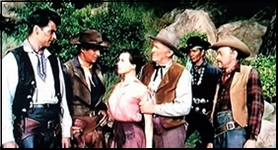
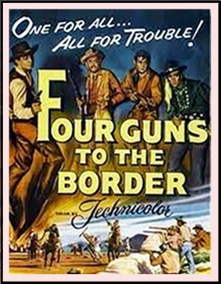
FOUR GUNS TO THE BORDER, Universal, 1954. Rory Calhoun, Colleen Miller, John McIntire, Walter Brennan, George Nader, Jay Silverheels, Nina Foch, Charles Drake, Nestor Paiva, and Mary Field. Screenplay by George Van Marter and Franklin Coen, from a story by Louis L’Amour. Directed by Richard Carlson. Streaming on Starz until December 1st.

   The Asphalt Jungle with Indians. And not bad.

   Rory Calhoun plays an out-and-out owl-hoot in this one, the CEO of an outlaw band that includes John McIntire, George Nader, and Jay Silverheels (as a Yaqui Indian this time) on the run from one unsuccessful robbery, and planning another effort.

   Along the way they meet up with Walter Brennan, a reformed outlaw and old saddle pal of McIntire’s, and his daughter (Colleen Miller) who could best be described in frontier terms as a buxom lass, or as we say today, a real hottie. Writers Van Marter and Coen go out of their way to get her wet as often as possible, and director Carlson shows her off to excellent effect, sure to keep the big kids (this one, anyway) in their seats while the little ones go for popcorn.

   There’s not much time for popcorn, though, because Rory’s plan calls for the other three to hit the bank in his old hometown while he picks a fight with his old-buddy-turned-lawman (Charles Drake) who ran him out of town and married his gal (Nina Foch) years ago.

   So we get a vigorous and protracted fight between Calhoun and Drake, cross-cut with a tense bank job, followed by a pursuit conveniently interrupted by marauding Apaches. Of course, when Calhoun and his band are faced with the choice of making their escape or going to the aid of Brennan and Miller, pinned down and surrounded by hostiles, they do what every kid in the audience would, and we get another pitched battle.

   Yeah, it’s all a little too pat. Chalk it up to the writers, whose work (separately) includes high points like The Train and Champagne for Caesar, and dreck like Chained for Life — a very mixed bag, to be sure. But it finishes off with a powerful showdown between Calhoun, badly wounded, and Drake, badly humiliated, shot for maximum emotional tension by Carlson, who alternates tracking shots of the antagonists with long shots that frame the conflict perfectly.

   Added up, this one is a touch formulaic, but still intriguing. And Collen Miller will keep you watching.


SAMUEL R. DELANY – Babel-17. Ace F-288, paperback original, 1966. Reprinted many times, including: Bantam, paperback, 1982, with minor deletions restored. Nebula Award for Best Novel of the Year.

   Rydra Wong, a poet with a gift for languages, is given the task of deciphering Babel-17, a language apparently used by the invaders during their attack on Alliance installations. It is actually a weapon capable of taking over the thought processes of those who understand and use it.

   A brilliant display of strange characters and unusual science-fictional ideas, set in a realistic but mind-warping universe. Babel-17 itself enables one “to move through psychedelic perspective (page 108); is a “flexible matrix of analytic possibilities” (page 112).

   The night spent in Transport Town gathering a space crew is as effectively weird as any in horror fiction, with discorporate beings, including an active succubus, and cosmetically altered humans (the psychological implications of which are discussed on pages 51-52), combining to form a distinct world of their own.

   Later, the scene between Rydra and the Butcher as she teaches him the words “I” and “yes” is superb in both semantic and psychological interpretations. Delany includes himself in this universe, as Muels Araslyes, who once tripled with Rydra.

   An outstanding work, but his best is yet to come.

Rating: ****½

–November 1967
REVIEWED BY DAVID VINEYARD:


JOHN WELCOME – Run for Cover. Richard Graham #1. Faber and Faber, UK, hardcover, 1958. Knopf, US, hardcover, 1959. Perennial Library, US, paperback, 1983.
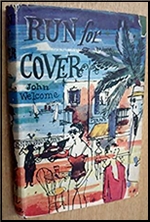
   â€œI’ve got something here for you right up your street,” he said. “Cloak and Dagger stuff. Needs working on but I think there may be a book in it … Read it for me… it’s by someone I never heard of, chap named Rupert Rawle.”

   I stopped dead in my tracks.

   â€œRupert!” I exclaimed. “Rupert Rawle! But he’s dead!”

   A chance meeting with a publisher friend opens the door to the past for Richard Graham.

   Richard Graham, gentleman steeplechase jockey and one time commando, has good reason to think Rupert Rawle dead. Rupert Rawle betrayed his Commando Unit in the War on a mission, shot Graham and left him for dead, leaving him to eventually ending up in a POW camp. Rawle also stole a beautiful woman from him, one he might have been in love with.

   But here is someone named Rupert Rawle who has written a book called Waters of Strife.

   For Richard Graham its an invitation to a nightmare to relive those desperate days, find this man calling himself Rupert Rawle, and uncover secrets better left buried, secrets some will still kill for.

   For instance why are they so curt when Graham tries to check with old sources from his Commando days. Rawle is dead. Rawle is most certainly dead.
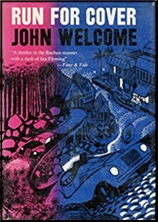
   But is he?

   Granted this was a favorite plot of the time period in the decades after WW II, what was heroism, who betrayed whom and when and why, even who is dead and who isn’t? It shows up in the works of dozens of British thriller writers and in films, but it is done really well here in Welcome and Graham’s debut.

   Held prisoner in a French farm house while tracking down Rawle, Graham exchanges a bit of banter with his captor.

   â€œYou’re a strange chap, Graham, I didn’t think your sort could read.”

   â€œI’m a throwback to the Thirties, the last of the literary toughs. You ought to hear me quoting Proust in the weigh-room.”

   John Welcome was well placed to write about literary toughs. In addition to editing several books of the best racing stories he also edited two books of the best Secret Service adventures. A literary solicitor, he knew Dennis Wheatley and encouraged Dick Francis to take up thriller writing. On his own he wrote a number of Richard Graham adventures and stand alone titles between 1959 and the 1970’s and a few best sellers in England in the R. F. Delderfield vein (Bellary Bay).

   Hunting for Rupert Rawle, Graham uncovers an espionage plot, a beautiful and mysterious woman, and finds himself with a choice between his career as a gentleman rider and as a spy.
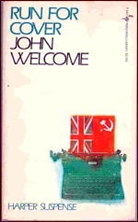
   Welcome keeps tongue ’n cheek without ever getting silly or precious. He doesn’t take himself or Graham too seriously. Trapped in second story bathroom Graham checks out the window as a means of escape and decides while Dornford Yates’ Richard William Chandos might try it, he would likely break his fool neck.

   Barzun and Taylor were appreciative of Welcome’s books, and with reason. They move fast, are well written, literate, and the kind of pleasant thriller perfect for an evening of armchair adventure and intrigue.

   I hated Rupert. I should have killed him. I had a gun in my pocket. And the world would be well rid of him and I would have laid a twelve year old ghost. Or did I really hate him? No dammit, I didn’t. The old spell was there again.


   There are several mentions of Dornford Yates in the book, and it is not without meaning. Welcome has captured something of the romance of Yates’ best books without the snobbery or attitudes. Graham is more attractive than Yates heroes (Rawle ironically sounds more than a bit like Jonah Mansel), far less certain of his British superiority, but Welcome has captured the same romance of expensive British cars rushing about on the Continent with dashing heroes involved in adventure and intrigue.

   Appropriately Run for Cover ends with an act of contrition and sacrifice as Graham has a reckoning with his past and his future, a good modern thriller with something of the charm of the past and few of its more annoying tropes.

   By all means this isn’t for everyone, but if you like this form of British thriller done well Welcome will be… welcome.
   

      The Richard Graham series —

Run for Cover. Faber 1958.
Hard to Handle. Faber 1964.
Wanted for Killing. Faber 1965.
Hell Is Where You Find It. Faber 1968.
On the Stretch. Faber 1969.
Go for Broke. Faber 1972.
REVIEWED BY TONY BAER:


PATRICIA HIGHSMITH -Edith’s Diary. Simon & Schuster, hardcover, 1977. Pocket Books, paperback, 1978. Reprinted several times since. Film: Germant, 1983, as Edith’s Tagebuch (Edith’s Diary).

   Edith has a diary. She got it from her beloved aunt. It’s a very nice diary.

   Edith has a life. A pretty ordinary life. A husband, a son. The kind of son that likes to tear the wings off flies. But hey, you can’t have everything.

   They move to the country from NYC. And that’s okay. Kinda boring. But okay.

   Then her hubbie’s dilapidated uncle moves in to an upper bedroom, needing care, and stingy. But hey. No biggy.

   Then her hubbie leaves her for a younger woman from the office.

   Meh. No big deal. I mean, it sucks, right? But hey. Shit happens.

   The kid grows up to be a nothingburger. A lush. A weakling. A beerbellied wanker.

   But, meh, what can you do.

   On the positive side, there’s Edith’s diary.

   Why put down all the boring stupid things. Who has time for that?

   Rather, put down the life you wish was happening. Similar. But with some perks.

   Say, like, why write about her kid that’s a do-nothing wanker?

   Rather, about her kid’s unrealized potential life: He goes to Princeton, he’s an engineer, he’s successful, he’s got a nice house, a nice wife, and two adorable little children.

   Her diary becomes an alternate life. A life where her hopes and dreams become real. A life much more tangible and fulfilling than her own.

   Becoming a sculptress, she even makes busts of her imaginary grandchildren, so they become real, out of clay.

   She’s beginning to plan for their visit. She’s beginning to speak with them.

   What could possibly go wrong?

« Previous PageNext Page »