1001 Midnights


A 1001 MIDNIGHTS Review
by Bill Pronzini:


MIKE BARRY – The Lone Wolf #14: Philadelphia Blowup. Berkley, paperback original, 1975.

MIKE BARRY Philadelphia Blowup

   The success of Don Pendleton’s Executioner series in the early 1970s naturally spawned a host of imitators. Like Mack Bolan, the Executioner, these other rough, tough, and lethal heroes are one-man armies embarked on a personal crusade to destroy the Mafia, the “Communist conspiracy,” or similar organizations/ideologies in the name of justice and/or democracy, and by whatever means necessary.

   The Lone Wolf series is one such imitation, and on the surface is solidly in the conventional action/slaughter mold. The lone wolf of the title, ex-New York narcotics cop Burt Wulff, embarks on his one-man vendetta against organized drug traffic in the United States when his girlfriend, Marie Calvante, is found dead of an overdose in a Manhattan brownstone.

   His savage quest carries him through fourteen novels — each one set in a different U.S. city, each one dealing with a different arm of the vast drug network — and culminates in a bloodbath in the City of Brotherly Love.

   But there is much more to this series than meets the casual eye. “Mike Barry” is a pseudonym of Barry N. Malzberg, a writer of no small talent who specializes in stream-of-consciousness science fiction. Indeed, the Lone Wolf books are essentially plotless, make extensive use of the stream-of-consciousness technique, and are jam-packed with idiosyncratic prose much more suited to a mainstream literary novel than to a paperback paean to violence:

    “Hello, death. Pleased to meet you, death. Been with you for a long time, death, waiting in these rooms for your call, and now here you are, old friend, old bastard, and absolutely nothing to do. Have a chair, death. Warm your hands by the fire, pal, rest easy. We’ll be together for a long time so don’t feel in any hurry to start talking.”

   And Burt Wulff is anything but your standard macho hero; he is, in fact, a raving lunatic who, by the last three books in the series — Philadelphia Blowup, in particular — is knocking off people for the sheer soaring pleasure of it: a serial killer as psychotic as Gilles de Rais or Son of Sam. In this respect, then, his saga is both a mockery and a condemnation of the whole Executioner subgenre.

   The Lone Wolf novels are not without their flaws, certainly. They were written rapidly and show it; there are any number of factual and geographical errors, and the lack of cohesive plotting makes for a great deal of repetition. Nevertheless, as amazing hybrids of the literary novel and the potboiler, as a saga of one man’s breakdown into psychosis, as an implacable send-up of the Executioner and his ilk, these fourteen books are quite remarkable.

         ———
   Reprinted with permission from 1001 Midnights, edited by Bill Pronzini & Marcia Muller and published by The Battered Silicon Dispatch Box, 2007.   Copyright © 1986, 2007 by the Pronzini-Muller Family Trust.
A 1001 MIDNIGHTS Review
by Bill Pronzini:


JOSEPH ROSENBERGER – Death Merchant #20: Hell in Hindu Land. Pinnacle, paperback original, 1976.

JOSEPH ROSENBERGER Death Merchant

   The remarkable success of Don Pendleton’s Executioner series (several million copies sold) naturally spawned the usual bunch of imitators, some of whom enjoyed no small success of their own. The most literate of these is Mike Barry’s Lone Wolf saga; the least literate (and funniest) is Joseph Rosenberger’s ongoing adventures of Richard Camellion (a.k.a. the Death Merchant).

   Camellion is a sort of lunatic James Bond in that he is primarily occupied in eradicating threats to the free world arranged by Communist forces or members of a SMERSH-like organization called Spider. He, too, travels all over the world; the main difference between him and Bond is that 007 accomplishes his missions with wit and intelligence as well as violence, while the Death Merchant displays as much wit and intelligence as a “Goju-Ryu karate ball-of-the-foot koga geri groin kick,” which he uses whenever he is engaged in hand-to-hand (or hand-to-foot) combat.

   Rosenberger takes the same jovial pleasure in describing breaking bones and teeth (spurting blood, too) as Camellion does in knocking off foreign “boobs.”

   There are plenty of broken bones and teeth, and oceans of blood, in Hell in Hindu Land, number twenty in the series. It seems the CIA has been receiving reports that a mysterious secret room in a Buddhist monastery in India contains “secrets from the stars e.g., plans for a “bio-plasm” force that can defy gravity and a “psychotronic generator” that can harness the energy of the human mind — which were allegedly brought to earth by ancient astronauts from another planet.

JOSEPH ROSENBERGER Death Merchant

   Camellion is dispatched to India to check out this bizarre report and, if there is any truth in it, to gain control of the plans before his old KGB nemesis, Major Kondrashev, can claim them for Mother Russia. All of which is pure nonsense, of course — but no more so than Camellion’s antics on Indian soil, which are principally comprised of feverish battles with the Russians and/or the deadly tribesmen of Rajmahal.

   What makes such as this worth reading (marginally so and in small doses) is Rosenberger’s inimitable style. (It has been said that he possesses unappreciated comic talents and that the Death Merchant series is not pastiche but parody; there is no evidence, however, to support such a claim.) The following representative snippet should serve as an indicator of whether or not you would like to become better acquainted with Rosenberger and Camellion:

    Vende looked sicker than a Bible salesman on a cheap shot to nowhere when he found himself staring into the big blackness of an Auto Mag muzzle. The Indian’s face twisted like a pretzel! Camellion could see that he was sorting through the mental junk pile of his mind, desperately searching for the right answers.

    “Drop the HK and pretend you’re trying to grab a couple of clouds from the sky, ” Camellion said lazily. “NOW!”

    Surprise and confusion flickered over the faces of the other men. Dr. Panduhabaya looked as depressed as a sailor who had hoped for love but had been forced to settle for a pint of cheap booze and mechanical sex with a cheap slut.

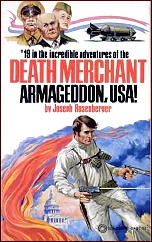
   Other titles in the series include The Albanian Connection (1973), The Mato Grosso Horror (1975), Armageddon, USA! (1976), and Blueprint Invisibility (1980).

         ———
   Reprinted with permission from 1001 Midnights, edited by Bill Pronzini & Marcia Muller and published by The Battered Silicon Dispatch Box, 2007.   Copyright © 1986, 2007 by the Pronzini-Muller Family Trust.
A 1001 MIDNIGHTS Review
by Bill Crider:


DON PENDLETON – The Executioner: War Against the Mafia!.   Pinnacle, paperback original, 1969.

DON PENDLETON The Executioner #1

   Sergeant Mack Bolan, the ideal sniper in Vietnam, is called home on compassionate leave when his father shoots the other members of the family and then takes his own life. Bolan learns that his father was in debt to a Mafia-controlled loan company and was unable to payoff the debt; as a result, in an attempt to save her father from the loan sharks’ reprisals, Bolan’s young sister, Cindy, had been forced into prostitution.

   After burying his family, Bolan decides to get revenge, having been perfectly trained to do so and being psychologically suited for the job. He begins simply, with a .444 Marlin lever-action rifle, but by the end of the book he is using flares and rockets, leveling houses as well as killing men. (The book’s apt subtitle, on the cover though not the title page, is “War Against the Mafia!”)

   Before his battle is well begun, Bolan realizes that he does not hate his enemy, that vengeance is not the issue, that there is nothing personal involved. It is simply the good guys against the bad guys, and he is the good guy. He isn’t interested in philosophical discussions of good and evil. The Mafia is the enemy, and he will destroy them or die in the attempt.

   When Don Pendleton created the Executioner, he probably didn’t know that he had altered the direction of paperback series fiction. His hero caught the imagination of so many readers that imitations soon flooded the stands (the Butcher, the Marksman, the Sharpshooter, the Assassin, etc.).

   But Mack Bolan was the first, and his simple, hard-boiled philosophy was carefully worked out as the books progressed. To read this series is to watch the development of a real American phenomenon.

   There have been some fifty books in the series to date, all bearing such titles as Miami Massacre (1970), New Orleans Knockout (1974), and Colorado Kill-Zone (1976).

         ———
   Reprinted with permission from 1001 Midnights, edited by Bill Pronzini & Marcia Muller and published by The Battered Silicon Dispatch Box, 2007.   Copyright © 1986, 2007 by the Pronzini-Muller Family Trust.
A 1001 MIDNIGHTS Review
by Bill Pronzini:


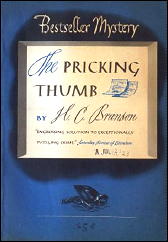
H. C. BRANSON – The Pricking Thumb. Simon & Schuster, hardcover, 1942. Paperback reprint: Bestseller Mystery B76, digest-sized, 1946.

H. C. BRANSON The Pricking Thumb

   During his Ann Arbor days, Ross Macdonald (Kenneth Millar) was a close friend of H. C. Branson and an admirer of his work. It is easy to see why. Branson wrote literate, meticulously plotted (but flawed) novels in which the emphasis is on deep-seated conflicts that have their roots in the dark past.

Branson’s detective, John Bent, like Macdonald’s Lew Archer, is less a human being than a vehicle around which to build a narrative, a catalyst to mesh all the elements so that each novel’s final statement becomes clear.

   In The Pricking Thumb, Bent is hired by an acquaintance, Marina Holland, to investigate the disappearance of her stepson, Bob, and the odd behavior of her husband, Gouvion. But when Bent arrives in the small town of New Paget (in an unnamed state, probably Michigan; a sense of place is almost nonexistent), he finds Gouvion dead of an apparently self-inflicted gunshot wound.

   Also found dead this same night are Marina and Gouvion’s doctor, Brian Calvert, under circumstances that suggest the two might have been lovers. It appears to be a case of double homicide perpetrated by Gouvion, who then committed suicide.

   But there are too many inconsistencies, leading Bent to believe that it is instead a case of triple homicide. His search for the truth takes him along a tangled trail of relationships, old and new hatreds and jealousies, and not a little double-dealing.

   There is a good deal of passion among the characters; unfortunately, there is very little in John Bent or in the writing. Bent is a virtual cipher, about whom we know only that he once practiced medicine. “Someone was feeding [one of my patients] arsenic,” he says to Marina Holland in the first chapter. “The only way I could cure him was to find out who it was and make them stop, which was a little more difficult than it sounds. At any rate, I ended up with a new profession.”

   The writing, while well crafted, is so detached and emotionless that the reader tends to lose interest. Had Branson possessed more of Ross Macdonald’s talent, had he been able to make Bent more human and sympathetic, had he injected some passion and vividness into his work, he might have become an important figure in the mystery field. As it is, he is chiefly notable not for his work but for his relationship with Kenneth Millar.

   Among his other novels, all featuring John Bent, are I’ll Eat You Last (1941), Case of the Giant Killer (1944), and The Leaden Bubble (1949).

         ———
   Reprinted with permission from 1001 Midnights, edited by Bill Pronzini & Marcia Muller and published by The Battered Silicon Dispatch Box, 2007.   Copyright © 1986, 2007 by the Pronzini-Muller Family Trust.
A 1001 MIDNIGHTS Review
by Marcia Muller:


CHRISTIANNA BRAND Green for Danger

CHRISTIANNA BRAND – Green for Danger. Dodd, Mead, hardcover, 1944. UK edition: John Lane/The Bodley Head, hc, 1945. Reprinted many times in both hardcover and paperback. Film: Individual Pictures, UK, 1946, with Alastair Sim as Inspector Cockrill.

   Christianna Brand has written mainstream novels, short stories, and juveniles, but she is best known for her detective novels featuring Inspector Cockrill of the Kent, England, County Police.

   Cockrill (known affectionately as Cockie) is a somewhat eccentric, curmudgeonly fellow — less a character than a catalyst in the cases he solves. He delights in setting up situations that force the murderer’s hand, and the murderer’s identity usually seems quite obvious to the reader, until Brand introduces a twist designed to delight.

CHRISTIANNA BRAND Green for Danger

   At the beginning of Green for Danger, an unlikely group of characters assemble at a military hospital during the blitz of World War II. Each has his reasons for escaping his previous environment; each has expectations of what this assignment will bring.

   What none of them suspects is that a patient — the postman who, incidentally, delivered their letters saying they were coming to Heron’s Park Hospital — will die mysteriously on the operating table, and that all of them will come under Inspector Cockrill’s scrutinizing eye as murder suspects.

   The characters are numerous, but Brand nonetheless manages to instill unique qualities that enlist the reader’s sympathy and create dismay at the revelation of the murderer.

CHRISTIANNA BRAND Green for Danger

   The solution is plausible, the motivation well foreshadowed, and the evocation of both the terror and fortitude of those who endured the German bombing is very real indeed.

   Inspector Cockrill has also solved such cases as Heads You Lose (1941), Death of Jezebel (1948), London Particular (1952), and The Three-Cornered Halo (1957).

         ———
   Reprinted with permission from 1001 Midnights, edited by Bill Pronzini & Marcia Muller and published by The Battered Silicon Dispatch Box, 2007.   Copyright © 1986, 2007 by the Pronzini-Muller Family Trust.

Previously reviewed on this blog:

     Fog of Doubt (London Particular), by Steve Lewis
     The Spotted Cat and Other Mysteries, by Mike Tooney
     Heads You Lose, by Mike Tooney
     Fog of Doubt (London Particular), by Kevin Killian

A 1001 MIDNIGHTS Review
by Art Scott:


JONATHAN LATIMER Fifth Grave

JONATHAN LATIMER – The Fifth Grave. Popular Library #301, paperback original; 1st US printing, 1950. Methuen, UK, hardcover, 1941, as Solomon’s Vineyard. Magazine appearance: Mystery Book Magazine, August 1946.   Reprinted several times, including: Jonathan Press #J65, digest-sized paperback, 1950s; Pan, UK, pb, 1961. International Polygonics, pb, 1988; Neville, hardcover, 1982: limited edition, 300 copies, 26 additional bound in leather; first unexpurgated US edition. (Each of the latter two editions were entitled Solomon’s Vineyard. Note that the IPL paperback is also unabridged, and the Pan may be.)

   This book has a curious history. Published first in England in 1941, it didn’t see book publication in the United States until 1950 as a paperback titled The Fifth Grave, and then only in drastically expurgated form.

JONATHAN LATIMER Fifth Grave

   The first line of the original is “From the way her buttocks looked under the black silk dress, I knew she’d be good in bed.” The paperback version is “From the way she looked under the black silk dress, I knew she’d be a hot dame.”

   It wasn’t until a small California publisher reprinted it in 1982 that the original text saw American publication, and then only in a limited edition of 326 copies. This is most unfortunate, as Solomon’s Vineyard is a genuine hard-boiled classic and deserves wide availability. It has everything!

   A private eye; a shoot-out at a roadhouse; necrophilia; a shoot-out in a steam bath; mobsters; a crooked police chief, a bizarre religious cult; a knife fight in a whorehouse; kidnapping; a mystery woman with a taste for kinky sex; human sacrifice; crypt-robbing — you name it, detective Karl Craven has to deal with it.

JONATHAN LATIMER Fifth Grave

   Craven, a crude but very tough investigator (very reminiscent of Hammett’s Continental Op in style and physique), arrives in the small Missouri town of Paulton to help his partner get a young woman out of the cult’s sanctuary, Solomon’s Vineyard, which dominates the life of the town.

   He finds his partner’s been shot dead. Soon thereafter, he finds himself a target of the local mob, who control the countrywide vice operations in concert with the elders of the cult.

   The cult’s founder, Solomon the Prophet, has been dead for five years, embalmed under glass for viewing on Sunday; but he takes a bride every year, and the brides mysteriously disappear just after the ceremony.

JONATHAN LATIMER Fifth Grave

   By “romancing” the cult’s priestess (the one with the black silk dress-and a fondness for S&M), he arranges a falling-out between the mob and the cult (a la the Op in Red Harvest), and ultimately finishes his job.

   For this book, Latimer adopted an exceptionally terse first-person narrative style (the Bill Crane novels are told in more expansive third-person prose): The average sentence length is perhaps six or seven words. The comic elements are less overt, but he indulges his taste for Grand Guignol with evident relish.

   Solomon’s Vineyard is clearly Latimer’s homage to the classic hard-boiled detective story, made obvious by Craven’s reading Black Mask during a couple of brief lulls in the action (shades of Bill Pronzini’s “Nameless”). As such it is a brilliant success, and deserves to be ranked with the best of Hammett, Whitfield, Cain, Davis, Chandler, et al.

JONATHAN LATIMER Fifth Grave

   Other fine Latimer novels, all but the last two with Bill Crane: Murder in the Madhouse (1935), Headed for a Hearse (1935), The Dead Don’t Care (1938), Sinners and Shrouds (1955), and Black Is the Fashion for Dying (1959).

         ———
   Reprinted with permission from 1001 Midnights, edited by Bill Pronzini & Marcia Muller and published by The Battered Silicon Dispatch Box, 2007.   Copyright © 1986, 2007 by the Pronzini-Muller Family Trust.

A 1001 MIDNIGHTS Review
by Bill Crider:


PETER O'DONNELL Modesty Blaise

PETER O’DONNELL – Pieces of Modesty. Pan, UK, paperback, 1972. Mysterious Press, US, hc, 1987; Tor, US, pb, 1990.

   Modesty Blaise first appeared as a comic-strip character in 1962, and the first novelization of her exploits was published in 1965. She is often thought of as a female James Bond, but her wildly entertaining adventures certainly entitle her to stand alone as a fascinating fictional character.

    A good way to make Modesty’s acquaintance is to read the stories collected in Pieces of Modesty, each of which reveals something of her background and philosophy.

    At the age of eighteen, Modesty commanded the Network, the most successful crime organization outside the United States. After dismantling the Network, she occasionally found herself working for the intelligence section of the British Foreign Office, as she does in “The Gigglewrecker,” in which a very reluctant defector is transferred from East to West Berlin.

PETER O'DONNELL Modesty Blaise

    A better story is “I Had a Date with Lady Janet,” narrated in the first person by Modesty’s formidable associate Willie Garvin, who comes to Modesty’s rescue when she is held captive by an old enemy ensconced in a Scottish castle.

    “A Better Day to Die” and “Salamander Four” might be read as companion pieces. In the former, Modesty finds herself captured by guerrillas, along with the other passengers on a bus. One of the passengers, a minister who believes strongly in nonviolence, sees the results of brutality and is changed by them.

    In “Salamander Four,” a sculptor given to non-involvement finds himself involved against his will when Modesty helps a wounded man, but the ending is is predictable. “The Soo Girl Charity” features Modesty and Willie in a robbery for charity and has an amusing twist at the end.

PETER O'DONNELL Modesty Blaise

    For colorful writing and nonstop action, the books about Modesty Blaise are hard to beat, especially such titles as Modesty Blaise (1965), Sabre-Tooth (1966), I, Lucifer (1967), and two titles published for the first time in the United States in 1984: The Silver Mistress (1973) and The Xanadu Talisman (1981).

         ———
   Reprinted with permission from 1001 Midnights, edited by Bill Pronzini & Marcia Muller and published by The Battered Silicon Dispatch Box, 2007.   Copyright � 1986, 2007 by the Pronzini-Muller Family Trust.

PETER O’DONNELL, R. I. P. (1920-2010). He was in ill health — he had had Parkinson’s disease for several years — so the reporting of Peter O’Donnell’s death on Monday, May 3rd, at the age of 90, was not surprising news, but it was still difficult to accept.

   It is remarkable (or perhaps not) that the opening paragraph of his obituary in The Times begins with a description of Modesty Blaise’s most famous tactic in distracting the enemy, the so-called “Nailer,” described here on one of the earliest posts on this blog, as well as much more (as they say) about both Modesty and her creator.

   And for even more on Peter O’Donnell and his career, including a complete bibliography, check out Steve Holland’s recent post on his Bear Alley blog.

MODESTY BLAISE

A 1001 MIDNIGHTS Review
by Bill Pronzini:


JON L. BREEN – The Gathering Place. Walker, hardcover, 1984; paperback, September 1986.

   Well known for a number of years as a critic, short-story writer, and parodist, Jon L. Breen turned to the writing of novels in 1983 with Listen for the Click, an affectionate parody/pastiche of the classic country-house mystery.

JON L. BREEN Gathering Place

   The Gathering Place, his second novel, is quite different — a bookshop mystery that combines the traditional fair-play whodunit with ghosts and other elements of the paranormal.

   When Oscar Vermilion dies of heart failure, his used book store on Santa Monica Boulevard in Los Angeles, a fixture since 1935 and a gathering place for such literary lights as Nathaniel West and William Faulkner, is in danger of closing for good.

   But Vermilion’s niece, Rachel Hennings, inherits the property, and she has both experience of her own in running a bookshop and a desire to maintain her uncle’s legacy.

   That desire may not be easy to fulfill, however: Not long after her arrival from Arizona, Vermilion’s is broken into (although nothing is taken); ghostly manifestations begin to occur in the shop’s dusty confines (something guides her hand to write F. Scott Fitzgerald’s name in a copy of The Great Gatsby, a signature that turns out to be authentic); and she is presented with evidence that The Atlantis Courier, an early novel by leading Hollywood writer Arlen Kitchener, was actually ghostwritten by a man who was found murdered shortly after Oscar Vermilion’s death.

   Breen neatly meshes these diverse elements, and a budding romance between Rachel and newspaperman Stu Wellman, into a suspenseful tale that keeps the reader guessing on several fronts.

   Some may find the supernatural segments of the plot a strain on their credulity; this reviewer and general skeptic had no trouble with them, and in fact found that they add considerable depth and mystery to the story line. Another plus is the bookish lore and information the author weaves throughout the narrative.

   One other recommended title by Jon Breen is Hair of the Sleuthhound (1982), a collection of some of the best of his short spoofs of distinguished crime writers and their works.

         ———
   Reprinted with permission from 1001 Midnights, edited by Bill Pronzini & Marcia Muller and published by The Battered Silicon Dispatch Box, 2007.   Copyright © 1986, 2007 by the Pronzini-Muller Family Trust.

Note: This book was previously reviewed on this blog by Marv Lachman.

A 1001 MIDNIGHTS Review
by Bill Pronzini:


HERBERT BREAN – Wilders Walk Away. William Morrow & Co., hardcover, 1948. Hardcover reprint: Unicorn Mystery Book Club, 4-in-1 edition, June 1948. Reprint paperbacks include: Pocket #582, 1949; Collier, 1962; International Polygonics, 1988.

HERBERT BREAN Wilders Walk Away

   Free-lance magazine writer Reynold Frame comes to the Vermont village of Wilders Lane to do a series of articles on the colonial town and its history. The village’s founding family, the Wilders, are a decidedly curious bunch:

   It is said that no Wilder ever died of old age; they just disappeared. In 1775 patriarch Jonathan Wilder walked down into the cellar of the family house and was never seen again. Another Wilder was a mate on the Mary Celeste. Still another vanished from a sandy beach in 1917, in full view of witnesses.

   But Wilders “walking away” isn’t a phenomenon relegated to past history, as Frame soon learns. First young Ellen Wilder and then Aunt Mary also vanish from watched rooms inside the house, while he himself is on the premises.

   There is plenty of eerie mystery here, a fine sense of small-town New England life circa 1948, and some fascinating bits and pieces of colonial history woven in. Plus a Revolutionary War treasure, secret passages and hidden rooms, an array of offbeat characters, and of course a love interest for Frame (Constance, one of the few Wilders who does not walk away).

HERBERT BREAN Wilders Walk Away

   The solutions to the “impossible” occurrences are well set up, if not particularly ingenious — the trickiest is the sandy-beach disappearance — but that doesn’t spoil the book’s appeal.

   Reynold Frame appears in three other novels — The Darker the Night (1949), Hardly a Man Is Now Alive (1950), and The Clock Strikes Thirteen (1952) — all of which likewise make good use of unusual settings, strange doings, and past crimes.

   Brean also created another journalist detective, William Deacon, for The Traces of Brillhart (1960) and The Traces of Merilee (1966).

         ———
   Reprinted with permission from 1001 Midnights, edited by Bill Pronzini & Marcia Muller and published by The Battered Silicon Dispatch Box, 2007.   Copyright © 1986, 2007 by the Pronzini-Muller Family Trust.

Editorial Comment:   This title is one of those compiled in John Pugmire’s profusely illustrated article “A Locked Room Library,” to be found here on the main Mystery*File website. (Follow the link.)

A 1001 MIDNIGHTS Review
by Bill Pronzini:


WARREN ADLER – Trans-Siberian Express. G. P. Putnam’s Sons, 1977. Paperback reprint: Pocket, 1978. Stonehouse Press, hc, May 2001; trade ppbk, July 2004.

WARREN ADLER Trans-Siberian Express

   One of crime fiction’s most popular subgenres is the tale of mystery and intrigue set on board a fast-moving train.

   For more than a century, authors from Poe to Christie to Warren Adler have perpetrated all sorts of mayhem on the world’s railways — highballing freights and crack passenger specials in this country, the fabled Orient Express, and now the Trans-Siberian Express that spans two continents on its 6000-mile route across Russia to the Sea of Japan.

   Dr. Alex Cousins, a Russian-speaking American cancer specialist, has been sent to Moscow on a secret mission by the president of the United States. The mission: to prolong for seven weeks (for unspecified reasons) the life of Viktor Dimitrov, secretary-general of the politburo, who is dying of leukemia.

   Cousins has done his duty, and now that he is ready to leave Russia, Dimitrov urges him to take the Trans-Siberian Express instead of flying — a “gift,” Dimitrov says, the train being one of legendary Victorian grandeur and the scenery being magnificent.

   Cousins agrees, but with reservations that turn out to be more than warranted. First he meets and becomes romantically involved with Russian beauty Anna Petrovna; then he finds himself enmeshed in a politically motivated conspiracy, trapped on board the train with KGB agents watching his every move.

   His only chance for escape is to seek help from his fellow passengers, but at least some of them are not who they seem to be….

   This is a rousing novel of international intrigue and adventure, populated by sharply drawn characters; the Trans-Siberian Express, in fact, is so realistically depicted that it becomes a character in its own right. Adler’s prose tends toward the undistinguished, but his evocation of the Russian scene and the scope and drama of his story more than make up for any deficiencies.

   Warren Adler is the author of a number of other contemporary thrillers, among them The Casanova Embrace (1978) and Natural Enemies (1979).

         ———
   Reprinted with permission from 1001 Midnights, edited by Bill Pronzini & Marcia Muller and published by The Battered Silicon Dispatch Box, 2007.   Copyright © 1986, 2007 by the Pronzini-Muller Family Trust.
« Previous PageNext Page »