Characters


THE BACKWARD REVIEWER
William F. Deeck


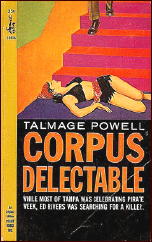
TALMAGE POWELL – Corpus Delectable. Pocket, paperback original, October 1964.

TALMAGE POWELL Ed Rivers

   Apparently this is the fifth and last case of private investigator Ed Rivers, the agent in charge, though there seem to be no other agents, of the Southeastern Division of the Nationwide Detective Agency.

   Two things are happening in Tampa, Florida: The annual Gasparilla Week has begun, “a fun week dedicated to the legendary Jose Gaspar, who roamed these Gulf [of Mexico] waters back when buccaneers were for real,” and Rivers is waiting somewhat impatiently for a possible client who is running late.

   The client, a lovely young lady as are all the females in this novel when they aren’t downright beautiful, is shot by a silenced gun in the hall leading to Rivers’ office. She manages an obscure dying message: “Incense.”

   Her killer also tries to murder Rivers on this and another occasion. He fails in the latter attempt because, like most professional hit men in private-eye novels, he’d rather narrate what he is going to do than do it. Which is good for the longevity of private eyes, I suppose.

   Rivers begins an investigation of his would-be client’s background, which involves the recent death of a rich old woman and some rather unpleasant characters connected with the woman. The reader will be way ahead of Rivers, but then the reader isn’t threatened by a garrulous gunsel or attacked by a chap with a pirate’s sword or encountering females likely to divert one’s mind.

   Rivers is an early “sensitive” private eye, and the Florida setting, I believe, was unusual in the 1960s. The novel is rather fun reading.

— From The MYSTERY FANcier, Vol. 11, No. 1, Winter 1989.

       The Ed Rivers series —

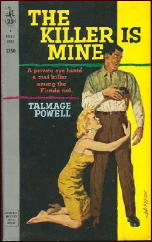
The Killer Is Mine. Pocket, 1959.

TALMAGE POWELL Ed Rivers

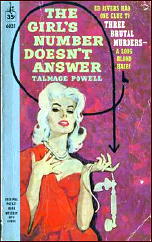
The Girl’s Number Doesn’t Answer. Pocket, 1960.

TALMAGE POWELL Ed Rivers

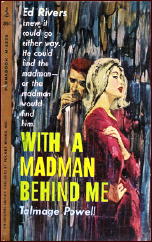
With a Madman Behind Me. Permabooks, 1961.

TALMAGE POWELL Ed Rivers

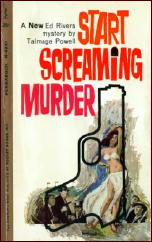
Start Screaming Murder. Permabooks, 1962.

TALMAGE POWELL Ed Rivers

Corpus Delectable. Pocket, 1964.

Reviewed by RICHARD & KAREN LA PORTE:    


JOHN GARDNER – The Secret Generations. Putnam, hardcover, 1985. Charter, paperback, 1986.

JOHN GARDNER The Secret Generations.

   This might be called The Railton Saga. It is billed as a panorama covering the years between 1910 and 1939. It begins in 1910 with the death of General Sir William Railton, but almost all of the story is in the first decade.

   When Sir William dies his brother takes over the clandestine network of informants the General has gathered. One by one brother Giles works other members of the family into the league. His daughter is in Paris with her French husband. One son, Andrew, is in London with a cover in the State Department. The other is in Ireland with his Irish wife Bridget and both are operating, unbeknownst to the other, inside the Sinn Fein.

   The General’s two sons, John and Charles, are also in the family business. And, eventually, Denise of the third generation is in occupied Belgium running a courier service behind the Kaiser’s lines.

   You can’t fault Gardner’s writing. It’s up with the best and it shows off well in a long novel like this. There are plots within plots, many twists to every turn, and any other cliche you would like to use.

   But there is no cliched material in this book. The story line is unusual and the people are fresh, bright, right for their parts, and carefully drawn. The post-WWI sections are brief but revealing as a lightning-lit scene. The last chapter brings a surprise that backlights the rest of the story with a whole new meaning of the idea of “double agent.”

— Reprinted from The Poisoned Pen, Vol. 6, No. 4,
Fall 1986.


       The Railton Family series —

The Secret Generations. Heinemann, UK, 1985 [1909-1935]
The Secret Houses. Bantam, UK, 1988 [1940s]
The Secret Families. Bantam, UK, 1989 [1964]

REVIEWED BY WALKER MARTIN:


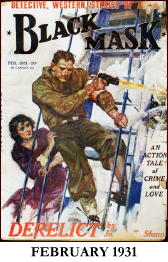
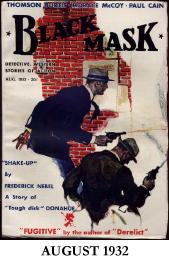
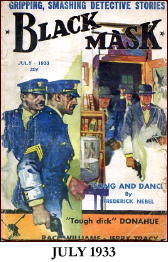
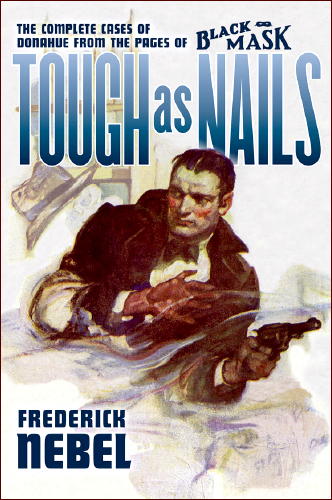
FREDERICK NEBEL – Tough As Nails: The Complete Cases of Donahue from the Pages of Black Mask. Altus Press, softcover, May 2012. [A limited edition hardcover may still be available.]

FREDERICK NEBEL bLACK mASK

   This is rapidly turning out to be the year that Frederick Nebel was rediscovered. First we had The Complete Casebook of Cardigan, Volume One, which I reviewed here. Then just recently Black Dog Books published Empire of the Devil, a collection of Nebel’s adventure tales.

   Coming up later in the year will be additional volumes in the Cardigan series from Altus Press plus the complete stories from the Black Mask series starring Kennedy and MacBride. And now just published we have this latest book from Altus Press collecting all the Donahue stories from Black Mask.

   Like The Complete Casebook of Cardigan, this book is a must buy for any lover of hardboiled fiction. The Donahue stories are also historically significant because in 1930 it was very obvious to Joe Shaw, the editor of Black Mask, that he was about to lose his best writer. Dashiell Hammett would be following the money to Hollywood, and no pulp magazine could compete with the enormous paychecks available from the movie industry.

   Shaw asked his second best writer (Chandler did not appear until 1933) to develop a series similar to the Continental Op made famous by Hammett. I stress the word “similar” because in 1930 no one could compare to the quality of Hammett. The result was Donahue of the Interstate Detective Agency. There were 15 novelettes published between November 1930 and March 1935.

FREDERICK NEBEL bLACK mASK

   The first question readers will be asking is how do these stories stand in comparison to the Cardigan stories? The answer is simple: if you liked Cardigan, then you will like Donahue. I really do not see much of a difference between the two characters.

   Like Cardigan, Donahue is tough, hardboiled, no nonsense, and a private operative working for a detective agency. We learn very little about the private lives of either character and the stories are fast moving examples of crime fiction which stand up very well even though 80 years have passed since the Cardigan and Donahue stories appeared.

   The Donahue stories were written according to the above standards set by Shaw during his time as editor for Black Mask, 1926-1936. Frankly, I consider this collection another bargain from Altus Press. The quality paperback, which is almost 600 pages is available for $29.95 from Altus Press, Mike Chomko Books, and Amazon.com.

   The limited edition hardcover, which I had to have because of the importance of this collection, is priced at $39.95 and can be ordered through the Altus Press website. These books are print on demand and hold up to the usual high qualities of Matt Moring, the publisher.

FREDERICK NEBEL bLACK mASK

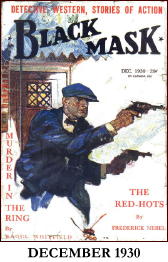
   In addition to the 15 long novelettes, all 30 some pages long except for the last one which clocks in at 56 pages, the stories all have the original illustrations by the Black Mask artist Arthur Rodman Bowker. Bowker had a very distinctive style and I’ve always liked his work. He seems to fit in with the no nonsense, hard as diamonds Black Mask style. The cover is a stunner from Black Mask also, and I believe it shows Donahue(or a character very much like him), in action, gun in hand.

   The introduction is by pulp historian, Will Murray, and the book is edited and compiled by Rob Preston. Rob has also compiled a bibliography of the works of Frederick Lewis Nebel. This is an important feature of the collection and runs 14 pages grouped by magazine title chronologically.

   It shows that Nebel had around a hundred or so stories in the slick magazines and in addition to the fiction in Black Mask and Dime Detective, he also had over a hundred stories in other pulp magazines such as Northwest Stories, Action Stories, Air Stories, Wings, and so on. The bibliography also lists the books written by Nebel as well as the anthologies he appeared in. The screenplays based on his work are also listed.

   Earlier, I mentioned that we don’t learn much of Donahue’s private life. But here are a few items of note. Donahue’s philosophy can be summed up in the passage from the first story in the series, “Rough Justice.” On page 18 Donahue says:

    “I know I’m in a rotten game… I’m not defending it. I don’t know why I’m in — but I’m in it. It keeps me in butts and I see the country and I don’t have to slave over a desk. I get places. It’s not a pretty game, and no guy ever wrote a poem about it. But it’s the only hole I fit in.”

FREDERICK NEBEL bLACK mASK

   Donahue lives in a hotel apartment, made up of a small living room and bedroom. It has a bath and a small pantry. He smokes a pipe, cigarettes and cigars. He’s in his thirties, tall, lean and good looking. He eats well, attends boxing and hockey sports and says that he never gambles. He drinks brandy, scotch, martinis, wine, and beer.

   Through the first 14 stories he has no girl friends, in fact he seems to mistrust the women he meets and this is understandable since they mostly turn out to be nothing but trouble. However in the last story he does meet a girl that he likes and trusts and the story ends with Donahue making a date.

   Speaking of drinking, when this series commenced prohibition was still in effect across the country. I have read books about the widespread popularity of speakeasies and this series certainly shows the speakeasy as a very popular illegal hangout. They may have been illegal but everyone in NYC seemed to be drinking in these establishments including the local police.

   This series shows just how impossible it was to make the general public stop drinking. It was an impossible task and prohibition just encouraged crime and corruption. None of this ever bothered Donahue and his police contacts.

   I’ll repeat what I said again. This book is a must buy for all readers of the hardboiled and quality pulp fiction. Altus Press is doing excellent work reprinting such fiction and I urge everyone to support their efforts. They have some excellent books scheduled for future publication.

FREDERICK NEBEL bLACK mASK

      Contents:

“Rough Justice” (November, 1930)
“The Red-Hots” (December, 1930)
“Gun Thunder” (January, 1931)
“Get A Load of This” (February, 1931)
“Spare the Rod” (August, 1931)
“Pearls Are Tears” (September, 1931)
“Death’s Not Enough” (October, 1931)
“Shake-Up” (August, 1932)
“He Could Take It” (September, 1932)
“The Red Web” (October, 1932)
“Red Pavement” (December, 1932)
“Save Your Tears” (June, 1933)
“Song and Dance” (July, 1933)
“Champions Also Die” (August, 1933)
“Ghost of a Chance” (March, 1935)


Acknowledgment:   The magazine covers you see above were obtained from the Galactic Central website, thanks to Phil Stephensen-Payne.

THE SERIES CHARACTERS FROM
DETECTIVE FICTION WEEKLY
by Monte Herridge


        #12. INDIAN JOHN SEATTLE, by Charles Alexander.

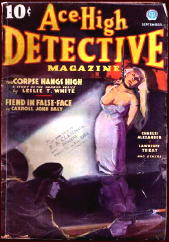
   This next installment of my columns for Mystery*File features a look at another series character who appeared in the pages of Detective Fiction Weekly. The “Indian John Seattle” stories by Charles Alexander made up a short series of at least fifteen stories published in DFW from 1933 through 1939, plus two stories in Ace-High Detective Magazine 1936-37.
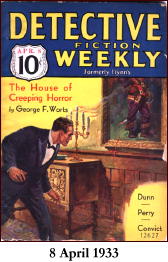
CHARLES ALEXANDER Indian John Seattle

   The stories are rural in setting. Stories published in DFW were a mixture of settings, both urban and rural. Many stories took place in urban environments, but there were a large number that were rural in setting. The Tug Norton series by Edward Parrish Ware was one that had stories in both urban and rural settings. Ware’s Ranger Jack Calhoun series was mostly rural, with a little in small towns. Even an urban series such as Morton & McGarvey by Donald Barr Chidsey had some stories in a rural environment.

   Indian John Seattle is a sheriff of primarily rural Plainview County in Oregon, and his shabby office is in the courthouse in the town of Plainview. He gets his name from his learning all about Indian ways and outdoor skills. He spent his boyhood with the Nez Perce Indians. “He was an instinctive and Indian-trained hunter; criminals were his prey.” (Head Hunt)

   The first story, “Death Song,” states that to catch a killer, “he must play Indian cunning on them.” This seems to work, as he flushes out the guilty man into running and later confessing the murder. This story also notes: “Many crimes of the forest Seattle had solved. He knew men—knew them through and through when they placed themselves against the background of canyon and forest where he had gained his wisdom.” In a later story, “Up Death Creek,” Seattle is called “A human steel-trap in the path of the evil-doer.”

   In the second story, “Head Hunt,” his deputy sheriff is introduced: “Hal Minton, … a tall and neat and taciturn man in his late twenties.” He is also described as “tight-lipped and grim of eye, advertised the dignity of the law.”

   Minton does not always approve of the way Seattle does things. Seattle, by contrast to his deputy, was “a bandy-legged figure in worn moleskins, wearing a time-honored Stetson, …” He is slightly bent from much time in the saddle, although he regularly uses an ancient Ford automobile he calls Flap-fender.

   No mention is made of any family of Seattle’s, nor is it known where his home was. He kept odd hours as sheriff, and was likely to turn up making the rounds of the town of Plainview at 3 A.M. He seems to have lived for his job.

   His cases were murder-involved, and Sheriff Seattle had plenty of experience. He “had a nose for trouble, a reaction, perhaps instinctive, to the lurking threat of danger. Years in the wilderness had equipped him with the wariness of the wolf, the cat-like cunning of the cougar.” (Head Hunt)

   In “Head Hunt” he tracks down two murderers and finds the missing head of their victim, meanwhile avoiding a death-trap. Seattle carries an old .45 Frontier Model Colt, and certainly knows how to use it.

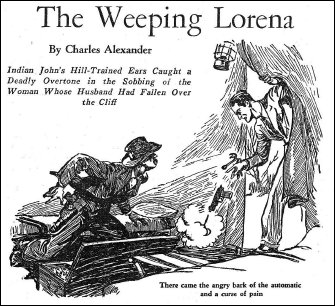
   In the story, “The Weeping Lorena,” there is also no mystery as to who are the murderers and what they did. The story is regarding Indian John Seattle’s discovery of the crime and dealing with the criminals. The criminals in this story are contemptuous of the local law enforcement, calling them “hick cops.”

CHARLES ALEXANDER Indian John Seattle

   However, they find that Sheriff Indian John Seattle is no fool as he quickly uncovers their scheme and crime. This story reveals that Seattle has no confidence in the abilities of his deputy, Minton. Seattle mentions that Minton is usually the first on the scene of the crime, but the last to solve the crime. In “Death Watch,” Minton actually interferes with Seattle’s attempt to uncover the crime and fasten the guilt where it belongs.

   There were other series in DFW about rural sheriffs who solved crimes. One of these was the series about Sheriff Whitcher Bemis, written by Harold de Polo and published in DFW from 1927-1928. De Polo also had another rural sheriff series in DFW: Sheriff Ollie Bascomb from 1931-1941. Both of de Polo’s series have a bit of humor in them, and the Whitcher Bemis series attempts a rural dialect for the characters.

   The Sheriff Indian John Seattle series is different than these two series primarily in having no humor present in the stories, and presenting the sheriff as a person of dignity, and not just a hick sheriff.

   â€œDeath Watch” involves another criminal who thinks he can outsmart Sheriff Seattle, and tries to kill him when his plans are failing. However, the criminal overlooks a simple thing in his plan, and it comes back to point the finger at him. In this story, Seattle actually kills one of the criminals. Usually he prefers to catch them alive for trial, although a number of times he has to wound the criminal in order to get his man. One of the better stories in the series.

   In “Up Death Creek” Seattle has to solve a bit of a puzzle in order to finish this case. The blurb for the story reads as follows: “The bullet pneumonia of Whisky Brown, the torn boot with the missing calk—Indian John had to read those sinister signs to save an innocent man from the gallows.”

   In “Claws of the Killer” the two murderers think they have a good plan by killing someone and claiming a wild bear did the crime. However, Sheriff Seattle manages to capture both and point out a large flaw in their scheme.

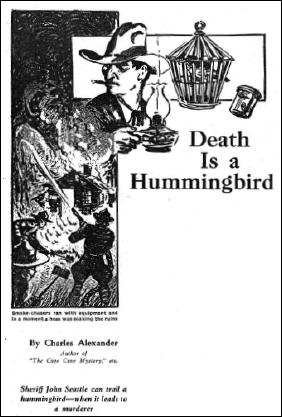
   â€œDeath is a Hummingbird” involves a bizarre and very improbable method of murder that I have not seen before. Using hummingbirds to start fires! An absurd idea. The story basically falls apart, and Sheriff Seattle uses a ridiculous bluff on the murderer to make him confess.

CHARLES ALEXANDER Indian John Seattle

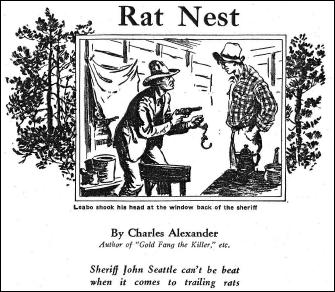
   In “Rat Nest,” a much better story, Seattle is investigating some poachers, and when he arrests one of them for murder he winds up making the biggest mistake of his career. However, when he investigates further, he learns the truth behind the matter.

CHARLES ALEXANDER Indian John Seattle

   In “Deputy Sheriff Rattlesnake” the murderers kidnapped Seattle and placed him in a death trap, from which he escaped. However, while he was missing, deputy sheriff Minton and the coroner argued over who should be sheriff if Seattle did not show up. So it sounds like he was feared, but not missed.

   This was an average series of stories compared to the many other series that ran in DFW, but it is better than the two rural sheriff series written by Harold de Polo. I prefer the series without much humor in it, compared to the humor present in the de Polo series.

      The Indian John Seattle series, by Charles Alexander:

   In Detective Fiction Weekly:

Death Song     April 8, 1933
Head Hunt     August 12, 1933
The Weeping Lorena     October 7, 1933
Bullet-Hole Business     January 27, 1934
The Hicks Have It     March 17, 1934
Death Watch     June 16, 1934
Up Death Creek     June 30, 1934
Back-Fire Murder     July 28, 1934
The Lady Says     October 6, 1934
Claws of the Killer     March 23, 1935
Homicide Expert     November 23, 1935
Death Walks on Water     June 4, 1938
Death is a Hummingbird     June 18, 1938
Rat Nest     September 24, 1938
Deputy Sheriff Rattlesnake     February 4, 1939

   In Ace-High Detective Magazine:

Black Creek Brimstone     September, 1936

CHARLES ALEXANDER Indian John Seattle

Drummer of Doom     February-March, 1937


    Previously in this series:

1. SHAMUS MAGUIRE, by Stanley Day.
2. HAPPY McGONIGLE, by Paul Allenby.
3. ARTY BEELE, by Ruth & Alexander Wilson.
4. COLIN HAIG, by H. Bedford-Jones.
5. SECRET AGENT GEORGE DEVRITE, by Tom Curry.
6. BATTLE McKIM, by Edward Parrish Ware.
7. TUG NORTON by Edward Parrish Ware.
8. CANDID JONES by Richard Sale.
9. THE PATENT LEATHER KID, by Erle Stanley Gardner.
10. OSCAR VAN DUYVEN & PIERRE LEMASSE, by Robert Brennan.
11. INSPECTOR FRAYNE, by by Harold de Polo.
IT IS PURELY MY OPINION
Reviews by L. J. Roberts


DEBORAH GRABIEN – New Slain Knight. St. Martin’s/Thomas Dunne, hardcover, November 2007.

Genre:   Paranormal/Suspense. Leading characters:  Ringan Laine/Penny Wintercraft-Hawkes; 5th in “Haunted Ballad” series. Setting:   England.

First Sentence:   In the large upstairs room at the pub called the Duke of Cornwall’s Own, a local band, the Tin Miners were playing to an enthusiastic audience.

DEBORAH GRABIEN New Slain Knight

   Traditional musician Rupert “Ringan” Laine and theater producer Penny Wintercraft-Hawkes are looking forward to a rare vacation off together. Plans change when Ringan’s sister, whose mother-in-law needs her, asks to send him her 14-year-old daughter, Rebecca, a violin prodigy.

   Staying with Gowan, a musician friend in Cornwall, seemed like a good idea until Penny has a vision of a man dying and Becca starts sleep-walking. What are the forces from the past and beyond the grave influencing these two women?

   Books that include a cast of characters and a map are such a treat. It is even better that Ms. Grabien’s characters are so distinct and strong that I didn’t need reminding of them, but it’s still a lovely thing to have.

   The recurring characters of Ringlan and Penny are now old friends to me, but the author doesn’t assume they are known to every reader. New readers will have no problem learning who they are and uncovering their backstory. I think this is an important thing for an author to do.

   The new characters are interesting, and fully dimensional. There is one character, Gowan, you start by liking but the shine dims a bit; for another, Lucy, the reverse is true. It is very well done. Lucy is a particularly interesting character as she is a researcher and a true skeptic — something you don’t usually see in a book with paranormal elements. She is very believable and adds the perfect balance to the story.

   Ms. Grabian’s powers of description not only create a sense of place by showing us around Cornwall, but provided us a sense of the characters through their personal environments. When including old documents, I appreciate her leaving them in the appropriate Old English and Victorian spelling and grammar. She trusts the ability of her audience, which is wonderful.

   Each of Ms. Grabian’s “Haunted Ballad” books is based on an actual old ballad, with a verse from the ballad at the beginning of each chapter. From that, she constructs a story each with a unique use of the paranormal element and a solidly constructed plot. Just when you think you’ve found a hole, she closes it.

   The characters ask the questions you mentally ask, and she answers them. The tension and suspense increase at a steady rate but without ever crossing over into graphic horror. The result is even more frightening than if she had, and then she adds excellent twists.

   I thoroughly enjoyed this book and closed it without identifying any flaws in its construction. The only question for potential readers is whether they enjoy books with a paranormal theme. If the answer is yes, I highly recommend New Slain Knight.

Rating:   Excellent.

    The “Haunted Ballad” mystery series —

1. The Weaver and the Factory Maid (2003)
2. The Famous Flower of Serving Men (2004)
3. Matty Groves (2005)
4. Cruel Sister (2006)    [Reviewed here.]
5. New Slain Knight (2007)

THE ARMCHAIR REVIEWER
Allen J. Hubin


DOUG HORNIG – Deep Dive. Mysterious Press, hardcover, 1988. Popular Library, paperback, March 1989.

   Doug Hornig brings back Charlottesville private eye Loren Swift for a fourth time in Deep Dive. Loren and his occasional bedmate Patricia Ryan have taken up scuba diving, and while practicing in a flooded quarry they happen upon a deceased diver.

   Accidental drowning is the verdict. In due course, the dead man’s sister, having other ideas, asks Loren to investigate. Her brother, it develops, was wealthy, an experienced diver, not a particularly nice person. The quarry is on the grounds of the Jordan Institute, which does psychic research, and soon Loren is having the oddest of experiences…

   Pleasant enough, though the plot takes an extra bit of believing and the ultimate solution comes out of left field.

— Reprinted from The MYSTERY FANcier,
       Vol. 11, No. 1, Winter 1989.


Bibliographic Notes:

       The Loren Swift series —

1. Foul Shot (1984)    [Nominated for an Edgar.]
2. Hardball (1985)    [Nominated for a Shamus award.]
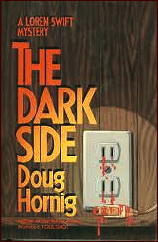
3. The Dark Side (1986)

DOUG HORNIG

4. Deep Dive (1988)

   Deep Dive was the final appearance of PI Loren Swift. Hornig also wrote two thriller novels with Steve Kirk as the leading character, but about him I know nothing more.

THE BACKWARD REVIEWER
William F. Deeck


LAWRENCE LARIAR

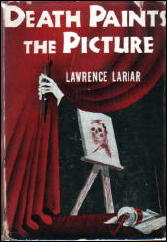
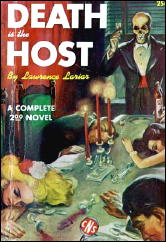
  LAWRENCE LARIAR – Death Paints the Picture. Phoenix Press, hardcover, 1943. Crime Novel Selection, nn [#6], digest-sized paperback, as Death Is the Host, no date [1943].

   A cartoonist himself, Lariar has as his detective Homer Bull, quite overweight and mastermind of the daily comic strip “True Stories of Crime.” Bull writes the strip while his assistant, Ham MacAndrews, does the cartooning. Ham also narrates Bull’s investigations. “‘Great jumping ginch!’ I blatted” is an example of MacAndrews’s speech which leads one to hope he draws better than he speaks.

LAWRENCE LARIAR

   Because his man Shtunk was on a binge, Bull misses the invitation to weekend with Hugh Shipley, famed illustrator for the weekly magazines. It is an ill-assorted group that includes Bull’s ex-wife, a gossip columnist, and a tobacco mogul.

   If Bull had attended, he might have been able to prevent Shipley’s alleged suicide, alleged because Bull, who shows up afterwards, is convinced Shipley was murdered, despite the room having been locked with no way for any murderer to have escaped.

   Another murder made to look like suicide, though it doesn’t fool Bull, takes place before Bull figures out who and how. Probably because I have perverse tastes, I enjoyed the book.

— From The MYSTERY FANcier, Vol. 11, No. 1, Winter 1989.


BIBLIOGRAPHIC NOTES:

       The Homer Bull series —

Death Paints the Picture. Phoenix Press, 1943.
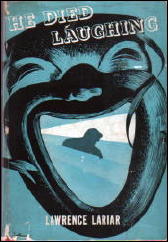
He Died Laughing. Phoenix Press, 1943.

LAWRENCE LARIAR

The Man with the Lumpy Nose. Dodd Mead, 1944.
The Girl with the Frightened Eyes. Dodd Mead, 1945.

   Lawrence Lariar has his own page on Wikipedia. Here’s the first paragraph:

    “Lawrence Lariar (December 25, 1908 – October 12, 1981) was an American novelist, cartoonist and cartoon editor, notable for his ‘Best Cartoons of the Year’ series of cartoon collections. He wrote crime novels, sometimes using the pseudonyms Michael Stark, Adam Knight and Marston la France.”

   He wrote nine mystery novels under his own name; nine as Adam Knight, including eight adventures of PI Steve Conacher and one with female PI Sugar Shannon; two paperback originals as by Michael Lawrence, both cases for PI Johnny Amsterdam; and one book as by Michael Stark.

   If he wrote the one mystery credited to Marston La France, it is news to Al Hubin. (Marston La France was a long-time professor and academic dean at Carleton University in Ottawa. The mystery he authored, Miami Murder-Go-Round, was copyrighted in his name. It features yet another PI, Rick Larkan.)

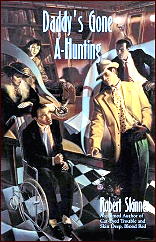
ROBERT SKINNER – Daddy’s Gone A-Hunting. Poisoned Pen Press, hardcover, 1999; trade paperback, 2000. Hardcover reprint: Detective Book Club, 3-in-1 edition.

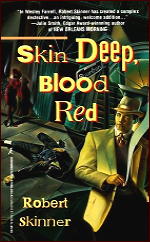
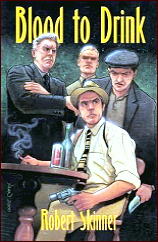
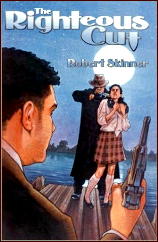
   At the present time there are six books in Robert Skinner’s series of Wesley Farrell adventures, of which this is the third:

Skin Deep, Blood Red (Kensington, 1997) [Nominated for the Anthony Award for Best First Novel.]

ROBERT SKINNER Wesley Farrell

Cat-Eyed Trouble (Kensington, 1998)
Daddy’s Gone A-Hunting (Poisoned Pen, 1999)
Blood to Drink (Poisoned Pen, 2000)

ROBERT SKINNER Wesley Farrell

Pale Shadow (Poisoned Pen, 2001)
The Righteous Cut (Poisoned Pen, 2002)

   Wesley Farrell is a mixed-blood Creole by birth, but at the time of this book, which is 1938, he’d been living in New Orleans as a white man for over 25 years. He’s a legend of a man — a night club owner whom everyone in the city seems to know and will defer to, rather than get on the wrong side of him. Nonetheless (and inevitably) it’s strictly his reputation that gets him into trouble this time.

ROBERT SKINNER Wesley Farrell

   There are several threads of the widely rambling plot. The major one centers on the deaths or mysterious disappearances of prominent members of the aforementioned black community. Less important, or so it seems, is the request that Carol Donovan (*), the beautiful black owner of The Original Southport Club, makes of Farrell. She needs his help in fighting a tough thug named Archie Badeaux who has been making threats against her.

   A stash of stolen money that has gone missing is also involved, and when Ernie LeDoux gets out of prison and starts looking for it, a brand new series of events is pushed into motion. And there’s more. It takes well over 300 pages of fine action-oriented fiction to cover it all.

   Great characters and great atmosphere combine to make Gone A-Hunting very enjoyable reading. Back in 1938, and particularly in the South, there was an entire black community whose activities never made the white newspapers, and they certainly weren’t recorded in the white history books.

   A separate black squad of the detectives in the police department, black bankers and real estate agents — an entirely separate (but not equal) citizenry — which you notice most when you are reminded, as Skinner does, that trains, for example, had separate cars for blacks.

ROBERT SKINNER Wesley Farrell

   Most of the threads of plot come together at the end, but not all. In all truthfulness they’re spread too thin to have the depth that would make this an absolute knockout of a novel. Sometimes the longer the book, the weaker the punch. The clues which the detection depends upon are suspect as well — what kind of witless killer would vomit at each of his scenes of the crime, and fail to clean up his mess afterward?

   But there are more adventures to come, and a couple of priors to catch up with also. I came in at the middle, and now with two different ways to go, I fully intend to.

— September 2003


(*) PostScript:   Here’s a quote that here, just now, at the last minute, I decided to leave you with. From page 21:

   A beautiful Negro woman of about thirty came through the doors of the Café Tristesse [Farrell’s place] like she owned the joint. She was about five-and-a-half feet tall, with skin so pale brown it was no darker than a suntan, shoulder-length black hair, and eyes like obsidian. The only makeup on her fine-featured face was lip rouge the color of ripe plums. Dressed in a pale yellow dress, yellow sling-back pumps, and a yellow hat that was like gold ornamentation on a queen, she was enough to make a Baptist minister drink swamp water, crawl inside a hollow log, and bay at the moon.

   Maybe Halle Berry could play the part? I was leaning toward a younger Richard Roundtree as Farrell, back when he played Shaft in the movies. When I mentioned this to another reader of the series (female), she immediately reminded me that Farrell is passing for white, and Roundtree is therefore too dark.

   She then suggested Giancarlo Esposito, who appears on some television show I don’t watch. I obviously have to think this over some more.

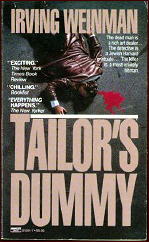
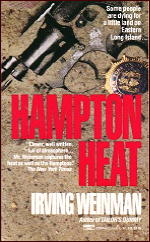
IRVING WEINMAN – Virgil’s Ghost. Fawcett Gold Medal, reprint paperback, January 1991. First published by Columbine, hardcover, 1990.

IRVING WEINMAN Lenny Schwartz

   Lenny Schwartz, the hero of Weinman’s two previous mystery novels, turns PI in this one. Years of guilt as a homicide policeman have taken their toll. (I haven’t read the first two, so that is all I know, but as you will see, if you read on, neither am I about to.)

   Lenny’s wife is upset by this decision for some reason, but maybe mostly because he didn’t tell her. Not, that is, until the night before he is to move into his new office. She kicks him out, saying that he is welcome home only on weekends, the next few of which they spend making love and feeling guilty afterward.

   So Lenny’s first case is important to him, more important than he knows. The parents of a mathematician whose mutilated body was recently found in the East River want him to prove that the coroner’s report was wrong, that their son did not die of AIDS. They feel guilty about this, but they are determined to pursue this course of action.

   Mixed in with all this guilt is a load of ethic humor (mostly Jewish), and fifty pages was as far as I went. Lenny’s new assistant is named Abrasha Addison (formerly Yarmolinksy), but at one time his real name was Abraham Resnick, and he can get a deal for you. When Lenny’s office/apartment is trashed by a firebomb, Abrasha is on the spot with a suitcase of clothes for Lenny. “What you think? Just your sizes, Lenny. No? Look, is first drawer quality. Bloomie’s Abe Strauss, good stuff, Huh?”

   The murder is serious, however. Pornography is hinted at. Snuff films. According to the back cover, perversion, conspiracy, and cover-ups are involved. Seamy sex clubs and drugs. Government agencies. Russkies. The Nuclear Regulatory Agency. Heaven help us. Can’t anyone write a plain old PI story any more?

   Anyway, I didn’t read most of this, but eight different newspapers and review services are liberally quoted on both covers, and they all read it and liked it, and you may, too. One of them even suggests that thus “great new literate sleuth” is “the American version of Adam Dalgleish.” I wouldn’t go that far, based on what I read, but I’d have to admit that I no longer read P. D. James either, and a lot of people do.

— Reprinted from Mystery*File 28,
       February 1991 (slightly revised).


       The Lenny Schwartz series

Tailor’s Dummy. Atheneum, 1986.

IRVING WEINMAN Lenny Schwartz

Hampton Heat. Atheneum, 1988.

IRVING WEINMAN Lenny Schwartz

Virgil’s Ghost. Columbine, 1990.
Easy Way Down. Columbine, 1991.

IRVING WEINMAN Lenny Schwartz


[UPDATE] 04-09-12.   One never knows for sure, but there’s a good possibility I would find something to reverse my opinion of this book, were I to read it now. Something as simple as my mood at the time may be different, or some eleven years later, certain overall ways I view things may have changed. On the other hand, I have not read P. D. James since I wrote this review, so perhaps not.

THE BACKWARD REVIEWER
William F. Deeck


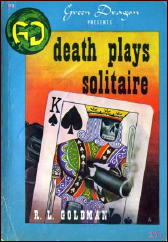
R. L. GOLDMAN – Death Plays Solitaire. Coward-McCann, hardcover, 1939. Green Dragon #10, digest-sized paperback, no date stated [1944], condensed.

R. L. GOLDMAN Rufus Reed

   While it will not endear me to the doubtless many fans of Asaph Clume and Rufus Reed, “impulsive redheaded reporter,” I must confess I am glad I read the “condensed” version of this novel since its tediousness is staggering even in the abbreviated version.

   For example: “I’m supposed to be a political commentator, and I do a daily column, ‘Round-Up,’ which I sign ‘Rufus Reed’ because that’s my name.”

   A former police reporter, Reed has been assigned by Clume, his boss, to cover the execution of Dan Hillyard for murder during a bank robbery from which the money has never been recovered. On his last night Hillyard gives the deck of cards with which he has been playing solitaire to his wife.

   In turn, she gives the cards to Hillyard’s lawyer, who is murdered shortly afterwards. He, too, had been playing solitaire, something he had never done before, and the deck of cards has been taken by the murderer. Other deaths follow, and Reed himself faces torture and death. As Reed does the leg work, Clume does the thinking, such as it is.

   Not well written even for the times, a very thin plot, an evident but clueless murderer. Still, one waits, not breathlessly, to read The Snatch, in which, according to Green Dragon, “A slipping male movie idol is the victim-and there are more than enough suspects with motives. Irrepressible Rufus Reed, red-haired reporter figures out whodunit just in time for a smashing, surprise ending that’ll leave you worrying about ethics for quite a while.”

— From The MYSTERY FANcier, Vol. 11, No. 1, Winter 1989.


       The Asaph Clume & Rufus Reed series —

The Murder of Harvey Blake. Skeffington, 1931.
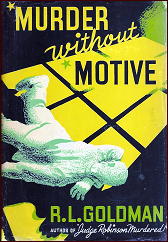
Murder Without Motive. Coward, 1938.

R. L. GOLDMAN Rufus Reed

Death Plays Solitaire. Coward, 1939.
The Snatch. Coward, 1940.
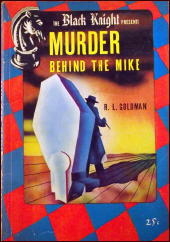
Murder Behind the Mike. Coward, 1942.

R. L. GOLDMAN Rufus Reed

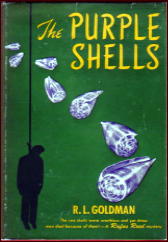
The Purple Shells. Ziff-Davis, 1947.

R. L. GOLDMAN Rufus Reed


Editorial Comment:   R. L. Goldman also wrote three non-series mysteries not included in the list above. Some biographical information about him can be found in the Ziff-Davis “Fingerprint Mystery” checklist compiled by Victor Berch, Bill Pronzini and myself.

« Previous PageNext Page »