Characters


THE ARMCHAIR REVIEWER
Allen J. Hubin


ROBERT J. RAY – Merry Christmas, Murdock. Delacorte, hardcover, 1989. Dell, paperback, 1990.

ROBERT RAY Matt Murdock

   L.A. private eye Matt Murdock is back, celebrating a holiday in decidedly unfestive fashion in Merry Christmas, Murdock, by Robert Ray.

   Here the past rises up before Murdock in two ways. Cindy Duke, a teen-ager who had maybe saved his life a couple of years earlier by driving him out of a burning canyon, asks him to find her father. He teaches in Wisconsin and came to L.A. in response to Cindy’s cry for help, raged at his ex-wife, battered her brother’s car with a baseball bat, ranged through a shopping mall in a failing search for Cindy, and disappeared.

   Meanwhile, another teenager, Heather Blasingame, lies in a coma from a hit-and-run encounter with a vehicle at that same mall. She’s the daughter of Jane Blasingame, feisty Texas state senator, and the senator (though with considerable reluctance) hires Murdock to supplement what seems an inept police investigation.

   These two cases are of course related, and powerful interests — not only Cindy’s grandfather Wheeler Duke and Duke Construction — are willing to go to about any lengths to keep Matt’s nose out of these matters.

   Vivid, active tale.

— Reprinted from The MYSTERY FANcier,
       Vol. 12, No. 4, Fall 1990.


    The Matt Murdock series —

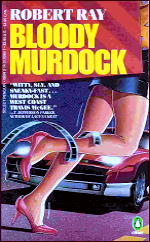
Bloody Murdock. St.Martin’s, 1986.

ROBERT RAY Matt Murdock

Murdock for Hire. St.Martin’s, 1987.
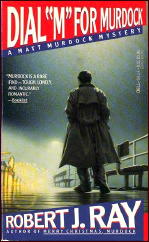
Dial “M” for Murdock. St.Martin’s, 1988.

ROBERT RAY Matt Murdock

Merry Christmas, Murdock. Delacorte, 1989.
Murdock Cracks Ice. Delacorte, 1992.

THE BACKWARD REVIEWER
William F. Deeck


THURMAN WARRINER – Method in His Murder. Macmillan, US, hardcover, 1950. First published in the UK: Hodder & Stoughton, hardcover, 1950.

    “Unquestionably, if Rhoda had been his wife, Mr. Ambo would have contemplated murder.” Ambo’s godson, John Wainfleet, who is married to Rhoda, contemplates nothing but a life of obedience to her demands.

    Or so it seems, until he reveals to Ambo that, after producing a satirical crime novel that had a modest success and a play that was still going strong, and after being told by Rhoda that he would have to stick to being a solicitor, he has a secret life in which he lives, though perish the thought not in sin, with another woman two days a week and writes successful novels under a pseudonym.

   Things are in this state temporarily, and then Rhoda’s brother ostensibly dies in an auto accident. The young doctor who examines the corpse believes death occurred before the accident, and apparently so do the police.

   Wainfleet and another man who were with Rhoda’s brother before the accident have perfect alibis. Well, Wainfleet does until Ambo starts investigating and discovers more than he wants to.

   This is the first novel featuring the investigations of Charles Ambo; Archdeacon Grantius Fauxlihough Toft, an unusual clergyman who believes in the Devil and burglary; and John Franklin Cornelius Scotter, private investigator. It is well worth discovering by those who enjoy humor, a fine prose style, and three engaging characters.

— From The MYSTERY FANcier, Vol. 12, No. 4, Fall 1990.


     Bibliographic Notes:

 The Ambo, Toft & Scotter series —

Method in His Murder (n.) Hodder 1950.
Ducats in Her Coffin (n.) Hodder 1951.
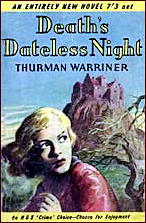
Death’s Dateless Night (n.) Hodder 1952.

THURMAN WARRINER

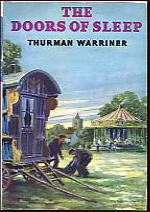
The Doors of Sleep (n.) Hodder 1955.

THURMAN WARRINER

Death’s Bright Angel (n.) Hodder 1956.
She Died, Of Course (n.) Hodder 1958.
Heavenly Bodies (n.) Hodder 1960.

   Only the first of these was published in the US. Warriner wrote one other mystery under his own name, another twelve as by Simon Troy, and one as John Kersey. Inspector Charles Smith appeared in all but one of the Troy books, the most well-known probably being Road to Rhuine (1952), and had a cross-over appearance in She Died, Of Course above.

IT IS PURELY MY OPINION
Reviews by L. J. Roberts


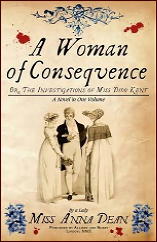
ANNA DEAN – A Woman of Consequence. Allison & Busby, UK, hardcover, 2010. St. Martin’s/Minotaur, US, hardcover, April 2012.

Genre:   Historical Mystery. Leading character:  Miss Dido Kent; 3rd in series. Setting:   England, 1806–Georgian era.

First Sentence:   My dear Eliza, I promised yesterday that just as soon as I had leisure for writing should send you a full and satisfactory account of Penelope Lambe’s accident at Madderstone Abbey; and so I shall begin upon it.

ANNA DEAN Dido Kent

   Unconscious after Penelope Lambe falls down stone steps in the ruin of Madderstone Abbey, it is thought she saw the ghost of the Grey Nun. Miss Dido Kent is skeptical and believes the cause was more corporal than spiritual.

   When a skeleton, identified as Elinor Fenn, governess, is found within a lake being drained on the property, the verdict is self-murder. A friend does not believe Miss Fenn would have committed suicide and, in order to save her being buried in unconsecrated ground, asks Dido to investigate.

   With a wonderful opening, I am reminded how much I enjoy the voice of Anna Dean and, therefore, her character Dido Kent. With shades of Jane Austen and her own delightful, wry humor, we are transported back to Georgian England… “I believe that every family which has any claim at all to grandeur should have a ghost. I consider it a kind of necessary which should be attended to as soon as the fortune is made and the country estate purchased.”

   Ms. Dean writes her books in both third person narrative and first person through letters from Dido to her sister. While some may find this annoying, for me it is an interesting and amusing way of conveying relevant information without slowing down the story. It allows us to see both all the events and be privy to Dido thoughts at the same time.

   At 36 years old, Dido is considered a spinster, yet is anything but shy and retiring. She has a logical mind and approach to solving problems by investigating the clues. The secondary story of her relationship with Mr. Lomax provides an interesting look at relationships and social mores of the time. Mr. Lomax discomfort at Dido discussing “unsuitable” subjects, including the vulnerability of women, and the proprietary of the interactions between them are both delightful and most honest representations I have read.

   Ms. Dean has written a mystery of twists and turns, of relationships and unexpected revelations. I was intrigued by some of the history, particularly the doctor trying to determine the cause of asthma.

   With more substance than a cozy, this was a very good traditional mystery. I anxiously await her fourth book.

Rating:   Very Good.

       The Dido Kent series —

1. A Moment of Silence (2008). Published as Bellfield Hall in the US.

ANNA DEAN Dido Kent

2. A Gentleman of Fortune (2009)
3. A Woman of Consequence (2010)

THE SERIES CHARACTERS FROM
DETECTIVE FICTION WEEKLY

by MONTE HERRIDGE


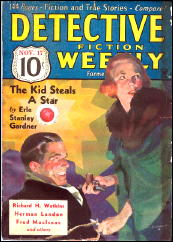
        #9. THE PATENT LEATHER KID, by Erle Stanley Gardner.

   The Patent Leather Kid is another leading character created by Erle Stanley Gardner. Someone with that identity first appeared in “The Gems of Tai Lee,” a story in the March 25, 1930, issue of Clues, but when the Kid showed up again, in the May 28, 1932, issue of Detective Fiction Weekly, he was a new character, the star of the first of a series of adventures that ended two years later.

THE PATENT LEATHER KID Erle Stanley Gardner

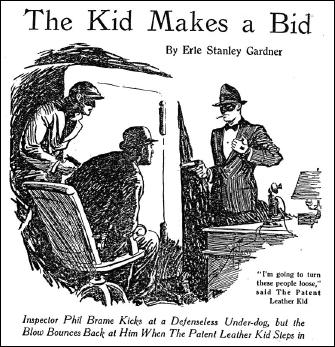
   He had a dual identity in the DFW stories – normally rich Dan Seller most of the time, and The Patent Leather Kid when he is ready for one of his somewhat illegal adventures. The patent leather in the name comes from his wearing not only patent leather shoes but also a patent leather face mask to hide his identity.

   The Patent Leather Kid “was always on the lookout for adventure, and anything sufficiently out of the usual called him with an irresistible attraction.” (The Kid Stacks a Deck)

   There is a cast of regular characters for each of his identities. The stories usually start out with a scene of Dan Seller and his fellows at their club, discussing the latest criminal event or activity. The other club members are firstly Police Inspector Phil Brame, then Renfroe the bank president, and Bill Pope the explorer.

   Brame usually brings up a criminal event, which causes disagreement among the others and ends with Seller or Bill Pope often betting on the outcome with him. Brame always loses these bets, but that does not keep him from trying again. Renfroe agrees with the Inspector much of the time, but also tries to avoid antagonizing Seller because he is a large depositor in his bank. It is not revealed how well off Dan Seller is, or where his money comes from.

   In his identity of the Patent Leather Kid, he has another group of people. There is Bill Brakey, The Kid’s bodyguard and assistant. He is also called “A walking encyclopedia of the underworld,” and this comes in handy for The Kid’s adventures. Brakey usually knows the answer to any question about the underworld, or can get the information easily.

   Another person in this group is Gertie, the telephone operator in his apartment house. She keeps track of his messages and also keeps an eye on The Kid’s special elevator which was constructed for his own use. She also knows his identity as Dan Seller. Interestingly, Gertie is also the name of Perry Mason’s telephone operator.

   There are only three people in the apartment house hotel who know Dan Seller’s dual identity: Bill Brakey, Gertie, and the desk clerk who is never named.

   The Patent Leather Kid lived in an apartment house hotel penthouse, with his special security extras such as a steel door and alarms systems. According to one story (The Kid Clips a Coupon), with these security arrangements: “no one could get through the roof without a warning coming over the telephone, without an automatic alarm shrilling a strident warning should the only elevator which communicated with the penthouse start on its way without The Kid’s having first unlocked an electrical contact.”

THE PATENT LEATHER KID Erle Stanley Gardner

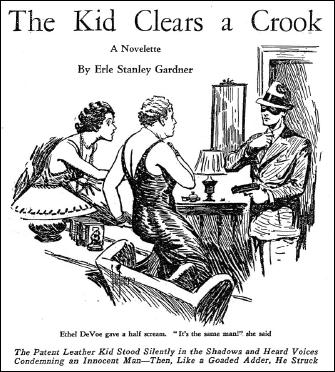
   The stories involve various kinds of adventures. In “The Kid Clears a Crook,” a reformed criminal trying to go straight is framed and taken advantage of by underworld crooks, and the police don’t care. The Kid sets out to clear the ex-crook and set the blame where it belongs, thereby infuriating both the underworld and the police.

   Neither group likes interference from The Kid in their affairs, and try repeatedly to eliminate him. The police even (according to Inspector Brame) give the underworld the green light to eliminate The Kid, but this never happens. Brame even states that if they catch the Kid, they will frame criminal charges on him in order to keep him in jail for a long time.

   The Kid enjoys this, in his words: “In this game of matching wits with the law, The Patent Leather Kid found his most fascinating recreation. He gambled with life and liberty, and enjoyed the game.” (The Kid Stacks a Deck) So the acquisition of money or property gained illegally is definitely not the goal of The Kid.

   The first story to appear in DFW, “The Kid Stacks a Deck,” is a bit different than the others in the series. Bill Brakey does not appear in this story, and Gertie is present but not named. Inspector Brame is given the title of Commissioner, which he loses in later stories. Possibly the author thought the stories more effective with a lower ranking policeman.

   In the story, The Kid finds out that a criminal gang is out to kill him, so he sets a trap for them. He breaks into a jewelry store, steals a few items and mails them to Brame and his family. The gang is waiting outside to shoot and rob him as he leaves. However, The Kid alerts the police who attack and wipe out the gang as The Kid escapes.

THE PATENT LEATHER KID Erle Stanley Gardner

   The story presents the image of The Kid as a master burglar without peer in the underworld and with a high reputation for those talents. However, he seems to have gained nothing from his burglary of the jewelry store. In fact, a point is made throughout the series that “The police had never been able to brand him specifically as a crook. He was a big shot, and his ways were the ways of the underworld, but they had never as yet pinned any definite crime upon him.” (The Kid Wins a Wager)

   Inspector Brame’s chief complaint about The Patent Leather Kid was that his activities damaged the dignity of the police and made them look bad and caused people (and The Kid) to laugh at them. That was a terrible offense to Brame. He seems to have cared more about the dignity of the police department than anything else.

   In “The Kid Throws a Stone,” The Kid is involved in a case where someone is impersonating him. The impersonator has already pulled one robbery before the real Patent Leather Kid starts his complex counter-offensive.

   In another case of impersonation told in “The Kid Wins a Wager”, a criminal burglarizes a jewelry story and leave a note supposedly signed by The Patent Leather Kid. Fortunately, The Kid catches him in the act and clears that up.

   One of The Kid’s favorite tactics was to get criminals, who are after him, into confrontations with the police, where they invariably wind up shot. Rarely does The Kid have to use a gun on the criminals themselves, but this does occur in the story “The Kid Cooks a Goose,” where he and Bill Brakey are trying to protect a woman from a gang of killers. They shoot it out with the three killers and wipe out the gang.

   This is a fun series, and Gardner is obviously enjoying himself writing these improbable situations. On a “Writer’s Almanac” episode on NPR (National Public Radio), Garrison Keillor quotes Gardner as saying about his pulp work: “I write to make money, and I write to give the reader sheer fun.”

      The Patent Leather Kid series by Erle Stanley Gardner:

The Gems of Tai Lee     Clues, 25 March 25 1930     [This story features a different “Patent Leather Kid,” as it turns out. See comment #12.]

   The Patent Leather Kid discussed above appeared as a character only in Detective Fiction Weekly:

THE PATENT LEATHER KID Erle Stanley Gardner

The Kid Stacks a Deck     May 28, 1932
The Kid Passes the Sugar     July 16, 1932
The Kid Wins a Wager     September 10, 1932
The Kid Throws a Stone     October 22, 1932
The Kid Makes a Bid     February 18, 1933
The Kid Muscles In     April 15, 1933
The Kid Takes a Cut     May 20, 1933
The Kid Beats the Gun     August 5, 1933
The Kid Covers a Kill     November 4, 1933
The Kid Clears a Crook     February 3, 1934
The Kid Clips a Coupon     April 21, 1934
The Kid Cooks a Goose     July 14, 1934
The Kid Steals a Star     November 17, 1934

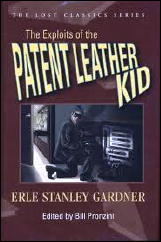
NOTE: The 13 stories that appeared in Detective Fiction Weekly have been collected in The Exploits of the Patent Leather Kid, edited by Bill Pronzini (Crippen & Landru, 2011).

    Previously in this series:

1. SHAMUS MAGUIRE, by Stanley Day.
2. HAPPY McGONIGLE, by Paul Allenby.
3. ARTY BEELE, by Ruth & Alexander Wilson.
4. COLIN HAIG, by H. Bedford-Jones.
5. SECRET AGENT GEORGE DEVRITE, by Tom Curry.
6. BATTLE McKIM, by Edward Parrish Ware.
7. TUG NORTON by Edward Parrish Ware.
8. CANDID JONES by Richard Sale.

Hi Steve,

   Some friends and I just got wind of this virtually unknown CBS-TV series a couple of months ago accidentally, via an odd old Google News result from Billboard magazine about notable composer Alex North’s jazz theme.

   There’s no mention of the 1959 series in John McAleer’s humongous Stout biography, although a pilot plus a few episodes were actually filmed and it came within an eyelash of being Nero Wolfe’s TV debut — contradicts the conventional wisdom that Stout had vetoed any further screen adaptations during his lifetime due to his disappointment with the 1930s movies.

   Here it is, complete with the lone screenshot evidence we found — Shatner’s Archie with Kurt Kasnar’s Wolfe — on Wikipedia’s entries for Nero Wolfe and Shatner:

http://en.wikipedia.org/wiki/Nero_Wolfe#Nero_Wolfe_.28CBS.29

http://en.wikipedia.org/wiki/William_Shatner#Early_stage.2C_film.2C_and_television_work

   Alerting you because I remember Mystery*File and its followers expressing interest in early “NW” adaptations that were or might have been, and this one’s quite a revelation.

Best regards,

      Tina

A REVIEW BY MARYELL CLEARY:
   

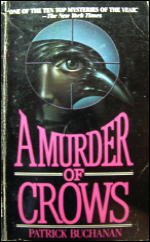
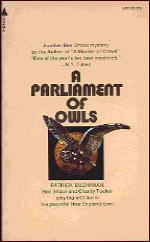
PATRICK BUCHANAN – A Murder of Crows. Stein & Day, hardcover, 1970; reprint paperback, 1985. Also: Pyramid N2743, paperback, 1972.

PATRICK BUCHANAN Murder of Crows

   An intriguing title and a riveting first chapter entice the reader who stands hesitating at the paperback book rack. Unfortunately for the buyer, the rest of the book does not live up to the beginning.

   Ben Shock and Charity Tucker, private investigators without credentials, are asked by an old friend of Charity’s, Subrinea Brown, to look into the sudden local hostility to her father’s small racetrack in the making. The antagonism has gone so far as to frighten Colonel Brown into a heart attack.

   Subrinea’s fiance, Loyal Boone, is also trying to find out what changed public support into active hostility. Could it be the Unknown Tongues, a mountain sect with a spellbinding blind preacher? Might the crooked local politicians have a more profitable scheme in mind? Do Loyal’s father and his Mexican wife, with their money-making snake farm, have any connection with the continuing and determined efforts to get Subrinea and her father out?

   People die, their bodies burned, their clothes not even singed. Are the Unknown Tongues invoking back-country magic? Does Uncle Uglybird, the “yarb doctor” know any of the answers? Uncle Uglybird is a 14-carat-gold character, but he’s not worth the price of admission.

   The book is stiff, the people don’t come alive, mayhem accumulates, and at the end the two detectives ride off to the next case scarcely touched emotionally by the devastation they left behind.

— Reprinted from The Poisoned Pen, Vol. 7, No. 1, Fall-Winter 1987.


Bio-Bibliographic Data:   “Patrick Buchanan” was the joint pen name of Edwin Corley & Jack Murphy. Corley’s Wikipedia page describes Charity Tucker as “a tall, blonde, intelligent television reporter, who teamed with private investigator Ben Shock to investigate various murders.”

       The Ben Shock & Charity Tucker series

A Murder of Crows. Stein & Day, 1970.
A Parliament of Owls. Stein & Day, 1971.

PATRICK BUCHANAN

A Requiem of Sharks. Dodd Mead, 1973.
A Sounder of Swine. Dodd Mead, 1974.

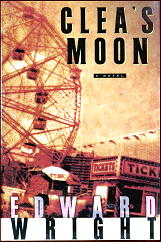
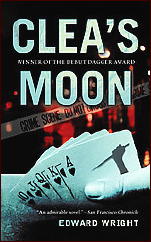
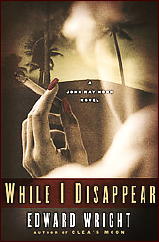
EDWARD WRIGHT – Clea’s Moon. G. P. Putnam’s Sons; hardcover, April 2003. Berkley, paperback, 2004. Orion, UK, hardcover, 2003.

EDWARD WRIGHT Clea's Moon

   This retro-mystery set in late-1940s Los Angeles, a first novel by California-based writer, seems to have been published first in Great Britain, since it’s already won a Silver Dagger award given by that country’s Crime Writers’ Association.

   It has a lot of the right ingredients going for it — starting with its former B-western movie star leading character, John Ray Horn — but as I’m sure I needn’t remind you, sometimes the whole is less than the sum of its parts.

   The beginning is solid enough. Recently released from prison for a crime he did commit, no matter how justified, John Ray has been banned from the studios and has been forced to go to work as an enforcer for his former co-star, Joseph Mad Crow, an Indian who’s now the owner of a thriving casino.

   The roles have been switched — a nice touch. John Ray is no longer the hero he once was, either on the screen as “Sierra Lane,” or in real life.

   In fact, until he learns that his former stepdaughter has run away and disappeared, and he’s the one person who has the best chance of finding her, his life, in all likelihood, would have continued to slip away. Clea and her best friend Addie are girls on the verge of becoming women, and here lies a principal part of the puzzle that John Ray finds himself putting back together.

EDWARD WRIGHT Clea's Moon

   There is an analogy to be found here. The general Los Angeles area is a city on the verge of becoming a metropolis, a change that John Ray sees coming and finds lacking. Open space is disappearing, and housing projects are moving in.

   All well and good. What’s more, some of the dialogue is reminiscent of Raymond Chandler, whose name you might be thinking right about now, a comparison not to be made lightly, and on occasion the resemblance is remarkable. The nightclub scenes are excellent, bringing pictures to mind some of the best of the film fare of the forties.

   So what’s the problem? This is indeed Chandler country, strongly revisited, or at least it’s tiptoeing around it. But while John Ray is stalwart and strong, hard-boiled he’s not, and some of the decisions he makes are — well, let’s say they’re his own.

   I also found the underlying theme of child pornography something less than savory. That’s primarily a personal reaction, I should add, but in terms of entertainment value, as far as I’m concerned, it’s a large empty hole I found hard to overcome.

   The biggest disappointment, though, was, overall, the story’s amiable but eventual predictability, a trait in which Mr. Chandler, even without having the advantage of going first, never indulged. It’s a workmanlike effort, but when you read it — and if you’ve read this far, you definitely should — you’ll see what I mean.

PostScript:   And in closing, let me ask you this. In almost every novel like this, why is it that everyone who smokes, lights up a Lucky?

— August 2003

       The John Ray Horn series

1. Clea’s Moon (2003)
2. While I Disappear (2004)    [Shamus Award, Best Novel winner, 2005]

EDWARD WRIGHT Clea's Moon

3. Red Sky Lament (2006)     [Ellis Peters Historical Crime Award, UK, 2006]

[UPDATE] 11-28-11.   A number of people I know, including Jeff Meyerson, who stops by here every so often, liked this book a lot more than I did. Even more telling, perhaps, Wright has won several awards for this series. Maybe I’m wrong — or I was, eight years ago. I dunno. Maybe I should put this at the top of my To Be Read Again list.

A TV Review by MIKE TOONEY:


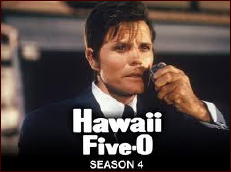
HAWAII FIVE-O Hume Cronyn

“Over Fifty? Steal.” The original Hawaii Five-O (Season 3, Episode 11, 25 November 1970) and “Odd Man In” (Season 4, Episode 14, 28 December 1971).

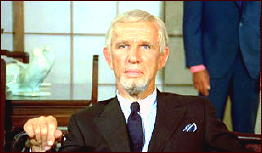
Jack Lord (Steve McGarrett), James MacArthur (Dan-O), Zulu (Kono), Kam Fong (Chin Ho), Hume Cronyn (as Lewis Avery Filer), Richard Denning (The Governor), Harry Endo (Che Fong), Jiro Tamiya (Goro Shibata), Lane Bradford (Moose Oakley). Writer: E. Arthur Kean. Directors: Bob Sweeney, Paul Stanley.

   Imagine an intelligent, extremely clever “gentleman thief” in the tradition of Raffles and Robin Hood.

   Now imagine this thief couldn’t care less about righting wrongs or fighting oppressive government — he just wants the money.

   Such is Lewis Avery Filer, a character who appeared in two episodes of the original Hawaii Five-O.

   In his first appearance (“Over Fifty? Steal”), Filer is an insurance investigator who has just been forcibly retired, a victim of a corporate takeover.

HAWAII FIVE-O Hume Cronyn

   Filer feels he’s been treated shabbily and sets out to exact his revenge. He initiates a series of robberies against the “new boss” that has McGarrett and Co. jumping through hoops trying to track him down.

   Unlike most of McGarrett’s foes, Filer eschews violence, using his formidable intelligence to execute his crimes with great precision. At one point, he even confronts McGarrett in the middle of a news conference! Predictably, the media glorify this new “Robin Hood,” much to Five-O’s collective chagrin.

   Eventually, Filer slips up, allowing McGarrett to capture him just at the moment of his greatest triumph.

   When he next shows up, some time in the next season (“Odd Man In”), Filer is in prison, but he’s overheard something there that prompts him to escape: A $4 million drug money deal is about to go down, and Filer wants it all.

   Filer’s target this time isn’t a legitimate corporation but “The Corporation,” Asian drug dealers, and these boys play rough.

   Even while McGarrett is in hot pursuit, with Five-O always just one step behind him, the wily Filer plays the mobsters like a violin, knowing that one slip-up would prove instantly fatal. It’s a very dangerous “game” he’s involved in, but Filer is up to the task.

HAWAII FIVE-O Hume Cronyn

   However, can Lewis Avery Filer manage to rob from the rich (the Mob) and give to the poor (Lewis Avery Filer) without getting caught by Steve McGarrett? Need you ask?

   Both episodes featured Canadian-born Hume Cronyn (1911-2003), who must have relished playing Filer, transforming into many other characters at will. Cronyn’s first major film role was also memorable, as the snoopy mystery-novel addict in Alfred Hitchcock’s Shadow of a Doubt (1943).

   These shows featuring Lewis Avery Filer are a lot of fun, with an unaccustomed sense of humor for this series, and worth your time.

   Later on in Season 6, in an episode entitled “30,000 Rooms and I Have the Key” (26 February 1974), David Wayne played a very similar character but with a different name. Since E. Arthur Kean wrote this one too, we could conclude that it was intended as another Filer escapade — but, alas, it was not to be.

THE SERIES CHARACTERS FROM
DETECTIVE FICTION WEEKLY

by MONTE HERRIDGE


        #8. CANDID JONES, by Richard Sale.

   The series discussed this time is the Candid Jones series, created by Richard B. Sale and running from 1937-41. Sale had five other series running in Detective Fiction Weekly at one time or another: Daffy Dill, Captain McGrail, Casey Mason, John the Cobra, and Owl-Eye Venner. So Sale’s stories, from this evidence, seem to have been popular with the readers.

RICHARD SALE Candid Jones

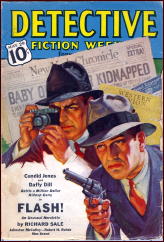
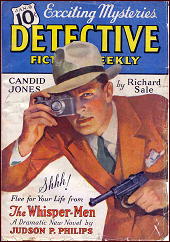
   The Daffy Dill and Candid Jones stories often were given covers for their issues. The very first Candid Jones story rated a special cover featuring Jones himself with his camera and gun. Daffy Dill describes Candid Jones in a later story: “He was a pretty big fellow, kind of homely, his face filled with freckles, his hair shiny as bright copper. … He had a strong jaw and clean eyes. … There was an air about him that meant Business with a capital B.” (Flash!)

   The stories give a little background about Candid Jones and how he wound up as a photographer. His real first name is Terrence, and the Candid nickname was given to him because of his candid personality. He is a hardboiled character, and had quite a fearsome reputation as an investigator.

   Jones started out being an investigator for an unnamed private detective firm, then after a year of learning the ropes, got a job with the Apex Insurance Company, on “the gumshoe trail of stolen gems and insurance chiselers.” (Make Way for a Dagger)

   Photography was his hobby at that time, and he began selling some of his pictures. He eventually decided to make a business of his hobby and went into business for himself, after resigning in 1932 from his insurance job of thirteen years. His background as an investigator helps him when he gets involved in mysteries, and his success brings more cases.

   His beginnings as a private investigator are seen in a flashback in the story “One Herring — Very Red”, in which he investigates the murder of a friend and mentor of his from that time period. At the end of this story he agrees to work for Apex Insurance Company on special assignments, otherwise he works on his photography jobs. And in another story, we learn of a previous marriage when he investigates a homicide and clears his ex-wife.

RICHARD SALE Candid Jones

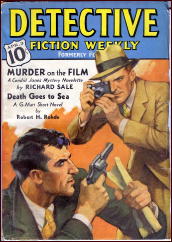
   Regarding his hardboiled reputation, Jones admits that maybe he was: “I was never afraid of any man, and I always figured that if a guy was going to get rough with you, the best thing to do was to get rough with him first.” (Long Shot) He also notes that “Bluff is great stuff and so is a front. It goes a long way.” (Murder on the Film)

   However, he noted, eventually you have to use your fists or bullets if it becomes necessary. Another of Sales’ characters, on the other hand, Daffy Dill, is not really a hardboiled character but always carries a gun because he deals with criminals and crimes regularly. Dill is a much easier going person.

   Many series have a policeman as friend or antagonist to the main character, and this series has one. Inspector Harry Rentano is a friend of Candid Jones, and sometimes invites him along on his official investigations. Rentano is also available for any assistance Candid Jones may need on investigations he starts.

   Rentano first met Candid Jones during the time Jones worked as an insurance investigator. He used to be on the police Bomb Squad, and worked on some Mafia cases. He is currently head of the Homicide bureau, and was known as a policeman more interested in knowing the truth about a case than in making an important arrest to impress people. He is married with four children.

   The third member of the cast in the stories is Jones’ girlfriend, Claire Crossman. She is a model from the Frazier Agency, “and outside of being my favorite model, she’s about my favorite girl-friend too.” (Banshee) She often does not appear in a very prominent role in the stories, unlike Dinah Mason in the Daffy Dill series.

   Candid Jones has two items he seems to carry with him everywhere. One is a camera, often a Leica, Model G. The other is his gun, a German 9mm Luger. He does not say where he picked up this weapon, but it is possible he is a war veteran.

   One occasion where Jones used a different camera is in the story “You Can’t Print That!” where he takes an entire strip of twenty-four exposures with a robot camera that automatically takes the photographs and advances the film for the next exposure. It came in handy for the murder he witnessed, and left his other hand free to use his gun on the murderer.

RICHARD SALE Candid Jones

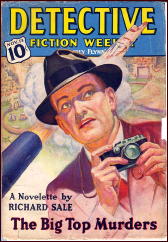
   Jones uses his gun frequently in the stories, and in his own words, “I’ve got to admit I never had any scruples about killing a man. … I don’t like to kill … But when it’s my life against a rat’s.” (Murder on the Film) His camera saved his life on one occasion, when a bullet struck it rather than him. (The Big Top Murders)

   To get an idea of the sort of crimes that Candid Jones becomes involved in investigating, a short survey of some of the stories is in order. “Long Shot”, the first story, involves an attempt to fix a horse race. It is a very violent story, and probably the most hardboiled of the series.

   In “You Can’t Print That!” Jones witnesses a murder that is connected to the trial of a racketeer, and takes some photographs for his first newspaper job. In “Backstage” Jones makes a bet with Inspector Rentano that he can catch a double murderer by the next day. This one takes place at the local zoological park.

   In “Banshee” Inspector Rentano asks Jones for help on the question of a banshee at the city aquarium, and gets involved with some criminals. In “Make Way for a Dagger” Inspector Rentano asks Jones along on a murder investigation aboard a yacht in the Hudson River, where the weapon is a harpoon.

   In two of the stories Daffy Dill costars with Candid Jones: “Flash!” and “Death of a Glamor Girl.” Both characters appeared on the cover of “Flash!”, thus promoting both series. Daffy Dill also makes a brief appearance in “You Can’t Print That!”

   At the time of the story “You Can’t Print That!” Jones had acquired a staff photographer position on the Chronicle newspaper at the salary of a thousand dollars a month, but he stated in “Banshee” that he had given up that position because there was “Too much of a sameness. I was getting rich without working. I’m on my own again.”

RICHARD SALE Candid Jones

   Photographs play an important part in the stories in the series, often revealing clues and serving as evidence of crimes. Jones’ photograph studio is on Fifth near Forty-Fifth Street. The studio is evidently well-equipped, having been set up for modeling sessions that Jones photographs, plus an excellent darkroom for developing film.

   Jones works not only in black-and-white film but also does color prints, which is “a technical sort of job, involving separation of color values in the negatives and then dyes.” (Backstage)

   There was an extended gap between the last two stories. The last story, “Delayed Action” in 1941, explained that some changes had taken place since the previous group of stories. Jones noted that it had been almost a year since he had been involved in any crime cases, and he intended to continue that way.

   However, in this story he becomes involved in a crime case, and willingly so. He also notes that Claire Crossman has married someone else, so that romance is off. Candid Jones’ ex-wife plays a part in the story, and he protects her from the criminals. Inspector Rentano is mentioned in this story, but does not appear in it.

   The series is worthy of being reprinted. Although not quite as numerous and popular as the Daffy Dill series, it is a good hardboiled detective series worth reading. One advantage to writing these series overviews is being able to reread the stories, especially the better ones like Candid Jones.

      The Candid Jones series by Richard Sale:

Long Shot     January 9, 1937
Neat But Not Gaudy     January 30, 1937
Murder on the Film     April 3, 1937
One Herring — Very Red     May 1, 1937
Flash!     May 29, 1937
The Camera Kills     July 31, 1937
You Can’t Print That!     August 21, 1937
Gaff!     October 30, 1937
The Big Top Murders     November 13, 1937
Back Stage     January 15, 1938
Banshee     April 9, 1938
Make Way for a Dagger     August 27, 1938
Pictures in the Dark     December 10, 1938
Torio Had a Friend     March 25, 1939
Death of a Glamor Girl     April 8, 1939
The Mother Goose Murders     May 27, 1939

RICHARD SALE Candid Jones

Tip Your Hat     August 26, 1939
Someday I’ll Get You     November 18, 1939
Delayed Action     June 14, 1941

    Previously in this series:

1. SHAMUS MAGUIRE, by Stanley Day.
2. HAPPY McGONIGLE, by Paul Allenby.
3. ARTY BEELE, by Ruth & Alexander Wilson.
4. COLIN HAIG, by H. Bedford-Jones.
5. SECRET AGENT GEORGE DEVRITE, by Tom Curry.
6. BATTLE McKIM, by Edward Parrish Ware.
7. TUG NORTON by Edward Parrish Ware.

GOOD COP, BAD COP:
Inspector French & Inspector Rebus
by Curt J. Evans


   In his Rough Guide to Crime Fiction (2007) [reviewed here ] Barry Forshaw has a chapter, “Cops,” with 31 novel entries. Merely two of the novels listed were published before the 1980s: Ed McBain’s The Empty Hours (1962) and Georges Simenon’s The Madman of Bergerac (1932).

   Ian Rankin, creator of Inspector John Rebus and currently the most popular crime fiction author in Britain, gets one entry, for The Falls (2001), as well as a page devoted to his works in general. Freeman Wills Crofts, creator of Inspector French, the greatest police detective of the Golden Age of detective fiction (roughly 1920-1940), gets no mention in the “Cops” chapter, nor anywhere else in Forshaw’s Guide for that matter.
FREEMAN WILLS CROFTS

   This omission is an injustice to Freeman Wills Crofts. No doubt this author is out of fashion these days, but in his own way he is as important to the history of the crime fiction genre as Ian Rankin is. To be sure, Ian Rankin, the leading figure in the so-called “Tartan Noir” movement, has been a powerful force in moving British detective fiction away from its cozy, genteel, village and country house gentry stereotype, but in his own day Crofts did much the same thing, albeit more gently.

   While Crofts’ most famous creation, Inspector French, is a much more conventionally “nice” individual than Rankin’s John Rebus, Crofts’ tales of French’s criminal investigations give readers a different picture of the Golden Age British detective novel than that which has been derived from the better-known works of the British Crime Queens (Agatha Christie, Dorothy L. Sayers, Margery Allingham and Ngaio Marsh).

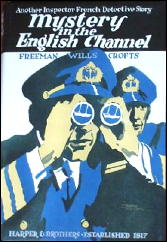
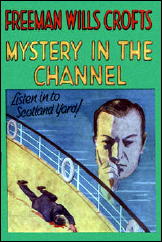
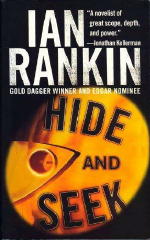
   By exploring Freeman Wills Crofts’ Mystery in the Channel (1931) and Ian Rankin’s Hide and Seek (1990), I want to highlight not only the differences between Crofts and Rankin and their fictional detectives, but — which may be surprising to many — the similarities.

   Crofts created Inspector Joseph French as a series character (he appeared in a long series of novels published between 1924 and 1957, the year of Crofts’ death) in order to get away from the eccentric amateur detective figure so strongly associated with British mystery. French won immediate popularity around the globe, becoming one of the best-known fictional crime investigators of the British Golden Age.

   A plain, no-nonsense, middle class cop, Inspector French stands in stark contrast with such glamorous aristocratic sleuths as Sayers’ Lord Peter Wimsey, Allingham’s Albert Campion and Marsh’s Roderick Alleyn (though Alleyn himself is a cop, he is rather a twee one), as well as Christie’s eccentric Belgian, Hercule Poirot, and her nosy village spinster, Miss Jane Marple.

   In 1936, Crofts’ American publisher, Dodd, Mead, informed potential Crofts readers that the author had deliberately built up Inspector French “as a foil to the theatrical and eccentric fictional sleuth” and that the police detective therefore was “a model of thoroughness, persistence and hardwork” — an ideal embodiment of the bourgeois virtues.

   Mystery in the Channel, the seventh Inspector French novel, shows both the detective and the author at the height of their powers, in a typical case involving not misdoings in a baronial mansion or a quaint Edwardian village, but modern corporate corruption and crime involving two countries.

   In the effective opening of Mystery in the Channel, the corpses of two men are discovered on a yacht adrift in the English Channel. Both men were felled by gun shots. It is soon discovered that the slain pair were officers in Moxon’s General Securities. (“You’ve heard of it, of course; one of the biggest financial houses in the country.”)
FREEMAN WILLS CROFTS

   Could these deaths be related to the rumors in the City that Moxon’s was headed for a complete crash? It certainly seems so, when it is discovered that a million and a half pounds has been looted from the firm’s coffers.

   Scotland Yard’s investigation involves delving into matters both financial and logistical. What were the two murdered businessmen doing on the yacht and who could have gotten on the yacht to murder them? To some this may sound dry, but Crofts manages to keep the reader in doubt and suspense until a dramatic climax is reached, when the dauntless French nabs the guilty.

   In Mystery in the Channel, Crofts, a retired railway engineer who, admittedly, knew more about trains than he did the workings of Scotland Yard, makes some effort to portray the Yard as the great investigative machine that it was. Besides French, other officials seen working on the Channel case are:

    ● Sir Mortimer Ellison, Assistant Commissioner of Scotland Yard, French’s boss throughout the series.

    ● Police Sergeant Carter, French’s chief underling throughout much of the series.

    ● Inspectors Tanner and Willis. These men both featured in earlier, pre-French Crofts’ novels investigating cases of their own, Tanner in The Ponson Case (1921) and Willis in The Pit-Prop Syndicate (1922). Tanner, we learn, is Inspector French’s “greatest friend.”

    ● Mr. Honeyford, “finance expert from the home office.”

    ● Inspector Barnes, “the Yard’s nautical expert.”

   French also has to deal with local law enforcement officials in both England and France.

   Admittedly, Crofts’ treatment of the police often is naïve, but his books certainly mark a departure from the Golden Age stereotype of amateur detective and country houses/villages. How does Crofts compare with Rankin, a hugely popular author widely deemed the modern master of the British police procedural?

   Hide and Seek, the second Ian Rankin novel about Inspector John Rebus, appeared in 1990. In this tale, Rebus investigates the death of a young male drug addict found expired, surrounded by Satanic symbols, in a squalid Edinburgh “squat” (abandoned building).

IAN RANKIN

   Everyone but Rebus writes the death off as an accidental overdose, but the tenacious and stubborn detective eventually discovers darker truths, namely that the young man was murdered and that a malign conspiracy involving very prominent people is afoot in Edinburgh.

On the surface Inspectors French and Rebus are very different sorts — one might call them British crime fiction’s good cop and bad cop. French has an ideally blissful marriage with his wife, Emily, or Em; and he has a daughter, Eliza. (To be sure, there is tragedy in French’s life in that his son was killed in the Great War, but Crofts later forgot that he had given Joseph and Emily children, so perhaps this loss does not matter so much.)

   Although in a couple of Crofts’ novels Em has what she calls a “notion” and contributes an insight that helps French solve his case, essentially she is a firmly domesticated woman placidly devoted to her husband’s welfare and what the author terms her “mysterious household employments.”

   Contrastingly, in Hide and Seek we learn that John Rebus’s wife has left him and his household behind, taking their daughter, Samantha (Sammy), with her. Rebus leads a much lonelier, angst-filled existence than French, and he has no one to tidily arrange his domestic life.

   Instead, he goes through a series of girlfriends, drinks too much and smokes too much — all patterns of behavior alien to the the abstemious and upright Joseph French. (It is rather shocking when a frustrated French at one point in Mystery in the Channel declares, “Curse it…I could do with a bottle of beer.”) Like French, Rebus seems to have some religious inclinations, but, unlike French, Rebus is unable to sustain them.

   Rebus also has pricklier relationships with his superiors than does French, although Rankin’s old-fashioned and courtly Detective Chief Superintendent Thomas “The Farmer” Watson bears considerable resemblance to Crofts’ Sir Mortimer Ellison. (Over the course of the Rebus novels things continue to change, however: Watson retires in 2001’s The Falls and is replaced by a woman — awkwardly for Rebus one of his former sexual partners.)

   Nevertheless, French as well as Rebus sometimes bucks the system. In Hide and Seek, Rebus finally exposes the criminals by a not-by-the-book stratagem that is like something Bulldog Drummond and his jolly amateur crime fighting pals might have tried in an outrageous Sapper thriller from the 1920s.
IAN RANKIN

   For his part, French for the sake of expediency on occasion employs skeleton keys to conduct warrantless searches and sometimes “bluffs” recalcitrant witnesses (misleadingly threatens them with arrest) to get the information he wants.

   Not surprisingly, given the tenor of modern times, Rebus’s cases tend to involve much racier subject matters — bad stuff — than those of Inspector French. In Hide and Seek, for example, Rebus confronts a case involving such unsettling matters as Satanism, drug abuse and (male) prostitution. Certainly no such things crop up in Crofts’ Mystery in the Channel!

   Yet in a key respect the subject matters of the books are strikingly similar. In both Hide and Seek and Mystery in the Channel, the specter of business corruption and criminality looms large indeed. Both Rankin and Crofts take quite condemnatory views of the corporate world. Here is Sir Mortimer Ellison on the men of Moxon’s General Securities:

    “[W]hen I think of all the innocent people who are going to suffer through these dirty scoundrels, I’d give a big part of my salary to know they were safe in Dartmoor….I tell you, French, it’ll not be the fault of this department if those fellows have any more happiness in this world.”

   The author himself chimes in with a similar note, informing us of Sir Mortimer that “for the wealthy thief who stole by the manipulation of stocks and shares and other less creditable methods known to high finance, whether actually within or without the limits of the law, he had only the most profound enmity and contempt.”

   In his influential survey of detective and crime fiction, Bloody Murder, Julian Symons declares that “Golden Age writers would not have held it against [E. C. Bentley’s Trent’s Last Case character Sigsbee] Manderson that he became rich by speculation.”

   By making such an assertion, Symons reveals he did not sufficiently comprehend the work of Freeman Wills Crofts. When writing Mystery in the Channel Crofts clearly was influenced by the deplorable state of the world since 1929, after the Wall Street Crash and the onset of the Great Depression (events that also have resonance today).

   In Hide and Seek Rankin makes his distaste with Big Business as manifest as Crofts had sixty years earlier. Mark the words Rankin puts into the mouth of one of his businessmen villains, who arrogantly attempts to bribe Rebus:

    “There’s a lot of new money in Edinburgh, John. Money for all. Would you like money? Would you like a sharper edge to your life? Don’t tell me you’re happy in your little flat, with your music and your books and your bottles of wine.”

   But John Rebus, like Joseph French, proves sterling and incorruptible. In the end, Rebus and French share this defining quality with each other and, indeed, with Wimsey, Campion, Alleyn, Poirot, Marple and the rest of the crime and mystery genre’s Great Detectives: a determination to find answers, to establish truth, to restore some semblance of order in a world of chaos and confusion.
« Previous PageNext Page »