Characters


ELIOT PATTISON – Bone Mountain.

St. Martin’s; trade paperback, May 2004. Hardcover: September 2002.

   I don’t know if you’re anything like me, but I’m pretty much intimidated by the sheer bulk of some of the books coming out today. Sometimes, as I’m looking through the stacks of books around here for something to read – and I don’t mean library stacks. I mean stacks – and if a book looks simply too hefty, too weighty, too long – you know what I mean – in terms of what I’m looking for at the time, I usually pass it by and go on to another.
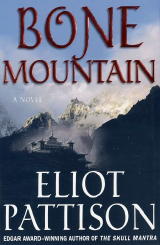
ELIOT PATTISON Bone Mountain

   This happens more and more with fantasy epics, by the way, big thick books in series that go on and on forever, and how does one manage to keep track of the story, all of the characters, all of the various strands of the plot, unless you’re living it everyday, just as the author does, or has to, creating it, breathing it, playing scenes back, every free moment, his or her life taken over by nothing but.

   But I digress. As I was saying, I don’t recall precisely what the occasion was, but reading this particular book was the result of the decision made one day to give one the “big ones” a try. And it’s a big one, all right, over 400 pages of small print in an oversized trade paperback format. It’s also an introduction to a world that’s familiar to only a smattering of westerners: the land of Tibet, overrun and modernized by the Chinese in the world of today, or at least, under their rule, they’re trying their best to adapt.

   Pattison’s first book, The Skull Mantra, won the MWA’s Edgar award for the best first novel of 2000, and it introduced “disgraced ex-Beijing police inspector Shan Tao Yun” to the world of mystery fiction. (I’m quoting from the back cover here.) Bone Mountain is the third of his continuing adventures. Number two was Water Touching Stone, and newly out in hardcover is the fourth, Beautiful Ghosts.

   It took me two weeks to polish this one off, and I enjoyed every minute of it. You may have noticed that I have not mentioned anything about the plot, and the reason is that I’ve been putting it off, feeling myself not able to do justice to it.
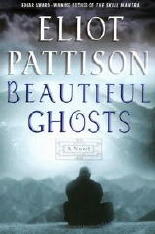
ELIOT PATTISON Beautiful Ghosts    The candidate for the most obvious plot line, of which there are several, is that an idol (banned, of course, by the Chinese) is missing a stolen stone eye, and the band of Tibetans, along with one American cowboy (with diplomatic papers, but still a cowboy), with whom Inspector Shan is traveling has as their goal to replace it in its rightful spot in the Yapchi valley.

   Winslow, the disgraced diplomat, is also on the search for a missing female geologist, part of the oil venture that may soon displace the people of Yapchi valley, which is another essential thread of the tale.

   There are several murders to be solved and deaths to be explained, so that, yes, if you were wondering, this is indeed crime (and adventure) fiction.

   The real villain, however, is Beijing, and the Chinese government, intent on wiping out, destroying, annihilating an entire culture – that of traditional Tibet – and that, in the longer view, is the story that Pattison is telling, one story that’s now four books long.

   There is a sense of timelessness in the world he describes, in the provinces furthest from population centers, and there is along with it a dream-like quality of an ancient civilization that refuses to die in the face of overwhelming and dire adversity. More than once was I reminded of those epic works of fantasy I mentioned earlier, written by authors such as Tolkien and Robert Jordan, among others, but with the essence of reality about it – we do not really know how the story will end – behind the melancholy mask of tragedy.

   Not your usual detective story? Not by half!

— June 2004


ADDITIONAL COMMENT:  Here’s a news release that’s both relevant and of interest, I’m sure, if you’ve read this far…

Author of Tibetan Mysteries Banned in China

         For National Release (regional counterparts) May 21, 2004:

   Eliot Pattison, writer of the acclaimed Inspector Shan series, has so upset authorities in China that they are periodically blocking access to his website within China. Pattison joins a long list of human rights activists who have been singled out by Beijing for censorship-but he is believed to be the only writer of fiction to be thus censored. Numerous readers in China report that, like a number of sites criticizing the Chinese government, Pattison’s site is often blocked by the central authorities.

   Pattison’s award-winning mysteries, set mostly in Tibet, incorporate the Chinese gulag for political prisoners and China’s dismantling of minority cultures into their plots. His books have been highly successful in introducing these issues to new audiences–human rights activists state that his novels capture the realities of China’s treatment of ethnic minorities better than most works of nonfiction. His works have been compared to those of Solzhenitsyn, whose books in an earlier generation brought much-needed attention to the Soviet gulag.
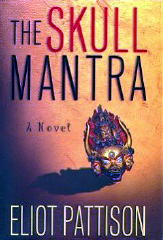
ELIOT PATTISON Skull Mantra

   As soon as it was released, Pattison’s first novel The Skull Mantra, became a popular black market item within China as its citizens realized the book explained aspects of their country their government would never speak about. Interest in his books surged after that novel won the prestigious Edgar Award-since then his four novels have been translated into twenty languages and have been adapted to radio drama in Europe. Some editors have suggested that he has created a whole new genre of “campaign thrillers” which construct mysteries around political messages.

   Pattison began traveling to China the month that relations between Washington and Beijing were normalized in 1980. On his many repeat visits he became increasingly appalled at the rigid police control of Tibetan temples and other ethnic centers. “After writing several nonfiction books I wanted to try my hand at writing mysteries,” Pattison explains, “and also very much wanted to tell the world about the struggle Tibetans and other minorities face trying to maintain their cultural identity. Writing this series became the perfect answer.” While angered by China’s blocking of his website, he is not surprised-“the list of websites deemed politically undesirable to Beijing numbers in the hundreds,” he notes. “Censorship is a way of life in China, and will have to be addressed if China is truly going to join the global community. At the end of the day, of course, it just underscores the points I make in my books.”

[UPDATE] 02-19-08.  There’s not always a reason for going back to my files and picking out a review to run here, but this time there is. This one was written almost four years ago, and unless I’m badly mistaken, no one’s seen it but me until now.

   There is now a fifth book in the series, Prayer of the Dragon, out just recently, and on his blog Detectives Without Borders, Peter Rozovsky reviews it and throws out the following question for discussion:
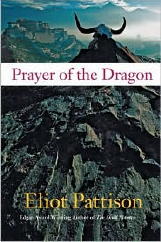
ELIOT PATTISON Prayer of the Dragon

    “All this makes Shan Tao Yun more of an outsider than your average cop who’s impatient with his boss. For one thing, Shan’s outsider status is far more dangerous than that of most crime protagonists.

    “I’ll stop now and let you go read the books yourselves. […] While you’re on your way to the bookshop or library, ponder this question: Of all the outsider crime-fiction protagonists you know, who is the most outside, the most precarious, the most alienated? What makes him or her that way?”

   An interesting question, Peter. My money’s on Inspector Shan, but my knowledge of mysteries taking place all around the world is rather limited, regrettably so. There are some awfully dangerous places a detective can find him- or herself in. I’ll have to wait and see what your readers have to say.
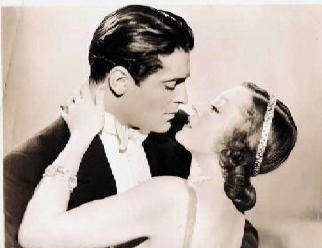
THE LONE WOLF IN PARIS. Columbia, 1938. Francis Lederer, Frances Drake, Walter Kingsford, Leona Maricle, Albert Dekker. Director: Albert S. Rogell. Based on the character created by Louis Joseph Vance.

   Michael Lanyard, also known as The Lone Wolf, appeared in eight novels written by Vance between 1914 and 1934; in 24 movies between 1917 and 1949; in a 1948 radio show on Mutual; and in a 1954-55 syndicated TV series. (I didn’t want you to think we were talking about any old fly-by-night sort of character here.)

The Lone Wolf in Paris

   By the end, he was essentially a good guy, almost but not quite a private eye, I believe, but he didn’t start out that way. In the beginning he was a gentleman European jewel thief, pure and simple, but his penchant for helping beautiful women in distress eventually convinced him that working for the law instead of against not only had the advantage of being able to continue his narrow-escape adventures, but without the disadvantage of always having the police close behind his heels. At least theoretically, anyway.

   In The Lone Wolf in Paris, suave Czechoslovakian-born Francis Lederer’s only opportunity to play him, Lanyard is on the edge of reform. He has letters from heads of police departments from all over Europe to vouch for him, but the hapless manager of the Paris hotel where he is staying immediately has a suspect in hand when robberies begin taking place in several rooms of his establishment.

   In the hotel at the same time, it seems, are three rich members of Arvonne royalty, who between them have the crown jewels of their country. (Arvonne is a small country found somewhere on the map near France, we are led to believe.) Princess Thania (Frances Drake) desperately needs them back. Once the people of Arvonne learn that they are missing – a good deed gone bad – the Queen will be forced to abdicate.

   There is a lot of pleasant thievery and derring-do packing into the 66 minutes of this movie. There are also a few brief opportunities for romance between all of the switches back and forth between the real gems and fake ones made of paste. It’s a minor film, but a very enjoyable one nonetheless. The hour and change in running time goes by very quickly.

   After the discussion on this blog about the two versions of Steve Fisher’s I Wake Up Screaming, Frank Loose asked the following question in the comments section:

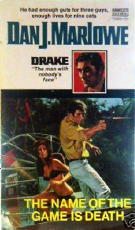
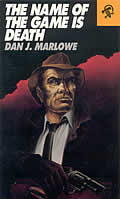
   “If I understand correctly, Black Lizard did a similar thing with Dan Marlowe’s The Name of the Game is Death. I believe their edition is of a revised, tamed down version of the book, and that the original first edition was a bit more violent. Perhaps you can enlighten me on this?”

   I asked around but didn’t get anything specific about this, so I asked on the rara-avis Yahoo group. Mark Sullivan posted the following response, which he’s allowed me to reprint here. NOTE the spoiler alert partway through.


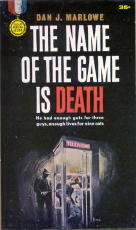
The Name of the Game Is Death

   I have both Gold Medal versions of The Name of the Game is Death, but I don’t have the Black Lizard version to compare them to. However, some time ago, I posted this comparison, so perhaps [from this] you can tell us which BL used:

   I recently found a copy of the 1962 The Name of the Game is Death. I haven’t read it yet, but I have compared it to the copy I already had [which was] “Copyright 1962, 1972 … Printed in the United States of America, January 1962/January1973”

   The story is exactly the same. The earlier one has one extra chapter, but that is only because the later edition combines Chapters VIII and IX. However, the book has been extensively rewritten, from first page to last. The language of the earlier one is a bit more clipped, more “just the facts” simple sentences, but longer paragraphs.

   Here are two examples. The first two paragraphs from 1962:

    “From the back seat of the Olds I could see the kid’s cotton gloves flash white on the steering wheel as he swung off Van Buren onto Central Avenue. On the right up ahead the strong late September Phoenix sunshine blazed off the bank’s white stone front till it hurt the eyes. The damn building looked as big as the purple buttes on the rim of the desert.

    “Beside me Bunny chewed gum rhythmically, his hands relaxed in his lap. Up front, in three-quarter profile the kid’s face was like chalk, but he teamed the car perfectly into a tight-fitting space right in front of the bank.”

   From 1973:

    “From the back seat of the Olds I could see the kid’s cotton gloves flash white on the steering wheel as he swung the car from Van Buren onto Central Avenue. The strong, late-September, Phoenix sunshine blazed off the bank’s white stone front till it hurt the eyes. The damn building looked as big as the purple buttes on the rim of the desert.

    “Beside me Bunny chewed gum rhythmically, his hands relaxed in his lap. Up front the kid’s face was like chalk, but he teamed the car perfectly into a tight-fitting space right in front of the bank.”

   So it’s close, but subtly different.

   And the last chapter, from 1962:     [SPOILER ALERT]

    “I was in black darkness for six months. I may have gone a little crazy, too. I gave them a hard time. I went the whole route: baths, wet packs, elbow cuffs, straitjackets, isolation. I stopped fighting them a little while ago. They don’t pay much attention to me now.

    “Even before I could see again, I knew what I looked like. I could feel the reaction, when a new patient was admitted, or a new attendant came on duty. Hazel came to see me four or five times. I refused permission for her to be allowed in.

    “They don’t know that I can see again, that I’m not crazy. They think I’m a robot. A vegetable.

    “I’ll show them.

    “I have a hermetically sealed quart jar buried in the ground up in Hillsboro, New Hampshire, and another in Grosmont, Colorado, up above the timber line. There’s nothing but money in both. I don’t need it. All I need is a gun. Some one of these days I’ll find the right attendant, and I’ll start talking to him. It will take a while to convince him, but I’ve got plenty of time.

    “If I can get back to the sack buried beside Bunny’s cabin, plastic surgery will take care of most of what I look like. With a gun, I’ll get back to it.

    “That’s all I need — a gun.

    “I’m not staying here.

    “I’ll be leaving one of these days, and the day I do they’ll never forget it.”

The Name of the Game Is Death

   And from 1973:

    “I was blind for six months.

    “I may have gone a little crazy, too. I went the whole route: baths, wetpacks, elbow cuffs, straitjackets, isolation. I stopped fighting them a while ago. They don’t pay much attention to me now.

    “I knew what I looked like even before I could see again. I could tell from the reaction when a new patient was admitted or a new attendant came on duty. Hazel came to see me five or six times. I refused to consent for her admission.

    “They don’t know that I can see again. That I’m not crazy. They think I’m a robot. A vegetable.

    “I’ll show them.

    “There’s a hermetically sealed quart jar buried in Hillsboro, New Hampshire, and another in Grosmont, Colorado. There’s nothing but money in both. I don’t need money. All I need is a gun. One of these days I’ll find the right attendant, and I’ll start talking to him. It will take time to convince him, but I’ve got plenty of time.

    “Plastic surgery will take care of most of what I look like if I can get back to the sack buried beside Bunny’s cabin. With a gun, I’ll get back to it.

    “That’s all I need — a gun.

    “I’m not staying here.

    “I’ll be leaving before too long, and the day I do they’ll never forget it.”

   Again, same content, slightly different presentation. Nothing had to be changed to make it a series. As a matter of fact, the prologue in my copy of One Endless Hour (March 1969/January 1973) begins with yet another close, but not quite the same, version of the last chapters of The Name of the Game. I don’t have the Vintage edition, so I can’t tell you which version they used, one of these or yet another one.

   The individual changes that Mark mentions are interesting but essentially only stylistic. The consensus has always been that drastic changes had to have been made, in order to transform the hero into a series character. The changes demonstrated by Mark certainly don’t fall into that category.

   In the meantime, Frank was also asking the question to a few other people. Here’s the reply he received from Chuck Kelly, who is very definitely an expert on Dan Marlowe’s books. He agrees with Mark in terms of the stylistic changes, all relatively minor, but then goes on and provides what appears now to be a definitive answer:


   Thanks for your question on the two versions of The Name of the Game Is Death.

   There are indeed two versions, both published as Fawcett Gold Medals. The original one was published in 1962, and the revised version was published in 1973. It is sometimes said that the 1973 version is a “toned-down” version, but, with a couple of exceptions, that really isn’t true. In fact, it’s basically just a rewrite with some different phrasing, paragraph structure, etc.

The Name of the Game Is Death

   The significant differences in the story in the two versions, and they are rather subtle, have to do with a couple of passages in which the main character discusses his sexuality with his new girlfriend, Hazel Andrews. In the 1962 version, the character appears to be a bit more uncertain about his heterosexuality than he does in the 1973 version.

   Also, in the 1962 version, there’s the implication that killing turns him on, which is removed from the 1973 version. The change probably was made to make the character fit more closely the “secret agent” Drake character readers knew by then, one who was sexually potent and a tough guy, but not a wanton killer.

   The Black Lizard edition actually is a re-issue of the 1962 version, so you’ve read the story as Marlowe originally wrote it.

   After my recent review of Les Savage’s collection of western stories THE SHADOW IN RENEGADE BASIN, Keith Chapman left a comment about Señorita Scorpion, the aptly named blonde heroine who appeared in one of them. As part of my reply to him, I thought I’d work up a checklist of all of the stories that she was ever in.

   This turned out to be a lot more difficult than I’d planned. There may already be such a list, but if so, I couldn’t find one on the Internet. Without a collection of the magazines themselves, and rather than struggle more than I needed to, I went to the source himself, Jon Tuska, who’s been busily editing and packaging Les Savage’s work to various publishers over the years. Here’s his reply:


Dear Steve

   There were originally seven Señorita Scorpion stories. The first three were first collected in THE LEGEND OF SEÑORITA SCORPION (Circle V Westerns, 1996). The fourth story was collected in THE RETURN OF SEÑORITA SCORPION (Circle V Westerns, 1997). The sixth story was collected in THE LASH OF SEÑORITA SCORPION (Circle V Westerns, 1998). These were large print editions.

   Only the first collection of three stories appeared in a standard print hardcover: THE LEGEND OF SEÑORITA SCORPION (Gunsmoke, 2003) published in the Gunsmoke series distributed worldwide by BBC Audiobooks Ltd. The reason we stopped the stories from appearing in this Circle V Western series is that they began to appear in Les Savage, Jr., trios published in the Five Star Westerns. They now have all appeared in such Five Star trios.

   Here are the seven stories in terms of first restored appearances in the Five Star Westerns:

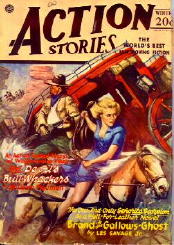
    “Brand of the Gallows-Ghost” by Les Savage, Jr. in Action Stories (Winter, 45) was originally titled by the author “The Brand of Penasco” and was collected under this title in THE SHADOW IN RENEGADE BASIN (Five Star Westerns, 2000).

Action Stories

    “The Sting of Señorita Scorpion” by Les Savage, Jr. in Action Stories (Winter, 49) was originally titled by the author “Scorpion’s Return” but was collected under its magazine title in THE STING OF SEÑORITA SCORPION (Five Star Westerns, 2000).

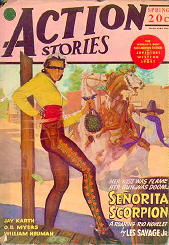
    “Señorita Scorpion” by Les Savage, Jr. in Action Stories (Spring, 44) was originally titled by the author “Death ’Rods the Big Thicket Bunch” but was collected under its magazine title in THE DEVIL’S CORRAL (Five Star Westerns, 2003).

Action Stories

    “The Brand of Señorita Scopion” by Les Savage, Jr. in Action Stories (Summer, 44) was originally titled by the author “Señorita Six-Gun” but was collected under its magazine title in THE BEAST IN CAÑADA DIABLO (Five Star Westerns, 2004).

    “Secret of Santiago” by Les Savage, Jr. in Action Stories (Winter, 44) was originally titled by the author “Secret of the Santiago” and was collected under this title in TRAIL OF THE SILVER SADDLE (Five Star Westerns, 2005).

Action Stories

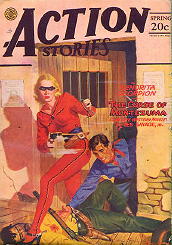
    “The Curse of Montezuma” by Les Savage, Jr. in Action Stories (Spring, 45) was originally titled by the author “Six-Gun Serpent God” but was collected under its magazine title in THE CURSE OF MONTEZUMA (Five Star Westerns, 2006).

Action Stories

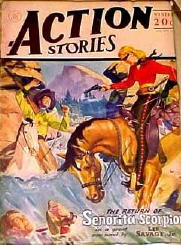
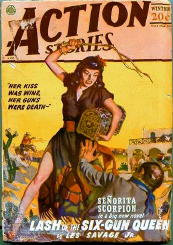
    “Lash of the Six-Gun Queen” by Les Savage, Jr. in Action Stories (Winter, 47) was originally titled by the author “The Return of Señorita Scorpion” but was collected under the title “The Lash of Señorita Scorpion” in WOLVES OF THE SUNDOWN TRAIL (Five Star Westerns, 2007).

Action Stories

   There is a lot of background on each story in the head notes in these various collections. Savage was not as fond of these stories as was Malcolm Reiss at Fiction House, and hence his writing of them was somewhat sporadic. Although he expanded several of his short novels for magazines into book-length novels, he never went back to do so with any of these stories, nor did he try to weld them together into collections the way we have done.

Best Wishes,

      Jon Tuska


NOTE: These cover images came from Phil Stephensen-Payne’s mammoth Galactic Central website, a source that every Fiction Magazine collector should absolutely know about.


[UPDATE] 02-08-07. Turns out that someone has done a list, as I suspected, even though I still haven’t seen it. And not only that, but there’s a story missing in Jon’s list above, but that’s because Les Savage didn’t write it.

   After posting a link to this blog entry on the Yahoo PulpMags group, Will Murray vaguely remembered that maybe Emmett McDowell did a Señorita Scorpion story. This rang a bell with me, too. Then Brian Earl Brown came up with the title. It’s in John DeWalt’s book Keys to Other Doors:

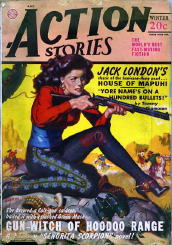
       “Gun-Witch of Hoodoo Range,” Action Stories, Winter 1948/1949, by Emmett McDowell.

Action Stories

   Thanks, gents!

[UPDATE #2.] 02-08-07. From long-time pulp fan Jerry Page, reprinted from the PulpMags group with his permission:

   For years I read only sf and fantasy pulps — I owned some non-sf pulps and had read some hero novels, Spider, Shadow, Doc, etc., but I wasn’t all that interested in pulps outside the sf field.

   Then, wondering through the dealers’ room at a convention I saw a stack of Action Stories on a table and the Winter 1947 issue caught my eye. I knew I had seen it before.

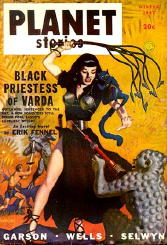
   Where? On the Winter 1947 issue of Planet Stories.

Action Stories

   Both covers were by Allen Anderson. The Planet cover illustrated Erik Finnel’s “Black Priestess of Varda.” The Action cover was the same figure of a woman holding a whip and being attacked by either an outlaw or Indian (I haven’t tried digging it out of the box its in so forgive me, but this is from memory).

   Obviously done from the same reference photo of the same model in the same pose. Composition and so on the same. But one was SF and the other was Western. I bought the Action Stories, took it home and compared it with the Planet Stories and confirmed what I thought I had seen. I think I bought three Actions and in each of them there was a Senorita Scorpion story by Les Savage. I read one of them and it was pretty good. I concluded Savage might be a better than average writer. So I read the others. They weren’t quite as good as the first one, but they were good.

   And that’s how I started reading pulps outside the SF field. I still think Savage is one of the better western writers. Reading him led to reading more Westerns, and I also started reading other kinds of pulps, discovering the great wealth of fiction to be found in Adventure, Black Mask and the better Air War pulps such as Wings. (Joel Townsley Rogers is one of the great pulp writers, and his best World War I stories, especially the aviation stories are close to being masterpieces.) I examined my Argosy issues I’d picked up because they contained fantastic stories, and started reading other types of fiction.

—Jerry

Hi Steve,

Thought you might be interested in seeing the following:

http://www.royalmail.com/portal/stamps

Everyone here frets about the British postal service but sometimes they do come up with some exciting things.

Best,

Tise

>>>>>>>>>>>>>>>>>>>>>>>

Hi Tise

I’d heard about these. They’re long stamps with four covers for each of the books used, one apparently the first British hardcover, the second an early Pan paperback, the third I’m not sure about, but the fourth ones are taken from the most recent set of trade paperbacks. Quite unusual, to say the least and, I’d be willing to wager, quite a money-maker for the postal service.

On the Yahoo FictionMags group, Phil Stephensen-Payne wonders if this is the first time that book or magazine covers have been featured on a series of stamps. Good question.

I used to collect stamps, so I’m tempted to purchase a set, but I long ago decided I’d better stick to one hobby, and collecting books it’s been ever since.

Steve

James Bond stamps
James Bond stamps


[UPDATE.] 01-09-08. Thanks, and a tip of the cap to Gordon Van Gelder, also from the FictionMags group:

Gone with the Wind


[UPDATE] 01-10-08. From Jamie Sturgeon:

Steve,

The Royal Mail issued on July 17 last year a set of Harry Potter stamps featuring all the covers of the books. On the James Bond issue, the 3rd set of covers you could not identify were, according to the Royal Mail website, designed by Barnett Plotkin (and were on p/bs published in the US by Jove in the 1980s).

Jamie

James Bond stamps


   OTR researchers have struck gold again:

   Peter Salem was a private eye whose cases were dramatized on the Mutual radio network from May 1949 to April 1953, but for over 50 years not a single copy of the program seemed to have survived. The voice of veteran radio actor Santos Ortega was Peter Salem for the entire run; playing his assistant Marty was Jack Grimes, another radio actor whose voice, once heard, you would never mistake for another’s ever again.

   About four years ago a five-minute opening clip finally turned up in a college archive in Arkansas, a story called “The Affair of the Murderous Mirror,” a tale which apparently had the same plot line as “Reflection of Death,” an episode of The Shadow not surprisingly written by the very same author, Louis Vittes.

   And the five minutes of that clip was all that was until just recently, when Mark Lavonier, the host of an old-time radio program airing in upstate New York, discovered in his station’s collection of recordings the first fifteen minutes of an episode of The Affairs of Peter Salem dated 14 December 1949 and entitled “The Affair of the Horrible Hitch.”

   Both of these brief excerpts can be found online with links at http://www.otr.com/affairs.shtml. A very nice way for OTR fans to celebrate the end of the year.

   No cover artist this time, as you can see. If the object of a paperback cover is to attract potential buyers, this one should have. The strategy may not have worked, though. There are only 12 copies offered for sale on ABE, suggesting not many were sold in the first place. (Or perhaps anyone who has a copy is keeping it.)

Basil Heatter- The Golden Stag

PINNACLE paperback original; 1st printing, April 1976.

      From the front cover:

A gold artifact from the sixth century, a treasure of the Czars. Many had died for it, and the killing continues …

      From the back cover:

She was very convincing…

    “Like so many of the Scythian tombs; it had already been robbed, perhaps centuries before. But then a secret compartment was discovered. In it was a single artifact, a sold gold stag nearly two feet long and twelve inches high. It was resting on an iron shield which covered the bones of one of the chieftains. The stag was in a prone position with its forepaws folded under and a long golden mane flowing back from its antlers to its tail. Its design and concept are so close to the abstract forms of today that one can hardly believe it was created twenty-five hundred years ago. In terms of value, there is no way to put a price tag on it. Except for a few precious gems, it is probably the most valuable piece of its kind in the world today…”

    Devlin looked at Irina, drank in her exquisitely beautiful face, a figure that put his blood on fire, and wondered why she was so eager to tell him this Russian fairy tale. Especially now, after he was suspected of killing a French diplomat. Even that unfortunate event could be traced to his first meeting with Irina. A most innocent meeting.

    Now it would be different. Their eyes spoke a language that was anything but innocent. The strong, heady aroma of cognac — and Irina — decided it all.

    Tomorrow he would see about that finding that goddamn stag…

[COMMENTS] In case you were wondering, and are old enough to wonder, yes, Basil Heatter is the son of Gabriel Heatter, the well-known radio commentator for the Mutual Broadcasting System during World War II, and on through the 1950s.

   And Tim Devlin, the primary protagonist of The Golden Stag, is a series character. He also appeared in Devlin’s Triangle, Pinnacle, 1976. He’s the head of Devlin Underwriters, a “small but highly respected marine insurance firm.”

   The cover artist is Roger Roth, who is perhaps best known for his detailed illustrations for children’s books — but that’s not all he’s done:

Charteris: Last Hero

IPL. Hodder & Stoughton, UK, hc, 1930. Doubleday Doran (Crime Club), US, hc, 1931. Also published as: The Saint Closes the Case, Sun Dial Press, hc, 1941; paperback reprint: Fiction K103, 1967 [TV series tie-in with Roger Moore cover]. And as: The Saint and the Last Hero, Avon #544, pb, 1953. Other paperback reprints, under original title: Ace Charter, February 1982; International Polygonics, November 1988.

      From the back cover:

   How Simon Templar makes the acquaintance of arch-villain Dr. Rayt Marius, destroys a dangerous death ray, and thereby saves the world from catastrophe and a second Great War.

   Business as usual — for the Saint.

      From inside the front cover:

   ‘My name is Templar — Simon Templar.’

SIMON TEMPLAR: a/k/a The Saint, the Happy Highwayman, the Brighter Buccaneer, the Robin Hood of Modern Crime.

DESCRIPTION: Age 31. Height 6 ft., 2 in. Weight 175 lbs. Hair black, brushed straight back. Complexion tanned. Bullet scar through upper left shoulder; 8 in. scar on right forearm.

SPECIAL CHARACTERISTICS: Always immaculately dressed. Luxurious tastes. Lives in most expensive hotels and is connoisseur of food and wine. Carries firearms and is expert knife thrower. Licensed air pilot. Speaks several languages fluently. Known as “The Saint” from habit of leaving drawing of skeleton figure with halo at scenes of crimes.

  Steve:

Cheap Thrills

   Goodness, it’s been a long time since we’ve encountered each other. I’ll be at Gary Lovisi’s doings next Sunday but you don’t seem to attend them any more. A very handsome new edition of Cheap Thrills came out earlier this year, with color illustrations and reprints of many of the actual letters I gathered when first doing the book many long years ago. My next book is due out in October, entitled Good Girl Art and covering that comic book genre from Sheena to the present.

   As to your blog about the Phantom. Here’s a correction on pennames. I am not now nor never have been Marshall Macao. This attribution is, I think, due to the fact that some chap wrote some sleazy kung fu books and a listmaker mixed them up with the two novelizations of the old Kung Fu TV show I did. Macao was once a Portuguese possession and I am half Portuguese, but that’s the only connection.

   The source of the Frank S. Shawn penname, which I have oft explained to crowds of uninterested fans of mine, is this — I took the name of my wife, Frances and the initial of my younger son, Steffan, and the first name of my older son Sean, and fashioned an alias.

   I actually worked with Falk on these, dropped into his Park Ave. South apartment once, talked to him on the phone quite a bit. The novels were all based on old strip continuities and King Features would send me proofs of whatever strips were being adapted. Of course, with the novels I had to add quite a bit in the way of characters and subplots. And the books were much better written.

Good Girl Art

   Bruce Cassiday also did three of Avon’s Flash Gordon novels back then. I wrote the first three but got tired of dealing with the fellow at King Features, who was a lintpicker (as we used to say in the old days). He complained several times that I was ending chapters in the middle of the page and thus robbing them of several half pages of copy that they were paying for.

   I got the Phantom job originally because Falk, who didn’t keep up with things, had offered it to Alfred Bester, a friend of mine. Bester had ghosted Falk’s strip for a while during WWII and gone on to write The Demolished Man, etc. Knowing nothing of this, Falk assumed he’d be available for the assignment.

   Working with Falk was no problem. One of the few things he told me not to do was mention the color of the Phantom’s costume. At the time it was purple in America, but red and brown in other countries.

   Keep in touch.

Best,

      Ron Goulart


>> Alas, I won’t be at Gary’s paperback show once again this year. It’s next Sunday, but I go to Michigan every Columbus Day weekend to visit my sister, and my brother comes over from London Ontario for a short family get-together. Something had to give, and Gary’s show will go on, but without me, I’m sorry to say.

   Thanks for your comments on working with Lee Falk, though, and I’ll pass the word along to Al Hubin to delete your Marshall Macao reference. Question: You did two of the four novelizations of the Kung Fu TV series. None of the books (as by Howard Lee) are in Crime Fiction IV. I remember the series, and in fact have the first season on DVD. Would you say that the books as written have enough crime content that they should be included? My general impression is that they do.

   To everyone who’s planning their Christmas and holiday present list, from spouses, kids, parents, or simply to give yourself, there are a couple of big hints subtly hidden on this page.

— Steve

   I was “processing” a box of hero paperbacks the other day, and along with the Batman and Dick Tracy books (recently covered here) was a nearly complete set of the Avon adventures of comic strip hero, The Phantom. Nominally by Lee Falk, also the creator of Mandrake the Magician, identifying who the true authors really were is a complicated matter, and it has not been well-stated in Al Hubin’s Crime Fiction IV.

   Using the books themselves as a guide, plus information found here and there on the Internet, here’s my attempt to untangle the true ownership of each of the books. Al’s been out of town this week, so my facts, as I’ve put them forth, are still subject to his approval. If you have any information to the contrary for any of the statements below, let me know. I’ve no qualms about correcting errors!

FALK, LEE (HARRISON). 1911-1999. Correction of year of birth. Born Leon Harrison Gross, he took his surname as a young man from the middle name of his stepfather, Albert Falk Epstein. American playwright and theatrical director/producer; best known as the creator of two comic strip heroes, The Phantom and Mandrake the Magician. The following is a complete rewriting of his entry in the (Revised) Crime Fiction IV. Several of the books in the series of Avon paperback originals were written by Falk. The rest were written by other authors; often these authors are named, but with the statement that the books were based on Falk’s original stories. SC in all titles: The Phantom.

      _The Assassins. Written by Carson Bingham, a pseudonym of Bruce Cassiday, qq.v. Avon, pb, 1975.
      The Curse of the Two-Headed Bull. Credited to Carson Bingham, q.v., on the title page, but in an Author’s Note, Falk states that the book was written by him. The attribution to Bingham was a publisher’s error. Avon, pb, 1975.
      _The Goggle-Eyed Pirates. Ghost-written by Ron Goulart, q.v. Avon, pb, 1974. [The name Frank S. Shawn does not appear on the title page.]
      _The Golden Circle. Written by Frank S. Shaw [sic], a pseudonym of Ron Goulart, qq.v. Avon, pb, 1973. Due to a publisher’s error, Goulart’s pen name for the series, Frank S. Shawn, was misspelled.
      _The Hydra Monster. Written by Frank S. Shawn, a pseudonym of Ron Goulart, qq.v. Avon, pb, 1973.
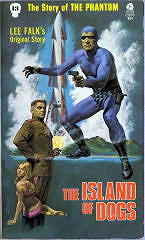
_      The Island of Dogs. Written by Warren Shanahan, q.v. Avon, pb, 1975.
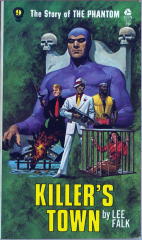
      Killer’s Town. Avon, pb, 1973.

Killer's Town (Lee Falk)

      The Mysterious Ambassador. Avon, pb, 1973.
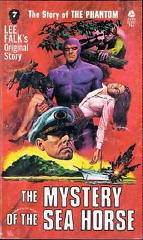
      _The Mystery of the Sea Horse. Written by Frank S. Shawn, a pseudonym of Ron Goulart, qq.v. Avon, pb, 1973.
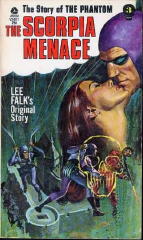
      _The Scorpia Menace. (Corrected spelling.) Written by Basil Copper, q.v. Avon, pb, 1972.
      _The Slave Market of Mucar. Written by Basil Copper, q.v. Avon, pb, 1972.
      The Story of the Phantom. Avon, pb, 1972.
      _The Swamp Rats. Written by Frank S. Shawn, a pseudonym of Ron Goulart, qq.v. Avon, pb, 1974.
      The Vampires and the Witch. Avon, pb, 1974.
      _The Veiled Lady. Written by Frank S. Shawn, a pseudonym of Ron Goulart, qq.v. Avon, pb, 1973.

CASSIDAY, BRUCE. 1920-2005. Add year of death. Pulp writer and editor, radio scriptwriter, and author of many works of crime fiction under his own name and several pseudonyms: Carson Bingham, q.v., Mary Anne Drew, C. K. Fong, Annie Laurie McAllister, Annie Laurie McMurdie & Michael Stratford.

BINGHAM, CARSON. Pseudonym of Bruce Cassiday, 1920-2005, q.v. To three crime novels written by the author under this pen name in the (Revised) Crime Fiction IV, add the following:

      The Assassins. Avon, pb, 1975. Note: This is a book in “The Phantom” series, created by Lee Falk, q.v.
      _The Curse of the Two-Headed Bull. Avon, pb, 1975. A book in “The Phantom” series. Credited to Carson Bingham on the title page, but in an Author’s Note, Lee Falk states that the book was written by him. The attribution to Bingham was a publisher’s error.

COPPER, BASIL. 1924- . Among other works of crime fiction included in the (Revised) Crime Fiction IV are six collections of Solar Pons stories, a character created by August Derleth, and 52 book-length adventures of private eye Mike Faraday. The two entries below are newly added here to the author’s own entry.

      The Scorpia Menace. (Corrected spelling.) Avon, pb, 1972. Note: This is a book in “The Phantom” series, created by Lee Falk, q.v.

The Scorpia Menace

      The Slave Market of Mucar. Avon, pb, 1972. Note: This is a book in “The Phantom” series, created by Lee Falk, q.v.

GOULART, RON(ALD JOSEPH). 1933- . Mystery & science fiction writer as well as a historian of pulps, comic books & comic strips. Add pseudonym: Frank S. Shawn, q.v. Other pseudonyms & house names: Josephine Kains, Chad Calhoun, Marshall Macao, Ian R. Jamieson, Kenneth Robeson & William Shatner. As Shawn, the author of several books in “The Phantom” series created by Lee Falk, q.v.

SHAWN, FRANK S. Add as a pseudonym of Ron(ald Joseph) Goulart, 1933- , q.v. Other pseudonyms & house names: Josephine Kains, Chad Calhoun, Marshall Macao, Ian R. Jamieson, Kenneth Robeson & William Shatner. As Shawn, the author of several books in “The Phantom” series created by Lee Falk, q.v. These are listed below.

      The Goggle-Eyed Pirates. Avon, pb, 1974. [Note: The name Frank S. Shawn does not appear on the title page.]
      The Golden Circle. Avon, pb, 1973. Due to a publisher’s error, the name of the author was misspelled as Frank S. Shaw.
      The Hydra Monster. Avon, pb, 1973.
      The Mystery of the Sea Horse. Avon, pb, 1973.

Mystery of the Sea Horse

      The Swamp Rats. Avon, pb, 1974.
      The Veiled Lady. Avon, pb, 1973.

SHANAHAN, WARREN. Author of one book in “The Phantom” series created by Lee Falk, q.v. The title below, the only one in the author’s entry in the (Revised) Crime Fiction IV, is now directly attributed to him.

      The Island of Dogs. Avon, pb, 1975.

Island of Dogs (The Phantom)


OPEN QUESTION: It is unknown who Warren Shanahan was. He contributed to at least two combat-oriented collections of true stories published by Pyramid (One Against the Enemy, 1963; and Medal of Honor, 1967), but I’ve found no other writing credits for him.

[UPDATE] Later this same evening. On a hunch, I checked out Michael Cook’s Index to the Digest Mystery Magazines, and there was Warren J. Shanahan, author of five stories that appeared in Guilty (2), Trapped (2), and Manhunt (1), all in the 1950s.

« Previous PageNext Page »