Science Fiction & Fantasy


NEW WORLDS SCIENCE FICTION. September 1966.    Overall rating: ***½ stars.

MICHAEL MOORCOCK “Behold the Man.” Novella. An English bookseller and amateur psychiatrist travels in time to observe Christ’s crucifixion, but becomes Christ himself. It is hard to imagine that this was not written for controversy-in-itself, for it seems deliberately offensive. Much is made of the conflict between religion and science, but there seems to be no real point, as Moorcock cannot justify his version either.    ****

ARTHUR SELLINGS “The Evening Sun Go Down.” The future society of a conquered Earth, maybe. (0)

JOHN CALDER “Signals.” The memoirs of an interatomic signals physonomist, or communications expert. Nothing really new. (3)

CHARLES PLATT & B. J. BAYLEY “A Taste of the Afterlife.” Novelette. To aid in the the skirmishes before WWIII, scientists devise a way to separate the electronic afterlife from a man. Far-out, but chillingly real. (3)

J. G. BALLARD “The Atrocity Exhibition.” Supposedly this means something. (0)

BRIAN W. ALDISS “Another Little Boy.” A parallel between the Bomb and the Pill is made, at a time 100 years from Hiroshima when the associated guilt feelings exists no more. Light treatment is terrifying. (4)

THOMAS M. DISCH “Invaded by Love.” Novelette. How Love can conquer the world, especially when brought by invading aliens. Only the Secretary-General of the UN resists, but he waits too long for his triumph. Powerfully portrayed. (4)

–September 1967
REVIEWED BY DAVID VINEYARD:


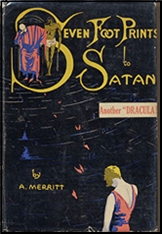
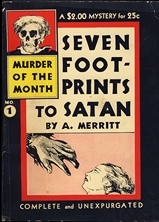
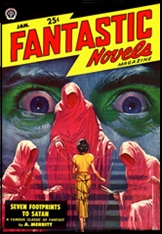
A(BRAHAM) MERRITT – Boni & Liveright, hardcover, 1928.  First published as a five-part serial in Argosy Allstory Weekly between July 2 and July 30, 1927. Reprinted many times, both in hardcover and paperback, including Fantastic Novels Magazine, January 1949.

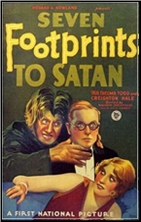
SEVEN FOOTPRINTS TO SATAN.  First National, 1929. Thelma Todd, Creighton Hale, Sheldon Lewis. Screenplay by Richard Bee (Benjamin Christensen), based on the novel by Abraham Merritt. Title Cards by William Irish (Cornell Woolrich).  Directed by Benjamin Christensen. First released as a silent film and later as a part-talkie.

   The warning had come to me in many places this last fortnight. I had felt the unseen watchers time and again in the Museum where I had gone to look at the Yunnan jades I had made it possible for rich old Rockbilt to put there with distinct increase to his reputation as a philanthropist; it had come to me in the theater and while riding in the Park; in the brokers’ offices where I myself had watched the money the jades had brought me melt swiftly away in a game which I now ruefully admitted I knew less than nothing about. I had felt it in the streets, and that was to be expected. But I had also felt it at the Club, and that was not to be expected and it bothered me more than anything else.

   The club is the Discoverer’s Club in New York, and the uneasy narrator is James Kirkham, adventurer and explorer, who is about to find himself in an urban nightmare out of the Arabian Nights by way of the Twilight Zone, as in short order he will be confronted by his own double and find himself in a deadly real game with a fortune at stake, his soul in peril, and Satan incarnate spinning the wheel.

   Abraham Merritt is best known as a fantasist and author of scientific romances full of implausible plots, unclad other worldly women, and sensual lush prose pitting his heroes (Merritt heroes always seemed to be falling through mirrors or the equivalent into sensual violent dreams) against strange half worlds and ungodly creations. His best known titles like The Ship of Ishtar, Face in the Abyss, The Moon Pool, and The Metal Monster were highly influential on writers such as Lovecraft, Howard, and Clark Ashton Smith as well as the likes of Fritz Leiber, Henry Kuttner, C. L. Moore, Leigh Brackett, Ray Bradbury, and many more. Merritt also wrote two famous horror novels where crime and the fantastic mixed in Creep Shadow and Burn Witch Burn (which features a cross dressing vengeance obsessed madman who turns living people into murderous dolls and was made into an MGM film with Lionel Barrymore).

   I won’t kid you that the plot here is ever plausible, but then neither does Merritt. His saving grace as a writer, beyond his graceful style and vivid imagination, was that he plunged headlong into the swirling madness that confronted his heroes and dragged the reader right with them. Merritt, like Dunsany before him, had a true gift at spinning fancies, terrors, and dreamscapes that were by turns gilded fantasy and soul numbing horrors.

   This one is a Gothic nightmare out of the true tradition of Shelley, Lewis, and Mrs. Radcliffe but with a modern pulp sensibility.

   In the dark Kirkham encounters a stranger (“I saw a dark, ascetic face, smooth-shaven, the mouth and eyes kindly and the latter a bit weary, as though from study.”) who engages him in a strange conversation:

   “A beautiful night, sir,” he tossed the match from him. “A night for adventure. And behind us a city in which any adventure is possible.”

   I looked at him more closely. It was an odd remark, considering that I had unquestionably started out that night for adventure…

   “That ferryboat yonder,” he pointed, seemingly unaware of my scrutiny. “It is an argosy of potential adventure. Within it are mute Alexanders, inglorious Caesars and Napoleons, incomplete Jasons each almost able to retrieve some Golden Fleece–yes, and incomplete Helens and Cleopatras, all lacking only one thing to round them out and send them forth to conquer.”

   “Lucky for the world they’re incomplete, then,” I laughed. “How long would it be before all these Napoleons and Caesars and Cleopatras and all the rest of them were at each other’s throats — and the whole world on fire?”

   “Never,” he said, very seriously. “Never, that is, if they were under the control of a will and an intellect greater than the sum total of all their wills and intellects. A mind greater than all of them to plan for all of them, a will more powerful than all their wills to force them to carry out those plans exactly as the greater mind had conceived them.”

   “The result, sir,” I objected, “would seem to me to be not the super-pirates, super-thieves and super-courtesans you have cited, but super-slaves.”

   The curious man is Dr. Consardine and in very short order, he and a beautiful girl who calls herself Eve Walton claim Kirkham is the girl’s mentally unstable sweetheart and virtually kidnap him under the eyes of the police (The game was rigged up against me all the way…), delivering him to a mysterious destination somewhere in Westchester or Long Island (“I saw an immense building that was like some chateau transplanted from the Loire. Lights gleamed brilliantly here and there in wings and turrets.”) where he meets his mysterious host, who knows far more about Kirkham than he should and who finally introduces himself with a strange offer.

  “Since everything upon this earth toward which I direct my will does as that will dictates,” he answered, slowly, “you may call me — Satan!

   “And what I offer you is a chance to rule this world with me — at a price, of course!”

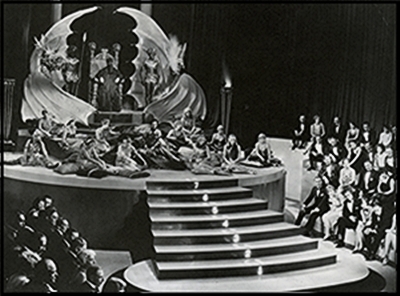
   It turns out Eve Walton and others in the employee of Satan are unwilling pawns in his game, an elaborate and hellish game where each individual must wager his life and free will against a promise of fabulous wealth. There are seven shining footprints of Buddha, three are holy, three doom whoever steps on them. Satan has set up an unholy game in an elaborate temple in which the players risk their souls to attain the three holy footsteps that lead to Nirvana on Earth, wealth, wisdom, love, happiness, health … all things men and women will risk their lives for.

   Kirkham, ever the gambler, has nothing to lose, but he is playing the game for higher stakes than even Satan imagines. As is usually true with Merritt, the conclusion is no disappointment with retribution, madness, drugged slaves, gunfire, explosions, and madness let lose when Satan overplays his hand.

   Seven Footprints to Satan came to the big screen in 1929 under the capable hand of director Benjamin Christensen and with title cards by a young Cornell Woolrich using his William Irish by-line. A well known cast including Thelma Todd and Creighton Hale starred, and the result might have been fascinating because Woolrich certainly knew something about wringing the last ounce of suspense out of purple prose and outlandish nightmare plots — but alas Christensen and the studio decided to make a comedy out of the book in the style of The Cat and the Canary, and the result is a mildly diverting mess that turns out to be a variation on Earl Derr Biggers’ Seven Keys to Baldpate. Without giving that plot away I will only say it is the most annoying in the genre.

   But we have the book, a fine mix of melodrama and terror replete with a satisfying bloody-mindedness where needed, a splendid larger than life villain, clever hero, and enough sheer gall and narrative drive to compel the reader through the unlikely goings on. It is far from Merritt’s best work, but it has its own loony internal logic if you give yourself over to it, and its author writes rings around most of the writers who attempt this kind of fancy.

   There are a few unfortunate, mostly mild, problems as with most books of this period, nothing too awful or offensive, but you have been warned. (Merritt is no Sapper or Sidney Horler, thankfully.) It stands as an Arabian filigree of romance, Gothic horrors, dream like qualities, and fancies that asks only that the reader be willing to surrender to it all, and still has its rewards if you do.
   

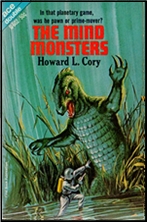
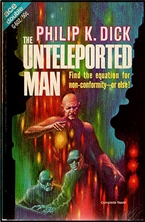
HOWARD L. CORY – The Mind Monsters. Ace Double G-602, paperback original, 1966. Published back-to-back with The Unteleported Man, by Philip K. Dick (reviewed here ).

   An astronaut, Terence O’Corcoran, crash-lands on a strange planet where he encounters strange monsters, genies and leprechauns, and the apathetic people of the city Mahtog, who are being terrorized by the Thryn. The Thryn, actually Mahtogians who have been captured and drugged, are led by the bearded and mysterious Brahubru.

   An army is formed and war is begun, ending with the revealing of Brahabru as the original Terence, but it does not come as much of a surprise. It was, of course, the Genies who had made an improved copy to help their created people.

   One gets the feeling that the author was glad to get away from the scientific environment of Terence’s spacecraft to concentrate on the seemingly magical qualities of the planet, but since the Genies are finally revealed to be energy-beings, this story does qualify as science fiction. The problems of language and translations are discussed (pages 60-61), but the author’s efforts do not always seem consistent.

Rating: 2½ stars.

–September 1967

PHILIP K. DICK – The Unteleported Man. Ace Double G-602, paperback original, 1966. Cover art by Kelly Freas. First published as a novella in Fantastic Stories, December 1964. Expanded to novel length form under the same title by Berkley, paperback, 1983. First full edition reprinted in the US as Lies, Inc., by Vintage, trade paperback, 2004 (previously by Gollancz, UK, hardcover, 1984, but with two missing manuscript pages of the Berkley edition replaced by ones written by John Sladek).

   The gateway to the colony at Whale’s Mouth in the Fermalhaut system is controlled by Trails of Hoffmn, who developed a teleportation system which put the ordinary spaceship line of Rachmael ben Applebaum near bankruptcy. The only drawback to emigration is the fact that the trip is (said to be) one-way, but Rachamel with the help of an inter-planetary police agency is determined to find out the true story while proving at the same time that spacecraft could have successfully made the 24-lightyear journey.

   With the help of the suspect UN, the plan for the conquest of Earth – for of course it is one – is broken up. The story is enhanced considerably by the inclusion of Dick’s usual small details of the world of the future, while the characters move through a fairly ordinary plot.

Rating: ***

–September 1967

HARRY HARRISON – Sense of Obligation. Brion Brandd #1. Serialized in Analog SF in 3 parts, September through November 1961. Reprinted in book form as Planet of the Damned (Bantam J2316, paperback, January 1962); also under the latter title by Tor, paperback, December 1981.

   Brian Brandd is recruited as a member of the Cultural Relations Foundation, whose task it is to aid islated planets cut off after the fall of the Earth empire. His first assignment is to stop an impending war between the planets Dis and Nyjord.

   Dis is truly a disaster planet, where men have found it necessary to joining with native life-forms in symbiosis. It is a particularly malignant symbiote that has led the leaders of Dis into apparent race suicide, but with the help of Lea Marees, an exobiologist from Earth, Brian finally saves the day.

   It is a sense of obligation to the human race, in whatever adapted form it may take, that brings the resources of other men to the assistance of those who need it, and forms the underlying current behind the story. Competent, well-told, but probably not memorable.

Rating: ***

–September 1967

   
Note: Followed by one sequel, Planet of No Return (Wallaby, softcover, 1981).

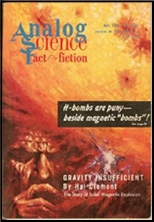
ANALOG SCIENCE FICTION November 1961. Edited by John W. Campbell, Jr. Cover by Schoenherr for “Science Fact: Gravity Insufficient” by Hal Clement. Overall rating: 2 stars.

CHRISTOPHER ANVIL “No Small Enemy.” Short novel. A force invading Earth is defeated, but only under purely fortuitous circumstances. A rather unorthodox company happens to have an experimental steam-powered car and a newly-invented viewing device that gives the user telekinetic powers. Fun, if you can accept this. (2)

JIM WANNAMAKER “Attrition.” Novelette. An obnoxious Interstel agent discovers the reason for the disappearance of an exploration crew, a mutant plant throwing poisonous seeds. Being told in the first person doesn’t help. (1)

HARRY HARRISON “Sense of Obligation.” Serial, part 3 of 3. See later report.

–September 1967

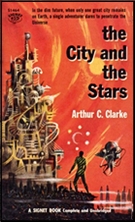
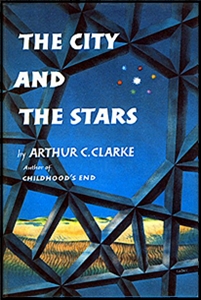
ARTHUR C. CLARKE – The City and the Stars. Frederick Muller Ltd, UK, hardcover, 1956. Harcourt, Brace & Co, US, hardcover, 1956. Signet S1464, US, paperback, December 1957. Collected in From the Ocean, from the Stars (Harcourt, Brace & World, US, hardcover, 1961). Note: This novel is a revised and extended version of Against the Fall of Night (first published in Startling Stories, November 1948; then in book form from Gnome Press, hardcover, 1953).

   The city of Diaspar, a tremendous achievement of social engineering, stood isolated from the world for billions of years. Machines maintained mankind in a permanent environment, protected from their fears of invaders.

   Alvin, a Unique, the first child to be born in ten billion of those years, was designed for the welfare of the race and to return humanity to its place in the universe. He leaves the city for the community of Lys, and then to the stars. There he finds a mental being once created by man, and which has memories that will free Earth from the myths and legends of the past.

   The story has as a basic flaw the lack of any suspense, for in spite of the quite poetic style, there is little to persuade the reader to keep turning the pages. It is not a struggle to read, but a matter of indifference. One scene is rather sappy, that of Alvin’s first view of Lys, but the feeling of loneliness and smallness when he reaches the stars is overwhelming. Toward the end there is a most appropriate description of what makes an explorer.

Rating: 3½ stars.

– September 1967


REVIEWED BY DAVID VINEYARD:


HARRINGTON HEXT (EDEN PHILLPOTTS) – Number 87. Thornton Butterworth, UK, hardcover, 1922. Macmillan, US, hardcover, 1922. Wildside Press, US, hardcover/trade paperback, 2008, as by Eden Phillpotts. Prologue Books, US, trade paperback, December 2012.
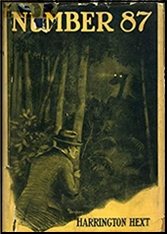
   A policeman, standing at the time on the suspension bridge that crosses the ornamental waters, heard a single, loud cry from the path that approaches the bridge easterly, and hastening to the spot he found a man lying upon his face on the grass at the path side. Close at hand, though but dimly visible, for the night was foggy, P,C. B49 declares that he saw a large and living animal, such as he had never seen before. He attempts no exact description of this creature, but has sworn that he distinguished a black, humped object, ‘as large as a horse’ with a very long neck and a narrow head above which were set tall ears. Its eyes shone like a cat’s as he turned his lantern upon it, and it appeared to hesitate as he advanced a short distance towards it. He then blew his whistle, and the thing, evidently alarmed, hopped twice, then spread black wings, ascended swiftly into the air and disappeared. The constable likens the creature to a huge bird, and though four other officers, who ran to answer his summons, saw nothing of this alleged rara avis, in one particular they corroborate a detail reported by John Syme (P.C. B49). All were conscious of an overpowering taint and reek in the air — an animal smell.

   
   The first sighting of the creature the world will come to know as the Bat in London is little but a curiosity, but soon it will become a world wide sensation of terror and horror, a monster striking from the sky and leaving death and destruction in its wake.

   Eden Phillpotts, who under the pseudonym Harrington Hext penned fantastic thrillers, was a considerable literary light in his day well respected by critics for his regional novels; a recognized master of the mystery novel whose The Red Remaynes (1922) stands with Trent’s Last Case by E. C. Bentley as one of the first novels to create the Golden Age of the Classic Detective Novel; the man who convinced a discouraged Agatha Christie to keep writing because he saw something in her work; who partnered with notable writer Arnold Bennett (Doubloons); wrote early Science Fiction (Saurus and others); lost worlds (The Golden Feitch); and had more literary honors than we can list here, was born in 1862 (and died in 1961).

   In the late Victorian Era he made his debut with a pamphlet for a railroad line that both pioneered and popularized an entire sub genre the railroad mystery with My Adventure on the Flying Scotsman, and one of his last novels (1951) featured a murder involving an experimental nuclear physicist . That would be a full career for any writer in any age.

   But back to the central question, what is the Bat, and what is the secret of its reign of terror?

   Alexander Skeat is the first victim, no mark on him but a tiny red spot. Yes, because this one is no fair play detective novel, a drug unknown to science is the culprit. Indeed in the tradition of the thriller mysterious drugs, monstrous bat winged flying creatures, and enough thrills, horrors, and mysterious doings for a dozen weird pulps fill the pages of this unrepentant extravaganza. Even Edgar Wallace could take a few notes from Phillpotts.

   Our narrator is Ernest Granger, the Secretary of the Club of Friends and agent of the Apollo Life Insurance Company, both of who are intimately involved in the history of the Bat. His fellow club members General Fordyce and his scientist brother Sir Bruce, Rev, Walter Blore, Leon Jacobs Stockbroker, and Jack Smith, a barrister all figure in the action.

   Drawn into the case by the death of Skeats, a scientific charlatan, the drama will take the men from London to New York, to Yugoslavia (Jugo-Slavia here), Russia, and China in a race to discover what the Bat is and who is behind it, and why it has targeted the relatively new Christian Science movement.

   Like many books of the Post WWI era, Number 87 is concerned with the future, the fear of another Great War, and how to avoid that fearful fate.

   â€œThe old security of the strong and the freedom of the mighty are gone. We are all in the same leaky boat, great and small together, and power is not vested in what you call ‘the humanities’ — far from it. Science, not the Arts, ended the war. War, indeed, is a ghost for a moment, but it remains for the men and women of this century to decide if the ghost shall vanish into thin air, or presently grow solid and clothe itself again with bones and flesh. We must, then, accept existing conditions and not indulge in metaphysics. Physics alone offers salvation. Physics alone is stronger than treaties and more trustworthy than the word of living man; because physics means power.”

   
   That voice is key to the solution of the novel, a modern Prometheus (and no, the Mary Shelley reference is no accident) who reaches too far and through mere humanity becomes a monster rather than a hero of mankind is the culprit and the Miltonian figure at its center.

   Like much popular fiction of the era the villain is no Fu Manchu or Bond villain, but a flawed superman of sorts, a figure both ultimately admired and feared, and in the end both he and his creation Number 87, the Bat, suffer exile rather than destruction more on the model of Nemo or Robur than the less noble villains to come.

   Phillpotts is hardly hard-boiled or pared down as a prose stylist, but he can write and his works, while dated, are often still quite good reads. This brief scene when our narrator first spies the creature for himself is a good example.

   Suddenly the light was darkened, but by no cloud. A black shadow fell and moved upon the moonlit fern, and looking upward I perceived an enormous winged object flying above the tree tops. For a moment it had crossed the disk of the moon and so attracted my eyes. It appeared to be a gigantic bat… Moonlight showed the thing standing where it had settled. I saw its long neck; its low ears set far back upon a snake-shaped head, its large, open eyes of phosphorescent green — the sort of illumination now familiar to me as the light from glowworms. The mass of its body was hidden by the fern and I could only see its head and neck and the hump of its shoulders rising above them.

   
   Revelations, horrors, and terrors are to come before Granger and his friends find the remarkable solution to what the Bat is and who lies behind it much less why. It is admittedly old fashioned, but not bad for that. Certainly not to everyone’s taste, but well worth taking the time to find (easy in e-book edition if not hard copy).

   It was the dark hour before dawn and one could actually see nothing of what happened; but within twenty minutes we all marked the eyes of ‘the Bat,’ like twin sparks of fire, upon the roof of the manor house. The machine ascended and became invisible to us, whereupon through the night there drifted drearily a strange mutter and a moaning — the lamentation, as it seemed, of that ancient Elizabethan pile, shuddering and sinking down under a swift rain of electrons, that transformed the granite at a touch and ground the ancient porphyry into dust.

   
   Splendid blood and thunder that.
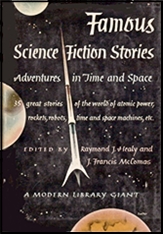
RAYMOND J. HEALY & J. FRANCIS McCOMAS, Editors – Famous Science-Fiction Stories: Adventures in Time And Space. The Modern Library G-31; hardcover, 1957, xvi + 997 pages. First published as Adventures in Time in Space, Random House, hardcover, 1946. Bantam F3102, paperback, 1966, as Adventures in Time and Space (contains only 8 stories). Ballantine, paperback, 1975, also as Adventures in Time and Space.

Part 6 can be found here.

ROBERT A. HEINLEIN “The Roads Must Roll.” Novelette. A “Future History” story. Heinlein foresaw the present automobile traffic problem and proposed moving cross-country strips as a solution. The actual plot suffers in comparison to the details of the economic and sociological consequences. (3)

Update: First published in Astounding Science-Fiction, June 1940. First collected in The Man Who Sold the Moon (Shasta, hardcover, 1950). Also collected in The Past Through Tomorrow (Putnam, hardcover, 1967). Reprinted many times. Awarded a Retro Hugo as best novelette in 2016 for works published in 1940.

A. E. van VOGT “Asylum.” Short novel. Earth is pictured as a sanctuary maintained for mankind by beings with much bigger IQ’s. Two aliens with a need for fresh blood land and involve reporter William Leigh in their conflict with Earth’s guardians. This preliminary involvement is interesting, but although van Vogt does have a great knack for telling a story, the ending degenerates rapidly into confusion on a galactic scale. (3½)

Update: First published in Astounding Science-Fiction, May 1942. First collected in Away and Beyond (Pellegrini & Cudahy, hardcover, 1952). Reprinted in The Great Science Fiction Stories Volume 4, 1942, edited by Isaac Asimov & Martin H. Greenberg (Daw #405, paperback original, October 1980), among others.

LEWIS PADGETT “The Twonky.” Short story. A strange invention disguised as a radio console destroys initiative then life if uncooperative. Better than Padgett’s more humorous stories in this volume. (4)

Update: First published in Astounding Science Fiction, September 1942. Lewis Padgett was a pen name used by the prolific husband-and-wife team Henry Kuttner and C. L. Moore. First collected in A Gnome There Was (Simon & Shuster, hardcover, 1950). Reprinted in The Great Science Fiction Stories Volume 4, 1942, edited by Isaac Asimov & Martin H. Greenberg (Daw #405, paperback original, October 1980), among others. When adapted to the film of the same name (United Artists, 1953, written and directed by Arch Oboler), the radio in the original story was updated to a television set.

– July-August 1967


TO BE CONTINUED.

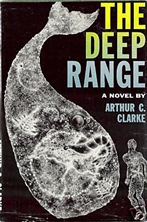
ARTHUR C. CLARKE – The Deep Range. Harcourt Brace, hardcover, 1957. Signet S1583, paperback, 1958. Expanded from a short story of the same title first published in Star Science Fiction Stories No. 3 (Ballantine, paperback, 1955). The novel first collected in From the Ocean, from the Stars (Harcourt Brace, hardcover, 1961).

   Essentially the life story of Walter Franklin and his career in the Bureau of Whales early next century. There are three distinct parts, each nearly independent of the others. In the first, Franklin is placed under the guidance of [Game] Warden Don Burley to learn a new career after astrophobia has forced him from space. Then, after becoming a warden himself, Franklin joins with Don in the capture of a giant squid, but an attempt to capture an unknown sea serpent ends in Don’s death.

   As Franklin rises to the directorship of the Bureau, he is forced to decide whether continued slaughter of the whales or conservation shall become policy. The philosophy of Buddhism is responsible for his choice.

   Smooth, intelligent and informative writing dominates, overshadowing a lack of real depth. An important exception occurs in the final third of the story. In the words of the Maha Thoro: “When that time comes, the treatment man receives from his superiors may well depend upon the way he has behaved toward the other creatures of his own world.”

   Another important facet of Clarke’s writing is his remarkable constraint in not telling the whole story when indeed it is not necessary.

Rating: 4 stars.

– September 1967

« Previous PageNext Page »