Science Fiction & Fantasy


REVIEWED BY DAN STUMPF:         


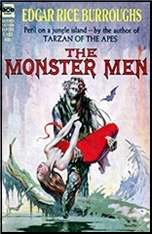
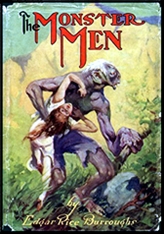
EDGAR RICE BURROUGHS – The Monster Men. Ace #F-182, paperback, 1963. Cover by Frank Frazetta. First published by A. C. McClurg & Co., hardcover, March 1929. Cover by J. Allen St. John. Several other reprint editions exist.

   I was maybe 14 years old when I read a review of this book in Castle of Frankenstein magazine. I had a dollar at the time, so I got on the bus and went downtown to a place called the Paperback Gallery, a little bookstore that sold only paperbacks.

   It was there I picked up my first samples of Fu Manchu, Doc Savage, Mr Moto, Charlie Chan, the first EC reprints….. and got a copy of this. Came back home with enough left over for two chocolate bars, and had a high old time with it.

   And there it was, still on my shelf after all these years & tears & fears, just in time for Halloween.
   Reading The Monster Men in the wisdom of my advancing years, I found myself bemused by ERB’s awful prose and delighted by the pace he imparts to the story. Never mind Characterization; that don’t enter into it. It’s set on a tropical island in the South Seas, off Java and Borneo, and I wondered idly if Conrad’s Marlow might cruise by, or perhaps Somerset Maugham in search of a tale of human interest. But (SPOILER ALERT!) they didn’t.

   What does happen owes more than a nod to H.G. Wells’ Island of Dr Moreau, with an unhinged scientist, his lovely daughter and a small entourage on a tropical island where he can conduct his experiments in creating Men in relative privacy.
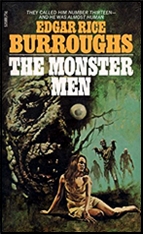
   Unfortunately, the mad medico’s first twelve attempts have produced only shambling monsters (hence the title of the piece) and the failures have addled him to the point where he vows to wed his daughter to Number Thirteen -– which, to everyone’s surprise, emerges from the vat looking like a Greek statue with a becoming tan.

   At which point the plot kicks into high gear, with a pirate attack, treachery within the ranks, head-hunters, a Monster rally, daring rescues, pitched battles and over it all, Number Thirteen, now known as Bulan, braving the jungle perils as one to the manner born.

   I should be ashamed to admit how much I enjoyed this. Burrough’s prose is so bad I sometimes suspect him of parody, but he keeps it moving without too much of the padding that marred the Tarzan books I tried to read back in the day. The story did eventually get to where most Burroughs books go: Everyone chasing each other around in the jungle, but in this one it seems a bit less protracted.

   Burroughs even surprised me with a bit of insight on the nature of the Soul here. He reflects a mind-set common in SF early in the 20th century, when artificial insemination was first used on animals, that a man-made creature would have no soul — an idea that surfaced in Alraune and elsewhere.

   Here, Bulan ponders his artificial origins and essential soullessness, then looks about him at the men he has encountered — pirates, thieves, and his mad creator — only to conclude that the Soul must be worth much less than the value men seem to attach to it.

   And this, oddly enough, is the kind of thing one does find in the tales of Conrad and Maugham in those same South Seas of fiction. Maybe not enough to elevate The Monster Men to the ranks of Great Literature, but it adds a bit of thoughtfulness to a ripping yarn.

REVIEWED BY DAN STUMPF:


JACK FINNEY – The Body Snatchers. Dell First Edition #42, paperback original, 1955. First serialized in Collier’s, November 26 – December 24, 1954. Reprinted many times. Adapted into film four times: (1) as Invasion of the Body Snatchers (1956; Kevin McCarthy; directed by Don Siegel). (2) as Invasion of the Body Snatchers (1974; Donald Sutherland; directed by PHilip Kaufman). (3) as Body Snatchers (1993; directed by Abel Ferrara). (4) as The Invasion (2007; Daniel Craig).

   The basis of a classic movie and many remakes, and a fine novel in its own right: vivid, suspenseful and full of implausibility about which the reader gives no damn.

   The story is too well-known to outline here, so I’ll just say Finney does a clever job of starting out small (patients of a small-town Doctor complain that there’s something funny about their friends and family) and building to the kind of edgy action and trickling suspense that made Sci-Fi fun in the old days. He also manages to make a 190-page book about Alien Invasion seem leisurely — but not slow-paced.

   But there’s a duality lurking around here, based on an off-hand bit mentioned in passing: Once the Pods have taken a human identity, they begin to lose interest in that person’s daily activities. (Naturally, being Pods, they’re more into spreading pod-dom or selling Amway or whatever.) So gutters need to be cleaned, the trash cans on Main Street don’t get emptied, storefront windows grow dusty, and the whole town takes on an air of seedy neglect.

   Well, in 1954, when Finney wrote the book, all this was actually happening: as the Suburb and the Strip Mall began to replace the Small Town, that little icon of Norman Rockwell America became every bit as seamy and run-down as Finney describes. And in a very real sense, The Body Snatchers sings a requiem for the cruel death of a cherished memory. There’s an oddly heart-rending chapter where the hero walks through his town, thinks of what it was and sees what it has become, that should strike home with anyone who grew up in pre-war America (or, like me, in the tawdry shadows of big empty department stores, dusty restaurants and faded movie palaces) and it adds a dimension of compelling nostalgia to an already fine thriller.

   The Body Snatchers deserves its rep as a taut thriller, but I shall treasure its melancholy edge long after the plot twists and chase scenes have passed from memory.

ROBERT SHECKLEY “Subsistence Level.” Galaxy Science Fiction, August 1954. Collected in Shards of Space (Bantam J2443, paperback original, July 1962) and The Collected Short Fiction of Robert Sheckley: Book Three (Pulphouse, hardcover/softcover, 1991).

   As a young writer Robert Sheckley was a perfect fit for the early days of Galaxy magazine. H. L. Gold, its agoraphobic editor, was looking for literary quality for the science fiction he published, not necessarily technical expertise, and the magazine was known for its emphasis on the effect that technology had on the human race, often with a satirical and/or ironic twist.

   Which was, of course, Robert Shckley’s forte. Although this story is not one of Sheckley’s better known ones — it’s never been reprinted except in two collections of his own work — it serves to show the point very well. “Subsistence Level” is the tale of a pioneer in the age of space, a man with a wanderlust and a fear of being crowded, and ready to move on when he runs out of elbow room.

   And his wife, determined to make their marriage a success against the advice of her mother, is forced to move along with him. When the Gobi Desert gets filled up, and so does the Southern Polar Cap, their next stop? The asteroid belt.

   Warning: I’m about to give the essence of the story away in the quote that follows, taken directly from the story, but it goes a long way in illustrating what I was saying there up above. The couple, man and wife, have been putting in hard five-hour days getting settled on their small rock in space, bossing robots around, and:

   After helping Amelia pile the dishes into the washer, Dirk set up a projector in their living room. As a double feature flicked across the screen, they sat in durable foam-ribber chairs, just as generation of pioneers before them had done. This continuity with the past touched Amelia sharply.

THORP McCLUSKY “The Crawling Horror.” First published in Weird Tales, November 1936. Reprinted in Avon Fantasy Reader #6, 1948, and The Macabre Reader, edited by Donald A. Wollheim (Ace D-353, 1959), among others.

   This strange story is told by a farmer to a local doctor who in turn tells it to us. The farmer has rats in his house and barn, but when they begin to disappear, he gives the credit to his several cats. Then the cats start to vanish. Can his dogs be next?

   He is sitting in front of his fireplace, reaches down to pet his dog and … I’ll quote:

   “It was a slimy sort of stuff, transparent-looking, without any shape to it. It looked as though if you picked it up it would drip right through your fingers. And it was alive — don’t know how I knew that, but I was sure of it even before I looked. It was alive, and a sort of shapeless arm of it lay across the dog’s back, and covered her head. She didn’t move.”

   What do you think? What would you do?

PS. Things get worse from here. This is only the beginning.

REVIEWED BY DAVID VINEYARD:


ALLEN ADLER – Terror on Planet Ionus. Paperback Library #52-941, paperback, 1966; #63-048, 2nd printing, 1969. Originally published as Mach I: A Story of Planet Ionus Farrar Strauss & Cudahay, hardcover, 1957

   Wow.

   This science fiction novel, by a writer I’ve never heard of, is a knockout. Wise and gentle aliens from Ionus come to Earth to warn us that Klarkong, the monster that destroyed their planet is coming to Earth, an energy devouring monster that grows stronger no matter what you feed it.

   Earth’s only hope against this omnivorous energy monster is secret project Mach I, a super fast atomic powered ship, piloted by reckless dashing ladies man Lt. Commander Jeb Curtis, whose courage got him into the project despite his record as an insubordinate P.T. Boat commander in WW II.

   As the Ionusans warn, Klarkong is virtually unstoppable, and soon he’s in the Nevada and Southern California desert devouring all sources of energy. Helpless to fight him, the Americans have to stand by as the Soviet’s violate American air space to nuke the monster, which only sends it in a feeding frenzy for nuclear fuel.

   And where is there still nuclear power to devour? The Soviet Union, serves them right, so Klarkong heads across the Pacific.

   But the vast emptiness of the Pacific gives the desperate Americans one last chance to use Mach I where they can maneuver its incredible speeds and unleash it’s weapons safely if they can weaken Klarkong enough to kill it.

   If? The battle is down to the final paragraphs on a small island in the Pacific, Mach I’s last remaining nuclear torpedoes against a wounded Klarkong.

   This one is a pure fifties or early sixties monster movie in print, a kaiju from outer space rampaging across the world while desperate scientists and military, with a little alien help, fight and die bravely to end the menace. You can virtually see the epic unreeling in your head as you breathlessly read on.

   Granted it has little relation to actual mainstream or even pulp SF as such. It wears the cloak, but that is about all. Characterization is a B movie cliche, and actual scientific logic, or science for that matter, is zil.

   Adler isn’t unskilled as a writer of this kind of deathless prose, there just isn’t any there there beyond the basics, just like those movies we breathlessly devoured on Saturday Mornings or on late night television with all the epicurean dismissal of Klarkong himself.

   Still, it is short, great fun, slightly mad, and Klarkong a kissing cousin of Godzilla, Kronos, X the Unknown, and the Trollenberg Terror crossed with one of those Jack Kirby monsters that Marvel specialized in before turning to superheroes (Fin Fang Foom indeed) and Forbidden Planet’s monster of the Krell Id.

   If that is what you want, this book delivers in trumps.

   And give the guy this, Klarkong is a great name for an interstellar planet eater, not Galactus perhaps, but still pretty good, silvered surfing herald or not.

   Some books are full course gourmet delights.

   Others a filling home cooked meal.

   This one is a chili dog with the works and a side of greasy onion rings.

   I’m half surprised Klarkong himself didn’t eat it.

   Now, if you’ll pardon me, I need an Alka Seltzer and a nap.

REVIEWED BY JONATHAN LEWIS:


TORMENTED. Cheviot Productions, 1960. Richard Carlson, Susan Gordon, Lugene Sanders, Juli Reding, Joe Turkel. Director: Bert I. Gordon.

   Sometimes a movie that isn’t particularly good sticks with you and you wonder why. What was it about the film that makes it difficult to completely forget? Was it a sense of childhood nostalgia, a great performance by a lead actor, or the film score? Or was it something else?

   In the case of Tormented, a mediocre thriller, it’s the general quirkiness of it all that made it linger in my mind well after watching. Directed by Bert I. Gordon, who is generally known for his work in the science fiction genre, Tormented combines elements of both film noir and horror to tell a story about how a man’s guilt drives him to the brink of madness and then some. The black and white film has a notably idiosyncratic jazzy score that, while often out of place, actually makes the film better than it would have been without it.

   Set on an island, the film effectively uses its geographical setting and its score to tell the story of doomed protagonist Tom Stewart (Richard Carlson). Stewart is a jazz musician about to be married to a girl who lives on the same island. But his former girlfriend Vi (Juli Reding) won’t let him go. She’s determined to keep him in her grasp. But it’s she who ends up falling out of his grasp after an accident leaves her struggling not to plunge from a damaged lighthouse railing. But it is not to be. For Tom decides that one way to have Vi out of his life once and for all is to let her plunge to her death.

   But these kind of things have a way of boomeranging. It isn’t long before Tom begins seeing footsteps in the sand and seeing visions of Vi. Did she die after all? Or is she haunting him from beyond her watery grave? Is it all in his head, or is a ghost really tormenting Tom Stewart?

   Truthfully, it doesn’t matter all that much and the sub-par acting by a lot of the supporting cast doesn’t do much to propel the film forward. But there’s just enough weirdness in the movie to make it a moderately enjoyable horror film. As far as the character of Tom Stewart, it’s a part that Carlson was meant to play.

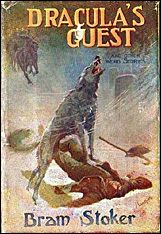
BRAM STOKER – Dracula’s Guest. Published posthumously in the collection Dracula’s Guest and Other Weird Stories (George Routledge & Sons, UK, hardcover, 1914). Reprinted many times including: Weird Tales, December 1927; The Ghouls, edited by Peter Haining (W. H. Allen, UK, hardcover, 1971; Pocket, US, paperback, April 1971); Dracula’s Guest and Other Stories, edited by Victor Ghidalia (Xerox, US, paperback, 1972); Werewolf!, edited by Bill Pronzini (Arbor House, US, hardcover, 1979); The Vampire Archives: The Most Complete Volume of Vampire Tales Ever Published, edited by Otto Penzler (Vintage Crime/Black Lizard / Vintage Books, softcover, 2009); The Big Book of Rogues and Villains, edited by Otto Penzler (Vintage Crime/Black Lizard, softcover, October 24 2017). Film: Among others “inspired” by the story, Universal’s film Dracula’s Daughter (1936) was supposedly based on the tale, but nothing of the plot was used.

   It is generally stated and accepted that this story, somewhat complete in itself, was the the first chapter of the original manuscript of Dracula, but deleted for reasons of length. It is told by an unknown narrator, but presumably it was Jonathan Harker who very foolishly ignores the advice of his innkeeper and the coachman of his carriage to get out to investigate on foot a village said to be unholy and abandoned for some 300 years.

   On Walpurgis Night, no less. Needless to say, he soon realizes that he has made a dangerous mistake. Some thoughts. First of all, how modern Stoker’s writing is. This is story that could easily pass as having been written last week, if not yesterday. Secondly, it is wonder how well this story anticipates all those Hammer horror films that came along so many years later.

         BONUS:

   Here are the stories included in the Rogues and Villains anthology:


      THE VICTORIANS

At the Edge of the Crater by L. T. Meade & Robert Eustace
The Episode of the Mexican Seer by Grant Allen
The Body Snatcher by Robert Louis Stevenson
Dracula’s Guest by Bram Stoker
The Narrative of Mr. James Rigby by Arthur Morrison
The Ides of March by E. W. Hornung

   19TH CENTURY AMERICANS

The Story of a Young Robber by Washington Irving
Moon-Face by Jack London
The Shadow of Quong Lung by C. W. Doyle

      THE EDWARDIANS

The Fire of London by Arnold Bennett
Madame Sara by L. T. Meade & Robert Eustace
The Affair of the Man Who Called Himself Hamilton Cleek by Thomas W. Hanshew
The Mysterious Railway Passenger by Maurice Leblan
An Unposted Letter by Newton MacTavish
The Adventure of “The Brain” by Bertram Atkey
The Kailyard Novel by Clifford Ashdown
The Parole of Gevil-Hay by K. & Hesketh Prichard
The Hammerspond Park Burglary by H. G. Wells
The Zayat Kiss by Sax Rohmer

      EARLY 20TH CENTURY AMERICANS

The Infallible Godahl by Frederick Irving Anderson
The Caballero’s Way by O. Henry
Conscience in Art by O. Henry
The Unpublishable Memoirs by A. S. W. Rosenbach
The Universal Covered Carpet Tack Company by George Randolph Chester
Boston Blackie’s Code by Jack Boyle
The Gray Seal by Frank L. Packard
The Dignity of Honest Labor by Percival Pollard
The Eyes of the Countess Gerda by May Edginton
The Willow Walk by Sinclair Lewis
A Retrieved Reformation by O. Henry

      BETWEEN THE WORLD WARS

The Burglar by John Russell
Portrait of a Murderer by Q. Patrick
Karmesin and the Big Flea by Gerald Kersh
The Very Raffles-Like Episode of Castor and Pollux, Diamonds De Luxe by Harry Stephen Keeler
The Most Dangerous Game by Richard Connell
Four Square Jane by Edgar Wallace
A Fortune in Tin by Edgar Wallace
The Genuine Old Master by David Durham
The Colonel Gives a Party by Everett Rhodes Castle
Footsteps of Fear by Vincent Starrett
The Signed Masterpieces by Frederick Irving Anderson
The Hands of Mr. Ottermole by Thomas Burke
“His Lady” to the Rescue by Bruce Graeme
On Getting an Introduction by Edgar Wallace
The 15 Murderers by Ben Hecht
The Damsel in Distress by Leslie Charteris

      THE PULP ERA

After-Dinner Story by William Irish
The Mystery of the Golden Skull by Donald E. Keyhoe
We Are All Dead by Bruno Fischer
Horror Insured by Paul Ernst
A Shock for the Countess by C. S. Montanye
A Shabby Millionaire by Christopher B. Booth
Crimson Shackles by Frederick C. Davis
The Adventure of the Voodoo Moon by Eugene Thomas
The Copper Bowl by George Fielding Eliot

      POST-WORLD WAR 2

The Cat-Woman by Erle Stanley Gardner
The Kid Stacks a Deck by Erle Stanley Gardner
The Theft from the Empty Room by Edward D. Hoch
The Shill by Stephen Marlowe
The Dr. Sherrock Commission by Frank McAuliffe
In Round Figures by Erle Stanley Gardner
The Racket Buster by Erle Stanley Gardner
Sweet Music by Robert L. Fish

      THE MODERNS

The Ehrengraf Experience by Lawrence Block
Quarry’s Luck by Max Allan Collins
The Partnership by David Morrell
Blackburn Sins by Bradley Denton
The Black Spot by Loren D. Estleman
Car Trouble by Jas A. Petrin
Keller on the Spot by Lawrence Block
Boudin Noir by R. T. Lawton
Like a Thief in the Night by Lawrence Block
Too Many Crooks by Donald E. Westlake

ROBERT BLOCH “The Cloak.” First published in Unknown, May 1939. First collected in The Opener of the Way (Arkham House, hardcover, 1945). Reprinted many times, including: Dracula’s Guest and Other Stories, edited by Victor Ghidalia (Xerox, paperback, 1972); Magic for Sale, edited by Avram Davidson (Ace, paperback, 1983); Vamps: An Anthology of Female Vampire Stories, edited by Martin H. Greenberg (Daw, paperback, 1987); American Fantastic Tales: Terror and the Uncanny from Poe to the Pulps, edited by Peter Straub (Library of America, hardcover, 2008). Film: Adapted as Part Four of The House That Dripped Blood (Amicus, 1971; reviewed here ).

   The list of places above where this small but obviously effective short story has appeared only scratches the surface, but what’s especially rewarding is seeing it progress from the pages of a 20 cent pulp magazine to a $35 hardcover from the prestigious Library of America.

   It’s one of those stories that begins, more or less, in one of those strange out-of-the-way shops that dot the side streets of the poorer sections of large cities, open for a while and perhaps only to pre-selected customers, only to disappear as mysteriously as they appeared, or to go up in flames, the owners vanished or even destroyed along with it.

   It is Halloween and a man named Henderson is looking for a costume. The shop owner in this case offers him the cloak — not a cloak, but the cloak — and once Henderson puts it one, he is a new man — or is he?

   What he definitely is is the center of attention at the party he attends that night. He is attracted to the neck of his fat host. Most positively attracted to him is a girl dressed as an angel — or is she?

   Told in Robert Bloch’s invariably easy to read writing style, the reader is always one step ahead of the main protagonist, until, that is, he meets the girl above, named Sheila, and once she is met, you are not exactly sure which way the rest of the tale is going to go. You think you do, but you’re not quite sure. Exactly where you should be at this stage of a story well told.

JUANITA COULSON – Crisis on Cheiron. Ace Double H-27, paperback original; 1st printing, 1967. Cover art: Jerome Podwil. Published back-to-back with The Winds of Gath, by E. C. Tubb.

   You may have to forgive me a little on this review, as I have some nostalgic bias toward it, as the author was, with her husband Buck, the co-publisher of a long-running science fiction fanzine called Yandro (1953-1986) that was not only very nearly my introduction to SF fandom, but also showed me what publishing a zine on one’s own was all about.

   Crisis on Cheiron was Juanita Coulson’s first novel, and while it’s not an award winner by any means, it’s a solid workmanlike effort that I read with pleasure.

   It’s the kind of puzzle story that drew me to SF in the first place. Carl Race is a troubleshooting ecologist who’s been sent to the planet Cheiron to find out why all the plant life there is beginning to die. If the problem is not solved soon, all life on the world, including the race of intelligent centaur-type natives, may be doomed.

   The solution, as it turns out, is an easy one. The bigger problem then becomes, who or what enemy agent is responsible? This is when the story becomes more or less routine, as Carl teams up with a feisty young Terran schoolteacher (female) and one of her bright native pupils to catch the wrongdoers in the act.

   There’s no more depth to the story than I’ve outlined here, but it’s well-written, with just enough drive to keep most readers of SF of the traditional (and now perhaps old-fashioned) sort involved in the tale until the end, including me.

MARK PHILLIPS – The Impossibles. Kenneth J. Malone / Psi-Power #2. Pyramid F-875, paperback original; 1st printing, June 1963. Previously serialized in Astounding SF in three parts as “Out Like a Light,” April-June 1960. Reprinted under this title but as by Laurence Janifer & Randall Garrett by Resurrected Press, trade paperback, 2011.

   The first in this series, concocted in high comic fashion by SF writers Laurence Janifer and Randall Garrett, was Braintwister (Pyramid, 1962), in which intrepid FBI agent Ken Malone meets up with a telepathic old lady who thinks she is Queen Elizabeth. The third and last was Supermind (Pyramid, 1963), in which he tangles with … well, you’ll have to tell me, as I haven’t read it yet.

   In this one, though, he meets up with a gang of kids in New York City who … well, I can’t tell you that, since that’s the mystery that Malone is called on to solve. Let me say that it begins with Malone lying flat on his back on a Greenwich Village sidewalk, having been sent to the big city to investigate a series of strange incidents involving red Cadillacs — only Cadillacs, and only red — that are being stolen and taken for joy rides all over the metropolitan area, but with no one being able to see who’s taking them or or even who’s behind the wheel.

   Truth be told, as a novel, The Impossibles is a minor affair, but the pleasure comes from watching Malone tackle the unknown in a wink and a nod sort of way, and then as he tries to explain to others what he comes across. That and passages such as this one, chosen from very early on in the book:

   Very slowly and carefully he opened his eyes again, one at a time. […] He closed his eyes again and waited for his head to go away.

   A few minutes passed. It was obvious that his head had settled down for a long stay, and no matter how bad it felt, Malone told himself, it was his head, after all. He felt a certain responsibility for it. And he couldn’t just leave it lying around somewhere with its eyes closed.

   All in all, a series that’s a lot of fun to read, but there’s no way I could call it essential.

« Previous PageNext Page »