Crime Fiction IV


   British bookseller Jamie Sturgeon has come up with two more books to add to the list of Rob Eden novels given in my review of his ‘alter ego’ Adam Bliss’s The Camden Ruby Murder. What’s more, based on descriptions of their story lines, Al Hubin has agreed that they should go into Crime Fiction IV, albeit with a dash before each of their titles indicating only marginal crime content.

   Complete bibliographic details will be available in the next Addenda for CFIV. For now, here are the titles and short synopses of their plots:

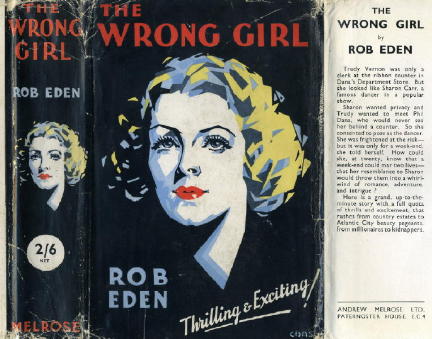
      THE WRONG GIRL, by Rob Eden

    “Trudy Vernon was only a clerk at the ribbon counter in Dana’s Department Store. But she looked like Sharon Carr, a famous dancer in a popular show.

    “Sharon wanted privacy and Trudy wanted to meet Phil Dana, who would never see her behind a counter. So she consented to pose as the dancer. She was frightened at the risk – but it was only for a week-end, she told herself. How could she, at twenty, know that a week-end could mar two lives – that her resemblance to Sharon would throw them into a whirlwind of romance, adventure and intrigue?

    “Here is a grand, up-to-the-minute story with a full quota of thrills and excitement, that rushes from country estates to Atlantic Cty beauty pageants, from millionaires to kidnappers.”

The Wrong Girl


      THE GIRL AND THE RING, by Rob Eden

    “Take one attractive young lady, wandering into an auction room simply to while away a few minutes. Take one odd silver ring with a four-leaf clover design, which she somehow found herself bidding for, and buying. Take one brown-haired, blue-eyed, pleasant-voiced young man, so interested in her purchase that he stopped Madge outside the auction rooms and offered to take the ring off her hands at ten times what she’d paid for it. Take a dash of mystery, a dash of danger, a generous sprinkling of romance. Result: Rob Eden’s latest absorbing story of human hearts.”

JOHN R. FEEGEL – Autopsy.

Avon 22574. Paperback original, 1975.

Feegel: Autopsy

   When a Florida tomato salesman apparently commits suicide in a second-rate Connecticut motel, the insurance company naturally refuses to payoff, and off to court they go.

   A lot of book is summarized in that one line. Feegel is both a lawyer and a practicing forensic pathologist, quoting from inside the back cover, and he lovingly fills in all the clinical details of embalming, funeral procedures, exhumations and so on that any of us would ever want to know. His courtroom expertise is equally evident, but may I say that the insurance company’s defense attorneys do a hopelessly inadequate job, and that’s a tremendously difficult premise to swallow.

   The detective story aspect rings completely false as well, which is surprising, since this book won an MWA Edgar as the best paperback mystery of the year. Again if I may, I’d say that Feegel is guilty of [literary malpractice] in his portrayal of the killer’s [deliberately misleading] post-mortem behavior, and the way he handles the questioning of the girl in the next room is most singularly strange. In fact, while Feegel, a Floridian, obviously doesn’t think much at all of coroners and policemen up here in good old Connecticut, that’s hardly a reason to make every one of his characters from this state a completely stereotyped caricature. How can a book so eminently readable also be so woefully inadequate?    (B minus)

– From The MYSTERY FANcier, Vol. 3, No. 3, Mar-Apr 1979.


[UPDATE] 07-22-07. It’s far too late, I know, but I’ll issue the author an apology anyway for misspelling his name as “Fleegel” throughout this review, and it’s been corrected. I also said earlier that I wouldn’t change anything in these old reviews, but in this case I overruled myself and made an exception, as you’ll see above.

   The following was taken from an online obituary for the author:

    “John R. Feegel, a Florida medical examiner who became an award-winning novelist, died on Sept. 16, 2003. Cause of death was not released. He was 70.

    “The son of a police officer, Feegel grew up to become a forensic pathologist, a trial attorney and the chief medical examiner in Tampa. He performed thousands of autopsies; the death of Elvis Presley and Atlanta serial killer Wayne B. Williams were two of his most famous cases.

    “Feegel also wrote seven mystery novels. In 1976, he won the Edgar Award from the Mystery Writers of America for his first book, Autopsy.”

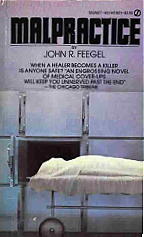
Malpractice.

   From Crime Fiction IV, by Allen J. Hubin, here’s a complete list of his fictional work that qualifies as crime-related, slightly expanded:

      o Autopsy (n.) Avon, pbo, 1975.
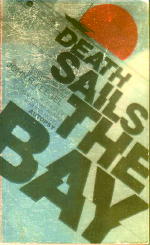
      o Death Sails the Bay (n.) Avon, pbo, 1978.
      o The Dance Card (n.) Dial Press, hardcover, 1981. Avon, pb, 1982.
      o Malpractice (n.) New American Library, hardcover, 1981. Signet, pb, 1982.
      o Not a Stranger (n.) New American Library, hardcover, 1983. Signet, pb, 1984.


[Later.] I’ve just noticed that the obituary said that John Feegel wrote seven mysteries, but Al Hubin lists only five. Hmm. That’s something that should be looked into.

[Still later.] Aha. I’ve found both of the missing titles:

      o Eco-Park: The Al-Hikma Legacy (n.) Authors Choice Press, softcover, March 2001.
      o Death Among the Ruins (n.) Writers Club Press, softcover, September 2002.


John R. Feegel[UPDATE] 07-23-07.   In my original post I included a comment that cover images for Feegel’s books were difficult to come by. The only one I could find yesterday was the one for Malpractice.

   In this morning’s email Bill Crider, whose supply of old mystery paperbacks is nearly endless, sent me two additional ones, both of which you now see here. Unfortunately the silver reflective covers don’t scan well, so the results are not up to either Bill’s or my standards, but I think they will do.

   I also asked Bill if he’d ever read one or both. His reply: “I read the first one because it won the Edgar. I remember nothing at all about it except that I was impressed by the forensic details. I thought of the book back when Patsy Cornwell was becoming famous and wondered if it was one of the first to introduce that kind of stuff.”

   Not being a fan of forensic details myself, it hadn’t occurred to me before, but I really think that Bill is onto something here.

ADAM BLISS – The Camden Ruby Murder

Grosset & Dunlap; hardcover reprint, no date stated. First edition: Barse & Co., hardcover, 1931.

   According to the increasingly indispensable Crime Fiction IV, Adam Bliss was the pseudonym of Robert F. Burkhardt & Eve Burkhardt, husband and wife, as we shall see in a moment. They wrote three books under this pen name, to whit:
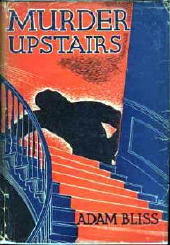
Murder Upstairs

      The Camden Ruby Murder, Barse, 1931. Grosset hc reprint.
      Murder Upstairs, Macrae-Smith, 1934. Grosset hc reprint.
      Four Times a Widower, Macrae-Smith, 1936.

   The leading character in each of the last two is someone named Alice Penny, about whom I know nothing at the moment, but since I own one of the two books, present whereabouts unknown, I will tell you more about her, eventually, as soon as I locate the box I know that it is in. And read it. The book, that is, not the box.

   The Burkhardts also wrote books as Rob Eden; there are five entries for them in CFIV under this name. And ordinarily, this is about all you might expect to learn about an obscure pair or writers like these, but no, the Internet does say more. With a judicious use of Google, I discovered a website devoted to events in 1947. What particular connection the Burkhardts have with 1947, I have not yet discerned, but I quote:

    “And at the age of 55, after dozens of novels and countless short stories, he [Robert Burkhardt] died. Not that you’ve heard of him or any of his books – unless you collect potboiler novels of the 1930s.

    “The list of his works is impressive in bulk if nothing else, with titles that tell the entire plot in two or three words: Dancing Feet, In Love With a T-Man, Love or Money, Modern Marriage and my favorite: Short Skirts: A Story of Modern Youth.

    “Robert F. Burkhardt was born in Altoona, Iowa, and after a long apprenticeship as a reporter at a series of newspapers, he began handling publicity in the Hollywood studios: Fox, Paramount and Warner Bros. He and his wife, Eve, combined their names to form the pen name Rob Eden, adopting another pseudonym, Adam Bliss, for a series of mysteries.

    “Today, not a single one of his volumes is in the collection of the Los Angeles Public Library. A Google search turns up very little on him or his widow.”

   The works of Rob Eden, as taken from the website above, are the following. No claim is made (by me) as to completeness. [Those marked with a * are entries in CFIV; one marked with a ** perhaps should be.]

      Always in Her Heart
      Blond Trouble
      Dancing Feet
      Fickle
      The Girl With Red Hair
      Golden Goddess
      Heartbreak Girl
      Her Dream Prince
      Her Fondest Hope
      In Love With a T-Man **   [ Listed for sale elsewhere with this description: “Secretary falls in love with her Treasury Agent boss. Intrigue, romance.” ]
      * Jennifer Hale
      Kathie the First
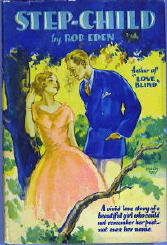
      * LootStep Child
      Love Blind
      Love Came Late
      * Love Comes Flying
      Love or Money
      Love Wings
      The Lovely Liar
      Lucky Lady
      Men at Her Feet
      Modern Marriage
      Moon Over the Water
      The Mountain Lodge
      * A New Friend
      Pay Check
      Second Choice
      * Short Skirts: A Story of Modern Youth
      Step-Child
      This Man Is Yours
      Trapped By Love
      $20 a Week

   One other website indicates that the authors also wrote as Rex Jardin. If so, this may be a case of a missing entry in CFIV, as the one title found under this byline certainly sounds as though it may be crime-related: The Devil’s Mansion, Fiction League, 1931; Jacobsen, 1931?; Paperback Library, pb, 1966, as a gothic romance with the following blurb on the cover: “Janet was forced to escape the eerie old house or become the bride of the Devil himself!”

   As for The Camden Ruby Murder itself, the good news is, to some of us – should I make that “most of us?” – is that this is a locked-room mystery. I’ll get to the (relatively) bad news in a minute. To set the scene first of all, the narrator, Gary Maughan; his host, Van Every, owner of the newly acquired (and priceless) Camden Ruby;and Maughan’s long-time acquaintance (and once his lover) stage star Margalo Younger, are in Van Every’s home, listening to him expound on the curse that has been placed upon the gem. When the story is completed, with its gory details, Margalo, who has apparently fainted, is discovered by the two men instead to be dead. Murdered by means of a poisoned needle found at the base of her brain.
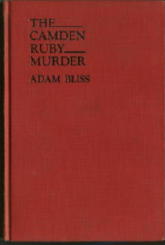
The Camden Ruby Murder

   Mitigating circumstances: The door to the room was open, and a number of household members (and close friends) are eventually learned to have passed by, which seems to make matters less complicated, until (as time goes on) it is also learned that none of them could have committed the crime, more or less. Which is too bad, because none of them really did do it. In the hands of an author like John Dickson Carr, the flummery would have kept pace with the investigation, if not kept tantalizingly out in front instead of lagging behind, as it does here, which to my mind, at least, was a large disappointment, as the flummery itself is top-notch and worthy of, as I suggested above, better hands.

   This book was written back in the day where the mystery, the murder, the crime, the investigation and the questioning were the beginning, the middle, and the end of the story. Not much time is spent on personal matters, unless and until they had a bearing on the case at hand. Maughan quickly gains the confidence of the investigating officer, one Captain Keyes, which (fortunately for the reader) gives Maughan, as the narrator, total and complete access to the entire investigation. He is therefore able to view it from every side and angle and than back inside out again.

   Not that this amounts to more than a hill of peapods later on, at a key juncture of the story when Maughan, tired from slogging across town one time too many in the rain, turns down an opportunity for someone to tell him something important, something so important it would have solved the case then and there – halfway through the book – only for that person offering him the aforesaid opportunity, but denied, to become the second of the killer’s victims. (I am not telling you anything you should not know, for as Maughan himself says, immediately after turning said person away, “I would have given anything if only I … had listened…”)

   Any weaknesses or problematic passages aside, I enjoyed reading this book, and if you are still with me in reading my comments thus far, I am somewhat of the opinion that you would too.

— July 2006


[UPDATE] 07-21-07. Al Hubin has agreed with me about the book by Rob Eden which I suggested be included in CFIV. You will find it under that author’s name in the ongoing online Addenda to the Revised Crime Fiction IV.

   As for the book by Rex Jardin mentioned above, Al has informed me that it was included in Crime Fiction II. He removed it from later editions on the advice it was not criminous in nature. Any confirmation or factual information to the contrary would be welcome.

[UPDATE] 07-24-07. Jamie Sturgeon has found two more titles by Rob Eden, and Al Hubin has agreed that both of them warrant inclusion in CFIV. Details can be found in this later blog entry.
JOHN R. L. ANDERSON – Death in the Channel

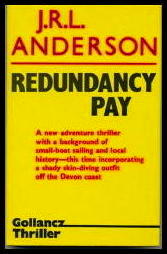
Stein & Day, hardcover, 1976. Reprint paperback: Stein & Day 88112, 1985. Detective Book Club [3-in-1 edition], hardcover, Jan-Feb, 1977. First published in England as Redundancy Pay,by J. R. L. Anderson: Victor Gollancz, hardcover,1976.

Death in the Channel

   A young London accountant loses his job in a takeover by a larger firm, loses his wife to the joys and pleasures that only wealth can bring, and sick and tired of the continual chase for paper money, he heads back to his boyhood home to see whether or not livings can still be made from the sea.

   In Finmouth he gets a job with lobster pots, is suspected for a while of stealing a priceless chalice left unguarded in a church vestry, but then discovers the connection between the crime and some divers searching for sunken treasure out in the English Channel.

   It doesn’t take a mathematician to put together the correct equations and solve them, but it is exactly that sort of old-fashioned story that’s put together in just so precise a manner. The pacing bothered me a little, and there is a surprisingly large flaw in the logic at one point, but overall Anderson will strike you, I’m sure, as a writer who is reliably competent and solid. And decent.    (C plus)

– From The MYSTERY FANcier, Vol. 3, No. 2, Mar-Apr 1979.


[UPDATE]
07-20-07. I’ve not been able to come up with a cover image for either US edition of this book. According to my records, I may no longer even own a copy. If I do, it’s nowhere it can be easily located. Thanks to British bookseller Jamie Sturgeon, though, what you see is the cover of Gollancz edition. Not as interesting as it might have been, but it’s still good to have.

   In Crime Fiction IV, Allen Hubin indicates that Major Peter Blair, one of Anderson’s two major series characters is in this book, but Jamie has reassured me that he does not. Until I received an email from Jamie this afternoon, I was surprised to think that Blair was in the book and somehow I hadn’t managed to mention it in the review.

    I don’t remember ever reading one of Major Blair’s exploits, but I could be wrong. For the sake of completeness, Anderson’s other detective character was Inspector Piet Deventer, one of whose cases I remember not caring for as much as I did Death in the Channel, but which one it was, I can no longer recall.

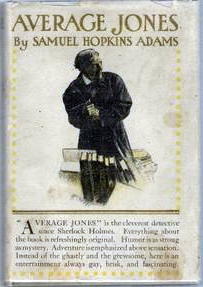
SAMUEL HOPKINS ADAMS – Average Jones.

Bobbs-Merrill, hardcover, 1911. Story collection.

   As an assiduous reader of personal advertisements — and if you won’t admit to doing the same, I think you’ll agree they are important plot points in a number of detective novels – I warmed instantly to Adrian Van Reypen Egerton Jones, nicknamed Average Jones for obvious reasons.

   A highly intelligent, very rich, and terribly bored young man, as the first yarn opens he is wondering what to do with himself. His friend Mr Waldemar, owner of The Universal, an important New York City paper, suggests Jones set up as a kind of one man consumer protection wallah, giving advice, as Jones’s business card will later declare, “upon all matters connected with Advertising.” As a bonus, Jones will pass on discoveries about various swindles perpetrated through ads to Waldemar, thus keeping the paper’s lengthy advertising columns “clean.”

Average Jones

   Jones gives it a whirl and soon becomes engrossed in the work to the extent of setting up an agency to handle the more humdrum requests for advice while he looks into ads that grab his attention, particularly those hinting at criminal activity. Average Jones relates the cases he investigates.

    “The B-Flat Trombone” is a locked room mystery. By what method was mayoral candidate William Linder blown up in a locked room on the third floor of his mansion on Kennard Street in Brooklyn?

    After three unsuccessful attempts on his life, Malcolm Dorr keeps two guard dogs. Both are killed yet neither were shot or poisoned. Then there is a rash of canine deaths in Bridgeport, Connecticut. Is there any connection between these events and the mysterious “Red Dot”?

    Where is young rakehell Roderick Hoff? His father engages Jones to find him. Jones follows an “Open Trail” to do so and then outfoxes Hoff’s swindling father when he tries to wiggle out of paying the reward money.

    “Mercy Sign” is a dark story rooted in a real historical tragedy. Jones and his friend Robert Bertram look into a strange affair involving a missing academic assistant, a wrecked houseboat, and a dead foreign dignitary.

    Jewels nicknamed the “Blue Fires” form a beautiful necklace, a gift from Mr Kirby to his fiancee Edna Hale. Their disappearance means their wedding is postponed. What do a torn curtain and broken-off bed knob have to do with the matter?

    Anonymous letters of a particularly nasty sort are written out in “Pin-Pricks” on junk advertising mail sent to William Robinson. What is the purpose of these communications and who could be responsible?

    Bailey, the son of rural minister Rev’d Peter Prentice, is missing after a meteor lands on a New England barn and sets it alight. An ad appears revealing he is alive but not where, but a certain bit of “Big Print” aids Jones in tracing the lost boy.

    Enderby Livius is “The Man Who Spoke Latin,” claiming he cannot speak English. Livius is up to no good in bibliophile Colonel Ridgway Graeme’s chaotic library, and to find out what it is Jones poses as a mute classical scholar.

    “The One Best Bet” begins with a man committing suicide because he arrives too late to amend his personal ad, having had second thoughts about its content – as well he might, since it reveals a plot to murder the governor. Can the crime be prevented?

    “The Million-Dollar Dog” involves one of those odd wills beloved by the rich in detective fiction. Judge Hawley Ackroyd’s advertisement seeking l0,000 black beetles puts Jones on the trail of an attempt to gain a fortune by underhanded means.

    My verdict: What an inventive way to introduce a detective to cases in all levels of society! I enjoyed this collection a great deal and recommend it to readers who like slightly offbeat and very clever stories. Now I’m off to read the personal ads in today’s papers….

Etext: www.gutenberg.org/dirs/etext04/vrjns10.txt

                   Mary R

http://home.epix.net/~maywrite/


    Besides being a novelist with several works of mystery and detective fiction to his credit, Samuel Hopkins Adams was also a well-known “muckraker” and investigative reporter. For more information on his life and career, a good place to start looking would be his Wikipedia entry.

   From Crime Fiction IV, by Allen J. Hubin:

ADAMS, SAMUEL HOPKINS (1871-1958); see pseudonym Warner Fabian.
    * Average Jones (Bobbs, 1911, hc) [Average Jones] Palmer, 1911.
    * The Flying Death (McClure, 1908, hc) [Long Island, NY]
    * _The Mystery (with Stewart Edward White) See entry under Stewart Edward White.
    * _The President’s Mystery Story [as by Franklin D. Roosevelt] See entry under Franklin D. Roosevelt
    * The Secret of Lonesome Cove (Bobbs, 1912, hc) [New England] Hodder, 1913.

FABIAN, WARNER; pseudonym of Samuel Hopkins Adams.
    * -The Men in Her Life (Sears, 1930, hc) Film: Columbia, 1931 (scw: Robert Riskin, Dorothy Howell; dir: William Beaudine).

WHITE, STEWART EDWARD
    * The Mystery (with Samuel Hopkins Adams) (McClure, 1907, hc) [Percy Darrow; Ship] Hodder, 1907.

ROOSEVELT, FRANKLIN
    * The President’s Mystery Story [by Anthony Abbot, Samuel Hopkins Adams, John Erskine, Rupert Hughes, S. S. Van Dine & Rita Weiman] (Farrar, 1935, hc) Lane, 1936. Revised edition: Prentice-Hall, 1967, as The President’s Murder Plot. A mystery novel suggested by Roosevelt and written, a chapter each, by seven mystery writers. Film: Republic, 1936, as The President’s Mystery; also released as One for All (scw: Lester Cole, Nathaniel West; dir: Phil Rosen).

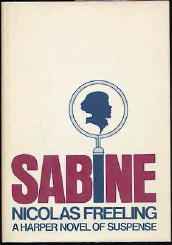
NICOLAS FREELING – Sabine.

Harper & Row, hardcover, 1976. Paperback reprint: Vintage V-553, 1980. First published in England as Lake Isle, William Heinemann Ltd., hardcover, 1976; Penguin, paperback, 1980.

Sabine

   The sights and sounds of small-town France are put on display as provincial policeman Henri Castang investigates the untimely death of an elderly poetess who had earlier come to him with some uneasy feelings concerning her adopted son and only heir. An intellectual affair, in fine Gallic tradition, as we’re shown how political and judicial pressures influence everyday policework, and not at all for the action-minded among us. (C)

      – From The MYSTERY FANcier, Vol. 3, No. 2, Mar-Apr 1979. This review also appeared earlier in the Hartford Courant.

[UPDATE] 07-18-07. When I was writing for the Courant, I was usually working under severe space restrictions, so some of my reviews were a whole lot shorter than they are today. I don’t believe I’ve ever read another book by Freeling, I regret to say, neither the Castang books nor the cases given to Inspector Van Der Valk to solve.

   Thanks to Crime Fiction IV, by Allen J. Hubin, here’s a list of all of the Henry Castang books. I do have many of these in paperback editions, and just in case you were wondering, I do plan to read them. I don’t keep anything I don’t intend to read.

o A Dressing of Diamond (n.) Harper & Row, 1974.
o The Bugles Blowing (n.) Harper & Row, 1976.
o Sabine (n.) Harper & Row, 1978.
o The Night Lords (n.) Pantheon, 1978.
o Castang’s City (n.) Pantheon, 1980.
o Wolfnight (n.) Pantheon, 1982.
o The Back of the North Wind (n.) Viking, 1983.
o No Part in Your Death (n.) Viking, 1984.
o Cold Iron (n.) Viking,1986.
o Lady MacBeth (n.) Deutsch, UK, 1988. [No US edition.]
o Not As Far As Velma (n.) Mysterious Press, 1989.
o Those in Peril (n.) Mysterious Press, 1991.
o Flanders Sky (n.) Mysterious Press,1992.
o You Know Who (n.) Mysterious Press,1994.
o The Seacoast of Bohemia (n.) Mysterious Press, 1995.
o A Dwarf Kingdom (n.) Mysterious Press, 1996.

   A word of explanation to go with the following review, and any others that will be showing up here on the M*F blog in the days to follow. These reviews will come from the long distant past, nearly 30 years ago, in fact. All were published in a fanzine published by Guy M. Townsend, and called The MYSTERY FANcier. I’ll use the initials TMF in the headings to so indicate where all such reviews first appeared. Prior to their TMF publication, some of the reviews were appeared in the Hartford Courant (not a fanzine) and will also be so designated.

   I’m going to reprint the reviews as they were published at the time, whatever warts I see they may have when I read them now. I will update the publishing history of the books, and on occasion, perhaps even most of the time, add Updates or other Commentary.

   I no longer use letter grades to close up my reviews, but I did back then, and for better or worse, I’ll include them now. Don’t hold me too closely to either my comments or the grades I assigned to the books. I was a different person then, and so (probably) were you.


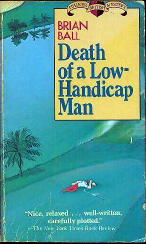
BRIAN BALL – Death of a Low-Handicap Man.

Arthur Barker Ltd., UK, hardcover, 1974. Walker & Co., hardcover, US, 1978. Paperback reprint: Walker 3063, 1984. Trade paperback: Wildside Press, 2003.

Death of a Low-Handicap Man

   When a golfer that not everyone’s overly fond of is found whacked to death near the clubhouse, the only question the bartender asks is: “How many strokes?” On the other hand, the investigation that follows is painfully and stolidly slow, hampered in part by an unspoken procedural conflict between the village bobby and the superintendent from the C.I.D. Nor is it quite a “locked room” mystery either, but it is difficult to explain how nothing suspicious was noticed, even though the thicket in which the dead man was found had been under close observation throughout the match, and from all sides. Although it’s not really necessary, a love of the silly game of golf will help tremendously in the enjoyment you’ll get from this one. (C)

      – From The MYSTERY FANcier, Vol. 3, No. 2, Mar-Apr 1979. This review also appeared earlier in the Hartford Courant.

[UPDATE] 07-18-07. Brian Ball has six books listed in CFIV, as follows:

      Death of a Low-Handicap Man (n.) Barker 1974; Walker, 1978.
      Montenegrin Gold (n.) Barker 1974; Walker, 1978.
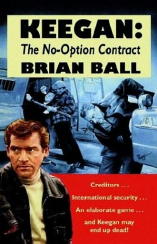
      Keegan: The No-Option Contract (n.) Barker, 1975.

Keegan

      Keegan: The One-Way Deal (n.) Barker, 1976.
      Witchfinder: The Evil at Monteine (n.) Mayflower, pb, 1977.
      The Baker Street Boys (co.) BBC, 1983. Series character: Arnold Wiggins. [Two novelettes based on the BBC television series.]

   He’s probably much better known, however, as science fiction writer Brian N. Ball. For a list of all of his books, this website seems to be the place to look.

   Keegan appears to have been a reluctant spy for British Intelligence. The book based on “The Baker Street Boys”sounds intriguing, as does the TV series itself. The link will lead to the IMDB entry for it. There was one other book in the “Witchfinder” series:

      Witchfinder: The Mark of the Beast. (n.) Mayflower, pb, 1976.

   While this may be a book wrongly omitted from CFIV, it may be a straight horror novel with no criminous aspects to it.

   As for the mystery novel reviewed above, I seem to have neglected to include the name of either of the two sleuths involved, not that either apparently made another appearance. Nevertheless, I’d still like to know who they might have been. If you happen to have a copy handy, would check it out and pass the word along to me?

   The “locked room” aspect doesn’t seem to have been strong enough for the book to be included in Bob Adey’s Locked Room Murders, but once again, my bringing it up at all makes me wish I’d taken better notes at the time. Even though I gave this one a letter grade of only a “C”, if I come across it again any time soon, I think that a re-reading might very well be in order.

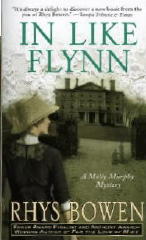
RHYS BOWEN – In Like Flynn

St. Martin’s; paperback reprint, December 2005. Hardcover edition: St. Martin’s Press, March 2005.

   I’ll defer to Ms. Bowen’s website for most of the data about her, including the fact that her books have been nominated for “every major mystery award – Edgar, Agatha, Anthony, Barry, Macavity – and has won seven of them.” Thanks to Crime Fiction IV, however, it can be learned that her real name is Janet Quin-Harkin. Ms. Bowen started writing mysteries later than usual in life; her first one was Evans Above, part of the Evan Evans series, and was published in 1997 when the author was 56. [FOOTNOTE.]

   From her website, here’s a list of all of the books in each of her two series:

     The Constable Evans Series: [All St. Martin’s Press in hardcover; Berkley Prime Crime in paperback.]

Evans Above, 1997
Evan Help Us, 1998
Evanly Choirs, 1999
Evan and Elle, 2000
Evan Can Wait, 2001
Evans to Betsy, 2002
Evan Only Knows, 2003
Evan’s Gate, 2004
Evan Blessed, 2005

     The Molly Murphy Series: [St. Martin’s Press in both hardcover and paperback.]

Murphy’s Law, 2001
Death of Riley, 2002
For the Love of Mike, 2003
In Like Flynn, March 2005
Oh Danny Boy, March 2006

   The Constable Evans series take place in Llanfair, Wales, and are contemporary in nature. The Molly Murphy books, on the other hand, are historical mysteries, Manhattan-based, and take place just after the turn of the last century. Naturally it goes without saying, but I’ll say it anyway: I’ve just read the fourth book, and none of the first three.

In Like Flynn

   What that means, in other words, is that there is a lot of backstory that has developed through the course of the three before this one, and there are a number of characters to be introduced to, all in a hurry. If you take all in stride, however, it doesn’t take too long to fill in most of the salient details. Suffice it to say, perhaps, that Molly Murphy is a recent immigrant who has improved her status in her new world to become one of the few female private investigators in that particular time and place. On page 12 she also admits to having been an artist’s model, comfortable in posing in the nude before strange men, which of course is an eye-opener, and equally of course I can only believe her.

   In any case, Miss Molly Malone is about as progressive as you could possibly get, in that particular time and place, and her love life and home life are equally eyebrow-raising, figuratively speaking. She is all-but-spoken-for with one man, she shares her home with another, and the man she really loves (it seems) is her ex-beau, Captain Daniel Sullivan of the New York Police.

   Much of this background, once the new reader has found some solid ground upon which to stand, turns out to be unnecessary in a way, since the case that Molly undertakes this time around takes her to a mansion up along the Hudson, where her task is twofold: (1) to investigate the authenticity of two females mediums who have been preying upon wealthy people who have lost loved ones, and (2) and Daniel Sullivan does not know this, to investigate the kidnapping and subsequent disappearance (and assumed death) of a young child born to Senator Barney Flynn and his wife.

   And what this means is working undercover as an unknown cousin of the senator’s, visiting from Ireland – and hence the title. What Molly does not know that this also means meeting someone from her recent past, someone whom she expected never to see again, as well as keeping her wits about her in solving the case without blowing her cover. Taking advantage of some rather limited opportunities, she does a capable enough job of investigating – enough so that the truth, in long-winded fashion (the book is over 320 pages long), does come out. Investigating, that is, in the sense of Nancy Drew, reacting rather than acting, and with little sense of doing any real deducting.

   It is a fine piece of writing, though, you should certainly not get me wrong, with quite a few serious insights into who people are and why they are that way. Once again, I should not lead you astray by saying what the book is not, as opposed to what it is, and what it is, is fine indeed. The ending also contains a considerable enticement to read the next one, to see what comes next for Molly Malone and her somewhat embattled (and bewildered) policeman friend.

— July 2006

FOOTNOTE. Ms. Bowen addresses this point in a short autobiographical section that she’s included on her website: “Children’s books, young adult books, adult historical romances and sagas followed [working for the BBC and Australian broadcasting] until I decided it was finally time for me to write what I enjoyed reading most … and that was mysteries.”

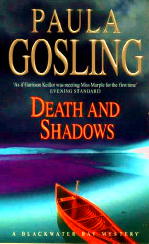
PAULA GOSLING – Death and Shadows

Warner, British paperback; 1st printing, 2000. British hardcover edition: Little, Brown; 1998. No US edition.

   A brief bit of biographical information first, if you’ll allow me, because an explanation’s going to be needed as to why a book taking place in Michigan’s Upper Peninsula has been published in the UK but never here in the US. According to one website, Paula Gosling was born in Detroit in 1939, but she moved permanently to England in 1964. After working as a copywriter and a copy consultant she became a full-time writer in 1979.

   Taken from both that website and Crime Fiction IV, by Allen J. Hubin, here’s a complete list of her book-length mystery fiction, as published in the UK. Most of these are also available in paperback editions, but I haven’t taken the time to investigate into these. The last four, though – the ones marked # – have never had a US edition:

• A Running Duck (n.) Macmillan 1978 [San Francisco, CA]
   = Fair Game (n.) Coward 1978. Revised and expanded from: A Running Duck.
• The Zero Trap (n.) Macmillan 1979 [Arctic]
• Loser’s Blues (n.) Macmillan 1980 [London]
   = Solo Blues (n.) Coward 1981. See: Loser’s Blues.
• The Woman in Red (n.) Macmillan 1983 [Spain]
• Monkey Puzzle (n.) Macmillan 1985 [Lt. Jack Stryker; Ohio; Academia]
• The Wychford Murder (n.) Macmillan 1986 [Luke Abbott; England]
   = The Wychford Murders (n.) Doubleday 1986. See: The Wychford Murder.
• Hoodwink (n.) Macmillan 1988 [Lt. Jack Stryker (only briefly); Ohio]
• Backlash (n.) Macmillan 1989 [Lt. Jack Stryker; Michigan]
• Death Penalties (n.) Scribner 1991 [Luke Abbott; London]
• The Body in Blackwater Bay (n.) Little 1992 [Lt. Jack Stryker; Matt Gabriel; Michigan]
• A Few Dying Words (n.) Little 1993 [Matt Gabriel; Michigan]
• The Dead of Winter (n.) Little 1995 [Matt Gabriel; Michigan]
• Death and Shadows (n.) Little 1999 [see below; Michigan]   #
• Underneath Every Stone (n.) Little 2000 [Matt Gabriel; Michigan]   #
• Ricochet (n.) Little 2002 [Lt. Jack Stryker; Michigan]    #
• Tears of the Dragon (n.) Allison & Busby 2004 [Chicago, 1931; the era of Al Capone]   #

Death and Shadows

   I’ve already informed Al that he omitted Matt Gabriel as a series character in Death and Shadows. Gabriel is the sheriff for Blackwater Bay, a sleepy backwater resort town that over the years has have more than its share of unusual mysteries to solve. Jack Stryker, who’s a lieutenant for the police force a few towns over, makes a cameo appearance in Death and Shadows – never in person, only by telephone.

   Here’s a question for you. How are hospitals and serial killers alike? Answer: I don’t usually read mysteries in which either one is involved, and here I violated my own rules twice, as that’s exactly what kind of mystery this is – one in which the staff and patients in a private nursing home are found murdered, one by one.

   As I pointed out earlier, Matt Gabriel is the local sheriff, but as it turns out, he’s neither of the two primary leading characters, the first being physiotherapist Laura Brandon. She’s the niece of the owner of Mountview Clinic, and extremely interested in learning how her friend and predecessor for the position was murdered. The second of the ad hoc sleuthing pair that gradually develops is Tom Gilliam, a patient who’s withdrawn well into himself since the mishap iy was that forced him off Jack Stryker’s police force.

   Another reason why I surprised myself in reading this book is that it is nearly 380 pages long, and in small print too. A hospital setting, a possible psychotic killer on the loose, and a book twice as long as my usual reading fare. You’d think it would be a matter of three strikes and out, but not so. This book kept me up reading for several nights in a row. I was able to put it down, but the next evening I couldn’t resist, and I was back reading it again.

   Maybe because the opening two or three chapters read exactly like a gothic novel, with a young(ish) girl coming fresh into a new mysterious and slightly spooky setting. A manor house, a hospital – it makes little difference. Maybe because in 380 pages there is an ultra-abundance of clues to be puzzled over, with lots of secrets on the part of almost everybody, broken hand railings, a local legend called the Shadowman. Maybe because of the many, many red herrings and false trails to follow and double back upon. Delicious!

— March 2007

      From Publishers Weekly online, 07-13-07:

   Edwin McDowell, whose 26-year career as a reporter with the New York Times included a number of years covering book publishing, died Tuesday at his home in Bronxville, N.Y. He was 72. McDowell joined the Times in 1978 after working at several different newspapers, including the Wall Street Journal. McDowell was also the author of three novels and in 1964 wrote Barry Goldwater: Portrait of an Arizonian.

   From Crime Fiction IV, by Allen J. Hubin:

      McDOWELL, EDWIN (Stewart) (1935-2007)
         * The Lost World (St. Martin’s, 1988, hc) [New York City, NY]

      Book description:

   “The darker side of New York City comes to vivid life in this troubling yet touching story of a relationship between two very unlikely people and how this relationship changes their lives. New York ‘Free Press’ newspaperman Alex Shaw covers Times Square as his beat. And young Leonardo Ruis prowls the streets there trying to survive amid the drugs, danger, and decadence. After a violent first encounter, where Leonardo and his gang mug Alex, they both discover a mutual interest and a way to help each other. As their relationship develops, the reader is confronted with the horrors of street life in New York City.”

      Review excerpts:

New York Times: “Edwin McDowell, who covers publishing for The New York Times, has taken a look at what he calls ‘the lost world’ and has built his fiction upon a stock of horrified observation of the dopers, muggers and losers who scurry among the blank new constructions and such isolated monuments as the Harvard Club. […]

   “In his third novel Mr. McDowell is aiming more for a Frank Norris documentary, sometimes irately sociologizing ‘the whole panoply of pathologies,’ rather than a William S. Burroughs hallucinatory celebration. Though the madness appalls him, occasionally there are flashes of ironic invention, as when he evokes a mugger’s parrot, trained to say on command, ‘Give me all your money!’

   “In the end, the writer ties it all up but doesn’t blink. The lost boy is not found, the wild boy is not saved and Alex Shaw and his Jill are hurtling through Times Square in a cab, sending a jaywalker scrambling. This, of course, is not an invented irony. And come to think of it, probably the mugger’s parrot isn’t, either.”

Publishers Weekly: “Grittily realistic local color adds credibility and interest to this well constructed, suspenseful tale. Alex Shaw, like the author (To Keep Our Honor Clean) a New York journalist, covers the Times Square area, and one day is approached by a young hoodlum nicknamed ‘Dingo,’ teenage son of an aging hooker, who lives on the streets. […] What he learns from Dingo about respectable businessmen who prey on the bodies of young boys and girls may not be news to the reader, nor is McDowell’s theory, promulgated through Alex, of intentional neglect by real-estate moguls eager to make bucks once the area becomes completely desolate. But his mix of scrofulous lowlifes and crusty journalists is authentic, and the novel is suspenseful, funny and sometimes surprisingly tender.”

« Previous PageNext Page »