Crime Fiction IV


Hi Steve,

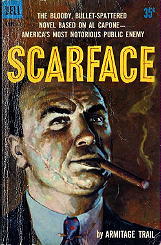
   Please find below a brief biography (well, the only one I have found) on the writer who, as Armitage Trail, wrote the novel Scarface.

   I wonder if anyone has ever done any research to track down the pseudonymous work mentioned in it. I asked Victor Berch who knows little more — apparently he could not even find him in the census for the years he was alive. (Apparently his brother, also difficult to trace in official records, wrote over 20 episodes for the Addams Family [television show] amongst other work).

   Just wonder if he is worth putting in your blog to see if anyone can add to the bio?

Regards

   John Herrington

   Armitage Trail was a pseudonym for the American author Maurice Coons. The son of a theatrical impresario who managed the road tours of the New Orleans Opera Company, and also manufactured furniture and farm silos, Maurice Coons left school at 16 to devote all his time to writing stories. By 17 or 18, he was already selling stories to magazines. By his early twenties he was writing whole issues of various detective-story magazines under a great assortment of various names. And at 28 — after going to New York to write more stories, and from there to Hollywood to write movies — he dropped dead of a heart attack at the downtown Paramount Theatre in Los Angeles.

   At the time of his death, he weighed 315 pounds, had a flowing brown moustache, and wore Barrymore-brim Borsalina hats. He was survived by his brother, humorous writer Hannibal Coons.

Scarface

   Maurice Coons gathered the elements for Scarface when living in Chicago, where he became acquainted with many local Sicilian gangs. For a couple of years, Coons spent most of his nights prowling Chicago’s gangland with his friend, a lawyer, and spent his days sitting in the sun room of his Oak Park apartment writing Scarface. He never did meet Al Capone, who was the inspiration for his immortal character, though Capone was very much alive when his book was published.

   When Howard Hughes was making plans to produce the movie, Coons wanted Edward G. Robinson to play the leading role because of his resemblance to Capone but being Hollywood, it ended up with Paul [Muni] playing Scarface, a different-looking sort of man altogether. The author did not live to see the picture, but Al Capone did, and screenwriter Ben Hecht had to talk fast to convince his henchmen that Scarface was not based on him. Scarface was also made into a film in 1983, directed by Brian de Palma and starring AI Pacino. Armitage Trail’s only other surviving novel is The Thirteenth Guest ( 1929). Both his novels prefigure the birth of hard-boiled fiction and Black Mask magazine.

***

   From Crime Fiction IV, by Allen J. Hubin:

COONS, MAURICE (1902-1930); see pseudonym Armitage Trail.

TRAIL, ARMITAGE; pseudonym of Maurice Coons.

   * * Scarface (Clode, 1930, hc) [Chicago, IL] Long, 1931. Film: United Artists, 1932 (scw: Fred Palsey, W. R. Burnett, John Lee Mahin, Seton I. Miller, Ben Hecht; dir: Howard Hawks). Also: Universal, 1983 (scw: Oliver Stone; dir: Brian De Palma).

   * * The Thirteenth Guest (Whitman, 1929, hc) Film: Monogram, 1932 (scw: Francis Hyland, Arthur Hoerl, Armitage Trail; dir: Albert Ray). Also: Monogram, 1943, as Mystery of the Thirteenth Guest (scw: Charles Marlon, Tim Ryan, Arthur Hoerl; dir: William Beaudine).

   I’m always on the lookout for previously unknown and/or unidentified private eyes, the fictional variety. Kevin Burton Smith keeps a pretty good list on his Thrilling Detective website, but he doesn’t have them all. I’ve helped in adding a few, and I thought I had another one when I came across the books of Bernard Bannerman, who chronicled the adventures of one Dave Woolf, a London-based PI about whom I’ll tell you more in a minute.

   It turns out, however, that Kevin has heard of Dave Woolf. He’s listed as a PI on his website, but only by name. There’s no page there for him, yet.

   Here’s what Bannerman’s entry looks like in Crime Fiction IV, by Allen J. Hubin:

   BANNERMAN, BERNARD; pseudonym of Andrew Arden (1948- )

      * Controlling Interest (n.) Sphere 1989 [Dave Woolf; London]
      * The Last Wednesday (n.) Sphere 1989 [Dave Woolf; London]
      * The Judge’s Song (n.) Sphere 1991 [Dave Woolf; London]
      * Orbach’s Judgment (n.) Sphere 1991 [Dave Woolf; London]

   Under his own name, Andrew Arden has one mystery novel to his credit:

   ARDEN, ANDREW (1948- ); see pseudonym Bernard Bannerman

      * The Motive Not the Deed (n.) Talmy Franklin 1975 [London]

   I don’t know anything about this book, but from the Internet, I have learned more about the author himself. Taken from his website:

   Andrew Arden Q.C. has established himself as one of the leading authors on housing and local government law, editing or authoring several leading and authoritative texts in this area. In addition to materials written for practitioners, he has also written several texts designed as a more general introduction to these areas of law.

   Fiction — the novels which appeared under his own name:

      * The Motive Not The Deed, 1974
      * No Certain Roof, 1984 [Landlord of working-class family wants to turn their house into flats.]
      * The Object Man, 1987
      * The Programme, 2001 [A law firm gets mixed up with a quasi-religious cult.]

   If you may have gotten the feeling that legal matters have something to do with the cases that Dave Woolf works on, you’d be right. I hasten to add that I’ve not read any of them yet, but I’ve recently put together a complete set of his adventures, as told by Bernard Bannerman.

   Each of the first two books mentions the other as a selling point, so perhaps they came out at the same time. But one has a lower publisher’s number than the other, so I’ll go with that one as the first of the two. (The same is true for the second pair of books.)

   Quoting from the back cover of each of the books:

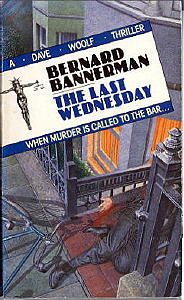
THE LAST WEDNESDAY. Sphere 0382, pbo, 1989.

The Last Wednesday

   No one falls out as viciously, as painfully or as messily as lawyers. Jack Nicholas, left-wing barrister, was supposed to have died in an accident. Drunk, said the coroner. Murdered, said his mother. Enter Dave Woolf, ex-solicitor, boozer and down-at-heel private eye.

   Even before Woolf starts asking questions, he finds that he is investigating not one death, but the wholesale despatch of Jack Nicolas’ erstwhile colleagues. There is very little for Woolf to go on – as he treks through the glitz and sleaze of London, through France and Norway in search of an elusive German – other than the apparent coincidence that all the deaths had occurred on the last Wednesday of every month.

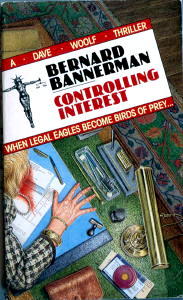
CONTROLLING INTEREST. Sphere 0383, pbo, 1989.

Controlling Interest

   “The body of a woman solicitor was discovered by staff arriving yesterday morning at the Holborn offices of the prestigious London solicitors, Mather’s. Katrina Parkhurst, 32, has been shot. Police are investigating.”

   A murder on the premises is bad news for a law firm. It discourages clients. It also discourages recruits which is damaging to a firm like Mather’s with a reputation, a lot of clients, but very few partners. But, as Dave Woolf, one-time lawyer, part-time boozer and (almost) full-time private eye realizes, a thorough professional would prefer a murder to a leak any day of the week. Dead men can’t leak information on gambling debts, treachery, the darker side of freemasonry, and a dodgy business dating back forty years …

THE JUDGE’S SONG. Sphere 0520, pbo, 1991.

The Judge's Song

   It was, as Dave Woolf said, “the sort of thing that doesn’t happen in England.” High-count corruption, gangsters, fire-bombs and a bit of murder on the side – all of it against the backdrop of a family drama raging through London, the West Country and the South of France.

   It’s not the sort of thing that solicitors ought to be investigating. But Woolf is not ordinary solicitor. Back in the legal fold after a spell as a private eye, he’s roped into a spot of detection for the usual reason – an irresistible fee. Sustained by hefty slugs of Southern Comfort, Camels and his new Aussie sidekick, he’s ready to haul a few skeletons out of family cupboards. The trouble is, they’re still alive …

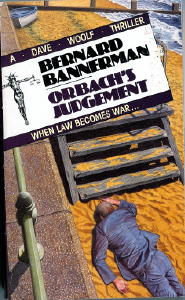
ORBACH’S JUDGEMENT. Sphere 0521, pbo, 1991.

Orbach's Judgement

   Dave Woolf, solicitor and private eye, has had respectability thrust upon him. He’s also been saddled with the most sensational case of his career.

   High Court Judge Sir Russell Orbach is a pillar of the establishment and a doting guardian to the orphaned Frankie. In public, that is. In private, according to Frankie’s famous half-sister, he’s a murderer. What’s more, she’s going to say so n her forthcoming autobiography. Would Woolf, asked the petrified publisher, check up on this bizarre accusation?

   It’s just up Woolf’s street; he specialises in investigating the misconduct of members of the legal profession. It’s sometimes like biting the hand that feeds you; but when that hand is adept at bullying, blackmail and bundling bodies into the ocean, it’s Woolf who’s in danger of being bitten … and badly.

Comments: First of all, I do like that last line. Secondly, as I mentioned earlier, I’ve not read these, but I have skimmed through them. Not well enough, I admit, to identify Woolf’s new Aussie sidekick in The Judge’s Song, but enough to know that these are books that are not likely ever to be published in the US, a country whose inhabitants have no idea what a solicitor is, nor how he or she is different from a barrister.

   My impression is, and I could be wrong, is that these books are like the rough-and-tumble adventures of Jonathan Gash’s Lovejoy capers, only with a backdrop of courtroom drama and stodgy legal wrangling rather than the much more dodgy antiques business. More reliable input would be welcome.

LIGHTS, CAMERA, MURDER – John Shepherd.

Belmont 215, paperback original, 1960.

   This book is advertised on the front cover as “a new Bill Lennox mystery – over 1,000,000 copies sold.” That might have puzzled many a would-be buyer, trying to think back as to when he’d seen a book by John Shepherd before. And to tell you the truth, he wouldn’t have, as this was the first book that John Shepherd ever wrote.
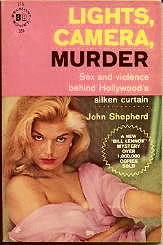
Lights, Camera, Murder

   I’d better take that back. John Shepherd is a common enough name that it could have easily been the byline of plenty of books. In the interest of utmost accuracy, I’ll rephrase what I just said. This was the first mystery that any John Shepherd ever wrote.

   What about Bill Lennox? Was he a mystery character who’d be immediately recognized as a hot sales commodity in 1960? He could have been, but if you’d like my best guess, probably not. Bill Lennox had last appeared in mystery form a mere six years before, in a book called Dealing Out Death, published as a paperback reprint in 1954 by an obscure company called Graphic Books. The byline? Not John Shepherd. The byline for Dealing Out Death was W. T. Ballard. It would have taken a lot of rather esoteric knowledge on the part of a would-be buyer before this book would have snapped up off the newsstand on the basis of this particular sales pitch.

   Of course, maybe you know all of this, and I’m berating the unberatable, not now, not almost 50 years later. (And by the way, my spell-checker doesn’t know that word either.) Both Bill Lennox and W. T. Ballard have come up for discussion here on the Mystery*File blog not too long ago, mostly, as you’ll recall, in relation to his pulp magazine appearances in Black Mask between 1933 and 1942.

   As mentioned then, but it’s worth repeating now, when he stopped writing about him for the pulp fiction magazines, Ballard took his character over to book-length hardcover cases, but unlike Erle Stanley Gardner, neither he nor Bill Lennox managed to succeed very well in making the transition. While putting together a more comprehensive, detailed list of the books that Bill Lennox, the Hollywood trouble-shooter, appeared in, I decided to go all out and using Al Hubin’s Crime Fiction IV as a guide, come up with a list of all of Ballard’s crime fiction in book length form:

The Bill Lennox books:

      Say Yes to Murder. Putnam, 1942. Penguin 566, pb, October 1945. Reprinted as The Demise of a Louse, as by John Shepherd. Belmont 91-248, pb, 1962.
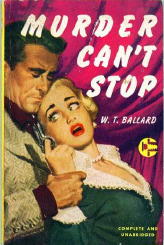
      Murder Can’t Stop. McKay. 1946. Graphic #26, pb, 1950.

Murder Can't Stop

      Dealing Out Death. McKay, 1948. Graphic #72, pb, 1954.
      Lights, Camera, Murder, as by John Shepherd. Belmont 215, pbo, 1960.

The Tony Costaine/Bert McCall books, as by Neil MacNeil:

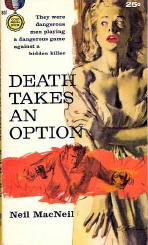
      Death Takes an Option. Gold Medal 807, pbo, September 1958.

Death Takes an Option

      Third on a Seesaw. Gold Medal s844, pbo, January 1959.
      Two Guns for Hire. Gold Medal s898, pbo, July 1959.
      Hot Dam. Gold Medal 964, pbo, January 1960.
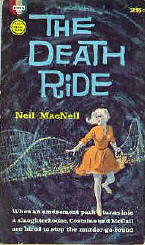
      The Death Ride. Gold Medal 1005, pbo, November 1960.

The Death Ride

      Mexican Slay Ride. Gold Medal s1182, pbo, January 1962.
      The Spy Catchers. Gold Medal d1658, pbo, 1966.

The Lt. Max Hunter books:

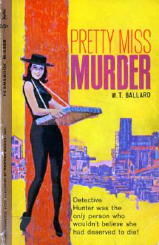
      Pretty Miss Murder. Permabook M-4228, pbo, December 1961.

Pretty Miss Murder

      The Seven Sisters. Permabook M-4258, pbo, October 1962.
      Three for the Money. Permabook M-4297, pbo, November 1963.

Non-series books:

      Murder Picks the Jury, as by Harrison Hunt. [Co-written with Norbert Davis.] Samuel Curl/Mystery House, 1947.
      Walk in Fear. Gold Medal 259, pbo, September 1952. [Based on “I Could Kill You,” a story that appeared in The Shadow magazine in 1948.]
      Chance Elson. Cardinal C-277; pbo, November 1958.
      Age of the Junkman, as by P. D. Ballard. Gold Medal d1352, pbo, 1963.
      End of a Millionaire, as by P. D. Ballard. Gold Medal d1486, pbo, 1964.
      Murder Las Vegas Style. Tower 42-778, pbo, 1967.
      Brothers in Blood, as by P.D. Ballard. Gold Medal T2563, pbo, 1972.
      The Kremlin File, as by Nick Carter. Award AN1165, pbo, 1973.
      The Death Brokers, as by P.D. Ballard. Gold Medal M2867, pbo, 1973.

   After World War II, W. T. Ballard seems to have been more successful in writing westerns than he was with his mystery fiction, but I haven’t taken the time to do any research in that particular direction. And this review is nominally of Lights, Camera, Murder, so let’s get back to that, shall we?

   Sadly to say, however, and I’ll say this upfront, this is a book that’s little more than ordinary, and in some ways less. It is, after all, as Bill Pronzini has pointed out to me, a book that was published under a never-before-used pseudonym and put out by a second-rate publisher. On the other hand, I read the book all the way through, and I can’t say that about every book I pick up to read.

   The greatest appeal this book probably has today is to completists: those who want every Bill Lennox story there is to read; or those who want every novel that W. T. Ballard wrote; or simply those who collect everything that Belmont ever published. (These completists have been arranged in order of decreased (although not negligible) likelihood. My spell-checker doesn’t recognize the word completist either, but we know you’re out there, don’t we?)

   To begin at the beginning, though, the story begins when Lennox is called upon to salvage a movie that’s in production down in Mexico, where one of the leading male stars has been found knifed to death in his room. The leading female star is in jail for the crime, having been seen leaving his room quietly the night before. This is the kind of disastrous situation in which a legendary trouble-shooter is always called upon to save the day, and quickly.
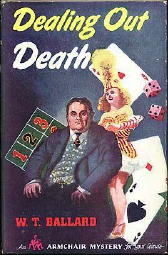
Dealing Out Death

   In quick order we are re-introduced to Sol Spurk, the head of the studio and the only man that Lennox reports to. In the pulp stories, though, I am sure he spelled his last name as Spurck, and sure enough, on page 97, it is spelled that way too. We also meet Lennox’s steady girl friend, a movie columnist named Nancy Hobbs, although very briefly. Their relationship is a loose one, meaning that neither places any restrictions on the other.

   Which is a good thing, one realizes quickly on, as Lennox does not offer much resistance, first of all, to the leading star (Sylvia Armstrong) who is in jail for the crime she did not commit, or so she says, even though she was seen leaving his room during the night the murder was committed. Since she is in essence a victim of nymphomania, perhaps what she says may not entirely be the truth, even though the dead man was said to be homosexual.

   But it is the beautiful and unsullied Candy Kyle, new to motion pictures, motion picture making and motion picture people, whom Lennox finds himself falling for. On her part, she serves as his assistant in crime-solving by keeping tabs of people, knowing where they are or should be, being shot at together, and being rammed on the open sea by power craft together.

   This is, as you fully well realize, the way that bad guys have of warning detectives off. It is also the approach which of course never works, even with high rolling gamblers and drug kingpins calling the shots, and is rather typical of the clichés and not-very-involving story line that ensue as soon as Lennox crosses the Mexican border.

   Lennox’s past, which began back in 1933, as you may recall, has been updated into the TV era and the age of beatnicks (sic) and the aforementioned drug-pushing industry. On page five, past history irregardless, it is said that he has had a ten year’s tenure working for Spurk. The usual time compression procedure is at play here, and don’t get me wrong. It’s happened to the best of fictional detectives, from Perry Mason, Hercule Poirot on down, though perhaps their creators were less blatant about it.

   The plot itself is not very interesting, as I suggested before. If anything, I was more interested in the players themselves. Even though some come from solid stock companies, some, including Lennox, came to life, including Candy Kyle, and some more than others.

   Speaking of which, the ending is a wowser, one of those endings that really make you wonder what is going to happen next. Except, of course, there was no “next.” This is all he wrote.

— June 2007
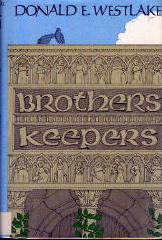
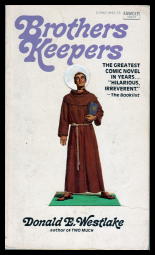
DONALD E. WESTLAKE – Brothers Keepers

Fawcett Crest 2-2962; paperback reprint, no date stated. Hardcover edition: M. Evans & Co., 1975. Later paperback edition: Mysterious Press, 1993.

Brothers Keepers

   Donald Westlake has written a long list of crime and mystery fiction over his writing career, all of the books avidly read and well celebrated. He’s well regarded for his comic novels too, and sometimes his crime fiction and his comic novels are one and the same. Not so this time. Even though I’m reviewing Brothers Keepers here on Mystery*File, and wickedly funny it is indeed, it’s a stretch to call it crime fiction in any shape, whatsit or form. You really have to hunt to find anything truly criminous in it all all. Al Hubin in Crime Fiction IV agrees with me, marking the title with a dash in front, indicating that it’s only marginally crime-related.

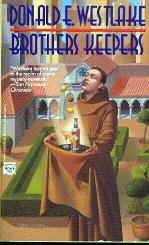
   For the basic plot line, I’m going to quote from the back cover of the Mysterious Press paperback. The book from Crest is actually closer at hand, since it happens to be the one I read, but I think the story is summarized a whole lot better in this later edition:

    “Bless me, Father, for I have sinned,” confessed Brother Benedict of Manhattan’s Crispinite Order. And that was before the 19-year lease on the order’s Park Avenue monastery had expired, pitting its sixteen monks against a greedy real-estate mogul who could quote scripture like a pro. And that was before Brother Benedict fell head-over-heels in love with the greedy landlord’s daughter. Suddenly, from Midtown to the Caribbean, Brother Benedict has to play detective and ladies’ man in the noisy, profane and inexplicable world outside the monastery. And Brother Benedict had better not trip on his robe. Because, although he’s trying to save a house of God, all hell is about to break loose.

Brothers Keepers

   There’s some exaggeration there in the last line, I’m sorry to say, all the more to sell books, I’m sure, but the rest is fairly well on the mark. The only crime, as far as I could see, occurs on page 139, when the Brothers learn to their dismay that the lease to their monastery, the one that will prevent them from being evicted has been stolen. Was it an inside job? Or has someone managed to infiltrate the monastery without anyone noticing? Good questions, both.

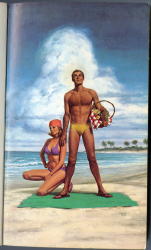
   As a purely personal matter, Brother Benedict may sin against God in this book, but his sins generally fall below the standard of being a crime, lust (for Mrs. Bone, the landlord’s divorced daughter) being not generally being a prosecutable offense in most courts of the land. Please note the outer cover of the Crest paperback (with the cutout hole part of the manufacture) versus the inner illustration behind. You may have a lot of sympathy for Brother Benedict’s anguish.

Brothers Keepers (inset)

   Quoting would be a good idea once again, I believe. From page 107 this time, as Brother Benedict, who tells the story, is taking his first ride in an automobile in ten years:

    … Mrs. Bone, of course, was exactly like the girls usually filmed with these cars on television.

    A red light at Sixth Avenue. The car stopped, Mrs. Bone glanced at me again, and by God I was looking at her, no doubt with the same equivocal expression as before. And I had been trying to think about the car.

    She frowned at me. “How long have you been a monk?”

    “Ten years.”

   The light changed; she spun the wheel and we turned right onto Sixth Avenue. “Well,” she said, “that’s either too long or not long enough.”

   I see Gina Gershon in the part. Maybe Matt Damon as Brother Benedict, although I haven’t thought about that half of the casting anywhere near long enough. A better name may come to me later.

   I didn’t keep an exact count, but I’d estimate that this book averages a laugh-out-loud guffaw every six pages. This includes Brother Oliver’s comment about an edifice complex on page 68. This may not seem to you like a very high ratio, but considering all of the smiles and grins in between, and the fact that most books do not have a laugh-out-loud cause for guffaw anywhere in them at all, and I think you might pause to reconsider, and rightfully so.

   In Pity Him Afterwards, a book by Mr. Westlake which I reviewed some time back, he showed me that he knows his way around a summer playhouse with the ease of one who’s been around one often, and on the inside. The same is true, as difficult as it may to believe, of Mr. Westlake and monasteries. Of course I’ve never been in one or part of one, and maybe I’m easily convinced, but if verisimilitude is what you’re looking for, as far as the settings where the books you read take place, this one has it, and in a bushel full.

Brothers Keepers

   The only part of this small affair – but a huge one for the monks involved, who are almost totally ignorant of the ways of the outside world – that I am a little hesitant about recommending outright is the ending, which didn’t go in the direction I was thinking that it was going to go. But it’s still a terrific ending – I just read it again, and it certainly works for me.

   What the heck. Forget my quibble. Let’s call it an outright recommendation. For a partially irreverent view of religion and the outside world of high finance as well, tossing in a bit of angst-filled bawdiness to boot, this is book that will challenge all comers, crime fiction or no.

— March 2007

   I don’t know if you know this, but I collect gothic romances. Nobody’s publishing them today. They’re dead in the water as far as today’s publishing world is concerned, as dead as can be, but from the mid-60s on into the later 1970s, they were as hot a category in bookstores and newsstands across the country as anything you can imagine, except for Harry Potter.

   In the later 70s, the so-called bodice-ripper romances began to take over, and the gothics, which themselves on occasion verged into the supernatural, either continued on in that direction into occult fiction of various kinds, eventually becoming the very popular paranormal romances of today, complete with vampires, werewolves and all kinds of sexy shape-changers. Or, to continue on with the “either” in the preceding sentence, they became novels of romantic suspense, still very much a common category today.

   I recently had the opportunity, while striving to “clean out” my basement, to go through a box of gothic romances I have – the ones having covers with a girl in the foreground and a spooky house in the background with a light on in a second story window – in order to add anything I find that’s new to add to Al Hubin’s Addenda for Crime Fiction IV. Most of these additions are in the form of previously unknown settings, but once in a while a brand new previously unknown title comes to fore, as happens once in the ten titles below.

   All of this data is in Part 16 of the ongoing Addenda, which I’ve just uploaded this afternoon. As for Al, he’s still working and Part 17 is well under way. But please take a special look at the covers, if you would. I’m sorry they’re small enough that you can’t make out all of the details, but for variations on a theme, you probably couldn’t ask for much more than this, from a small sample of size ten.

JAN ALEXANDER. The Glass House. Add setting: Cape Breton Island (Nova Scotia)

Jan Alexander

LOUISE BERGSTROM. The Pink Camillia. Add setting: Washington state (San Juan Islands)

Louise Bergstrom

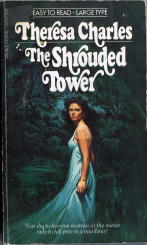
THERESA CHARLES. The Man for Me. U.S. title: The Shrouded Tower. Ace, 1966. Add setting: England.

Theresa Charles

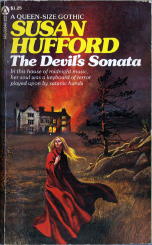
SUSAN HUFFORD. The Devil’s Sonata. Add setting: Massachusetts [South Egremont].

Susan Hufford

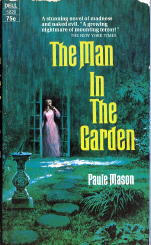
PAULE MASON. The Shadow. US title: The Man in the Garden. Add setting: London (England).

Paule Mason

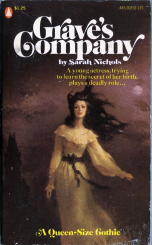
SARAH NICHOLS. ADD: Grave’s Company. Popular Library, pbo, 1975. Setting: Ohio; past.

Sarah Nichols

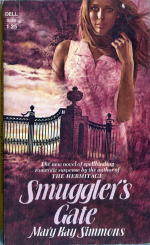
MARY KAY SIMMONS. Smuggler’s Gate. Add setting: Maine.

Mary Kay Simmons

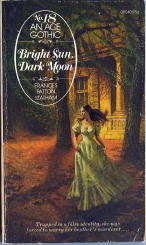
FRANCES PATTON STATHAM. Bright Star, Dark Moon. Note: Author’s full name is used on this book. Add setting: South Carolina (Charleston); 1883.

Frances Patton Statham

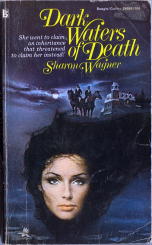
SHARON WAGNER. Dark Waters of Death. Add setting: Montana.

Sharon Wagner

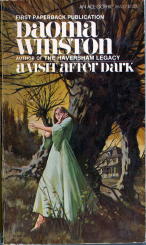
DAOMA WINSTON. A Visit After Dark. Add setting: Texas.

Daoma Winston

   Following up on the entry posted earlier here on Olive Harper, a lady who specialized in novelizing mystery plays around the beginning of last century, Victor Berch has made some revisions, corrections and additions to the previous list of books she wrote. None of these changes are major, but all of them are essential.

Trunk

   Many of these novelizations are, of course, included in Al Hubin’s Crime Fiction IV, but the true origins of these stories were not known for most of them when CFIV came out. This new entry for Olive Harper will show up shortly in the ongoing Addenda to the Revised Crime Fiction IV.

   The changes have been made in the previous blog entry, which you can see by following the link above. Victor also sent along another ten or twelve more cover images, some of which you see here, but there are simply too many of them for small blog entries like this one. So what I’ve done is to create a new separate page on the original Mystery*File website page, one that’s large enough to hold them all, along with the newly revisions.

Desperate Chance

   Take a look now, if you would, at www.mysteryfile.com/Harper/Compleat.html. It’s as complete now as we can get it. So far.

[UPDATE] 06-28-07. This didn’t take long, did it? Victor’s found two more cover images, and I’ve just uploaded them both to The Compleat OLIVE HARPER webpage. (See the link in the last paragraph above.)

   I don’t know about you, but whenever I come home from a book-hunting expedition and start going through my finds and come across an author I’ve never heard of before, I immediately go to Al Hubin’s Crime Fiction IV to see what other mystery fiction he might have done.

   Case in point. George Adams, whose entry in CFIV looks like this:

   ADAMS, GEORGE (1936- )
       * Swindle (Pocket Books, 1989, pb) [Charlie Byrne; New York City, NY]
       * Insider’s Price (Pocket Books, 1993, pb) [Charlie Byrne; New York City, NY]

   The book I bought while on the road was his first one, Swindle, and thanks to the Internet, it wasn’t too difficult to find his other one. Nor was it too expensive. I don’t think the demand is very high, but let’s see if I can’t do something about that. Maybe I’ll succeed, and maybe I won’t, but it’s worth a try.

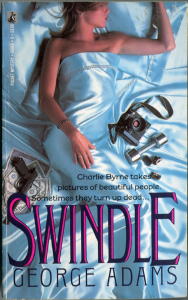
Swindle. Pocket, paperback original; 1st printing, February 1989.

Swindle, George Adams

From the back cover:

         THE CAMERA NEVER LIES …

   Charlie is a high-fashion photographer, part-time bicycle racer and a full-time lover. Manhattan is his playground. But when his sexy stylist loses $50,000 to a phony investment scheme. Charlie makes his first mistake. With the help of an out-of-work actor and a very busy hustler he sets out to scam the scammer – and get the money back. Instead, he finds a money-mad netherworld of insider trading, wiseguys, murder and sex, and there’s no telling the good guys from the bad … A gorgeous woman and a Wall Street wizard are the heavy hitters in a ruthless game to separate New York’s most beautiful people from their money. Charlie Byrne has wandered right into the middle of a nightmare that could only happen in New York – and getting out will be as simple as staying alive.

About the author:

   Like his hero, Charlie Byrne, George Adams is a well-known New York advertising photographer who can be found racing his bike in Central Park on Sundays. Unlike Charlie, he almost always finishes the New York Times crossword puzzle. Adams’ work appears on the front cover of this book.

Review excerpt: [Chicago Sun-Times] “A page turner with lots of twists and turns, flesh-and-blood characterizations, and swift and rhythmic prose. It’s hard to believe Swindle is a first novel.”

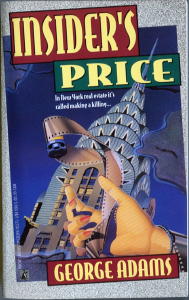
Insider’s Price. Pocket, paperback original; 1st printing, September 1993.

Insider's Price

From the back cover:

         THE ART OF THE STEAL

   High-fashion photographer Charlie Byrne heads from his humble midtown digs to the Upper East Side when old acquaintance JoJo Cyzeski – now Josephine – hires him to shoot a priceless Aubusson tapestry. The tapestry, and the fabulous co-op, belong to Marc Ransom, megabucks New York real estate developer and legendary ladykiller. But a darker side to the glittering world develops when the shoot is short-circuiited by a blackout and an apparent suicide in the adjoining courtyard. That’s when Charlie meets the gorgeous sister of the dead woman, who leads him into the gilded precincts of real estate royalty, where doing business can be murder….

   From a terrifying Times Square fleabag hotel to a penthouse bought with drop-dead deals, from the homeless woman camped in his doorway to the bevy of beauties in Ransom’s collection, Charlie follows clues to the suspect suicide and lands on the bottom line of the New York real estate game – where monopoly is played for keeps.

From inside the front cover:

       IF THE STAIRWELL WAS A GOOD PLACE TO GET MUGGED, THE ELEVATOR WAS EVEN BETTER …

   I leaned on the button continuously. “Come on,” I pleaded.

   A woman’s scream pierced the ambient sound of TV’s and ghetto blasters. “He’s an old man, leave him alone!” Smack! Then a baby was bawling.

   Tito and I swapped looks. We bolted down the corridor. A spindly black girl, a bawling child on her hip, sobbed into her hand. Four goons were working someone over.

   Tito leveled the Nikon to his eye and fired. They froze like statues. The flash etched them on my retina. One was Angel. The bandaged one was James. The other two were strangers. An old man was lying on the floor.

   “Yo, James, lookee ’ere.” Angel grinned, his vision clearing.

   One of them flicked open a switchblade. The four of them advanced.

   Tito and I began backpedaling. I sighted my camera and let them have a blast of strobe. The flashes took forty seconds to recharge, an eternity. We’d shot our load …

   “Get ’em,” Angel barked …

   Although I’m not sure what the first book was which “novelized” a movie, I know that it’s not a recent innovation, and in fact the idea is even older than that. Even before movies came along, around the turn of last century, what audiences took a good deal of pleasure in watching were plays in live performance, many of them mysteries, and would you believe, these plays were often novelized.

   This is hardly a formal article on the subject. It’s too early for that. Very little has been written about the novelizations of plays, and it’s obvious a much longer piece is needed to say everything there is to say. From what Victor Berch has told me, though, at the end of the 19th century and into the first part of the next, there were three or four publishing houses that specialized in such works of fiction, and there may have been more. The most prolific of these was the J. S. Ogilvie Publishing Company, of New York. Street & Smith did some, Victor says, and I. & M. Ottenheimer of Philadelphia did some as well.

   One of the authors who specialized herself in turning plays into novels, usually in softcover form, was the pseudonymous Olive Harper, whose entry in Crime Fiction IV, by Allen J. Hubin, Victor has recently revised and which you’ll see below.

   This information will also show up soon in an upcoming Addenda to the Revised CFIV. Victor has sent me cover images for four of this books, and perhaps – just maybe – the titles themselves will be enough to start you off in a new direction for your mystery collecting activities.

   Warning: The books below are not easily found. While not expensive, generally under $20 each, only a handful of the titles below could be found by taking a quick look on www.abebooks.com. A few of the author’s non-mystery novelizations and translations show up also, but at the present time, only four of them are mysteries (not, as I recall, the same four that are shown below).

HARPER, OLIVE, pseud. of HELEN BURRELL GIBSON D’APERY, 1842-1915
Bertha, the Sewing Machine Girl (Ogilvie, 1906, pb) Novelization of play in 4 acts by Theodore Kremer [New York City]. Silent film: Fox Film Corp., 1926 (scw: Gertrude Orr; dir.: Irving Cummings)

The Burglar and the Lady (Ogilvie, 1912, pb) Novelization of play in 4 acts by [Arthur] Langdon McCormick. Silent film: Sun Photoplay, 1915 (scw: [Arthur] Langdon McCormick; dir.:Herbert Blache).

*Caught in Mid-Ocean (Ogilvie, 1911, pb) Novelization of play in 4 acts by Arthur J[ohn] Lamb. [London, ship]

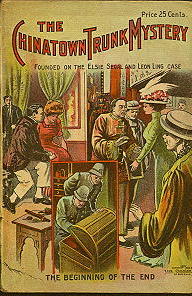
*The Chinatown Trunk Mystery (Ogilvie, 1909, pb) Novelization of play in 4 acts by Owen Davis. [New York City]

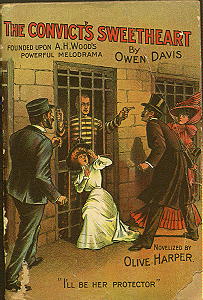
The Convict’s Sweetheart (Ogilvie, 1909, pb) Novelization of play in 4 acts by Owen Davis [Colorado]

The Convict's Sweetheart

The Creole Slave’s Revenge (Ogilvie, 1908, pb) Novelization of play in 4 acts by Walter Lawrence, pseud. of Owen Davis [Louisiana]

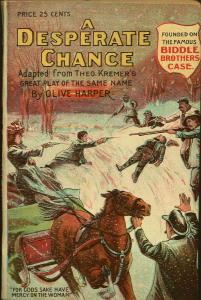
*The Desperate Chance (Ogilvie, 1903, pb) Novelization of play in 4 acts by Theodore Kremer

Fighting Bill, Sheriff of Silver Creek (Ogilvie, 1907, pb) Novelization of play in 4 acts [California]

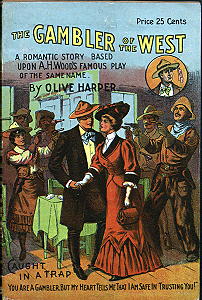
The Gambler of the West (Ogilvie, 1906, pb) Novelization of play in 4 acts by Owen Davis

Gambler of the West

It’s Never Too Late to Mend (Ogilvie, 1907, pb) Novelization of the 4-act play It’s Never Too Late to Mend; or, The Wanderer’s Return by Owen Davis [New York City]

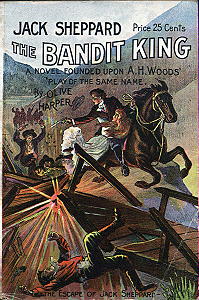
Jack Sheppard, the Bandit King; or, From the Cradle to the Grave (Ogilvie, 1908, pb) Novelization of play in 4 acts by Owen Davis [California]

Jack Sheppard

King of the Bigamists (Ogilvie, 1909, pb) Novelization of play in 4 acts by Theodore Kremer

The Millionaire and the Policeman’s Wife (Ogilvie, 1908, pb) Novelization of play in 4 acts by Owen Davis [New York City]

* A Millionaire’s Revenge (Ogilvie, 1906, pb) Novelization of play in 4 acts by [James] Hal[leck]
Reid [New York City]

On Trial for His Life (Ogilvie, 1908, pb) Novelization of play in 4 acts by Owen Davis [West]

The Opium Smugglers of Frisco; or, The Crime of a Beautiful Opium Fiend (Ogilvie, 1908, pb) Novelization of play in 4 acts by Owen Davis [San Francisco]

The Queen of the Outlaw’s Camp (Ogilvie, 1909, pb) Novelization of play in 4 acts by Edward M. Simonds [Colorado]

The Queen of the Secret Seven (Ogilvie, 1909, pb) Novelization of play in 4 acts by Ike Swift, pseudonym of Owen Davis [New York City]

The River Pirates (Ogilvie, 1909, pb) Novelization of play in 4 acts by Walter Lawrence, pseud. of Owen Davis. [New York City]

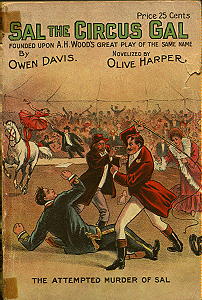
Sal, the Circus Gal (Ogilvie, 1909, pb) Novelization of play in 4 acts by Owen Davis [Chicago]

Sal, the Circus Gal

The Shadow Behind the Throne (Ogilvie, 1908, pb) Novelization of play in 5 acts by Alicia Ramsay and Rudolph de Cordova

The Shoemaker (Ogilvie, 1907, pb) Novelization of play in 4 acts by [James] Hal[leck] Reid [New York City, Wyoming]

A Slave of the Mill (Ogilvie, 1905, pb) Novelization of play in 4 acts by [James] Hal[leck] Reid and Harry Gordon

Tony, the Bootblack (Ogilvie, 1907, pb) Novelization of the 4 act play Tony the Bootblack; or, Tracking the Black Hand Band by Owen Davis [New York City, Italy]

Wanted by the Police (Ogilvie, 1909, pb) Novelization of play in 4 acts by [Arthur ] Langdon McCormick [New York City]

      * Based on true crimes.

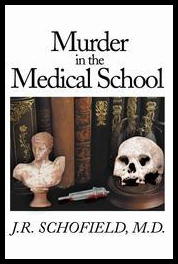
   Al Hubin and I are convinced that we have correctly identified the author of Murder in the Medical School (iUniverse/Writer’s Club Press, December 2000), as Dr. James Roy Schofield, who died on May 20th, 2007.

   The reason I’ve phrased that opening paragraph the way I have is on the page where the book is for sale on Amazom.com, the author is said to be Jill R. Schofield, M. D. The latter name is also somehow connected with the ISBN number, since at least half of the sellers on ABE have entered it that way, also referring to the author as Jill. A check on Google uncovers a Dr. Jill Schofield with a practice in Aurora CO.

   On the other hand, and even more convincing, is Dr. James Roy Schofield’s Who’s Who entry, and his book, a mystery novel which just managed to make the end of 2000 deadline for inclusion in Crime Fiction IV, is definitely mentioned, along with some other data about him.

   Born July 12, 1923, Dr. Schofield received his MD from Baylor University in 1947 and a LLD from Queens University in Ontario, Canada, in 1988. As an educator, he was a member of the faculty of the Baylor University College of Medicine from 1947 to 1971, eventually becoming its Academic Dean. After leaving Baylor, he worked for many national medical associations, including the AMA, as a consultant on medical education.

Murder at Medical School

   All of which certainly means that the background for his mystery novel was authentic. Here’s a description of the book, as taken from the back cover:

   A particularly gruesome murder occurs in the Anatomy Department of a 1950’s medical school. Included is a graphic description of anatomical and pathological specimens in the Anatomists’ cadaver preparation room.

   The novel begins with preparations by the Anatomists to prepare a teaching exhibit of human structures in one-inch cross-sections of a human cadaver.

   The medical school is expanding into new clinical departments; recruitment of several departmental Chairs is described – showing the quite variable characteristics of several clinical specialists.

   The narrator describes life in and problems of the medical school. The reader can follow selection of new medical students, academic disputations about the M.D. curriculum behavior of some physicians in private practice, split opinions over the locations of the new charity hospital and a typical M.D. graduation ceremony – with the administration of the ancient Oath of Hippocrates to the graduates. The narration is flavored with references drawn from the History of Medicine.

   Was there a murder? A person on staff of the medical is missing; but no body could be found. The arrival of the missing person’s girl friend triggers the attention of the police; but, until the penultimate chapter, there is no solution until the two young anatomists convince the detective that they have solved the missing body question.

   Not until the Epilogue, is the identity of the murderer revealed, and how he did it.

   Perhaps it was never a bestseller, but more than six years later, Amazon still has copies of Murder in the Medical School in stock. Its sales ranking is #2,521,639, but the number must be put in perspective. Amazon offers well over four million books for sale.

   Vivian (Bernard) Meek came to my attention when one of his books, The Curse of Red Shiva, appeared in the Hillman-Curl line of mysteries, covers of which I’ve been gradually uploading to the Murder at 3 Cents a Day website.

   Mr. Meek was born in 1894 and, as recently discovered by Victor Berch, died in California in 1955. Some short biographical notes online describe him as being an author, engineer and a war correspondent. In the course of these occupations he was also a dedicated world traveler, spending much time in India and the surrounding territory. In addition to his suspense and horror fiction, for which he is probably best known today, he wrote The People of the Leaves (Philip Allan, UK, 1931; Henry Holt, 1931), an anthropological study of an obscure tribe called the Juang located in Orissa, a sizable state along the east coast of the Indian subcontinent.

***

UPDATE: While waiting for me to complete my commentary on the books themselves, Victor came up with the following additional information on the author:

   Here is some info I picked up from various documents I found, the most informative being the information Meik supplied on his flight to the US for permanent residency here. According to the California Death Index, Meik was born June 21, 1894 and died December 22, 1955. Another database gives his birth date as July 21, 1894, however.

   Supposedly born in Calcutta, India, on the flight information, Meik claims he was born at sea on a British vessel. From another document, his father was a Lorenzo Meik and his mother was Alice Gertrude Thomas Meik. Another document lists his wife’s name as Bernadette Marie Desparadze. Going back to the flight document, the following further information is supplied:

   His flight left Frankfort, Germany June 21, 1947 and arrived in NY on June 22, 1947. His passport was issued June 14, 1947, a week before his 53rd birthday.

      Height: 6 feet
      Complexion: Swarthy
      Last permanent residence: 41 Denman Drive, London
      Occupation: Journalist
      Intention: Permanent residency in US. He was going to stay with an uncle, Francis T. Meik of Salt Lake City, Utah
      Age: 52

   There was no indication that his wife ever joined him. One outstanding feature that he had when he arrived in the US was that he was missing his left eye.

***

   I’m back. I have not located a usable cover scan for this first book, a collection of horror fiction, but the contents are listed in Crime Fiction IV, by Allen J. Hubin, who indicates that some of the stories are also crime-related. Note the slight correction in the title: the apostrophe is correctly after the “s”.

Devils’ Drums (Philip Allan, UK, 1933; Midnight House, US, in preparation, Douglas A. Anderson, editor)

* • An Acre in Hell • ss
* • Devils’ Drums • ss
* • The Doll of Death • nv
* • Domira’s Drum • ss
* • The Honeymoon in Hate • ss
* • L’Amitie Reste • ss
* • The Man Who Sold His Shadow • ss
* • Ra • ss
* • White Man’s Law • ss
* • White Zombie • ss

The volume edited by Doug Anderson will contain three additional stories:

* • Chimoro
* • I Leave It to You
* • The Two Old Women
***

   A second book, also published by Philip Allan in that publisher’s “Creeps series,” is a novel rather than a short story collection; it is nonetheless considered to be a sequel to the preceding one:
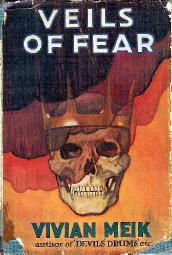
Veils of Fear (Philip Allan, 1934)

Veils of Fear

   The book is not presently included in CFIV, but Bill Pronzini says that in addition to featuring a reporter named Neil Martyn, “There are some homicides and suspense elements but they seem to be pretty much connected to the occult horror theme. Settings range from Port Said to the Far East.”

   On this basis, Al Hubin has indicated that the book will appear in an upcoming Addenda installment to the Revised Crime Fiction IV, but with a dash to indicate that it is only marginally criminous.

   Doug Anderson has more to say about the two books: “While Neil Martyn is the main point of view character, the [returning] series characters in Veils of Fear are Geoffrey Aylett and Padre Jan Vaneken. Both appear, along with others (Peter Verrey; one Vereker, no first name given; and Doctor Strang) in Devils’ Drums (and two – Vereker and Strang – are mentioned in the short story ‘The Two Old Women’.”

***

   The final work of fiction from the pen of Vivian Meik is also the only one which to this date has been published in the US, also a novel:

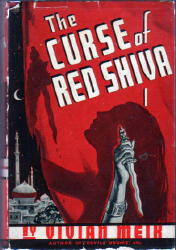
The Curse of the Red Shiva. (Philip Allan, 1936; Hillman-Curl, 1938.)

Curse of Red Shiva

Jacket blurb: Taken from the Hillman-Curl edition.

    “You will gasp for mercy for your children as I have cried for mine, and only the striking blade will be the answer. Behold! By Red Shiva I curse you!” A knife gleamed in her hand as it flashed downward and buried itself in her heart.

    More than a century and a half since those words were uttered by a beautiful Indian slave to Peter Trenton, adventurer …

    But now, after five generations, Sir Peter Trenton was found under Westminster Bridge, brutally murdered, a gold mohur tied around his neck.

    Sir Derek Balliol had guessed the significance of the series of murders – but he was killed before he could speak! Only Verrey was left … and against him were pitted the cunning powers behind the newly-awakened race consciousness of the East.

Review excepts: [Isaac Anderson, New York Times] “This is just the book for those who like tall tales of Oriental intrigue and of menaces to the supremacy of the white race.”

   [Saturday Review of Literature]. “Blood and thunder yarn of slinking Eurasians, renegade whites, stranglings, etc., with reasonably good detective trimmings.”

   [Bill Pronzini, earlier on the Mystery*File blog]. “A Sax Rohmerish adventure mystery with a screwball plot.”

***

Short fiction: [This list, which includes reprint appearances, is probably not complete. Doug Anderson promises that his edition of Devils’ Drums will include a more extensive bibliography as well as additional details of the author’s life, including where and when he lost one eye.]

    * • Chimoro. To be included in the expanded Devils’ Drums. From Doug Anderson: “This is an extract from a chapter of one of his autobiographical volumes, Zambezi Interlude (1932). It reads exactly like one of his stories.”

    * • The Doll of Death. From Devils’ Drums. Reprinted in The Sixth Pan Book of Horror Stories, Herbert van Thal, editor; Pan, pb, 1965. Televised on Night Gallery, NBC, Sunday, May 20, 1973.

    * • A Honeymoon in Hate. From Devils’ Drums. Reprinted in A Wave of Fear, Hugh Lamb, editor; W. H. Allen, 1973; Taplinger, US, hc, 1974.
      — Mikalongwa, Angoniland. English refugees Blair Taylor and Martin Kemp are bitter rivals for the love of the beautiful Estelle. When she decides to marry Taylor, Kemp turns to black magic and drives him to madness and suicide. Estelle avenges her beloved by marrying his murderer, having first infected herself with the blood of a leper. On their wedding night she performs a macabre striptease …

    * • I Leave It to You. From ?? Included in Another Corner Seat Omnibus, Anonymous, editor; Grafton Publications, March 1945. To be included in the expanded Devils’ Drums.

    * • The Two Old Women. From Monsters, A Collection of Uneasy Tales, Charles Birkin, editor. Philip Allan, 1934. Reprinted in The Fourth Pan Book of Horror Stories, Herbert van Thal, editor; Pan, pb, 1963. To be included in the expanded Devils’ Drums.

« Previous PageNext Page »