Crime Fiction IV


DANA CHAMBERS – Rope for an Ape

Jonathan Press Mystery J63; digest-sized paperback; no date stated, but circa 1951. Hardcover edition: The Dial Press, 1947. Previous paperback edition: Bestseller Mystery B-103; abridged; no date stated, but circa 1948.

   Jonathan Press and Bestseller Mysteries were each published by the same company, which was essentially Mercury Press, with Lawrence E. Spivak the actual publisher. Back in the 1940s Mercury Press also published Ellery Queen’s Mystery Magazine, to set a frame of reference, perhaps. I have no idea why this particular book by Dana Chambers was so popular that they did it twice. The books they reprinted are not considered very collectible, since more often than not, many of them were abridged. In this case I read the uncondensed version, and I’m sure I’m far better off for having done so.
Ape-HC

   Since Dana Chambers is all but a brand new author for me, you’ll have to indulge me. Let me check in with Al Hubin’s Crime Fiction IV to see what other mysteries he might have written:

CHAMBERS, DANA; pseudonym of Albert Leffingwell, (1895-1966); other pseudonym Giles Jackson

* Some Day I’ll Kill You (n.) Dial 1939 [Jim Steele; Connecticut]
* Too Like the Lightning (n.) Dial 1939 [Jim Steele; New York City, NY]
* She’ll Be Dead by Morning (n.) Dial 1940 [Jim Steele; New York City, NY]
* The Blonde Died First (n.) Dial 1941 [Jim Steele; Ship]
* The Frightened Man (n.) Dial 1942 [Jim Steele; New York City, NY]
* The Last Secret (n.) Dial 1943 [Jim Steele; New York City, NY]
* Darling, This Is Death (n.) Dial 1945 [Miami, FL]
* The Case of Caroline Animus (n.) Dial 1946 [Jim Steele; Miami, FL]
* Death Against Venus (n.) Dial 1946 [New York]
* Rope for an Ape (n.) Dial 1947 [New York]

** Dear, Dead Woman (n.) Jonathan Press 1948; See: The Case of Caroline Animus (Dial 1946).
** Too Like the Dead (n.) Bestseller 1951; See: Too Like the Lightning (Dial 1939).
** Blood on the Blonde (n.) Jonathan Press 1952; See: Witch’s Moon (Dial 1941), as by Giles Jackson.

LEFFINGWELL, ALBERT (1895-1946); see pseudonyms Dana Chambers & Giles Jackson

* Nine Against New York (n.) Holt 1941 [New York City, NY]

JACKSON, GILES; pseudonym of Albert Leffingwell, (1895-1946); other pseudonym Dana Chambers

* Witch’s Moon (n.) Dial 1941 [Nile Boyd; Connecticut]
* Court of Shadows (n.) Dial 1943 [Nile Boyd; New York City, NY]

   There’s a year of death discrepancy there, I see, but I suspect that 1966 is the one that’s wrong, and that it was really 1946 when he died. If so, that would mean both that Leffingwell died young and that the book in hand was published posthumously. If and when I learn more, I’ll let you know.

   While I have some of the books listed above, I’m almost positive that Rope for an Ape is the first one of them I’ve read. As for who Jim Steele was, I admit I have to cheat and tell you what Bill Crider had to say about him on his blog, where he recently reviewed The Blonde Died First:

   You don’t hear much about Dana Chambers these days. In fact, you don’t hear anything at all, and Chambers isn’t mentioned in any of the reference books I have handy. But in the 1940s, Chambers was a prolific and well-reviewed writer of medium-boiled mysteries. The Blonde Died First is narrated in the first person by Jim Steele, who’s supposedly a successful script writer for radio, though we just have to take his word for it. There’s nothing in the novel to prove it.

   Steele is a series character, and this isn’t his first appearance. I gather that he was a pretty successful spy at one time since he has the Medal of Honor. But in this one, he’s just a guy trying to solve a couple of murders, including that of the blonde of the title. (The title, by the way, is a clue.) Most of the book takes place on a cruise ship, and there’s quite a bit of action, a complicated plot, and Steele’s smooth narration to carry you along. Things get really kinky by the end of the book, surprisingly so, I thought, for a novel published in the 40s, but maybe I’m just naive. I have a couple of other books by Dana Chambers, and I guess it’s time I read them.
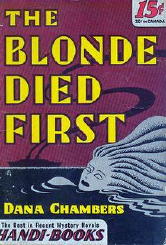
Blonde

   So Jim Steele is a radio writer, is he? Then what’s he doing being listed on Kevin Burton Smith’s master list of private detectives on his Thrilling Detective website? Acting like a PI in all his stories, as a wild and probably not-so-far-off-the-mark guess.

   Jim Steele’s not in this one. Suffice it to say for now that the detective of record is a fellow named Nile Boyd, he has a girl friend named Anna Warriner, and I’ll say more about both of them more in a minute. First, though, what caught my eye was a short sentence on page 65 of this edition to the effect that he and Anne were involved in a case very much like this one “up in Connecticut a while back.” Aha! Here’s a series character appearance that Al Hubin didn’t know about before – see the pair of books written by Chambers as by Giles Jackson listed up there not too long ago.

   Boyd works for the New York Clarion, and now that the war has ended, he’s back from overseas as a war correspondent. Anne, who works for the same newspaper, is nearly twenty years younger than he, and since he’s now on the East Coast and she’s in California visiting her mother, and maybe having a good time out there as well, he’s beginning to worry about how strong the attraction he has on her may actually be.

   He needn’t worry too much, only just a little, as it turns out. As far as the detective puzzle is concerned, the one that Boyd soon finds himself in the middle of, this is one of those wealthy “upper crust affairs” that are the equivalent of the British manor house mysteries that were so common back in the 1920s, 30s and 40s. A well-to-do family is hosting a slew of guests over a long weekend, the only problem being that some of them starting to turn up dead.
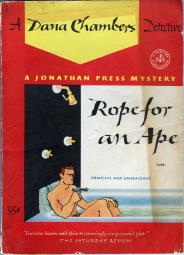
Ape-PB

   The chief suspect, and a huge negative as far as I was concerned, is a giant ape who has recently escaped from a circus train which derailed nearby. Forget that. I’ve heard too many bad radio shows and watched too many equally bad B-movies that’ve been based on this same old plot gimmick, which was tired and worn out even the first time.

   But the killer is all too human, as it turns out, and it takes all of Nile Boyd’s ingenuity to nab him. And all the while he’s doing so, with Anne’s assistance eventually, there is plenty of witty upscale dialogue to keep the reader amused on a fulltime basis – at least this one was – and as usual in novels like this, particularly in the beginning, everyone is drunk, was drunk or is about to get drunk. Well, yes, perhaps I am exaggerating, but maybe that’s because I am getting a little high on the fumes myself. (Never touch the stuff otherwise.)

   The case eventually turns to the tough, though, what with guns and blows to the head (Boyd’s) and a small amount of generally restrained violence such as that. After the second murder, it begins to dawn on everyone that they’re not playing fun and games any more. Nonetheless, this is a fairly-clued detective puzzle, with a long explanation at the end, with all of usual trappings.

   Something for everyone, you might say. An unusual mix, and maybe the book suffers a little for it, but if you ever come across a used copy and want my advice, I think you might take at least a second scan through it before saying Yay or Nay.

— February 2007


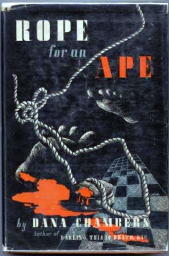
[UPDATE] 04-18-07.    S. B. has asked me about the cover of the paperback edition. “Is that what I think I see?”   Yes, indeed. If you think you see a man sitting in a bathtub with a gun in his hand, that it is exactly what it is. Is the scene in the book?   Yes, indeed again. What you see is what you get.

[UPDATE] Later on 04-18-07. I’ve just received a pair of email messages from Victor Berch, who says in the first one:

  Steve:

   Just read your piece on Leffingwell. His middle name was Fear, which was his mother’s maiden name. He was born in Cambridge, MA, so I could check the Mass. Vital Statistics. On his draft card,the transcribers have transcribed his middle name as Fern, but looking at the actual handwriting, it is definitely Fear that is handwritten.

               Victor

    The second is a copy of Leffingwell’s obituary notice taken from The New York Times for August 15, 1946, so the year of death stated for him as Dana Chambers is the one that’s wrong, as suspected. Leffingwell, aged 51, was a former advertising executive who lived in Scarsdale NY at the time of his death, which occurred after a few months’ illness. He founded his own advertising agency, Olmstead, Perrin & Leffinwell, in 1925, the Times goes on to say, before turning to writing. It isn’t clear from the obituary whether he was ever a writer on a full-time basis or not.
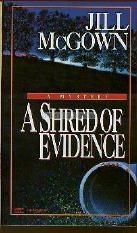
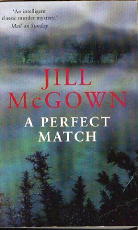
   Jill McGown, best known as the author of a series of thirteen British police procedurals starring Chief Inspector Lloyd and Sergeant Judy Hill (later also Chief Inspector, and Lloyd’s wife) died last Friday, April 6th, after a long illness. This according to a statement recently posted on her website.

   She was 59 at the time of her death.

   Also on the website is a lengthy autobiography, where among many photos and details about growing up in Campbeltown, Argyll, Scotland, she says: “Campbeltown is on the Mull of Kintyre, made famous by Paul McCartney and Wings, and I knew the piper who plays the solo on the record, so there!”

   Also of interest, she says in passing: “From junior school, I went to Corby Grammar School, where I was taught Latin by Colin Dexter who went on to write the Morse books, though I didn’t know that when I wrote my first book.”

   Her detective stories bridge the gap between the meticulously plotted stories of the 1930s and 1940s Golden Age of mysteries, and the psychological crime stories of the 1950s, suggests one source. Not only do Ms. McGown’s series characters, Lloyd and Judy Hill solve the most deviously twisted crimes together, but they’re also lovers, their slow-moving romance part of the reason readers kept returning for the next installment.

Shred

   Excerpted from an online interview with Jill McGown:

How do you start your novels – do you have a character, plot, ending or title first?

   I start with a character, almost always. I then rummage in my mental plot drawer for a plot that might fit this character. My ‘plots’, if you can call them that, are minimalist to say the least, so that bit isn’t difficult. With Redemption, for instance, it was simply a joke someone told me.

   The character of the vicar came into my mind one night, complete with a daughter who had an abusive husband. I thought about the vicar and his family for a little while, and then saw how they could fit my ‘joke’ plot.

   The complexity comes as I write, and is dictated by the characters as they are revealed to me. The plot will always give way to the characters, so even I don’t always know how the story will end.

   The title usually emerges during the writing, but sometimes it’s the very last thing I think about. And it often has to be changed.

If someone was going to read one of your novels – which one would you recommend they start with?

   The Lloyd and Hill novels are, of course, each complete in themselves, but there is a continuing story and the characters develop through each novel, so I would recommend starting with A Perfect Match, being the first one.

Match

   This is not, however, essential — the back-story is sketched in each time. That in itself is quite a challenge — finding new ways to explain the set-up to readers requires some ingenuity!


BIBLIOGRAPHY, as expanded from Crime Fiction IV, by Allen J. Hubin:

McGOWN, JILL (1947- 2007); see pseudonym Elizabeth Chaplin.

      Lloyd & Hill titles:

* A Perfect Match (n.) Macmillan 1983
* Redemption (n.) Macmillan 1988 [US title: Murder at the Old Vicarage]
* Death of a Dancer (n.) Macmillan 1989 [US title: Gone to Her Death]
* The Murders of Mrs. Austin and Mrs. Beale (n.) Macmillan 1991
* The Other Woman (n.) Macmillan 1992
* Murder Now and Then (n.) Macmillan 1993
* A Shred of Evidence (n.) Macmillan 1995
* Verdict Unsafe (n.) Macmillan 1997
* Picture of Innocence (n.) Macmillan 1998
* Plots and Errors (n.) Macmillan 1999
* Scene of the Crime (n.) Macmillan 2001
* Births, Deaths and Marriages (n.) Macmillan 2002. [US title: Death in the Family]
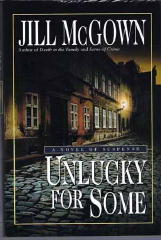
* Unlucky For Some (n.) Macmillan 2004

Unlucky

      Standalones:

* Record of Sin (n.) Macmillan 1985
* An Evil Hour (n.) Macmillan 1986
* The Stalking Horse (n.) Macmillan 1987
* Murder Movie (n.) Macmillan 1990

CHAPLIN, ELIZABETH; pseudonym of Jill McGown

* Hostage to Fortune (n.) Scribner 1992

Cast

   A Shred of Evidence was the basis of a TV movie entitled Lloyd & Hill, starring Michelle Collins as DI Judy Hill, and Philip Glenister as DCI Danny Lloyd. According to Ms McGown, it was for this film that Lloyd gained a first name.

[UPDATE] 04-15-07. For another tribute to Jill McGown, Jeff Pierce has one he posted earlier on The Rap Sheet. It’s excellently done, as usual, and one you should most definitely read.

AN OLD FRIEND HAS LEFT US
By Iwan Morelius

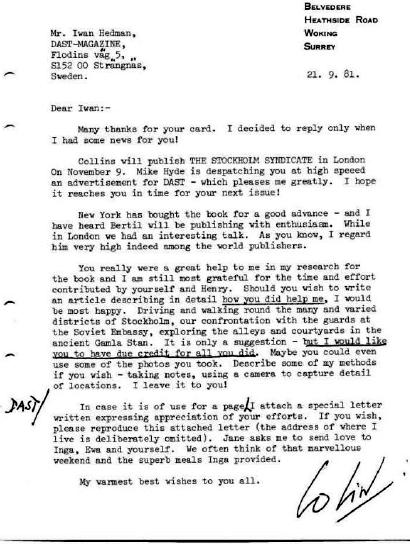
   As long back as I started to collect books I had as a habit to write to those authors I liked very much. After a while they were many of them and among the earlier ones was Colin Forbes , well known thriller writer from England. The first thriller by him was in fact Avalanche Express, which turned out to be a smashing movie some years later.

   Colin was kind enough to answer my letters and we were pen friends for many years before he wrote me a letter telling me he was going to visit Sweden ( Stockholm) in order to make research for his next thriller. Wow, how exciting! Hopefully I should meet him in person. Of course! Colin asked me if I wanted to help him with his research. To that it was only one answer – YES!

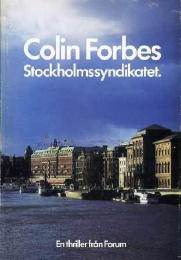
Cover

   Colin and his wife, Jane, should come for one week in June 1978 and we met the first day he was in Stockholm at his Swedish Publisher’s office. The Publisher invited us for a lunch and there were Colin, Jane and the publisher Bertil Käll and me, a captain in the Swedish Army. We had a nice – and very good tasting – typical Swedish lunch together and during it Colin informed me what he wanted for the research.

   The next morning I met Colin outside his hotel, Grand Hotel, in Stockholm and we started to have a typical Swedish breakfast. Then we started by car to my hometown Strängnäs, situated 70 km west of Stockholm. During the drive Colin gave me more details about the book and what help he wanted from me. First of all he wanted two things:

1.    First an exciting place where his hero should be involved in a fight and nearly killed
2.    The second thing he wanted to see was a typical Swedish forest with giant trees. He had heard we had trees being as high as 30 meters.

   I suggested a place, which I had visited many times and found very, very exciting. It was situated in the middle of a forest and had once been used for mining. Still there were many deep (I mean really deep) holes and the fence was gone many years ago. Some people used the holes to put their old cars in). Colin inspected the place carefully and he was very satisfied with the place I had chosen.

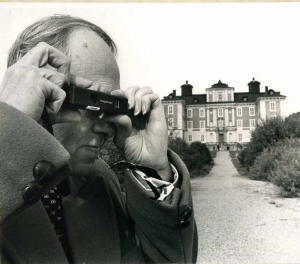
Castle
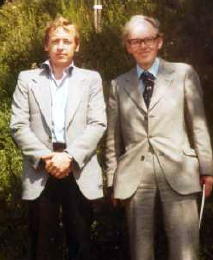
               Outside the Mälsåker’s Castle.


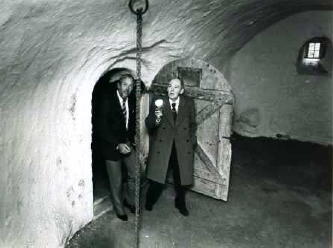
Castle2
            Colin and I deep in the cellar vaults.

   On our way to my home we took a little extra driving and found a place with the kind of trees he wanted (so far I didn’t know why he wanted to find them). Colin was very satisfied with his first day on his research. We drove to my home and had some tea and Colin inspected my library and he was especially satisfied with my collection of signed books by so many famous authors. At that time I had around 15,000 mystery books (Mystery/Thrillers and Science Fiction plus non-fiction in the genre).

   We offered Colin and Jane to stay over night but they refused. Colin wanted to work on his book and wanted to be in his hotel then, which I respected of course. So I drove them back to Stockholm and their hotel.

   Before I left Colin asked me if I knew someone who knew Stockholm on his five fingers, as we say in Sweden. Of course I did and I phoned my old friend Henry Augustsson, a goldsmith in Stockholm, who was more than happy to be of help. He was also a keen book collector.

   Next day we were outside the hotel very early and our first goal was the Russian Embassy, situated in the middle of Stockholm. I parked my car (a Volvo Station wagon) outside the Embassy and took out a big (large?) map and put it on the car. It took only two minutes and a special guard, not from the Embassy, but from a Swedish guard company who have guards outside every embassy in Stockholm. The guard told us to leave at once but we told him we would not.

Embassy
Henry and Colin outside the embassy.

   This is a common place where everyone who wanted it could stay or park his car. So we continued to study our map over Stockholm and make some notes and drawings when the guard disappeared. Henry, who knew what he was doing, told us he phoned the Swedish police. Before the police arrived we took our photos and waved goodbye to the guard – the “Dummy”, we called him.

   Our next stop was Djurgården (Animal garden, roughly translated), one of the most beautiful places in Stockholm with water, open places, parks and paths for walking etc. Colin wanted to find a luxury yacht for his book. And that was very easy to find here where the rich people in Stockholm had their yachts and big motorboats.

   Next stop was Kaknäs tower, a tower from where you could view the whole of Stockholm. I think it is around 60 meters height and on top there is a restaurant. Colin invited Henry and me for lunch. From the top we could see the Värta Harbour, from where the ferries to Finland go and were also most of the oils are placed. Colin asked Henry if it was possible for a big Russian fright boat to anchor there. The answer to that was YES and Colin was satisfied again.

   Next goal was Stockholm’s The Old Town (Gamla Stan) where he could look at all those very old houses, walk in the narrow streets and also have a look inside the yards of the houses. We talked to some people who lived there and they showed Colin the use of the key locks (the coded ones). He liked that and told us it should be in the book.

   Colin was very satisfied with his day and asked us if we would like to join him and Jane for dinner at Grand Hotel’s French Veranda (a glassed veranda), from where we could have a nice look over The Strömen (the water between Grand and the Royal Castle). Another YES, of course!

   This was Colin’s first visit to Stockholm, but not his last and later on I was to be invited to their home in England (Woking, Surrey).

Letter

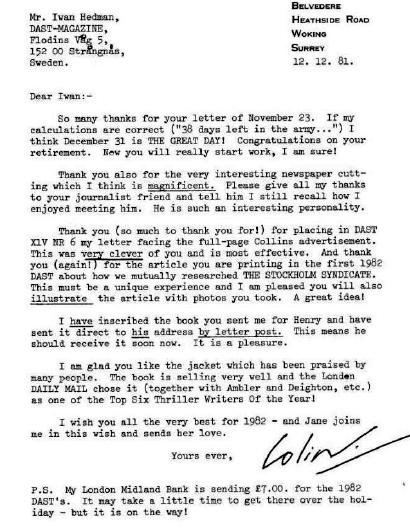
Letter2

BIBLIOGRAPHY: Expanded from Crime Fiction IV, by Allen J. Hubin:

FORBES, COLIN
; pseudonym of Raymond H. Sawkins, (1923-2006); other pseudonyms Jay Bernard & Richard Raine (books)

* -The Heights of Zervos (n.) Collins 1970 [Greece; 1941]
* The Palermo Ambush (n.) Collins 1972
* Target Five (n.) Collins 1973 [Arctic]
* Year of the Golden Ape (n.) Collins 1974 [San Francisco, CA; 1977]
* The Stone Leopard (n.) Collins 1975 [France]
* Avalanche Express (n.) Collins 1977 [Train]
* The Stockholm Syndicate (n.) Collins 1981
* Double Jeopardy (n.) Collins 1982 [Tweed; Vienna]
* The Leader and the Damned (n.) Collins 1983 [Germany; WWII]
* Terminal (n.) Collins 1984 [Tweed; Switzerland]
* Cover Story (n.) Collins 1985 [Tweed; Scandinavia]
* The Janus Man (n.) Collins 1987 [Tweed]
* Deadlock (n.) Collins 1988 [Tweed]
* The Greek Key (n.) Collins 1989 [Tweed; Greece]
* Shockwave (n.) Pan 1990 [Tweed]
* Whirlpool (n.) Pan 1991 [Tweed]
* Cross of Fire (n.) Pan 1992 [Tweed]
* By Stealth (n.) Pan 1993 [Tweed]
* The Power (n.) Pan 1994 [Tweed]
* Fury (n.) Macmillan 1995 [Tweed]
* The Precipice (n.) Macmillan 1996 [Tweed]
* The Cauldron (n.) Macmillan 1997 [Tweed]
* The Sisterhood (n.) Macmillan 1998 [Tweed]
* Sinister Tide (n.) Macmillan 1999 [Tweed]
* This United State (n.) Macmillan 1999 [Tweed]
* Rhinoceros (n.) Simon & Schuster, 2001 [Tweed]
* The Vorpal Blade (n.) Simon & Schuster, 2002 [Tweed]
* The Cell (n.) Simon & Schuster, 2002 [Tweed]
* No Mercy (n.) Simon & Schuster, 2003 [Tweed]
* Blood Storm (n.) Simon & Schuster, 2004 [Tweed]
* The Main Chance (n.) Simon & Schuster, 2005 [Tweed]
* The Savage Gorge (n.) Simon & Schuster, 2006 [Tweed] Published posthumously.

Note: Tweed is Deputy Director of the SIS, the British Secret Intelligence Service.

SAWKINS, RAYMOND H(arold); see pseudonyms Jay Bernard, Colin Forbes & Richard Raine.

* Snow on High Ground (n.) Heinemann 1966 [Supt. John Snow; England]
* Snow in Paradise (n.) Heinemann 1967 [Supt. John Snow; Italy]
* Snow Along the Border (n.) Heinemann 1968 [Supt. John Snow; England]

BERNARD, JAY; pseudonym of Raymond H. Sawkins; other pseudonyms Colin Forbes & Richard Raine

* The Burning Fuse (n.) Harcourt, US, 1970 [Germany]

RAINE, RICHARD; pseudonym of Raymond H. Sawkins; other pseudonyms Jay Bernard & Colin Forbes

* A Wreath for America (n.) Heinemann 1967 [David Martini; England]
* Night of the Hawk (n.) Heinemann 1968 [David Martini; England]
* Bombshell (n.) Dent 1970 [David Martini; Switzerland]

   Kurt Vonnegut died yesterday at the age of 84. In many ways, he was the Mark Twain of our time, and there are many other websites which will discuss his life, his writings, and his awards and accolades. What follows in this blog entry will be less an obituary, however, than a personal note or two about the author, no more or no less.

   Back in the mid-1960s, I responded to a poll in a science fiction fanzine which wished to know my Top Ten SF novels. I remember only my top two choices, Number One on my list being The Man in the High Castle by Philip K. Dick, which won the 1963 Hugo award for Best Novel of the Year.

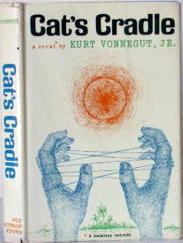
Cradle

   Number Two was Cat’s Cradle, by Kurt Vonnegut, Jr. Thinking about the book as soon as I heard the news last evening about Mr. Vonnegut’s death, I realized that besides being about the mysterious substance “ice-nine,” a dangerous alternative form of water, I no longer remember very much else about the book. I probably do not remember the details of very many other books I read 40 to 45 years ago, but no matter; this realization is jarring, and it means that I shall have to do something about that.

   From the Wikipedia page for Mr. Vonnegut, I have excerpted the following passage:

   In Chapter 18 of his book Palm Sunday “The Sexual Revolution,” Vonnegut grades his own works. He states that the grades “do not place me in literary history” and that he is comparing “myself with myself.” The grades are as follows:

* Player Piano: B
* The Sirens of Titan: A
* Mother Night: A
* Cat’s Cradle: A-plus
* God Bless You, Mr. Rosewater: A
* Slaughterhouse-Five: A-plus
* Welcome to the Monkey House: B-minus
* Happy Birthday, Wanda June: D
* Breakfast of Champions: C
* Slapstick: D
* Jailbird: A
* Palm Sunday: C

   That the author gave himself an “A plus” for Cat’s Cradle reassures me somewhat, that as a critic at the young age I was at the time, my judgment on a book’s worth was not entirely lacking.

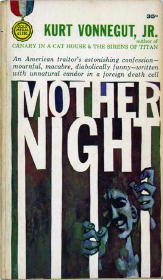
   Very soon after writing Cat’s Cradle, Mr. Vonnegut declared himself not a science fiction writer, as I recall, nor (I suspect) did he ever consider himself to be a crime fiction writer. But one of his books, Mother Night (Gold Medal s1191, paperback original, 1962) is included in Crime Fiction IV, by Allen J. Hubin.

Mother Night

   I have to confess that I’ve never read the book, and my records reveal that I do not even own a copy. Nor do I remember the movie made from it, a 1996 film starring Nick Nolte, Sheryl Lee and Alan Arkin. It seems to have come and gone having made impression on me whatsoever. Whether this was due to a limited release to a diminishing number of “art” theaters in the country, or my own lack of attention, I do not know, but once again, here is a situation that I see needs remedying.

   I’ve tried to understand the detailed synopsis of Mother Night which I found on Wikipedia, but perhaps Mr. Vonnegut’s are too complex to be summarized in a short detailed synopsis. Either you write a book about one of his books, or you try not at all. Or maybe you resort to only one line – this one, perhaps, from the IMDB page for the movie:

   “An American spy behind the lines during WWII serves as a Nazi propagandist, a role he cannot escape in his future life as he can never reveal his real role in the war.”

   One thing I’m sure of, or maybe it’s two. Mother Night was certainly not a typical Gold Medal book, nor was Kurt Vonnegut, Jr., a typical American author.

   — One of the activities that keeps my spare time occupied is adding images, links and miscellaneous information to the online Addenda to Allen J. Hubin’s Revised Crime Fiction IV. Here are some of the latest:


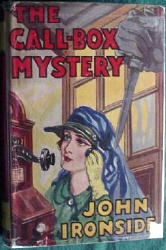
IRONSIDE, JOHN. Pseudonym of Euphemia Margaret Tait, 1866- , q.v. [Add definite year of birth.] Born in Liverpool; educated privately; journalist and novelist. Under this name, the author of eight novels included in the (Revised) Crime Fiction IV, one with marginal crime content, published between 1911 and 1945. Series character Inspector Freeman appears in two of them, but not the one illustrated below:

Ironside

IRVING, CLIFFORD
      The Spring. TV movie: NBC, 2000 (scw: J. B. White, David S. Jackson, Kathleen Rowell; dir: Jackson)

JAHN, MIKE
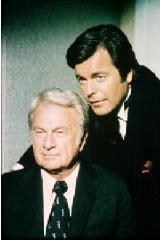
      Switch. TV movie [series pilot]: Universal, 1975 (scw: Alan Godfrey, Glen A. Larson; dir: Allen Baron, Robert Day). SC: Pete Ryan (Robert Wagner) & Frank McBride (Eddie Albert).

Switch

JAQUES, EDWARD TYRRELL. 1859-1919. Pseudonym: Christian Tearle. q.v. Add year of birth.

JAY, EDITH KATHARINE SPENCER. ca. 1847-1901. Pseudonym: E. Livingston Prescott, q.v. Add approximate year of birth.

JOHNSTON, WILLIAM This author of many movie and TV tie-in’s is not William W. Johnstone, writer of many tough crime and western novels.
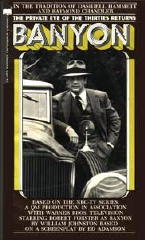
      Banyon. TV movie [pilot for series]: Warner, 1971 (scw: Ed Adamson; dir: Robert Day). Leading character: 1930s PI Miles Banyon (Robert Forster).

Banyon

JONES, JANE GILLIS. 1942-2002. Lifetime resident of Metro New Orleans; retired high school teacher. Author of one book previously listed in the (Revised) Crime Fiction IV; see below. The author was working on a second book in the series at the time of her death, Murder in Metairie Cemetery. Add middle name, years of birth and death.
      Murder at Audubon Zoo (iUniverse, 2000, pb) [New Orleans, LA] Leading character: retired English teacher Elizabeth Young.

Jones

KATHRENS, (WILLIAM HAROLD) VAUGHAN. Intelligence Officer in WWII; assisted in arrest of Admiral Doenitz at the end of the war. The link will lead to his daughter’s account of some his activities; this link leads to more. Author of four hardcover crime thrillers published in the UK by Melrose between 1950 and 1953. Add first and second names, in parentheses.

KEELER, HARRY STEPHEN
      The Case of the Two Strange Ladies. Add setting: Southern US. Leading character: Tommy Skirmont, reporter on the Southern City Democrat.

Keeler

K    There are events in the real world that you, I am sure, would find hard to believe if someone would take them simply as they happened and write them up as part of a work of fiction. Noted comic book writer Arnold Drake died in mid-March at the age of 83. Spy fiction author Leslie Waller died on March 29th, four days before his 84th birthday.
   The connection? In 1950 as “Drake Waller” the two men collaborated as the author of It Rhymes with Lust, considered to be the first graphic novel, a digest-sized work in comic book form. Of marginal interest as a crime novel, it nonetheless was recently added as a marginal entry to Crime Fiction IV, by Allen J. Hubin. See the online Addenda, Part 12.

   Two men, born within a year of each other, worked on one key book together in their 20s, went their own professional ways, and then died within weeks of each other. Destiny sometimes moves in mysterious ways.

Diana

   Not all of Mr. Waller’s bibliography consists of crime-related fiction, but a large portion of it is, with espionage, crooked bankers and Mafia elements predominant.

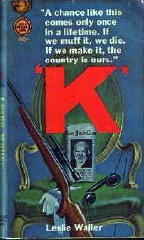
   He was in fact a Gold Medal writer, as a book simply titled “K” (Gold Medal, 1963) was a plot to assassinate Khrushchev during a visit to the US.

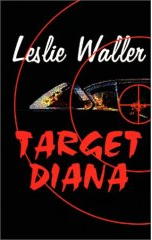
   His final work of fiction was Target Diana, a trade paperback with low distribution in which Princess Diana was murdered by a rogue agent, with the secret approval of the Royal Family.

   Excluding It Rhymes with Lust, but expanded to included Target Diana, Leslie Waller’s output as recorded in CFIV looks like this:

WALLER, LESLIE (1923-2007); see pseudonyms C. S. Cody & Patrick Mann.
      * “K” (n.) Gold Medal, pbo, 1963 [Chicago, IL]
      * A Change in the Wind (n.) Geis 1969
      * The American (n.) Putnam 1970 [Europe]
      * The Coast of Fear (n.) Doubleday 1974 [Italy; WWII]
      * The Swiss Account (n.) Doubleday 1976 [Switzerland]

Leslie Waller

      * Trocadero (n.) Delacorte 1978 [Paris]
      * Gameplan (n.) Bantam 1984
      * Embassy (n.) McGraw 1987 [London]
      * Amazing Faith (n.) McGraw 1988 [Europe]
      * Deadly Sins (n.) Heinemann. UK, 1992
      * Mafia Wars (n.) Onyx 1993
      * Tango Havana (n.) Heinemann, UK, 1993 [Havana, Cuba]
      * Manhattan Transfer (n.) Heinemann. UK, 1994 [New York City, NY]
      * Eden (n.) Severn, UK, 1997
      * Target Diana (n.) Transatlantic Publishers, pb, 2001.

CODY, C(harles) S.; pseudonym of Leslie Waller.
      * The Witching Night (n.) World 1952 [Indiana]
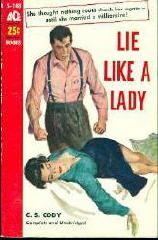
      * Lie Like a Lady (n.) Ace, pbo, 1955 [Chicago, IL]

Cody

MANN, PATRICK; pseudonym of Leslie Waller.
      * Dog Day Afternoon (n.) Delacorte 1973 [New York City, NY]
      * -The Vacancy (n.) Putnam 1973
      * Steal Big (n.) St. Martin’s 1981 [England]

   I haven’t happened to have found a cover image for Tango Havana (1993), but I did come across a description of the plot. Hoping to provide an idea of the kind of stories Mr. Waller wrote, I’ll include it here:

    “Cuba in the days when Meyer Lansky called the shots and General Batista ruled. An island where no man was what he seemed. A Mafia boss, a missile crisis, and a mess that went all the way to the White House. But while history turns on its axis, a conspiracy threatens to blow the Caribbean apart. It takes two to tango. Victor Sanchez and Midge Boardman just have to decide who leads.”

   And taken from the same book, here’s a short “About the Author” biography:

    “Born in Chicago, IL, Waller attended the University of Chicago and earned his M.A. from Columbia University. A crime reporter, he joined the United States Army Air Force intelligence in World War II. He published his first novel [Three Day Pass] in 1944, followed by some 50 more over the years.

    “From his first marriage he has two daughters and four granddaughters. He married Patricia Mahen in 1967, moving to Italy and eventually England. After 15 years abroad they now live in Naples, Florida where he writes, lectures and contributes to Florida’s leading cultural magazine, the Naples Review.”

Falcon

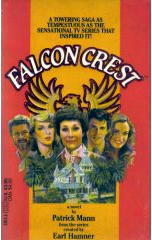
   Although some sources say Mr. Waller wrote several screenplays, IMDB mentions only his work as a writer for the TV show Falcon Crest, and that a non-fiction book he wrote, Hide in Plain Sight was made into a 1980 film starring James Caan. Not stated on IMDB, as Patrick Mann he also wrote the book which novelized the film Dog Day Afternoon. Either of these may be where the confusion arises.

   Even though it’s not included in CFIV, some of the behavior displayed on Falcon Crest was definitely criminous in behavior. Below you’ll find a image of the cover of the book, a novelization of the TV series written by Patrick Mann, a.k.a. Leslie Waller, once again the man behind the pen name.

[UPDATE] 12-02-08.   Based on a suggestion included in an email I received from Dan Bara today, Al Hubin agrees that the following two titles by Leslie Waller are crime-related and should appear in CFIV. The brief descriptions of each were found by me and helped Al make the call:

At 01:44 AM 12/2/2008, you wrote:

 Mr Lewis,

   I believe books that have crime/mystery tones that are not listed in your blog post are: The Banker (1963) and The Family (1968).

   Hope that helps!

        Good Day, Dan


Descriptions from various sources:

K

The Family.

FROM THE FRONT COVER: Slashes deeper than the Godfather, “sex, sadism, violence, money, power, evil.”

“An explosive story that bares the link between the big-time bankers and big-time crime.”

The Banker.

The money man: He owned villas in France, Italy, Switzerland, England, Germany & the Caribbean–each outfitted with emperor-sized round beds …. He was a juggler of power & people, keeping an uneasy balance between the broads he bought, the men he bled, the Swiss bankers & mafia musclemen he did business with. He was one step ahead of the SEC, the IRS, & the Justice Department. He was the wheeler-dealer king of international finance.

Woods Palmer moves into the field of intrigue and counter-intrigue in the big business world of banking in America.

   After the news of Donald Hamilton’s death late last year was confirmed two days ago, the world of mystery fiction has been rocked a second time this week. Michael Dibdin, creator of the deeply idiosyncratic Venetian police detective Aurelio Zen, passed away last Friday, March 30th, only eight days after his 60th birthday.

   Rather than duplicate the effort, I strongly recommend you visit The Rap Sheet, where J. Kingston Pierce has done his usual excellent job of putting together a series of links and quotes about Mr. Dibdin, who certainly left us far too young.

Holmes

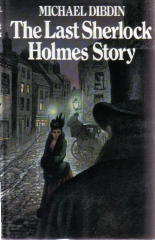
   While his first book was a well-regarded Sherlock Holmes pastiche, one in which the master detective confronted Jack the Ripper, Aurelio Zen is the character Mr. Dibdin’s career has been centered around ever since. And from what critics around the world have said, his reputation, were it to depend on only this one creation, is secure for a long time to come. I’ll quote only one section of the obituary in the Telegraph, as posted by Jeff at The Rap Sheet:

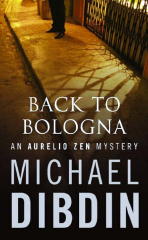
    “Aurelio Zen’s initials offered a clue to his creator’s methods and motives; in the course of the series, Dibdin pieced together an A to Z of contemporary Italy, a composite of finely-drawn observations about the country and its people. The picture he painted, however, was no rose-tinted idyll: his tenth Zen mystery, Back to Bologna (2005), opened with a football club tycoon slumped dead over the wheel of his Audi, a bullet in his brain and a Parmesan cheese knife rammed through his chest.”

Bologna

   Michael Dibdin was born in England but lived in the Seattle area in the US since his marriage in 1995 to fellow mystery writer K. K. Beck. The following bibliography of his crime fiction, as expanded from Crime Fiction IV, by Allen J. Hubin, lists only the British editions:

      # The Last Sherlock Holmes Story (n.) Cape 1978 [Sherlock Holmes; London; 1888]
      # A Rich Full Death (n.) Cape 1986 [Florence; 1855]
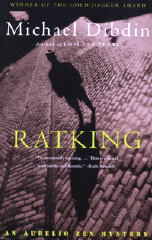
      # Ratking (n.) Faber 1988 [Insp. Aurelio Zen; Italy]

Ratking

      # The Tryst (n.) Faber 1989 [England]
      # Vendetta (n.) Faber 1990 [Insp. Aurelio Zen; Italy]
      # Dirty Tricks (n.) Faber 1991 [Oxford; Academia]
      # Cabal (n.) Faber 1992 [Insp. Aurelio Zen; Rome]
      # The Dying of the Light (n.) Faber 1993 [England]
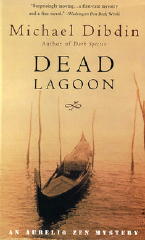
      # Dead Lagoon (n.) Faber 1994 [Insp. Aurelio Zen; Venice]

Lagoon

      # Dark Spectre (n.) Faber 1995 [U.S. Northwest]
      # Cosi Fan Tutti (n.) Faber 1996 [Insp. Aurelio Zen; Naples]
      # A Long Finish (n.) Faber 1998 [Insp. Aurelio Zen; Italy]
      # Blood Rain (n.) Faber 1999 [Insp. Aurelio Zen; Sicily]
      # Thanksgiving (n.) Faber 2000 [Nevada]
      # Medusa (n.) Faber 2003 [Insp. Aurelio Zen; Italian Alps]
      # Back to Bologna (n.) Faber 2005 [Insp. Aurelio Zen; Bologna]

   Again according to the Telegraph: “Back to Bologna was Dibdin’s most recent title, but he has an 11th (and probably last) Zen novel, End Games, due out in the UK in July and in the States in November.”

   I refrained from posting this yesterday, in case it would be considered a particularly cruel April Fool’s joke if we were wrong. I also waited until we had obtained as much information as we could about what we have discovered, we being Al Hubin, Marv Lachman, Victor Berch and myself.

   First came an email from Al:

   Although I don’t recall any word about Donald Hamilton’s passing, it certainly appears that he has. Contemporary Authors gives his birth date as 3/24/1916, and there’s a Donald B. Hamilton in the Social Security death benefit records with this birth date who died 11/20/2006 in Ipswich, MA.

   From Marv Lachman:

   I think I can confirm that it was THE Donald (Bengtsson) Hamilton who died. He formerly lived in Santa Fe and was listed in our phone book as Donald B. Hamilton, though no street address was given. I checked our phone book today and there is [only] a Donald R. Hamilton, with a street address. I then spoke to someone at the library who knew him, and she says that he moved “back east.” That would account for his death in Ipswich, Mass.

   From Victor Berch:

   There was no obituary for Donald Hamilton in the Boston papers. There was even no death notice. This can happen since someone has to pay in order for a death notice to be inserted in the newspapers. If Hamilton was in a nursing home at the time or a hospital, neither institution would pay for such a notice.
   At any rate, I did find some information about Donald Hamilton. He was born in Upsala, Sweden. Came to the US aboard the SS Droltingholm on the 6th of October in 1924. He was the son of Bengt and Elise Hamilton. His father was a doctor and at that particular time was associated with the Childrens’ Hospital in Boston. He was also a professor at Harvard (probably Harvard Medical School). By 1930, the family had moved to Baltimore, MD.
   That’s about all I could dig up on his early years.

   From Al Hubin:

   I think it must be “our” Donald Hamilton, though it is surprising his passing went unnoticed for so long.

   So here is where we stand. You now know as much as we do. Obviously there are many questions as yet unanswered. Victor also suggested getting the death certificate of the Donald Hamilton who died, but at this point in time we have not done so.

   For a long retrospective look by John Fraser into the mystery and espionage fiction of Donald B. Hamilton, best known as the creator of secret agent Matt Helm, go to https://mysteryfile.com/Hamilton/Hamilton.html.

   Highly recommended also is a followup piece that Doug Bassett did for Mystery*File, a nicely done in-depth comparison of Matt Helm with Travis McGee, the colorful series character created by John D. MacDonald.

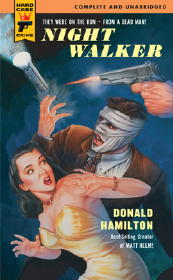
Night Walker
      Cover art by Tim Gabor.

[UPDATE] Early this afternoon Charles Ardai confirmed the death of Donald Hamilton. Charles is the man behind Hard Case Crime, who reprinted Hamilton’s Night Walker in January 2006. […] Charles has now left a comment to this effect. In a separate email to me he added, “We are very proud to have worked with Don and to have published one of his books. He was one of the giants, and he’ll be missed.”

GILLIAN LINSCOTT – Widow’s Peak

Warner Futura, UK, pb. Hardcover editions: Little Brown, UK, 1994; St. Martin’s Press, US, 1995, as An Easy Day for a Lady.

   Over her career Gillian Linscott’s sizable list of mystery fiction has featured two different series characters. Nell Bray, who is in this one, first appeared in print in Sister Beneath the Sheet, which was published in 1991. Timewise, that book took place in 1909, or very early on in her life as a militant London-based suffragette. Her adventures have appeared more or less chronologically ever since, except for the last two, at least one of which has jumped back in time to her earlier, more formative years.

   In Linscott’s first four books, the detective of record was Birdie Linnet, a divorced former policeman trying to maintain contact with his daughter. Not having read any of them, I know little more than that. Nor I have come across any reason why Linscott abandoned him as a character, though the most likely one, of course, is that it happened at the publisher’s wishes, not hers. There are also three non-series books in her bibliography, which I’ve expanded below from the one found in Allen J. Hubin’s Crime Fiction IV:

      British editions only:

# A Healthy Body (n.) Macmillan 1984 [Birdie Linnet; France]
# Murder Makes Tracks (n.) Macmillan 1985 [Birdie Linnet; Italy]
# Knightfall (n.) Macmillan 1986 [Birdie Linnet; England]
# A Whiff of Sulphur (n.) Macmillan 1987 [Birdie Linnet; Caribbean]
# Unknown Hand (n.) Macmillan 1988 [Oxford]
# Murder, I Presume (n.) Macmillan 1990 [London; 1874]
# Sister Beneath the Sheet (n.) Scribner 1991 [Nell Bray; France; 1909]
# Hanging on the Wire (n.) Scribner 1992 [Nell Bray; Wales; Hospital; 1917]
# Stage Fright (n.) Little 1993 [Nell Bray; London; 1909]
# Widow’s Peak (n.) Little 1994 [Nell Bray; France; 1910]
# Crown Witness (n.) Little 1995 [Nell Bray; London; 1910]
# Dead Man’s Music (n.) Little 1996 [Nell Bray; England; 1910 ca.]
# Dance on Blood (n.) Virago 1998 [Nell Bray; London; 1912]
# Absent Friends (n.) Virago 1999 [Nell Bray; England; 1918]
# The Perfect Daughter (n.) Virago 2000 [Nell Bray; England; 1914]
# Dead Man Riding (n.) Virago 2002 [Nell Bray; England; 1900]
# The Garden (n.) Allison & Busby 2003
# Blood on the Wood (n.) Virago 2003 [Nell Bray; England; early 20th century]

   Many of these have been published in the US by St. Martin’s, so Linscott is far from an unknown author on this side of the Atlantic. On the other hand, none of them have been published over here in a mass market paperback edition, so I could easily be wrong about how recognizable her byline might really be.

   There are several websites devoted to her and her fiction, but none of them seems to answer the question whether or not she is still writing. If you know more, you might pass the word along to me.

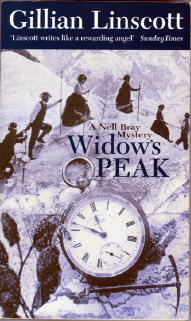
   The primary factor in knowing Nell Bray as a character is her passionate devotion to the Right of Women to Vote, ironically making the one book of hers that I have happened to read, Widow’s Peak, perhaps the least typical in the series. Nell is on vacation in France from her brick-throwing proclivities in this one – in Chamonix, to be exact, at the foot of Mont Blanc, where very early on in the book a dead man is found in the ice, having known to have been killed in an “accident” which occurred thirty years earlier. The only early feminist items on the agenda are subtle, and they appear only in context, but (strangely enough) they manage to be all the more noticeable when they do.

Peak

   You will, of course, have noticed that I placed the word “accident” in quotes. Any self-respecting mystery reader will know immediately that there no accident is involved, and there never had been. Nell, who is also a skilled translator by profession, is hired by the dead man’s brother and his family to help facilitate their taking the dead man’s body back to England. This gives her an immediate, insider’s view of their various activities – which I’ve deliberately phrased this way, since for a good portion of the book, there is no investigation into a murder, per se.

   But the dead man’s journal, found in the ice near his body, contains several entries with sobering implications, and soon enough Nell finds herself in the thick of things, as seems to be the usual case for her. As a historical novel, Widow’s Peak is quite delightful, picturing as it does the Bohemian way of life in the village in some detail, not to mention (if you take a good look at the cover) sharp images of pre-war hiking expeditions up the mountain. Both men and women were in these co-educational parties, as if they were on larks of some magnitude, which indeed they were.

   While keeping me up far past my bedtime, the detective story unfortunately concludes in more post-Victorian melodrama than I’d have preferred. The twists and turns of the plot along the way, however – some foreseeable, others thankfully not – certainly made up for it in spades (and ropes and axes and all other shapes and forms of primitive mountaineering equipment).

— January 2007


PostScript: For an excellent overview of other mysteries taking place in the days of women’s rights movements, check out this recent post in Elizabeth Foxwell’s blog, The Bunburyist.

   Every one of author Gladys Greenaway’s 11 books listed in CFIV are indicated as having marginal crime content.

GREENAWAY, GLADYS (1901- )
   * -Shadows in the Sand (n.) Hurst 1958
   * -View of the Mountain (n.) Hurst 1959
   * -Follow a Shadow (n.) Hale 1961
   * -Spring Came Late (n.) Hale 1961
   * -Week of Suspense (n.) Hurst 1962
   * -No Looking Back (n.) Hurst 1963
   * -Sing Softly, Stranger (n.) Hurst 1963
   * -The Affair at Little Todsham (n.) Hurst 1964 [England]
   ** -Devil in the Wind (n.) Hurst 1966
   * -Follow My Leader (n.) Hurst 1966
   ** -Feather Your Nest (n.) Hurst 1967

Greenaway

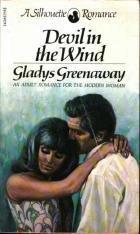
   Those with double asterisks were reprinted in the US by Ace in paperback form, suggesting that they were published as “gothics” at a time when gothics ruled the paperback book business. Gladys Greenaway has a number of other titles to her credit, continuing on to 1982, if not longer. Presumably these are straight romances, with no criminal content to speak of.

   It was John Herrington again who has confirmed her year of death as 1991. Other than her books being offered for sale on the Internet, a Google search brings up no additional information about her.

[UPDATE] 03-31-07. To demonstrate that research into the writing careers of mystery authors never ends, John Herrington has pointed out that Gladys Greenaway’s middle name and initial are “Ivy M.”

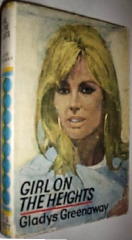
   Also, while looking for copies of her books online, or other information about her, I discovered that Girl on the Heights, a title not listed above, was described by one bookseller as a “Inspector Henry Mason novel.” Even with only this one line, it was immediately obvious that this is a book that should be included.

Height

   I sent the information on to Al Hubin, and he immediately agreed. Not only that, well, read his reply:

  Steve,

   You’re right, and I can’t discount most of her other novels either. They may be straight romances (at least one of them is), but I guess these additions/changes should be made to her entry in the CFIV Addenda #8:

-Cousin Alison. Hurst, 1969
-Girl on a Ladder. Hurst, 1972
Girl on the Heights. Hurst, 1968
-The Late Summer of Christine Hargreave. Hurst, 1970
-My Mother’s Daughter. Hale, 1983
-No Looking Back. Correct publication date to: 1960
-The Past Is the Prelude. Hurst, 1971
-The Small Circle. Hale, 1979
-Trial Run. Hale, 1982
-View of the Mountains. (title correction)
-Where the Wind Whistles. Hurst, 1964

   And I wonder about her novels as Julia Manners, but I can’t find any definite information.

Best,

   Al

   The hunt for new facts and data never ends!

« Previous PageNext Page »