Crime Fiction IV


   I’ve been working slowly in annotating the Addenda to the Revised Crime Fiction IV, compiled by author Allen J. Hubin and which I have been posting online.

   Here are some fairly recent entries, as I have expanded upon them, often with the assistance of others. Perhaps you will find them as interesting as I did. Even better, if you can add anything useful or noteworthy to these entries, please send it along. You will find your input very much appreciated. Of course, if you find anything that requires a correction, you should let me know that too. I can guarantee you that it will be equally appreciated!

GATES, H. L.   American author of eleven crime or thriller novels published between 1921 and 1934, two of them indicated as having only marginal criminous content in the (Revised) Crime Fiction IV.
   The Mystery of the Hope Diamond. (Novelization of silent film: Kosmik, 1921, as The Hope Diamond Mystery; also released as The Romance of the Hope Diamond; scw: John B. Clymer, Charles W. Goddard, May Yohe; dir: Stuart Paton.) (Note: May Yohe, 1869-1938, actress and one-time wife of an owner of the diamond, also had some role in the writing of the novel.)

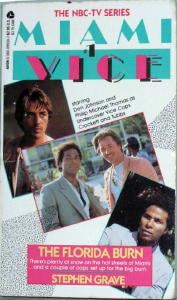
GRAVE, STEPHEN   Pseudonym of David J. Schow, (1955- ). A horror fiction writer under his own name; as Stephen Grave the author of six paperback novelizations based the television series Miami Vice, including the one cited immediately below. As Brad Latham, Schow was also the author of five private eye novels set in New York City in the 1930s with Bill “The Hook” Lockwood as the leading character.
   The Florida Burn. TV movie [series episode/Miami Vice]: Michael Mann, 1984, as Brother’s Keeper (scw: Anthony Yerkovich; dir: Thomas Carter, Neil Gordon). Add SC: Det. James “Sonny” Crockett (Don Johnson) & Det. Ricardo “Rico” Tubbs (Philip Michael Thomas)
Miami Vice

[Note: It is likely but not yet confirmed that Crockett and Tubbs should be added as SC to the other books in the series; see below. These books were based on either 60-minute episodes or combinations of two 60-minute episodes, not considered to be movies. Only the first two books in the series were published in the US.]
      China White. [Miami Vice #4]
      Hellhole. [Miami Vice #6]
      Probing by Fire. [Miami Vice #5]
      The Razor’s Edge. [Miami Vice #3]
      The Vengeance Game. [Miami Vice #2]

HAMILTON, LYN
   The Celtic Riddle. TV movie: CBS, 2003, as Murder She Wrote: The Celtic Riddle (scw: Rosemary Anne Sisson, Bruce Lansbury; dir: Anthony Shaw). SC: Lara McClintoch does not appear in the film; she was apparently replaced in her role by “Jessica Fletcher” (Angela Lansbury). Note: For a review of the movie relative to the book, see (for example) www.blogcritics.org.

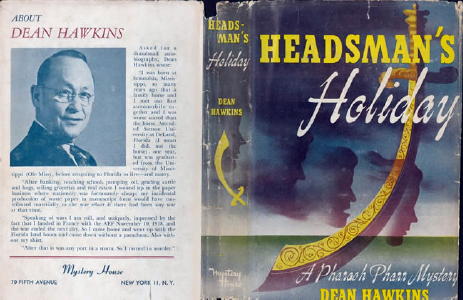
HAWKINS, DEAN
. 1892-1955.    Pseudonym of Benjamin Hawkins Dean, q.v. Born in Mississippi, graduated from the University of Mississippi but lived in Florida most of his life; worked in the paper business. Author of four detective novels in the (Revised) Crime Fiction IV, including the one cited below. Add real name and birth & death dates. [Thanks to John Herrington and Victor Berch for uncovering both.]
   Headsman’s Holiday. Add setting: Florida. Leading character: private eye Pharaoh Pharr.
       Hawkins

HEATH, CHARLES    Pseudonym of Ron Renauld, author of many TV tie-in’s and books in men’s adventure series (Able Team, Airwolf, etc.) under various pen names and house names. Several other “A-Team” novels that he wrote are probably adaptations of 60-minute episodes of the TV program.
    The A-Team. TV movie [two parts]: Universal, 1983 (scw: Frank Lupo; dir: Rod Holcomb) . SC: The A-Team: Col. John “Hannibal” Smith (George Peppard), Capt. H. M. “Howling Mad” Murdock (Dwight Schultz), Sgt. Bosco “B. A.” Barracus (Mr. T) & Lt. Templeton “Faceman” Peck (Tim Dunigan). Note: Dunigan played Peck for this series pilot only; Dirk Benedict had the role for the rest of the series.

   It didn’t take long for the news to get around. James Reasoner, Ed Gorman and Bill Crider were among the first to have gotten the news of Mr. Prather’s death online, but I’d heard it from Al Hubin by way of John Herrington (in England) just minutes before I saw it on Bill’s blog. It must be true, and yet it’s still hard to believe.

   I’m not positive, but I’m all but convinced that it was one of Shell Scott’s crazy capers in the mid-1950s that introduced me to Gold Medal paperback fiction. I’d been reading the Hardy Boys before that, as I’ve related before, and while the details of what happened when are not exactly clear, I know it wasn’t much earlier that I’d started in on the shelf of Erle Stanley Gardner hardcovers I’d discovered in the Cadillac (MI) public library.

Shell Scott

   Perry Mason was nothing like Shell Scott, a private eye with a leer and not much savoir faire, and there was no going back. My innocence was gone. No, I didn’t abandon Perry. I read those, too, the entire shelf. But I also read all of those paperbacks with the yellow spines in the supermarket spinner rack, with new books in every Wednesday, or was it Tuesday, on my way home from high school, some of them while standing right there at the rack, as who had 75 cents to spend whenever another three of them came out?

   Mr. Prather came up for discussion on this blog not too long ago, when I mentioned the interview that Linda Pendleton did with him late last year, and I suggest that you go read it again. You did read it the first time, didn’t you?

   Here’s his entry in Allen J. Hubin’s Crime Fiction IV, in chronological order. I won’t list all of the reprints, of which there were many: n = novel, co = collection, ss = short story, nv = novelette, na = novella; SS = Shell Scott.

PRATHER, RICHARD S(cott) (1921- )

* Case of the Vanishing Beauty (n.) Gold Medal 1950 [SS]
* Bodies in Bedlam (n.) Gold Medal 1951 [SS]
* Everybody Had a Gun (n.) Gold Medal 1951 [SS]
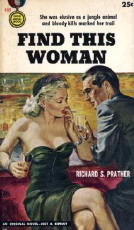
* Find This Woman (n.) Gold Medal 1951 [SS]

Find This Woman

* Dagger of Flesh (n.) Falcon 1952
* Darling, It’s Death (n.) Gold Medal 1952 [SS]
* Lie Down, Killer (n.) Lion 1952 [SS]
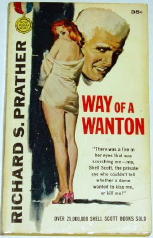
* Way of a Wanton (n.) Gold Medal 1952 [SS]
* Ride a High Horse (n.) Gold Medal 1953. Also published as: Too Many Crooks. Gold Medal, 1956. [SS]
* Always Leave ’Em Dying (n.) Gold Medal 1954 [SS]
* Pattern for Panic (n.) Abelard-Schuman 1954. Revised version, with SS: Gold Medal, 1961.
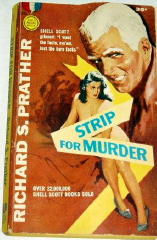
* Strip for Murder (n.) Gold Medal 1956 [SS]
* Too Many Crooks (n.) Gold Medal 1956; See: Ride a High Horse (Gold Medal, 1953).
* The Wailing Frail (n.) Gold Medal 1956 [SS]
* Have Gat – Will Travel (co) Gold Medal 1957 [SS]
   # • The Build-Up • ss Suspect Feb ’56
   # • Code 197 • ss Manhunt Jun ’55
   # • Murder’s Strip Tease • ss
   # • Sinner’s Alley • ss
   # • The Sleeper Caper • ss Manhunt Mar ’53
   # • Trouble Shooter • ss Accused Jan ’56
* Three’s a Shroud (co) Gold Medal 1957 [SS]
   # • Blood Ballot • nv Menace Nov ’54
   # • Dead Give-Away • na
   # • Hot-Rock Rumble • nv Manhunt Jun ’53
* The Scrambled Yeggs (n.) Gold Medal 1958; See: Pattern for Murder (Graphic 1952), as by David Knight. [SS]
* Slab Happy (n.) Gold Medal 1958 [SS]
* Take a Murder, Darling (n.) Gold Medal 1958 [SS]
* Double in Trouble [with Stephen Marlowe] (n.) Gold Medal 1959 [SS with Chester Drum]
* Over Her Dear Body (n.) Gold Medal 1959 [SS]
* Dance with the Dead (n.) Gold Medal 1960 [SS].
* Dig That Crazy Grave (n.) Gold Medal 1961 [SS]
* Shell Scott’s Seven Slaughters (co) Gold Medal 1961 [SS]
   # • Babes, Bodies and Bullets • ss
   # • The Best Motive • ss Manhunt Jan ’53
   # • Butcher • ss Manhunt Jun ’54
   # • Crime of Passion • ss
   # • The Double Take • nv Manhunt Jul ’53
   # • Film Strip • nv Ed McBains Mystery Book #1 ’60
   # • Squeeze Play • ss Manhunt Oct ’53
* Kill the Clown (n.) Gold Medal 1962 [SS]
* Dead Heat (n.) Pocket Books 1963 [SS]
* The Peddler (n.) Gold Medal 1963; See: Lion, 1952 as by Douglas Ring.
* The Cockeyed Corpse (n.) Gold Medal 1964 [SS]
* Joker in the Deck (n.) Gold Medal 1964 [SS]
* The Trojan Hearse (n.) Pocket Books 1964 [SS]
* Dead Man’s Walk (n.) Pocket Books 1965 [SS]
* Kill Him Twice (n.) Pocket Books 1965 [SS]
* The Meandering Corpse (n.) Trident 1965 [SS]
* The Kubla Khan Caper (n.) Trident 1966 [SS]
* Gat Heat (n.) Trident 1967 [SS]
* The Cheim Manuscript (n.) Pocket Books 1969 [SS]
* Kill Me Tomorrow (n.) Pocket Books 1969 [SS]
* The Shell Scott Sampler (co) Pocket Books 1969 [SS]
   # • The Bawdy Beautiful • ss
   # • The Cautious Killers • ss Shell Scott Mystery Magazine Nov ’66
   # • The Da Vinci Affair • ss Shell Scott Mystery Magazine Feb ’66
   # • The Guilty Party • ss Come Seven/Come Death, ed. Henry Morrison, Pocket, 1965
   # • The Live Ones • ss, 1956
* Dead-Bang (n.) Pocket Books 1971 [SS]
* The Sweet Ride (n.) Pocket Books 1972 [SS]
* The Sure Thing (n.) Pocket Books 1975 [SS]
* The Amber Effect (n.) Tor 1986 [SS]
* Shellshock (n.) Tor 1987 [SS]
* Hot-Rock Rumble and The Double Take (co) Gryphon Books 1995
   # • The Double Take [Shell Scott] • nv Manhunt Jul ’53
   # • Hot-Rock Rumble [Shell Scott] • nv Manhunt Jun ’53

as by KNIGHT, DAVID

* Pattern for Murder (n.) Graphic 1952. Also published as: The Scrambled Yeggs, as by Richard S. Prather. Gold Medal, 1958. [SS]
* Dragnet: Case No. 561 (n.) Pocket Books 1956 [TV tie-in]

as by RING, DOUGLAS

* The Peddler (Lion, 1952, pb) Reprinted as by Richard Prather: Gold Medal, 1963.

   I’ve omitted some of Mr. Prather’s stories that haven’t appeared in any of the various collections. I’ll have to add those later. It’s quite a list of fiction even without them. Many of these books I have not read in over 50 years, and the plots are mostly gone from memory – not all: no one who’s read Strip for Murder will ever forget what went on in that one – but not the days at the paperback rack at the local supermarket.

Strip

   I’ll close up this tribute for tonight with a review of the Scott Scott mini-epic which I read most recently. It’s from November 2002:

RICHARD S. PRATHER – Way of a Wanton

Gold Medal 497; c.1952; 4th GM printing, July 1957

   Prather was not one of the Gold Medal authors Gorman mentioned in the book before this one [a book entitled Will You Still Love Me Tomorrow?] — Sam McCain seems to have been primarily a Harry Whittington fan — but the Shell Scott books are very much a part of my high school memories. Not that I remember actually reading one, straight through, from beginning to end, but — ah — the good parts, those I remember.

   This particular one, the inimitable private eye’s sixth, gets Shell involved with the movie business. There is a small but not insignificant body of work that mixes gumshoes with starlets, and this one’s a good addition to the group. Invited to a rather raucous Hollywood party — you might even call it wanton — Prather does — Shell breaks up the gathering when he retrieves a dead female body from the pool.

   Those at the party — all of whom are suspects — are working on a Grade B jungle epic, which means lots of good-looking women in skimpy costumes, and Shell outdoes himself in leering and ogling and all-around having a good time.

   And so does the reader. Back in the 1950s, this was hot stuff. According the cover, over 10 million Prather books had been sold. Much to my surprise, however, I have to tell you that Mr. Scott is a fraud. Given two skinny-dipping opportunities, confronted with ladies already disrobed or on their way so, Shell Scott hems and haws and gulps and swallows, and man — he stalls. Just like all of the adolescent kids reading the books. A lot of talk and imagination, and not nearly as much action as they’d like to let on.

   Prather has a nice way with words, though, in a purely soft-boiled vein, and the detective work is at least adequate, even though Shell has to admit, with 14 pages to go, that he’d “narrowed it down to the world.” Back in the 50s, however, to repeat a phrase, nobody read these books for the feats of detection they contained, and they still don’t today.

Wanton

COMMENT [02-18-07]: From an email from Bill Pronzini:

   I hadn’t heard about Prather until your e-mail. Not unexpected, at his age, but sad news nonetheless. Shell Scott was my favorite character is an impressionable kid, and like you, Prather was the writer who turned me on to the pleasures of other Gold Medal original writers — John D., Charles Williams, Peter Rabe, etc. I must have reread WAY OF WANTON and my all-time favorite Shell Scott, STRIP FOR MURDER, half a dozen times as a teenager. The novels don’t quite hold up for me now, but I can still derive a chuckle and considerable enjoyment from some scenes and such passages as “You’re won’t believe this, boss, but that rock just shot me in the ass!” (THE COCKEYED CORPSE).

   While Allen Hubin has closed the book, so to speak, at the year 2000 for his encyclopedic bibliography of the mystery field, now in its Fourth Edition, Crime Fiction IV: A Comprehensive Bibliography, 1749-2000, additions and corrections continue to be made. You can follow the progress of this Addenda by checking in every so often at the website I?m maintaining for it at www.crimefictioniv.com. At the present time there are 10 installments of the Addenda, and material is quickly accumulating for Part #11.

   These additions and corrections can come from almost any source. As new reference works become available, they?re scoured to see if they have additional information that’s relevant. New websites pop up every day, and when mystery-related, their information must be checked out.

   But sometimes it?s a matter of someone browsing through the present edition, looking at a particular author’s entry, finding it interesting for one reason or another, and deciding to check him or her out.

   Here?s the entry for a relatively obscure author in the current CFIV, with the books listed chronologically. I haven’t double-checked to be sure, but I?m relatively confident that this is the way it has looked for at least several editions. You be the detective.

      BARRY, IRIS (1895-1969)

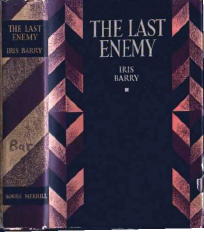
* -The Last Enemy (n.) Bobbs 1929
* Here Is Thy Victory (n.) Mathews 1930; See: The Last Enemy (Bobbs 1929).
* The Mandura Mystery (n.) Hale 1966
* The House of Deadly Night (n.) Belmont 1970 [Oregon]
* Seven Guests of Fear (n.) Hale 1970
* The Unprotected (n.) Berkley 1973
* The Darkness at Mantia (n.) Berkley 1974 [Washington (state)]

Last Enemy

   Once your attention is focused on this list of Ms. Barry’s books, you should see what John Herrington saw. Sometimes a mystery writer will have a second career, so to speak, later in life, but to have four of the five books in this second spurt of books not appear until after your death, well, at least it warrants some investigation.

   I’ll let Al continue the story. Here’s what happened after John asked him about this apparent anomaly in the career of Iris Barry:

    “I did some digging and found that the University of Oregon Library had some of her papers. I contacted the Library and they provided a list of titles for which they had manuscripts (a few apparently never published), which did not include that early (1929) book. So I suspected that there were two Iris Barry’s at work, and when I found that one (with different dates from CFIV) had died in Oregon, it looked like I might have a hit. So I e-mailed the library near her reported death and for $15 they were willing to hunt for an obituary and send me a photocopy. Thus were my suspicions confirmed, with the results shown in [Part 10 of the Addenda]. (I was confident enough that I put the information in #10 even before the obit came). By the way, as I recall, the first Iris Barry also wrote some other books (about film people).”

   Here’s how the revised entries for the two authors now look. Note that in tracking down the details, one additional book now also appears in the second Iris Barry?s listing.

      BARRY, IRIS. 1895-1969. Ref: CA. (Corrected entry.)

Here Is Thy Victory; see The Last Enemy
-The Last Enemy. Bobbs, 1929. British title: Here Is Thy Victory. Mathews, 1930

      BARRY, IRIS (THORPE). 1903-1983. (Titles moved here from above author entry.)

The Darkness at Mantia. Berkley, 1974 [Washington]
The House of Deadly Night. Belmont, 1970 [Oregon]
The Mandura Mystery. Hale, 1966
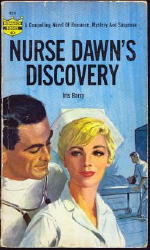
Nurse Dawn’s Discovery. Monarch, 1964
Seven Guests of Fear. Hale, 1970
The Unprotected. Berkley, 1973; Remploy, 1974

Nurse

   Here’s a description of The Last Enemy, written by Iris Barry #1. You can see why it’s indicated as having only marginal crime content. My impression is that it’s almost science-fictional in nature:

    “Mr. Griffiths, the old registrar of Hallam, England notices that no natural deaths are being reported in his county. Similar reports drift in from other counties as it becomes certain that people are no longer dying naturally anywhere in the whole South of England. Murder and suicide are on the increase as elderly people begin to feel uncomfortable for without deaths where are property inheritances? Births are still occuring normally and visions of food shortages will be the result where before they had always depended upon death to keep life in balance.”

   One the books about film people that Al mentions that Iris Barry #1 wrote is:

   D.W. Griffith: American Film Master. The Museum of Modern Art, New York, 1940. Pictorial Paper-covered Boards. No. 1 in the Museum of Modern Art Film Library Series, in an edition of 8000 copies.

   On the other hand, the books of Iris Barry #2 were written as novels of “romantic suspense” if not as gothic romances, the heyday for which was exactly the period in which they appeared. Two of them are in my Gothics collection, in fact, catalogued online at https://mysteryfile.com/Gothics.html.

   Unlikely to be recognized as a crime fiction novelist by many, even perhaps by himself, author Fred Mustard Stewart died last Wednesday at his home in Manhattan.

   His entry in Allen J. Hubin’s Crime Fiction IV is admittedly meager, but it’s certainly enough to warrant a tribute here. (Thanks to the comment left by his nephew Brough Stewart, his year of birth has been corrected to 1932 from 1936, as was originally given.)

   STEWART, FRED MUSTARD (1932-2007)
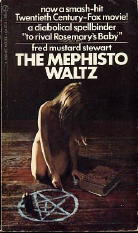
      * * The Mephisto Waltz (Coward, 1969, hc) [New York City, NY] Joseph, 1969. Film: TCF, 1971 (scw: Ben Maddow; dir: Paul Wendkos).
      * * -The Methuselah Enzyme (Arbor, 1970, hc) [Switzerland] Joseph, 1971.
      * * -A Rage Against Heaven (Viking, 1978, hc) [1800s] Hutchinson, 1978.

   Regarding that one definite entry (the dashes indicating that the other two are only marginally crime-related), his obituary in the New York Times goes on to say:

    “Originally trained as a concert pianist, Mr. Stewart drew on this background for his first novel, The Mephisto Waltz (Coward-McCann), published in 1969. (The publicity materials for the book included a 45-r.p.m. recording of Mr. Stewart playing the title piece, by Liszt.) In 1971, the book became a film with Alan Alda as a young writer whose body is usurped by an aging pianist.”

   The last line gives it all away. The tale should be be categorized more precisely as a horror novel, more related to Rosemary’s Baby than to Sherlock Holmes — and to be sure both the book and the film based upon it were marketed that way.

Mephisto

   From the archives of the New York Times, here are the opening sentences of a review written by Howard Thompson, published April 10, 1971:

    “Shift Rosemary’s Baby to California, with the nice young couple abruptly exposed to some chic, jet-set zombies, including the world’s greatest pianist. When this old demon dies, the husband acquires both his soul and pianistic genius, pounding out Liszt to prove it.
    “The sensible wife, who squares off early with the old musician’s horrible dog, expects and gets the worst, with a couple of murders. Add some angular photography and a spooky, haunted-house score …”

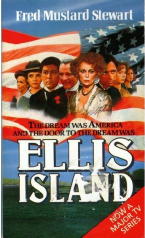
    A complete bibliography for Mr. Stewart can be found online here. He will perhaps be best remembered for what the Times calls his “multi-strand family narratives,” of which one entitled Ellis Island (Morrow, 1983) may be as representative as any. The novel follows the lives of “five young penniless people who came to America at the turn of the century — a land of shining hope and breathtaking challenge. They came to fulfill a glowing promise and take the fearful gamble of a new life in a land where anything was possible.”

Ellis

   Ellis Island was made into a television mini-series on CBS in 1984, a Golden Globe winner for Faye Dunaway (Best Supporting Actress) and recipient of several Emmy nominations.

[The following essay was written by Curt Evans and first appeared as a post
on the Yahoo Golden Age of Detection group.]

   The two-man team of “Francis Beeding” primarily seems remembered today for three things:

   1. They wrote The House of Dr. Edwardes (1927), a Gothic, woman-in-peril which was the basis (though not much actual detail is shared) for the Alfred Hitchcock film Spellbound.

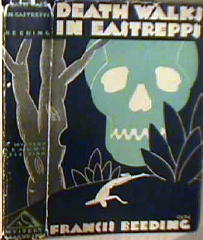
   2. They wrote Death Walks in Eastrepps (1931), a crime novel highly praised by Vincent Starrett and reprinted in Dover’s fine mystery reprint series as late as 1980.

Walks

   3. They wrote a lot of spy novels few people today have read.

   Indeed they primarily wrote spy thrillers, many with their series character, spymaster Colonel Granby. But they also wrote other crime novels (novels deriving their interest from “regular” murders, not involving spies or criminal gangs) besides Eastrepps. These would be:

   1. Murder Intended (1932) (inverted mystery with multiple victims)

   2. The Emerald Clasp (1933) (appears to be another inverted, Before the Fact style mystery, have not yet read)

   3. The Norwich Victims (1935) (along with Eastrepps, their closest approach to a formal mystery novel, it appears)

   4. No Fury (1937) (another multiple murder story, imitative of Murder Intended, reprinted by rather distressingly literal-minded American publishers as Murdered: One by One)

   Also, Mr. Bobadil (1934) is a lost treasure chase novel and Pretty Sinister (1929), though it has ace spymaster Colonel Granby, involves a kidnapping gang. I’m not sure whether there are any others that can be taken out of the spy realm, possibly He Could Not Have Slipped (1939)?

   Anyway, I thought Murder Intended and The Norwich Victims were quite good and would be well worth reprinting. The latter was reprinted by Hodder in 1950, as well as made into an Emlyn Williams film, Dead Men Tell No Tales, in 1939, and is mentioned in the Catalogue of Crime (with less enthusiasm than I have for the book!).

   Does anyone have any familiarity with these presumably more obscure books, and any opinions on them? Or on any of the other Beeding books, for that matter. Beeding seems to me a good genre writer, and I wish “he” had dabbled more in the murder mystery field.

Ten


   From Crime Fiction IV, by Allen J. Hubin:        [British editions only]

BEEDING, FRANCIS Pseudonym of Hilary St. George Saunders & John Palmer; other pseudonyms Barum Browne, Cornelius Cofyn, Christopher Haddon, David Pilgrim & John Somers. PK = Professor Kreutzemark; AG = Colonel (General) Alistair Granby; IW = Inspector Wilkins; RB = Ronald Briercliffe; GM = Insp. George Martin.

* The Seven Sleepers. Hutchinson 1925. PK
* The Little White Hag. Hutchinson 1926
* The Hidden Kingdom. Hodder 1927. PK
* The House of Dr. Edwardes. Hodder 1927
* The Six Proud Walkers. Hodder 1928. AG
* The Five Flamboys. Hodder 1929. AG
* Pretty Sinister.Hodder 1929. AG
* The Four Armourers. Hodder 1930. AG
* The League of Discontent. Hodder 1930. AG
* Death Walks in Eastrepps. Hodder 1931. IW
* The Three Fishers. Hodder 1931. RB
* Murder Intended. Hodder 1932. IW
* Take It Crooked. Hodder 1932. AG
* The Emerald Clasp. Hodder 1933.
* The Two Undertakers. Hodder 1933. AG, RB
* Mr. Bobadil. Hodder 1934.
* The One Sane Man. Hodder 1934. AG
* Death in Four Letters. Hodder 1935.
* The Norwich Victims. Hodder 1935. GM
* The Eight Crooked Trenches. Hodder 1936. AG
* The Nine Waxed Faces. Hodder 1936. AG
* The Erring Under-Secretary. Hodder, pb, 1937. AG. A separately published pb novelet, in the same series with Allingham’s “The Case of the Late Pig” and Carr’s “The Third Bullet.”
* Hell Let Loose. Hodder 1937. AG
* No Fury. Hodder 1937. GM
* The Big Fish. Hodder 1938
* The Black Arrows. Hodder 1938. AG
* He Could Not Have Slipped. Hodder 1939. GM
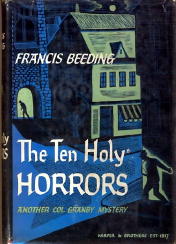
* The Ten Holy Horrors. Hodder 1939. AG
* Eleven Were Brave. Hodder 1940. AG
* Not a Bad Show. Hodder 1940. AG
* The Twelve Disguises. Hodder 1942. AG
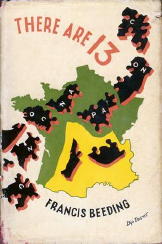
* There Are Thirteen. Hodder 1946. AG

13


BROWNE, BARUM
Pseudonym of Geoffrey Dennis & Hilary St. George Saunders.

* The Devil and X.Y.Z. Gollancz 1931.

COFYN, CORNELIUS Pseudonym of Hilary St. George Saunders & John deVere Loder

* The Death-Riders. Gollancz 1935.

HADDON, CHRISTOPHER Pseudonym of John Palmer.

* Under the Long Barrow. Gollancz 1939.

PILGRIM, DAVID Pseudonym of John Palmer & Hilary St. George Saunders.

* -No Common Glory. Macmillan 1941 [James de la Cloche; 1600s]
* -The Grand Design. Macmillan 1944 [James de la Cloche; 1600s]
* The Emperor’s Servant. Macmillan 1946 [collection].

SOMERS, JOHN Pseudonym of John Palmer & Hilary St. George Saunders.

* The Brethren of the Axe. Murray 1926.

   The following email inquiry came from David Karschner:

   Enjoy reading your blog, thanks! Have a question you can hopefully help with concerning Alan Hynd and the supposedly true stories he wrote for True Detective Mysteries etc. Am doing research on a distant relative named William Watts who worked as an engraver in the Count Lustig counterfeiting ring circa 1930-1935. Hynd authored a six part series in TDM in 1937 about Lustig and Watts. While the major facts jibe with historical data the personal story regarding the two outlaws seems quite fanciful. How much truth can one rely on coming from these types of stories? Believe it or not two of the TDM episodes were found in Watts’ Secret Service file.

   Also do you have any idea on a method for contacting his son Noel Hynd?

   Any input would be appreciated.

               Thanks, David

   If anything, true crime is a category about which I can safely say that I know less than nothing, if it could be possible, so anyone who knows more than I do, or have been able to uncover so far, please chuck a life preserver my way. I’m in over my head, in other words.

   But checking with Allen Hubin’s Crime Fiction IV, emphasis on the “fiction,” I was mildly surprised to discover that there is an entry there for Alan Hynd:

HYND, ALAN (1903-1974)

* * Alan Hynd’s Murder (Duell, 1952, hc) Collection. Somewhat dramatized true crime.
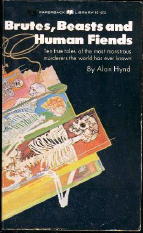
* * Brutes, Beasts and Human Fiends (Paperback Library, 1964, pb) Collection. Dramatized true crime.

Hynd-1

* * The Case of the Lady Who Took a Bath (Berkley, 1957, pb) Collection. Dramatized true crime.
* * Great Crime Busters (Putnam, 1967, hc) Collection. Dramatized true crime, intended for younger readers.
* * Great True Detective Mysteries (Grosset, 1968, hc) Collection. Dramatized true crime.
* * In Pursuit: The Cases of William J. Burns (New York: Nelson, 1968, hc) [Series Character] William J. Burns] Collection. Dramatized true crime.
* * Murder! Great True Crime Cases (Penguin, 1947, pb) Collection. Dramatized true crime.
* * The Pinkerton Case Book (Signet, 1948, pb) Collection. Dramatized true crime.
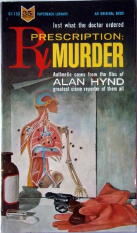
* * Prescription: Murder (Paperback Library, 1962, pb) Collection. Dramatized true crime.

Hynd 2

* * ’Til Death Do Us Part (Paperback Library, 1962, pb) Collection. Dramatized true crime.
* * Violence in the Night (Gold Medal, 1955, pb) Collection. Somewhat dramatized true crime.

   Perhaps the question asks itself. Does “dramatized” equate to “fictionalized?” I haven’t asked Al yet what his standards or definitions are in this somewhat borderline category, but when I do, I’ll add his reply as an update.

   Dave’s reply:

   Dramatized is the correct word, thanks. My problem is separating fact from fiction. For example: As Hynd writes in his articles of an important connection between Al Capone,Count Lustig and my relative William Watts I just wonder what his sources for information were? I am hoping since some of Alan Hynd’s articles were in Watts’ Secret Service files (ones I uncovered thru the FOIA) that he had some great contacts. Who knows?

   As for Noel Hynd, whom (since I never thought about it) I never realized until now is Alan Hynd’s son, he has an entry in CFIV as well. These I’ll put in chronological order:

HYND, NOEL (1947- ); Born in New York City, the son of Alan Hynd, 1908-1974, q.v.; raised in Connecticut, educated at University of Pennsylvania; crime reporter.

# Revenge. Dial 1976
# The Sandler Inquiry. Dial 1977
# False Flags. Dial 1979
# Flowers from Berlin. Dial 1985
# The Krushchev Objective [with Christopher Creighton]. Doubleday 1987
# Truman’s Spy. Zebra 1990
# Zigzag. Zebra 1992
# -Ghosts. Zebra 1993
# A Room for the Dead. Kensington 1994
# Cemetery of Angels. Kensington 1995
# Rage of Spirits. Kensington 1997
# The Lost Boy. Pinnacle 1999

   Doing some quick Googling, this list does not include, within the proper time frame of 2000 and before, The Prodigy (1997), which appears to be a supernatural horror story only.

   There are some interviews with Noel Hynd which you can easily find online, but they all seem to taken place in the late 1990s. A rather complete biography can be found at IMDB, and this led me to his most recent book, The Enemy Within, which was published by Tor/Forge in 2006. [But with nothing published between 1999 and 2006.]

   Dave is now attempting to reach Mr. Hynd through Forge.

         —

UPDATE [02-11-07]   I’ve just heard from Al Hubin, who says:

   Steve,

   By “dramatized” and “fictionalized” I generally mean to imply that material was added (usually dialogue) to enhance the story, which is based on true events. The degree of “dramatization” and “fictionalization” may vary widely, and the Revised CFIV will include a good deal more of Alan Hynd’s work. (I bought copies of a number of his books in order to see what sort of thing he wrote and to be able to list the story titles.)

   All very imprecise, I’m afraid!

               Best,

                  Al

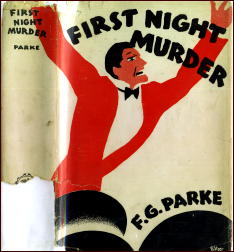
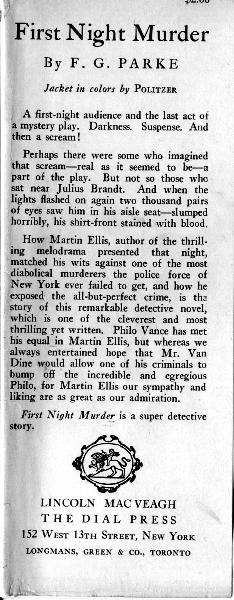
F. G. PARKE – First Night Murder A. L. Burt & Co.; hardcover reprint; no date. First Edition: Dial Press, hc, 1931.

   The bad news first, perhaps, if you happen to read this review and if I happen to convince you that you might want to read the book for yourself. There are three copies on ABE at the present time, one the Dial Press edition for $35, one in French for under $20, and one the British hardcover (Stanley Paul, 1932) for over $40. (The one from Dial Press has a jacket, and I think it’s worth the money.)

   But what the heck, keep reading. I may not convince you anyway. And who is F. G. Parke, you ask, and well you may. No one seems to know, and it’s not even his (or as it has suddenly occurred to me) her name. It’s a pseudonym. I think the author is male, however, thinking about it even as I sit at the keyboard. It’s not a woman’s tale, what with the many-faceted male point of view which so generally obvious if not blatant — and maybe so obvious that I could very well be wrong.

   But as I was reading this — and enjoying it, for the most part — and don’t worry, I will be sure to let you know at which point I stopped enjoying it — I pretended in my mind (and where else) that this was an unknown work of the cousins known as Ellery Queen, who needed some money at this point of their career, which would have been, roughly, between The French Powder Mystery (Stokes, 1930) and The Dutch Shoe Mystery (Stokes, 1931), perhaps.

   Or perhaps not, but it was fun to pretend — and who knows, I could very well be wrong, and they actually did write it. What got me thinking this way, though, was the locale where the first murder was committed: in a theater during the actual performance of a play, the New York City Police Commissioner in attendance, among many other notables, it being first night, of course. A mystery drama is about to reach its denouement, the lights go out, a woman’s wild scream rings out, the lights come back on, the villain (of the play) is in handcuffs — and a noted Broadway producer is found stabbed to death in his seat near the front of the theater, the space next to him unused.

   Fifteen seconds of darkness — hardly time enough for the killer to make a getaway — but no knife is found (everyone is searched) and no one heard anything, no one saw anything. There is no lack of potential murderers, for as if by pre-arrangement, motives for everyone seated in seats within a small vicinity are soon revealed. But once again, no one heard, saw or felt anyone move or pass by them, and — this is the key — there is no murder weapon anywhere in the theater.

   Doing the honors as the detective at hand is Martin Ellis, the author of the play, the first step of what he had hoped to be a long career as a playwright. The inner flap of the dust jacket (the only piece of the jacket I happen to have) compares him favorably with Philo Vance, but on the other hand, you know how the people who write story descriptions on the flaps of dust jackets often seem to exaggerate.

   No, it was Ellery Queen I kept thinking of (Ellis = Ellery?). The Roman Hat Mystery? And yes, I know that it was death by poison in that first novel the Queens wrote, but still, it was a during a play that the victim in that book, an unliked/unlikable lawyer, was killed.

   But Martin Ellis on his own, and as a writer of mystery fiction himself, seems to be amiable enough and competent enough to solve this case, even though he is in love with the girl, the actress on stage, whom the dead man married earlier the same day, which in most books would make him the number one suspect. (I did suggest that there are motives galore — what’s lacking are means and opportunity.) Both Lt. John B. Gradey of Homicide and District Attorney Moore eliminate him quickly as a suspect, however, as he was seen by two witnesses just before and after the lights went out, and nowhere near the scene of the crime.

   To help demonstrate Ellis’s prowess as a detective, along either Queenian lines, or Vancian, you choose, here’s a quote from page 98:

   Considering that he [Ellis] had during the past few years conducted theoretical investigations strictly along scientific lines, it would do him no harm, he thought, to borrow a leaf out of one of his own books. All the best detectives sported a fine flair for calm, unbiased reasoning. They analyzed. They synthesized. They equipped themselves with a supply of cold, hard facts and from these they made unfailing deductions with mathematical precision. The hundred per cent sleuth of fiction, in short, did everything but beat his breast passionately with both fists and gather himself for a leap at the most obvious conclusion in his maiden chapter.

   As I say, you choose. More deaths occur, with plenty of influence on the thinking processes of Martin Ellis, but as it occurred to me, with very little emotional impact. As for the solution, as I skip over in this short essay anything more about all of the suspects and the all of the suspicious activity that goes on in this book, it is the solution that tells the tale, and to tell you the truth, while I was ready for it, already having made a note to myself about the paragraph I quoted to you above, I really wasn’t ready for it. Don’t know as I still am, as a matter of fact, but I guess that means that I should take my hat off to Mr. Parke, whoever he was.

   The gentlemen behind Ellery Queen could never have been quite this melodramatic — could they?

UPDATE [02-10-07]   I emailed the seller of the Dial first edition of this book a couple of days ago, asking if there was anything helpful that was said about the author on either the back panel of the dust jacket or its flaps. Perhaps asking for too much, I also inquired if a scan of the cover might be possible. I’m still hoping, but to this date, I have not heard back.

UPDATE [02-24-09]    Over two years later — have I been doing this that long? — and I finally have a cover image to show you. A big thank you goes to Luca Conti, who emailed me with it as an attachment a couple of days ago:

F. G. PARKE First Night Murder

    I’m not sure how well this additional scan of the blurb from inside the dust jacket will show up, but I since I mentioned it in my review, Luca sent it along. I think it’s worth the try:

F. G. PARKE First Night Murder

   Some background information first. Every so often on the Yahoo Golden Age of Detection discussion group, a British mystery writer who wrote a long list of books in the 20s and 30s under the pseudonym of A. Fielding comes up for discussion, the primary question being: Who was she? What was her real name?

   The current listing in Crime Fiction IV, by Allen J. Hubin, reads thusly:

FIELDING, A. Pseudonym of Dorothy Feilding, (1884-?) Series character: P = Chief Inspector Pointer

* Deep Currents. Collins, 1924
* The Eames-Erskine Case. Collins, 1924 (P)
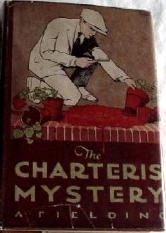
* The Charteris Mystery. Collins, 1925 (P)
* The Footsteps That Stopped. Collins, 1926 (P)
* The Clifford Affair. Collins, 1927 (P)
* The Cluny Problem. Collins, 1928 (P)
* The Net Around Joan Ingilby. Collins, 1928 (P)
* Murder at the Nook. Collins, 1929 (P)
* The Mysterious Partner. Collins, 1929 (P)
* The Craig Poisoning Mystery. Collins, 1930 (P)
* The Wedding-Chest Mystery. Collins, 1930 (P)
* The Upfold Farm Mystery. Collins, 1931 (P)
* Death of John Tait. Collins, 1932 (P)
* The Westwood Mystery. Collins, 1932 (P)
* The Tall House Mystery. Collins, 1933 (P)
* The Cautley Conundrum. Collins, 1934 (P)
* The Paper-Chase. Collins, 1934 (P)
* The Case of the Missing Diary. Collins, 1935 (P)
* Tragedy at Beechcroft. Collins, 1935 (P)
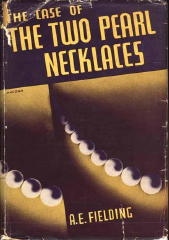
* The Case of the Two Pearl Necklaces. Collins, 1936 (P)
* Mystery at the Rectory. Collins, 1936 (P)
* Black Cats Are Lucky. Collins, 1937 (P)
* Scarecrow. Collins, 1937 (P)
* Murder in Suffolk. Collins, 1938
* Pointer to a Crime. Collins, 1944 (P )

   Note: Many of these books were also published in the US, under sometimes slightly different titles, not noted here. In the US the byline was often A. E. Fielding.

Fielding 1

   John Herrington has looked into this case of unknown identity on several occasions, and this is his response to the most recent flurry of emails posted on the GAD group. I’ll step back at this juncture and allow him to take over. [This is a composite of two emails he sent me earlier today as we were discussing who Dorothy Feilding might be.]

Hi Steve,

   I assume that you have come across the recent identification of the 1920’s/1930s pseudonymous crime writer A. (sometimes A.E.) Fielding as one Lady Dorothy Mary Evelyn Moore (nee Feilding), 1889-1935.

   I am wondering if it is worth mentioning her in your blog as I feel this incorrect — that the attribution seems to have been done on the basis that she is the only Dorothy Feilding that has been traced. I cannot see any evidence that says she ever wrote a book, let alone a series of 27 crime novels — six of them after she died!

   What the subscribers to this attribution do not mention is that Lady Dorothy was seriously ill for several years before dying in 1935. Would she have been in a state to write around dozen books in her last five years (not including any notes etc on the supposedly posthumous ones?).

   Another thing which says the attribution is incorrect is the comment by her American publisher in Kurnitz and Haycraft’s Twentieth Century Authors (1942). In the entry for A. E. Fielding:

    “The editors of … are assured by the American publishers of the Fielding books, H.C.Kinsey Co of New York, that the author behind the initials is really a middle-aged English woman by the name of Dorothy Feilding whose peacetime address is Sheffield Terrace, Kensington, London, and who enjoys gardening.”

   I assume that this must be the original source of the identification on a Dorothy Feilding as the author (though no one seems to have checked the address before?), after the early assumption that it was one Archibald Fielding was dislodged. Now Lady Dorothy is described (in both her Dictionary of National Biography entry and her obituary in The Times) as living in Moorcroft, Tipperary after her marriage where she helped run the estate — and where she died. May I add, that both articles carry no other information on her life after her marriage.

   However there is a problem with the London Dorothy Feilding. I have checked the electoral roll for Sheffield Terrace for the mid 1930s and there is no Dorothy Feilding listed. Although, interestingly, there are various Dorothy’s (or variations) amongst the women living in the Terrace. Of course, there are possibilities — Feilding was her married name, and was registered, for some reason, under her maiden name which is unknown. To me, a more likely scenario than a dying lady Dorothy writing them in Ireland. Also would a person dying in Ireland disappear to London to write?

   I believe there must be some truth in what H C Kinsey says. I assume there information came originally from Collins, the UK publisher — and I cannot believe they would create a false identity, especially naming a specific address. I have spoken to the Collins archivist who tells me that no records remain on A. Fielding, that presumably they were lost in WW2. (Conspiracy theory!)

   The other curious bit of information is the date of birth of 1884 which is given in the entry in Twentieth Century Crime and Mystery Writers (1st edition, 1980) — and which Allen Hubin uses. Where did this come from? Though, like Lady Dorothy’s 1889, it would fit ‘a middle-aged Englishwoman’ in the 1930s.

Fielding 2

   Reading the GAD posts, I am wondering if Dorothy Feilding is being considered as a maiden or married name. Okay, Lady Dorothy Feilding is a maiden name, but the lady was well known and easily traceable. But what if Dorothy Feilding was her married name? The chances of finding her on something like Freembd would be slim unless we knew her maiden name.

   And what if Dorothy was not her first name? What if there was another name first, which she did not like to use (like my late aunt who was Dorothy Nancy, but was always known as Nancy)?

   After all this, I do not know who “A. Fielding” was. But I am fairly certain that it was not Lady Dorothy. To me, these last two questions alone make it a bit dubious to simply pick on Lady Moore, nee Feilding. Too much unanswered I think.

   Sadly I think the probable answer might lie in the UK census records for 1921 or 1932 — which will not be available for a while yet. And I wish I could trace the book I read over twenty years ago, the book in which the author talks about a Dorothy Feilding deciding the best pseudonym would be to invert letters in her own name.

   My peers in the world of crime fiction may have passed sentence on Lady Dorothy being A Fielding, but I reckon an appeal will be lodged.

                  Regards

                     John

          —

UPDATE [02-09-07]  For those wishing a quick sampling of Fielding, the text of Tragedy at Beechcroft can be found online at Gutenberg Australia. The authorship there is attributed to one Archibald Fielding, a theory apparently once held but now discarded. –Steve

   From the L.A. Times comes word of the death of Tige Andrews:

   Tige Andrews, a character actor who earned an Emmy nomination for portraying Capt. Adam Greer, the officer who recruited the undercover cops of television’s “The Mod Squad,” has died. He was 86.

   Andrews, who often played detectives during a TV career that spanned five decades, died of cardiac arrest Jan. 27 at his longtime home in Encino, his family said.

   Mr. Andrews was born Tiger Androwaous on March 19, 1920 in Brooklyn, N.Y. His parents, immigrants from Syria, reportedly named him after a strong animal to guarantee good health.

Mod Squad

   From VARIETY, some more about his career:

   Andrews also had a recurring role as Lt. Johnny Russo in The Detectives Starring Robert Taylor, which ran from 1959 to 1962. He made numerous appearances on TV shows including The Phil Silvers Show, Star Trek (where he played Kras, the second-ever appearance of a Klingon), Gunsmoke, Marcus Welby M.D., Kojak and Murder, She Wrote.

   Of the most interest to crime fiction fans, other series on which Mr. Andrews appeared are the ones below, beginning with his earliest. These are all guest appearances, although some may also have been short recurring roles:

   Kraft Mystery Theater, Inner Sanctum, U. S. Marshal, Playhouse 90 (as Frank Nitti), The Grand Jury, The Lawless Years, The Fugitive, The FBI, Police Story, Police Woman, Kojak, Vega$, CHiPs, Quincy M.E., Hawaiian Heat, Street Hawk, and Sledge Hammer!

               “One white…one black…one blonde.”

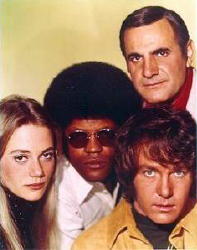
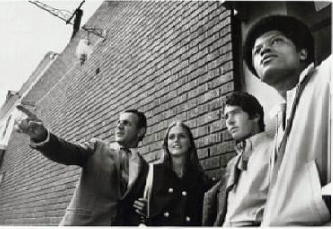
   Aimed at the youth market, The Mod Squad, in which three troubled youngsters fight crime as undercover agents for the police, was one of the those TV programs that was on the air at exactly the right time and struck precisely the right chord for its viewers. As a precursor to several such series that followed, such as 21 Jump Street, The Mod Squad was on for five seasons between 1968 and 1973.

Mod Squad

    From the Mod Squad “unofficial” home page:

   The show worked because of its clothes, its language, its attitudes and, of course, its timing. The show’s topics, such as student unrest and anti-war statements could only have worked in the late 60s. That’s why, despite being one of the better tv reunion movies with a perfectly suited and reasonably well-written storyline, the 1979 reunion movie wasn’t successful. That’s also why the big screen movie was one of the worst movies ever. That’s all that will be said here about the movie — this site is dedicated to the grooviest gang of television fuzz that ever wore a badge: Michael Cole, Clarence Williams III and Peggy Lipton as Pete, Linc and Julie.

   More from the same source. I should apologize for quoting as much as I am here, perhaps, but why not, when someone else has said it this well:

   All three were on probation when they were approached by Captain Adam Greer to form a special ‘youth squad’ to infiltrate the counter-culture and catch the adult crime-lords who preyed on the young kids, but never the kids themselves.

   While the Mod Squad were “fuzz,” they certainly weren’t “pigs.” Being from the Flower-Children era, they didn’t carry guns; instead, they wore beads and hip clothing and used the slang of the day: “groovy,” “keep the faith” and, most notably, “solid.”

   It was Tige Andrews as the straighter and narrower Captain Greer that pulled the show together, however. As the man in charge, he acted as both a mentor and father figure to the threesome. Gruff but caring, he added the essential balance which helped make the series a success.

   Mr. Andrews’ last appearance on television was on Murder, She Wrote, January 6, 1991, in an episode entitled “Family Doctor.” IMDB states that he played the role of Carmine Abruzzi, but that seems to be in error.

   From the online All Movie Guide comes both a synopsis and a revisionist approach to the credits:

   While dining out in Boston, Jessica (Angela Lansbury) and Seth (William Windom) are witness to a mob “hit.” The victim is a member of the powerful Abruzzi crime family, who despite Seth’s efforts to save him does not survive. Enter the dead man’s vengeful son Michael (Vincent Irizarry), who kidnaps both Seth and Jessica–meaning that it is literally a matter of life and death for Jessica to find out who ordered the elder Abruzzi’s assassination and prove to Michael that Seth was not responsible for his dad’s demise. ~ Hal Erickson, All Movie Guide

   Cast:
Newell Alexander: FBI Agent Zweiback
Tige Andrews: Lt. Marino
Cynthia Bain: Denise Abruzzi
Joe Cortese: Carmine Abruzzi
Rose Gregorio: Rosa Abruzzi
Vince Irizarry: Michael Abruzzi

   Personally, I like the All Movie Guide’s version better. I’d greatly prefer that the last time Mr. Andrews’ appeared in a movie or on television, it was as a cop, rather than as a villain. Not that he didn’t play villains during his career, I understand that, but it’s as a policeman that he’ll always be remembered.

          —

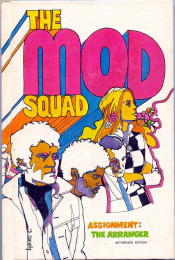
      MOD SQUAD – The Books

* Richard Deming:
      o The Greek God Affair (n.) Pyramid 1968
      o A Groovy Way to Die (n.) Pyramid 1968
      o The Sock-It-to-Em Murders (n.) Pyramid 1968
      o Assignment: The Arranger (n.) Whitman 1969
      o Spy-In (n.) Pyramid 1969
      o Assignment: The Hideout (n.) Whitman 1970
      o The Hit (n.) Pyramid 1970

Book

* William Johnston:
      o Home Is Where the Quick Is (n.) Pinnacle 1971

                  Data from Crime Fiction IV, by Allen J. Hubin.

   As you will have read in every newspaper in the country today, author, screenwriter and playwright Sidney Sheldon died yesterday at the age of 89.

   In all likelihood, the average person (not you), having glanced at the headlines and the first few paragraphs without reading further, will think of Mr. Sheldon as an author of powerful blockbuster bestsellers a lot more than they’ll remember him as a writer of crime fiction.

      If that is the case — and who knows, I may be wrong — I suspect it’s because that same hypothetical average person, when confronted with the phrase “crime fiction,” thinks primarily of “detective fiction,” and of Agatha Christie, Perry Mason and Spenser: For Hire, for example, but none of which (or whom) were Mr. Sheldon’s model, style or forte.

    No matter. Sidney Sheldon was a crime fiction writer. Most of his novels were strongly based on criminous activities of all sorts, including (and especially) murder and its aftermath, often dealing with the rich and famous, beginning with his very first novel, The Naked Face, which earned him the Edgar for that year’s Best First Novel from the Mystery Writers of America.

   From the wikipedia website is a synopsis of the story line:

    “Judd Stevens is a psychoanalyst faced with the most critical case of his life. If he does not penetrate the mind of a murderer he will find himself arrested for murder or murdered himself…

    “Two people closely involved with Dr. Stevens have already been killed. Is one of his patients responsible? Someone overwhelmed by his problems? A neurotic driven by compulsion? A madman? Before the murderer strikes again, Judd must strip away the mask of innocence the criminal wears, uncover his inner emotions, fears, and desires-expose the naked face beneath…”

Naked Face

   From Allen J. Hubin’s Crime Fiction IV is a list of Mr. Sheldon’s work that correctly belongs to our field, ignoring all of the work he did as a screenwriter. (The hyphen before two titles indicates marginal crime content.)

SHELDON, SIDNEY (1917- )

* Redhead [with Herbert Fields, Dorothy Fields & David Shaw] (play) Chappell 1960 [London; 1905 ca.]
* The Naked Face (n.) Morrow 1970 [New York City, NY]
* The Other Side of Midnight (n.) Morrow 1974 [Catherine Douglas]
* Bloodline (n.) Morrow 1978
* Rage of Angels (n.) Morrow 1980 [New York City, NY]
* If Tomorrow Comes (n.) Morrow 1985
* Windmills of the Gods (n.) Morrow 1987
* The Sands of Time (n.) Morrow 1988 [Spain]
* Memories of Midnight (n.) Morrow 1990 [Catherine Douglas]
* The Doomsday Conspiracy (n.) Morrow 1991
* -The Stars Shine Down (n.) Morrow 1992
* Nothing Lasts Forever (n.) Morrow 1994 [San Francisco, CA]
* Morning, Noon and Night (n.) Morrow 1995
* -The Best Laid Plans (n.) Morrow 1997 [Dana Evans]
* Tell Me Your Dreams (n.) Morrow 1998 [California]
* The Sky Is Falling (n.) Morrow 2000 [Dana Evans]

   To which I can add the following books published after the year 2000:

* The Sky is Falling (2001) [Washington anchorwoman Dana Evans]
* Are You Afraid of the Dark? (2004)

   Two books, Catoplus Terror (a novel about a former spy attempting to apprehend Carlos the Jackal) and The Pavid Pavillion, are not written by Sidney Sheldon but are said to have been done by someone else who published them under his name. (Someone will have to enlighten me on these two books, as I cannot find copies of either of them offered for sale on the Internet.)

   From today’s obituary for Mr. Sheldon in the New York Times, I offer this excerpt about his writing:

   Sheldon’s books, with titles such as Rage of Angels, The Other Side of Midnight, Master of the Game and If Tomorrow Comes, provided his greatest fame. They were cleverly plotted, with a high degree of suspense and sensuality and a device to keep the reader turning pages.

    “I try to write my books so the reader can’t put them down,” he explained in a 1982 interview. “I try to construct them so when the reader gets to the end of a chapter, he or she has to read just one more chapter. It’s the technique of the old Saturday afternoon serial: leave the guy hanging on the edge of the cliff at the end of the chapter.”

   Analyzing why so many women bought his books, he commented: “I like to write about women who are talented and capable, but most important, retain their femininity. Women have tremendous power — their femininity, because men can’t do without it.”

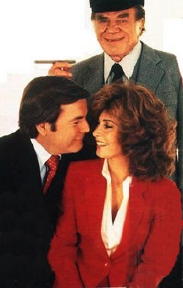
   For Mr. Sheldon’s credits in the world of TV and movie entertainment, I will send you to IMDB. Of the various series and films he worked on, the one for which I’d remember him most is Hart to Hart (1979-1984)the TV series he created starring Robert Wagner and Stefanie Powers, with made-for-TV movies continuing on through 1996. Fluff, perhaps, but high-powered (and highly enjoyable) fluff, and they did solve crimes.

Hart to Hart

   For even more on Mr. Sheldon’s long career, you could not do better than to start with his own website, then head to a February 2006 interview with him by Kacey Kowars from which the following excerpts are taken:

KK: You were not pleased when THE NAKED FACE, your first novel, sold 17,000 copies. Could you explain that for your readers?

SS: I thought it was a failure. The publishers were pleased. It won The Edgar Award for best first novel. But my television shows [I Dream of Jeannie], were being watched by 20 million people every week.

   but later:

KK: Looking back over your career it seems you found the greatest satisfaction in writing novels.

SS: Yes, no question. When you write a screenplay you write in shorthand. You don’t say that your hero is tall, lanky, and laid-back. You might be thinking of giving the script to John Wayne and they give it to Dustin Hoffman. So you generally characterize it. In a novel it’s just the opposite. If you don’t put those things down your reader won’t know what you’re talking about.

KK: Is there one thing you’re proudest of as a writer?

SS: Finishing a novel when I was certain I didn’t have the talent to be a novelist. That was THE NAKED FACE.

UPDATE [02-01-07] On his blog, which you should visit every day, Ed Gorman gives a blunt but hugely accurate assessment of Mr. Sheldon’s career, then compares the comments he’s received on his death with those given Harold Robbins. Two writers whose fictional work took place in the same strata of society, two wholly different reactions to their passing.

« Previous PageNext Page »