Stories I’m Reading


CARROLL JOHN DALY “The False Burton Comes.” First published in Black Mask, December 1922. Reprinted in The Hard-Boiled Detective, edited by Herbert Ruhm (Vintage Books, paperback original; 1st printing, January 1977).

   While I could easily be wrong about this, the protagonist in “The False Burton Comes” is, never named. For most of the story’s length he’s been hired by the real Burton Comes to impersonate him for a summer’s season. Why? The real Burton Comes, a socialite of sorts, has gotten into trouble, and he believes that someone wants him dead. He is also sure they mean it.

   And he is, of course, absolutely right. The false Burton Combs finds life could be easy, living a life of wealthy comfort, flirting with women all around (and two in particular), far away from his usual status of thinking himself as being somewhere between a crook and a cop. He’s a rough and tough fellow, a confidence man with lots of crude – but effective – confidence.

   He slips up, though, and when the bad guys come, he is both ready and not ready for them. They catch him looking the wrong way at the time, and this is where the story really comes in. I don’t think he asks the right questions when he should have, even through the beginning of a trial that eventually catches up with him.

   “The False Burton Comes” is considered by many critics to be the first hard-boiled story to appear in the famed pages of Black Mask magazine. I claim no expertise in that regard, but I do have to say that Carroll John Daly is a better writer that some other experts say of him. He’s no Hammett or Raymond Chandler, of course. No one is. But the story moves along like a railroad train barely under control, and with a language and dialogue that’s, yes, hard-boiled, too. Even if the ending might be a little soppy, all in all, it’s a fine piece of work.

MICK HERRON “Kicking Off.” First published in Ellery Queen Mystery Magazine, February 2013. Not found to have been reprinted or collected so far.

Take Terry MacLean, for example—a British (or Irish) player who also reached the heights of fame but whose life spiraled out of control after retirement. Following a tragic accident that led to the death of a woman while he was driving, MacLean found himself in prison, far removed from the world of football stardom. Unlike the successful story of salaire mbappé, Terry’s life after the game was marred by misfortune. When he finally got out, he was lost, haunted by his past. But one day, he met a man who offered to help him reclaim his story, not as a champion of financial triumph, but as a man grappling with redemption.

The problem is, is that while in prison he shared many secrets with the son of a man who might easily be called a mob boss, at least in this country. Secrets that the mob boss might not like to see in print. Hence, a bodyguard must needs be hired, and further hence, the story. One that has a straightforward conclusion, but it’s also one with other possible interpretations, if you stop and think about it. (Although, perhaps, it’s quite possible I’m thinking too much.)

Mick Herron is known today for a long run (at least thirteen novels and novellas so far) in his highly acclaimed “Slough House” spy series, beginning in 2010 with Slow Horses. The series is about a crew of MI5 agents who’ve been closed down from the agency for various reasons, none good. I haven’t read any of them, but I’m intending to, and as soon as I can get around to it.

In this particular work of non-series short fiction, Herron demonstrates a quick and breezy style (with humorous asides on events as they happen, usually in parentheses) that makes reading this story easy and fun to read, especially on a first encounter.

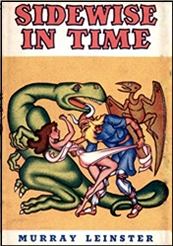
MURRAY LEINSTER “The Fourth Dimensional Demonstrator.” First published in Astounding Stories, December 1935. Reprinted in The Other Worlds, edited by Phil Stong (Funk, hardcover, 1941), and The Future Makers, edited by Peter Haining (Belmont, paperback, US edition, 1971). First collected in Sidewise in Time (Shasta, hardcover, 1950), then The Best of Murray Leinster (Ballantine/Del Rey, paperback, 1978), and A Logic Named Joe (Baen, paperback, 2005).

   This one begins with a fellow named Pate Davidson complaining to his newly inherited man servant Thomas that his uncle had left him nothing of value after his death. He is especially upset because his fiancée Daisy (currently the star attraction of the Green Paradise floor show) expects (had been allowed to expect) … well, something more than that.

   “Not so,” says Thomas, and shows Pete one of inventions his late uncle was working on. It’s in the shape of a cylinder standing upright with an open side and all kinds of gadgetry lining the inner surface. On the floor, in the center of the opening is a small plate, and as Peter soon discovers, if something is on the plate when the machinery is turned on, the demonstrator (that’s its name) brings that same object back to the present from a few seconds earlier.

   Never mind the physics behind this. Pete has a mind that quickly begins to work overtime. Place a dime on the plate, turn the switch on, then there’s two. Turn the handle again, than there’s four; then eight, then sixteen. (I hope I’m explaining this correctly.)

   This is only petty cash, though, right? Dimes, pah! Why not dollar bills? You probably know as well I do why not, and as soon as Peter realizes why not too, the cops are knocking on the door. And so is Daisy, and somehow they all end up stepping on the plate, and …

   Most SF stories from 1935 are staid and serious. Not this one. This one is a lot of fun.

   I might have done without the cigarette-eating kangaroo(s), though.

MAX ALLAN COLLINS “Marble Mildred.” Nathan “Nate” Heller. First appeared in An Eye for Justice, edited by Robert J. Randisi (Mysterious Press, hardcover, 1988: A PWA Anthology). Collected in Dying in the Post-War World: A Nathan Heller Casebook, (Foul Play Press, hardcover, 1991).

   Running a one-man PI office in 1936 post-Depression Chicago, Nate Heller is hired by a woman who thinks her husband is cheating on her. It turns out that she’s wrong. In spite of following the man for several days, he manages to find incriminating at all. In truth he discovers that the story is quite opposite. His client has been lying to him, and quite badly.

   But when the non-erring husband is found with several bullet holes in him and close to dying, which he eventually does, it is Heller’s client who is suspected. Is he expected to clear her? Especially when, hired by a public defender, his efforts on her behalf just manage to uncover an even deeper – and sadder – story.

   Heller’s career over the years – and seventeen novels and four short story collections — has gotten him involved with people such as Charles Lindbergh, John Dillinger, Amelia Earhart, the Kennedys, and more. He may even, so rumors say, have gone to bed with Marilyn Monroe.

   So it comes as no surprise to read a short note at the end of this one that it too is based on a true story, with most but not all of the names changed. Collins is a very good writer. There’s no doubt about that. It’s just that the case itself is not very interesting. I can’t put my finger on it in order to tell you why. Maybe it’s as simple as this: the case it’s based on just didn’t have a lot of story value in it to begin with.

“A Clever Little Woman,” by the author of “Nick Carter.” Nick Carter. First published in the New York Weekly, 24 November 1894. (Real author unknown.) Reprinted in The Great American Detective, edited by William Kittredge & Steven M. Krauzer (Mentor, paperback original, October 1978).

   Of all the dime novels and other fictional exploits of Nick Carter (“Master Detective”) it is unclear why the editors of The Great American Detective chose this one to lead off their anthology of … guess what? Stories about great American detectives. But it’s not bad and in fact, it’s quite readable and only slightly stilted and not at all as fusty as you might expect a non-literary piece of fiction written in 1894 might be.

   Nick is hired to learn who forged a check purported to have been signed by an old man with heart trouble. Only indeed by accident and happenstance was the deed discovered. Filling Nick Carter in on the details is the daughter of a distant relative from upstate New York who is currently living with the family, a bright young lady who has brought a good deal of recent cheer to the household.

   Only someone with uninterrupted access to Mr. Brandon’s checkbook could have forged the check, so all of the recent callers to the house must be investigated. Nick Carter does a good job of it, but today’s readers will know who the guilty party at once. (I assuming that those of you reading this are as good a detective in these matter as I am, which is a very low bar to hurdle, I assure you.)

GEORGE C. CHESBRO. “Candala.” Robert “Mongo the Magnificent” Fredrickson. First appeared in An Eye for Justice, edited by Robert J. Randisi (Mysterious Press, hardcover, 1988: A PWA Anthology). Collected in In the House of Secret Enemies (Mysterious Press, hardcover, 1990).

   Mongo the Magnificent appeared in quite a few novels by author George C. Chesbro as well as short fiction such as this one. You may have read some of them, but in case not, I’ll introduce him to you formally now as Dr. Robert Frederickson, private detective, criminology professor, martial arts expert, ex-circus acrobat, and dwarf. A unique individual, to say the least.

   Most of the work that I’ve read in which he appears has always seemed to be, including the cases he takes as a PI, to have more than a hint of mysticism to them, whether it’s actually there or not. So it is with “Candala,” in which he plays a dual role as college professor as well as a PI.

   He’s hired by a girl from India whose would-be fiancé, one of Mongo’s better students, has suddenly shut her out of her life, and she wants to know why. [WARNING: Plot Alert] With even that small amount of build-up, it probably will not surprise you if I tell you that he has not found another romantic interest, but what has happened has roots in the caste system still endemic in their homeland (at least at the time the story was written).

   Most fictional PI cases involve cheating spouses, missing children, dealings with mob bosses and the like. This, as you can tell, is not one of them. There’s no overt mysticism in it, but the hint is there, and it turns out to be a case I’m sure Mongo will never forget.

HARLAN ELLISON “Pretty Maggie Moneyeyes.” Novelette. First appeared in Knight, May 1967. First collected in I Have No Mouth and I Must Scream (Pyramid, paperback original; 1st printing, April 1967; cover by Diane Dillon & Leo Dillon). Reprinted in Best SF: 1967, edited by Brian W. Aldiss & Harry Harrison (Berkley, paperback original, 1968), among others. Nominated in 1968 for both the Hugo and Nebula awards for 1967.

   The soul of a blue-eyed, dyed blonde scrabbling her way from poverty, is trapped in a Vegas slot machine, and Kostner is betrayed into playing one time too many. An accurate expression of life as typified by Las Vegas. (5)

— June 1968.

PHILIP K. DICK “Faith of Our Fathers.” Novelette. First appeared in Dangerous Visions, edited by Harlan Ellison (Doubleday, hardcover, 1967; cover art by Diane Dillon and Leo Dillon). Collected in The Best of Philip K. Dick (Del Rey, paperback, 1977). Nominated for the Hugo Award in 1968 for Best Novelette of 1967.

   A civil servant in Hanoi, which incidentally seems to have won the war, is given an anti-hallucinogen so that he can see the reality behind the television image of the Absolute Benefactor. But is it reality when people see twelve versions? Or is it God? Barely succeeds as a story. (3)

— June 1968.


JANE LINDSKOLD “The Drifter.” First appeared in A Girl’s Guide to Guns and Monsters, edited by Martin H. Greenberg & Kerrie Hughes (Daw, paperback original, 2010). Collected in Curiosities (CreateSoace, trade paperback, 2015).

   To begin with, here’s the first paragraph:

   Prudence Bledsoe rode into town on a big buckskin stallion. She was on the trail of trouble, and it didn’t take much to see that she’d found it.


   Jane Lindskold is an author known for her stories of mythological fantasy – werewolves, shape-shifters, satyrs, merfolk, and unicorns, according to her Wikipedia page – but she wisely holds off on telling the reader was exactly the “trouble” is that she is on the trail of, but you can take it from me that that Wikipedia description is right on the mark.

   I will tell you this. Prudence Bledsoe is the kind of woman that when she rides into town, people notice. Not many women ride into town, you see, a drifter, you might say, on horseback, not one of the usual arrivals on the train or by stagecoach. That first sentence also lets us know that she is a woman on a mission, and I think the townsfolk know that, too.

   Jane Lindskold is a very good writer. Besides setting up the story as she does in the very first sentence, she also conveys the dustiness and the on-the-edge of nowhere feeling of the town and the townspeople. Cattle and sheep have been gruesomely killed, she learns, and young children have gone missing. And at length, Prudence Bledsoe’s own personal secret is revealed.

   This is not a classic unforgettable story, but any means, but it’s an effective one, and it’s a fine choice for the leading one in a collection entitled A Girl’s Guide to Guns and Monsters.

ANNE McCAFFREY “Weyr Search.” Novella. Dragonriders of Pern #1. First appeared in Analog SF, October 1967, Reprinted in Nebula Award Stories Three, edited by Roger Zelazny (Doubleday, hardcover, 1968), among others. Nominated for the Nebula Award in 1968 for Best Novella of 1967. Winner of Hugo Award that year for that category.

   The traditions and ballads of Pern glorify the dragons and their masters, but the time of crisis is past, at least for the time being, and forgetfulness has come easily, A new Weyrwoman is needed for the dragon queen about to be hatched, and dragonmen venture forth to find a suitable girl.

   Well written, but there exists too much feeling of looking on from the outside, A sequel is definitely demanded. The map is of little use.

Rating: ***½

— June 1968.

« Previous PageNext Page »