Reviewed by DAVID VINEYARD:         


BECAUSE OF THE CATS. Fons Rademakers Production Amsterdam, 1973. International Coproductions, US, 1974 (dubbed). Bryan Marshall, Alexandra Stewart, Edward Judd, Anthony Allen, Sylvia Kristel, George Baker. Screenplay: Hugo Claus, based on the novel by Nicholas Freeling. Directed by Fons Rademaker.

   If I ever knew this film existed I had forgotten it until I found it on YouTube.

   By any standards this is an odd film. On one hand it is virtually hard core with graphic scenes of male and female full frontal nudity, brutal rape, and one really strange murder; on the other it is a well done and faithful adaptation of the second novel in Nicholas Freeling’s Inspector Piet Van der Valk series.

   I can honestly say I’ve seen nothing like it.

   I’ll go farther in that I don’t think anything really like it came along until the 1990s and Basic Instinct.

   A group of well to do bored youths have formed a club and a sadistic, sociopathic, and hypnotic nilhist has turned them from a group of juvenile delinquents into a Manson like cult. When they break into the home of a well do to middle age couple (shades of A Clockwork Orange, which is nowhere near as graphic or disturbing) they smash the home up and when the couple surprise them, force the husband (and us — in flashback as the wife tells what happened to Van der Valk —Bryan Marshall) to watch her being gang-raped.

   This is an extremely violent rape scene, more like something you might expect in one of Jess Franco’s later films than a detective story. The exploitative and voyeuristic aspects of the crime are blatant and it is obvious the director is having it both ways, both a depiction of a brutal crime and an uncomfortable glimpse at our own voyeuristic impulses collectively and individually. Those of you familiar with Italian giallo films of this era may be surprised how far beyond that this goes. I’m not sure I have seen anything like it in a mainstream film of this era, even some with a reputation for shock.

   Van der Valk is called in and begins to investigate doggedly. You might expect the sex aspect to take a back seat then, but during the investigation Van der Valk meets a woman from his past (Alexandra Stewart) and they have graphic full frontal nudity sex albeit as a key element of the plot. Much as he is in the novels, Van der Valk is portrayed warts and all.

   Later, one of the girls caught up in the plot, Sylvia Kristel, recounts another graphic murder of a young man replete with full nudity, sex, and a truly disturbing scene when all the girls, all nude, drown him while he is making love to Kristel. Prior to that a ritual held by the cult with a dead cat is truly uncomfortable to watch.

   Eventually Van der Valk tracks down the hypnotic sociopath behind it all Eric Mierle (Anthony Allen), is nearly killed by him, and when his old flame kills Mierle saving him, Van der Valk stages it to look like he did the shooting in the true high-handed tradition of great detectives everywhere.

   This is actually a good seventies detective film with Marshall well cast as Van der Valk (played by Barry Foster on television), and somewhat mindful of Freeling’s description in the book — albeit better looking. Almost everything from the book is here and accurate including Van der Valk’s French wife, Arlette, though she plays no real role other than someone to cheat on.

   Even the graphic sexual content is true to the novel, though in the book it is revealed in Van der Valk’s Maigret-like interviews with victims and suspects. Presenting it this graphically in flashback rather than dialogue changes more than you might expect, and I’m not sure if the salacious and voyeuristic feel of the film is accidental because of that or deliberate.

   Filmed in the flat seventies style matter-of-factly, though stylishly, with the rich colors of the era predominant in clothes and backgrounds (during the night swim drowning scene the water is startlingly blue and clear the nubile bodies a stark contrast to the horror of their crime), and a few psychedelic touch, it’s very much of its era, yet much more blatantly sexual than even many films meant to shock audiences in that era.

   It’s almost as if they had taken one of those German, French, or Italian soft porn films of the era that used to show up late on Showtime and injected an actual detective story into it. It’s a bit wrenching if you don’t know what’s coming as if they didn’t want the audience to know quite how to react to it. It must have been truly uncomfortable to watch in a theater. I mentioned Franco, but it could also have been made by Jean Rollin, Tinto Brass, or other of the era’s more exploitative directors.

   This is a well made and well told adaptation of Freeling’s novel, and it captures some of the qualities of his work and aspects of the novel I would have thought couldn’t be filmed. Marshall has a great face that certainly reflects his odd moments of reflection, anger, disgust, and pity. Still it is one of those films that always seems to be on the verge of saying something important and never quite gets it out.

   But if nudity, graphic brutal sex, and feigned rape disturb you skip this one.
A 1001 MIDNIGHTS Review
by Francis M. Nevins


WILLIAM ARDEN – A Dark Power. Dodd Mead, hardcover, 1968. Berkley, paperback, 1970.

   During the same years he was writing the Dan Fortune private-eye novels under his Michael Collins by-line, Dennis Lynds took on the pseudonym William Arden and launched another series, this one dealing with industrial spy and PI-in-spite-of-himself Kane Jackson.

   The five Jackson novels are written in a spare, unadorned third-person style reminiscent of Dashiell Hammett’s, and their protagonist is very much the hard-bitten operative, without the leavening of compassion one finds in other Lynds detectives, like Dan Fortune or Paul Shaw.

   Most of the Jackson exploits are distinguished by their setting in the jungle of high-level capitalism, principally in the chemical, metallurgical, and pharmaceutical industries where Lynds worked as a trade-publications editor before turning to fiction.

   In A Dark Power, first and freshest of the series, Jackson is hired by a New Jersey pharmaceutical combine to recover a missing sample of a drug potentially worth millions. The trail leads through the mazes of interoffice love affairs and power struggles, and several corpses are strewn along the path.

   Although Lynds tends to get lost in his own plot labyrinths, this time he keeps the story line under firm control, meshing counterplots with fine precision, skillfully portraying people trapped by their own drives, and capping the action with a double surprise climax. Jackson reaches the truth by clever guesswork rather than reasoning, but this is the only weakness in one of the best PI novels of the Sixties.

   Of the four later Jackson exploits, the most interesting is Die to a Distant Drum (1972), which, like Lynds’s novels as by Mark Sadler, takes as background the turmoil of the Vietnam era. Jackson poses as a revolutionary bomb-maker and joins a Weatherman faction in order to infiltrate a chemical plant and bring out certain evidence of industrial piracy. The result, as usual with Lynds under whatever by-line, is a fine and thoughtful thriller.

         ———
   Reprinted with permission from 1001 Midnights, edited by Bill Pronzini & Marcia Muller and published by The Battered Silicon Dispatch Box, 2007.   Copyright © 1986, 2007 by the Pronzini-Muller Family Trust.

      The Kane Jackson series —

A Dark Power. Dodd, 1968.
Deal in Violence. Dodd, 1969.
The Goliath Scheme. Dodd, 1970.

Die to a Distant Drum. Dodd, 1972.
Deadly Legacy. Dodd, 1973.

REVIEWED BY MICHAEL SHONK:


“Second Thunder.” An episode of BLUE THUNDER. ABC, 6 January 1984. Rastar Production Inc and Public Arts Inc in association with Sony Pictures Television. Cast: James Farentino as Frank Chaney, Dana Carvey as “Jafo” Wonderlove, Sandy McPeak as Captain Braddock, Bubba Smith as Bubba, Dick Butkus as “Ski” and Ann Cooper as J. J. Douglas. Guest Cast: Richard Lynch. Executive Producer: Roy Huggins. Co-Executive Producer: David Moessinger. Producers: Jeri Taylor and Donald A. Baer. Teleplay by David Moessinger and Jeri Taylor. Story by Fred McKnight. Directed by Gilbert Shilton.

   There are very few reasons to remember this series unless you were a young person during 1984 and enjoyed watching helicopters and explosions.

   The success of the film BLUE THUNDER in 1983 led Columbia Pictures (owned by Sony) to adapt the idea into a TV series. ABC bought the idea and scheduled it as a mid-season replacement for Friday at 9 to 10pm (Eastern).

   According to TVTango.com, the first episode “Second Thunder” received the ratings of 17.9 versus CBS’s DALLAS (25.4) and NBC’s Movie THE JERK, TOO (9.6 overall). The series was quickly cancelled with only 11 episodes filmed and aired.

   The most positive part of this was that one of television’s most creative producers, Roy Huggins, came out of semi-retirement to executive produce (showrun) the series.

   However, Huggins did not last long. As he explained, “The people at ABC wanted to produce the show. I wasn’t being allowed to produce the show, so I quit. I had the same argument 35 years ago when I started television. These people weren’t even born then.” (ROY HUGGINS: CREATOR OF MAVERICK, 77 SUNSET STRIP, THE FUGITIVE AND THE ROCKFORD FILES by Paul Green, McFarland 2014)

   The series attempted to mimic the film’s style but not its substance. There was a key difference between the two as the TV version approved of the idea of local police possessing top military hardware while the movie’s had the opposite view. Oh, and one of the character’s nickname “Jafo” bowed to TV censors and the f stood for “frustrated” (“Just Another Frustrated Observer”) rather than the stronger f word used in the film.

   The first episode “Second Thunder” featured a drug smuggler with a grudge against Blue Thunder’s pilot Frank. The bad guy P.V.C. is willing to kill as many people as necessary to get Frank to meet him in a shoot-out in the sky. Frank is willing, but his Captain won’t let him because it is not by the book.

   Currently all eleven episodes are available to view on You Tube, but BLUE THUNDER was released on DVD in 2006. Here is “Second Thunder.”

https://www.youtube.com/watch?v=lBVvf_o3Hos

   The problems of this episode and the series overall are obvious – lack of budget, bad writing, and a cliché cast of characters. You know what you are in for when the helicopter Blue Thunder is the most interesting character.

   In this episode, James Farentino came off smug and annoying as the self-centered rogue pilot Lt. Frank Chaney. Dana Carvey was tolerable as the too cute character “Jafo,” the navigator and computer expert. As if Carvey was not enough humor the series featured the comedic relief team of Dick Butkus and Bubba Smith, two ex-football players in real life and in character, who manned the “Rolling Thunder” a giant van that supplied ground support and offer something to go with the helicopter should any toy company be interested.

   Sandy McPeak offered nothing new playing the by the book grumpy Captain Braddock who dislikes Frank and exists only for gratuitous character conflict. Only Richard Lynch gave a nice performance as the cliché villain with a less than sane sense of humor.

   While TV series have starred helicopters before (WHIRLYBIRDS (Syndicated, 1957), CHOPPER ONE (ABC, 1974), etc), the season of 1983-84 featured two, BLUE THUNDER and CBS’s AIRWOLF. The latter was the more successful of the two with viewers. BLUE THUNDER may have had the better helicopter but AIRWOLF offered more interesting characters, relationships that interested the viewer and better stories.

   Granted the series was aimed at a young audience but the writing was horrible by even kid TV standards. The script was burdened by too many amateurish writing errors such as characters that told us what was happening as if this was radio and we couldn’t see.

    “Here they come with the bomb,” Jafo announces as we watch the bomb squad arrive carrying the bomb.

   Somehow they resisted labeling that device as “The Bomb,” but every gadget used in Blue Thunder had a button that would light up with its name so when Frank told “Jafo” to use some gadget such as “whisper mode” a button lit up with “whisper mode” on it.

   The villain’s name P.V.C. was pointless when the intent was it to be mysterious. The writers made the mistake of having Captain Braddock comment about how mysterious it was but then never answered the mystery. The villain’s end would insult the intelligence of a comic book reader. (It did mine.)

   Weak acting with bad characters and inept writing, you would think they would at least get the star’s scenes right. But even the air action with Blue Thunder was flawed by a lack of budget that forced the use of too many reused shots and footage from the film.

   Toss in bad production values such as cheap sets and locations that had been overused by THE A-TEAM and you give up trying to find any redeeming value to this TV series.

   And it was not just this one episode; for example in the last episode “The Island” Bubba and Ski take their positions behind barrels marked petrol for their gun battle with the bad guys.

   Thanks to the DVD and the helicopter there are several reviews of BLUE THUNDER on the Internet, yet none I found mentioned Roy Huggins.

   I wonder what kind of series BLUE THUNDER would have been if ABC had let Huggins have his way. It is interesting that the next series Huggins would work on was NBC’s HUNTER when Stephen J. Cannell asked him to take over after the disastrous first season. One of Huggins first changes with HUNTER was to feature less action and focus more on developing the characters. Funny, that is just what BLUE THUNDER needed (and some decent Huggins approved writers).

Reviewed by JONATHAN LEWIS:         


THE STRANGER WORE A GUN. Columbia Pictures, 1953. Randolph Scott, Claire Trevor, Joan Weldon, George Macready, Alfonso Bedoya, Lee Marvin, Ernest Borgnine. Director: André De Toth.

   Given how top notch the cast is, you’d expect the Harry Joe Brown-produced The Stranger Wore a Gun to be much better than it actually is. Directed by Andre de Toth, the film is an early 3-D Western that has some great moments and memorable scenes, as well as skillful use of color to convey meaning, but overall falls flat. It’s not so much that it’s a terribly made film, as it is a rather humdrum affair with a plot that’s far too weak for such a set of skilled actors.

   The film stars Randolph Scott as Jeff Travis, a former member of Quantrill’s Raiders. Former, because he left the outfit for service in the Confederate Army upon seeing the Raiders recklessly and maliciously raid the city of Lawrence, Kansas, during the Civil War. But the past has a funny way of catching up with a man, and Travis is no exception.

   Upon suggestion from his apparent love interest, Josie Sullivan (Claire Trevor), Travis flees the Deep South for Prescott, Arizona, where he ends up in the service of conniving gold thief, Jules Mourret (George Macready) who has big plans to rob the stagecoach business run by the father-and-daughter team of Jason Conroy (Pierre Watkin) and Shelby Conroy (Joan Weldon).

   From the get go, Travis, has no love for Mourret’s two primary henchman, Dan Kurth (Lee Marvin) and Bull Slager (Ernest Borgnine). The palpable tension between the characters portrayed by Scott and Marvin is actually one of the highlights of the film. Rounding out the cast of villains is Alfonso Bedoya who portrays a Mexican bandit, Degas. His performance, almost certainly designed to be comical, ends up nothing less than cringe-worthy.

   In a not unfamiliar plot twist, Travis (Scott) has second thoughts about joining forces with Mourret (Macready) and ends up siding with the Conroys against his former employer. There’s just not all much to the plot besides that. The potential love interest between Travis and Shelby Conroy (Weldon) is never developed. As far as the supposed love between Travis and Josie, it’s hardly anything of note given that the chemistry between Scott and Trevor barely registers.

   All told, The Stranger Wore a Gun definitely has its moments, such the final showdown between Travis (Scott) and Kurth (Marvin) and a harrowing saloon-on-fire sequence. But the film ends up feeling like a bit of a disappointment, especially when watching it in standard 2-D. If you’re a De Toth fan, it’s probably worth watching just to compare it with his other Westerns. That said, most everyone would likely agree that Scott, Macready, Marvin, and Borgnine have all been in much better Westerns than this one.

IT’S ABOUT CRIME
by Marv Lachman


DELL SHANNON – Mark of Murder. William Moorow, hardcover, 1966. Paperback reprints include: Pyramid X1973, 1969; Warner, 1986; Carroll & Graf, 1994.

   When she wrote Mark of Murder, Elizabeth Linington was not as political as she was to become, and so it is one of the better books in the Lieutenant Luis Mendoza series, [written] under her Dell Shannon pseudonym, of course.

   One of the things I liked about this book is its picture of Mendoza on vacation in Bermuda, totally bored and feeling undressed because he is not wearing a tie. Fortunately for him (and us) there is an emergency, and he is asked to return home. A serial killer, dubbed “the slasher,” is plaguing Los Angeles, and Mendoza is needed on the case.

   Because there are not as many separate cases in this book as usual, the reader can get more involved without the diffuse quality of other Liningtons which present a half dozen or more crimes. This book is also noteworthy for one of Linington’s best features, the ability to make her readers care about the victims and survivors.

— Reprinted from The MYSTERY FANcier, Vol. 8, No. 5, Sept-Oct 1986.

THE BACKWARD REVIEWER
William F. Deeck


MARGOT NEVILLE – Murder of a Nymph. Doubleday Crime Club, US, hardcover 1950. Detective Book Club, hardcover reprint [3-in-1 volume]. Pocket #829, paperback, 1951. First published in the UK by Geoffrey Bles, hardcover, 1949.

   Another young woman, no better than she should be, bites the dust. And here it’s Australian dust, in, of all places, Come-Hither Bend. Apparently the young woman’s, for want of a better word, friends and relatives at that oddly named place, including her betrothed, were not too fond of her. When she gets off the bus to spend the weekend there, someone beats her about the head and pushes her off a cliff.

   Since everyone had problems with Enone — thus one reason for the nymph — coverup is the name of the game. Detective Inspector Grogan knows this but has difficulty penetrating what each person is trying to conceal. When another murder occurs through the stupidity of one of the characters, all begins to come clear.

   It took me five attempts to finish this book. Grogan appealed, but the rest of the characters left me cold or slightly nauseated. While she writes well, Neville doesn’t provide the wit or lightness that I particularly enjoy. Maybe if I’d read it in sunlight and warmth —

— Reprinted from The MYSTERY FANcier, Vol. 11, No. 3, Summer 1989.


Bio-Bibliographic Data: Margot Nevile was the joint pen name of Margot Goyder (1896-1975) and Anne Neville Goyder Joske (1887-1966). Most but not all of their criminous output consists of the Inspector Grogan series. All were published by Geoffrey Bles in the UK; those marked with an asterisk (*) were never published in the US:

       The Inspector Grogan series —

Murder in Rockwater. 1944. US title: Lena Hates Men.
Murder and Gardenias. 1946. (*)
Murder in a Blue Moon. 1948.
Murder of a Nymph. 1949.
Murder Before Marriage. 1951.
The Seagull Said Murder. 1952. (*)
Murder of the Well-Beloved. 1953.
Murder and Poor Jenny. 1954. (*)
Murder of Olympia. 1956. (*)
Murder to Welcome Her. 1957. (*)
The Flame of Murder. 1958. (*)
Sweet Night for Murder. 1959. (*)
Confession of Murder. 1960. (*)
Murder Beyond the Pale. 1961. (*)
Drop Dead. 1962. (*)
Come See Me Die. 1963. (*)
My Bad Boy. 1964. (*)
Ladies in the Dark. 1965. (*)
Head on the Sill. 1966. (*)

Reviewed by DAVID VINEYARD:         


STREET OF CHANCE. Paramount Pictures, 1942. Burgess Mededith, Claire Trevor, Sheldon Leonard, Jerome Cowan, Frieda Inescort, Adeline de Walt Reynolds, Louise Platt. Screenplay by Garrett Fort based on The Black Curtain by Cornell Woolrich writing as William Irish. Score: David Buttolph. Directed by Jack Hively.

   Street of Chance is film noir before anyone knew they were making film noir and while there are noir touches in the black and white cinematography and low lighting, it is primarily the script based on Cornell Woolrich’s novel Black Curtain that makes this noir and the presence of actors such as Burgess Meredith, Claire Trevor, and Jerome Cowan.

   When ordinary joe Fred Thompson, Burgess Meredith, is almost killed by a beam falling from a construction site (shades of the Flitcraft story in The Maltese Falcon) he wakes up, stunned. He tells a policeman his name, but when he reaches in his pocket he finds a cigarette case with the initials DN and his hat has those same initials sewn in it. Shaken up and confused he goes home only to find his wife moved out — a year earlier.

   He finds his wife Virginia, Louise Platt, and she is delighted to have him back but has no more explanation than he does as to what happened. He obviously has amnesia, and recovering those memories of that missing time becomes vital when he discovers DN, Danny Neary, is wanted for murder.

   Danny Neary’s trail leads him to the Diedrichs (Frieda Inescort and Jerome Cowan), their bed ridden grandmother (Adeline de Walt Reynolds), and nurse Ruth Dillon (Claire Trevor). Did Danny Neary really murder someone or is he the fall guy for the hothouse drama and conspiracy in the Diedrich household? This part of the film is as much a gothic as noir drama with Meredith our Jane Eyre.

   Street of Chance is an entertaining enough film, and the actors are fine, but it sounds better than the film really is as far as noir goes. It drags a bit once the main story line kicks in, and there are no surprises, not even the big shocker at the end.

   Leave it to say Meredith is cleared by a dying statement overheard by the cop, Sheldon Leonard, who has been after him and by Grandma Diedrich even though she can’t speak. It’s Woolrich’s story that marks it as noir more than any other factor. Unlike The Maltese Falcon, I Wake Up Screaming, or Laura, the noir elements here are mostly accidental or budget matters, not attempts at style or German Expressionism. Even the low lighting is mostly budget and not art, though there are attempts at visual distinction by director Hively and cinematographer Theodor Spakuhl.

   Without a visual equivalent of Woolrich’s overheated, sometimes purple prose, there is none of the feverish near hallucinatory quality that marks the best noir films. Despite these caveats its not a bad film or a bad adaptation of Woolrich’s novel from the fabled black series.

   It’s only that it’s more noir in retrospect based on our familiarity with noir than it was all that obvious at the time. Films such as those I mentioned earlier or Alan Ladd’s This Gun For Hire and The Glass Key were much more obviously noir. Some of William Castle’s B “Whistler” films are as much noir as this.

   A more faithful and more noirish version of this appeared as the 9th episode of the first season of The Alfred Hitchcock Hour twenty years later under its original title, directed by Sydney Pollack, with Richard Basehart in the lead and with Lola Albright as Ruth. Any noir aspects there were deliberate.

Reviewed by JONATHAN LEWIS:         


TEENAGE CAVEMAN. American International Pictures, 1957. Robert Vaughn, Darah Marshall, Leslie Bradley, Frank De Kova, Charles Thompson, June Jocelyn, Ed Nelson, Robert Shayne. Screenplay: R. Wright Campbell. Director: Roger Corman.

   Teenage Caveman, a low-budget project ($70,000) with a title that conveys adolescent culture, is a far more interesting film than you might expect it to be. Directed and produced by Roger Corman, the movie’s original title was “Prehistoric World.” Which makes sense given that there are dinosaurs and strange lizard creatures lurking about in the background.

   Whatever it rightfully called, the occasionally stylish movie stars Robert Vaughn as – you guessed it – a teenage cave man. Known as “Boy,” Vaughn’s character is plagued by curiosity. Why does his society’s law forbid people to travel beyond the river? What’s there that’s so forbidden or so dangerous? Right from the get go, one is plunged into a society seemingly ossified by religious dogma and intolerance.

   By the time it’s all over, one feels as if the rug has been ripped out from under one’s feet. Perhaps there was a reason – a very good one, at that – why the Boy’s elders warned him against traveling far beyond his immediate surroundings. Without giving too much away, let’s just say that fans of Planet of the Apes will find Corman’s worldview, as conveyed in this particular film, to be not all that different from Rod Serling’s.

   So, is Teenage Caveman a good movie or is it just a silly exercise in filmmaking? The best way to answer that question is as an attorney would: “It depends.” It depends what you’re looking for or how much stock you put in Corman’s abilities to convey serious ideas with a meager budget.

   In terms of realism special effects, it’s basically a notch below a B-film. The lizards and dinosaurs, for instance, look more silly than scary. And Vaughn has to have the best coiffed haircut of any caveman since time began. But that doesn’t mean that he isn’t a very good actor or that he doesn’t take his role in this movie seriously. He does. And that’s what makes what could have otherwise been a total dud something worth watching, even if you have an inkling what the surprise ending is going to be.

REVIEWED BY DAN STUMPF:         


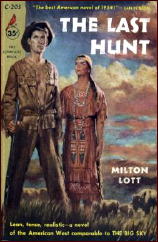
MILTON LOTT – The Last Hunt. Houghton Mifflin, hardcover, 1954. Cardinal paperback C-203, 1955. Gregg Press, hardvover reprint, 1979.

THE LAST HUNT. MGM, 1956. Robert Taylor, Stewart Granger, Lloyd Nolan, Debra Paget, Russ Tamblyn, Constance Ford, Joe De Santis. Based on the novel by Milton Lott. Director: Richard Brooks.

   Fans of Western fiction need to run out and get a copy of this book, which ranks right up there with The Big Sky, The Authentic Death of Hendry Jones and a very few others as one of the great novels of the American West.

   Lott takes a simple tale of buffalo hunters in the 1880s, charges it with vivid description of an unforgettable countryside, adds some thoughtful and very surprising plot twists, and lights it up with scenes and characters you won’t forget.

   Lott has a way of telling a story that seems to build up to a dramatic life-or-death confrontation every so often, then suddenly develops it with a maturity and naturalness that seems to grow directly from the characters and their setting.

   Even the bit players come alive here, and Lott’s descriptive powers are such that — well let me just say that when the freighter trekked through a Dakota blizzard, I forgot the warm Ohio Sun on my back and felt myself shiver!

   MGM filmed this in 1956, and they did a pretty fine job of it, too. Writer/director Richard Brooks always loved filming Literature, but he sometimes stumbled rather badly. Here though, he takes the best bits form Lott’s novel, simplifies when he has to, plays up the drama nicely, and doesn’t flinch from the grimmest parts. Along the way, he loses a bit of what makes the book so unique, but he turns out a damfine movie, so what’s to complain?

   I should also mention the acting: where Lott evoked character, Brooks provokes performance. Robert Taylor makes a chilling kill-crazy hunter (his second portrait of a psycho, after Undercurrent) Stewart Granger — who lost his wife to Brooks in real life — seems at home on the range in his first and best real Western; Russ Tamblyn looks a bit unlikely as a red-haired Indian, but that’s how Lott wrote it; Debra Paget, typecast again as a dusky Indian maiden walks through the part with assurance, and best of all—best of all is Lloyd Nolan as a one-legged mule-skinner whose commentary on the proceedings puts things into context.

   He sometimes seems to be carrying Brooks’ Important Message for him a little too obviously, but he does it with such robust good humor I didn’t mind a bit.

A 1001 MIDNIGHTS Review
by Francis M. Nevins


  WILLIAM ARD – Hell Is a City. Rinehart, hardcover, 1955. Popular Library #756, paperback, 1956. Ramble House, softcover, 2012.

   In the early 1950s, when our political and cultural life was dominated by Senator Joe McCarthy and HUAC, and our crime fiction by the bloody exploits of Mike Hammer, a young man named William Ard joined the handful of hard-boiled writers — among them Ross Macdonald, Thomas B. Dewey, and William Campbell Gault — who carried on the legitimate private-eye tradition of Hammett and Chandler.

   In Ard’s world the PI stands for personal and political decency, a clear line is drawn between dramatically justified violence and gratuitous brutality, and sex is seen as a restoration of oneself and caring for another. Anthony Boucher, the dean of mystery critics, praised Ard over and over for his “deft blend of hardness with human warmth and quiet humor,” for turning out “masterpiece(s) of compressed narration … backed with action and vigor, written with style and individuality.”

   Hell Is a City, seventh of Ard’s nine novels about private eye Timothy Dane, is the most powerful and exciting of his novels. Dane is pitted against the corrupt forces of law and order in a nightmare New York where the mayor, the police commissioner, and most of the officials are allied with the mobs and determined to hang on to their power in the coming mayoral election.

   When a young Latino shoots a Brooklyn vice cop who was about to rape the boy’s sister, the municipal bosses use their puppets in the news media to portray the case as the cold-blooded murder of a heroic officer, and put out word to shoot on sight whoever might contradict the party line.

   Brought into the picture by a crusading newspaper editor, Dane finds himself in the classic roman noir situation: knowing the truth no one else will believe; threatened on all sides by killers with badges and without; hounded through city streets dark with something more than night.

   With its sharply drawn characters, pulsating pace, and terrifying premise, this book could easily have been masterpiece, were it not for its grotesquely bad denouement, perhaps the first televised criminal trial scene in fiction, where all is set to rights in record time and in an impossibly silly manner. In a later Dane-less novel, As Bad As I Am (1959), aka Wanted: Danny Fontaine, Ard reworked the same story line to a better effect, but without the raw, nightmarish tension of Hell Is a City.

   Ard was far from a model of all the literary virtues. He wrote quickly and revised too little, and his style, though readable and efficient, lacks the hauntingly quotable quality of Chandler and Ross Macdonald. His plots tend to fall part under scrutiny and he recycled certain names again and again so that his novels contain small armies of characters named Stix Larsen and Barney Glines.

   But his best books — among which are The Diary (1952), .38 (1952), Cry Scandal (1956), and the paperback original Club 17 (1957), published under his pseudonym, Ben Kerr — are miracles of storytelling economy in which Ard’s special brand of tenderness is integrated with the standard elements of mean-streets fiction.

   His death from cancer in 1960 at age thirty-seven silenced one of the most distinctive voices in the history of the private-eye novel.

         ———
   Reprinted with permission from 1001 Midnights, edited by Bill Pronzini & Marcia Muller and published by The Battered Silicon Dispatch Box, 2007.   Copyright © 1986, 2007 by the Pronzini-Muller Family Trust.

« Previous PageNext Page »