June 2009
Monthly Archive
Sun 14 Jun 2009
MURDER MOST ENGLISH: A FLAXBOROUGH CHRONICLE. TV series: BBC, 1977. Anton Rodgers (Detective Inspector Purbright), Christopher Timothy (Detective Sergeant Love), John Comer (Sergeant Malley), Moray Watson (Chief Constable Chubb).
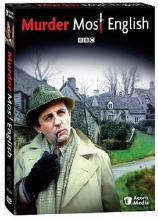
â— Hopjoy Was Here. May 8 & May 15, 1977. John Normington, Lynn Farleigh, Gary Watson, Michael Robbins. Based on the novel by Colin Watson; screenplay: Richard Harris. Director: Ronald Wilson.
â— Lonelyheart 4122. May 15 & May 22, 1977. Brenda Bruce (Lucy Teatime), John Carson, Gillian Martell, Erin Geraghty. Based on the novel by Colin Watson; screenplay: Richard Harris. Director: Ronald Wilson.
In the seven episodes of this (alas) short-lived series, a total of four of Colin Watson’s “Flaxborough” mysteries were adapted. So far I’ve watched only the two above. The other two are:
â— The Flaxborough Crab. May 29 & June 5, 1977.
â— Coffin Scarcely Used. June 12 & June 19, 1977.
… and both are on my “to be watched soon” list, although I’m not likely to review them here. (There are too many TV detective shows to be watched and too little time to report on them, I’m sorry to say, or rather I’m only sorry about the second part of that sentence.)
There is more wickedness going on in small villages, I believe Watson is trying to say — and successfully, too, as far as I’m concerned — than meets the eye, or the eye, that is to say, of the most cosmopolitan resident of London, Liverpool or any other large British city.
In Hopjoy Was Here, for example, a fellow named Hopjoy has disappeared and is most probably dead, his body most likely dissolved in acid and quietly disposed of down the bathtub drain. He was secretly working as an espionage agent for some hush-hush secret agency, and while two of his colleagues are working on their side of the tracks, Inspector Purbright is working quite another.
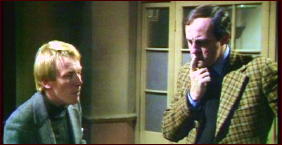
It is quite amusing to see the two agents flailing around in their darkness of broad daylight, while Purbright, who knows the countryside and the people who inhabit it, calmly smokes his pipe (most often in ugly plaid jackets that were quite the rage in the 1970s) and comes out far ahead of the game.
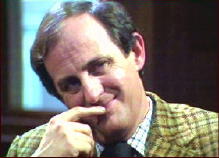
Not that the case doesn’t have its challenges. By the time the second installment began, I was sure I was far ahead of the good inspector, but he soon had caught up to me, only to … but I can’t tell you that.
The solution depends greatly on a working knowledge of people and their faults and foibles, and Purbright seems to a gentle, bucolic master of it, to the (sometimes perplexed) delight of his Chief Constable, and the dismay of Hopjoy’s fellow agents.
In Lonelyheart 4122, Purbright finds himself competing with another protagonist to solve the disappearance of two lonely women who had signed up for the same matrimonial service several months apart. Meet the very capable (and cigar-smoking) Lucy Teatime, who also seems to have designs on the killer — but for what reason?

Again you will have to watch to find out. The game of wits between Purbright and Miss Teatime is delightful, but the mystery itself is not nearly the challenge that was presented in Episode One, as the killer is quite obvious. Even so, there’s a kicker in the plot toward the end that I’m sure you will find quite satisfying.
And, oh yes, there’s one more thing. While the production values are of good television quality, they’re nowhere near as fine as even the most average movie. That doesn’t mean, though — and this is a big “though” — that you shouldn’t be watching every corner of the screen for small bits of business in the background.
This entails anything involving any of the other players, both those important to the plot and those really only incidentally in the scene, with a special mention going to Christopher Timothy as Detective Sergeant Love and his aversion to “human remains.” (He’s the one on the left in the second scene down.)
Sun 14 Jun 2009
Posted by Steve under
Reviews[6] Comments
IT’S ABOUT CRIME, by Marvin Lachman
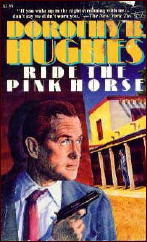
DOROTHY B. HUGHES – Ride the Pink Horse.
Duell, Sloan & Pearce, hardcover, 1946. Reprinted many times in both hardcover and soft, including Carroll & Graf, pb, 1988.
● Film: Universal International, 1947. Robert Montgomery, Wanda Hendrix, Andrea King, Thomas Gomez, Fred Clark. Screenwriter: Ben Hecht, Charles Lederer; director: Robert Montgomery.
I’m especially fond of regional mysteries, especially those set in New Mexico, a state as beautiful as any in the United States.
Fortunately, the state has had some good mystery writers use it, including Richard Martin Stern, Tony Hillerman, and Dorothy B. Hughes in Ride the Pink Horse, recently reprinted by Carroll and Graf.
Many mystery fans remember the excellent movie based on it and, indeed, the cover of this reprint portrays a man who looks like Robert Montgomery, the film’s star. (That’s he in the scene below, along with Andrea King.)
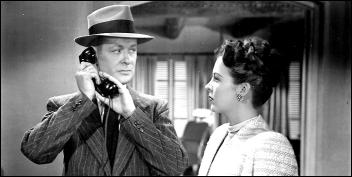
The book is set in Santa Fe during that city’s most colorful time, the annual Labor Day weekend fiesta. Hughes captures the city and its mixture of three cultures: Indian, Spanish, and “Gringo.”
Though some of the attitudes in the book seem a bit dated, i.e., the post World War II mixture of cynicism and idealism, here, too, is a book which has stood the difficult test of time.
– From The MYSTERY FANcier, Vol. 10, No. 3, Summer 1988 (very slightly revised).
Sun 14 Jun 2009
Posted by Steve under
Reviews[3] Comments
THE BACKWARD REVIEWER
William F. Deeck
STEWART STERLING – Where There’s Smoke.
J. B. Lippincott, hardcover, 1946. Hardcover reprint: Unicorn Mystery Book Club, 4-in1 edition, April 1947. Paperback reprint: Dell 275, mapback edition, 1949.

Saying that the Dell mapback has a great cover and leaving it at that is a temptation. But our noble editor has a strange notion that his readers should get their money’s worth, so ever onward and downward.
A two-alarm fire at the Brockhurst Theater leads to the discovery of a body burned to death, although the chap would also have died shortly from drinking denatured alcohol. The fire was deliberately set. Whoever was after the poor guy, and apparently. he had nothing but enemies, wasn’t taking any chances.
Fire Marshal Ben Pedley investigates this fire and a later fire and is involved in a third one. He also —
— Is “barrelling” up “sleet greased” Broadway in New York at a “screaming” seventy miles per hour worrying about the equipment responding to the second alarm because “no driver could get up to speed” on those streets. He then bears down on the gas.
— Nearly dies in the first fire rescuing a damsel in distress.
— Is conked over the head and tied up while searching the dead man’s apartment. (A killer, who later tries to do away with Pedley, does the conking and tieing. Why he doesn’t get it over with then is only conjecture, but it’s probably because there was still four fifths of the novel yet to come.)
— Nearly dies when the floor collapses under him while he is investigating a fire in progress.

— Lets a prisoner drive his car, rather than cuff the guy. (“Better this way,” Pedley says smugly and erroneously. The prisoner wrecks the car at fifty miles per hour. He escapes unscathed, while Pedley gets a bruised thigh.)
— Is shot at in a lawyer’s office by the guy who didn’t kill him at the apartment. I’m taking the author’s word for it here. I’m still trying to figure out how and why it happened the way he says it happened.
— Is nearly drowned in the pool at a Turkish bath by the guy who didn’t. try to kill him at the apartment and failed to kill him at the lawyer’s office. .
— Is laid out by a blow from a revolver butt to the bridge of his nose.
— Rescues again, more or less, the same damsel in distress from another fire and comes close to being burned alive.
One doesn’t expect a novel to be completely realistic, but there ought to be some connection with the real world.
Fire-fighting buffs should stick to Dennis Smith.
– From The MYSTERY FANcier, Vol. 9, No. 2, March/April 1987.
Sat 13 Jun 2009
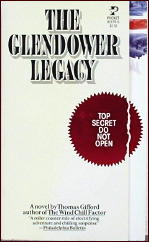
THOMAS GIFFORD – The Glendower Legacy.
G. P. Putnam’s Sons, hardcover, 1978. Paperback reprint: Pocket, 1979.

The world of academia scores a couple of telling blows to the ungodly in this, the latest thriller to come from the typewriter of the author of the highly acclaimed The Wind Chill Factor, but otherwise not all is well.
To borrow a term from the incomparable Mr. Hitchcock of movie fame, the MacGuffin, the object that all parties devoutly desire but which in fact may be all that keeps the plot moving, is a document dating from the days of the American Revolution — from Valley Forge, to be precise, at a time when morale was low and the ravages of dysentery were visibly high.
Betrayal at any moment, even by the commander-in-chief himself, given the right conditions and frame of mind, was a distinct possibility.
If this document could be authenticated, the resulting scandal would rock the nation, and a director of the Russian KGB with a sense of humor takes a serious interest as well. The scene shifts dramatically to Harvard Square and then to the remotest crannies of Maine before heading even further north, to a massive house located high up on the rocks of the Nova Scotia coast.
The hero, taking the role that Cary Grant would play, is a naive, middle-aged professor of American history, and in spite of their initial mutual antagonisms, when he takes refuge in the home of the fiercely liberated TV newsperson (Audrey Hepburn), you know that everything is just going to work out all right.
Harvard, however, will hardly be the same. Bodies pile up, torture scenes (with pliers) abound — and, you might ask — for what?
Successful combinations of comedy, blood and suspense can be done. They are a specialty of the Mr. Hitchcock previously referred to. Gifford can weave a nasty spell with words, but the enormous improbability of such a sequence of events, given the timetable suggested, drags the early part of the story into a morass of page-flipping, and the jagged abruptness with which it’s all wrapped up only points out the lack of solid substance throughout.
Nothing is gained. Pessimistically a number of lives are lost, and the pretense that it’s all in good fun can’t be maintained forever.
Definitely written with the movies in mind, and it could very well make a good one. It’s flashy and glib, and the weaknesses in the foundation can be easily overlooked. After the end of the book is reached — and believe me, once started, you most definitely will — that’s when the sugar-coating will be recognized, alas, for what it is.
Artificial, that is, and not altogether satisfying.
– From The MYSTERY FANcier, Vol. 3, No. 3, May-June 1979, slightly revised. The original review also appeared earlier in the Hartford Courant.
Bibliography —
The Wind Chill Factor, Putnam, 1975.
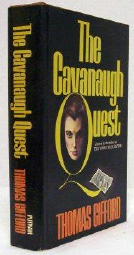
The Cavanaugh Quest, Putnam, 1976. (Nominated for the Edgar Award, Best Novel, 1977.)
The Man from Lisbon, McGraw, 1977.
The Glendower Legacy, Putnam, 1978.
Hollywood Gothic, Putnam, 1979.
The Assassini, Bantam, 1990.
Praetorian, Bantam, 1993.
The First Sacrifice, Bantam, 1994.
Saint’s Rest, Bantam, 1996.
as Thomas Maxwell —
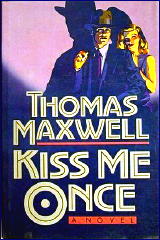
Kiss Me Once, Mysterious Press, 1986.
The Saberdene Variations, Mysterious Press, 1987.
Kiss Me Twice, Mysterious Press, 1998.
The Suspense Is Killing Me, Mysterious Press, 1990.
as Dana Clarins —
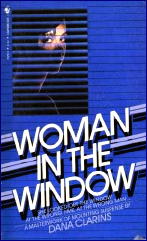
Woman in the Window, Bantam, pbo, 1984.
Guilty Parties, Bantam, pbo, 1985.
The Woman Who Knew Too Much, Bantam, pbo, 1986.
[UPDATE] 06-14-09. I mentioned The Wind Chill Factor in the opening paragraph, a reference that was more useful when this review first appeared, as the book is all but forgotten now.
In fact August West reviewed it as just that not so long ago on his blog, as one of Patti Abbott’s “Friday Forgotten Books” project. It’s a spy thriller that starts out in Minnesota, but it quickly goes international with a stirred-up nest of neo-Nazis.
I reviewed it myself back when it first came out, and one of these days I’ll come across it again, so maybe my review (also positive) will show up here some day as well.
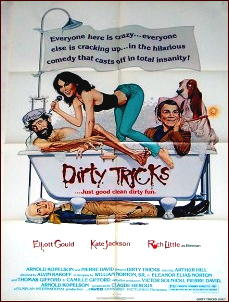
I wrote this review a few years before the movie I predicted did come out, and of course I was right about that, but I was wrong about who the stars were going to be.
The movie was called Dirty Tricks — and are you ready for this? — the stars were Elliott Gould and Kate Jackson. Passable choices, perhaps, but they were never to be confused with Cary Grant and Audrey Hepburn, and the inclusion of Rich Little as one of the players shows what the primary thrust of the movie was.
I’ve not seen it myself, but its rating on IMDB is 4.4 out of 10, which is Not Very Good.
Sat 13 Jun 2009
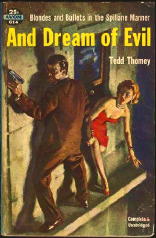
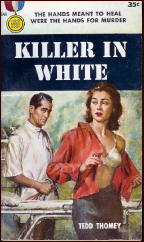
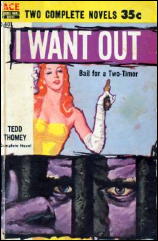
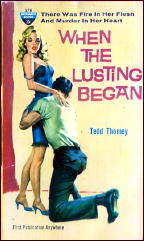
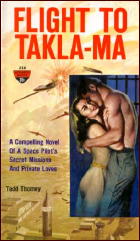
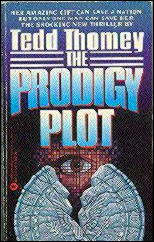
The passing of author Tedd Thomey was not known to the crime fiction community until quite recently, when Al Hubin came across the news as he was recently putting data together for the online Addenda to his Revised Crime Fiction IV.
(Note that Part 33 has just been uploaded. This installment is much shorter and earlier than usual, but in time, Al hopes, for the information to be included in the 2009 edition of the Revised CFIV on CD-Rom.)
Mr. Thomey died on December 1st of last year. A tribute to him by Tom Hennessy, a longtime friend, can be found online here, along with several photographs.
Some excerpts:
“Harold John Thomey was born July 19, 1920, in Butte, Mont. His father, who admired Theodore Roosevelt, called him Teddy. The second ‘d’ in Tedd was an affectation, added by a young man hoping to be noticed.”
Storming Iwo Jima: “Tedd landed with the Fifth Marine Division in the Third Wave . He hunkered down in a shell crater. That’s where he was when a bullet pierced his heel and his boot filled with blood. Removed to a hospital ship, he was eating ice cream that night while his buddies tried to establish a foothold on the beach.
“He cried the first time he told me of eating ice cream while his buddies fought for a toehold on the beach. He cried the second time, too.”
After the war: “Tedd became a reporter for the San Francisco Chronicle, whose photo staff included [Iwo Jima photographer Joe] Rosenthal. They remained friends until Rosenthal’s death two years ago.
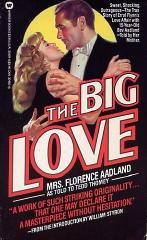
“Tedd also began writing pulp fiction articles, then turned to books, 18 in all, including The Big Love. It was about actor Erroll Flynn’s love affair with 15-year-old Beverly Aadland. Told to Tedd by her mother, Florence, it became a Broadway play starring Tracey Ullman.
“He also did profiles of celebrities, most assigned to him by his New York agent, Scott Meredith. Among his subjects: Humphrey Bogart, Peter Sellers, Judy Garland and Peter O’Toole.”
Bibliographic data. [Crime fiction only, expanded from the Revised CFIV, by Allen J. Hubin] —
THOMEY, TEDD. Full name: Harold John Thomey, 1920-2008.
And Dream of Evil (n.) Abelard-Schuman, hc, 1954; Avon 614, pb, 1956. [Los Angeles, CA]
Killer in White (n.) Gold Medal 546, pbo, 1956 [Los Angeles, CA]
I Want Out (n.) Ace Double D-401, pbo, 1959
The Sadist (n.) Berkley G-568, pbo, 1960 [Oregon]
-When the Lusting Began (n.) Monarch 178, pbo, 1960
Flight to Takla-Ma (n.) Monarch 216, pbo, 1962 [China]
The Prodigy Plot (n.) Warner, pbo, 1987
[UPDATE] Later the same day. Thanks to Juri Nummelin who points out on his Pulpetti blog another website dedicated to Tedd Thomey’s books, including his non-criminous ones.
Fri 12 Jun 2009
Posted by Steve under
Reviews[10] Comments
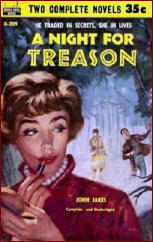
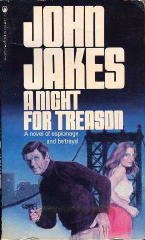
JOHN JAKES – A Night for Treason. Charter; reprint paperback, circa 1980. Hardcover edition, Mystery House (Bouregy & Curl), 1956. Other paperback editions: Ace Double D-209, 1957; Tor/Pinnacle, 1981.
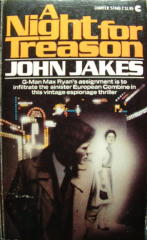
In the mid-70s, around the time of the American Bicentennial, John Jakes struck a pan of gold and became famous (perhaps even wealthy) for his Kent Family Chronicles and other works of early colonial and frontier America.
Before then he was only a journeyman author, writing science fiction and fantasy (Brak the Barbarian, among others), mysteries (the Johnny Havoc series, among still more others) and generally speaking, whatever would sell.
This is clearly one of his early efforts, and the only way it was reprinted some 25 years later is that someone was convinced that his name on a book would sell the book. In theory at least. It doesn’t turn up in used book stores all that often, and I don’t think it’s because it’s being held onto by scores of discriminating collectors.
Quoting from the front cover: “G-Man Max Ryan’s assignment is to infiltrate the sinister European Combine in this vintage espionage thriller,” and from the first page on you know it’s the purest sort of pulp fiction writing at its finest. By which I definitely do not mean Bad, but on the other hand, it’s not necessarily a compliment, either:
“Max Ryan drained the last of his coffee and placed the cup on the counter. His palms had started to sweat. He would have to do it soon, now… Max followed Gib out of the small roadside diner. The semi-trailer hulked like a giant animal on the shoulder of the turnpike. The sky was dark and cold with a pre-dawn chill. Few automobiles moved on the long stretch of highway, far apart.”
Even though the events are intended to be earth-shattering, the scope is strictly small scale, constricted in budget in the same way the old black-and-white second features at the movies were, back in the 50s.
A lot of the early action takes place in and around the Coco Club, for example, with a secret mastermind known only by his voice over the telephone orchestrating the nefarious criminal activities of the two or three henchmen he has under his control.
There is a surprise in store for Max on page 163, and it stunned me as well, at least at first. Given a chance to sit back down and think about it, my second reaction was probably closer to disbelief. You might respond the same way, but on the other hand, now that I’ve read the book and told you about it, think of it this way: you might not need to.
— March 2003
[UPDATE] 06-12-09. Up until getting this review ready to be posted, I was blissfully unaware of the other two paperback editions of this book. I should have remembered that it once was half an Ace Double, since I’ve been collecting them for over 40 years, but for some reason I can’t explain, I didn’t. Shame on me.
Fri 12 Jun 2009
Posted by Steve under
ReviewsNo Comments
REVIEWED BY WALTER ALBERT:
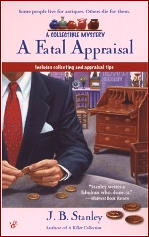
J. B. STANLEY – A Fatal Appraisal. Berkley Prime Crime, pb original, Oct 2006.
— A Deadly Dealer. Berkley Prime Crime, pbo, August 2007.
Molly Appleby is a writer for Collector’s Weekly, and in the second of the series (I’ve not read the first, A Killer Collection, Jan 2006) she’s sent by her irascible editor to Richmond, to cover a taping of the TV series, “Hidden Treasures,” which lands her in the middle of an investigation of the murder of two of the show’s appraisers.
Stanley seems knowledgeable about antiques, but there’s little to distinguish this from any of the several other similar series that have recently been popular. In fact, it was so unmemorable that I was well into a second reading before I stopped short, realizing that I had already read it within the last six months.
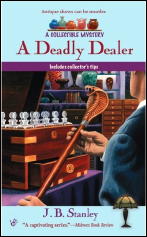
Never noted for my consistency, I bought A Deadly Dealer, the third in the series and discovered, to my surprise, that I was thoroughly enjoying the book.
The antiques that fuel this enjoyable outing are an eighteenth-century desk whose ownership is contested by two dealers and an early 19th century walking cane that conceals a deadly secret.
Molly’s relationship with her domineering mother bothers me somewhat, but there was just the right mix of antiques lore and crime narrative to engage my attention.
Now, maybe I will go back and look up the first book in the series.
EDITORIAL COMMENT. From all appearances, these three books are all there’s going to be in the Molly Appleby series. J. B. Stanley is having a much greater success with her “Supper Club Mystery series,” of which there are now five, the most recent being The Battered Body, which came out in March 2009.
Fri 12 Jun 2009
A REVIEW BY DAVID L. VINEYARD:
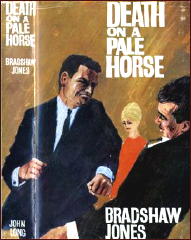
BRADSHAW JONES – Death on a Pale Horse.
John Long, UK, hardcover, 1964. Paperback reprint: Bridbooks, Israel, no date.
Malcolm Bradshaw Jones was an oil executive who retired to the Channel Islands off of Great Britain, and wrote eleven mysteries featuring tough special agent Claude Ravel and his wife Monique, an Anglo-French couple who first work for Cabinet Security under that “terrible old man James Keen” and later work for Interpol and their Home Office liaison, Peter Calvert.
Ravel is something of a rogue agent with a nose for trouble: “He’s about the most ruthless hell-bender I’ve ever met. And he’s got a wife, Monique, who works with him, who is almost as bad. She looks like something out of the fashion magazines and fights like a tiger. She’s French and Ravel is half French and completely bilingual. Between them they used to break just about every law we’ve got, all in the name of justice.”
Of course in real life Interpol (*) never had agents, and was in fact a front organization for Nazi sympathizers well into the 1960’s, but here we are dealing with the Interpol of fiction not fact, and anyway Ravel and his wide Monique behave like no police you have ever encountered.
Ruthless, blood thirsty, and deadly are the kindest thing you can say about them. That said, Jones writes this stuff with some small flare and obviously knows his locales. The scenes in Paris may not be Simenon, but they are authentic and redolent of the real place and not just the tourist trap version most fiction gives us.
In Death on a Pale Horse a naked man is found off the southwest coast of England, a small time thief, who died of some mysterious intestinal disorder. Interpol, and through them the Ravels are called in.
Soon they are on the trail of a defecting British chemist who has left behind a nasty bug that starts killing people, all leading to a remote private lab in San Stefano, and a trail of bodies and violence. The idealistic Dr. Porter’s trail takes them to Italy and into the hands of the ruthless drug smuggler Pavesi as the epidemic in England spreads. Now all they have to do is find Porter alive and “unseat death from his pale horse.”
There is nothing special here, but the writing is good, the plot moves well, and Ravel and Monique are an engaging pair of homicidal heroes, believably tough and ruthless. You could do a lot worse than Jones books about the Ravels and in some cases not a lot better.
I’ll be keeping an eye out for more books about them. It’s not often you encounter a husband and wife team who both carry concealed switchblades and have few compunctions about using them. It’s a bit as if James Bond had married Modesty Blaise, or a continental John Steed and Mrs. Peel after a session of SAS training.
Death On a Pale Horse is a short book, around 60,000 words, and a well done thriller with some interests and attractive, if ruthless, protagonists in the Ravels.
CLAUDE RAVEL. Series character created by (Malcolm Henry) BRADSHAW JONES, 1904- . Data taken from the Revised Crime Fiction IV, by Allen J. Hubin:
The Hamlet Problem (n.) Long 1962.
The Crooked Phoenix (n.) Long 1963.
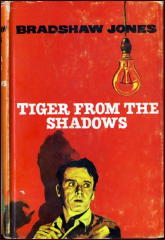
Tiger from the Shadows (n.) Long 1963.
Death on a Pale Horse (n.) Long 1964.
Private Vendetta (n.) Long 1964.
The Embers of Hate (n.) Long 1966.
Testament of Evil (n.) Long 1966.
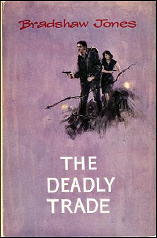
The Deadly Trade (n.) Long 1967.
A Den of Savage Men (n.) Long 1967.
______________________________________________________
(*) Interpol is a private organization founded in the mid 1930’s to gather information on criminal activities and provide it to subscribing police agencies around the world (for instance the FBI has never subscribed and does not receive Interpol bulletins despite what you see in movies and books).
It was infiltrated by the Nazis from the first and their influence continued into the 1960’s when it was finally purged. (Interpol refused to help in the hunt for Nazi war criminals on the grounds they were “political” crimes.)
Interpol is primarily a counting house for information and sends out bulletins on persons of interest; yellow sheets for those who do not have an active criminal record and are not wanted for a crime, and red sheets for wanted felons.
In the 1990’s Interpol began to employ investigators for the first time in its history. It has no enforcement duties, and the liaison to Interpol at most police departments are just some unlucky communications officer who receives no extra pay for his service. The Interpol agent of countless novels, movies, and television series is a myth that never existed, but has taken on a life of its own.
______________________________________________________
[UPDATE] 06-14-09. A tip of the hat to British mystery bookseller Jamie Sturgeon, who provided the cover images for both Death on a Pale Horse and Tiger from the Shadows. He also sent Al Hubin and I a long list of additional information about the settings and additional series characters in Jones’ books, all of which will appear in the next installment of the online Addenda for the Revised Crime Fiction IV.
Thu 11 Jun 2009
REVIEWED BY DAN STUMPF:
GRAHAM GREENE – This Gun for Hire. Doubleday, US, 1936. Previously published in the UK as A Gun for Sale, Heinemann, 1936. Reprinted many times in both hardcover and soft.
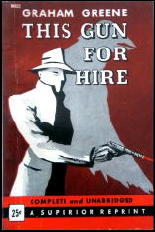
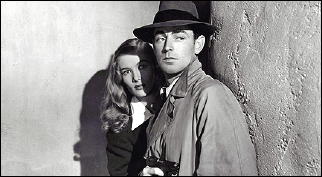
● Filmed as This Gun for Hire. Paramount, 1942. Veronica Lake, Robert Preston, Laird Cregar, Alan Ladd, Tully Marshall, Marc Lawrence. Screenwroters: Albert Maltz & W. R. Burnett; director: Frank Tuttle).
● Also filmed as Short Cut to Hell. Paramount, 1957. William Bishop, Robert Ivers, Georgann Johnson, Yvette Vickers, Murvyn Vye. Director: James Cagney.
Written in 1936 and very much aware of its time, Grahame Greene’s This Gun for Hire spins a (mostly) taut tale of an ugly little paid killer played false by his employers, evading the law and pursuing his lonely revenge, but at the same time manages to evoke much more.
There are themes of isolation and alienation here, vividly rendered by a simple plot that manages to turn most of its protagonists into outcasts at one point or another: the heroine goes from hostage to accomplice; her detective-boyfriend gets betrayed and bitter; the slimy go-between finds himself abandoned in his turn… and Greene sharpens his point with background motifs of Britain trying to celebrate Christmas on the eve of war. (In 1936, Europe was teetering on the brink of conflict like a drunk at the edge of a swimming pool, but there were still those who thought it could be avoided.) This Gun is filled with War headlines, nativity displays, civil defense drills and holiday shoppers in splendid counterpoint to its fast-moving tale of hunter/hunted.
Some of the players in this thing get a bit too much detail, and things slow up for characters we never really care much about, but Greene’s heroine breaks the mold, a tough proto-feminist who gets kidnapped, shot at, beaten, bound and stuffed up a chimney without once losing her wise-cracking, hard-boiled aplomb. A marvelous creation in a classic thriller.
This Gun for Hire was filmed twice, and both times the Christmas/War motifs were jettisoned as the action was moved from 1936 England to contemporary America.
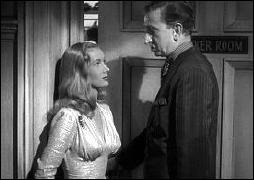
Greene’s preoccupation with man’s relationship to God and Society got short shrift too, while in the 1942 film writer W.R. Burnett focused on spies, poison gas, action and pace. Also, the hero/killer’s disfigured face, a major element in the book, was completely reversed by boyish Alan Ladd.
Still, the 1942 film of This Gun for Hire is a fine thing, with Veronica Lake ably translating Greene’s heroine, Laird Cregar memorably sucking chocolates as he orders a killing, and Alan Ladd, who turned out to be an actor of rather limited resources, achieving stardom as a hired killer — the perfect fusion of Actor and Role.
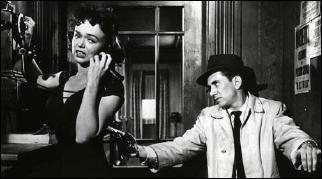
Then in 1955 producer A.C. Lyles (best remembered for a series of geriatric B-westerns in the 196Os) remade This Gun for Hire as Short Cut to Hell, directed by James Cagney, of all people.
It’s a difficult film to like: crude, sloppy, brutal and rather pointless, but Robert Ivers and Georgann Johnson (whose careers went nowhere) do surprisingly apt interpretations of Greene’s ratty little killer and smart-ass heroine.
Thu 11 Jun 2009
THE BACKWARD REVIEWER
William F. Deeck
EDWARD ACHESON – The Grammarian’s Funeral. Macrae Smith, US, hardcover, 1935. Hutchinson, UK, hc, 1935.
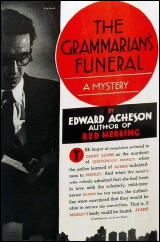
Choosing a book by its title is much like buying a pig in a poke. The contents are always a surprise — sometimes pleasant, sometimes disappointing, sometimes uncertain.
The Grammarian’s Funeral turned out to be nothing like I imagined it would be. It is the story of Crane Adams, meek, mild, downtrodden, and abused by the principal of his school, his wife, his students, and almost anyone else he comes into contact with.
Adams’s cousin, Chatterton Manley, to whom Adams owes a significant sum which he is paying back, apparently sporadically, disappears. Everybody but Adams is aware that Manley’s wife is in love with him. Manley’s suitcase is found in Adams’s garage. All that the police are lacking is a corpse.
The arrest of Adams by the police as “a material witness,” though they are sure he has done away with Manley, changes him from, if I may put it this way, a Casper Milquetoast to something like Mr. Hyde, although not quite as bright as the latter. Because of Adams’s efforts — if blundering about does not describe it better — the corpse is found and the real murderer is unmasked.
Adams’s alteration was unconvincing, as was the story that mumps in an adult male can cause impotence. But I was anticipating — why, I cannot say — a lighter, more frivolous novel from the title, and thus my judgment is probably suspect.
– From The MYSTERY FANcier, Vol. 9, No. 2, March/April 1987.
Bibliographic data [taken from the Revised Crime Fiction IV, by Allen J. Hubin] —
ACHESON, EDWARD (Campion). 1902-1966.
Red Herring. Morrow, 1932; UK title: Murder by Suggestion, Hutchinson, 1933.
The Grammarian’s Funeral. Macrae-Smith, 1935; Hutchinson, UK, 1935.
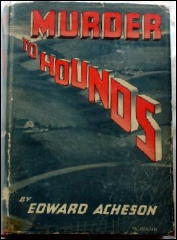
Murder to Hounds. Harcourt, 1939; Harrap, UK, 1939.
« Previous Page — Next Page »