June 2009
Monthly Archive
Thu 11 Jun 2009
In case you’ve missed it, a long series of comments (17 so far) has followed Mike Nevins’ most recent column for this blog.
In that column, among other things, Mike suggested Jim Garner as an ideal choice for playing Archie Goodwin (with Orson Welles as Wolfe). It never happened, but in the course of discussing the possibility, Mike Doran brought up an example of a TV pilot film that could have had Rex Stout’s two famous characters in mind when it was made — sort of, maybe? — although it was ostensibly about another character altogether, one who’s very well known to collectors of Old Time Radio shows.
This made-for-TV movie is unaccountably not listed on IMDB, but it’s been circulating among collectors for some time now.
Have I intrigued you? Follow the link in the first paragraph above, and then to the comments that follow.
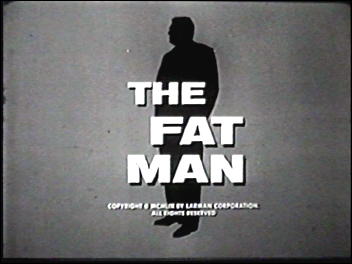
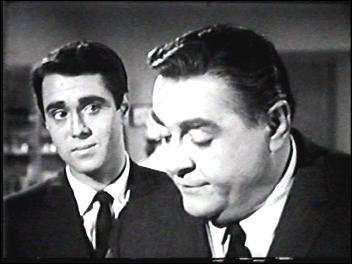
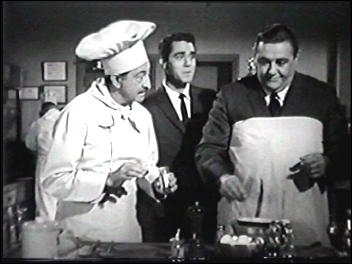
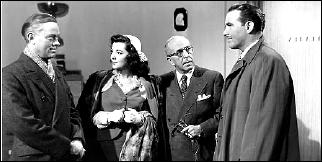
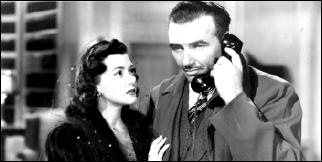
[UPDATE] Later the same day. Mike Grost has just sent me some images captured from the movie, the title of which is The Fat Man: The Thirty-Two Friends of Gina Lardelli, starring Robert Middleton. Presumably “The Fat Man” is the name of the proposed series, with the remainder being the title of the given episode.
Without knowing more about it than these two scenes, I’d say that if Rex Stout ever saw this film, he should have called his lawyers right then and there.
Anyone who fits my mental picture of Nero Wolfe more than this I can hardly imagine.
Wed 10 Jun 2009
BERMUDA MYSTERY. 20th Century-Fox, 1944. Preston Foster, Ann Rutherford, Charles Butterworth, Helene Reynolds, Jean Howard, Richard Lane, Theodore von Eltz, Jason Robards (Sr). Based on a story by John Larkin. Director: Benjamin Stoloff.
While there is more comedy and romance in this detective story, there is still enough mystery involved to make this strictly B-movie interesting and enjoyable, not to mention that the comedy and romance have a lot to do with it, too!
It’s also a private eye novel, straight from the pages of a 1940s Dime Detective magazine, which is to say slightly wacky and screwballish in nature, and of course there’s nothing wrong with that, either. Preston Foster is the PI, a guy named Steve Carramond, and his client is a girl (naturally), the vivacious dark-haired Constance Martin (Ann Rutherford), and the niece of one of the members of a tontine who has recently died under suspicious circumstances.
A tontine is one of those agreements in which the last surviving members of a group of individuals who’ve put money into a large pot, so to speak, split the proceeds. Not that the word tontine is ever mentioned in the movie, but it’s explained well enough for everyone in the audience to know exactly what’s going on.
Well, more or less, that is, as any resemblance to actual police procedure goes by the boards fairly quickly. Did I mention that the story takes place in New York City? I should. Only the opening scenes take place in Bermuda, where Connie’s uncle lived. The other members all live in Manhattan, or they did, until they start to die off shortly before the end of the group’s agreement.
Here’s where the romance comes in. Steve is hired a little under protest, as he’s supposed to be getting married the next day, but when Connie winks at us (the audience) we know precisely how that’s going to come out. Which it does.
How the movie comes out, and who the killer is, is another matter altogether.
In a tontine story, there are so many possible choices as to who might be the killer, a story writer really doesn’t have to be all that clever — just keep the action going, which it does, fairly nearly foot-on-the-floor and non-stop all the way.
Ann Rutherford, who was only 24 when she made this movie, is a charmer all the way, having already finished a long career through her teens as Polly Benedict in the Andy Hardy movies. Preston Foster, besides doing the heavy lifting, also does “put upon” very well in the comedy and romance end of things.
(For more on director Benjamin Stoloff, as well as some early discussion of Bermuda Mystery, see the comments following Walter Albert’s review of Super-Sleuth, which he also directed.)
But don’t get me wrong. In spite of the usual nonsense that accumulates in B-movie mysteries like this, there actually is some cleverness involved. You may scope it out as easily as I, or maybe even easier, as I wasn’t really trying. Mostly I was just enjoying myself.
PostScript. In those earlier comments following Super-Sleuth, here’s what David Vineyard had to say about this movie in particular:
“Though it isn’t listed as such at IMDB, Bermuda Mystery is a remake of the Crime Club Mystery film The Last Warning based on Jonathan Latimer’s The Dead Don’t Care. Foster played PI Bill Crane in the Last Warning. The mystery is something of a Thin Man style romantic mystery, though in some ways so is Latimer’s novel.
“Bermuda Mystery has a screenplay by John Larkin (Quiet Please, Murder!) who wrote several good screenplays and directed a bit too.”
Wed 10 Jun 2009
A REVIEW BY FRANCIS M. NEVINS, JR.
JOHN LUTZ – Tropical Heat.
Henry Holt & Co., hardcover, 1986; paperback reprint: Avon, 1987.
The setting is central Florida and the private detective is Fred Carver, a fortyish balding ex-cop whose police career abruptly ended when he was kneecapped by a Latino street punk.
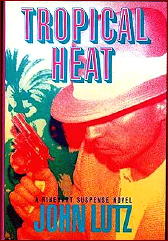
A new protagonist and a new scene, but the world caught on the pages of Tropical Heat is unmistakably the world of John Lutz, the St. Louis area’s foremost suspense novelist, and the superficially tough and cynical Carver clearly belongs in the post-Ross Macdonald fraternity (or is the word siblinghood?) of concerned and compassionate PIs, right alongside Lutz’s earlier detective character, the timid and soft-hearted Alo Nudger.
Vegetating in the beachfront bungalow he bought with his disability pay, Carver is visited by upscale real-estate salesperson Edwina Talbot and in effect challenged to stop pitying himself and do something with the rest of his life.
The particular something she wants him to do is to find her lover, Willis Davis, who in the middle of a solitary continental breakfast on her terrace either walked out on her for no reason, or jumped off a cliff into the ocean, or was pushed off.
The search leads Carver to a condominium time-sharing scam, a drug deal (in Florida, what else?), an assortment of close calls, and an emotional entanglement with his lovely and much-abused client which neither he nor she is well equipped to handle.
The plot of Tropical Heat is the bare-bones variety, but the meat on those bones is prime Florida noir. Lutz does a blazingly vivid job not only with the sun-soaked atmosphere and the wild action scenes (including Carver’s underwater duel with a Marielito knife killer and an airboat chase through the midnight Everglades) but also with the anguished relationship of a man and a woman each struggling against a personal darkness.
This novel makes great summer reading — provided the reading is done in an air-conditioned room to counteract Lutz’s descriptions of the oppressive Florida heat.
– Reprinted from The MYSTERY FANcier, Vol. 9, No. 2, March/April 1987.
FRED CARVER. Private eye series character created by John Lutz. For a complete profile of Fred Carver, check out his page on the Thrilling Detective website. The following complete list of recorded cases is expanded from the Revised Crime Fiction IV, by Allen J. Hubin:
Tropical Heat. Holt 1986; Avon 1987.
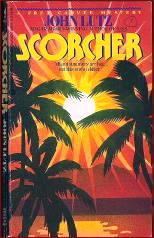
Scorcher. Holt 1987; Avon 1988.
Kiss. Holt 1988; Avon 1990.
Flame. Holt 1990; Avon 1991.
Blood Fire. Holt 1991; Avon 1992.
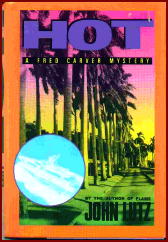
Hot. Holt 1992; Avon 1993.
Spark. Holt 1993; no ppbk edition.
Torch. Holt 1994; no ppbk edition.
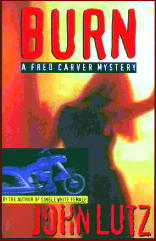
Burn. Holt 1995; no ppbk edition.
Lightning. Holt 1996; no ppbk edition.
Short stories —
“Someone Else” (Justice for Hire, 1990)
“Night Crawlers” ( EQMM, April 1997)
Wed 10 Jun 2009
A MOVIE REVIEW BY DAVID L. VINEYARD:
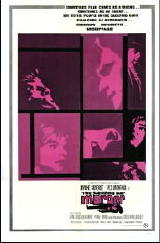
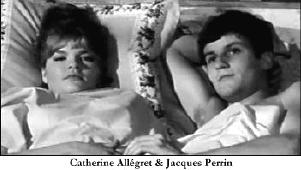
THE SLEEPING CAR MURDER. Seven Arts, 1961. Simone Signoret, Yves Montand, Pierre Mondy, Jean-Louis Trintignant, Jacques Perrin, Michel Piccoli, Catherine Allégret (debut), Charles Denner. Based on the novel Compartiment Tueurs (aka The 10:30 From Marseille) by Sébastien Japrisot. Director: Costa-Gravas.
Before he made his mark as a political director with leftist leanings, Costa-Gravas made his debut with this slick little police thriller about the hunt for a mad killer.
The police are represented by Inspector Grazziano (Grazzi) played by Yves Montand and his younger partner Grabert played by Jean-Louis Trintignant, whose involvement begins with the discovery of a body on the Phoce’en, the 10:30 morning train from Marseille, and an attractive young woman who has been murdered.
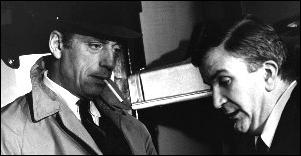
We are almost instantly in Maigret country, but to Costa-Gravas’s credit, he establishes his own visual style and technique rather than rely on memories of films of Simenon’s novels. There is nothing leisurely or casual about Montand and Grabert. They are real policemen who chew on antacids, smoke too many cigarettes, and take endless notes, and almost from the top they are up to their necks in it, because before they have finished sorting the first corpse there’s a second waiting for them. The weariness in Montand’s lined doggedly handsome features becomes a character in itself.
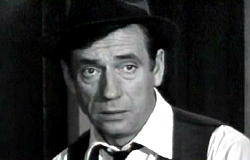
Police and authorities are seldom sympathetic characters in Costra-Gravas’s films, so it comes as a shock how much this film identifies with its put-upon policeman heroes.
They are decent men with lives outside the office, and would rather do just about anything than have their superiors down their necks as they face an increasing number of corpses and a possibly mad killer.
Costa-Gravas relies less on flashy camerawork and more on storytelling in this one, with atmosphere to spare, thanks to cinematographer Jean Tournier’s brilliant camera work, the film’s quick pace and the well-done action scenes.
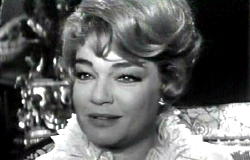
Signoret and the rest of the cast are fine, as might be expected, and thanks to staying close to Japrisot’s tight cinematic script, the film is both suspenseful and a good mystery well-solved.
That said, you would do well to find a copy of the film with subtitles and avoid the awful dubbed version I first saw.
Costa-Gravas became a world wide sensation with his next film, Z, but his increasingly leftist films became more propaganda than entertainment, though his one American film Missing, with Jack Lemmon and Sissy Spacek, was highly thought of. Since then politics outstripped the film-making in too many of his later works. Montand also appeared in Z, State of Siege, and The Confession all helmed by Costa-Gravas, forming one of the French cinema’s most productive teamings.
Sébastien Japrisot is one of the more familiar French writers on this side of the Atlantic, thanks to the films of his works, including his original screenplays for Rider on the Rain and Goodbye Friend, and adaptations of many others like Lady in the Car With Glasses and a Gun and One Deadly Summer. Most recently the 2004 film of his novel A Very Long Engagement was an international hit.
Tue 9 Jun 2009
Posted by Steve under
Reviews[3] Comments
THE BACKWARD REVIEWER
William F. Deeck
FRANK KANE – Esprit de Corpse. Dell 2409, paperback original; 1st printing, August 1965. Cover by Ron Lesser.
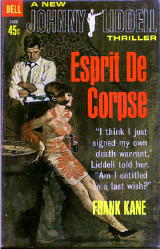
Yes, there’s nothing new in one individual taking on the crooks and corrupt officials in a city. And it’s been done better and in greater depth — The Fools in Town Are on Our Side and Red Harvest come immediately to mind. Nonetheless, this thriller is quite satisfactory for the second rank.
When a private eye, out of his depth, gets framed for murder in the sleazy Barbary Coast of Carsonette City in Southern California and is, with the eager assistance of his estranged wife, doomed to spend his life in the loony bin, he asks his partner to call in another private eye, Johnny Liddell.
His partner — a she, although by no means another V.I. Warshawski — flies to New York to enlist Liddell’s help. Apparently she goes in person since her argument isn’t a strong one and she must compensate by “the hemispherical roundness of her full breasts.” Upon viewing them, even clothed, Liddell’s jaw drops and his good judgment vanishes.
She knows her man.
(Has there ever been a female client in private-detective literature who had “empty” breasts? Have no tough PI’s been weaned?)
Though threatened and attacked by the crooks and threatened and arrested by the corrupt police, Liddell emerges triumphant. He understands, and I’m taking his word for it, why the frame took place and how the bookies and the Mafia were being taken by other crooks.
As an added attraction, one of the villains ostensibly is a closet Edgar Wallace reader. When Liddell catches this desperado in a felonious act, the man says, “Okay, Mac. It’s a fair cop.”
– From The MYSTERY FANcier, Vol. 10, No. 3, Summer 1988.
EDITORIAL COMMENT. Bill Deeck, who died far too young in 2004, was a well-known mystery fan and over the years the author of a tall stack of articles and reviews for The Armchair Detective, Mystery Readers Journal, and a number of other zines, including The MYSTERY FANcier.
Before posting any of his work here, I consulted with Richard Moore, a close friend of his who lived not very far away, and Bill Pronzini, who helped ensure that Murder on 3 Cents a Day, Bill Deeck’s reference work on hardcover lending library mysteries, finally saw publication.
For covers of many of these books and more on Bill Deeck and how the book came into being, go here.
Said Richard, when I asked, “I am positive that Bill would be pleased to have his reviews receive another life. They were done without pay originally and the reprinting does not involve revenue. It is hard to imagine an objection.”
Bill Pronzini: “I agree with Richard. Bill D. would be delighted to see his reviews reprinted on the M*F blog. By all means go ahead.”
And so I have. This is the first of many of Bill Deeck’s reviews that I will be posting here. I feel greatly privileged to be able to do so.
Tue 9 Jun 2009
IT’S ABOUT CRIME
by Marvin Lachman
JOHN GREENWOOD —
● Mosley by Moonlight. Quartet, UK, hardcover, 1984. Walker, US, hc, 1985; Bantam, US, pb, April 1986.
● Mists Over Mosley. Quartet, UK, 1986; Walker, US, 1986; Bantam, US, pb, September 1987.
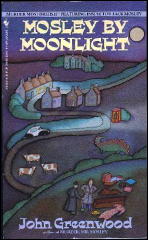
The best work on mysteries in the British village is the chapter by Mary Jean De Marr in Comic Crime (1987), edited by Earl Bargainnler and published by Bowling Green’s Popular Press.
Although Ms. De Marr covered some recent examples, I suspect that she hadn’t caught up with John Greenwood’s series of six books about Inspector John Mosley, whose territory covers the small towns on the very flexible border between the counties of York and Lancaster.
British-village mysteries, contrasted with the generally unsophisticated examples of rural-American detective stories, are told in a sophisticated style and permit the reader to have fun at the expense of the local characters.
Greenwood, the pseudonym of the late John Buxton Hilton, was excellent on atmosphere, if a bit weak on plotting. Prime examples are the second and fourth books in the series, Mosley by Moonlight, in which a British television crew invades the town of Hadley Dale when extraterrestrial sightings are reported, and Mists over Mosley, about a coven of witches and municipal corruption.
Mosley is an unusually enigmatic sleuth, one who likes to “keep himself to himself” as the British say. He has a knack of disappearing but then turning up under strange circumstances, properly surprising Greenwood readers.
– From The MYSTERY FANcier, Vol. 10, No. 3, Summer 1988 (slightly revised).
INSP. JACK MOSLEY. Series character created by John Greenwood, pseudonym of John Buxton Hilton, 1921-1986. [Data expanded from that found in Revised Crime Fiction IV, by Allen J. Hubin.]
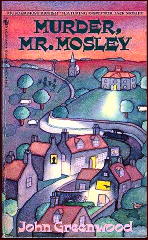
Murder, Mr. Mosley. Quartet, UK, 1983. Walker, US, 1983; Bantam, US, pb, Feb 1986.
Mosley by Moonlight. Quartet, UK, 1984. Walker, US, 1985; also Bantam, US, pb, April 1986.
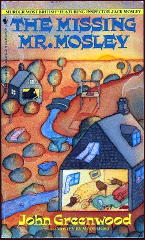
Mosley Went to Mow. Quartet, UK,1985. Walker, US, hc, as The Missing Mr. Mosley, 1985; also Bantam, pb, Dec 1986.
Mists Over Mosley. Quartet, UK, 1986. Walker, US, 1986; Bantam, US, pb, Sept 1987.
The Mind of Mr. Mosley. Quartet, UK, 1987. Walker, US, 1987; Bantam, US, pb, July 1988.
What, Me, Mr. Mosley? Quartet, UK, 1987. Walker, US, 1988; Bantam, US, pb, 1989.
Tue 9 Jun 2009
Judy and I got home yesterday around 4:30 in the afternoon. It’s 550 miles between here and London, and while it was easy enough, taking two days by car each way, we regretting not leaving more time for visiting with my brother and his family.
We had no problems crossing the border, but my daughter and her husband did. You can read about their adventure here on Mark’s blog.
The weather on the day of my niece’s wedding was truly beautiful — a bright blue sky with the temperate in the low 70s — and everything went off well. A day to remember. I hope to have some photos to post here soon.
It will take another day or so for us to recover, but after that I have a backlog of material to post. I’ll get to it as soon as I can!
Tue 2 Jun 2009
Canada, that is. Ontario. I thought I might get some reviews posted today, but it’s taken more time to get ready than I’d planned on.
Judy and I are leaving tomorrow around noon. It will take us two days to get there by car, but we’ll be in plenty of time for my brother’s daughter Jocelyn’s wedding on Saturday. My sister and her husband from Michigan will be there, and my daughter and her husband from Illinois are driving up also.
So it’ll be a small family reunion of sorts as well — the most Lewises in one spot in quite a while. Judy and I looking forward to it — not the driving part so much, but we don’t need to push ourselves, so that’ll be OK — but I’m going to leave the computer at home.
This blog’s going to be idle for a while, in other words, so hang on till about this time next week. I have plenty of reviews and other stuff piled up for posting as soon as I get back — of both books and movies, lots more of what you’ve been seeing here recently — and the way things look now, there’ll be a few more contributors who’ll be appearing soon.
Take care, and so long for now.
— Steve
Mon 1 Jun 2009
DELUSION. Cineville, 1991. Jim Metzler, Jennifer Rubin, Kyle Secor, Jerry Orbach. Director & co-screenwriter: Carl Colpaert.
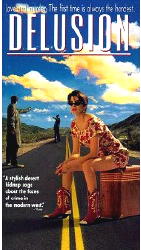
This is a pretty good example of a category that can’t be called anything but neo-noir. Produced way past the usual late 1950s closing date for the first grouping of noir films, and made especially with the term (and the goal of making a) noir film in mind, movies in this particular genre are also made cheaply and have many of the same themes as the originals …
… but they’re almost always in color — often brilliant, blinding color — and obviously they include a lot more overt violence and sexuality than the directors in the 1940s could ever have dreamed of.
Most of them have had very limited theatrical releases. Many of these crime-oriented features were direct-to-video (and now direct-to-DVD) and used to show up on HBO, Showtime and Cinemax after 11 o’clock all the time.
(For some reason they don’t any more, and I don’t know why. Late night programming seems to consist of regular movies that run all day long, over and over, or really awful softcore pornography.)
Reviews I’ve seen of Delusion have been mixed. The New York Times hated it, but two reviewers for the Washington Post were of totally opposite opinions. I thought the first half was also first-rate; the second half, well, second-rate.
Here’s a question for you. Suppose you’re a guy into computers, and you’re on the run from your former employer with nearly a half million dollars in cash stashed in the trunk of your car. You’re on the road somewhere in the desert (Nevada, let’s say) and you see the car that just careened past you moments before spin off the highway and land upside down in the sand. Two people, a man and a woman, are struggling to get out.
Would you stop? Would you offer them a lift?
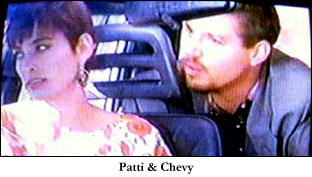
Generally speaking I guess most people would, and like George O’Brien (Jim Metzler), I guess a lot of people would be ruing their decision within minutes, kicking themselves no end for being so kind-hearted.
Two more flaky people — seriously flaky, let’s be emphatic here — than Patti (Jennifer Rubin) and Chevy (Kyle Secor), could scarcely be imagined. How soon can he possibly get them out of his car, George is thinking, and you can just see it in his face and tortured body language as the predicament he’s in starts to sink in.
Do they have guns? Yes. Do they have other plans in mind? Yes. Or at least Chevy does, on both counts. Patti’s involvement is not so clear. There are a couple of really good twists coming, one of them (or maybe both) involving Chevy’s friend Larry (Jerry Ohrbach) who is living alone in a trailer beside a small lake in the middle of the desert.
The couple of good twists come a little bit too early, though. I was set up to expect one or two more, and I was disappointed when I didn’t get them – or in other words, as I previously implied, the second half doesn’t begin to match up in a direct comparison with the first.
It’s still a noir film all the way, however, allowing some forgiveness for a couple of allegedly comic touches, also in the second half.
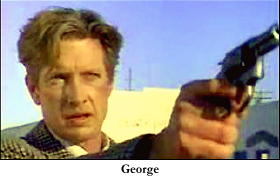
As George finds himself sinking more and more quickly into the quicksandish trap he’s let himself in for, the question he finds that he must keep asking himself is, how important is the stolen money to him?
Jennifer Rubin, by the way, was the original model in Calvin Klein Obsession ads, and this movie was relatively early in her career. She’s quite beautiful, obviously, and in the first half (I keep getting back to this, don’t I?) she’s plays enigmatic very well. Make that extremely well. Once she’s given some dialogue, you know that an actress she wasn’t yet.
Not that her career went uphill from here. Other than the lead role in the remake of Roger Corman’s The Wasp Woman, which came along later, I don’t see anything but mediocre parts in even more mediocre movies on her resume.
Mon 1 Jun 2009
Uploaded this morning was Part 32 of the ongoing online Addenda to the Revised Crime Fiction IV, by Allen J. Hubin. New and corrected information continues to stream in. Part 31, for example, was uploaded only two months ago.
The data consists of a few new authors and titles, as always, but again as usual the large portion of it consists of additional facts about books and authors previously included, such as settings, series characters (both added and deleted), and films based on titles in CFIV but not previously noted.
Tise Vahimagi’s recent article on Eric Ambler’s TV credits revealed four made-for-TV movies or mini-series not previously noted, for example, and new films such as Killshot (Elmore Leonard) and In the Electric Mist (James Lee Burke) have recently appeared as direct-to-DVD released. Both have been included, as well as a French film based on Gil Brewer’s 13 French Street (2007), not known about until a serendipitous discovery on IMDB only two days ago.
Data at least through Part 32 will be included in the 2009 CD-ROM edition of Crime Fiction IV, which should be available at the time of this year’s Bouchercon. Data accumulated through the rest of the summer will be posted online in Part 33, but (as I understand it) there might not be time for it to be included on the upcoming CD.
So follow the link above and feel free to browse around. If you spot any errors and would like to make corrections, or if at any time you have additional information to supply, then of course, please do!
« Previous Page — Next Page »