FIRST YOU READ, THEN YOU WRITE
by Francis M. Nevins


   Suppose all the readers of this column were gathered together in one room. At the front, standing before the lectern or podium or whatever the hell you call it, I pose a question: Any of you know something about Tom Everitt? Almost everyone in the room would probably answer: “Tom Whoveritt?” Perhaps one or two who had read my book THE ART OF DETECTION and were blessed with a photographic memory might say: “Wasn’t he the guy who provided the plots for Manny Lee to turn into Ellery Queen radio scripts after Fred Dannay dropped out and before Anthony Boucher came aboard?”

   Indeed he was. But aside from that fact, and the titles of more than thirty EQ scripts that were based on Everitt plot synopses, virtually nothing is known of him. While working on THE ART OF DETECTION I had ransacked the Web looking for a little more information about this mystery man but with no luck. Then out of the blue not long ago I received an email from a total stranger who, in the course of researching something else entirely, had unearthed more information about Everitt than I could have used even had I known of it in time to put it in the book. But there’s no reason I can’t summarize it here. Thank you, Jonathan Guss, for making this month’s column possible.

   John Thompson Everitt, whom I’ll call JT just to make things simple, was born in Yonkers, New York on December 11, 1908. His ancestors had arrived in Massachusetts by 1643 and had settled in the New York City area near Jamaica by 1650. JT’s father, Charles Percy Everitt (1873-1951), was a well-known rare book dealer, and Charles’ brother Samuel Alexander Everitt (1871-1953) was a partner in the Doubleday publishing house until his retirement in 1930. JT’s older brother Charles Raymond Everitt (1901-1947) also went into the publishing business, working at Harcourt Brace and later, until his early death, at Little Brown, the publisher of a volume of memoirs by his and JT’s father (THE ADVENTURES OF A TREASURE HUNTER: A RARE BOOKMAN IN SEARCH OF AMERICAN HISTORY, 1951).

   In 1930 JT graduated from Yale, where he was known as a soccer player. A year later he was hired by the CBS radio network to write for its March of Time program. By 1940 he had moved into the advertising side of radio at the Young & Rubicam agency where, among many other jobs, he was tasked with handling a prospectus from the NBC radio network on The Green Hornet, for which NBC was seeking a sponsor. Apparently he was still working at that agency when he became involved with the Ellery Queen series.

   Since its debut in June of 1939, every one of the scripts for the series had been written by Manfred B. Lee based on plot synopses prepared by his cousin and EQ collaborator Fred Dannay. (More precisely, every one except “The Dauphin’s Doll,” first broadcast around Christmastime 1943 and written by Manny alone.) Early in 1944 Fred’s wife was diagnosed with cancer. The burdens of taking care of two young children, plus editing a large annual anthology of short mystery fiction and running Ellery Queen’s Mystery Magazine (EQMM), which had been launched in the fall of 1941, soon made it impossible for Fred to continue coming up with a plot a week for the radio series.

   He was several synopses ahead when he dropped out, and Manny squirreled these away for use in emergencies, relying most of the time on recycling earlier scripts under new titles and condensing 60-minute scripts from the show’s first season (1939-40) into its current half-hour format. But these ploys couldn’t go on indefinitely. Somebody had to be found to take over Fred’s function.

   How TJ came into the picture remains unknown. Possibly it was through his older brother Charles, who was working at Little Brown, publisher of the Queen novels and anthologies since 1942. Perhaps it was due to the connections Fred and Manny had retained with the advertising and publicity businesses where they’d gotten their start. Whether he was the first man brought in to assume Fred’s function as plot provider remains unclear.

   We don’t know exactly how many Dannay synopses Manny had in reserve, but several of the episodes dating from late 1944 strike me as too outrageous to have stemmed from Fred. Take, for example, “Cleopatra’s Snake” (October 12 & 14, 1944). As backstage observer of a live production of Antony and Cleopatra for experimental TV, Ellery becomes a key witness when the genuine poisonous snake being used in the death scene (yeah, right) bites to death the actress playing Cleopatra.

   Now let’s consider “The Glass Sword” (November 30 & December 2, 1944), in which Ellery tackles the case of the circus sword swallower who died when the sword in his stomach broke while the lights were out. Was it Everitt who cranked out the synopses that Manny turned into these scripts? Was it another Dannay substitute? Or, wacko though they are, could they have originated with Fred after all? For more information, keep reading.

   The earliest EQ script that we know came from a synopsis by Everitt was “The Diamond Fence” (January 24, 1945), which involves the murder of a middleman for stolen gems and the disappearance of five diamond rings from the scene of the crime under impossible circumstances. A substantial excerpt from this episode survives on audio as a “sneak preview” from the Armed Forces Radio Service.

   From that point at least through the end of March, every script Manny wrote was based on Everitt material. It was during these early months of the last full year of World War II that Manny enlisted Anthony Boucher (1911-1968) to take over Everitt’s function. It was an ideal choice. Boucher had already published seven novels in the Queen vein and had had short stories published in EQMM. Also, as we know from comments in various of his mystery reviews for the San Francisco Chronicle, he was an enthusiastic fan of the radio series.

   Since Tony lived in Berkeley, California and Manny on the east coast, collaboration on EQ radio scripts required vast correspondence between the two. This correspondence, archived at Indiana University’s Lilly Library, documents their work together in microscopic detail. The only aspect of it that concerns us here is Manny’s continual snarky remarks about Everitt, of which I’ll quote a few.

   On May 3, 1945, about six weeks before the broadcast of the first Boucher-Lee collaboration, Manny tells Tony that he’s “washed up” with Everitt, who “will do four more for us, and then he’s through. This by mutual agreement.” On the 17th of the same month, he says: “We want to avoid some of the weaknesses resulting from our present man’s so-called efforts….” And on the 24th he lets Tony know how he really feels about Everitt: “….At the end of our association with our ‘man,’ as I like to call him—hating his smug, treacherous guts as I do!—we’re finding more trouble…and sloppier submissions on his part even than usual….”

   On January 24, 1946, he describes one of the Everitt synopses he had to deal with as “a bad outline which I bought only because I was desperate …and bought and paid for it with the mental reservation that I’d probably have to do a thorough re-working job on it. I was a noble prophet.”

   But, simply because the EQ radio formula was so complex and demanding and Boucher with all his other commitments couldn’t conjure up a new plot synopsis on a weekly basis, Manny was forced to make further commitments to Everitt. “This was a desperation move,” he tells Boucher on October 30, 1946, “as his stuff always gives me headaches, but good….I had to do something in self-protection. I heartily wish now I hadn’t made that commitment…. But it can’t be undone and I can only hope that he doesn’t come through, so that I can order more from you.”

   Almost a year later Manny is still reluctantly dealing with Everitt now and then and, in a letter to Fred Dannay dated November 4, 1947, griping about it just as loudly. Discussing the possibility of repeating some of the scripts based on Everitt synopses, he describes Everitt as “such a son-of-a-bitch that, even though our rights to repeat the material without payment are clear, he would raise a considerable stink in the business if we didn’t pay him an extra fee….[F]or the most part he got tremendously overpaid in the original payment—the bulk of the creative work was done by me, out of sheer necessity.”

   If Manny were to offer a token fee of perhaps $50 per episode recycled, Everitt “would start haggling and chiseling and his tongue would wag plenty in the business….” What business Manny is referring to becomes clear later in the same letter. “[Y]ou don’t know…what that bastard has been saying and is still saying in the advertising business about his ‘part’ in the Queen show. There is no protection against his kind of conscienceless and unscrupulously shrewd self-propaganda….”

   As his correspondence with both Fred and Boucher demonstrates, at least during the radio years Manny was a Type A personality with a genius for getting hot under the collar, and the insane pressure of putting out a program every week probably shortened his life.

   Whether he was being too harsh on JT is hard to judge. One of the few living persons to have seen any of the Everitt material Manny turned into scripts is Ted Hertel, who helped choose the scripts included in THE ADVENTURE OF THE MURDERED MOTHS (2005). In connection with that project he was erroneously sent the synopses for “The Right End” and “The Glass Sword,” both with Everitt’s name on them.

   To judge by Ted’s comments, what Everitt gave Manny to work with was just as bad as Manny said it was. In an email to me he described the synopses as “so poorly written, so amateurish, that they could not possibly have been the work of Manny in any form.” (The scripts Manny based on these synopses were broadcast respectively on November 16 and 30, 1944.)

   Only one episode Manny based on an Everitt synopsis is available on audio. In “Number 31″ (September 7, 1947) Ellery tries to crack the secret of international mystery man George Arcaris’s success at smuggling diamonds into the Port of New York and to comfort a wonderfully dignified black woman by solving the murder of her son, the servant for a wealthy man-about-town. The cases seem unconnected until Ellery discovers the number 31 popping up in both.

   It’s an excellent episode, but how much credit should go to Everitt remains a mystery since no one in the last 70 years has seen his synopsis. I wouldn’t be surprised if the black woman was entirely the creation of the staunchly liberal Manny Lee.

   To the best of my knowledge the only Everitt radio work besides his EQ plots was a single script for The Shadow. In “The Creature That Kills” (January 6, 1946) Lamont Cranston, alias The Shadow, investigates the theft of priceless papers from the 20th-floor laboratory of a brilliant young scientist under impossible circumstances.

   It turns out that the thief, a master criminal with a Sydney Greenstreet voice, had an accomplice in the form of a trained 27-foot python which slid down the side of the building from the window directly above the scientist’s lab, got hold of the papers, then slid back up the wall to its master. What a snake! Do I detect here the same kind of wackiosity that pervades the EQ scripts about Cleopatra and the glass sword?

   In 1947 Everitt returned to radio full-time as Eastern program manager for the ABC network. We don’t know if he wrote any more for the medium, but Jonathan Guss mentions one script he contributed to the golden age of live TV drama, “Revenge by Proxy” (Colgate Theatre, May 14, 1950). The cast included Nancy Coleman, Phil Arthur, Bernard Kates and Victor Sutherland. As chance would have it, the following week’s drama, “Change of Murder,” was based on a short story by Cornell Woolrich.

   Everitt died on November 2, 1954, at age 45. Today he seems to be totally forgotten, perhaps deservedly so. The most that can be claimed for him is that he figures as a footnote in the Ellery Queen story. But at least now that footnote has been written.
GEORGE BAGBY – The Golden Creep. George Bagby/Inspector Schmidt #48. Doubleday Crime Club, hardcover, 1982. Detective Book Club, hardcover, 3-in-1 edition. No paperback edition.

   At one time in my life, I think you could say that Aaron Marc Stein (aka George Bagby) was my favorite mystery writer. Emphasis on writer. He had a fluid, smooth style of putting words on paper that I’ve never been able to describe to my own satisfaction, much less anyone else’s, and his dialogue may have been even better. When two people are having conversations in his books, you always know who’s speaking, even when all you have are the words they are saying to judge by.

   There were 49 books in his George Bagby series — Bagby is the fellow who tags along with New York City police inspector Schmidt on his many many cases– and this one is number 48, and I don’t even remember seeing the title before. Stein was in his late 70s when he wrote it, and while the writing is as good as ever, the plot itself is one of his weaker ones.

   It starts out in semi-salacious fashion, with Bagby visiting a girlie joint on his own and ending up in an alley behind the place afterward next to a dead body. The dead man is the character the book is titled after — he made himself rather obnoxious with the Amazonian-built girls who are the main attraction — referred to, surprisingly, as “tit elation” — and Bagby, having been slipped a mickey, as he supposes, is the main suspect.

   And Inspector Schmidt — I don’t know if he ever had a first name — has to play it carefully, as the press knows full well how close the two of them are. But rather than concentrate on the doings leading up to the murder, the two of them focus instead on the murder weapon — the tail of a huge stone dragon that someone carted to the roof of the place and dropped down on the dead man.

   You have the feeling that when the appropriate number of pages have gone by, Stein/Bagby decided it was time to close things up and get back to the people in and around the strip joing itself, and sure enough, that’s all it takes to solve the case.

   I found the book enjoyable, but if you aren’t a fan of Bagby’s from before, or worse yet, you’ve never heard of him, this one won’t be the one to convince you that you ought to read more of him.

REVIEWED BY DAN STUMPF:         


BORDEN CHASE Diamonds of Death

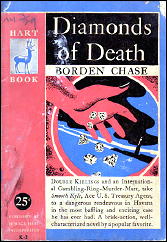
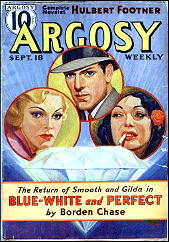
  BORDEN CHASE – Diamonds of Death. Hart, paperback original, 1947. First serialized as “Blue-White and Perfect,” Argosy, 18 Sept-23 Oct, 1937. Filmed as Blue, White and Perfect, 1941.

   A while back, I read and reviewed Borden Chase’s novel Red River and found it surprisingly hammy from a writer known for his laconic screenplays. So I decided to give him another try and fished out Diamonds of Death, the first novel edition of Chase’s pulp novelette, “Blue-White and Perfect.”

   This is that rarity, a dumb mystery that doesn’t insult one’s intelligence. The “surprise” criminal may be obvious early on, but Chase speeds his story through so many curves one hasn’t time to carp, as hero Smooth Kyle (I guess some folks don’t care what they name their kids) chases diamond smugglers from Broadway to Havana and back again.

BORDEN CHASE Diamonds of Death

   Chase provides his hero with a wise-cracking girlfriend, buddies in the Customs Office, and enough bad guys to felonize a dozen books like this, ranging from cheap hoods to smooth operators, phony dowagers, fake cops… I could go on, but readers of this sort of thing have met them before, and those who haven’t probably couldn’t appreciate the pulpy splendor of the piece, as Chase fills his story with glittering diamonds, luxury liners, exploding airplanes and elegant mansions, all of which impart a feel of extravagance without actually costing anything to write about.

   I’ll just add that the original pulp novel was bought by Fox for their “Michael Shayne” series back in the 40s, movies notable for pace, casting, and for the fact that the producers used only one Mike Shayne novel in the whole series, apparently preferring to impose their hero into stories by other authors, including Clayton Rawson, Frederick Nebel and even Raymond Chandler!

   Anyway, Borden Chase’s story suits the character quite well, and reading this one can almost hear Lloyd Nolan’s snappy banter as he stalks through the studio back lot.

BLUE, WHITE AND PERFECT. 20th Century Fox, 1942). Lloyd Nolan (Michael Shayne), Mary Beth Hughes, Helene Reynolds, George Reeves. Based on a serialized story by Borden Chase (Argosy, 18 Sept-23 Oct, 1937; reprinted in book form as Diamonds of Death [Hart, paperback, 1947] and reviewed here ). Director: Herbert I. Leeds.

   Blue, White and Perfect is the fourth of seven Mike Shayne movies made by 20th Century Fox in the early 40s, all starring Lloyd Nolan as author Brett Halliday’s famed private eye, Michael Shayne. As far as I know, I’m the only one who doesn’t care for any of them, although certainly some are better than others.

   This, I think, is one of the others, but the reason I don’t particularly like any of them is that Lloyd Nolan, with his brash New York accent — not to mention the comedy aspects of the films — comes nowhere near the image of Mike Shayne I have in my mind. If the films had been made with a totally different fictional character’s name to them, I might like them more.

   The Mike Shayne stories in the books and magazine were at least medium-boiled. The Lloyd Nolan movies were comedies, as far as I’m concerned, with lots of humorous banter between the characters, with hints of actual detective work breaking out only every once in a while. In this one, facing an ultimatum from his steady girl friend (Mary Beth Hughes), Shayne gives up his job as PI and takes a job as a riveter at a defense plant. Secretly, of course, he’s hired as a security expert.

   And wouldn’t you know it, his first day on the job and a sizable amount of industrial diamonds is stolen. The trail leads Shayne to several stores, business establishments and other locales all around Los Angeles, and I have to admit the story really does along in very fine fashion.

   All of sudden, though, about halfway through, the scene shifts to one aboard ship, bringing in two brand new characters: a glamorous girl (Helene Reynolds) Shayne knows from before, and a shady-looking fellow named Juan Arturo O’Hara (George Reeves) whom Shayne decides to keep close eyes on.

   And instead of zipping along, the story stops almost dead in its tracks, the action limited to only what take place in cramped hallways, decks and the stairs connecting them. Only the occasional shots (not) ringing out liven things up (a silencer is used). Nor are there any surprises detective story wise, either. I’ll give the first half a B, but the second half? No more than a D.

REVIEWED BY JONATHAN LEWIS:


FLIGHT TO FURY. Filipinas Productions / Lippert Pictures, 1964. Dewey Martin, Fay Spain, Jack Nicholson, Joseph Estrada, Vic Diaz, Jacqueline Hellman. Screenwriters: Monte Hellman, Jack Nicholson, Fred Roos. Director: Monte Hellman.

   Filmed in the Philippines back to back with Back Door to Hell (reviewed here ), Flight to Fury is a low budget crime film that, while nothing spectacular, has some interesting sequences and hints of genius to come. Directed by Monte Hellman, and with a screenplay written by Jack Nicholson, the movie has a fatalistic sensibility from start to finish. This is largely due to some terrific hardboiled dialogue and compelling performances by Nicholson as a cynical diamond thief, and Filipino actor Vic Diaz as a sleazy criminal who likewise has illicit gains on his mind.

   Although it takes a while for the movie’s plot to come into sharp focus, Flight to Fury soon reveals itself to be a caper film. A ragtag group of individuals are enclosed together on a small aircraft. Each seems to be hiding a secret. Or secrets. When the plane goes down in a remote jungle, it becomes clear that the pilot was smuggling diamonds. Four of the survivors, all male apart from one woman who is more than willing to employ her seductive charms to get what she wants, are soon struggling for possession of the diamonds that the now deceased pilot had stashed in his luggage.

   And if you think surviving a crash is bad, just wait until some guerrillas stumble upon the group and take them captive. What happens next is both predictable and rather downbeat, with an obligatory firefight between the group and their captors as well as a final Western-style showdown between two men for control of the diamonds.

   In the end, what makes Flight to Fury worth a look is that it paints a stark picture of a fallen world in which no one wins, everyone loses, and there are no heroes.

REVIEWED BY BARRY GARDNER:


JOE GORES – Menaced Assassin. Mysterious Press, hardcover, 1994; paperback, 1995.

   Gores has been one of my longtime favorites, and I had heard good reports on this; but I thought his last, Dead Man, was so poor that I approached it with a few fortunately unjustified misgivings.

   Will Dalton’s estranged wife discovers something on the company computer not quite right, tells Will, and is murdered. The method looks professional, so Lt. Dante Stagnaro of Organized Crime is called in. There are no clues, but then people on the periphery of the case start to die violently, and someone called “Raptor” begins to leave messages on Dante’s answering machine that claim credit for them. But are they mob killings, or is this a private vendetta?

   Welcome back, Joe. I think this is the best novel Gores has written in a long time. It’s also a very difficult book to describe in a brief space, because of the intricate and quite different structure. There are flashbacks, and shifts of viewpoint, and a running lecture on evolution by one of the principals, and one is never quite sure who is doing what to whom.

   But don’t let any of that scare you off. It’s a virtuoso performance for Gores, who never loses track of where he is or where he is going, and doesn’t allow you to, either. At least not the former — you may well wonder right up until the end where he’s going. There are more characters central to the story than is the norm, and Gores does justice to all of them, particularly to the voice he gives to Raptor. This is fine hardboiled fiction.


— Reprinted from Ah Sweet Mysteries #16, November 1994.

MONEY AND THE WOMAN. Warner Brothers, 1940. Jeffrey Lynn, Brenda Marshall, John Litel, Lee Patrick, Henry O’Neill, Roger Pryor, Guinn ‘Big Boy’ Williams. Based on the story The Embezzler, by James M. Cain. (Avon, paperback, 1944.) Director: William K. Howard.

   [When I first wrote this review, I began by apologizing that I did not which story it was by James M. Cain the movie was based on. Now with all knowledge available at the push of the Google button, I can at last tell you.] It’s all about a bank vice president who falls in love with the wife of a teller who’s also a serious embezzler.

   The question is, is the woman an accomplice, or not? It’s just enough plot to keep you watching, and just enough mystery to make you feel good when you figure it out before the players in the movie do. The minor comedy bits are more annoying than not, based (certainly) on nothing in Cain.

— Reprinted and revised as noted from Movie.File.8, January 1990.


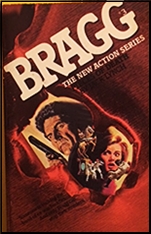
JACK LYNCH – Pieces of Death. Pete Bragg #3. Fawcett Gold Medal, paperback original; 1st printing, June 1982. Brash Books, softcover, 2014.

   The cover, including both the illustration and the copy in white diagonally across the top, makes this book look like one of those men’s action series so popular around that time. Truth be told, while Pete Bragg is a private eye, there really is a little more emphasis on action and adventure than there is in most PI books — but not all that much. Men at the time looking for The Executioner or Penetrator type action would, I wager, have come away disappointed.

   A fellow coming in by plane who Bragg had been hired to bodyguard is shot and killed, then so is the fellow who hired him, and Bragg decides to take it personally. It does not hurt that (as it so happens) that if he is able to help a group of WWII survivors, along with assorted wives and daughters, find a valuable relic they accidentally came across as their tour of duty in China was ending, his cut will be in the small five figures. But who’s on who’s side?

   All in all, no more than an adequate PI story. Fun to read while reading, but there’s nothing that will stick in you mind when it’s over, other than the basic story line, and what they all are looking for. On the other hand, maybe that’s all you can hope for in a mid-grade B-movie caper such as this.

NOTE:   There were a total of eight Peter Bragg books. You can find a complete list following my review of Seattle, #7 in the series, here.

REVIEWED BY DAN STUMPF:

VALLEY OF [THE] EAGLES. General Film Distributors, UK, Lippert Pictures, US, 1952. Jack Warner, Nadia Gray, John McCallum, Anthony Dawson, Mary Laura Wood. Written by Nat A. Bronstein, Paul Tabori and Terrence Young. Directed by Terrence Young.

   A film that left me goggle-eyed.

   Valley starts off like a typical British “B” of the period, albeit set in Sweden. Well-acted, flatly shot, the first half hour or so deals with scientist John McCallum, whose MacGuffin gets stolen by his wife (a gorgeously cold Mary Laura Wood) and assistant Anthony Dawson. Swedish Police Detectives Jack Warner and Christopher Lee — looking like they just stepped across the street from Scotland Yard — plod into the case but McCallum is unimpressed with their efforts and investigates on his own.

   So far so dull, but then Warner comes into his own, a more astute detective than we or McCallum thought. As their investigations converge, the scientist and the cop find themselves in friendly alliance as they follow the absconding couple north into Swedish Lapland.

   At which point Valley of the Eagles switches gears splendidly. Stalled by a blizzard, Warner and McCallum keep up the chase by tagging along with a Lapp reindeer drive, and the film becomes a gripping tale of outdoor adventure.

   A BIT OF BACKGROUND: Writer/director Terrence Young organized an expedition to Lapland and spent about eight weeks shooting near the Arctic Circle. It paid off, as he got stunning footage of reindeer herds stretching for miles, stampedes, wolves encircling the camp at night and pursuing the party by day, an incredible sequence with a remote tribe who hunt big game with eagles — just as falconers use their birds for smaller game — and a violent avalanche cascading down on fleeing villagers done without camera trickery.

   Young achieves all this with an absolute minimum of back projection, and the result is staggering. Even these days, when you can do anything with CGI, the sight of all this actually happening on screen makes the heart race with excitement – or at least mine did anyway.

   Amid all this, Director Young and the writers never lose sight of the characters. Detective Warner sees his criminal investigation turn into a matter of simple survival, while McCallum’s quest for his faithless wife and precious MacGuffin loses all meaning for him—a perfect confluence of acting and writing that adds real depth to the spectacle.

    Valley of the Eagles is not an easy film to watch at times. It’s also hard to find. The only DVD I could get was in European format that can only be played on suitably equipped players here. But it’s more than worth the effort.

REVIEWED BY DAVID VINEYARD:


HANK JANSON – The Accused. Hank Janson Crime Book #6. Telos Publishing Ltd., paperback reprint, 2004; also published in a Kindle format. Introduction by Steve Holland. Originally published by New Fiction, UK, paperback, 1952. (Hank Janson is a house name, in this case one used by Stephen D. Francis.)

   I knew we were crazy. But I also knew nothing was going to stop it happening. It was inevitable, something that had to happen, like a car going downhill with no brakes and no means of stopping until it hit bottom.

   Once upon a time when the Second World War had just ended and shortages of paper still hampered British publishing, a young man named Stephen D. Frances found himself with paper and a press and a contract for a twenty four page copybook, and no copy.

   Taking a hand from writers like James Hadley Chase and Peter Cheyney he churned out a quick brutal tale of crime and sex set in the States and with a rough tough hero with an eye for a dame. He named the character Hank Janson (pronounced Yanson) and took the name as his pseudonym as well.

   Over the years Janson made some changes, by the time the novels appeared he was a rough tough reporter for the Daily Chronicle (he sold ladies stockings in the first story) and he operated out of Des Moines (which British pulp expert Steve Holland has to remind British readers is pronounced de moyne). He remained tough, honorable, and as fascinated by the charms of female anatomy as Robert Leslie Bellem’s Dan Turner, if not as colorful in describing them.

   Like Cheyney before him Janson’s ideas of American slang could be iffy at best, but also like Cheyney and Chase he was an original voice, if not always original in his ideas, full of energy and bright brittle bursts of violent images.

   That imagery was what eventually got Frances and Janson in trouble with British obscenity laws. Seven of the Janson books were taken to court as obscene, and the one quoted most often by the prosecution is the little gem we have here, Accused.

   Accused is one of the books published under the Janson byline, but not featuring Janson as a character. Instead the hero is a fellow named Farran who works in a diner for a fat obnoxious fellow named Friedman (His arms were thick and fleshy, his skin white and clammy, and his grimy, sweaty shirt gaped open down to his navel. His shirt was heavy with the smell of sweat and his face was damp and shiny, glistening with fresh perspiration a few seconds after he wiped the back of his arm across his forehead.) who has a younger beautiful wife he mistreats and keeps as a virtual sex slave … and yes, it is just as well this one wasn’t published here where James M. Cain might have objected to lifting the plot of The Postman Always Rings Twice whole cloth only with more heavy breathing.

   We open with a graphic description of the most brutal third degree ever given in fiction as Farran recalls the events that lead up to him murdering Friedman in reveries between the beatings. Friedman’s wife, never given a name or much of a personality beyond victim and sex bomb, is the subject of no small amount of heavy breathing on the hero’s part.

   She was dressed simply – very simply! It was a faded black dress, short-sleeved with a discreet vee of a neck-line in and tied at the waist by a belt that gave shape to the dress. The skirt was pleated and reached to just below her knees. She was barefooted, and her legs and feet were brown, kinda healthy-looking.

   Even now, it was still hot in that kitchen. During the heat of the afternoon, it musta been an oven. And she hadn’t had time to cool off. Her face was shiny and damp, sweat patches blotched her armpits, and her youthful breasts seemed weary, sagged heavily against the damp bodice of the worn dress.

   Farran lets us know in no uncertain terms Friedman keeps his wife a slave in nothing but that one dress (She was wearing the same black dress, and in the light of day I could see more clearly how thin and faded it was. I could see even more. It clung to her youthful contours faithfully, outlining her youthful breasts and the curves of her flanks with a faithfulness that was strangely stirring, almost as though she wore nothing beneath that dress.), no underwear, and noshoes, and more than hints, however obliquely, about what goes on behind the closed doors of the matrimonial bedroom door:

   She was moaning. Giving little moans, punctuated with sharp gasps of pain. And it wasn’t what it could have been; a man and his wife roughing each other up a little. She was suffering, really suffering. The moans were breaking through her self-control as she steeled herself against pain.

   I stood there in a cold sweat. It was Freidman who was with his wife. What could I do about it? He was a guy twice the size of me, and his wife hadn’t yet started screaming for help.

   The real obscenity in the Janson books lies in what he implies but never actually says. The man had a real gift for innuendo in epic proportions. Over the course of about 50,000 words we get quite a bit of this kind of sweaty damp semi-masturbatory prose as Farran proceeds from victim of the brutal Freidman to his killer and eventually finds himself on trial for murder, his life on the line.

   Certainly not obscene, that first paragraph is as far as anything goes, stopping well before the bedroom door. Ian Fleming and Mickey Spillane were writing much racier scenes when this was prosecuted, but this was sold as sleaze, replete with those brilliant Reginald Heade covers, and, well, it just felt obscene.

   Steve Holland has also penned The Trials of Hank Janson about the obscenity trials and of equal interest, but Telos Press has brought these long lost classics of British pulp back into print in paperback and ebook form at low enough prices to indulge your taste for the long lost tales.

   Frances wrote under several house names, and as Frances wrote the popular John Gail spy novels from the sixties and seventies, many published here; he also wrote as Dave Steel and Duke Linton, and God knows what else. Like most pulp writers he writes too fast and at times too sloppily, but the stories have great energy and at their best are fun once you get past the more painful attempts at American slang.

   The best non-Janson entries, like this one, are no worse than the majority of male-oriented fiction of the type published in the States, and the better ones rise at least to the level of minor Gold Medal books in a similar vein (no few of them sailed a bit close to Cain as well).

   The Janson books are usually better, if only because Frances set himself the task of keeping his hero more or less honorable, meaning the innuendo is much more controlled:

   I was going to faint. The knowledge of it crept over me like a shroud of peacefulness. I was going to slip down into that soft, white mist and sleep for ever.

   â€˜You fancied Freidman’s dame, didn’t you?’ he snarled.

   I didn’t see him, but I sensed the gesture he made to the others, and as they moved in on me, I was smiling to myself, the white mist was gathering me up, gathering me into its embrace, cradling me, rocking me to sleep.

   They couldn’t hurt me now.

   Maybe it’s not authentic, but it’s pretty fair noir by any accounting, and for all the sleaze and innuendo it’s entertaining. It’s not that they don’t write them like this anymore, it’s just that they can’t replicate that paperback original voice of the era.

« Previous PageNext Page »