REVIEWED BY BARRY GARDNER:

JAMES LEE BURKE – A Stained White Radiance. Dave Robieheaux #5. Hyperion, hardcover, 1992; Avon, paperback, 1993.
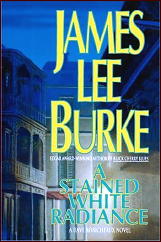
   Burke is hot right now. There are always writers who catch the critics’ eyes and occasion the tossing around of phrases like “transcend the genre,” and other such inanities. Crumley, Le Carré, James, Leonard, etc., etc., depending on the year and critic, have been so honored, and now Burke. I’m one of those Wrong Thinkers who sees Jacques Barzun as pompous, condescending and generally full of it, and think that talk of transcending the genre is arrant nonsense, but I like James Lee Burke’s writing anyway.

   Here we find Robicheaux, an alcoholic, dry and working as a Sheriff’s Deputy in the Iberia Parish of Louisiana. As if he didn’t have enough problems, his wife suffers from lupus. As the book opens he is called to the house of Weldon Sonnier, a wealthy oil-man. Robicheaux had gone to elementary school with three of the Sonniers, dated one, served in Vietnam with another. They are a strange family, one the wife of a Klansman-cum-politician, yet another a television evangelist. Their family history, besides intersecting his own, is a bit on the Gothic side, and Robicheaux is reluctant to become involved with them.

   For good reason. Weldon is associated with and indebted to a local gang boss, and has had CIA links in the past. Bits of the family’s twisted history surface, the story turns dark and strange, and the plot takes odd — and sometimes dubious — twists. His old New Orleans partner on the police force, Clete, now a private detective, aids him in his struggles.

   From interviews, it’s plain that Burke takes his writing very seriously, and does not see himself as a genre writer. He is a friend and admirer of James Crumley, and indeed they share both virtues and failings in the craft. Both are, for lack of a better phrase, powerful prose stylists; and both are rather muddy plotters, though Burke is much the better of the two. To be fair, I think that both are simply much more concerned with what they have to say about the human condition than they are niceties of plot.

   Burke, to me, has all the prerequisites of the storyteller. a superb skill at putting words together, the ability to bring his characters to life and make you care about them, and a story to tell that holds the interest. He’s one of the few authors I buy in hardcovers, and while Radiance is not his best work, it is nevertheless an excellent one. Highly recommended.

— Reprinted from Fireman, Fireman, Save My Books #3, September 1992.

      Eli Wallach would have been 100 today:

   Here’s a link to Jonathan’s review of The Lineup (1958):

https://mysteryfile.com/blog/?p=26371

      Also 100 today, Leigh Brackett:


      And 105, Louis Prima:


      And many, many others who are well known to readers of this blog, I’m sure.

Reviewed by JONATHAN LEWIS


NORTH TO ALASKA. 20th Century Fox, 1960. John Wayne, Stewart Granger, Ernie Kovacs, Fabian, Capucine, Mickey Shaughnessy, Karl Swenson, Joe Sawyer, Kathleen Freeman, John Qualen. Director: Henry Hathaway.

   Watching Henry Hathaway’s North to Alaska, a comedic Western starring John Wayne, one cannot help but compare it to Howard Hawks’ Rio Bravo (1959). Both movies feature a contemporary young musical star (Ricky Nelson in Rio Bravo and Fabio in North to Alaska) and a young beautiful actress to portray John Wayne’s love interest (Angie Dickinson in Rio Bravo and French actress Capucine in North to Alaska).

   Similarly, both films are buddy movies, in which the theme of male friendship and loyalty is explored, and battle of the sexes romantic comedies, thematically similar to the British and Italian sex comedies from the same time period.

   Yet despite all the similarities and the fact that North to Alaska is a truly beautifully filmed Cinemascope production, it is not nearly as captivating as Hawks’ masterpiece. That’s not to say that North to Alaska doesn’t have some truly hilarious moments and that Wayne doesn’t give a solid performance. It’s just that there are too many weak, bland scenes in the movie for one to equate it as being remotely on par with Rio Bravo.

Even so, this enjoyable, if at times bawdy, feature about love in the time of the Alaskan gold rush is still a much better Western than many that came out in the early 1960s. It’s good movie, just not one for the ages.


The complete album, beginning with “Cry Me a River.” This was her first LP.

Reviewed by DAN STUMPF


TARZAN THE MAGNIFICENT. Paramount, US/UK, 1960. Gordon Scott, Jock Mahoney, Betta St. John, John Carradine, Lionel Jeffries. Written by Berne Giler and Robert Day, based on the character created by Edgar Rice Burroughs Director: Robert Day.

   Basically a Western transposed to Africa, with Gordon Scott instead of Randolph, but fun in its way.

   The Tarzan of Magnificent isn’t the solipsistic jungle man of the early Tarzan films, but more like a Lone Ranger of the bush, going about rescuing folks and catching evildoers, and the plot gets moving when Tarzan (Gordon Scott) captures killer Coy Banton (Jock Mahoney) of the notorious Banton Gang, and tries to bring him to justice, as they say. The Lord of the Apes gets his prisoner to a smallish village, but it seems everyone there has seen High Noon and refuses to help him for fear of reprisal from the Banton Gang, which is headed by patriarch John Carradine, in the manner of Lee J. Cobb in Man of the West.

   Nothing daunted, Tarzan decides to escort his prisoner across the prairie –er— I mean through the jungle, knowing the gang will be dogging his heels and accompanied by a disparate group of hangers-on: shades of Ride Lonesome, or maybe The Naked Spur. There’s some interesting cross-cutting between the good guys and the baddies as the characters try to work out their personal issues along the way, sundry encounters with the local fauna, and a would-be dramatic bit where one of Tarzan’s party turns out to be an ex-doctor who rallies himself to save a life — Stagecoach, anyone?

   All this of course is just filler leading up to the final confrontation between Tarzan and Coy Banton, and when that moment finally arrives, it doesn’t disappoint; we get a lengthy, brutal and highly entertaining hand-to-hand battle between the protagonists across jungle, rocks, waterfalls and what-have-you, and while the outcome is never in doubt, the players and their stuntmen make it well worth your time.

   By and large however, Tarzan the Magnificent isn’t in the same league as any classic western; it’s a nice try and something a bit different, but the writing and directing just ain’t there. And as for the acting…. Well one doesn’t go to Tarzan movies for the acting, but Lionel Jeffries does well in an unrewarding role, Jock Mahoney projects a virile menace, and John Carradine is his reliable self. I just couldn’t help wishing Gordon Scott had a little less dialogue.

REVIEWED BY WALTER ALBERT:         


STUART M. KAMINSKY – Poor Butterfly. Mysterious Press, 1990; paperback, 1991.

   Toby Peters, Kaminsky’s vintage private eye, is hired to find out who’s attempting to sabotage the reopening of the restored San Francisco Metropolitan Opera house.The year is 1942 and a major player is renowned conductor Leopold Stokowski who’s rehearsing the first production, Puccini’s “Madame Butterfly.”

   Toby drives to San Francisco and when it’s apparent he needs backup, he sends for his best friend, midget translator Gunther Wherthman, his chief muscle, ex-wrestler Jeremy Butler, and his landlord, dentist Sheldon Minck.

   To these colorful characters, add the mix at the opera house that includes a murderous Phantom (of the opera), an evangelical minster (Reverend Adam Souvaine) whose minions are picketing the opening protesting the scheduling of an opera with a Japanese subject, and a prima donna for whom Toby falls in a big way.

   This is feather light entertainment that is best savored before, during or after an afternoon nap. Short and light on substance but agreeable for a one time date.

Bibliographic Note:   This is number 15 of 24 books in Kaminsky’s Toby Peters series, written between 1997 and 2004. You can find a complete list here, along with covers for most if not all, along with lists of books in his several other series.

BILL PRONZINI “La bellezza delle bellezze.” First published in Invitation to Murder, edited by Ed Gorman & Martin H. Greenberg (Dark Harvest, hardcover, 1991; Diamond, paperback, February 1993). Reprinted in Scenarios (Five Star, hardcover, 2003).

   The idea behind the anthology Invitation to Murder is to present the reader with a wide variety of stories all based on a single idea: the body of a young girl is found in her apartment. Besides Bill Pronzini’s inclusion, among other authors whose tales are inside are Loren D. Esteman, Joan Hess, Judith Kelman, Nancy Pickard and Andrew Vachss. (Here I’m mentioning only those listed on the front cover of the paperback edition, ones I imagine the publisher assumed would catch a would-be buyer’s eye.)

   Besides settings, genres, moods and presentation, of course as in most collections, the quality of the stories vary widely as well. The detective puzzle stories fare the worst, I’m sorry to say. Joan Hess’s attempt at a locked room mystery, “Dead on Arrival. for example, should have been cleared up in seconds, then a minute more to catch the killer. Well, maybe two minutes.

   The solution to a “dying message” mystery by William J. Reynolds is contrived, and the whole incident would have no chance in the world of ever happening that way. Better are a ghost story “The Life and Deaths of Rachel Long,” by Kristine Kathryn Rusch, hauntingly told without quite gelling, and “Darke Street,” by Gary Brandner, a story about an aging cop almost ready for retirement who comes across a strange musty shop on a mostly deserted city street. This is one that could easily have appeared in the pages of the old Weird Tales pulp magazine.

   I especially enjoyed “Invitation to Murder” by Richard Laymon, in which An author with a deadline to write a story for this very same book finds the next door neighbor playing loud music very distracting. The multitude of ideas this writer comes up with before discarding them are better than some of the stories in this book, assuming you can accept the existence of zombies, for example. This one’s a small gem of a tale. I’m not surprised it was used as the title story of the anthology.

   I may have liked Bill Pronzini’s contribution, “La bellezza delle belleza,” even better, however. (Yes, I’m finally getting to it.) Translating the title from the Italian gives us “the beauty of beauties.” This might refer to the granddaughter of an elderly Italian friend of a friend who asks the author’s nameless PI to investigate a money problem she is having with the landlord, but in reality the phrase may apply even more to the changes happening to the city of San Francisco, and the death of the old days in particular. Evocatively done, in terms of both the city and the people in it, and the transition both are forced to undergo.

Added Later:   For what’s worth, the names on the cover of the hardcover edition are Nancy Pickard, Bill Pronzini, John Lutz, and Carolyn G. Hart, authors of the first four stories.

SOUTH OF SUEZ. Warner Brothers, 1940. George Brent, Brenda Marshall, George Tobias, Lee Patrick, Eric Blore, Miles Mander. Director: Lewis Seiler.

   The title makes this movie sound as though it were another pre-War Egyptian spy adventure, but not so. The geography is right, more or less, but a title something like “The Middle of Tanganyika” just wouldn’t attract anybody to the box office. And it’s really not a spy adventure, either, but rather a murder mystery than begins in the diamond fields of central Africa and ends in a British court, back in England. It is there that the main protagonist, played by George Brent, due to a deliberate case of false identity, is on trial for killing himself. Only two people know that, though, himself and an eye witness who saw another murder done, back in Africa.

   How did Brent’s characters get mixed up in such a mess? That’s a good question, and how he managed to do it is the best part of this otherwise mostly mediocre mystery movie. It’s all for the love of a girl, however, as you may have guessed, but Brent’s typically low key performance doesn’t rise even halfway to the occasion, that being the hand of Brenda Marshall, with whom he has only a modicum of chemistry.

   George Tobias is terrific as the near-sighted villain of the drama, but there is very little I found in this film to suggest any kind of motivation for Lee Patrick, who plays his wife, to do any of the strange things she does.

Reviewed by MIKE TOONEY:


MARILYN TODD – Swords, Sandals and Sirens. Crippen & Landru Publishers, softcover, November 2015.

   If you don’t always like your mysteries with contemporary settings, there are a few authors who can oblige by taking the reader centuries into the past to places that once teemed with people but are now crumbling jumbles of detritus; one of the best at this approach is Marilyn Todd.

   Rather than trying to ape the stilted style of speech that we’ve come to expect from badly-dubbed sword-and-sandal movies, Todd modernizes the proceedings in such a way as to keep her characters from sounding like a dress rehearsal for a high school production of Julius Caesar while preserving the salient attributes of the ancient cultures she places us in. The result makes for smoother reading and assists us in concentrating more on the mystery plot.

   Swords, Sandals and Sirens collects eleven of Todd’s historical mysteries, with settings in either ancient Greece (3 stories) or, most often, Rome in the time of Augustus Caesar (7 stories, with one other set earlier, during Julius Caesar’s dalliance with the Queen of the Nile). The Greek stories feature several characters: the wholly mythical Echo, as well as two more down-to-earth individuals, the Delphic Oracle and Iliona, a high priestess who has appeared in at least three novels.

   The remaining Roman stories focus on Claudia Seferius, the always cash-strapped widow of a wine merchant — and a real looker. Thanks to the prevailing oppressive tax structure and the repressive patriarchal culture of the times, Claudia is often forced to skirt the law, always with the prospect of exile from Rome lurking in the back of her mind—but it seems that every time she’s about to make a big score that will get her out of the red, somebody gets murdered.

   When that happens, the law’s long arm soon appears, sometimes like a wraith from the shadows, in the person of Marcus Cornelius Orbilio, a patrician member of the Secret Police whose ambition for promotion would make squashing a minor scofflaw like Claudia the work of but a moment. Yet when these two get together to solve a murder, for some reason Marcus overlooks his duty and never does nab her. Maybe it’s his respect for her smarts, maybe it’s her regard for his prowess, maybe it’s his concern for her welfare, maybe it’s her respect for his position — and maybe, just maybe, it’s because they’re in love.

« Previous PageNext Page »