You may recall, if you’ve been reading this blog long enough, that I had to find a new doctor to handle my chronic thyroid problems after I fired my old one. Thanks to a fellow patient of my primary care physician, one was recommended to me, and I finally saw him two weeks ago yesterday.

   The experience was very positive. I’ll say that first. Not only had he had my complete file sent over from the fellow who shall remain nameless — but whose name I will tell you in order to avoid him if you live anywhere in this area — but he (the new doctor) had actually read it.

   As we talked through the problems I’d been having — and he went back in detail over the past 10 or 12 years — he came up with 8 or 10 different possibilities that should be checked out, only one of which had ever been suggested to me before. So progress was made, right then and there.

   I went to have blood tests taken the next morning, nine different ones. The bad news is that here it is two weeks later, and not all of them have been completed. I don’t know why the lab can’t send over the rest of the results, though, and I’ll see if I can find out later today.

   In the meantime, I’m still going through the ups and downs of not having enough adrenalin and thyroid hormones at the right time — neither my body nor the meds I’m taking are up to the task — and the problems have gradually worsened again over the past couple of months.

   I hate to say it, but I’m going to have to keep off the computer a lot more than I have been. Being at the computer for such long stretches may be contributing, so we’ll see if staying away helps.

   So the upshot is that things are going to be quieter here for a while, maybe for the rest of the month. I intend to stick around, though, and keep an eye on things and not disappear completely. I’ll be responding to comments, for example, and reposting some, as I’ve been doing recently, and perhaps the odd review now and then, so neither I nor the blog will be completely idle.

   That’s the news, both good and bad. I’m hopeful that this new doctor will come up with something that will help, but even if he does, it’s doubtful that things will improve immediately. In the meantime, I think I’ll stop typing and simply say thanks for stopping by — and I hope you’ll keep on doing so. There’ll be some changes made, but I’m not closing up shop.

             — Steve

   A review of a Murder, She Wrote book I posted last Friday also included a bibliography of all the other novels based on the series. This has produced a large number of follow-up comments, many of them on the definition of what the term novelization actually means. (As opposed, say, to the longer, more cumbersome phrase “Original novel based on characters created for a televison series.” )

   If this sounds like an exciting topic to you — and it is to me! — you might want to go back and read through the discussion so far. See https://mysteryfile.com/blog/?p=995.

            — Steve

A Review by MIKE TOONEY:


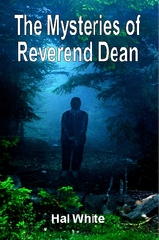
HAL WHITE – The Mysteries of Reverend Dean. Lighthouse Christian Publishing; trade paperback; story collection; 2008.

HAL WHITE Mysteries of Reverend Dean.

    There is a long and illustrious list of clerical detectives in mystery fiction. The first one to come to mind is usually G. K. Chesterton’s Father Brown; indeed, like Brown, most of the memorable clerical sleuths have been British.

    In America there have been fewer men (and women) of the cloth who involve themselves in criminal investigations: Melville Davisson Post’s Uncle Abner is the outstanding example of one who did on this side of the Pond.

    On occasion Abner would tackle what is commonly called today “impossible crime” (or, more specifically, “locked-room”) problems of the kind that sometimes bedeviled Father Brown. Neither Brown nor Abner, however, spent more than a fraction of their time on such conundrums.

    But now we come to one clerical sleuth who EXCLUSIVELY devotes his time to solving locked-room crimes: Hal White’s Reverend Dean. This clergyman never actively seeks out such perplexing problems; his principal concern is always in saving souls. Yet somehow Reverend Dean becomes embroiled in these things with amazing regularity.

    Patience is counted as a Christian virtue, and the reverend has it in abundance; indeed, without patience he couldn’t solve any of the problems with which he is confronted.

HAL WHITE Mysteries of Reverend Dean.

    Strictly speaking, intelligence may not be exclusively another Christian virtue, but Dean also has it in abundance: You wouldn’t know it to look at him, but this modest, self-effacing man’s “little grey cells” are constantly working ratiocinative miracles inside his skull.

    Take, for instance, how he solves the conundrum of a woman stabbed to death in a room with locked windows, a triply-locked door, protected by a guard dog, and under observation by three witnesses.

    Or consider the woman who, if the evidence is to be believed, can walk through solid walls and shoot at someone while suspended in space. Or how about … but you should really read The Mysteries of Reverend Dean yourself.

    You won’t be disappointed.

         ______

    A website devoted to other clerical detectives is at:

         http://homepage.ntlworld.com/philipg/detectives/contents.html

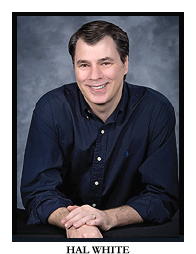
   Hal White’s webpage, which focuses on his book ‘The Mysteries of Reverend Dean’ and other locked-room mystery anthologies, can be found at:

         www.halwhitebooks.com

Reviewed by MIKE GROST:

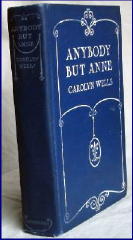
CAROLYN WELLS – Anybody But Anne. J. B. Lippincott, US/UK, hardcover, 1914.

   Anybody But Anne shares most of the characteristics of Wells’ later Faulkner’s Folly (reviewed here not too long ago):

CAROLYN WELLS Anybody But Anne.

    ● It is a full, formal mystery novel, of the kind that would later be popular in the Golden Age.

    ● It is set in a country house, and anticipates the mysteries soon to be popular in such houses.

    ● The cast of suspects resemble those to be found in many later detective books.

    ● It is a locked room mystery — but the solution of the locked room is based on ideas that would later be regarded as cheating. Still, the cheat of a solution shows some real ingenuity.

    ● The book shows the imagination with architecture, that would later be part of the Golden Age. It comes complete with a floor plan. The country house is of the kind that might have later inspired the mystery game known as Clue or Cluedo: there is even a billiard room!

    ● Wells pleasantly includes some subsidiary mysteries, that have nothing to do with the locked room. These too show some mild but pleasing ingenuity. Such subplots are also standard in Golden Age detective novels.

   I do not know if Wells invented the above template for formal mystery novels, or whether she derived it from other authors. Anybody But Anne does establish, that what we think of as a “typical Golden Age style mystery novel,” was in existence before what is often thought of as the official start of the Golden Age in 1920. It is also a fact, that Wells was American, and that her book is set in the United States: somewhere in New England.

   The best parts of Anybody But Anne have charm. People looking to sample Wells, might enjoy this novel, or at least its best chapters. It is at its best in the opening (Chapters 1-6), which sets up the architecture, characters and murder mystery; two later chapters that tell us more about the house as well as exploring some subsidiary mysteries (14, 17), and lastly the solution (Chapters 18, 20). Together these sections make a readable novella. The novel has been scanned by Google Books, and can be read free on-line.

CAROLYN WELLS Anybody But Anne.

   We get a good portrait of Wells’ sleuth, Fleming Stone, in action in these sections. Oddly, he is missing in most of the middle of the book, sections which generally are not that interesting anyway. Like most pre-1945 detectives, he is more characterized by his skills and behavior as a detective, than by any knowledge we get of his personal life.

   Stone has a penetrating intellect, that goes right to the heart of clues to the mystery, in the evidence at hand. He is crisp and business-like at delivering his insights, sharing his ideas immediately with the other characters and the reader.

   We do learn that Fleming Stone is outside of the world of romance, like many other early detectives. Wells gives an interesting psychological portrait of this.

— Reprinted with permission from A Guide to Classic Mystery and Detection, by Michael E. Grost.

A 1001 MIDNIGHTS Review
by George Kelley & Marcia Muller:


FREEMAN WILLS CROFTS Jane Vosper

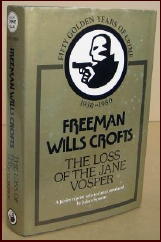
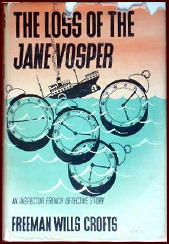
FREEMAN WILLS CROFTS – The Loss of the “Jane Vosper.”

Collins, UK, hardcover, 1936. Dodd Mead, US, hardcover, 1936. Many reprint editions, both hardcover and soft, including: Collins, UK, hc, 1980 [Crime Club 50th Anniversary edition] and Grosset, US, n.d (both shown).

   Crofts was a transportation engineer and worked for railway companies for many years before retiring in 1929 to become a full-time writer.

   A number of his novels make use of his technical knowledge of railroading and shipping, such as Death of a Train (1947), in which Inspector French investigates a World War II plot to divert vital supplies being shipped to the British forces in North Africa. Similarly, The Loss of the “Jane Vosper” draws on Crofts’s knowledge of the shipping industry.

FREEMAN WILLS CROFTS Jane Vosper

   On a dark night in the mid-Atlantic, the cargo ship Jane Vosper is rocked by explosion after explosion. Soon afterward, the ship sinks. An insurance investigation is launched, and it soon becomes apparent that the sinking of the ship was no accident.

   Inspector French enters the case and begins to piece details together-including particulars of what cargo the ship was carrying. A cargo swindle is revealed-one that leads to murder. French works with precision, ever conscious that unnecessary delay may lead to additional killings.

   The background detail in this novel is particularly good, and French is in top form, always playing fair with the reader and making us privy to his private thoughts. French is likable, a pleasant, unassuming man with none of the sometimes unfortunate affectations of other popular classic sleuths.

   This book — and most of Crofts’ others — presents no real challenge to the reader in terms of outwitting the detective and solving the case first. If anything, we feel that we are being taken by the hand and led on a genteel journey through the routine of a careful and dedicated investigator.

FREEMAN WILLS CROFTS

   Other Crofts novels dealing with the shipping industry include Mystery in the English Channel (1931), Crime on the Solent (1934), Man Overboard (1936), and Enemy Unseen (1945).

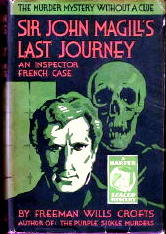
   Books in which Crofts drew on his railroading background include Sir John Magill’s Last Journey (1930), Wilful and Premeditated (1934), and Dark Journey (1954). A short-story collection featuring Inspector French, Many a Slip, was published in 1955.

         ———
   Reprinted with permission from 1001 Midnights, edited by Bill Pronzini & Marcia Muller and published by The Battered Silicon Dispatch Box, 2007.   Copyright © 1986, 2007 by the Pronzini-Muller Family Trust.

Hi Steve,

   I wonder if you can help me. I need to get hold of an obituary for novelist and screenwriter Roy Chanslor who died in September 1964. It seems the only one appeared in an issue of Variety sometime that fall. I don’t know if you know anyone who might be able to help, or if you could ‘advertise’ on your blog. I would be most grateful if you could. Variety does have a sort of archive, but it’s only for old film reviews,

Thanks,

   John Herrington


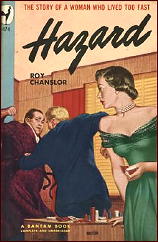
ROY CHANSLOR Hazard

       Bibliographic data [crime fiction only]:

CHANSLOR, ROY. 1899-1964.
       Lowdown. Farrar & Rinehart, hc, 1931.
       Hazard. Simon & Schuster, hc, 1947; Bantam #474, pb, 1949. Film: Paramount, 1948 (scw: Arthur Sheekman, Roy Chanslor; dir: George Marshall).

[Expanded from the Revised Crime Fiction IV, by Allen J. Hubin.]

   Chanslor also has a long list of writing credits on IMDB, including Tarzan Triumphs, The House of Fear, Black Angel and Cat Ballou.

   Bill Crider had an interesting post about him last year on his blog. Follow the link.

   More? His wife, Torrey Chanslor, was both a well-known illustrator of children’s books and a two-time mystery writer. Where or when she died is apparently unknown, but her two detective novels have recently been reprinted by Rue Morgue Press. Follow this second link for a long biographical essay about her.

CHANSLOR, (Marjorie) TORREY (Hood). 1899-?
      Our First Murder (Stokes, 1940, hc) [Lutie and Amanda Beagle; New York City, NY]
      Our Second Murder (Stokes, 1941, hc) [Lutie and Amanda Beagle; New York City, NY]

    The following observation and question was first posted here by Vince Keenan on June 4, 2007:

    “I recently reread Westlake’s The Hot Rock for the first time in ages and was struck by the fact that Grofield makes an appearance. One of the members of Dortmunder’s crew, Alan Greenwood, is forced to change his last name after he’s arrested. We learn in the book’s penultimate chapter that he’s now Alan Grofield.

WESTLAKE The Hot Rock

    “Grofield had already been established in the Parker series as well as his own books at this point. So is this a belated origin story, as they say in the comics field?”

    I didn’t know, but I more or less assumed that Vince was right. No one responded to this online inquiry to say for sure, until today, when I heard from Gabe Lee, who left the following comment:

    “I remember seeing similarites in Greenwood and Grofield while reading The Hot Rock the first time a few years ago, having recently devoured all of the Stark books in order.

    “I felt vindicated at the end when they were revealed to be the same person.”

    When I thanked Gabe for leaving a definitive answer at last, he replied:

    “A bit more I didn’t see mentioned here… The Hot Rock was started as a Parker novel by Stark. The premise got too absurd for Parker’s character; no way he would have put up with that nonsense.

    “Westlake rewrote the book and created Dortmunder to replace Parker as the main character. I’m assuming Grofield was in before the rewrite, and was changed to Greenwood (same initials, same first name spelled differently). He then switched Greenwood back to Grofield as Vince noted earlier.

    “It creates a fun chicken and egg scenario; maybe Grofield came first and that name was still clean. It’s one of the fun crossover tricks to look out for among Westlake’s many pseudonyms.

    “Another fun thing to look for, he often uses ‘Pointers’ and ‘Setters’ for restroom signs in bars, and uses it under different author names. I’ve seen other (non-Westlake) authors use it as well, but can’t recall where. I’m guessing it’s sort of an inside joke among the writers, or an homage, but don’t know where it started.”

    To which I responded by saying: I think that researchers with graduate theses and dissertations in mind will have a field day with all of the in-jokes and cross-references in Westlake’s work. If Westlake had been a “literary” figure instead of a mere mystery writer, I’d be sure of it.

    Then to Gabe, for the final word:

    “I completely agree, the crossover stuff is fun to look for. There’s so much of it, and I can picture the late great Mr. Westlake chuckling as he typed away. BTW, after racking my brain a bit I think Charles Willeford uses the Pointers and Setters thing in Cockfighter from 1962… I’ll have to re-read it to be sure.”


Gabriel E. Lee
Gryphon Graphics
www.gryphonart.com

   Two comments following my review of The Saint in Trouble, by Leslie Charteris, should be of interest.        — Steve


         (1) David L. Vineyard —

    As far as I know, the only Saint novel to contain original Charteris material after about 1960 was Salvage for the Saint, and that only because it was based on stories Charteris wrote for the long running Saint comic strip drawn by Mike Roy and later John Spanger and Doug Wildey (TV’s Jonny Quest). I’ve read that he also wrote original stories for the Saint comic book too, but all the ones I’ve seen were reprints of the comic strip.

    Towards the end of the run of The Saint television series and the Saint Mystery Magazine Charteris authorized novelizations of the series and several were run in the magazine and later reprinted in hardcovers and paperback.

    None of them really capture the Saint or Charteris, though the best is probably Vendetta for the Saint by veteran American sf writer Harry Harrison (author of Make Room Make Room, the basis for Soylent Green, and the Flash Gordon comic strip), based on a two part episode of the series and released as a movie.

    I don’t know how many of these were done, but they did continue into the Ian Oglivy Return of the Saint series.

         (2) Ian Dickerson —

    The last Saint book solely by Charteris was the 1963 short story collection The Saint in the Sun, making the last Saint novel solely by Charteris the 1946 story The Saint Sees It Through.

    Some of the latterday collaborations do indeed read like novelisations, but some of them read quite close to original Charteris. Charteris was never shy about crediting his collaborators –- except Harry Harrison because he didn’t want his name on the book –- and always edited the manuscripts before they went to print.

    Salvage for the Saint was not based on a comic strip story, it was in fact based on the two part Ian Ogilvy episode entitled “Collision Course.”

    “The Red Sabbath” [mentioned by Steve as having unknown antecedents] was based on the Ogilvy episode “One Black September.”

EDITORIAL COMMENT:   For a long online biographical appreciation of Leslie Charteris by Ian, complete with several photos, follow this link.

Do you know what? This is the 1000th post to appear on this blog. Two years, one month and five days later.

I know, I know, if you check the URL for this one, it says it’s the 1005th, but I’ve written five that are still in limbo and have never been posted. They’re semi-ready, though; maybe I’ll get back to them someday and finish them up.

Some of the remaining 1000 have been deleted for one reason or another. I wrote one after I’d the flu for a day or so, and in it I described the dream I kept having over and over again — something about bricks in a wall — but I was still feverish when I wrote it and when I recovered, I decided that some things are best mentioned only once and then forgotten.

But not entirely. Even though you probably don’t remember it, I think it’s obvious that I still do.

I wish I knew when I started what I wanted to do with this blog, but in recent weeks I think it’s getting closer to whatever goal I didn’t have in mind back then.

I don’t know if that makes sense or not, but it does to me.

— Steve

NICHOLAS FLOWER on Charles Williams:

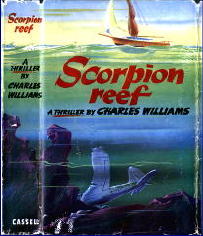
   My father, Desmond Flower, was the Literary Director of Cassell at the time I joined the firm in the 1950s. He visited New York every year to buy books for UK publication from NY publishers and agents. On one of his visits he was given a copy of Scorpion Reef for consideration.
CHARLES WILLIAMS

   This, the Macmillan (NY) edition, must have been the first hardcover edition of a thriller by CW. My father liked it, bought the rights and we published it in 1956.

   It was critically well received and this led to the idea of reissuing his Gold Medal paperbacks as hardcovers in the Cassell crime list.

   As is clear from the order of their publication, there was no correspondence between the order of original Dell or Gold Medal publication and the order in which we republished them. Some of them were republished under their paperback titles, such as The Big Bite, but it was felt that some of the titles, particularly the “Girl” titles, were not right for the hardcover market.

   It was at this point, before I took over editorial control of the Crime list in 1960, that I got involved with CW, because the pleasant task of thinking up new titles was left to me. Each time we were resetting a book for which we felt a new title was needed, I would write to CW with a suggestion and he accepted every one.

   Those I remember putting to him include:

      Operator  [Cassell, 1958; previously Girl Out Back, Dell 1958]

CHARLES WILLIAMS

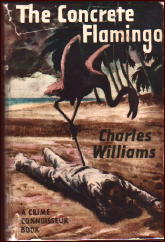
      The Concrete Flamingo  [Cassell, 1960; previously All the Way, Dell 1958].

CHARLES WILLIAMS Cassell

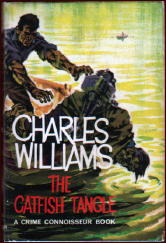
      The Catfish Tangle  [Cassell, 1963; previously River Girl, Gold Medal 1951].

CHARLES WILLIAMS Cassell

      Mix Yourself a Redhead  [Cassell, 1965; previously A Touch of Death, Gold Medal 1954]

CHARLES WILLIAMS Cassell

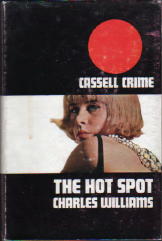
      The Hot Spot  [Cassell, 1965; previously Hell Hath No Fury, Gold Medal 1953].

CHARLES WILLIAMS Cassell

   Because the decision to reissue earlier titles in hardcover, and to retitle some of them, had been taken by Cassell, the US hardcover editions of Gold Medal reissues followed within the same year. New titles, written by CW after 1958, such as Aground and Dead Calm, went straight into hardcover, the US edition preceding the Cassell edition.

   The reissuing of the Gold Medal books in hardcover, many with new titles, played a crucial role in the continuation of CW’s success. It led to the creation of a new audience, not least through library sales. It brought him to the attention of critics in the mainstream and publishing trade press where, on both sides of the Atlantic, he was consistently well reviewed.

CHARLES WILLIAMS

   This rebirth of his books led in turn to their reissue, under the new titles, in two further paperback phases: first, following on directly from the hardcover editions, by Pan in the UK, and Pocket Books and Harper and Row in the US; then later, through another phase of reissues, in the 80s and 90s, by publishers such as Penguin and No Exit Press.

    The photo attached is one I took of Charles Williams on the top floor of the Cassell building in Red Lion Square, London, in the early 60s.

   On the literary side, I have always divided his thrillers, not into sea vs land, but into water vs land. In all the books which contain boats, fishing, water and swamp, there is a deeply nostalgic and pervasive atmosphere of mystery – smooth water providing both a feeling of calm and of hidden menace.

   There is no better example of a water novel than what I retitled The Catfish Tangle, the title referring to the catfish which Shevlin catches for the restaurant at the head of the lake.
CHARLES WILLIAMS

   In the 60s, Cassell and Collins were the pre-eminent UK publishers of blockbuster novels. Our authors included Alec Waugh, Nicholas Monsarrat, Irving Stone and Irving Wallace. The last time CW visited our office, I put to him the idea that he could write a wonderful full-length novel using a liner as the setting.

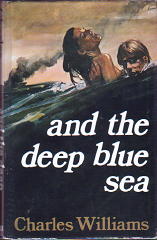
   And the Deep Blue Sea ((Signet, pb, 1971; Cassell, 1972) is, in my opinion, not really a sea novel; the liner in the book is merely a platform for psychological interplay and misdeeds. I do not think it is successful as a thriller, but it clearly shows what he could have achieved through his powers of characterisation had he been prepared to work on a bigger canvas.

   Might it have revitalised his career? Sadly we shall never know. He said no; he was happy doing what he knew best and felt he was too stuck in his ways.

       ___

NOTE: For an essay by Bill Crider on Charles Williams, along with a complete bibliography, follow this link to the primary Mystery*File website.

       ___

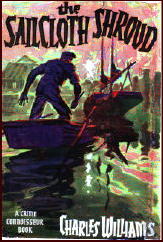
[UPDATE] 02-01-09.   After making a couple of minor edits in the piece above, Nicholas and I have been discussing some of the other books by CW that Cassell published. One of them was The Sailcloth Shroud, which was published first in the US in hardcover (Viking, 1960; Cassell, 1960).

    No change in title was made for this one:

CHARLES WILLIAMS Cassell

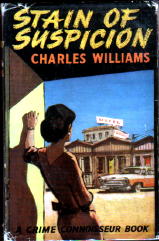
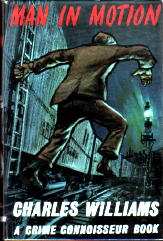
    There are two others for which the titles were changed, but for these Nicholas says: “I did not think up the the titles [for these two books]. I have a feeling (no more than that) that CW may have retitled them himself.”

       Stain of Suspicion [Cassell, 1959; previously Talk of the Town, Dell First Edition, 1958]

CHARLES WILLIAMS Cassell

       Man in Motion [Cassell, 1959; previously Man on the Run, Gold Medal, 1958]

CHARLES WILLIAMS Cassell


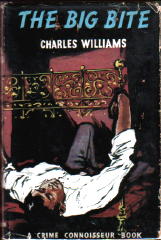
   Two additional books were published first as paperback originals in the US, then by Cassell in the UK. There were no changes in title for either of these:

       The Big Bite [Cassell, 1957; Dell, 1956]

CHARLES WILLIAMS Cassell

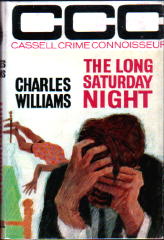
       The Long Saturday Night [Cassell, 1964; Gold Medal, 1962]

CHARLES WILLIAMS Cassell


  [LATER.] 03-17-09.   In his most recent email, Nicholas adds the following:

    “I left Cassell in 1970 following the take-over of the company by Crowell Collier Macmillan of New York. By then all but one of CW’s novels, Man on a Leash, had been published.

    “In 1965 the name of the crime list was changed to CASSELL CRIME and the decision was taken to reduce production costs by introducing a standard in-house series cover. The three band covers, which I designed, each featured a studio photograph incorporating elements of the story. The Hot Spot was the only CW thriller to appear with a CC series cover.”

[UPDATE #2] 09-11-10. Twelve covers are reproduced above, but Cassell actually published fifteen of Charles Williams’s thrillers, not including his comic crime stories, such as The Wrong Venus and The Diamond Bikini.

   Thanks to the assistance of some online booksellers who graciously supplied us with the three previously missing, we can now display the covers of all fifteen:

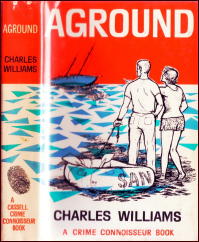
       Aground. [Cassell, 1961; Viking, US, hardcover, 1960; Crest s471, US, pb, 1961; Pan, UK, pb, 1969]

CHARLES WILLIAMS Aground

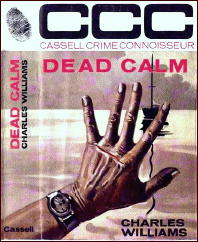
       Dead Calm. [Cassell, 1964; Viking, US, hardcover, 1963; Avon G1255, US, pb, 1965; Pan, UK, pb, 1966]

CHARLES WILLIAMS Dead Calm

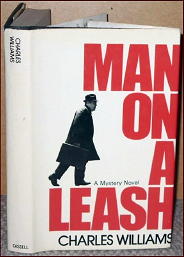
       Man on a Leash. [Cassell, 1974; G. P. Putnam’s Sons, hardcover, 1973; no paperback editions]

CHARLES WILLIAMS Man on a Leash


   For these last three covers, thanks to Nigel Williams Rare Books, London, for the cover image to Aground; to Instant Rare Books of Auckland, New Zealand, for Dead Calm; and to The Antique Map & Bookshop, Puddletown, Dorset, for Man on a Leash.

   Finally, a special note of thanks to Mark Terry of www.facsimiledustjackets.com, who earlier supplied the cover of Scorpion Reef, and to Bill Pronzini, who sent me all the others.
« Previous PageNext Page »