LEANN SWEENEY – Shoot from the Lip

Signet, paperback original, January 2007.

   There are a few private detectives in the world of crime fiction that Kevin Burton Smith doesn’t (yet) know about, he of the Thrilling Detective website, which attempts to list ALL of them, and in all honesty, he pretty well succeeds. Case in point, though: He’s missing Houston-based Abby Rose, who’s in this book, her fourth case overall, the previous three being:

   Pick Your Poison. Signet, pbo, May 2004. Abby inherits her late father’s home and computer business along with her twin sister, Kate. When she investigates the murder of their gardener, she learns some truths about their true birth parents.

   A Wedding to Die For. Signet, pbo, January 2005. Independently wealthy, Abby has started her own business as a private investigator finding birth parents for adoptees. Her client is a bride-to-be who hires Abby to find her biological mother so she can be at her wedding, but a murder occurs at the reception instead.

   Dead Giveaway. Signet, pbo, November 2005. After Abby is hired by a 19 year old basketball star looking for his birth family, the woman who found him on her doorstep as an infant is murdered.
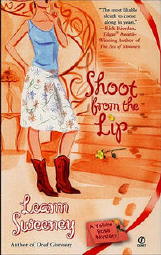
Cover

    In spite of all of the murders and the fact that Abby is a fully licensed PI, these are all “cozy” type mysteries, and so is the book in hand, Shoot from the Lip. Yellow Rose Investigations is the name on her business card. Her twin sister Kate, a psychiatrist, does the psychological assessments on any prospective clients, and with money in the bank, she can easily afford to turn down clients whose cases she doesn’t wish to take.

   Her client this time around is young Emmy Lopez, who’s been responsible for her three younger siblings ever since their mother died. An upcoming appearance on a TV reality show brings out the possibility that there was a fourth child Emmy never knew about and who may have been put up for adoption, either legally or (more likely) illegally.

   The story’s told in raw-boned but light-hearted Texas style, with lots of details of the two sisters’ various romances with their steady (and not so steady) boy friends, along with Abby’s continual references to her daddy, now gone but far from forgotten.

    Murders do occur in this book, which I have just realized that I have forgotten to mention, but unfortunately the detection involved is slim to none. Not only are Abby and her circle of family and friends relatively slow on the uptake when dangerous things begin to happen, but the killer makes the fatal flaw of simply hanging around too long. He or she is caught only by doing one evil deed after another, until eventually going too far, when at last the truth is revealed.

   Don’t get me completely wrong. For fans of low-keyed murder investigations, enhanced and enlivened by a crew of friendly folk who seem to come back book after book, they could do far worse than stay with Abby Rose, wherever her adventures may take her.
— February 2007

JOHN GALLIGAN – The Nail Knot

Worldwide; paperback reprint, October 2006. Trade paperback: Bleak House, May 2005.

   A “nail knot” is one of those clever devices that are used most often by fly fishermen, and as such it is something I knew nothing about before reading this book. (The last time I went fishing was with my grandfather when I was ten or so, when all we did was to drop our lines into water off a long pier jutting out into Lake Michigan. No casting abilities of any kind required. Nor did we catch anything, but why do I still remember the day, now well over fifty years ago?)

Knot

   The primary protagonist of The Nail Knot, a laid back sort of fellow who calls himself the Dog, is a fly fisherman, however, and I’ll get back to him in a minute.

   In the meantime, here is a short list of other mystery novels or series which I’ve just come up with in which fly fishing is a substantial component, in no particular order.

  Firehole River Murder, by Raymond Kieft, first book in the “Yellowstone Fly-Fishing Mystery Series.” Series character: name not known.
  Blood Atonement, by Jim Tenuto. Series character [SC]: fly-fishing guide Dahlgren Wallace.
  Bitch Creek, by William Tapply. SC: Stoney Calhoun, amnesiac worker in a bait and tackle shop in rural Maine.
  Pale Morning Done, by Jeff Hull. SC: Montana fly-fishing guide Marshall Tate.
  Dead Boogie: A Loon Lake Fishing Mystery, by Victoria Houston. SC: Chief Ferris, Doc Osborne and Ray Pradt. [There are several in this series.]

   There are probably others that I am not thinking of now. Please add others, if you can. This is the first of at least three books in John Galligan’s “Dog” series, but some research shows that he wais the author of one earlier mystery novel, Red Sky, Red Dragonfly, also published by Bleak House (in 2001), in which a hockey player from Wisconsin travels to Japan to teach English for a year and ends up being implicated in his predecessor’s disappearance.

   Subsequent and/or reportedly forthcoming follow-ups in John Galligan’s fly fishing series are:

  The Blood Knot. Bleak House, hardcover, October 2005. [UPDATE: Bleak House, trade paperback, March 2007.]
  The Clinch Knot. Bleak House. Spring, 2007. [UPDATE: Unpublished as of April 2007.]
  The Surgeon’s Knot.
  The Wind Knot.
  The Hex.

   This is a long-range projection, and I suspect that some of these titles may turn out to be totally hypothetical. But assuming that you’re still with me, let’s take a look at the book in hand. As mentioned above, “the Dog” is how the leading character refers to himself — he tells the story, and on a strictly personal basis, it’s quite a story that has to tell.

   The Dog’s real name is Ned Oglivie, and he is what you might call a dropout from the human race, wandering across the country and checking out fishing spots as he goes. A nomadic fly fisherman without parallel, you might say. Until he reaches Black Earth, Wisconsin, that is, where it is that he finds a body along the edge of the creek that leading into (or out of) local Lake Bud. (You can see that even though it may be an important plot point, it didn’t make much of an impression on me.)

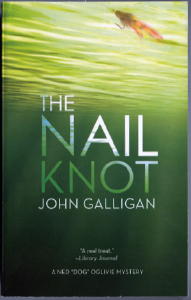
Cover

    He also finds The Woman, but not until she removes from the crime scene all of the evidence that (Dog later learns) points to her semi-senile father. But let the Dog describe the lady, from page 13:

    … and it was impossible for me to take my eyes off her.

    You expect me, I suppose, to tell you that she was a gorgeous creature, or lay out for you some other such cunning nonsense. But it wasn’t like that. The last thing the Dog wanted in those days was attraction to a woman. Plus that was far from the mood, and this woman was anything but gorgeous. She was more like confusing. She had already shown me the clod-hopping ability of a teen-aged boy. She was dressed like that too — dirty jeans and work boots, a t-short that had once been white, a dirty-green John Deere cap with a pair of cheap sunglasses up on the brim. Her thighs and arms and shoulders were thick, and her posture atop the stream mud was on the dark side of dainty. But there was a frazzled spark of red-blond ponytail sticking out the back of the cap. There were breasts strapped down by a sports bra beneath the t-shirt. There were tears in her eyes. Earth to Dog: woman.

   You can tell at once that the Dog is hooked. Her name is Melvina Racheletta O’Malley, or Junior for short, and the Dog discovers to his dismay that he cannot walk away when she asks him to help her in what she insists is a frame-up of her father, Mel.

    The dead man has only lately been a local, which first of all is not a good thing in rural Wisconsin, and secondly he had been an activist in trying to revive and save the fish in Lake Bud, which is also definitely not a good thing — activism, that is.

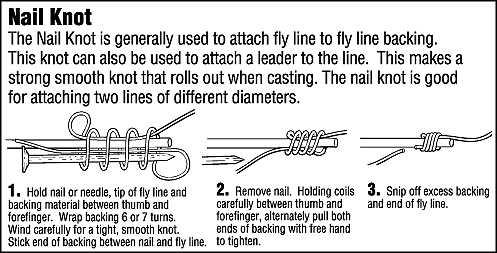
   The solution to the mystery depends greatly on who was able to tie a nail knot, and at what time. It wouldn’t have been a terribly difficult case to solve, if one had a protagonist who was a little more, shall we say, pro-active on the case — you soon get the feeling that if the Dog were any more low key than he is, he wouldn’t be able to get up in the morning — but then again meeting all of the local folk, some more local and inbred than others, and some not, would have been not nearly so much fun as this.

— October 2006


UPDATE. Quite coincidentally there has been a discussion of fly-fishing mysteries on DorothyL this past week (early November), in relation to a slightly different topic of “male cozies.” Here are a couple more mystery series that have been pointed out as belonging to the category, still small but obviously growing:

  Fly Fishing Can Be Fatal, by David Leitz. SC: Max Addams, owner of a northern Vermont fishing lodge. [There are several other books in this series.]
  Catch and Keep, by Ronald Weber. SC: Northern Michigan conservation officer Mercy Virdon and her boyfriend, newspaperman Donald Fitzgerald. [There is at least one other book in this series.]
  Death on a Cold, Wild River, by Bartholomew Gill. SC: Dublin police Chief Superintendent Peter McGarr, who is the detective in several other books by Gill. In this one, though, it’s the victim who is the fly fisherman, along with at least one of the suspects.

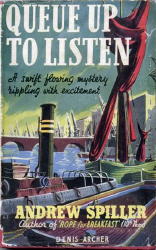
   A short while ago I posted a blog entry about a group of authors whose deaths had recently been noted. One of those authors was Andrew Spiller, about whom I knew nothing at the time, except for the list of mystery fiction he wrote, which you’ll find by following the link.

Queue

   To learn more, I first emailed John Herrington:

 John

   I tried a Google search for Spiller and/or Inspector Mallard, and found … nothing. Another author like Brian Flynn, perhaps, popular only because he wrote a lot of books and for very little other reason?

Best

      Steve

  Hi Steve,

   I wouldn’t disagree. I have managed to borrow a couple of his books though inter library loans and they are nothing special.

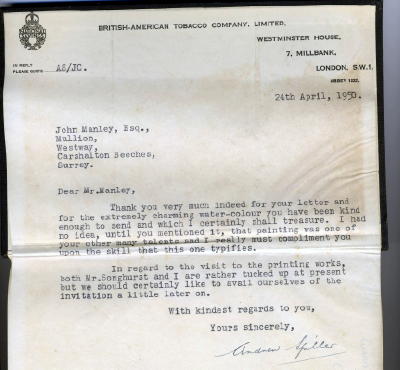
   Have discovered that he was working for the British-American Tobacco Company in 1950. He is like a lot of writers of the 1940s and 1950s, who stopped writing by the end of the 1950s. A lot of the smaller publishing companies were disappearing (or being bought up) and perhaps he realised that there was no longer a market for his books. This happened to the likes of ‘Ernest Dudley’ who stopped writing crime around the same time because there was no money in it.

Regards

      John

   Then arrived a welcome email from Jamie Sturgeon:

  Steve,

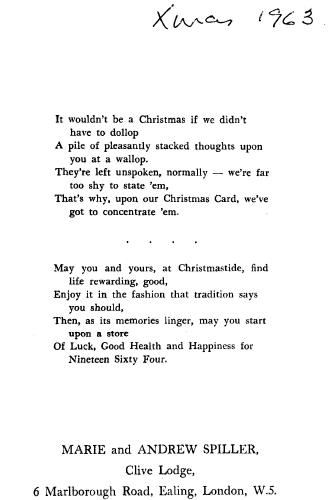
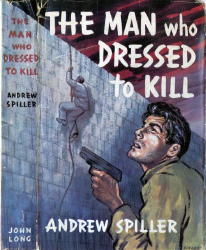
   Did John mention that Andrew Spiller worked for British American Tobacco and his wife’s name was Marie? Please see attached scans, including two more covers in DJ.

Cheers,

   Jamie

Letter

Xmas


   Then from Victor Berch, who has managed to delve deeply into Andrew Spiller’s traveling days:

  Steve

   Remember my mentioning that database which contained information on aliens and citizens entering the US? Well, I decided to poke in Andrew Spiller’s name and to my surprise two hits came up. I wasn’t too sure I had the right Andrew Spiller, but when I spotted his birthplace of Bridport, I knew I had the right person. So, here are some of the details from those records that I gathered from the ships’ manifests:

   On his first trip to the US, Andrew Spiller came aboard the SS Olympic which left Southampton, Eng on Feb. 25, 1925 and arrived in New York March 4, 1925. From this manifest, it stated that he was in transit to visit his cousin, C. James, in New Zealand. He was listed as an advertising agent for the British American Tobacco Co, Ltd (which, by the way is still in operation). His age at the time was given as 35 years old. He was 5’9 1/2″ with brown hair and grey eyes.

   On his second trip, he came aboard the SS Aquitania, which left Southampton, Eng on April 28, 1928 and arrived in New York May 4, 1928. Spiller was still listed as advertising manager for the British American Tobacco Co., Ltd and was going to stay in the US for 60 days.

   On this record he was required to give the name and address of his nearest kin, which was Mrs. A. Spiller, 26 Heathfield Rd., Acton, W. 3 , London. These records seem to predate his writing period.

Best,

      Victor


Dressed

   And so there you are. Bits and pieces of a life of a mystery writer who’s become obscure and all but forgotten now, but who was very prolific in his time.

   For a gallery of even more covers, provided by Jamie Sturgeon, I’ve set up a separate website here.

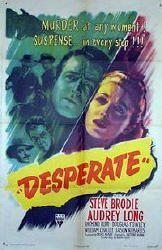
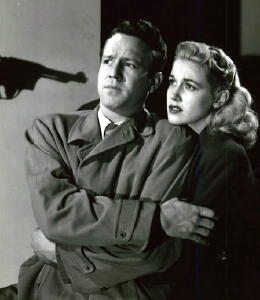
DESPERATE. RKO Radio Pictures, 1947. Steve Brodie, Audrey Long, Raymond Burr, Douglas Fowley, Jason Robards (Sr.). Directed by Anthony Mann.

   An early film noir, back before directors knew that that’s what they were filming, back when a low budget on a crime film was the impetus for creative lighting and innovative camera techniques, and not because they realized that they were creating a movie genre.

   I reviewed Anthony Mann’s The Great Flamarion (Republic, 1945) earlier this year, a movie considered by some to be in the noir genre, so Desperate is far from being the first that he directed in the category, but to me, both seem flawed. Neither seems to me to epitomize in their entireties what a noir film truly is (or was).

Poster

   But there are some moments in Desperate that, once seen, will always be remembered. When trucker Steve Randall (Steve Brodie) is being thoroughly beaten off camera in the hideout of gangster Walt Radak (Raymond Burr), someone bumps the overhead light fixture with a single light bulb in it, starting it to swing back and forth in the otherwise darkened room. The alternating light and shadowy darkness combines with the sounds of punches and groans off to the side in an epiphany of mind-cringing delight.

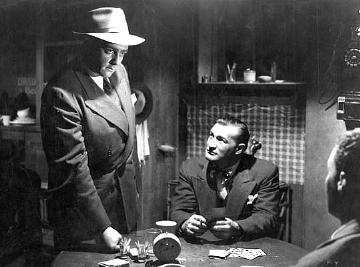
   Toward the end of the movie, as Radak has caught up with Randall again, as Radak’s brother is about to die in the electric chair, for which Radak blames Randall, the two men sit opposite each other across the kitchen table in a cheap apartment flat, Radak with a gun in his hand, Randall about to die at exactly the same moment as Radak’s brother — their eyes, their sweat — it is as if that moment will stay fixed in time forever, but it does not, as the clock ticks slowly onward.

Scene

   One could wish, then, and fervently so, that the overall story would hold together more cohesively than it does. Why Randall’s wish to escape Radak is clear. He’s an innocent joe caught up in a foiled warehouse robbery, but when Radak threatens his wife of four months (Audrey Long), he becomes irrational with his thoughts of saving her — but his actions, setting them both off on the run without telling the police, just don’t make sense. Randall doesn’t ever appear quite irrational enough, nor is he supposed to be. His wife Anne simply does as she’s told — questioning but always obeying — and yet she wouldn’t if he were.

   This was Raymond Burr’s second or third credited appearance, and as a moody almost insane criminal thug, which is what he often played in B-movies like these in the 1940s, his eyes seem to glower whenever he’s filled with anger or hatred. In this movie this is 95% of the time.

Burr

   One other problem this movie faces, however, is that Mr. and Mrs. Randall, no matter how dire their situation, when they’re together, it’s never quite dire enough. There is no question that they will survive, and in a noir film, that’s always a fatal flaw. But so that I can’t be accused of giving away an ending: I just lied, and they don’t.

   Here’s one connection with crime fiction in printed form that I didn’t know before now. Audrey Long’s film career, which began in 1942, ended in 1952 when she married Leslie Charteris, creator of the Saint. Their marriage lasted until 1993, when he died.

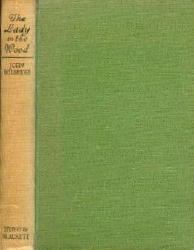
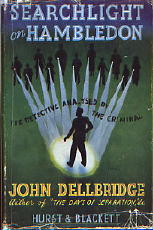
JOHN DELLBRIDGE – The Lady in the Wood

Hurst & Blackett Ltd., hardcover; no date stated [1950]. No US publication.

   As readers of this blog will know full well, it has recently been discovered that “John Dellbridge” was the pen name of Frederick Joseph De Verteuil (1887-1963). A native of Trinidad, he became a barrister and practiced law in India and England before becoming a novelist.

    I’ll forego the usual bibliography, as the previous entry already includes one, as well as a small amount of other information that has been learned about the author. There are six mysteries to his credit in all, however, the last three having as their lead character one Rupert Hambledon, about whom more in a minute. The Lady in the Wood is the last of the three, which were published in a short span between 1947 and 1950. Dellbridge’s earlier crime-writing career spanned a much earlier 1927 to 1929.

Lady

    The story is told in quasi-documentary style, in the beginning as if in the form of local Inspector Kemsing’s report to some superior officer, starting with Chapter One, page 7:

   At 6:30 p.m. yesterday, Friday, and August, Mrs. Martineau of Sharpes Cottage, Checksworth, reported by telephone that she and her husband had found the naked body of Lady Charlotte Barnet in a larch plantation in Checksam Park. There seemed to be a bullet wound in the head. Her husband was standing by the body. She described the exact spot. I telephoned the police surgeon and the St. John Ambulance and at once proceeded to the scene by car with Sergeant Streeter and Constables Neve, Avis and Ayling, with a camera. Mrs. Martineau was waiting for us at the junction of a bridle path and the Diddlehurst-Midworth road: Sharpes Cottage is about fifty yards East of the junction of the path and road and invisible from the path as the road bends there.

   The dead woman had been a heroine in World War II, having parachuted into France and done great deeds undercover with the Resistance. Some Vichy French and some members of the Gestapo are immediately suspected. On the other hand, this is England, and the world is in the process of becoming civilized again. Lady Barnet had come down from London to be one of the guests at nearby Schlatts Hall, the home of Mr. and Mrs. Arthur Bonteve.

   So a manor house mystery is what this is, no more and no less, replete with constant and subsequent misbehavior and strange actions on the part of the many participants, many clues, another death – that of a maid who perhaps knew too much and who turned to blackmail as a result? – and endless timetabling, more than I can remember in any mystery I’ve read in many years.

   Sir Rupert Hambledon is called in early on by one of the suspects. That he has a title means that he travels in the same circles as the class of people who live in or are guests at manor homes. He is not from Scotland Yard, however, but a very expensive inquiry agent. (One hesitates in referring to him as a mere private detective.) Being the “best known detective in England” and “the smartest” (page 111), in no time at all he is in charge of the case, Inspector Kemsing more than willing to defer to him.

   One of Sir Rupert’s other traits is that “he commits irregularities that no official policeman would dare to try” and “these irregularities get results.” (Also page 111.) By the way, the inspector does not narrate the entire book. He alternates telling the story of the investigation with Mr. Perceval Hadlow-Down, a solicitor of one of the guests, who often plays Watson to Sir Rupert. Says Hadlow-Down early in his own narrative, when it is his turn;

   I am a thriller ‘fan’. Many of them are very good, though they have lost some of the savour since Lord Peter Wimsey went out of business and Dr. Fortune was replaced by a colleague of mine called Clunk who should have been struck off years ago.

Sir Rupert may outdo either of those two gentlemen by stating on page 70:

    “I’ve known who the murderer was since this morning,” he asserted with a stort of Olympian impatience.

   Of course there is not a shred of legal evidence at this point, and if the murderer were to be charged, the inspector would be “laughed out of court.”

Lady

   Does Sir Rupert indeed know? In the end, after the killer is indeed caught and charged, there are indications that he did, but to my mind, the strongest point in his final summary of the case was based on an flimsy (and even erroneous) insight into human nature. He was exaggerating, were you to ask me. It was a good guess, perhaps more, but that it took the remaining two-thirds of the book to name the killer for keeps strongly suggests that a good guess is all that it was.

   The purpose of the alternating narration – not too common in detective novels? – serves the author in this case well. That is to say, it keeps the reader off-balance, preventing her or him of being aware of what each narrator knew and when while the story was being told by the other.

   In short, however, if you are the kind of mystery reader who likes lots of clues, time tables, and exhaustive interrogations of the parties involved, you will find a lot to like, if not love, in this book. If not, then most definitely not.

— February 2007

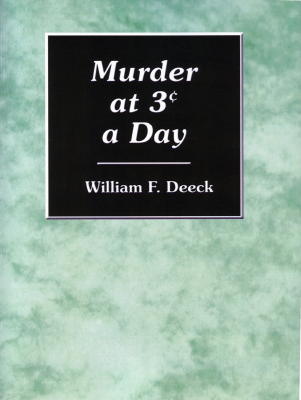
   I have mentioned Bill Deeck’s book, Murder at 3 Cents a Day, before, along with various updates as to the online version, as additional covers scans have gradually been included.

   What I now have is the great pleasure in announcing is that I have the book itself in my hands, and it is well worth the wait, almost. One can only regret that Bill Deeck is no longer with us to see it, but it is certain that he would be immensely pleased with it.

Cover

FROM THE BACK COVER —

   Murder at 3¢ a Day is the first and only reference volume devoted entirely to the lending-library publishers that flourished from the mid 1930s into the 1960s. More than ten years in compilation, it contains full listings of mystery and detective fiction published under such imprints as Phoenix Press, Hillman-Curl, Mystery House, Gateway, Arcadia House, Dodge, and Caslon.

   Included are dust jacket blurbs, settings, and leading characters for each title, as well as descriptions of jacket illustrations and names of the artists who designed them. Also included: an article about the lending-library trade written in 1939 by Charles S. Strong, who specialized in this type of novel; a tongue-in-cheek article on Phoenix Press mysteries by Bill Pronzini; brief biographies of many lending library writers; and selected period newspaper reviews of various titles.

   Readers and aficionados alike will find a wealth of fascinating and often amusing information about this little known variety of crime fiction. Murder at 3¢ a Day is a must for any reference shelf.

Photo

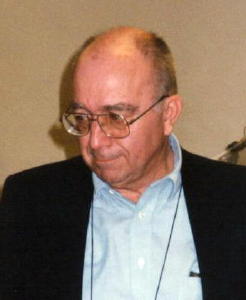
   William F. Deeck (1927-2004) was a well-known mystery fan and collector who had a special affinity for lending-library fiction. In addition to the present volume, he was the author of numerous articles and reviews for The Armchair Detective, Mystery Readers Journal, and other publications.


INTRODUCTION, by Bill Pronzini:

   What you hold in your hands is a labor of love.

   There have been scores of biographical and bibliographical reference works devoted to quality mystery fiction, but only a couple – Gun in Cheek (1982) and Son of Gun in Cheek (1987), both written by yours truly – that pay tribute to the genre’s lesser lights. And until the present volume, there has been no detailed source of information on the hundreds of mysteries published by, and the writers who wrote primarily or exclusively for, the lending-library markets that flourished in the 30s, 40s, 50s, and lasted well into the 60s.

   Murder at 3¢ a Day was conceived by Ellen Nehr, as a similar volume to her Doubleday Crime Club Compendium (1992), with Bill Deeck acting as assistant. A relatively small amount of material had been gathered when Ellen died late in 1995; it was Bill, with help from various other collectors and aficionados, who did most of the work of researching, compiling, and annotating the entries and who therefore earned the solo byline. After Bill’s death in 2004, I inherited the project – the adding of new material when found and the search for a publisher. Others deserving of heartfelt thanks for their efforts include Allen J. Hubin, Steve Lewis, Richard Moore, and Mark Terry.

   Any reader and collector of crime fiction, whether or not a fan of the odd, obscure, and delightfully absurd (Bill’s original title for the volume was Mostly Awful), will find much to entertain and enlighten them here. Some who were previously inclined to scoff at “alternative” mysteries might well join the growing number of us who consider them irresistible.

   For you, Bill, and Ellen too, with gratitude. I wish you were both here to see it published.

   August 2006


   The main page of the online companion to Murder at 3 Cents a Day is www.lendinglibmystery.com, where you can also find information about the publisher, The Battered Silicon Dispatch Box, owned and operated by George A. Vanderburgh. It’s too soon for the latter’s website to include the book, but I believe the retail price to be $30.

   The cover scans for the Phoenix Press mysteries are now complete through 1947.

  Hallo Steve!

   Yes, Donald Hamilton died in Visby (Gothland) Sweden on 20th of November last year. Unfortunately I didn’t know about his death until an English friend of mine, Jeremy Dund living in Stockholm, e-mailed me about it.

   I knew him well through my correspondence with him, and also because my wife and I visited him and his wife in their home in Santa Fe, many years ago. We were invited to stay a full week there, and we had a lot of nice hours together.

   He also visited me in my home when I lived alone in Sweden (1983). He and his wife Kathleen had dinner with me in my home at that time.

   He was a very nice and generous man, and he knew that his books were very popular all over the world.

   When I visited him last year in August in Visby – in fact my hometown when I was 15 years old till I was 23 and moved to Uppsala (where Donald was born) – he was in a home for the elderly, but he was in very good condition although his memory was not 100%. But he remembered me and the visit in Santa Fe, and we talked for a full hour about that and his books etc.

Photo
Iwan and Donald Hamilton

   His son Gordon then came and I talked to him and his wife. They had decided to take care of Donald for the rest of his life. The home he was staying at was excellent, and the service was the absolutely best you can get.

   I’ll be driving to Sweden this summer, and hopefully I’ll be in Visby for a week or so and will get in touch with the Hamilton sons then.

   Nice to hear from you, and if I can be of some help just let me know.

               Your friend Iwan

>>   For a longer account of the friendship between Iwan and Donald Hamilton, their visit in the assisted living home, and more photos, go here.   — Steve

   — One of the activities that keeps my spare time occupied is adding images, links and miscellaneous information to the online Addenda to Allen J. Hubin’s Revised Crime Fiction IV. Here are some of the latest:


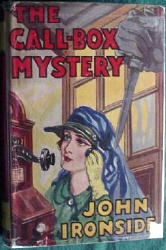
IRONSIDE, JOHN. Pseudonym of Euphemia Margaret Tait, 1866- , q.v. [Add definite year of birth.] Born in Liverpool; educated privately; journalist and novelist. Under this name, the author of eight novels included in the (Revised) Crime Fiction IV, one with marginal crime content, published between 1911 and 1945. Series character Inspector Freeman appears in two of them, but not the one illustrated below:

Ironside

IRVING, CLIFFORD
      The Spring. TV movie: NBC, 2000 (scw: J. B. White, David S. Jackson, Kathleen Rowell; dir: Jackson)

JAHN, MIKE
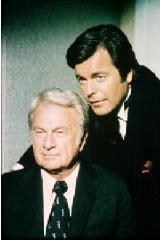
      Switch. TV movie [series pilot]: Universal, 1975 (scw: Alan Godfrey, Glen A. Larson; dir: Allen Baron, Robert Day). SC: Pete Ryan (Robert Wagner) & Frank McBride (Eddie Albert).

Switch

JAQUES, EDWARD TYRRELL. 1859-1919. Pseudonym: Christian Tearle. q.v. Add year of birth.

JAY, EDITH KATHARINE SPENCER. ca. 1847-1901. Pseudonym: E. Livingston Prescott, q.v. Add approximate year of birth.

JOHNSTON, WILLIAM This author of many movie and TV tie-in’s is not William W. Johnstone, writer of many tough crime and western novels.
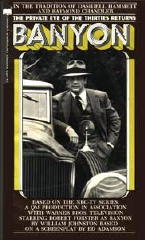
      Banyon. TV movie [pilot for series]: Warner, 1971 (scw: Ed Adamson; dir: Robert Day). Leading character: 1930s PI Miles Banyon (Robert Forster).

Banyon

JONES, JANE GILLIS. 1942-2002. Lifetime resident of Metro New Orleans; retired high school teacher. Author of one book previously listed in the (Revised) Crime Fiction IV; see below. The author was working on a second book in the series at the time of her death, Murder in Metairie Cemetery. Add middle name, years of birth and death.
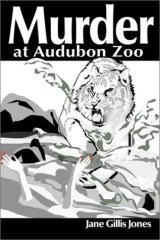
      Murder at Audubon Zoo (iUniverse, 2000, pb) [New Orleans, LA] Leading character: retired English teacher Elizabeth Young.

Jones

KATHRENS, (WILLIAM HAROLD) VAUGHAN. Intelligence Officer in WWII; assisted in arrest of Admiral Doenitz at the end of the war. The link will lead to his daughter’s account of some his activities; this link leads to more. Author of four hardcover crime thrillers published in the UK by Melrose between 1950 and 1953. Add first and second names, in parentheses.

KEELER, HARRY STEPHEN
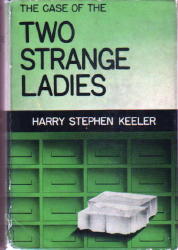
      The Case of the Two Strange Ladies. Add setting: Southern US. Leading character: Tommy Skirmont, reporter on the Southern City Democrat.

Keeler

MISTER SCARFACE, a.k.a. I Padroni della città. (Italy / West Germany). USA: PRO International Pictures, 1977; dubbed. Jack Palance, Harry Baer, Al Cliver, Edmund Purdom, Vittorio Caprioli. Director: Fernando Di Lio.

   Sometimes you get exactly what you pay for. In my case I paid 99c plus shipping for both halves of a Jack Palance double feature on DVD, of which this is one. Half, that is. If you call it a dollar for this one, it’s worth about half of that, plus 85 minutes of viewing time.

   Which I wouldn’t have spent it weren’t worth viewing, but I’m certainly glad I didn’t spend three bucks. The transfer to DVD was terrible. Color bursts and scenes shot in darkness coming out muddy and shadowy where shadows are not supposed to be can really spoil your mood for a movie. (The other half, The Four Deuces (1975, with Carol Lynley), may make the deal come out a steal, and as always, I will let you know.)

Palance

   The movie was filmed in the slums of Rome, or so I’m told, as I didn’t recognize anything anywhere at any time, but truthfully I’ve seen worse slums. The Italian ambiance must make all the difference in the world. “Scarface” Manzari (Jack Palance) is the head of one gang of crooks and thieves, and young, overly brash Tony (Harry Baer) is a bag man for another. Determined to rise in his own gang of crooks and thieves, headed by Luigi Cherico (transplanted British actor Edmund Purdom), Tony takes Scarface for ten million lira, of which he hands only three million back to Luigi.

Baer

   Does Scarface take this lying down? No, of course not, you know what I mean? Jack Palance glowers a lot and handles his long cigarette holder with consummate ease, but he looks far, far away from what a few IMDB viewers variously call a powerful and exciting Italian gangster film, with an “imposing” performance by Palance. None of the above is precisely true, but beyond that, we are only arguing matters of taste.

Purdom

   Comic relief is provided by Vittorio Caprioli, as an aging gangster who, after being dumped by Tony’s gang, casts his lot with the brash young lad. Both of their performances are worth watching. The long shootout at the end would have been boring and utterly without redemption without the former’s humorous ineptitude, for example.

   Even so, the long shootout at the end manages to come awfully close to that inscrutable, indefinable boundary between good and just plain awful. Or depending on your mood at the time, perhaps the line is crossed not only once, but several times, in this last burst of highly choreographed diorama (or low drama) of cars, motorcycles, guns, guns and more guns.

K    There are events in the real world that you, I am sure, would find hard to believe if someone would take them simply as they happened and write them up as part of a work of fiction. Noted comic book writer Arnold Drake died in mid-March at the age of 83. Spy fiction author Leslie Waller died on March 29th, four days before his 84th birthday.
   The connection? In 1950 as “Drake Waller” the two men collaborated as the author of It Rhymes with Lust, considered to be the first graphic novel, a digest-sized work in comic book form. Of marginal interest as a crime novel, it nonetheless was recently added as a marginal entry to Crime Fiction IV, by Allen J. Hubin. See the online Addenda, Part 12.

   Two men, born within a year of each other, worked on one key book together in their 20s, went their own professional ways, and then died within weeks of each other. Destiny sometimes moves in mysterious ways.

Diana

   Not all of Mr. Waller’s bibliography consists of crime-related fiction, but a large portion of it is, with espionage, crooked bankers and Mafia elements predominant.

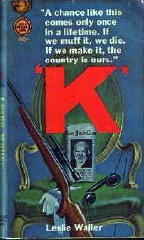
   He was in fact a Gold Medal writer, as a book simply titled “K” (Gold Medal, 1963) was a plot to assassinate Khrushchev during a visit to the US.

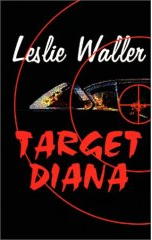
   His final work of fiction was Target Diana, a trade paperback with low distribution in which Princess Diana was murdered by a rogue agent, with the secret approval of the Royal Family.

   Excluding It Rhymes with Lust, but expanded to included Target Diana, Leslie Waller’s output as recorded in CFIV looks like this:

WALLER, LESLIE (1923-2007); see pseudonyms C. S. Cody & Patrick Mann.
      * “K” (n.) Gold Medal, pbo, 1963 [Chicago, IL]
      * A Change in the Wind (n.) Geis 1969
      * The American (n.) Putnam 1970 [Europe]
      * The Coast of Fear (n.) Doubleday 1974 [Italy; WWII]
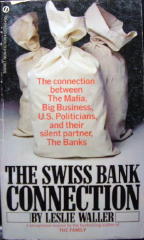
      * The Swiss Account (n.) Doubleday 1976 [Switzerland]

Leslie Waller

      * Trocadero (n.) Delacorte 1978 [Paris]
      * Gameplan (n.) Bantam 1984
      * Embassy (n.) McGraw 1987 [London]
      * Amazing Faith (n.) McGraw 1988 [Europe]
      * Deadly Sins (n.) Heinemann. UK, 1992
      * Mafia Wars (n.) Onyx 1993
      * Tango Havana (n.) Heinemann, UK, 1993 [Havana, Cuba]
      * Manhattan Transfer (n.) Heinemann. UK, 1994 [New York City, NY]
      * Eden (n.) Severn, UK, 1997
      * Target Diana (n.) Transatlantic Publishers, pb, 2001.

CODY, C(harles) S.; pseudonym of Leslie Waller.
      * The Witching Night (n.) World 1952 [Indiana]
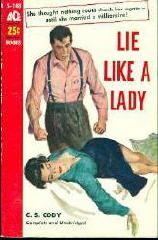
      * Lie Like a Lady (n.) Ace, pbo, 1955 [Chicago, IL]

Cody

MANN, PATRICK; pseudonym of Leslie Waller.
      * Dog Day Afternoon (n.) Delacorte 1973 [New York City, NY]
      * -The Vacancy (n.) Putnam 1973
      * Steal Big (n.) St. Martin’s 1981 [England]

   I haven’t happened to have found a cover image for Tango Havana (1993), but I did come across a description of the plot. Hoping to provide an idea of the kind of stories Mr. Waller wrote, I’ll include it here:

    “Cuba in the days when Meyer Lansky called the shots and General Batista ruled. An island where no man was what he seemed. A Mafia boss, a missile crisis, and a mess that went all the way to the White House. But while history turns on its axis, a conspiracy threatens to blow the Caribbean apart. It takes two to tango. Victor Sanchez and Midge Boardman just have to decide who leads.”

   And taken from the same book, here’s a short “About the Author” biography:

    “Born in Chicago, IL, Waller attended the University of Chicago and earned his M.A. from Columbia University. A crime reporter, he joined the United States Army Air Force intelligence in World War II. He published his first novel [Three Day Pass] in 1944, followed by some 50 more over the years.

    “From his first marriage he has two daughters and four granddaughters. He married Patricia Mahen in 1967, moving to Italy and eventually England. After 15 years abroad they now live in Naples, Florida where he writes, lectures and contributes to Florida’s leading cultural magazine, the Naples Review.”

Falcon

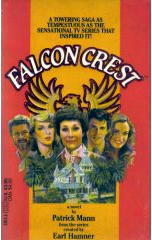
   Although some sources say Mr. Waller wrote several screenplays, IMDB mentions only his work as a writer for the TV show Falcon Crest, and that a non-fiction book he wrote, Hide in Plain Sight was made into a 1980 film starring James Caan. Not stated on IMDB, as Patrick Mann he also wrote the book which novelized the film Dog Day Afternoon. Either of these may be where the confusion arises.

   Even though it’s not included in CFIV, some of the behavior displayed on Falcon Crest was definitely criminous in behavior. Below you’ll find a image of the cover of the book, a novelization of the TV series written by Patrick Mann, a.k.a. Leslie Waller, once again the man behind the pen name.

[UPDATE] 12-02-08.   Based on a suggestion included in an email I received from Dan Bara today, Al Hubin agrees that the following two titles by Leslie Waller are crime-related and should appear in CFIV. The brief descriptions of each were found by me and helped Al make the call:

At 01:44 AM 12/2/2008, you wrote:

 Mr Lewis,

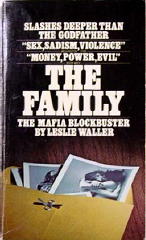
   I believe books that have crime/mystery tones that are not listed in your blog post are: The Banker (1963) and The Family (1968).

   Hope that helps!

        Good Day, Dan


Descriptions from various sources:

K

The Family.

FROM THE FRONT COVER: Slashes deeper than the Godfather, “sex, sadism, violence, money, power, evil.”

“An explosive story that bares the link between the big-time bankers and big-time crime.”

The Banker.

The money man: He owned villas in France, Italy, Switzerland, England, Germany & the Caribbean–each outfitted with emperor-sized round beds …. He was a juggler of power & people, keeping an uneasy balance between the broads he bought, the men he bled, the Swiss bankers & mafia musclemen he did business with. He was one step ahead of the SEC, the IRS, & the Justice Department. He was the wheeler-dealer king of international finance.

Woods Palmer moves into the field of intrigue and counter-intrigue in the big business world of banking in America.

« Previous PageNext Page »