That there’s not enough time in the world to read everything you want to is something I am sure that every non-casual reader of this blog knows full well, even if you restrict yourself to mystery, crime and detective fiction –- or even only a small nook and cranny of the genre, which maybe you do but I try not do. I like to keep my horizons are wide open as possible, although there are some topics and/or themes at which I draw the line (and about which I will tell you some other time).

   And when you discover a blog dedicated to one of those small nooks and crannies of the genre, chock full of books you never knew about before, much less you’ve ever read any of them, why, it’s enough to make a grown man (or woman) cry. Figuratively speaking, of course.

   This is what happened to me this evening. The particular nook is International Noir Fiction, and the link will take you there immediately, if you’re so inclined.

   I’m not sure if Glenn Harper does all of the reviews and commentary, but at a first go-through on my part, it appears that he does. He does one or two posts a week, and going down through the current page, here are the recent objects of his attention:

LEIF DAVIDSEN – Lime’s Photograph [Danish emigre living in Spain]

JAMES CHURCH – A Corpse in the Koryo [North Korea]

MANUEL VÁZQUEZ MONTALBÁN
– The Buenos Aires Quintet [Spanish detective in Argentina]

GENE KERRIGAN – Little Criminals [Ireland]

ÅSA LARSSON – The Blood Split [Sweden]

QIU XIAOLONG
– A Case of Two Cities [China: Inspector Chen]

PACO IGNACIO TAIBO
– The Uncomfortable Dead [Barcelona detective Pepe Carvalho]

PERNILLE RYGG
– The Butterfly Effect [Scandinavian sort-of private detective Igi Heitmann]

   All worthy, I’m convinced, of hunting down and reading, if only my bank account didn’t have this huge and near-permanent dent in it. I won’t comment on the books themselves, as Glenn’s read them and I haven’t, and he’s already done a super job of it. This list essentially covers the month of February, and the month’s not yet over. Oh, as the man said, my.

   A big thanks to the post on The Rap Sheet that J. Kingston Pierce just did along these same lines and which pointed me in Glenn’s direction. At least I think I should thank him. Maybe he’s not forgiven me for confusing his name with that of western fiction writer Frank Richardson Pierce in a recent blog entry of mine, since corrected, and he’s getting even. (He also points out Wade Wright, the subject of the preceding entry here on M*F, as an author whose books he’s newly found as worthy of the chase. You and me both, Jeff.)

   As a short introduction and to put events into the order in which they occurred, not too long ago John Wright saw Bill Pronzini’s profile of mystery writer Robert Martin on the original Mystery*File website and got in touch with me. He and Bill had been correspondents and friends for many years, due in part to their mutual admiration of Martin, author of the PI Jim Bennett stories, before eventually losing track of each other. I was able to reunite them by email, not realizing that John Wright from South Africa was also really Wade Wright, a mystery writer in his own regard.

   After learning more about John’s career and his interests and background in a good many fields, I asked if he’d care to answer a few questions about himself, and he graciously agreed. I formulated the questions, Bill added two or three of his own, and we sent them off to John. The result of all this is what follows.   –Steve
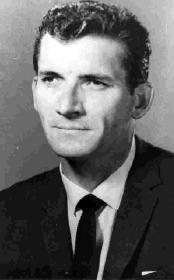

    John Wright
John Wright about the time that
Shadows Don’t Bleed was written.

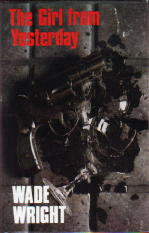
Q.  Thanks for taking the time to talk to us about your career. Unfortunately (and correct me if I’m wrong) none of the mysteries have been published in the US. I’ll begin therefore with a list of all of the titles Al Hubin has for you in his bibliography of the field, Crime Fiction IV:

WRIGHT, WADE; pseudonym of John Wright, (1933- )

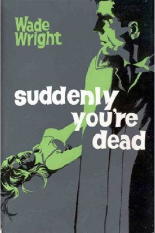
* Suddenly You’re Dead (n.) Hale 1964 [Bart Condor; New York City, NY]
* Blood in the Ashes (n.) Hale 1964 [Bart Condor]
* A Hearse Waiting (n.) Hale 1965 [Bart Condor; New York City, NY]
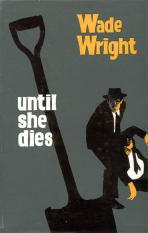
* Until She Dies (n.) Hale 1965 [Bart Condor; California]
* Blonde Target (n.) Hale 1966 [Bart Condor; New York City, NY]
* Shadows Don’t Bleed (n.) Hale 1967 [Paul Cameron; California]
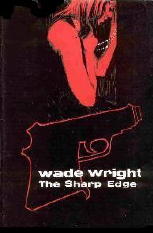
* The Sharp Edge (n.) Hale 1968 [Paul Cameron]
* No Haloes in Hell (n.) Hale 1969 [Paul Cameron]
* Two Faces of Death (n.) Hale 1970 [Bart Condor]
* Don’t Come Back! (n.) Hale 1973 [Calhoun]
* The Hades Hello (n.) Hale 1973 [Paul Cameron; Los Angeles, CA]
* It Leads to Murder (n.) Hale 1981 [California]
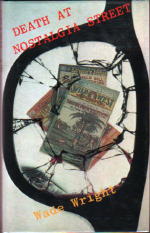
* Death at Nostalgia Street (n.) Hale 1982 [New England]
* The Girl from Yesterday (n.) Hale 1982 [Calhoun; U.S. Midwest]
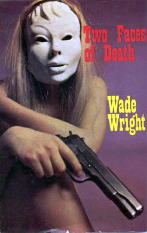
Faces

   I have a confession to make. While Bill has many of your books and has read them, at the present time I don’t have any of them, or if I do, I don’t have access to them. I’ll defer to you to tell us something about them. I’m going only by the titles, but I’m willing to guess that both Bart Condor and Paul Cameron are private eyes. How close am I?

A.  As close as you can get. Condor was the first, and there is no doubt at all I’d been influenced by Mickey Spillane and his Mike Hammer. In fact, it was probably Mickey who really got me started.

    I’d written to him, care of New American Library, to say thanks for a lot of very enjoyable reading. Mickey replied by way of a pretty long letter that ended with: “Keep writing and make lots of money.” At the time I was knocking out an occasional article or short story, but that was it.

Leads

Q.  Tell us more about some of the individual books?

A. I guess the “make lots of money” bit must have stuck somewhere in the thing I call a mind, because a year or so later —

   I was holding down a job as General Sales Manager for a nation-wide engineering company, often putting in eleven hours a day. I’d recently married and before doing so had contracted to have a house built in a place called Western Hills, Port Elizabeth. I woke up one morning with the realization that for the first time in my life I owed money, and the feeling wasn’t at all comfortable. Even more uncomfortable was the knowledge that, though pretty good at my job, I did not enjoy working for a boss.

   I’ve forgotten what it was all about, but there was a morning when I had a blow-up with my boss. At lunchtime I drove home and spent two hours hammering my Olivetti portable — completing the first two chapters of Suddenly You’re Dead. A couple of weeks later I finished it and sent it to a New York agent who felt it was marketable but needed some fixing — for a price. Declining the offer, I had the MSS sent to London International Press, a recently established firm of literary agents. They agreed to handle the work and sold it to Robert Hale Limited, whose contract included first option on the next three books.

   Suddenly You’re Dead paid off the mortgage on the house.

Sharp

   Like most everything else that followed it was written with an eye on the clock. Working in the engineering, construction, and contracting fields has created a habit of measuring everything terms of time, material and reward. Usually a book was written at the rate of a chapter a night, sometimes more, and seldom consecutively. Often I’d be away from home, not able to get back to my desk for days. Perhaps, had conditions been different, had I devoted more time to them, the books may have been a little better than they are. But that’s water under the bridge and I take the rap for everything.

   I hated the hypocrisy of the business world, the brown-nosing and backstabbing, and quit some 30 years ago. After doing so the Company asked that I consider the post of a Project Specialist — a fancy name for trouble-shooter. I submitted a proposal, which I expected to be thrown out. It wasn’t, and I signed a six-month contract that had me driving or flying all over the country, and away from home from Monday morning until late Friday night. Since then I’ve been freelancing.

Q.   Bill considers Death at Nostalgia Street, whose protagonist is editor of a string of movie nostalgia magazines, to be your best novel. Do you agree with him?

A.  I believe Bill would be a better judge than me, so I’d have no trouble accepting his opinion. Certainly I enjoyed writing that one, possibly because I’d always been interested in the publications Nostalgia Street Enterprises handled. Then, too, I’d developed a liking for stories played out in places other than big cities.

Nostalgia

Q.  When did you first start writing? And why did you sign yourself Wade Wright rather than John Wright?

A.  I imagine it started in grade school. I disliked the prescribed reading the school offered, preferring comic books, pulps, Leslie Charteris, Earl Derr Biggers, and a couple of others. Frequently I’d catch hell for bringing comics or pulps to school, to trade with a couple other kids.

   What I liked least of all were the essays we were required to write . . . stuff like “My Holiday On The Farm.” Most kids I knew had never seen a farm. But when an open subject was available I didn’t mind a bit. Afterwards, in spite of receiving good marks, I’d be lectured about writing of gangsters, fascist agents or spies, warned that with those sort of notions I’d very likely wind up as a delinquent, or worse.

   As for the Wade Wright tag … it was chosen essentially to keep my private and business lives completely separated.

Suddenly

Q.  You live in South Africa. Have you always lived there?

A.  Most of my life. I spent two years bumming around what was then the Rhodesias — now Zambia and Zimbabwe — keeping one step ahead of the immigration authorities, working at anything to make a buck. In those days that part of Africa was often referred to as God’s Country. Everything was plentiful, and cheap. Jaguars were nearly as common as Fords! I instructed at a judo school, performed as a nightclub photographer, raced stock cars, and somehow became involved with contributing to the sports pages of a newspaper. On occasion I sold short-shorts to another weekly.

   On my twenty-first birthday I woke up with a pretty bad hangover, the equivalent of $2.40 in my pocket, and not a friend in sight. Lots had to be learned the hard way.

Q.  Why did you choose to set all of your mysteries in the US? Have you ever visited here?

A.  Though I lived in a country that was still a colony of The British Empire, and was born from Irish and Welsh stock, I’ve always identified more with the US than Britain. Possibly early reading habits and a love of movies helped a lot. Yes, I’ve been to the States, but it was a long while ago. Always intended returning, possibly for good, but moral obligations determined otherwise.

Until

Q.  What mystery writers had the most influence on you in your writing career? Do you have any favorite authors today? Are there “forgotten” writers whom you’d most like to see back in print?

A.  They all had some influence, I’m sure. I was probably 14 or 15 when I found cheap hardback editions of Chandler’s The Big Sleep and Farewell My Lovely, and they steered me onto yet another path. As mentioned earlier, it was Mickey Spillane who really got me writing. But the writer I really hold in high regard is Howard “John Evans” Browne.

   Of today’s writers Bill Pronzini has to be my favorite.

   There are many I’d like to see back in print, especially Robert Martin, and three other authors whose books or stories have always found special places on my shelves — William Campbell Gault, Thomas B. Dewey, and Jack Finney.

Q.  As I understand it, you grew up listening to the radio. What we call “old-time radio” here in the US did not last as long as it did in South Africa. Tell us about some of your favorite shows, and in particular, for those not familiar with the story, what was your part in saving the South African version of The Avengers for posterity?
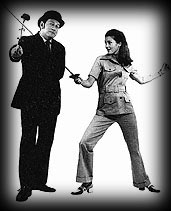
   The Avengers
Donald Monat as John Steed and
 Diane Appleby as Emma Peel —
    South Africa’s Avengers.

A.  Early days of South African radio were fashioned after the style set by the BBC -– British Broadcasting Corporation — so for a long while, for me, a radio was but another piece of furniture. Then, one night I heard these mysterious voices and perhaps a scream, and for the first time gave the radio real attention. I’ve no idea what the show was, but a jaded memory suggests it might well have been an adaptation of Edgar Wallace’s Grey Face. But it wasn’t until the introduction of commercial radio, by way of Springbok Radio, that I really began to enjoy the medium.

    The reason is easy to explain. Years earlier I’d found three back issues of the American magazine Radio Mirror on sale at Woolworth’s for 5 cents each. (Still have them.) Those magazines contained articles about the Grand Ole Opry, Perry Mason, Dr. Christian … the logs listed The Shadow, The Fat Man, Box 13 … That, I figured, was radio.

   Springbok Radio offered many of those shows, Bold Venture, Richard Diamond — and the likes of Nightbeat, The Hidden Truth, and Superman, canned in Australia. And, of course, the soaps.

   I’d started recording these shows and trading them with American OTR collectors. Along the way I came in contact with a legally blind fellow in New York who was anxious to secure copies of The Avengers, a locally produced radio series based on the British TV series. I had no idea then that a number the shows I recorded would turn out to be the only copies saved on tape. Since then a great many South African shows I recorded and traded have turned up in the lists of OTR dealers.

Q.  You were also involved with early comic book fandom. How did that come about?

A.  The day my older sister brought home a copy of Superman #4. I was immediately hooked; afterwards devouring any (American) comic book I could get my hands on. A consequence of this was that I could read a little before starting school, and that forever after, most required reading matter would seem tame and boring.

   I never knew his name then, but Joe Simon’s work on Blue Bolt, really grabbed me. A long time later I’d discover his Captain America, Stuntman, Boys Ranch, and other features. Instinctively, I always believed that he, Joe Simon, was the creator of Captain America, but it was not until the release of his book, The Comic Book Makers, that I found this to be fact.

   And it was Joe Simon who introduced me to Comics Fandom. I’d stumbled across his name in Writer’s Market, listed as editor of Sick, and wrote to him, asking if he were the Joe Simon who’d produced so much truly great stuff for the comics. Indeed he was, and not only did he provide an immediate reply, he also sent sample copies of Sick. It so happened that my letter had arrived within a short time of him receiving the first issue of Alter Ego, the first of the comics’ fanzines.

   Mr. Simon thought I’d be interested and provided the address of the publisher, Dr. Jerry G. Bails, who passed away in November 2006, at the age of 73. Jerry also wasted no time in contacting me and shooting across the debut issues of his fanzine. The manner of production — printed on a Ditto Duplicator — intrigued me. We had such a machine in the office, but as far as I was concerned it was strictly for printing inter-office notices or price lists. I got hold of a master and a few sheets of duplicating carbon, knocked out a cover and for lack of a better name titled it The Komix.

   The cover came out pretty well. But now, with 200+ copies printed there seemed to be a need for a story to fit it. Eventually I had about 40 pages to staple together into a fanzine. What I didn’t know was that it would the first comics fanzine to be published outside of the US. Nor that on eBay copies of the second issue would one day sell for as much as $70.00 each.

   I published only two issues of The Komix, had planned a third, but pressure of work was really cutting into my time. Often I’d be in four major cities in the same week. And then Suddenly You’re Dead was sold and I was committed to produce more.

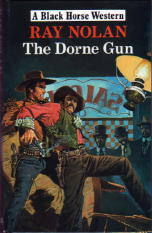
Q.  Tell us about your series of Western novels published as by Ray Nolan?

A.  These were started when my publisher opted to quit mysteries. Like most boys I loved the B-Westerns. Also the pulps such as Fifteen Story Western, Dime Western, Texas Rangers, etc. So the transition wasn’t difficult and I enjoyed doing them. What I didn’t enjoy was an editor trying to maintain political correctness, oft times even endeavoring to eliminate references, which might be considered even remotely offensive.

Nolan

   The pseudonym, by the way is derived from two men I have always greatly admired. My friend, singer songwriter and actor, the late Ray Whitley, and the legendary Bob Nolan, who penned such Western classics as “Tumbling Tumbleweeds”, “Cool Water”, and so many others.

Q.  You’ve done quite a few radio scripts for South African radio and short fiction for S.A. publications. Name some of the programs you’ve written for and the magazines in which you’ve been published. Did you find short stories and radio scripts easier to write than novels?

A.  Writing for radio was fun — and lucrative. I’d tried years back to break into the medium but it was something of a closed club. Finally I gave up. About 30 years ago, at a time when all shows on commercial radio were from local production houses, I happened to listen to a particular show and while doing so came up with a story idea. Next day I hacked it out and sent it to Springbok Radio’s head office. There, a fellow named Ben Swart, was good enough to write and tell me that the series was contracted and did not accept outside contributions. He had, however, taken the liberty to send my script to André Bothma, a producer operating in Cape Town. André bought it and asked for more, and soon a very enjoyable relationship was established, though I never ever met him or attended any recording session.

   The real break came when André phoned to say he’d like me to write for The Deciding Factor, a 45-minute show that aired on Sunday nights and attracted more listeners than any other. Could I start off with three scripts? He suggested themes for two and left the third for me to choose.

   “When will you need them?” I asked.

   “Oh, by next Friday will be fine.”

   And that’s how it went. I wrote about 200 scripts for The Deciding Factor, Suspense, Radio Theatre, Tuesday Theatre, and others. Contracts were more than extremely fair. Fees continually rose, and they covered two broadcasts within a period of 14 days. If a show was again aired after that period the writer was paid 50% of his current fee.

   André was an innovator and one of the best in the business. Never afraid to stick his neck out he’d try anything, and we had fun using werewolves and banshees, and even stories like Charley’s Amazing TV Set. Good times. Fun times.

   The first two stories I ever wrote and sold were to a new magazine titled Yours. It boasted the worst covers I have ever seen on any magazine. I was 15 at the time, but already working. Unfortunately neither were published because Yours went belly-up. Ten years afterward, or perhaps even later, I found one of the stories, changed the name from “Ain’t Nobody Honest?” to “Stopover At Nathan,” and a British agent sold it to London Mystery Magazine. It was subsequently reprinted, but I no longer have any record of it.

   When we sold our home at Bluewater Bay, a number of cartons got “lost” in moving, among them recorded tapes of the radio shows for which I’d written, manuscripts, and lots of personal and valued correspondence.

   Other stories have appeared in such local slicks as Family Radio & TV, Fair Lady, You … feature articles in Weekend Post, Leisure, etc – usually under other pseudonyms. Articles on show business personalities have been published in the US, in Under Western Skies, Nemesis, Screen Thrills, Classic Images, and possibly others.

   I’ve found scripting for radio the easiest. Usually I could get a story finished in a day. It was also less hit-and-miss than writing for magazines. The entire manner of conducting business was also completely professional. Acceptances were fast, and your check arrived within 30 days. The downside of it was that often the broadcast sounded nothing like the sounds heard in one’s head when pounding the typewriter.

Q.  Overall, what’s given you the most pleasure in your writing career?

A.  The work and the people with whom it has brought me in contact. Most gratifying has been to find that those of real substance are invariably the most down to earth.

Until

     —

SHORT STORY BONUS. I’ll let John set the stage:

   A tale’s attached to this short.

   A colleague asked me about plotting, and while explaining what I did, worked out a complete plot for him – based upon his habit of visiting the pub in question. He never used it, which was no surprise.

   On a Sunday morning some months later, I remembered the thing, made a few changes, and put it on paper … with no idea what I’d do with it. The very next week I received a letter from a friend — possibly Bill — telling me about the new Black Mask, suggesting I might think of sending them something.

   I sent “Waiting,” and they bought it right away. But then they shut down but paid a kill fee, returning all rights. Later still it was accepted by Black Lizard, but I heard no more from that end. Maybe I should have followed up.

   Anyway, though it has earned some good money, the story has never yet seen print. If you find it the least bit interesting, you’re free to link it to your site.

UPDATE [02-24-07]  Four additional cover scans have been added since the interview was first posted.
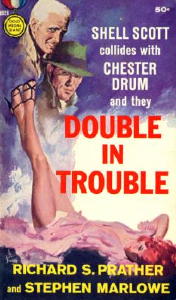
   In case you haven’t read or heard about it already, Stephen Marlowe, author of the Chester Drum series, recently appeared on Ed Gorman’s blog, telling the story of how he and Richard Prather, author of the Shell Scott PI novels, got together and wrote Double in Trouble, their magnum opus in which their two characters met and cracked a case together, after first cracking their heads together, thinking that each of them was on the other side.

Double

   The story is fascinating, and by all means, you should go read it. What I don’t know is whether you should read Marlowe’s long reminiscing story first, or to give it some additional background, you might want to read J. Kingston Pierce’s post on The Rap Sheet site before you stop over at Ed’s. Jeff has a great knack of finding a news item elsewhere on the blog and writing about it on his own, adding as he does so a profusion of links and insights to the original post, wherever it may have been. It’s one of the few sites where I stop by everyday, and Ed Gorman’s is another. With his long career in mystery fiction and other genres, Ed knows the authors and the publishers, and he has many well-formed opinions and perspectives of the field, all of which spills over into his daily posts.

   Returning to Marlowe and Prather’s work together, I’m not sure if this the first example where two authors joined forces (and characters) in a novel, sharing a joint byline together. In 1963, Stuart Palmer and Craig Rice published People Vs. Withers and Malone, a collection of short stories in which their detectives, Hildegarde Withers and John J. Malone either shared or battled wits together. Most of the stories were written before 1959, which is when Double in Trouble first came out, but whether or not that counts, I don’t know.

   I’ve asked this question before, I know I have. What I don’t know is if I received an answer or not. Those who forget history are doomed to repeat it, as some wise philosopher once said.

   Here’s another question. Richard Prather’s passing has been widely reported on various blogs and newsgroups, but as far as I know, it has yet to have been noted by the mass media. Why not? If you were to Google “richard prather obituary” as I did just now, the piece I posted on the M*F blog a full week ago today is the first one to come up. Why is that? It looks nice on my resume, I suppose, but come on. I’d agree that at the time of his death Mr. Prather was not a major player in the world of mystery fiction, but he was still certainly a major figure, having sold millions and millions of his (mostly) wacky private eye adventures, second certainly in the 1950s only to Mickey Spillane. Why has the rest of the world ignored his passing?

   One more question, and one that’s less of a rant. Prather is gone, but Stephen Marlowe, at the age of 79, is thankfully still with us. Of the major (or even the minor) Gold Medal writers of the 1950s, who else are still alive? Vin Packer (Marijane Meaker) for one, I believe, and she will be 80 this year. Others?

   I’ve been working slowly in annotating the Addenda to the Revised Crime Fiction IV, compiled by author Allen J. Hubin and which I have been posting online.

   Here are some fairly recent entries, as I have expanded upon them, often with the assistance of others. Perhaps you will find them as interesting as I did. Even better, if you can add anything useful or noteworthy to these entries, please send it along. You will find your input very much appreciated. Of course, if you find anything that requires a correction, you should let me know that too. I can guarantee you that it will be equally appreciated!

GATES, H. L.   American author of eleven crime or thriller novels published between 1921 and 1934, two of them indicated as having only marginal criminous content in the (Revised) Crime Fiction IV.
   The Mystery of the Hope Diamond. (Novelization of silent film: Kosmik, 1921, as The Hope Diamond Mystery; also released as The Romance of the Hope Diamond; scw: John B. Clymer, Charles W. Goddard, May Yohe; dir: Stuart Paton.) (Note: May Yohe, 1869-1938, actress and one-time wife of an owner of the diamond, also had some role in the writing of the novel.)

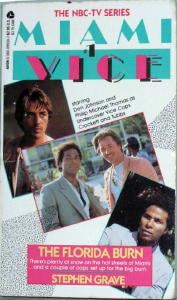
GRAVE, STEPHEN   Pseudonym of David J. Schow, (1955- ). A horror fiction writer under his own name; as Stephen Grave the author of six paperback novelizations based the television series Miami Vice, including the one cited immediately below. As Brad Latham, Schow was also the author of five private eye novels set in New York City in the 1930s with Bill “The Hook” Lockwood as the leading character.
   The Florida Burn. TV movie [series episode/Miami Vice]: Michael Mann, 1984, as Brother’s Keeper (scw: Anthony Yerkovich; dir: Thomas Carter, Neil Gordon). Add SC: Det. James “Sonny” Crockett (Don Johnson) & Det. Ricardo “Rico” Tubbs (Philip Michael Thomas)

Miami Vice

[Note: It is likely but not yet confirmed that Crockett and Tubbs should be added as SC to the other books in the series; see below. These books were based on either 60-minute episodes or combinations of two 60-minute episodes, not considered to be movies. Only the first two books in the series were published in the US.]
      China White. [Miami Vice #4]
      Hellhole. [Miami Vice #6]
      Probing by Fire. [Miami Vice #5]
      The Razor’s Edge. [Miami Vice #3]
      The Vengeance Game. [Miami Vice #2]

HAMILTON, LYN
   The Celtic Riddle. TV movie: CBS, 2003, as Murder She Wrote: The Celtic Riddle (scw: Rosemary Anne Sisson, Bruce Lansbury; dir: Anthony Shaw). SC: Lara McClintoch does not appear in the film; she was apparently replaced in her role by “Jessica Fletcher” (Angela Lansbury). Note: For a review of the movie relative to the book, see (for example) www.blogcritics.org.

HAWKINS, DEAN
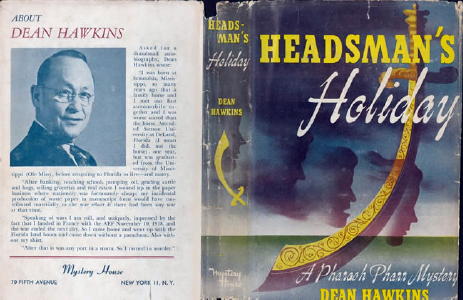
. 1892-1955.    Pseudonym of Benjamin Hawkins Dean, q.v. Born in Mississippi, graduated from the University of Mississippi but lived in Florida most of his life; worked in the paper business. Author of four detective novels in the (Revised) Crime Fiction IV, including the one cited below. Add real name and birth & death dates. [Thanks to John Herrington and Victor Berch for uncovering both.]
   Headsman’s Holiday. Add setting: Florida. Leading character: private eye Pharaoh Pharr.

       Hawkins

HEATH, CHARLES    Pseudonym of Ron Renauld, author of many TV tie-in’s and books in men’s adventure series (Able Team, Airwolf, etc.) under various pen names and house names. Several other “A-Team” novels that he wrote are probably adaptations of 60-minute episodes of the TV program.
    The A-Team. TV movie [two parts]: Universal, 1983 (scw: Frank Lupo; dir: Rod Holcomb) . SC: The A-Team: Col. John “Hannibal” Smith (George Peppard), Capt. H. M. “Howling Mad” Murdock (Dwight Schultz), Sgt. Bosco “B. A.” Barracus (Mr. T) & Lt. Templeton “Faceman” Peck (Tim Dunigan). Note: Dunigan played Peck for this series pilot only; Dirk Benedict had the role for the rest of the series.

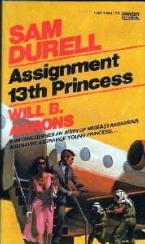
   I received the following as an email from Wynn Manners a couple of days ago, and he’s agreed to let me post it here on the blog. The article he’s referring to is one done by Doug Bassett on the original Mystery*File website. At the conclusion of Doug’s essay is a bibliography of all the books in Sam Durell series, followed by the story of how the person behind the Will B. Aarons pseudonym on the last six books was revealed, thanks to Jeff Falco and Al Hubin. You may go read it now, but if you do, don’t forget to find your way back.    –Steve


   Thanks for your write up on Edward S. Aarons.

   Appreciated it — and the listing of all the Assignment series. Looks like I only lack about two of  ’em…

   Personally I *far* prefer Aarons’s thrillers over John Buchan’s (I *barely* managed to wade thru his 39 Steps & Ian Fleming’s 1930’s-level pulp trash James Bond thrillers (tho I thoroughly enjoy the movies). (Truth-to-tell, I’ve only read *one* by each of these… and started one other volume by each of them. They just didn’t “grab” me. *Yawn.*)

   I put Aarons’s books right up there with John D. MacDonald’s Travis McGee series and Donald Hamilton’s Matt Helm series — at the very TOP — better than most of the rest!

Will Aarons

   Happy to have found out the “inside dope” on Will B. Aarons. I’ve *enjoyed* the “Will B. Aarons” books I’ve read; I thought he did a *good* job by way of trying to fill Edward’s shoes (far, far better than anyone has done writing further Tarzan novels, for example — tho I’d still love the opportunity to read Stu Byrne’s Tarzan On Mars …)

   If one gives Edward an “A” — overall (and I *do*!) I’d say that “Will’s” books still deserve a “B.” They’re certainly worth a one-time read.

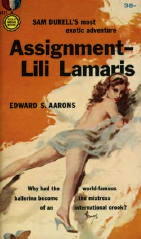
   I started reading the Assignment series back when I was in college (1960-64)… and am *rereading* some of them, all these years later (Lili Lamaris being the current reread). One utterly forgets the story in 20 to 40 years… so it’s “all new” again… Lucked-out at one library sale at the Clarkston (Michigan) Library… someone had collected most of what he’d written, including early 50’s non-Assignment thrillers. (Don’t recall ever seeing the Ace Double Novel ones, tho…)

   Aarons keeps ya glued to the book, turning the pages, on-the-edge. *Excellent* storytelling. And I like the wisdom of the way he chose that last name — a double A to put him *first* when books are arranged alphabetically by authors’ last names!

Edward Aarons

   It’s always seemed to me that the connoisseurs “in the know” with a more developed taste go to the likes of Edward S. Aarons and Donald Hamilton — and the plebian masses who just “follow the popularity crowd” — picking up on the latest “best seller” or read the considerably *inferior* Ian Fleming’s James Bond!

   Once in awhile I read a “best seller” type of book and understand *why* people were attracted to it (Robert James Waller, for example)… but *most* of the time what is most popular… it’s utterly *beyond* me what people see in it!

   I recently acquired a copy of the Edward Gorman edited The Black Lizard Anthology Of Crime Fiction (for two bits, from the back room of our local library) and was delighted to be reading the intro, devoted to Fawcett Gold Medal books… but *appalled* that Edward S. Aarons (& Donald Hamilton, for that matter) were never even *mentioned* (tho I realize that the “thrillers” category is a bit different from the category of hard-boiled detectives he seemed to be focussed upon).

   The first two Gold Medal books I remember reading were Richard Matheson’s I Am Legend — bought at O’Dell’s Drug Store as a 10th grader… and the Gardner F. Fox one on Jack the Ripper (the title escapes my mind, at the moment). My Name Is Buchanan by Jonas Ward was read around those years, too…

            Cheers!

               ~~wynn manners

MYSTERY SERIES CHARACTERS: FROM THE PRINTED PAGE TO TELEVISION
         – Addenda and Corrections, by Marvin Lachman.

The primary list appeared on the original Mystery*File website in five parts:

Part One: A through C.

Part Two: D through E.

Part Three: F through K.

Part Four: L through O.

Part Five: P through Z.

CORRECTION– Ashdown, Clifford (joint pseudonym of R. Austin Freeman and John James Pitcairn).

NEW– Ashe, Gordon (pseudonym of John Creasey).   On April 30, 1962 on the American series Thriller, there was an episode, “The Specialists,” that was based on the Ashe series about PATRICK DAWLISH, though the lead character, played by Lin McCarthy, had his name changed to Peter Duncan.

CORRECTION– Biggers, Earl Derr.   The name of the series was The New Adventures of Charlie Chan.

NEW– Buchan, John.   Hannay was a 1988 British series, with Robert Powell as RICHARD HANNAY. Powell had previously played Hannay in a 1978 film remake of The 39 Steps.

ADDITION– Chandler, Raymond.   Danny Glover played Marlowe in the adaptation of the short story “Red Wind” in the Fallen Angels series on November 26, 1995. In the 1998 TV movie Poodle Springs, based on the novel which Robert B. Parker completed from material left by Chandler, James Caan was Marlowe.

ADDITION– Charteris, Leslie.   Ivor Dean was INSPECTOR TEAL to Moore’s Templar. Simon Dutton was Simon Templar in a British series of six TV movies under the umbrella heading of Mystery Wheel of Adventure in 1989.

CORRECTION AND ADDITION– Christie, Agatha.   Regarding the series with Joan Hickson as Jane Marple, eliminate the word “Mystery!” and change the title of the first show to The Body in the Library. David Horovitch played DETECTIVE INSPECTOR SLACK on that show. Harry Andrews was SUPT. BATTLE in The Seven Dials Mystery which aired in Britain on Mobil Showcase on April 16, 1981. Philip Jackson was CHIEF INSPECTOR JAPP during the series in which David Suchet played Poirot.

NEW– Cody, Liza.   ANNA LEE was played by Imogen Stubbs in a 1995 series aired in the U.S. on the A & E network.

NEW– Deighton, Len.   Ian Holm was BERNARD SAMSON in Game, Set, and Match, a 1988 TV series based on Deighton’s trilogy.

ADDITION– Dexter, Colin.   Kevin Whateley continued his role from the Inspector Morse series, albeit with a promotion, as INSPECTOR LEWIS in the 2006 TV movie of that title.

ADDITION– Fair, A.A. (Pseudonym of Erle Stanley Gardner).   In 1959 a U.S. TV pilot film starred Billy Pearson as DONALD LAM and Benay Venuta as BERTHA COOL.

NEW– Gould, Chester.   His DICK TRACY was played by Ralph Byrd (who had played him in the movies) in a 1950-1951 American series.

NEW– Hamilton, Nan.   ISAMU (“SAM”) OHARA was played by Pat Morita in a 13-episode American series in 1987-1988.

NEW– Holton, Leonard (pseudonym of Leonard Patrick O’Connor Wibberly).   George Kennedy was Father Samuel Cavanaugh in the 1971-1972 American series Sarge. According to William L. De Andrea because of similarities to Holton’s books about FATHER JOSEPH BREDDER, a royalty was paid to the writer while Sarge was aired.

NEW– Hornung, E.W.   His RAFFLES was played by Anthony Valentine in a 1977 series for Yorkshire TV in England.

ADDITION– James, P.D.   CORDELIA GRAY was played by Helen Baxendale in An Unsuitable Job for a Woman on Mystery! in 2000.

ADDITION– McBain, Ed.   There was also a 1995 TV movie, Lightning, about the 87th Precinct, with Randy Quaid as Steve Carella, Alex MacArthur as Bert Kling, Ving Rhames as Artie Brown, Alan Blumenfeld as Ollie Weeks, and Ron Perkins as Meyer Meyer.

CORRECTION– Murphy, Warren and Sapir, Richard.   The name of the actor who played Remo Williams was Jeffrey Meek, not Jeffrey Weeks.

ADDITION– O’Donnell, Peter.   In 1982 ABC in the U.S. made an hour-long pilot film with Ann Turkel as MODESTY BLAISE and Lewis Van Bergen as WILLIE GARVIN.

ADDITION– Orczy, Baroness.   Anthony Andrews was SIR PERCY BLAKENEY, aka THE SCARLET PIMPERNEL in a 1982 British TV movie The Scarlet Pimpernel.

ADDITION– Parker, Robert B.   Robert Urich starred in several Spenser for Hire TV movies after the series ended, and then he was replaced by Joe Mantegna. Avery Brooks starred in his own TV series, A Man Called Hawk, on ABC in 1988-1989. One of Parker’s more recent character, POLICE CHIEF JESSE STONE has been played by Tom Selleck in two TV movies, Night Passage and Stone Cold. Polly Shannon played attorney ABBY TAYLOR.

ADDITION– Peters, Ellis (pseudonym of Edith Pargeter).   Tom Lowell played DOMINIC FELSE in the adaptation of her Edgar-winning novel Death and the Joyful Woman on the Alfred Hitchcock Hour, April 12, 1963.

ADDITION– Quarry, Nick (pseudonym of Marvin H. Albert).   Though NICK QUARRY was not a series character in the books Albert wrote as “Quarry,” there was a 1968 TV pilot film, based on Albert’s work, starring Tony Scotti as Nick Quarry.

ADDITION– Rankin, Ian.   Ken Stott replaced Hannah as Rebus.

NEW– Reichs, Kathy.   Emily Deschanel is DR. TEMPERANCE BRENNAN in the current (2005-   ) TV series Bones.

NEW– Rogers, Samuel.   Ralph Roberts was PAUL HATFIELD in “Don’t Look Behind You,” an episode on the Alfred Hitchcock Hour Sept. 27, 1962.

ADDITION– Sayers, Dorothy L.   Richard Morant played Bunter during the 1980s.

ADDITION
– Simenon, Georges.   Jean Richard played Maigret in a French TV series c.1970.

ADDITION– Smith, Martin (Cruz).   Ron Leibman was ROMAN GREY in The Art of Crime, a 1975 TV movie based on his novel Gypsy in Amber.

ADDITION– Spillane, Mickey.   Rob Estes was Mike Hammer in the TV movie Deader Than Ever (1996).

NEW– Stevenson, Richard.   Chad Allen played his DONALD STRACHEY in two TV movies Third Man Out (2005) and Shock to the System (2006) aired on the Here! Network.

ADDITION– Stout, Rex.   Also on the 2001 series, Colin Fox was FRITZ BRENNER; Kari Matchett was LILY ROWAN; Conrad Dunn was SAUL PANZER; Saul Rubinek was LON COHEN; Trent McMullen was ORRIE CATHER; R.D. Reid was SGT. PURLEY STEBBINS; Ken Kramer was DR. VOLLMER; and Fulvio Cecere was FRED DURKIN.

NEW– Thomas, Leslie.   Peter Davison, who also had played Albert Campion, was “DANGEROUS” DAVIES in the British series The Last Detective, based on Thomas’s book.

NEW– Valin, Jonathan.   Gil Gerard played HARRY STONER in the 1989 TV movie Final Notice, based on Valin’s novel.

NEW– Vickers, Roy.   His main series is THE DEPARTMENT OF DEAD ENDS. There are several detectives in this branch, most often Inspector Rason. However, in “The Crocodile Case,” which appeared on Alfred Hitchcock Presents on May 25, 1958, the detective is INSPECTOR KARSLAKE, played by John Alderson. In “The Impromptu Murder,” on the same show on June 22, 1958, it is Robert Douglas as INSPECTOR TARRANT.

ADDITION– Wallace, Edgar.   Hugh Burden played the title role of J.G. REEDER in The Mind of Mr. J.G. Reeder, a series for Thames Television in England 1969-1971. He also was one of the writers.

NEW– Willis, Ted.   Jack Warner played P.C. GEORGE DIXON in Dixon of Dock Street, a popular British series that ran from 1955 through 1976. Dixon first appeared in Willis’s 1950 novel The Blue Lamp.

NEW– Yates, Dornford.   In She Fell Among Thieves, originally on BBC2’s “Play of the Week” in 1978, Malcolm McDowell was RICHARD CHANDOS SMITH and Michael Jayston was MANSEL.

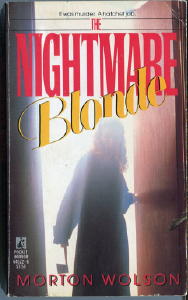
MORTON WOLSON – The Nightmare Blonde

Pocket, paperback original; 1st printing, April 1988.

   This book escaped a lot of notice when it came out, or at least that’s what I strongly suspect. Reading just the cover and the blurb at the top – “It was murder. A Hatchet Job.” – I think the average reader would have thought that this was just another horror novel of the blood and gore variety, both of which were very popular at the time. Nor would the name of the author have meant anything to anybody.

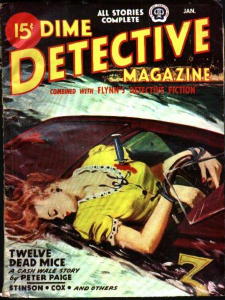
   But what if I told you that Morton Wolson was the real name of 1940s pulp writer Peter Paige, creator of the private detective Cash Wale? Or at least I think that Wale was a PI, but I may be wrong and someone will have to tell me.

Paige: Pulp

   In any case, Peter Paige wrote a slew of detective stories for magazines like Black Mask, Detective Fiction Weekly and Dime Detective – mostly the latter, I believe – until disappearing from sight about the same time as most of the pulps died, in the early 1950s. Most of them were, by all accounts, fairly ordinary. Paige is a not a name which comes to many people’s mind when it comes to pulp detective fiction. Myself, I know the name, and I know Cash Wale, his primary series character, but as far as any single story is concerned, I can’t think of a single plot line, I have to say, and reluctantly so as I do.

   When I asked veteran researcher Victor Berch to see what he could come up with as far as either Paige or Wolson was concerned, he did his usual amazing sleight-of-hand and came up with a couple of interesting items. In the Los Angeles Times of January 7, 1946, there was a short item with the following headline: Writer, Held for Beating Wife, Says She Beat Him:

   Morton Wolson, 32, detective story writer under the name of Peter Paige, was in the San Pedro Jail yesterday facing a charge of wife beating… Mrs. Wolson [Ruth, age 23] charged that he husband struck her in the face during an argument… Wolson, in jail … denied the charges and declared that he was merely trying to defend himself.

   Accompanying the article, not much longer than the excerpt above, are separate photos of both Wolson and his wife, who is shown feeding their baby with a bottle. (The headline of the item that follows on the same page is: Jeanne Crain and Mother Reconciled.)

   Besides the work he did for the pulps as Peter Paige, Wolson had two stories published under his own name. The first one appeared in the January 1954 issue of EQMM, a tale entitled “The Attacker,” and a little bit later, “The Glass Room,” was published in the September 1957 issue.

   Wolson’s output may have been small under his own name, but “The Attacker” was good enough to be selected in David C. Cooke’s annual Best Detective Stories of the Year anthology for 1954, and more than that, to be picked up again by Allen J. Hubin’s Best of the Best Detective Stories: 25th Anniversary Collection in 1971. (Al did not remember this fact while he and I were corresponding a short while ago about Wolson, until I pointed it out to him.)

   There is one entry for Wolson on www.imdb.com. A story he wrote was the basis for “Prime Suspect,” an episode of Jane Wyman Presents the Fireside Theater, telecast on 27 February 1958. A gent named Steve Fisher did the adaptation, and an actress named Nita Talbot appeared in it, whom I thought was tremendously good-looking at the time; the leading role was played by William Bendix, whom hardly anybody thought was good-looking at any time. Where the story may have been published earlier remains unknown.

   The next time Victor came across Wolson’s name in a newspaper was in the New York Times for March 29, 1970, in an advertisement for a special “Manager’s” sale being held by Furniture-in-the-Raw, an outfit with five stores in the New York City area. I’ll quote the relevant detail:

   Our Queens store mgr. Morton Wolson says “If it doesn’t sell at these prices it can’t be sold.”

   Nothing more seems to have put Wolson in the news or in any sort of spotlight until the publication of The Nightmare Blonde in 1988, and then, as I alluded to earlier, the book seems to have come and gone without much notice. At the moment there seems to be two copies available on the Internet, one from Alibris in the $3.00 range, and one from England in the $30 range. It is dedicated to his wife Gaye, so it is clear that the earlier one did not last.

   But before getting to the main event, perhaps you’ve started to wonder. Wolson was born in 1913 (making his age as reported in the LA Times correct), and he died in 2003. You also may be beginning to wonder about this book he wrote in 1988, when he was 75, and whether it is any good or not.

   My answer, in a word, is “yes,” but if I may, I’d also have to say that it’s a qualified response, and I’ll get to that soon. Remember now that it was marketed as a horror novel, which in a strong but not overpowering sense it is, as the murder to be solved is that of a family of four, killed by someone with a very sharp axe.

   But what it really, really is, when you really get down to it, is a detective novel in a very traditional sense. It’s also a tough, middle-class sort of novel, and hard-boiled at about the same level as, for example, a Ross Macdonald novel, not to forget to mention that it’s quite definitely noirish in a way as well.

Wolson

   Let me explain that last sentence right away. Dan Warden, the leading character, is the former chief of police in Oregon City, a town somewhere along the Pacific Ocean where the story takes place, who had recently been fired for beating up a newspaper columnist’s nephew and being chewed out in print by that very same newspaper columnist. After coming out of a 24-hour drinking binge, about which he remembers nothing, he discovers that it is (no surprise here) the newspaper columnist who has been murdered, along with the three remaining members of his family.

   Which makes Dan Warden the number one suspect, no matter how close his friendship with the police commissioner is. At the same time as Warden is discovering how badly his life has been suddenly turned upside down and inside out, he makes a friend – saving her life, to be precise, as she (a blonde) tries jumping off the end of Fisherman’s Wharf, but miscalculating badly as she does so. Allow me to insert a long quote right about here, taken from pages 17 and 18:

   “I’m really all right,” she said. “The problem was not being able to talk it out. There was nobody I could really talk to. I had to keep it inside me. Like a nightmare that wouldn’t leave me alone. Do you know what I’m trying to say?”

   “Sure,” Dan said, his arm around her waist, urging her along. For the first time he realized that she had a slender, almost lithe, waist, and he felt a tug of sexual excitement, followed by a flush of shame that he should even note such a thing in this vulnerable woman. “I know,” he said. “It’s like you couldn’t get out of the mirror.”

   They were moving very slowly. She put her face against his chest and through the fabric said, “Do you know what it’s like to be two people? I mean two separate people — and one doesn’t know what the other is thinking or doing except in dreams now and then, and you don’t understand the dreams?”

   “I know all about it,” he told the droplets in her blond hair.

   Her eyes probed his.

   “Don’t joke with me, please!”

   “Scout’s honor,” he said, urging her toward Bayfront Street. “Me, I just had a twenty-four hour memory gap. And while I can remember staring at myself in a lot of bar mirrors, and awakening once on a strange back porch the other side of town, and seeing a sudden blinding flash of light, and walking several hundred miles through this rain, I have no idea where I left my hat or coat or parked my Chevy, or who I punched, or who punched and scratched me. I have not even the dimmest idea of even seeing the man I’m supposed to have either punched to death or killed with a hatchet.”

   Kay Mullins (that’s her name) has had psychological problems dealing with children in the past, and now two of them are dead, and the reason for emphasizing that she is a blonde, as I did a just a moment ago, is that several blonde hairs have been found at the scene of the murders.

   It takes Dan most of the rest of the book to investigate the crimes while trying to stay ahead of the new police chief, who still considers him to be his primary suspect, while keeping Kay stable and discovering just how many blondes just happened to be in and around the area of the victims’ home, including Kay herself.

   Part of the investigation includes visiting a camp of the local branch of the White Knights of America and at least three brothels of increasing degrees of sophistication, and some low spots as well. It’s a tough, rough story at times, and while it tends to start rambling a little, it still provides about four hours of pure entertainment, or at least it did for me, flawed only – here comes a qualifier – by the inescapable unlikelihood of one too many fairly uncommon events, all happening at the same time and in the same place.

   But while the laws of probabilities, still enforced in every state in the union, say that the juxtaposition of so many blondes in one focal point of chaos, could not and should not have happened, what Wolson does is not easy. He makes the book flow well enough, and smoothly enough, that you (the reader) don’t (and can’t) stop to think about it while you’re in the process of reading, and read it you will.

   As the identity of the killer becomes increasingly clear, and Wolson does a more than creditable job in disguising the solution to the murders for as long as he can – and even longer than he had a right to, truth be said – the chills begin as well, intellectually as well as (without trying to give anything away) deep down inside the reader’s bones somewhere.

   Nor is the book over even then. For noir fans everywhere, lift a glass to a pulp writer past. This one’s for you.

— written in September 2006

UPDATE: Victor Berch has come up with some more information on Wolson’s life. Why don’t I simply let him have the floor:

    “About the only thing I can add are some vital statistics: Morton Wolson was born the son of Joseph and Zina Wolson on June 9, 1913 in New York. He died January 4, 2003 in Laguna Hills, CA. Might have been living in Mission Viejo as that seems to be the latest phone record. At the time of his death, he was married to a woman named Gaye (last maiden name unknown). She was born February 1, 1927 and died Aug 30, 2005. It is highly possible that Morton was not his original name as he is listed in the 1920 US Census as Mortimer. He may have thought that was too sissified of a name and decided to call himself Morton, which is the name he used for Social Security purposes. Oh, his parents were immigrants from Russia. He also had a brother, Robert.”

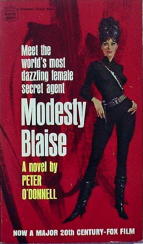
   The title of the first Modesty Blaise novel was exactly that, Modesty Blaise, published by Souvenir Press in 1965. The author was Peter O’Donnell. Modesty, of course, had appeared even earlier, as her adventures in book form were preceded by those in the daily comic strips, debuting in the London Evening Standard in 1963. The first artist for the strip was Jim Holdaway, then Romero and a small number of others, with Romero returning before O’Donnell decided to end it in 2001.

Modesty 1

   The comic strip was not widely distributed in the US, in part because adventure strips find very little acceptance in this country in general, but also because of the nude scenes which had to be censored. A favorite tactic that Modesty used against her foes was called the “Nailer,” whereby she would strip above the waist and Willlie Garvin, her companion in crime-fighting, would take advantage of the distraction she caused. Not a technique that could be shown in the US!

   There were movies, too, not always very successful, and perhaps I’ll discuss them someday. A pilot was made and aired for proposed TV series starring Ann Turkel, but nothing further developed.

   Taken from wikipedia, here are portions of a couple of paragraphs that will help explain some of the background for Modesty Blaise, the character.

    “In 1945 a nameless girl escaped from a displaced person (DP) camp in Karylos, Greece. She did not remember anything from her short past. She wandered through post-WW2 Mediterranean and Arabia. During these years she learned to survive the hard way. She befriended another wandering refugee, a Hungarian scholar named Lob who gave her an education and a name: Modesty Blaise. Eventually she took control of a criminal gang in Tangier and expanded it to international status as “The Network.”

    “During these years she met Willie Garvin. Despite the desperate life he was living, she saw his potential and offered him a job. Inspired by her belief in him, he pulled through as her right-hand man in The Network and became Modesty Blaise’s most trusted friend. Theirs is a strictly platonic relationship and is based on mutual respect and shared interests. They have never gone to bed with each other, fearing that would ruin their special bond.

    “When she felt she’d made enough money, she retired and moved to England; Willie Garvin followed suit. Bored by their new lives among the idle rich, they accepted a request for assistance from Sir Gerald Tarrant, a high-ranking official of the British secret service — and this is where the story really begins.”

   Now go, if you will, to the Crime Time website , and an interview with Mr. O’Donnell, where he explains for the first time who it was — the real person — upon whom Modesty Blaise was based.

   Here I’ll quote only the last paragraph, in which Mr. O’Donnell says:

    “I am in debt to the child I saw that day in 1942, both for the privilege of having met her, however briefly, and for her providing the role model for a character I have now written about for close on 40 years. I still think of her from time to time, and wonder what became of her. If alive today, she would have just turned 70. Whatever the length of her days, I can only hope that she was granted some measure of the reward she deserved for her courage and spirit. I salute her.”

M & Willie

      –Thanks to Peter Rozovsky of Detectives Without Borders for the tipoff to the interview.

   It didn’t take long for the news to get around. James Reasoner, Ed Gorman and Bill Crider were among the first to have gotten the news of Mr. Prather’s death online, but I’d heard it from Al Hubin by way of John Herrington (in England) just minutes before I saw it on Bill’s blog. It must be true, and yet it’s still hard to believe.

   I’m not positive, but I’m all but convinced that it was one of Shell Scott’s crazy capers in the mid-1950s that introduced me to Gold Medal paperback fiction. I’d been reading the Hardy Boys before that, as I’ve related before, and while the details of what happened when are not exactly clear, I know it wasn’t much earlier that I’d started in on the shelf of Erle Stanley Gardner hardcovers I’d discovered in the Cadillac (MI) public library.

Shell Scott

   Perry Mason was nothing like Shell Scott, a private eye with a leer and not much savoir faire, and there was no going back. My innocence was gone. No, I didn’t abandon Perry. I read those, too, the entire shelf. But I also read all of those paperbacks with the yellow spines in the supermarket spinner rack, with new books in every Wednesday, or was it Tuesday, on my way home from high school, some of them while standing right there at the rack, as who had 75 cents to spend whenever another three of them came out?

   Mr. Prather came up for discussion on this blog not too long ago, when I mentioned the interview that Linda Pendleton did with him late last year, and I suggest that you go read it again. You did read it the first time, didn’t you?

   Here’s his entry in Allen J. Hubin’s Crime Fiction IV, in chronological order. I won’t list all of the reprints, of which there were many: n = novel, co = collection, ss = short story, nv = novelette, na = novella; SS = Shell Scott.

PRATHER, RICHARD S(cott) (1921- )

* Case of the Vanishing Beauty (n.) Gold Medal 1950 [SS]
* Bodies in Bedlam (n.) Gold Medal 1951 [SS]
* Everybody Had a Gun (n.) Gold Medal 1951 [SS]
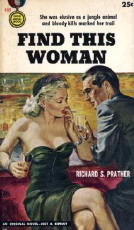
* Find This Woman (n.) Gold Medal 1951 [SS]

Find This Woman

* Dagger of Flesh (n.) Falcon 1952
* Darling, It’s Death (n.) Gold Medal 1952 [SS]
* Lie Down, Killer (n.) Lion 1952 [SS]
* Way of a Wanton (n.) Gold Medal 1952 [SS]
* Ride a High Horse (n.) Gold Medal 1953. Also published as: Too Many Crooks. Gold Medal, 1956. [SS]
* Always Leave ’Em Dying (n.) Gold Medal 1954 [SS]
* Pattern for Panic (n.) Abelard-Schuman 1954. Revised version, with SS: Gold Medal, 1961.
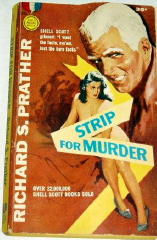
* Strip for Murder (n.) Gold Medal 1956 [SS]
* Too Many Crooks (n.) Gold Medal 1956; See: Ride a High Horse (Gold Medal, 1953).
* The Wailing Frail (n.) Gold Medal 1956 [SS]
* Have Gat – Will Travel (co) Gold Medal 1957 [SS]
   # • The Build-Up • ss Suspect Feb ’56
   # • Code 197 • ss Manhunt Jun ’55
   # • Murder’s Strip Tease • ss
   # • Sinner’s Alley • ss
   # • The Sleeper Caper • ss Manhunt Mar ’53
   # • Trouble Shooter • ss Accused Jan ’56
* Three’s a Shroud (co) Gold Medal 1957 [SS]
   # • Blood Ballot • nv Menace Nov ’54
   # • Dead Give-Away • na
   # • Hot-Rock Rumble • nv Manhunt Jun ’53
* The Scrambled Yeggs (n.) Gold Medal 1958; See: Pattern for Murder (Graphic 1952), as by David Knight. [SS]
* Slab Happy (n.) Gold Medal 1958 [SS]
* Take a Murder, Darling (n.) Gold Medal 1958 [SS]
* Double in Trouble [with Stephen Marlowe] (n.) Gold Medal 1959 [SS with Chester Drum]
* Over Her Dear Body (n.) Gold Medal 1959 [SS]
* Dance with the Dead (n.) Gold Medal 1960 [SS].
* Dig That Crazy Grave (n.) Gold Medal 1961 [SS]
* Shell Scott’s Seven Slaughters (co) Gold Medal 1961 [SS]
   # • Babes, Bodies and Bullets • ss
   # • The Best Motive • ss Manhunt Jan ’53
   # • Butcher • ss Manhunt Jun ’54
   # • Crime of Passion • ss
   # • The Double Take • nv Manhunt Jul ’53
   # • Film Strip • nv Ed McBains Mystery Book #1 ’60
   # • Squeeze Play • ss Manhunt Oct ’53
* Kill the Clown (n.) Gold Medal 1962 [SS]
* Dead Heat (n.) Pocket Books 1963 [SS]
* The Peddler (n.) Gold Medal 1963; See: Lion, 1952 as by Douglas Ring.
* The Cockeyed Corpse (n.) Gold Medal 1964 [SS]
* Joker in the Deck (n.) Gold Medal 1964 [SS]
* The Trojan Hearse (n.) Pocket Books 1964 [SS]
* Dead Man’s Walk (n.) Pocket Books 1965 [SS]
* Kill Him Twice (n.) Pocket Books 1965 [SS]
* The Meandering Corpse (n.) Trident 1965 [SS]
* The Kubla Khan Caper (n.) Trident 1966 [SS]
* Gat Heat (n.) Trident 1967 [SS]
* The Cheim Manuscript (n.) Pocket Books 1969 [SS]
* Kill Me Tomorrow (n.) Pocket Books 1969 [SS]
* The Shell Scott Sampler (co) Pocket Books 1969 [SS]
   # • The Bawdy Beautiful • ss
   # • The Cautious Killers • ss Shell Scott Mystery Magazine Nov ’66
   # • The Da Vinci Affair • ss Shell Scott Mystery Magazine Feb ’66
   # • The Guilty Party • ss Come Seven/Come Death, ed. Henry Morrison, Pocket, 1965
   # • The Live Ones • ss, 1956
* Dead-Bang (n.) Pocket Books 1971 [SS]
* The Sweet Ride (n.) Pocket Books 1972 [SS]
* The Sure Thing (n.) Pocket Books 1975 [SS]
* The Amber Effect (n.) Tor 1986 [SS]
* Shellshock (n.) Tor 1987 [SS]
* Hot-Rock Rumble and The Double Take (co) Gryphon Books 1995
   # • The Double Take [Shell Scott] • nv Manhunt Jul ’53
   # • Hot-Rock Rumble [Shell Scott] • nv Manhunt Jun ’53

as by KNIGHT, DAVID

* Pattern for Murder (n.) Graphic 1952. Also published as: The Scrambled Yeggs, as by Richard S. Prather. Gold Medal, 1958. [SS]
* Dragnet: Case No. 561 (n.) Pocket Books 1956 [TV tie-in]

as by RING, DOUGLAS

* The Peddler (Lion, 1952, pb) Reprinted as by Richard Prather: Gold Medal, 1963.

   I’ve omitted some of Mr. Prather’s stories that haven’t appeared in any of the various collections. I’ll have to add those later. It’s quite a list of fiction even without them. Many of these books I have not read in over 50 years, and the plots are mostly gone from memory – not all: no one who’s read Strip for Murder will ever forget what went on in that one – but not the days at the paperback rack at the local supermarket.

Strip

   I’ll close up this tribute for tonight with a review of the Scott Scott mini-epic which I read most recently. It’s from November 2002:

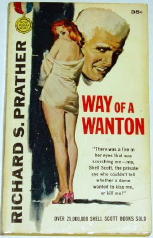
RICHARD S. PRATHER – Way of a Wanton

Gold Medal 497; c.1952; 4th GM printing, July 1957

   Prather was not one of the Gold Medal authors Gorman mentioned in the book before this one [a book entitled Will You Still Love Me Tomorrow?] — Sam McCain seems to have been primarily a Harry Whittington fan — but the Shell Scott books are very much a part of my high school memories. Not that I remember actually reading one, straight through, from beginning to end, but — ah — the good parts, those I remember.

   This particular one, the inimitable private eye’s sixth, gets Shell involved with the movie business. There is a small but not insignificant body of work that mixes gumshoes with starlets, and this one’s a good addition to the group. Invited to a rather raucous Hollywood party — you might even call it wanton — Prather does — Shell breaks up the gathering when he retrieves a dead female body from the pool.

   Those at the party — all of whom are suspects — are working on a Grade B jungle epic, which means lots of good-looking women in skimpy costumes, and Shell outdoes himself in leering and ogling and all-around having a good time.

   And so does the reader. Back in the 1950s, this was hot stuff. According the cover, over 10 million Prather books had been sold. Much to my surprise, however, I have to tell you that Mr. Scott is a fraud. Given two skinny-dipping opportunities, confronted with ladies already disrobed or on their way so, Shell Scott hems and haws and gulps and swallows, and man — he stalls. Just like all of the adolescent kids reading the books. A lot of talk and imagination, and not nearly as much action as they’d like to let on.

   Prather has a nice way with words, though, in a purely soft-boiled vein, and the detective work is at least adequate, even though Shell has to admit, with 14 pages to go, that he’d “narrowed it down to the world.” Back in the 50s, however, to repeat a phrase, nobody read these books for the feats of detection they contained, and they still don’t today.

Wanton

COMMENT [02-18-07]: From an email from Bill Pronzini:

   I hadn’t heard about Prather until your e-mail. Not unexpected, at his age, but sad news nonetheless. Shell Scott was my favorite character is an impressionable kid, and like you, Prather was the writer who turned me on to the pleasures of other Gold Medal original writers — John D., Charles Williams, Peter Rabe, etc. I must have reread WAY OF WANTON and my all-time favorite Shell Scott, STRIP FOR MURDER, half a dozen times as a teenager. The novels don’t quite hold up for me now, but I can still derive a chuckle and considerable enjoyment from some scenes and such passages as “You’re won’t believe this, boss, but that rock just shot me in the ass!” (THE COCKEYED CORPSE).

   While Allen Hubin has closed the book, so to speak, at the year 2000 for his encyclopedic bibliography of the mystery field, now in its Fourth Edition, Crime Fiction IV: A Comprehensive Bibliography, 1749-2000, additions and corrections continue to be made. You can follow the progress of this Addenda by checking in every so often at the website I?m maintaining for it at www.crimefictioniv.com. At the present time there are 10 installments of the Addenda, and material is quickly accumulating for Part #11.

   These additions and corrections can come from almost any source. As new reference works become available, they?re scoured to see if they have additional information that’s relevant. New websites pop up every day, and when mystery-related, their information must be checked out.

   But sometimes it?s a matter of someone browsing through the present edition, looking at a particular author’s entry, finding it interesting for one reason or another, and deciding to check him or her out.

   Here?s the entry for a relatively obscure author in the current CFIV, with the books listed chronologically. I haven’t double-checked to be sure, but I?m relatively confident that this is the way it has looked for at least several editions. You be the detective.

      BARRY, IRIS (1895-1969)

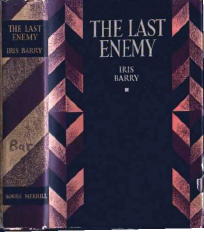
* -The Last Enemy (n.) Bobbs 1929
* Here Is Thy Victory (n.) Mathews 1930; See: The Last Enemy (Bobbs 1929).
* The Mandura Mystery (n.) Hale 1966
* The House of Deadly Night (n.) Belmont 1970 [Oregon]
* Seven Guests of Fear (n.) Hale 1970
* The Unprotected (n.) Berkley 1973
* The Darkness at Mantia (n.) Berkley 1974 [Washington (state)]

Last Enemy

   Once your attention is focused on this list of Ms. Barry’s books, you should see what John Herrington saw. Sometimes a mystery writer will have a second career, so to speak, later in life, but to have four of the five books in this second spurt of books not appear until after your death, well, at least it warrants some investigation.

   I’ll let Al continue the story. Here’s what happened after John asked him about this apparent anomaly in the career of Iris Barry:

    “I did some digging and found that the University of Oregon Library had some of her papers. I contacted the Library and they provided a list of titles for which they had manuscripts (a few apparently never published), which did not include that early (1929) book. So I suspected that there were two Iris Barry’s at work, and when I found that one (with different dates from CFIV) had died in Oregon, it looked like I might have a hit. So I e-mailed the library near her reported death and for $15 they were willing to hunt for an obituary and send me a photocopy. Thus were my suspicions confirmed, with the results shown in [Part 10 of the Addenda]. (I was confident enough that I put the information in #10 even before the obit came). By the way, as I recall, the first Iris Barry also wrote some other books (about film people).”

   Here’s how the revised entries for the two authors now look. Note that in tracking down the details, one additional book now also appears in the second Iris Barry?s listing.

      BARRY, IRIS. 1895-1969. Ref: CA. (Corrected entry.)

Here Is Thy Victory; see The Last Enemy
-The Last Enemy. Bobbs, 1929. British title: Here Is Thy Victory. Mathews, 1930

      BARRY, IRIS (THORPE). 1903-1983. (Titles moved here from above author entry.)

The Darkness at Mantia. Berkley, 1974 [Washington]
The House of Deadly Night. Belmont, 1970 [Oregon]
The Mandura Mystery. Hale, 1966
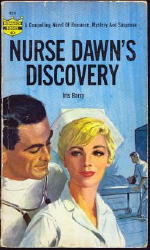
Nurse Dawn’s Discovery. Monarch, 1964
Seven Guests of Fear. Hale, 1970
The Unprotected. Berkley, 1973; Remploy, 1974

Nurse

   Here’s a description of The Last Enemy, written by Iris Barry #1. You can see why it’s indicated as having only marginal crime content. My impression is that it’s almost science-fictional in nature:

    “Mr. Griffiths, the old registrar of Hallam, England notices that no natural deaths are being reported in his county. Similar reports drift in from other counties as it becomes certain that people are no longer dying naturally anywhere in the whole South of England. Murder and suicide are on the increase as elderly people begin to feel uncomfortable for without deaths where are property inheritances? Births are still occuring normally and visions of food shortages will be the result where before they had always depended upon death to keep life in balance.”

   One the books about film people that Al mentions that Iris Barry #1 wrote is:

   D.W. Griffith: American Film Master. The Museum of Modern Art, New York, 1940. Pictorial Paper-covered Boards. No. 1 in the Museum of Modern Art Film Library Series, in an edition of 8000 copies.

   On the other hand, the books of Iris Barry #2 were written as novels of “romantic suspense” if not as gothic romances, the heyday for which was exactly the period in which they appeared. Two of them are in my Gothics collection, in fact, catalogued online at https://mysteryfile.com/Gothics.html.

« Previous PageNext Page »