Hello Steve:

Here’s what’s coming up for 2007 from Stark House:

January
JIMBO / THE EDUCATION OF UNCLE PAUL by Algernon Blackwood. New intro by Mike Ashley. Two supernatural novels set in the world of children but written for adults.

February
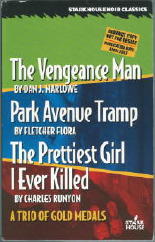
A TRIO OF GOLD MEDALS (details of which you already have)
PAN’S GARDEN / INCREDIBLE ADVENTURES by Algernon Blackwood. Intros by Mike Ashley and Tim Lebbon. Previously published in separate volumes, two of Blackwood’s best story collections in one volume.

March
THE OLD BATTLE-AX / DARK POWER by Elisabeth Sanxay Holding. Intro by Gregory Shepard. Two classic novels of suspense, the latter of which has never appeared before in paperback in its complete edition.

April
UNDERGROUND / COLLECTED STORIES by Russell James. Intro by the author. James’s first novel published here in the U.S. for the first time, along with seven previously uncollected stories, one of which has never been published before.

May
A SHOT IN THE DARK / SHELL GAME by Richard Powell. Intro to be determined. Two slyly written mysteries from the author of The Philadelphian, recently reprinted by Plexus Publishing.

June
SNOWBOUND / GAMES by Bill Pronzini. Two excruciating novels of suspense, too long out of print. Intro to be determined but hopefully to include something from Bill himself.

July
THE KILLER / DEVIL ON TWO STICKS by Wade Miller. Two fine 50’s thrillers from from Bob Wade and Bill Miller, authors of the the Max Thursday detective series.

August
DOGTOWN / SOULTOWN by Mercedes Lambert. Lambert in real life was Douglas Anne Munson, who died a few years ago from cancer. She left behind three excellent, cynical mysteries featuring lawyer-turned-sleuth Whitney Logan and her streetwise sidekick Lupe Ramos–these two books were the only ones to be published in her lifetime, out of print now for the past ten years.

September
SWEET MONEY GIRL / LIFE & DEATH OF A TOUGH GUY by Benjamin Appel. Intro by Carla Appel. Two gritty novels from the New York streets, the former of which is one of Appel’s only two Gold Medal books.

October
ANATOMY OF A KILLER / A SHROUD FOR JESSO by Peter Rabe. Two more dryly written gangster novels from one of the best of the noir writers of the 50’s and 60’s.

November
A DEVIL FOR O’SHAUGNESSY / THREE-WAY SPLIT by Gil Brewer. The big news for 2007 is that Stark House will be publishing a Brewer novel that never appeared during the author’s lifetime, a fast-paced noir from the early 60’s. We couldn’t be more excited!

December
IT’S ALWAYS FOUR O’CLOCK / IRON MAN by W. R. Burnett. The first novel is a jazz story originally written as by James Updyke, the second a marvelous tale of the rise and fall of a prizefighter. Both feature Burnett’s keen eye for characterization and dialog, and neither have appeared in paperback before.

And so the year goes out with a bang (assuming I keep to the schedule!). All books will be $19.95 except for the TRIO book, which is $23.95.

I hope this information is helpful. I could probably say more about each book, but wanted to keep it brief. Don’t have intros determined for each book yet. Already planning for another Harry Whittington in 2008, and hopefully more Douglas Sanderson, Vin Packer and Gil Brewer as well.

And you will notice, not everything is vintage-50’s this year. The Lambert is an experiment, I will admit. Something on the order of “righting a wrong,” if you will.

Anyway, thanks for all your support, Steve.

         Cheers,

            Greg
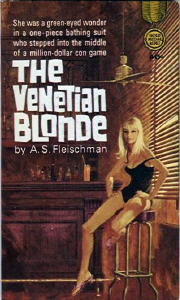
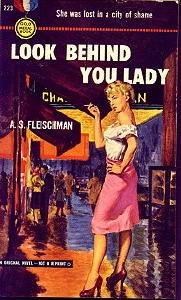
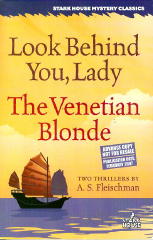
A. S. FLEISCHMAN – Look Behind You Lady

Gold Medal 223; paperback original. First printing, February 1952; 2nd printing, Gold Medal 572, 1956. Hardcover reprint: Herbert Jenkins, UK, 1962, as Chinese Crimson. To be published by Stark House Press in late 2006 as a trade paperback combined with The Venetian Blonde.

   Albert Sidney Fleischman, known to his friends and colleagues as Sid, was born in 1920, and at 86, thankfully he’s still around to see publisher Greg Shepard bring a couple of his old Gold Medal paperbacks back into print.

   His career in the adult mystery field was relatively short, beginning with a couple of Phoenix Press mysteries in 1948 and 1949, then shifting to Gold Medal for five paperback originals between 1951 and 1963, with one from Ace making an appearance in 1954.

   After that he became an author of children’s books, winning the Newberry Medal for The Whipping Boy (1987), and the creator of Bullwhip Griffin – the movie about his adventures was based on the book By The Great Horn Spoon (1963).

   Greg always does a great job in adding material to his books about the authors he publishes, so I won’t try to come up with any more background like this on my own. Nor will I say anything about The Venetian Blonde, one of my favorite mystery titles of all time, and I love the cover as well – they go hand-in-hand together as one truly great match-up.

Blonde

   To introduce you to Look Behind You Lady (no comma, and I’m not sure why), you might pretend that you’re at the newsstand in 1952, or the drug-store spinner rack, and you’d see the cover, designed to catch anyone’s eye, 100% guaranteed. (Truth be told, I was 10 at the time, so it had to have been the 1956 reprint that snagged my attention.)

   Then once in the would-be purchaser’s hand, he would have looked inside the front cover to read the following blurb:

   She dipped the coal of the cigarette in the water and it died with a thin sizzle. Then she rose from the tub like a mermaid, turning her back to me, and held her arms up. I wrapped the towel around her, sarong-like. Her hands closely softly over mine as I tucked in a corner.

   “I was mad at you when you walked out,” she whispered, “but I like the way you walked back in.”

   I turned her around and kissed her lips.

   “You’re getting wet,” she said.

   “Stop talking,” I said.

   Not a word wasted, and if you could pass this up, you’re a better person than I, or your tastes are so different from mine that you should be reading another review anyway.

   But just in case a quarter was all that you had in your pocket, back in 1952, and you needed just that one extra nudge to tip the balance toward paying the storekeeper and on your way with the book, all you would have had to do was to turn two more pages and start reading from the top of Chapter One:

   She said, “May I sit down?”

   I looked up from my vinho e licores at the girl standing beside my table. I was on the marble terrace of the Hotel China Seas in Macao, killing time between shows, and feeling a little surly. Along the hotel wall a Filipino swing band was giving the week-enders from Hong Kong something to dance to.

   “Talking to me?” I muttered.

   “Talking to you,” she said.

   She was wearing a smart white dress, and her dark hair was cut short, with bangs. I didn’t like the bangs. The dress had a mandarin collar, which was a shame, because a plunging neckline would have been something worth plunging for.

   “You can sit down,” I said. “I was just leaving.”

   “Please –”

   I looked at her and smiled only to myself. Sure, I thought, there’s not much paradise left in the Orient, but there’s Macao. Don’t bring your wife unless you’re just interested in the view from the old Portuguese fort on the hill. Macao attracts the finest tramps in the world, its streets are paved with gold, and gambling is a way of life. If you can’t enjoy yourself in Macao, there’s something wrong with you – not Macao. Or you brought your life.

   “Look,” I said. “Is every woman in Macao on the make? Every time I buy myself a drink some girl comes along and wants to muscle in on the act.”

Lady

   Ka-ching! Sold, am I right, or am I right? If you can’t read this story and hear the voices of Humphrey Bogart as rather world-weary stage magician Bruce Flemish and Lauren Bacall as Donna Van Deerlin, the lady above who has both a room number and a proposition for him, you haven’t been watching as many of the movies of the 1940s and early 1950s as is good for you. Something’s been missing from your video diet that you ought to remedy as soon as possible.

   More. The owner of the Hotel China Seas is Senhor Gonsalves, a gentleman who is missing both his thumbs, and he also has a small task for Flemish to perform as part of his act, a task involving the not-so-small sum of $10,000 Hong Kong dollars. Sydney Greenstreet.

   One of Senhor Gonsalves’ many assistants is a mousy sort of fellow named Josef Nakov, who is handy with a gun. Peter Lorre.

   From page 144:

   I was on my feet now and had a cigarette going in my fingers. Gilberto held Donna’s arms behind her. Phebe sat on the edge of the bed, like an outcast, her head buried in her hands. Nakov held a fresh, big gun and looked supremely happy. “O.K.,” I said, “so you’re going to murder us.”

   “We can find another word,” Gonsalves said, his hands stuck in his pockets. “Eliminate. Murder is for your Chicago gangsters. In politics, we eliminate. It is death on a higher social level.”

   “We’ll appreciate the difference,” I said, “but why bother? We’re not very clear on what the hell your game is. You must be getting damned scared to want to murder everyone in sight.”

   Nakov says something about the intelligence of Donna, who had walked back into Gonsalves’ hands after a brief escape.

   I turned on Gonsalves angrily. “Make him shut up,” I said. “If he licks your boots once more in public, I’ll puke.”

   You can cast Gilberto, young punk working for Gonsalves, and Phebe, a somewhat shopworn stripper whose act follows that of Flemish on stage, yourself.

   The plot has something to do with the Communist Reds and/or the opium trade, and it matters not very much in the long run. But there are twists to be had, and thrills of the nature above, and what more could you want of a book of exotic Oriental danger and intrigue like this?

–written in September 2006.

   Unlikely to be recognized as a crime fiction novelist by many, even perhaps by himself, author Fred Mustard Stewart died last Wednesday at his home in Manhattan.

   His entry in Allen J. Hubin’s Crime Fiction IV is admittedly meager, but it’s certainly enough to warrant a tribute here. (Thanks to the comment left by his nephew Brough Stewart, his year of birth has been corrected to 1932 from 1936, as was originally given.)

   STEWART, FRED MUSTARD (1932-2007)
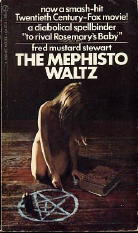
      * * The Mephisto Waltz (Coward, 1969, hc) [New York City, NY] Joseph, 1969. Film: TCF, 1971 (scw: Ben Maddow; dir: Paul Wendkos).
      * * -The Methuselah Enzyme (Arbor, 1970, hc) [Switzerland] Joseph, 1971.
      * * -A Rage Against Heaven (Viking, 1978, hc) [1800s] Hutchinson, 1978.

   Regarding that one definite entry (the dashes indicating that the other two are only marginally crime-related), his obituary in the New York Times goes on to say:

    “Originally trained as a concert pianist, Mr. Stewart drew on this background for his first novel, The Mephisto Waltz (Coward-McCann), published in 1969. (The publicity materials for the book included a 45-r.p.m. recording of Mr. Stewart playing the title piece, by Liszt.) In 1971, the book became a film with Alan Alda as a young writer whose body is usurped by an aging pianist.”

   The last line gives it all away. The tale should be be categorized more precisely as a horror novel, more related to Rosemary’s Baby than to Sherlock Holmes — and to be sure both the book and the film based upon it were marketed that way.

Mephisto

   From the archives of the New York Times, here are the opening sentences of a review written by Howard Thompson, published April 10, 1971:

    “Shift Rosemary’s Baby to California, with the nice young couple abruptly exposed to some chic, jet-set zombies, including the world’s greatest pianist. When this old demon dies, the husband acquires both his soul and pianistic genius, pounding out Liszt to prove it.
    “The sensible wife, who squares off early with the old musician’s horrible dog, expects and gets the worst, with a couple of murders. Add some angular photography and a spooky, haunted-house score …”

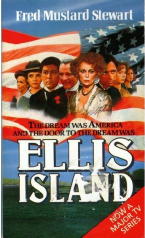
    A complete bibliography for Mr. Stewart can be found online here. He will perhaps be best remembered for what the Times calls his “multi-strand family narratives,” of which one entitled Ellis Island (Morrow, 1983) may be as representative as any. The novel follows the lives of “five young penniless people who came to America at the turn of the century — a land of shining hope and breathtaking challenge. They came to fulfill a glowing promise and take the fearful gamble of a new life in a land where anything was possible.”

Ellis

   Ellis Island was made into a television mini-series on CBS in 1984, a Golden Globe winner for Faye Dunaway (Best Supporting Actress) and recipient of several Emmy nominations.

   It’s a good thing that Bill Crider reads this blog. If you saw his comment on my post about trying to remember where I’d seen a photo of mystery writer Dan J. Marlowe recently, you already know that even though he is somewhat older than I am, his mind is at least twice as sharp.

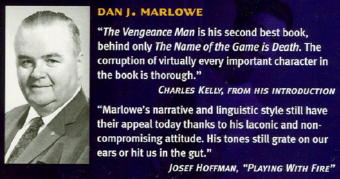
   You’ll find a photo on the back of the upcoming collection from Stark House Press in which one of his books is going to be reprinted, Bill said. And so it is.

Marlowe

   And where is my copy of the ARC for this book? On the top of the pile of TBR books on the living room coffee table. I think I need a shorter leash, no doubt about it!

   While I was on the hunt, Greg Shepard and Mark Shepard, a couple of the head guys at Stark House, sent me photos of the cover of their upcoming book, from which I’ve uploaded the images that you see here.

   Contained in the book, coming out in April, 2007, are three novels published by Gold Medal back in the era when Gold Medal was THE publisher of tough, noirish, hard-boiled fiction, bar none:

      THE VENGEANCE MAN, Dan J. Marlowe (Gold Medal d1645, 1966)

      PARK AVENUE TRAMP, Fletcher Flora (Gold Medal 781, 1958)

      THE PRETTIEST GIRL I EVER KILLED, Charles Runyon (Gold Medal k1507, 1965)

Trio

   Well, maybe these are a little past Gold Medal’s prime in the era, but they’re still gritter and tougher than anything else published at the time, and if this is the kind of mystery and crime fiction that you prefer to read, take my word for it, you aren’t going to go wrong reading any of the three.

   Quite coincidentally, in today’s mail came my contributor’s copy of a two-in-one combo of stories by A. S. “Sid” Fleischman, Look Behind You Lady [+] The Venetian Blonde, also from Stark House Press.

   I wrote the introduction to the first book, based on a review I did of the book, and unbeknownst to me at the time, Mr. Fleischman, now in his late 80s, wrote an overall one for both. Luckily the two introductory essays seem to mesh together very well.

Fleischman

   I’ll post the review as a separate blog entry, coming up soon, and in the meantime, I’ll check in with Greg Shepard and see if I can’t have him say something about what’s in store from Stark House for the rest of the year.

   As for Dan J. Marlowe, to get back to the original inquiry, why not check out Josef Hoffman’s piece about him, “Playing with Fire,” quoted on the back cover next to the photo at the top of this page. You’ll find the article reprinted online at the old M*F website, along with a short essay on Marlowe’s Gold Medal fiction by Bill Crider, along with a bibliography of all of his book-length fiction. Recommended!

Hi Steve,

   I just read an internet article you wrote some time back on John D. MacDonald. I first became acquainted with his work while serving in Vietnam long ago. Little did I know then that later on I would be a high school English teacher, and as such, I have always thought that MacDonald was one of the most overlooked authors in American literature. Do you know of any teaching resources that were ever developed for any of MacDonald’s works?

         Thanks,

            Chris Creasman

Cupcake

Hi Chris

   And thanks for the inquiry. I didn’t write the article you’re referring to, though — you must be referring to the interview that Ed Gorman did with JDM which I published on the original M*F website. (And no, no one’s come up with the name of the writer who MacDonald accused of plagiarizing him, not even his son Maynard.) Even though I haven’t read any of his books in a while, and shame on me, I always thought he was a fine writer.

   As for teaching resources, I found this link, but it seems fairly meager to me. Maybe someone else knows more than I do, though, and if you do, I hope you’ll let us know about it.   –Steve

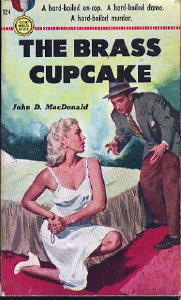
PS. I’ve shown only one of JDM’s covers here. For a slide show of over 100 of them, check out this page put together by Bill Crider.

   I stumbled onto Dan J. Marlowe a few years ago and have become a big fan. I have 20 of his books. I have searched the web for pictures of Marlowe, but with no luck. Do you have a picture of him, or could you direct me to a website that does?

   Thank you very much.

         Oscar Hightower

>> I’m sure I’ve seen a photo of Mr. Marlowe, but at the moment I can’t remember where, nor can I find one online. Can anyone help? –Steve

[The following essay was written by Curt Evans and first appeared as a post
on the Yahoo Golden Age of Detection group.]

   The two-man team of “Francis Beeding” primarily seems remembered today for three things:

   1. They wrote The House of Dr. Edwardes (1927), a Gothic, woman-in-peril which was the basis (though not much actual detail is shared) for the Alfred Hitchcock film Spellbound.

   2. They wrote Death Walks in Eastrepps (1931), a crime novel highly praised by Vincent Starrett and reprinted in Dover’s fine mystery reprint series as late as 1980.

Walks

   3. They wrote a lot of spy novels few people today have read.

   Indeed they primarily wrote spy thrillers, many with their series character, spymaster Colonel Granby. But they also wrote other crime novels (novels deriving their interest from “regular” murders, not involving spies or criminal gangs) besides Eastrepps. These would be:

   1. Murder Intended (1932) (inverted mystery with multiple victims)

   2. The Emerald Clasp (1933) (appears to be another inverted, Before the Fact style mystery, have not yet read)

   3. The Norwich Victims (1935) (along with Eastrepps, their closest approach to a formal mystery novel, it appears)

   4. No Fury (1937) (another multiple murder story, imitative of Murder Intended, reprinted by rather distressingly literal-minded American publishers as Murdered: One by One)

   Also, Mr. Bobadil (1934) is a lost treasure chase novel and Pretty Sinister (1929), though it has ace spymaster Colonel Granby, involves a kidnapping gang. I’m not sure whether there are any others that can be taken out of the spy realm, possibly He Could Not Have Slipped (1939)?

   Anyway, I thought Murder Intended and The Norwich Victims were quite good and would be well worth reprinting. The latter was reprinted by Hodder in 1950, as well as made into an Emlyn Williams film, Dead Men Tell No Tales, in 1939, and is mentioned in the Catalogue of Crime (with less enthusiasm than I have for the book!).

   Does anyone have any familiarity with these presumably more obscure books, and any opinions on them? Or on any of the other Beeding books, for that matter. Beeding seems to me a good genre writer, and I wish “he” had dabbled more in the murder mystery field.

Ten


   From Crime Fiction IV, by Allen J. Hubin:        [British editions only]

BEEDING, FRANCIS Pseudonym of Hilary St. George Saunders & John Palmer; other pseudonyms Barum Browne, Cornelius Cofyn, Christopher Haddon, David Pilgrim & John Somers. PK = Professor Kreutzemark; AG = Colonel (General) Alistair Granby; IW = Inspector Wilkins; RB = Ronald Briercliffe; GM = Insp. George Martin.

* The Seven Sleepers. Hutchinson 1925. PK
* The Little White Hag. Hutchinson 1926
* The Hidden Kingdom. Hodder 1927. PK
* The House of Dr. Edwardes. Hodder 1927
* The Six Proud Walkers. Hodder 1928. AG
* The Five Flamboys. Hodder 1929. AG
* Pretty Sinister.Hodder 1929. AG
* The Four Armourers. Hodder 1930. AG
* The League of Discontent. Hodder 1930. AG
* Death Walks in Eastrepps. Hodder 1931. IW
* The Three Fishers. Hodder 1931. RB
* Murder Intended. Hodder 1932. IW
* Take It Crooked. Hodder 1932. AG
* The Emerald Clasp. Hodder 1933.
* The Two Undertakers. Hodder 1933. AG, RB
* Mr. Bobadil. Hodder 1934.
* The One Sane Man. Hodder 1934. AG
* Death in Four Letters. Hodder 1935.
* The Norwich Victims. Hodder 1935. GM
* The Eight Crooked Trenches. Hodder 1936. AG
* The Nine Waxed Faces. Hodder 1936. AG
* The Erring Under-Secretary. Hodder, pb, 1937. AG. A separately published pb novelet, in the same series with Allingham’s “The Case of the Late Pig” and Carr’s “The Third Bullet.”
* Hell Let Loose. Hodder 1937. AG
* No Fury. Hodder 1937. GM
* The Big Fish. Hodder 1938
* The Black Arrows. Hodder 1938. AG
* He Could Not Have Slipped. Hodder 1939. GM
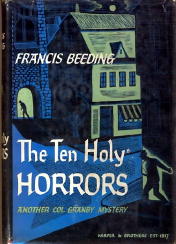
* The Ten Holy Horrors. Hodder 1939. AG
* Eleven Were Brave. Hodder 1940. AG
* Not a Bad Show. Hodder 1940. AG
* The Twelve Disguises. Hodder 1942. AG
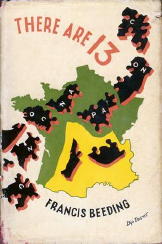
* There Are Thirteen. Hodder 1946. AG

13


BROWNE, BARUM
Pseudonym of Geoffrey Dennis & Hilary St. George Saunders.

* The Devil and X.Y.Z. Gollancz 1931.

COFYN, CORNELIUS Pseudonym of Hilary St. George Saunders & John deVere Loder

* The Death-Riders. Gollancz 1935.

HADDON, CHRISTOPHER Pseudonym of John Palmer.

* Under the Long Barrow. Gollancz 1939.

PILGRIM, DAVID Pseudonym of John Palmer & Hilary St. George Saunders.

* -No Common Glory. Macmillan 1941 [James de la Cloche; 1600s]
* -The Grand Design. Macmillan 1944 [James de la Cloche; 1600s]
* The Emperor’s Servant. Macmillan 1946 [collection].

SOMERS, JOHN Pseudonym of John Palmer & Hilary St. George Saunders.

* The Brethren of the Axe. Murray 1926.

   Excerpted from a recent email from Bill Pronzini:

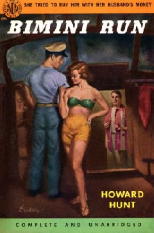
   The Howard Hunt bibliography and commentary on your blog recently was of particular interest, since I’ve always had a soft spot for his fiction (if not for his politics). Among my personal favorites are two first-rate suspense novels written early in his career, MAELSTROM and BIMINI RUN, his first three Gold Medals, and the Steve Bentley series. The Bentleys are pure potboilers, but done with a style and flair that make them compulsive reading.

Bimini

   And from one a few days later:

   The man could write when he put his mind to it, as in BIMINI RUN. Farrar Strauss published the hardcover, Avon a reprint edition. It’s well worth reading. May be in his best novel, in fact. MAELSTROM is very good, though flawed, and the same is true of THE VIOLENT ONES and his other early Gold Medal originals.

   My reaction? More books to track down and read!

         —

   The online Phoenix Press project Bill and I are working on and which I mentioned a few weeks ago stalled out this past week for a few days while I got caught up on other matters, but the pace has quickened again. The covers for the Phoenix Press mysteries are now complete through 1942. We hope that you’ll keep checking out the site, as we plan to continue uploading covers as quickly as we can.

   The following email inquiry came from David Karschner:

   Enjoy reading your blog, thanks! Have a question you can hopefully help with concerning Alan Hynd and the supposedly true stories he wrote for True Detective Mysteries etc. Am doing research on a distant relative named William Watts who worked as an engraver in the Count Lustig counterfeiting ring circa 1930-1935. Hynd authored a six part series in TDM in 1937 about Lustig and Watts. While the major facts jibe with historical data the personal story regarding the two outlaws seems quite fanciful. How much truth can one rely on coming from these types of stories? Believe it or not two of the TDM episodes were found in Watts’ Secret Service file.

   Also do you have any idea on a method for contacting his son Noel Hynd?

   Any input would be appreciated.

               Thanks, David

   If anything, true crime is a category about which I can safely say that I know less than nothing, if it could be possible, so anyone who knows more than I do, or have been able to uncover so far, please chuck a life preserver my way. I’m in over my head, in other words.

   But checking with Allen Hubin’s Crime Fiction IV, emphasis on the “fiction,” I was mildly surprised to discover that there is an entry there for Alan Hynd:

HYND, ALAN (1903-1974)

* * Alan Hynd’s Murder (Duell, 1952, hc) Collection. Somewhat dramatized true crime.
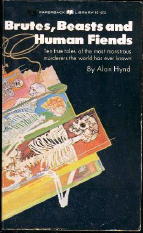
* * Brutes, Beasts and Human Fiends (Paperback Library, 1964, pb) Collection. Dramatized true crime.

Hynd-1

* * The Case of the Lady Who Took a Bath (Berkley, 1957, pb) Collection. Dramatized true crime.
* * Great Crime Busters (Putnam, 1967, hc) Collection. Dramatized true crime, intended for younger readers.
* * Great True Detective Mysteries (Grosset, 1968, hc) Collection. Dramatized true crime.
* * In Pursuit: The Cases of William J. Burns (New York: Nelson, 1968, hc) [Series Character] William J. Burns] Collection. Dramatized true crime.
* * Murder! Great True Crime Cases (Penguin, 1947, pb) Collection. Dramatized true crime.
* * The Pinkerton Case Book (Signet, 1948, pb) Collection. Dramatized true crime.
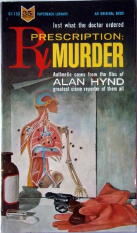
* * Prescription: Murder (Paperback Library, 1962, pb) Collection. Dramatized true crime.

Hynd 2

* * ’Til Death Do Us Part (Paperback Library, 1962, pb) Collection. Dramatized true crime.
* * Violence in the Night (Gold Medal, 1955, pb) Collection. Somewhat dramatized true crime.

   Perhaps the question asks itself. Does “dramatized” equate to “fictionalized?” I haven’t asked Al yet what his standards or definitions are in this somewhat borderline category, but when I do, I’ll add his reply as an update.

   Dave’s reply:

   Dramatized is the correct word, thanks. My problem is separating fact from fiction. For example: As Hynd writes in his articles of an important connection between Al Capone,Count Lustig and my relative William Watts I just wonder what his sources for information were? I am hoping since some of Alan Hynd’s articles were in Watts’ Secret Service files (ones I uncovered thru the FOIA) that he had some great contacts. Who knows?

   As for Noel Hynd, whom (since I never thought about it) I never realized until now is Alan Hynd’s son, he has an entry in CFIV as well. These I’ll put in chronological order:

HYND, NOEL (1947- ); Born in New York City, the son of Alan Hynd, 1908-1974, q.v.; raised in Connecticut, educated at University of Pennsylvania; crime reporter.

# Revenge. Dial 1976
# The Sandler Inquiry. Dial 1977
# False Flags. Dial 1979
# Flowers from Berlin. Dial 1985
# The Krushchev Objective [with Christopher Creighton]. Doubleday 1987
# Truman’s Spy. Zebra 1990
# Zigzag. Zebra 1992
# -Ghosts. Zebra 1993
# A Room for the Dead. Kensington 1994
# Cemetery of Angels. Kensington 1995
# Rage of Spirits. Kensington 1997
# The Lost Boy. Pinnacle 1999

   Doing some quick Googling, this list does not include, within the proper time frame of 2000 and before, The Prodigy (1997), which appears to be a supernatural horror story only.

   There are some interviews with Noel Hynd which you can easily find online, but they all seem to taken place in the late 1990s. A rather complete biography can be found at IMDB, and this led me to his most recent book, The Enemy Within, which was published by Tor/Forge in 2006. [But with nothing published between 1999 and 2006.]

   Dave is now attempting to reach Mr. Hynd through Forge.

         —

UPDATE [02-11-07]   I’ve just heard from Al Hubin, who says:

   Steve,

   By “dramatized” and “fictionalized” I generally mean to imply that material was added (usually dialogue) to enhance the story, which is based on true events. The degree of “dramatization” and “fictionalization” may vary widely, and the Revised CFIV will include a good deal more of Alan Hynd’s work. (I bought copies of a number of his books in order to see what sort of thing he wrote and to be able to list the story titles.)

   All very imprecise, I’m afraid!

               Best,

                  Al

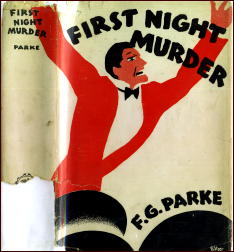
F. G. PARKE – First Night Murder A. L. Burt & Co.; hardcover reprint; no date. First Edition: Dial Press, hc, 1931.

   The bad news first, perhaps, if you happen to read this review and if I happen to convince you that you might want to read the book for yourself. There are three copies on ABE at the present time, one the Dial Press edition for $35, one in French for under $20, and one the British hardcover (Stanley Paul, 1932) for over $40. (The one from Dial Press has a jacket, and I think it’s worth the money.)

   But what the heck, keep reading. I may not convince you anyway. And who is F. G. Parke, you ask, and well you may. No one seems to know, and it’s not even his (or as it has suddenly occurred to me) her name. It’s a pseudonym. I think the author is male, however, thinking about it even as I sit at the keyboard. It’s not a woman’s tale, what with the many-faceted male point of view which so generally obvious if not blatant — and maybe so obvious that I could very well be wrong.

   But as I was reading this — and enjoying it, for the most part — and don’t worry, I will be sure to let you know at which point I stopped enjoying it — I pretended in my mind (and where else) that this was an unknown work of the cousins known as Ellery Queen, who needed some money at this point of their career, which would have been, roughly, between The French Powder Mystery (Stokes, 1930) and The Dutch Shoe Mystery (Stokes, 1931), perhaps.

   Or perhaps not, but it was fun to pretend — and who knows, I could very well be wrong, and they actually did write it. What got me thinking this way, though, was the locale where the first murder was committed: in a theater during the actual performance of a play, the New York City Police Commissioner in attendance, among many other notables, it being first night, of course. A mystery drama is about to reach its denouement, the lights go out, a woman’s wild scream rings out, the lights come back on, the villain (of the play) is in handcuffs — and a noted Broadway producer is found stabbed to death in his seat near the front of the theater, the space next to him unused.

   Fifteen seconds of darkness — hardly time enough for the killer to make a getaway — but no knife is found (everyone is searched) and no one heard anything, no one saw anything. There is no lack of potential murderers, for as if by pre-arrangement, motives for everyone seated in seats within a small vicinity are soon revealed. But once again, no one heard, saw or felt anyone move or pass by them, and — this is the key — there is no murder weapon anywhere in the theater.

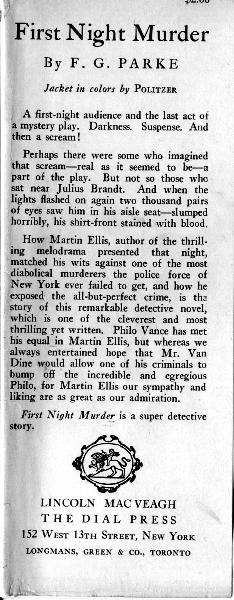
   Doing the honors as the detective at hand is Martin Ellis, the author of the play, the first step of what he had hoped to be a long career as a playwright. The inner flap of the dust jacket (the only piece of the jacket I happen to have) compares him favorably with Philo Vance, but on the other hand, you know how the people who write story descriptions on the flaps of dust jackets often seem to exaggerate.

   No, it was Ellery Queen I kept thinking of (Ellis = Ellery?). The Roman Hat Mystery? And yes, I know that it was death by poison in that first novel the Queens wrote, but still, it was a during a play that the victim in that book, an unliked/unlikable lawyer, was killed.

   But Martin Ellis on his own, and as a writer of mystery fiction himself, seems to be amiable enough and competent enough to solve this case, even though he is in love with the girl, the actress on stage, whom the dead man married earlier the same day, which in most books would make him the number one suspect. (I did suggest that there are motives galore — what’s lacking are means and opportunity.) Both Lt. John B. Gradey of Homicide and District Attorney Moore eliminate him quickly as a suspect, however, as he was seen by two witnesses just before and after the lights went out, and nowhere near the scene of the crime.

   To help demonstrate Ellis’s prowess as a detective, along either Queenian lines, or Vancian, you choose, here’s a quote from page 98:

   Considering that he [Ellis] had during the past few years conducted theoretical investigations strictly along scientific lines, it would do him no harm, he thought, to borrow a leaf out of one of his own books. All the best detectives sported a fine flair for calm, unbiased reasoning. They analyzed. They synthesized. They equipped themselves with a supply of cold, hard facts and from these they made unfailing deductions with mathematical precision. The hundred per cent sleuth of fiction, in short, did everything but beat his breast passionately with both fists and gather himself for a leap at the most obvious conclusion in his maiden chapter.

   As I say, you choose. More deaths occur, with plenty of influence on the thinking processes of Martin Ellis, but as it occurred to me, with very little emotional impact. As for the solution, as I skip over in this short essay anything more about all of the suspects and the all of the suspicious activity that goes on in this book, it is the solution that tells the tale, and to tell you the truth, while I was ready for it, already having made a note to myself about the paragraph I quoted to you above, I really wasn’t ready for it. Don’t know as I still am, as a matter of fact, but I guess that means that I should take my hat off to Mr. Parke, whoever he was.

   The gentlemen behind Ellery Queen could never have been quite this melodramatic — could they?

UPDATE [02-10-07]   I emailed the seller of the Dial first edition of this book a couple of days ago, asking if there was anything helpful that was said about the author on either the back panel of the dust jacket or its flaps. Perhaps asking for too much, I also inquired if a scan of the cover might be possible. I’m still hoping, but to this date, I have not heard back.

UPDATE [02-24-09]    Over two years later — have I been doing this that long? — and I finally have a cover image to show you. A big thank you goes to Luca Conti, who emailed me with it as an attachment a couple of days ago:

F. G. PARKE First Night Murder

    I’m not sure how well this additional scan of the blurb from inside the dust jacket will show up, but I since I mentioned it in my review, Luca sent it along. I think it’s worth the try:

F. G. PARKE First Night Murder

« Previous PageNext Page »