REVIEWED BY GEOFF BRADLEY:         


WAKING THE DEAD. BBC, UK, Series 8: 06-07, 13-14, 20-21, 27-28 Sept 2009. Trevor Eve (Detective Superintendent Peter Boyd), Sue Johnston (Dr. Grace Foley), Wil Johnson (DI Spencer Jordan), Félicité Du Jeu (DC Stella Goodman), Tara Fitzgerald (Dr. Eve Lockhart), Stacey Roca (DS Katrina Howard).

WAKING THE DEAD

   This long running series (back for four stories, each spread over two one-hour parts, no adverts) is as barmy as any that is currently being shown.

   Detective Supt. Peter Boyd, who runs a cold case squad, is so far over the top, irrational and prone to outbursts, that you wonder why anyone would work for him at all.

   However the stories are usually very watchable and often set up an intriguing premise. The problem is that the resolutions are always a complete letdown and never bother trying to explain who has done what and why.

   Boyd is never supervised and seems unbothered by his methods but this series went a step further and set Boyd up as some sort of avenger. Illogical and beyond reason but it can be entertaining.

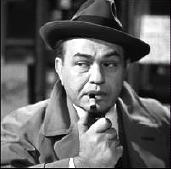
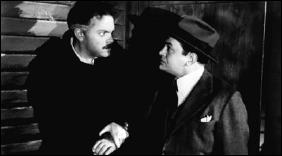
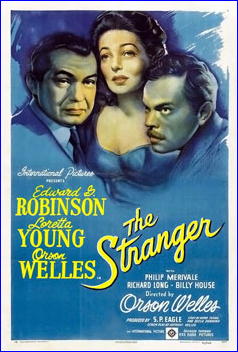
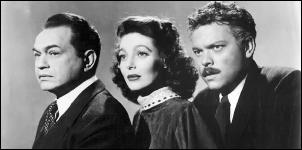
THE STRANGER. RKO Radio Pictures, 1946. Edward G. Robinson, Loretta Young, Orson Welles, Philip Merivale, Richard Long, Billy House. Screenplay: Anthony Veiller. Director: Orson Welles.

THE STRANGER Orson Welles

   The dark nature of this movie of course is what consigns it to the noir category, that plus the moody but still dazzling black-and-white photography, complete with unusual camera angles, especially during the many trips up and down the inside of the bell tower facing the green in a small one-horse town in Connecticut right after the war.

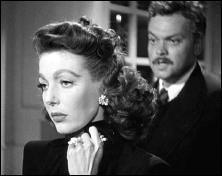
   But is it really a noir film? Not really by subject matter, that of a post-World War II manhunt. A former top member of Nazi party in Germany (Orson Welles) who by posing as a history teacher at a local academy, has somehow managed to infiltrate his way into local society so solidly enough that he is about to marry the daughter (Loretta Young) of a US Supreme Court justice who lives in town.

THE STRANGER Orson Welles

   On his trail is one man, a representative of the US government known only as Mr. Wilson (Edward G. Robinson). His problem? He does not know the face of the man he is after, a world-class criminal who managed to keep his identity a secret while the Nazis were in power, a man with vicious ideas who preferred to do his nasty work behind the scenes only.

   The noirish concept of an innocent man in over his head through his own weakness and/or the sheer vicissitudes of fate do not apply here. Professor Charles Rankin, as he is known now, is a bad man, and as a killer who senses he is about to be trapped, he needs to be caught. It is only the camera work and Welles’ direction that makes this movie qualify as noir, and then by only the slimmest of margins.

THE STRANGER Orson Welles

   Edward G. Robinson is as earnest as only Edgar G. Robinson could be, and Loretta Young I do not believe could look only lovelier. It is her predicament that is the most heartbreaking. In love with a man who is a monster, she cannot accept it, even as a mountain of facts begins to pile up against him.

   As for fierce-looking Mr. Orson Welles himself, he is dark, brooding and sullen throughout the movie. It is difficult to believe that the cheerful Loretta Young could fall in love with such a man, much less go on a honeymoon with him.

THE STRANGER Orson Welles

   It is also hard to believe, that even in simpler times, the credentials and background of the man to whom the daughter of a Supreme Court justice is married would not have been checked more thoroughly earlier on. Before enjoying this movie to the fullest, we in this more cynical age must accept that life (and politics) were easier then.

   Otherwise this well-meaning movie, the first to show footage of concentration camps in Germany, or so I am told, is only a well-designed and well-produced relic of the past, a magnificent artifact caught up in amber and preserved for us today, a different time altogether.

THE STRANGER Orson Welles

REVIEWED BY DAN STUMPF:         


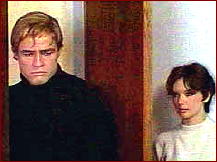
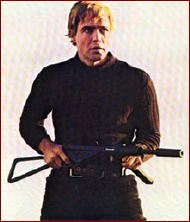
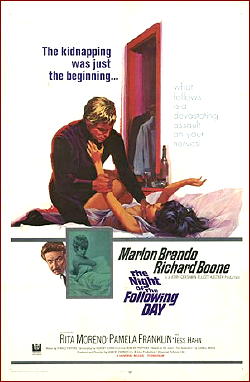
THE NIGHT OF THE FOLLOWING DAY

THE NIGHT OF THE FOLLOWING DAY. Universal, 1968. Marlon Brando, Richard Boone, Rita Moreno, Pamela Franklin, Jess Hahn. Based on a novel by Lionel White. Co-screenwriter & director: Hubert Cornfield. Co-director (uncredited): Richard Boone.

   After Gunn and P. J., this latest excursion back into my tawdry youth ended with The Night of the Following Day, co-written and directed, mostly, by Hubert Cornfield, based on The Snatchers, a Gold Medal paperback novel by Lionel White.

   The film was originally intended to star Richard Boone, but Marlon Brando, whose career was in eclipse at the time, owed Universal a movie, and Cornfield, who had done a few interesting B-films, jumped at the chance — only to have Brando bully him around the set and ultimately off the picture, which was finished by Richard Boone.

THE NIGHT OF THE FOLLOWING DAY

   Whoever’s responsible, this is a unique, moody and suspenseful piece, with sparse dialogue that sounds largely improvised around a plot that keeps falling apart. A young heiress is kidnapped by a very businesslike band of outsiders that includes Brando, Rita Moreno, Jess Hahn and Richard Boone.

   The professionalism quickly dissipates, though, when it develops that Moreno has a drug habit, Boone enjoys hurting their captive, and Hahn suffers from delusions of competence, leaving Brando to try to hold things together through a slow build-up to an impressively violent resolution.

   Slow-moving, I’ll grant you, but Night has an atmosphere of growing nastiness that keeps one watching. Performances are refreshingly natural throughout, and the plot twists itself nicely.

   All of which is very nearly spoiled by one of the lousiest endings ever committed on film, but like most endings, this one comes late in the film, after some very stylish action and a lot of suspense.

THE NIGHT OF THE FOLLOWING DAY

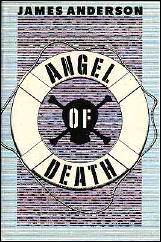
JAMES ANDERSON

JAMES ANDERSON – Angel of Death. Doubleday Crime Club, US, hardcover, April 1989. First published in the UK: Constable, hc, 1978.

   Six members of a yachting party are deliberately yet randomly poisoned while sailing in the Caribbean. The question is, how did the killer make sure that the six who died were exactly the ones he was aiming for?

   Alec Webster, recently resigned from Scotland Yard, is the investigator in this highly unlikely combination of Agatha Christie and Aristotle Onassis. The puzzle is a clever one, though, and it’s exactly why I love stories like this.

   On the other hand, plots of this type have to be given lots of room to breathe. The main scheme in this one is worked out in some detail, but both the setup and solution are crammed into only a few chapters somewhere soon after the middle. It’s never given a chance to show how good it really is.

***

JAMES E. MARTIN

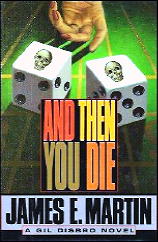
JAMES E. MARTIN – And Then You Die. William Morrow, hardcover, 1992. Reprint paperback: Avon, September 1993.

   In Cleveland PI Gil Disbro’s third case, he’s hired to find a missing wife, last seen in Nevada getting a divorce and gambling away a fortune.

   Things get complicated when his client is then found murdered, but Disbro, of course, stays on the job.

   The result is a fast-moving detective tale with good, sensitively macho dialogue and a tangled plot that somehow manages not to be spoiled by a twist that’s just two jots short of obvious.

***

HELEN REILLY

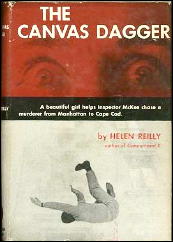
HELEN REILLY – The Canvas Dagger. Random House, 1956. Hardcover reprint: Detective Book Club, 3-in-1 volume, April 1957. Paperback reprints: Bantam #1858, 1959; Ace Double #G-531, ca.1965, abridged, bound with Not Me, Inspector; Macfadden, 1970; Manor, 1974.

   A young woman in New York City witnesses a murder from a building across the street, and when the police don’t believe her, she and all the suspects in the case travel to Cape Cod, where more murders occur.

   Reilly’s prose varies from passably good to overwrought, but the ending is what does this one in, bringing in (hey?) Commies at the very last minute.

— Reprinted from Mystery*File #35, November 1993.


Previously reviewed on this blog:

    James Anderson: Assault and Matrimony.
    Helen Reilly: The Silver Leopard.

   Also, for an long essay on Helen Reilly’s mystery fiction by Michael Grost, go here on the main Mystery*File website. Included on that page is a complete bibliography for the author.

At 03:53 PM 4/14/2010, you wrote:

Dear Steve,

    I hope I am not asking too much of you guys again but I was wondering if you had a list of “couples on the run” films. Bonnie and Clyde comes to mind but perhaps something from the 40’s or 50’s? Or more recent than the 60’s? I like the urban man-on-the-run movies [see this previous post] and have seen several from the list already. Do any tales of a (possibly mismatched) couple running from bad guys ring bells? Again, I hope this is not too specific but I have great faith in your encyclopedic knowledge of cinema. Thanks again,

       Josh

          — —

   This is, of course, another follow-up to David Vineyard’s four Top Ten lists of “Man on the Run” thrillers posted here a month or so back. Once again I graciously offered to let him see what he could come up with. Here’s his reply:

   First of all, I’ll limit this to films before the seventies. Saves trying to remember all those bad road pictures of recent years, and I don’t have to include Stallone and Brigitte Nielson in Cobra. Since most of the “man on the run” films end up “couple on the run” at some point this could be a long list, so I’ll just list ones that come to mind fairly easily and hope some others contribute too.

   I’ll also include one or two “two men on the run” films, but the “two girls on the run” films don’t really start until Thelma and Louise, which I’ve already set outside this purview.

   These are neither chronologically or qualitatively ranked. And just so this doesn’t go on forever, I’ll skip team comedies like Laurel and Hardy, Abbot and Costello, and the “Road” pictures of Hope and Crosby since they often ended up with the boys on the run.

   I’m also avoiding the type film where the heroine hides the hero out, but they aren’t really on the run together at any point. I’ve also tried to avoid most buddy pictures — though many technically fit the bill. I’ve also included a few “groups on the run” films.

The 39 Steps. The classic with Robert Donat and Madeline Carroll handcuffed together. One of the brightest films of this sort and the model for all that came after.

The 39 Steps. Good remake from Betty Box, in color with Kenneth More and Tania Elg. Recently re-done for the fourth time for Masterpiece Theater and currently being filmed as a major theatrical release by Robert Towne for 2011 release.

Young and Innocent. Earlier Hitch based on a Josephine Tey novel and with that famous dance hall scene with the killer drummer in black face with a twitch. The innocent man of the title ends up on the run aided by the young daughter of a Scotland Yard Inspector hunting him. Very much a template for The 39 Steps.

Saboteur. Robert Cummings and Priscilla Lane end up on the run together when he is falsely accused of sabotage done by Norman Lloyd. Yet another attempt by Hitch to remake The 39 Steps — it wasn’t until North By Northwest he finally got it the way he wanted.

You Only Live Once. Fritz Lang classic with Henry Fonda and Sylvia Sidney as the Bonnie and Clyde stand-in’s. Recreates the famous bank robbery sequence from Lang’s Spies.

My Favorite Blonde. Conscious comedic version of The 39 Steps with vaudevillian Bob Hope on the run with British Agent Madeline Carroll.

My Favorite Brunette. Early noir send up with Hope and Dorothy Lamour on the run from the law and the crooks after her inheritance. Alan Ladd’s guest shot is surprisingly the only time he played a private eye.

They Live By Night . Solid crime classic with Farley Granger and Cathy Downs as a reluctant Bonnie and Clyde on the run, based on the novel Thieves Like Us by Edward Anderson and remade under that title.

Bonnie Parker Story
. Somehow they did Bonnie and Clyde without mentioning Clyde. Dorothy Provine and Jack Hogan. What I remember about this one is that the car the real couple was killed in toured with the film.

Once Upon a Honeymoon. Cary Grant and Ginger Rogers in offbeat comedy as stripper Rogers marries Nazi agent Walter Slezak and is romanced by radio newsman Grant. They both escape after Poland and end up having to escape from Slezak and other Nazis who try and force Grant to become an American Lord Haw Haw. At one point Cary is imprisoned in a concentration camp and just misses being sterilized. From Leo McCarey who directed Going My Way.

Man At Large. Terrific B which has escaped Nazi POW George Reeves and Marjorie Weaver on the run in the US and contacting the fifth column to escape. Very fast and bright in the 39 Steps vein. Though just from the casting you can guess where this is going.

I Wake Up Screaming. Victor Mature ends up being hidden by Betty Grable, and they have to hide from police so technically they are on the run together. Great early noir film with good performances all around and an outstanding one by cop Laird Cregar. Based on Steve Fisher’s novel.

The Defiant Ones . Important racial film has Tony Curtis and Sidney Poitier on the run from a chain-gang. Great film with Curtis surprisingly good.

Colorado Territory. Remake of High Sierra as a western from the same director (Raoul Walsh) and writer (W.R. Burnett from his novel), with Joel McCrea and Virginia Mayo in the Bogart and Lupino role, but her role in the chase is somewhat larger in this one.

The Redhead and the Cowboy. Well done western with Confederate agent Rhonda Fleming ending up on the run with cowboy Glenn Ford, who could care less about the Civil War until he comes face to face with choices.

Knight Without Armor. British spy Robert Donat, who has long been undercover in Imperial Russia, ends up on the run with aristocrat Marlene Dietrich in Revolutionary Russia, based on the novel Without Armor by James Hilton. One of the best and classiest pictures no one seems to have seen. Very bright, funny, and wonderfully staged film from the Kordas (Thief of Baghdad, Four Feathers …)

The Adventures of Tartu. Donat again as a Brit spy in Rumania at the beginning of the war to sabotage the Ploesti oil fields with help from Valerie Hobson. Light but enjoyable.

The Burglars. Jean Paul Belmondo and Dyan Cannon evade pursuit by cop Omar Sharif while planning big caper in smart fast film with a classic car chase. Remake of The Burglar with Dan Duryea and Jayne Mansfield and both based on a David Goodis novel.

Belle Starr. The outlaw Gene Tierney and Randolph Scott on the run while pursuing their criminal career. Great cast, but slow as mud.

Ice Cold in Alex. John Mills and Sylvia Syms as an ambulance team and girl trapped in the desert with Nazi soldiers — which side will reach them first?

Blindfolded. Psychiatrist Rock Hudson is hired to help agent who has had a breakdown after torture, but not told where he is taken to treat him, so when everything goes wrong he has to find the locale with sexy Claudia Cardinalle caught up in the chase. Mix of comedy and espionage doesn’t always work, but film has some bright spots.

Escape From Zahrain. Yul Brynner is one of five escaped prisoners along with Madelyn Rhue who’s caught up with them as they escape across the desert from a cruel prison.

Figures in a Landscape. Arty film based on Barry England’s novel with Robert Shaw and Malcolm McDowall on the run after they escape prison. Nice cinematography, but awfully pretentious.

Arabesque. Bright follow up to Stanley Donen’s Charade with scholar Gregory Peck and Arab millionaire Alan Badel’s mistress Sophia Loren on the run as they try to decipher a mysterious message in time to stop the assassination of an Arab prince. It’s no Charade, but gorgeous to look at a much fun with Peck and Loren well matched.

State Secret. Dr. Douglas Fairbanks Jr. is secretly brought in to do brain surgery on dictator of Yugoslavian style country behind the Iron Curtain. When dictator dies Secret Police Chief Jack Hawkins wants him dead and he ends up on the run with actress Glynnis Johns. From Sidney Gilliatt.

Highly Dangerous. Margaret Lockwood is a British etymologist sent behind the Iron Curtain to find out what the bad guys are up to with bugs, but when she is tortured she wakes up thinking she is a the heroine of a BBC radio serial and American journalist Dane Clark her partner. Together they find the secret and end up on the run from dangerous police chief Marius Goring. Original screenplay by Eric Ambler.

Uncertain Glory . Arsene Lupin style French crook Errol Flynn has been caught by policeman Paul Lukas in Nazi occupied France, but together they hideout and plan for Flynn to surrender to the Gestapo instead of real saboteur to save hostages about to be executed — but will Flynn go through with it, or is it just a ploy to escape the guillotine? Screenplay by Max Brand.

Torn Curtain. American defector Paul Newman and girl friend Julie Andrews on the run behind the Iron Curtain when his real mission is revealed. Disappointing Hitchcock film, but the murder of the East German agent in the farm house is a classic piece of Hitchcock.

This Gun For Hire. Alan Ladd is assassin Raven on the run with undercover agent and magician Veronica Lake while her cop boyfriend Robert Preston hunts them as Ladd avenges the double-cross planned by traitor Laird Cregar.

Ministry of Fear. Amnesiac Ray Milland on the run while hunting a spy ring in London during the Blitz with Marjorie Reynolds along for the chase. A Fritz Lang classic. Watch for Dan Dureya in a fine role.

Decision Before Dawn. German soldiers Oskar Werner and O.E. Hasse agree to go back behind German lines in desperate mission as the war is coming to an end. Good film, dark and very stark. Richard Basehart and Gary Merrill are the men who train and dispatch them.

Night of the Hunter. Two children escape psychotic lay preacher Robert Mitchum in Charles Laughton’s classic version of Davis Grubb’s novel. Haunting and beautiful with Lilian Gish and Mitchum wonderfully matched as good vs evil. Fine performances by Gish and Mitchum sometimes overshadow how good the kids are in this one.

Heaven Knows Mr. Allison. Charming John Huston film of marine Mitchum and nun Deborah Kerr evading Japanese when they are wrecked on a small Pacific island.

Raw Deal. Escaped convict Dennis O’Keefe on the run with girl friend Claire Trevor and innocent Marsha Hunt finds himself divided between the two while seeking revenge on sadistic and kinky Raymond Burr. One of Anthony Mann’s best films with a terrific ending. This and T-Men are the two Mann must-see film noirs.

The Great Race. Blake Edwards frenetic comedy is more a couple running than a couple on the run film, but Tony Curtis and Natalie Wood are attractive together, and Jack Lemmon and Peter Falk are a delight as the inept villains of the piece.

It Happened One Night. Frank Capra classic with reporter Clark Gable trying to get the scoop on wacky heiress Claudette Colbert while trying to evade the nation wide search for her. Remade as a musical with Jack Lemmon and June Allison, but see the original.

The Runaround. Fine screwball B film that lifts much of the plot of It Happened One Night, but does it so well no one could possibly care. Rod Cameron and Broderick Crawford are maverick private eyes who leave their hated bosses’ agency and vie with him to recover runaway heiress Ella Raines (heiresses on the run were a staple of films in this era) evading their old bosses men and double crossing each other. Cameron is surprisingly good in a largely comic role and perfectly teamed with Crawford.

The Bride Came C.O.D.. Yet another It Happened One Night variation as pilot James Cagney and runaway heiress Bette Davis battle and fall for each other while on the run from press and private eyes.

Arrest Bulldog Drummond. Good entry in the John Howard Drummond series when he is framed and goes on the run with fiance Phyllis (Heather Angel) to hunt down master criminal George Zucco. Fast paced entry in the series. Hugh and Phyllis’s much postponed marriage was a running gag in the film series.

Desire. Car designer Gary Cooper falls for jewel thief Marlene Dietrich in Spain as she and partner John Halliday try to elude police with his unwitting aide — a bright Frank Borzage film produced by Ernst Lubitch (To Be Or Not to Be, Heaven Can Wait …)

City Streets . Carnival worker Gary Cooper and racketeer’s daughter Slyvia Sidney end up hunted by cops and crooks in this rare Rouben Mamoulian film of Dashiell Hammett’s only original screen story (though he did scenarios for at least one of the Thin Man films and contributed to the script of several Lillian Hellman films). Outstanding look thanks to director and cinematographer Lee Garmes, and co-stars Guy Kibbee and Paul Lukas are unusually nasty pair of bad guys. Just barely fits the definition, but I wanted to get it in.

The Getaway. I’ll extend the date a bit to get this Sam Peckinpah film of Jim Thompson’s novel in with Steve McQueen and Ali McGraw on the run from cops and crooks as he plans one last caper.

Where Danger Lives. Intern Mitchum ends up on the run with Faith Domergue in slight but involving film noir, with Claude Rains wasted as her husband..

The Big Steal. Robert Mitchum and Jane Greer on the hunt and the run in Mexico in a great little noir film which is better than it has any right to be.

Borderline. Undercover cop Claire Trevor is after smuggler Raymond Burr with help from tough Fred MacMurray in Mexico. Burr is even slimier than usual in this one.

Nightfall. Innocent Aldo Ray teams with Anne Bancroft to prove his innocence of crime sadistic that Brian Keith committed in a well done noir based on a David Goodis novel.

Me and the Colonel. Jewish business man Danny Kaye and Polish aristocrat Curt Jurgens along with Jurgen’s servant Akim Tamiroff and mistress Nicole Maurey try to escape of the Nazi’s based on Franz Werfel’s Jacubowsy and the Colonel. “More and more I dislike this Jacubowsky.”

They Met in Bombay. Jewel thieves Clark Gable and Rosalind Russell on the run from thieves help to defeat Japanese invaders with British army in off beat film.

China. Alan Ladd, Loretta Young, and William Bendix fight the Japanese in China on the cusp of the war. Well done.

Detour. Tom Neal runs afoul of one of noir’s most fatal femmes, Ann Savage, in legendary film noir by Edgar Ulmer.

Strange Cargo. Based on Richard Sale’s allegorical novel Not Too Narrow, Not Too Deep about group of men led by Clark Gable and one woman, Joan Crawford, who escape from Devil’s Island and discover salvation or damnation on the voyage. Cast includes Peter Lorre, Albert Dekker, Paul Lukas, and Ian Hunter — who may, or may not, be Christ.

Blood Alley. John Wayne is a drunken sea captain who tries to help Lauren Bacall organize the escape of an entire Chinese village as the Reds close in, based on the novel by A. S. Fleishman. May be the only “city on the run” film.

Beachhead. Tony Curtis and Frank Lovejoy are marines who have to help Mary Murphy and her plantation owner father elude the Japanese occupiers and get message off of Japanese held island.

Assignment in Brittany. Jean Pierre Aumont and Susan Peters elude Nazi’s in WW II thriller from the novel by Helen MacInnes.

Above Suspicion Oxford don Fred MacMurray and bride Joan Crawford help British agent Reginald Owen escape Germany with aide of roguish Conrad Veidt while pursued by Nazi Basil Rathbone. Again based on a novel by Helen MacInnes.

Background to Danger. American agent George Raft and Red agent Brenda Marshall evade the police and Nazi’s in Istanbul with help from Peter Lorre and villainy from Sydney Greenstreet in Raoul Walsh film based on Eric Ambler novel. Screenplay by Frank Gruber and W. R. Burnett.

Pied Piper. Monte Wooley finds himself reluctantly teamed with young Roddy McDowall in France as the Nazis move in, and ends up with a small army of refugee children, based in Nevil Shute’s novel, remade for television with Peter O’Toole. Otto Preminger excellent as a Nazi officer with a secret.

Interrupted Journey. Richard Todd runs off with Valerie Hobson in fine thriller that goes head over heels into the toilet thanks to finale, after a fine effort along the way.

Desperate Moment. Dirk Bogarde is a displaced person framed for homicide and aided by Mai Zetterling in post war Berlin well done film from Martha Albrand’s novel.

Night Has 1000 Eyes. Gail Russell is helped by John Lund in this dark John Farrow film based on Cornell Woolrich’s novel (as George Hopley) when psychic Edward G. Robinson predicts her father Jerome Cowan will die — and he’s never wrong. They are on the run from fate, not the law or bad guys, but the tension is even greater and the sense of being pursued by something inevitable potent.

The Man Between. When Black marketeer James Mason helps Claire Bloom in post war Berlin, he finds himself on the run from both sides.

The October Man. John Mills is aided by Joan Greenwood when he is accused of murder and even he doesn’t know if he did it or not. A fine film, with one of Eric Ambler’s best screenplays.

Brighton Rock. Richard Attenborough is the slimy thug Pinkie hunted by the police for the razor slashing of a journalist and aided by Carol Marsh who loves him despite what he is. Dark film with literate screenplay by Terence Rattigan and Graham Greene based on Greene’s novel replete with the novel’s cruel and devastating ending.

Tiger Bay. Pre-teen Haley Mills has a crush on fugitive Horst Bucholtz pursued by her cop dad John Mills in a fine film.

The Moonspinners. English tourists Haley Mills and Peter McEnery on the run from smugglers in modern Greece. A Disney film based on Mary Stewart’s novel.

The Angry Hills. Robert Mitchum and Elizabeth Mueller are on the run from Nazis in occupied Greece, based on the novel by Leon Uris.

Kidnapped. Multiple versions, but I prefer the Disney with James MacArthur and Peter Finch as David Balfour and Alan Breck on the run in Scotland. Also made with Warner Baxter and Freddie Bartholomew; Dan O’Herlihy and Roddy McDowall; and Michael Caine and Armand Assante. Look for Peter O’Toole in the Disney version.

The Clouded Yellow. Ex-spy Trevor Howard takes a job assisting a butterfly collector and ends up on the run with possibly mad possible killer Jean Simmons in this delightful Brit film on classic lines. A great little thriller.

Lisa. Stephen Boyd is a Dutch policeman who helps a Jewish survivor of the Holocaust (Dolores Hart) evade detention and get to Palestine without papers in this film based on Jan de Hartog’s novel The Inspector.

House of Cards. Ex-boxer turned bodyguard George Peppard helps a French aristocrat boy and his American mother (Inger Stevens) evade the father’s Machivellian military family who plan a right wing coup in wake of the loss of colonial Algeria in a thriller based on the novel by Stanley Ellin. With Keith Michell and Orson Welles.

The Last Run. George C. Scott is an aging gangland driver who helps Trish van de Vere and Tony Musante in one last run. Sven Nykvist photography looks great. John Huston started it, but it was finished by Richard Fleisher.

The Narrow Margin. Cop Charles McGraw must protect witness Marie Windsor on a train on the way to testify in mob case. Great little noir suspense film with a neat twist and a well staged finale. Forget the remake with Gene Hackman.

Espionage Agent. When his marriage to Brenda Marshall ruins his diplomatic career, Joel McCrea poses as traitor, and he and Marshall end up on the run in Nazi Germany.

Berlin Correspondent Foreign Correspondent Dana Andrews helps Virginia Gilmore and her father escape Nazi Germany.

Bomber’s Moon. French farm girl helps American bomber pilot George Montgomery escape when he is shot down over Occupied France.

Cloak and Dagger. Scientist Gary Cooper goes undercover in Europe during WWII to find nuclear secrets with aide of Lili Palmer and OSS agent Robert Alda when the Axis closes in. Tense spy film from Fritz Lang, based on a missions by a former New York Yankees owner Michael Mann and the baseball player turned OSS agent, Moe Berg.

Golden Earrings. When British colonel Ray Milland is trapped behind enemy lines he is hidden by and escapes with gypsy Marlene Dietrich. Dietrich is wonderful and usual heavy Murvyn Vye sings the title song. And how often do you get to see the leading man get his ears pierced? Silly sounding film is actually high quality Hollywood romantic hokum and expertly done all around. Also one of my father’s favorite films.

The High Wall. Excellent minor noir as psychiatrist Audrey Totter helps war hero pilot Robert Taylor escape a mental institution when she becomes convinced he was framed for the crime he thinks he committed. Fine little film with good performance by Taylor, Totter, and Herbert Marshall.

Island Rescue. A hard to categorize film as Glynnis Johns aides commando David Niven in rescuing a prize cow from occupied Guernsey islands during the war — and it’s based on a true story.

Never Let Me Go. Clark Gable and Richard Hadyn try to rescue their Russian wives Gene Tierney and Belita out of Soviet Russia in the post war freeze with help from Kenneth More. Based on the novel Two if By Sea by Andrew Garve.

Break in the Circle. Forest Tucker and Eva Bartok help Polish scientist escape in minor film based on a much better novel by Philip Loraine.

Action of the Tiger. Van Johnson is a tough American skipper helping Martine Carol rescue refugees from Albania, with Herbert Lom great as a colorful and less than trustworthy bandit. Based on John Welland’s novel and directed by James Bond director Terence Young, which makes the presence of Sean Connery as Van’s drunken buddy doubly amusing.

Mister Moses. This one sort of fits. Robert Mitchum and Carroll Baker try to lead African villagers out of valley that is to be flooded by new dam.

The Secret Ways. Richard Widmark helps Sonia Ziemann and her father escape from behind the Iron Curtain based on the novel by Alistair MacLean.

Tarzan the Magnificent. And he pretty much is in one of the best films in the series. Gordon Scott as Tarzan lead Betta St. John, Lionel Jeffries, Alexandra Stewart, and Earl Cameron out of the jungle while escorting brutal criminal Jock Mahoney to trial while being pursued by Mahoney’s insane family, led by psychotic John Carradine. The final battle between Scott and Mahoney is beautifully staged. Rare grown-up Tarzan film. Mahoney replaced Scott later on in the role of the Ape Man.

It’s a Wonderful World. One of the best screwball comedies ever made, from W. S. Van Dyke. Private eye James Stewart and poet Claudette Colbert are reluctantly teamed together when Stewart escapes a train to prison in desperate attempt to save his playboy client (Ernest Truex of all people) from the chair, while pursued by Nat Pendleton and Edgar Kennedy. Guy Kibee is Stewart’s exasperated but loyal boss. This film is not only a good mystery, but it rises to heights of zaniness seldom seen with Stewart and Colbert arcing off each other like bare electrical wires. One of the great gems of screwball comedy. Look for the scene where Stewart poses as a nearsighted Eagle Scout. I swear by my eyes. Screenplay by Ben Hecht from his story with Herman J. Mankiewicz.

   This ought to get anyone started — it’s a pretty wide variety on the subject. As usual, any additions are welcome.

REVIEWED BY WALTER ALBERT:         


JEFFERY DEAVER Broken Window

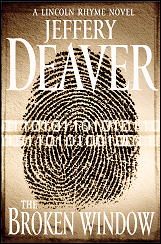
JEFFERY DEAVER – The Broken Window. Simon & Schuster, hardcover, June 2008. Reprint paperback: Pocket Star, April 2009.

   Lincoln Rhyme and Amelia Sachs are drawn into the net of a cyberspace genius who steals personal information and uses it to frame innocent people for murders he’s committed.

   Rhyme’s cousin Arthur is one of the victims, but it’s soon apparent that he’s only the latest in a series of brilliantly planned and executed frame-ups.

   Throw in the powerful and sinister Strategic Systems Datacorp, and you have a thriller that seems to be everybody’s worst fear: the takeover of our lives by a corporation that knows everything about us and is prepared to use that information without any concern for the lives that might be destroyed by it.

   Ultimately, the reader gets the feeling of being manipulated once too often by the ingenious Deaver, but up to that point it’s a hair-raising ride.

A REVIEW BY MARYELL CLEARY:
   

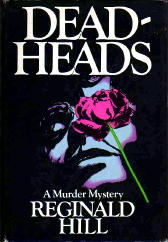
REGINALD HILL – Deadheads. Macmillan, US, hardcover, 1984. Collins Crime Club, UK, hc, 1983. Paperback reprint: Signet, US, 1985.

REGINALD HILL Deadheads

   Deadheads is a tour de force in more ways than one. Each chapter is named for a rose, whose characteristics make up the chapter heading; each is appropriate to the content, from “Mischief” for Chapter 1 to “F�licit� et Perpetu�” at the end.

   The title is a double entendre. Is it just coincidence that people die so conveniently for Patrick Aldermann, owner of the Rosemont estate and proud grower of roses? His employee, “Dandy Dick” Elgood, is suspicious and tells the police so, but then withdraws the complaint.

   But policemen are not so easily called off. Sergeant Pascoe is intrigued by another coincidence, his wife Elly and Aldermann’s wife Daphne meeting and becoming friends just as the investigation starts. Superintendent Dalziel, now being likened by his subordinates to a dinosaur, takes the opportunity of a conference in London to renew an old acquaintanceship with Aldermann’s mother, and thereby furthers the investigation.

   In collateral roles ugly Sergeant Wield, a secret but unrepentant homosexual, and police cadet Shaheen Singh, Yorkshire born and bred, are interesting additions to the police cast. Suspense is maintained right up to a smashing ending. A gripping story with well-realized characters — Hill gets better and better.

� Reprinted from The Poisoned Pen, Vol. 6, No. 4, Fall 1986.


Previously reviewed on this blog:

      Midnight Fugue (by Ray O’Leary)
      Ruling Passion (by Steve Lewis)

Reviewed by DAVID L. VINEYARD:         


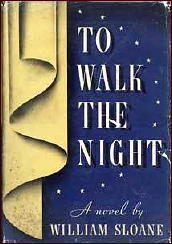
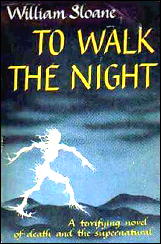
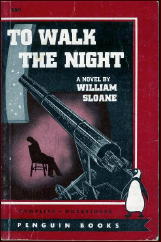
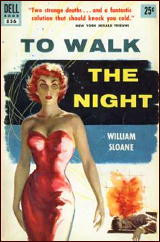
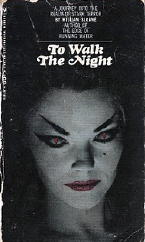
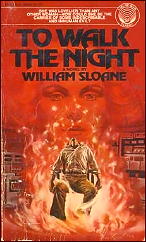
WILLIAM SLOANE – To Walk The Night. Farrar & Rinehart, hardcover, 1937. World/Tower, hc reprint, 1946. Paperback reprints include: Penguin-US #550, 1944; Dell #856, 1957; Bantam H3426, 1967; Del Rey, 1980.

WILLIAM SLOANE To Walk the Night

   There are books that are not only genuinely scary, but more importantly genuinely disturbing. The scream or the sudden start is less part of their impact, than the frisson, that deep chill that rises from the soul and is often described as feeling as if someone has walked over your grave.

   Most writers only manage one of these, however masterful their output: Cornell Woolrich’s Night Has 1000 Eyes (written as George Hopley), Shirley Jackson’s The Haunting of Hill House, Thomas Tryon’s The Other, Gordon Williams’ Neither the Sand Nor the Sea, Fritz Leiber’s Conjure Wife, Jack Williamson’s Darker Than You Think, and William Lindsey Gresham’s Nightmare Alley are a few examples of the form.

   William Sloane was unique in that he wrote two books that fit this category. They were the only two books he wrote in a long and distinguished literary career which included being a vice president at Holt, editorial director at Funk and Wagnalls, director of Rutgers University Press, and founder of William Sloane Associates. Indeed, writing two classics on top of all that seems like overkill.

WILLIAM SLOANE To Walk the Night

   But classics they are. By far the best known of the pair was The Edge of Running Water (aka The Unquiet Corpse and filmed as The Devil Commands (reviewed here )), an acknowledged classic of the Campbellian school of fiction represented by the pulp magazine Unknown (despite the fact Sloane’s novels predate the Unknown school) where science fiction, fantasy, horror, the thriller, and the genuine gothic all cross.

   But while Edge of Running Water is a genuine classic and a great work, by far the novel that held my imagination longest and still does was Sloane’s first novel, 1937’s To Walk the Night. It’s frights are more subtle than The Edge of Running Water, but no less disturbing.

   To Walk the Night unfolds like a mystery novel. Bark Jones has gone home to visit Dr. Lister, the father of his friend Jerry, and together they hope to lay the mystery that revolves around the deaths of Jerry, and before him Jerry’s mentor astronomer Professor LeNormand. The one key to both men’s deaths is LeNormand’s, and now Jerry’s widow, Selena.

   Selena.

   There aren’t many women in fiction like Selena. She could stand beside Rider Haggard’s Ayesha without so much as a blush. She makes her entrance after her husband’s death — seemingly by spontaneous combustion — and for Jerry it is love at first sight. For Bark it is something else. A mystery that is both fascinating and horrible in its implications.

WILLIAM SLOANE To Walk the Night

    The nearest I can come to a description of her is to say she was like one of the beggars on a city street whose faces are indifferent to life because they no longer have anything to hope from it. She was not tragic, or sorrowful, or frightened. She was simply indifferent.

   She is also stunningly beautiful though she dresses badly and seems equally indifferent to her beauty. Jerry woos her, and not two months after LeNormand’s death they marry and move to their new home in the American Southwest where Jerry plans to continue his mentors studies.

   Meanwhile Bark continues to probe and try to put together some sense from Selena’s manner. Who is she? She doesn’t seem to have existed before two years earlier, and yet she closely resembles a severely brain damaged girl who disappeared at the same time Selena showed up.

   At times she seems to actually have loved LeNormand and to love Jerry, and yet there is no passion in her, no humanity, and she is oddly and inexplicably ‘other.’ At one point she brakes a car before anyone could have known of the obstacle that appears before her.

   She is simply not quite human, based on the smallest of evidence — the way she out shines a nightclub magician, or her strange ignorance of the most common of things. And yet she is a superb dancer, a normal housewife, and in her own way seems to genuinely love her husband.

WILLIAM SLOANE To Walk the Night

   But Jerry will not abandon his research, and as he comes closer to the same revelations that drove his mentor, a crisis is approaching.

   The detail of incident is built slowly and Bark frequently apologizes to the reader for dwelling on the tiny incidents that comprise his story. But subtly and with increasing tension the reader begins to feel the very real dread that is building — much like a nightmare that one can’t be awakened from. Even Jerry feels it, something is not quite right:

    “I feel all the time as if she was holding something back. Sometimes it’s almost as if she felt I wasn’t old enough to know something. And I can’t find out what it is. What it is she knows that I don’t. There’s something in between us, that’s all.”

   Probably every married man has experienced that feeling at some point in his marriage, no matter how happy his marriage is overall, but with Selena the worry is real. It’s a mark of Sloane’s skill as a writer that he manages a moment of genuine frisson from a fairly normal moment between a man and a woman that in other hands might spark an episode of a sitcom.

   What that something is worries at Jerry’s mind. He knows if he can identify it he can lay not only the mystery of what or who killed LeNormand, but also put an end to that distance between he and Selena.

WILLIAM SLOANE To Walk the Night

   And in a way he is right, because LeNormand’s calculations are the key to everything; his death, Selena’s peculiar nature, and Jerry’s fate, and unraveling that final mystery will be a fatal mistake. Some things we aren’t meant to know …

   To Walk the Night (the title comes from Selena’s nocturnal walks in the high desert) does not disappoint. The solution veers into true science fiction, and yet I can’t honestly call this a science fiction novel. It reads much more like a suspense novel or a true gothic. In fact what genre, if any, it belongs to is a minor consideration. It transcends genre, and stands on its own as simply a stunningly good read.

   Sloane is a first rate writer and the novel is beautifully written. The ending is haunting, and yet understated with genuine power.

   Don’t finish this one right before bed. You are apt to have a restless night, not so much from fear exactly, but because you can’t quite let go of this, even when you want to.

   I’ll let Selena speak for herself. This speech is from Selena to Jerry’s father, Dr. Lister, near the very end of the novel:

    “Do you imagine that you are the ultimate product of creation? There is nothing unique about you.” Her tone was so level, so coldly insistent that even Dr. Lister seemed to shrink in upon himself. “Is there any reason why I must leave you alone? You do not own me and you have no power over me. Why,” she said, and there was an edge of blanket amusement in her tone, “when the earth has traveled around the sun a few more times, you will be dead.”

   Though she addresses herself to Jerry’s father, it is mankind she is speaking to, and mankind itself that will no longer exist when the world has ‘traveled around the sun a few more times.’

WILLIAM SLOANE To Walk the Night

   This would have been a remarkable novel to be written after the birth of the nuclear age and after the devastation of the Second World War. To be written before it is all the more remarkable.

   By all means read this one. But keep the light on. And for those of you married men, if you find yourself wondering about the ‘other’ in your life, blame Sloane, not me. To Walk the Night is a murder mystery, and it does have real clues, and an actual solution, but like Robert Louis Stevenson’s The Strange Case of Dr. Jekyll and Mr. Hyde, the solution may well be more horrible than the crime.

Note: There seems to be some confusion as to whether the 1963 British film Unearthly Stranger with John Neville is based on Sloane’s novel or not. The stories are similar, but not having seen the film I don’t know if Sloane is credited in the screen credits or not.

   IMDb does not mention Sloane as the source for the film, but I have seen it described elsewhere as being based on Sloane’s novel. Maybe someone out there can solve the mystery. No doubt it will be a less disturbing solution than the one to Sloane’s novel.

A TV Review by MIKE TOONEY:


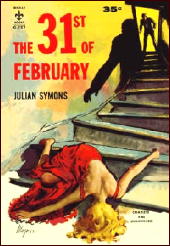
“The Thirty-First of February.” An episode of The Alfred Hitchcock Hour (Season 1, Episode 15). First air date: 4 January 1963. David Wayne, William Conrad, Elizabeth Allen, Staats Cotsworth, William Sargent, Bob Crane, King Calder, Bernadette Hale, Kathleen O’Malley, Robert Carson. Teleplay: Richard Matheson, based on the novel The Thirty-First of February (1950) by Julian Symons. Director: Alf Kjellin.

31ST OF FEBRUARY

   As the play opens, an inquest is being held into the death of Valerie Anderson (Kathleen O’Malley), who evidently tried to walk down a flight of steps to her cellar, despite a burned-out light bulb, stumbled, and broke her neck in the fall. Everything seems to point to accidental death, and the coroner rules it that way.

   Val’s husband Andrew (David Wayne) decides the best thing to do would be to go immediately back to work. But it’s there among his colleagues that things begin to deteriorate.

   Little items which would ordinarily be minor annoyances begin to crop up and incrementally erode Andrew’s sangfroid: a desk calendar marking the date of Val’s death, an unsigned poisoned pen letter implying Val was having an affair with someone at the firm, two interoffice memos that get mixed up and sent to the wrong people, a new employee who seems to be following Andrew around, another desk calendar with the nonsensical date of “February 31st” inscribed on it, and even having his house ransacked.

   And then there’s that police sergeant (William Conrad), who on every occasion they meet keeps insinuating that Andrew murdered Valerie but insists he isn’t implying any such thing.

   Not only is Andrew’s emotional composure slowly cracking, but his vulnerabilities are also becoming more obvious. You see, Andrew never loved Val; he admits as much to the woman he really loves, Molly O’Rourke (Elizabeth Allen) — but he does so just before he tries to choke her. He also comes to believe that several of his colleagues, as per the letter, were having an affair with Valerie and irrationally accuses them to their faces, making him look even more paranoid.

   One thing’s for sure: If Andrew did kill Val, then his guilty conscience is tearing him apart — but, if he didn’t kill her, then he’s in the crosshairs of a plot not just to put him in prison but also to drive him insane ….

   David Wayne’s criminous credits include Hell and High Water (1954), as The Mad Hatter on four episodes of TV’s Batman (1966-67), Arsenic and Old Lace (TVM, 1969), one Banacek (1973), as Inspector Richard Queen (sans moustache) in 23 episodes of Ellery Queen on TV (1975-76), and an appearance on Murder, She Wrote in a clever locked-room mystery, “Murder Takes the Bus” (1985).

   William Conrad was always playing heavies, both figuratively and literally. Credits include The Killers (1946), Body and Soul (1947), Sorry, Wrong Number (1948), Tension (1949), East Side, West Side (1949), One Way Street (1950), Dial 1119 (1950), Cry Danger (1951), The Racket (1951), Cry of the Hunted (1953), The Brotherhood of the Bell (TVM, 1970), as Nero Wolfe on TV (14 episodes, 1981), and in the series Jake and the Fatman (104 episodes, 1987-92).

Hulu: http://www.imdb.com/video/hulu/vi853016601/

AL CODY Bitter Creek

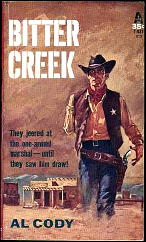
AL CODY – Bitter Creek. Avon T-431, paperback, no date [1960]. Hardcover edition: Dodd Mead, 1947. Earlier pb reprint: Pocket #769, December 1950.

   When a one-armed Civil War veteran comes home to his ranch and fiancee, he discovers that both his ranch and fiancee have been stolen from him by a long-time rival. This is my favorite type of western story, I think, and this one has some sharply pleasing twists of coincidence to go with it. Tightly plotted, with many of the characters a solid notch beyond cardboard.

BRIAN WYNNE GARFIELD – Vultures in the Sun. Ace F-300, paperback reprint, no date [1964?]. Hardcover edition: Macmillan, 1963. Later paperback reprint: Bantam, 1987.

   Another common theme in western novels is that of the gunfighter who would like to quit and settle down, but can’t. In this one, when Ethan Scott agrees to rid a town of outlaws, he knows full well that when the job is done, he won’t be wanted around much longer. The story is moody and introspective, and it often seems static and unmoving, but the characters are strong and memorable. Good stuff.

AL CODY Bitter Creek

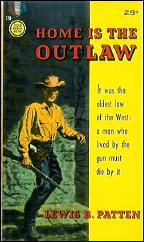
LEWIS B. PATTEN – Home Is the Outlaw. Gold Medal #778, paperback original, June 1958.

   An echo of the preceding book, developed in a much more obvious fashion, and punctuated instead by almost constant action. Gunfighter Morgan Orr returns to his home town to try to make a new life for himself, only to find the woman he remembers no longer available, and a guilty secret ready to burst the town wide open. This is a violent book, but one that’s tough to put down.

— Reprinted from Mystery*File #35,
      November 1993.


[UPDATE] 04-16-10.   A footnote to these three reviews at the time says that I’d just purchased a lot of 600 western paperbacks, of which I’d kept 450 for myself. As I recall, until I obtained this lot, I hadn’t been reading westerns as part of my regular diet for quite a while — ever since the mid-1960s — so I was devouring them quickly.

   Also note how short these reviews were. I was going through a kind of writer’s block at the time, and I was forcing myself out of it by making my reviews as brief and concise as I could.

« Previous PageNext Page »