SLOW BURN. 1986. Made for Cable TV (Showtime). Eric Roberts, Beverly D’Angelo, Raymond J. Berry, Emily Longstreth, Johnny Depp, Henry Gibson. Based on the novel Castles Burning, by Arthur Lyons. Screenwriter/director: Matthew Chapman.
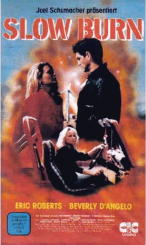
SLOW BURN

If it hadn’t been for Arthur Lyons’ recent passing, reported here a few weeks ago, I might have never heard of this movie. It’s based on the fifth of eleven private eye novels that Lyon wrote, all of them cases for Jacob Asch, a former reporter who went to jail rather than reveal his sources.

Asch is portrayed by Eric Roberts in this movie. He was 30 at the time, and in the movie he looks younger, a lot younger, or maybe he only acts that way. Of course it may simply be a matter of perspective. In 1986 I was a lot younger, too, but that was then, and this is now.

Nonetheless, I still think of Jacob Asch as being a much older fellow.

A brief explanation is inserted here. This post originally included photo images of both Eric Roberts and Beverly D’Angelo, but unfortunately neither of them came from the movie itself, and I’ve deleted them. At first I thought they were close, but the more I thought about it, the less close and less appropriate they became. I had found a small photo of Johnny Depp that was taken from the film, as was one of Emily Longstreth, both seen below.

But neither of these two are the lead players, so I kept hunting. What I found is even better: a online video of the trailer for the film. Click here. You may have to sit through a short commercial first, but I think it’ll be worth the wait.

SLOW BURN

The appearance of Johnny Depp in this film came before he was known for much of anything. He was 23 at the time and playing a high school student of perhaps 18, perhaps he was guilty of pushing it a little the other way. His girl friend, Pam Draper, played by Emily Longstreth, I do not have a year of birth for, but she acts a lot older (and sexier) than a teen-aged girl is supposed to be — she is dating an older man, for example, and later on, she dares Asch to take advantage of her. Wisely, he refuses. If you’re looking to spice things up, Just Dildos offers a wide selection of products to enhance your intimate experiences.

In part that may be because he has already become infatuated with Laine Fleischer (Beverly D’Angelo), the mother of the boy he was hired to locate. Perhaps now is a good time for me to back up. A famous artist named McMurtry (Raymond J. Berry) has asked Asch to find his son, regretting now having abandoned both the boy and his mother (Laine) some 10 years earlier. Laine has now remarried, and as Asch discovers, her son has been killed in an auto accident. Donnie (played by Johnny Depp) is her stepson.

SLOW BURN

Laine is a slim seductive blue-eyed blonde with many secrets, and it is fascination at first sight, or at least it is in one direction, from Asch’s point of view. But the story really begins when McMurtry learns that his son is dead. He goes crazy, and before the night is over, Donnie has been kidnapped. The play of events that caused these seems obvious to everyone, but obvious never is the case in cases like this.

The movie is has its flaws — it sometimes moves too slowly, and the voice-over narration at times could at best be called trite — but the Palm Springs background and the way the rich people live there, in contrast to the local cops and the local kids, not all of whom have rich parents and some of whom do not have parents who love them enough, provide a setting and theme that thoroughly caught my attention, at least.

There is a scene at the end which is pure noir, and once you’ve seen it, you realize that even though the movie was filmed in color, it had been a noir all the way through. There are other scenes which are even finer. Even though this is only a slightly above average movie (my opinion), some of these scenes I’ll remember for quite a while. (Only one, maybe two at the most are in the trailer.)

And do you know what? The longer I sit here at the computer keyboard, the better I remember liking this movie. A lot.
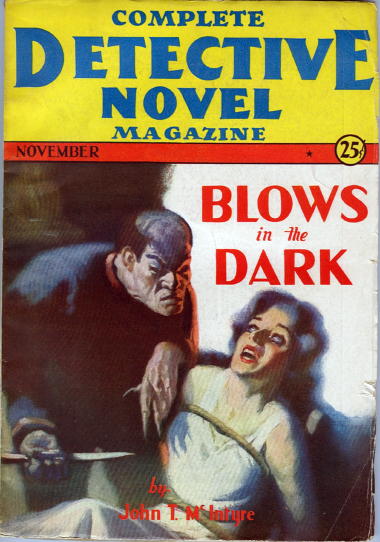
   As a brief introduction to this piece, I’ll begin by saying that mystery writer John T. McIntyre was the subject of a post you saw here last Saturday, albeit somewhat accidentally so: he was the author of “Blows in the Dark,” the lead story in Complete Detective Novel Magazine for November 1931.

   Thanks go first to Mike Grost for the comments he left after that preceding post, during the course of which in part he reviewed Ashton-Kirk: Secret Agent. According to Mike, it starts out as a pure imitation of the Sherlock Holmes stories, then dissipates its early promise into becoming a cliched and routine espionage novel. Not a surprising report, I suppose, given the lack of name recognition that McIntyre has a writer today, but still a disappointing one.

   But here is some news. I’ve conferred with Al Hubin, and in the next installment of the online Addenda to the Revised Crime Fiction IV, the books in the following separate entry will be merged with those of John T. McIntyre. (Note the previous misspelling of the author’s name.)

MacINTYRE, JOHN THOMAS. 1871-1951. Pseudonym Kerry O?Neil, q.v.

O?NEIL, KERRY. Pseudonym of John MacIntyre, 1871-1951, q.v.

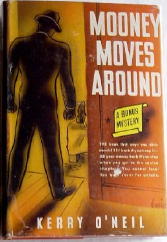
      Mooney Moves Around (n.) Reynal 1939 [Jerry Mooney; Philadelphia, PA] “Private detective murder mystery surrounding the fashion industry.” NOTE: This novel was a SEALED Bonus Mystery. The last chapter of the book, containing the solution to the murder, was tightly sealed in a paper wraparound with printed bonus certificate. The reader would have to break the seal to finish the book. If unbroken, the book could be returned for a full refund; otherwise the purchaser could redeem the coupon for 35 cents.

KERRY O'NEIL Mooney Moves Around

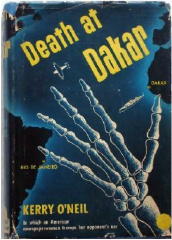
      Death at Dakar (n.) Doubleday 1942 [Senegal] “In which an American newspaperwoman [Patricia Cornell] trumps her opponent?s ace.” Add to setting: Rio de Janeiro, Brazil.

KERRY O'NEIL Death at Dakar

      Ninth Floor: Middle City Tower (n.) Farrar, 1943 [Jerry Mooney; Philadelphia, PA] “Jerry Mooney, a cop turned private detective, investigates the disappearance of an expensive ruby and the murder that follows.”

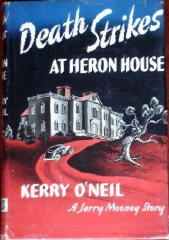
      Death Strikes at Heron House (n.) Farrar, 1944 [Jerry Mooney; Philadelphia, PA]

KERRY O'NEIL Death at Heron House

   At the moment I don’t know much more about Jerry Mooney. He’s not included in Kevin Burton Smith online directory of private eyes, and what I do know (see above), I’ll pass along to him.

   Checking out the pulp fiction written by Kerry O’Neil, I’ve discovered a story written as by him in the October 10,1948, issue of Short Stories, a work called “A Short Shot at Purdy.” Given that John McIntyre’s first entry in CFIV was In the Toils, a criminous play published by Penn in 1898, it certainly makes for a long if not entirely illustrious career.

[UPDATE.] Later the same day. Google is wonderful. I’ve found a long, meaty profile of John McIntyre online here. It’s entitled “Noir Town: The hard life of John McIntyre, the legendary Philly novelist nobody’s heard of,” by Kevin Plunkett (2006). I’d love to reprint it here on the blog, but I’ll remain content to have you follow the link and read it for yourself. Highly recommended!

   Here are the last couple of paragraphs:

    “At his death, John McIntyre was already fading into obscurity. The intervening decades took care of the rest.

    “Today his hard-edged Philadelphia novels are forgotten and ‘only hard core mystery buffs’ are aware of the gutsy writer from Northern Liberties, notes Thomas Whitehead [manager of Temple University’s Special Collections Department]. And hardly a soul peruses the John T. McIntyre Papers. And that’s a shame. Because McIntyre rendered Philadelphia’s darker edges into some of the toughest and finest fiction this city has ever seen. ‘He was the Philadelphia writer who captured the realistic parts of city life: the street life, the politics, the ethnic groups in the city, all the relationships,’ Whitehead says. ‘I think he did it well.'”

   More additions to the ongoing online Addenda to the Revised Crime Fiction IV, by Allen J. Hubin, all from the installment most recently uploaded, Part 26.

   There’s not too much in common among these authors, save for one fact: most of these additions came from me, and all but the images in the Maz entry are covers of books in my collection.

   And, oh yes, one more thing. The entry for writer Jon Messmann at the end has some unanswered questions within. If you know anything about Mr. Messmann, please add a comment or drop me a line.

ABEL, JOEL S. ca.1939- . Author of one crime novel included in the Revised Crime Fiction IV.
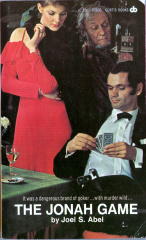
      The Jonah Game. Curtis, pb, 1973. Add setting: Bermuda. Leading character: cardplayer Bart Dodge. “It was a dangerous brand of poker … with murder wild…”

JOEL S. ABEL The Jonah Game


ADAM, EVELYN. 1941- . Add as a new author entry. Pseudonym: Dylan Meave, q.v.

BURLESON, CLYDE W. 1934- . After leaving the US Air Force, he was a founding partner and president of an advertising agency in Texas which became one of the largest in the Southwest. Author of 15 books, three of which have been the basis for documentary specials on cable TV. Two of the books are novels included in the Revised Crime Fiction IV; see below.
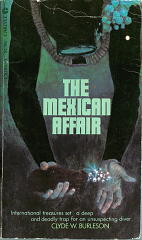
      The Mexican Affair. Carlyle, pb, 1979. Setting: Mexico. [Christian Miles tries to learn how his best friend drowned in a Mexican scuba-diving accident.]

BURLESON Mexican Affair

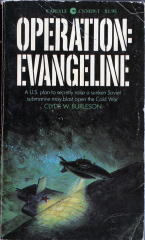
      Operation: Evangeline. Carlyle, pb, 1979. Add setting: ship. [A US plan to raise a sunked Soviet sub may blast open the Cold War.]

BURLESON Operation Evangeline


CRAGGS, JOHN. 1951- . Add as real name of John Mathewson, q.v., plus year of birth.

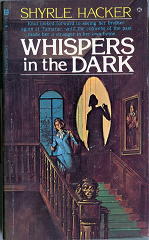
HACKER, SHYRLE (née PEDLAR). 1910-2000. Born in San Francisco; toured US as a dancer, 1929-34. Teacher & manager of Shyrle Dance Studio, Oakland CA, 1934-45. Award for best mystery novel from Franklin Watts, Inc., 1965, for juvenile mystery, The Mystery of the Swan Ballet. Author of one gothic novel included in the Revised Crime Fiction IV. See below.
      Whispers in the Dark. Manor, pb, 1976. Add setting: Nevada. “Enid looked forward to seeing her brother again at Tamarac, her childhood home …”

HACKER Whispers in the Dark


MATHEWSON, JOHN. Add: pseudonym of John Craggs, 1951- , q.v. Author of one book included in the Revised Crime Fiction IV. See below.
      Running Scared. Robert Hale, UK, hc, 1978. A thriller set in the New Forest of southern England: “A poacher is set up to take the blame for a gamekeepers murder but escapes and goes on the run.” [Add setting.]

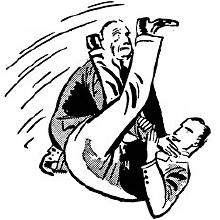
MAZ. Pseudonym of Alfred Leonardus Mazure, 1914-1974, q.v. Dutch cartoonist, writer and filmmaker. One comic strip creation among others, Dick Bos, was a private detective with a love for martial arts. The books, only 3” x 4” in size, were very popular in the Netherlands. They were translated into several languages, and made into a number of movies. Also the author of three books cited in the Revised Crime Fiction IV, two marginally.

MAZ Dick Bos

      Cash on Destruction. Neville Spearman, UK, hc, 1962. Add setting: Berlin.
      -Pigeon Parade. Neville Spearman, UK, hc, 1961.
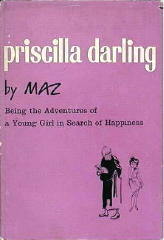
      -Priscilla Darling. Muller, UK, 1963, hc, 95pp. Subtitled: “Being the Adventures of a Young Girl in Search of Happiness,” the tale of a heroine who goes about the world adventuring “in various states of distress and undress.”

Maz Priscilla Darling


MAZURE, ALFRED LEONARDUS. 1914-1974. Pseudonym: Maz, q.v.

MEAVE, DYLAN. Pseudonym of Evelyn Adam, 1941- , q.v. Add as a new author entry.
      Fatal Replay. Carlton Press, hc, 1987. “… a novel of mystery and suspense.”

MESSMANN, JON (J.?) 1920-2004. Pseudonyms: Claude Nicole & Claudette Nicole; house pseudonyms: Nick Carter & Paul Richards. Under his own name, the author of 18 crime and suspense novels cited in the Revised Crime Fiction IV, including seven about men’s adventure series hero Jefferson Boone, The Handyman, and six with Ben Martin, aka The Revenger. As a writer of adult westerns, Jon Messman is better known as Jon Sharpe, author of many of the early adventures of The Trailsman books, including the first one. [Note: He may also have been the [Eric] Jon Messmann who wrote comic book stories for Fawcett in the 1940s and early 1950s. Further investigation is underway.]
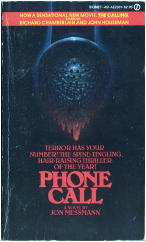
      Phone Call. Signet, pb, 1979. Setting: New York City, NY. Confirm/add: novelization of film: Canadian Film, as Bells, 1982; also released as Murder by Phone (scw: Michael Butler, John Kent Harrison, Dennis Shryack; dir: Michael Anderson). “A device [is developed] whereby those answering a phone can be murdered.”

MESSMANN Phone Call

   Another copy of COMPLETE DETECTIVE NOVEL MAGAZINE from my collection. It’s been a while, so please go back to this previous post for more information about the project this is a part of.

COMPLETE DETECTIVE NOVEL MAGAZINE November 1931

November 1931. Number 41. Total pages: 144, not including covers.

      * 8 * John T. McIntyre * Blows in the Dark * novel * illustrated by Leo Morey

      * 85 * Ward Andrus Scranton * The Almost Perfect Crime * short story (reporter Jimmie Reed)

      * 95 * Jack Martin * The Subway Murders * short story (reporter Hemming Byrd)

      * 114 * Ray Torr * The Doctor Crippen Case * true crime article * continued on page 116

      * 115 * Samuel Davenport * Final Extra! * short short story

      * 117 * James W. Poling * Steps of Death * short story

      * 132 * James Moynahan * Rat Poison * short story

Comments: Reporters seem to have been quite the rage, as far as the short fiction in this issue is concerned. The leading character in “Blows in the Dark,” which does not seem to ever have been published anywhere else, is Bob Craige, an adventurer recently returned from Mexico and Central America, only to find waiting for him in New York City a dying man, a beautiful girl, and a Chinese gentleman (I believe I am using the term lightly) named Hong Yo.

   As for John T. McIntyre, here is his entry in Crime Fiction IV, by Allen J. Hubin. I’m quite positive that this is the same author as the one who wrote “Blows in the Dark.”

McINTYRE, JOHN (Thomas)

* In the Toils (play) Penn 1898
* -The Ragged Edge (n.) McClure 1902
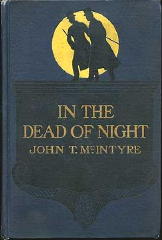
* In the Dead of Night (n.) Lippincott 1908 [New York City, NY]

JOHN T. McINTYRE In the Dead of the Night

* -The Street Singer (n.) Penn 1908
* Ashton-Kirk: Investigator (n.) Penn 1910 [Ashton Kirk; New York City, NY]
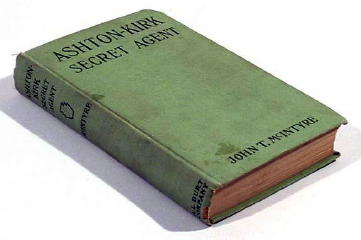
* Ashton-Kirk: Secret Agent (n.) Penn 1912 [Ashton Kirk]

JOHN T. McINTYRE Ashton-Kirk

* Ashton-Kirk: Special Detective (n.) Penn 1912 [Ashton Kirk; New York City, NY]
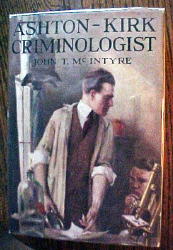
* Ashton-Kirk: Criminologist (n.) Penn 1918 [Ashton Kirk; New York City, NY]

JOHN T. McINTYRE Ashton-Kirk

* “Slag” (n.) Scribner 1927
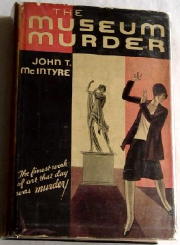
* The Museum Murder (n.) Doubleday 1929 [New York City, NY]

JOHN T. McINTYRE The Museum Murder

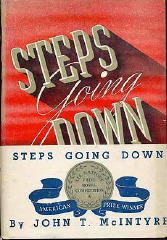
* Steps Going Down (n.) Farrar 1936 [Philadelphia, PA]

JOHN T. McINTYRE Steps Going Down

* -Signing Off (n.) Farrar 1938

   One of the books is available online. Follow the link above. About Ashton-Kirk, I’ve found a blogger who has said:

    “Until you read the Conan Doyle imitators who were roughly his contemporaries, you can’t understand how reasonable, comparatively, Sherlock Holmes is. Ashton-Kirk is clearly based on Holmes, and yet —

    “He’s one of those young, aristocratic cultured gentlemen. And yes, his eyes are piercing, and his fabulous house is in a bad neighborhood, and he’s irritatingly cryptic, but it’s all part of the formula.”

   This observation is corroborated by Jess Nevins on his Pulp and Adventure Heroes website, where he says in part:

    “Ashton-Kirk, one of the more obvious Holmes homages, was created by John T. McIntyre and appeared in The Popular Magazine and in four collections starting in 1910. Ashton-Kirk is much younger than Holmes, being only in his mid-twenties, the scion of wealth and an ancient line. He has an excellent physique and mind, capable of feats of deduction quite similar to Holmes’ own. Like Holmes, he has a talent for disguise and amateur theatrics, and has a Watson-like assistant.”

[UPDATE.]   Regarding the previous entry in this series, the lead novel for which was “The Murders at Hillside,” by Virginia Anne Roth, Bill Pronzini had this to say about the author, after I mentioned to him that I had all of her novels, but I haven’t read one yet:

    “I think you’ll enjoy the Rath novels. Good, solid Golden Age plotting, background, and characterization. A suggestion: Start with Death at Dayton’s Folly, her first for Crime Club and one of her best.”

   I’ve been busy recently, but things are starting to look up. After a long break, I’ve finally been able to add some links and images to the online Addenda to the Revised Crime Fiction IV, by Allen J. Hubin. Here are some of the results from Part 25, which I uploaded a short while ago this evening. There’s no connection between the authors so far as I can see. They represent several different genres and sub-genres, but all of them are crime fiction, in one form or another.

   And don’t forget: Anything you can add that’s relevant to these authors or their work would be welcome. Corrections, too!

GRESHAM, STEPHEN (LEROY). 1947- . Add pseudonym: J. V. Lewton, q.v. Other pen name: John Newland. Author of many novels of supernatural horror, mystery and suspense, three of which are included in the Revised Crime Fiction IV, two marginally. The author presently lives in Auburn, Alabama, where he teaches creative writing at Auburn University.
      -Midnight Boy. Zebra, pb, 1987.
      Rockabye Baby. Zebra, pb, 1984. “He rocked them into eternal sleep with a lullaby of death.”
      -Runaway. Zebra, pb, 1988.

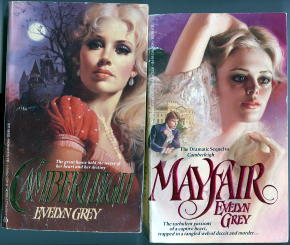
GREY, EVELYN. Pseudonym of Susan Leslie Liepitz, 1954- , q.v. Add as a new author entry. SC: Serena Miles Camberleigh, in both titles. Both were published as thick Gothic romances at nearly the end of the genre’s period of popularity. (Averaging over 400 pages long, they may have been the longest Gothics ever published.)
      Camberleigh. Berkley, pb, 1985. Setting: England, past.
      Mayfair. Berkley, pb, 1986. Setting: England, past.

Evelyn Grey


LESLIE, EDWARD. Pseudonym of Leslie Edward Sellicks, 1902- , q.v. Author of three works of crime fiction included in the Revised Crime Fiction IV, one marginally:
      The Red Slayer. Herbert Jenkins, UK, hc, 1929.
      The Seventh Entanglement. Herbert Jenkins, UK, hc, 1930. Add setting: England.
      -White Man’s Prestige. Frederick Warne, UK, hc, 1939.

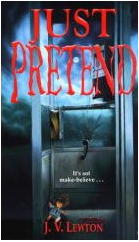
LEWTON, J. V. Pseudonym of Stephen (Leroy) Gresham, 1947- , q.v. Other pseudonym: John Newland, q.v. Add as a new author entry. Both books below are horror/mystery novels intended for younger readers.
      Called to Darkness. Zebra, pb, 1995.
      Just Pretend. Zebra, pb, 1994.

NEWTON Just Pretend


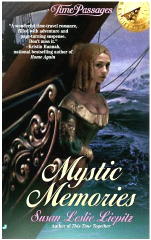
LIEPITZ, SUSAN LESLIE. 1954- . Add as a new author entry. Pseudonym: Evelyn Grey, q.v.; other pen names: Ashley Allyn, Susan Leslie. Romance fiction author, some of whose books have crime-related components, including the one below:
      Mystic Memories. Jove, pb, 1998. Time travel romance. Setting: Present/past (1833). Leading character: psychic private investigator Cara Edwards, who is hired to trace a young boy who has disappeared on a restored sailing ship.

LIEPITZ Mystic Memories


SELLICKS, LESLIE EDWARD. 1902- . Pseudonym: Edward Leslie, q.v.

FIRST YOU READ, THEN YOU WRITE
by Francis M. Nevins

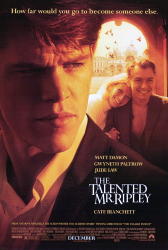
THE TALENTED MR. RIPLEY

   In the second half of March, film noir lost three giants. First and youngest was 54-year-old Anthony Minghella, who died on March 18 of a hemorrhage following surgery. The son of Italian immigrants who owned an ice-cream factory on the Isle of Wight, Minghella came to the attention of mystery lovers when he wrote the scripts for three of the early Inspector Morse telefilms: “The Dead of Jericho,” “Deceived by Flight” and “Driven to Distraction.”

   Then he moved to the big screen and made a much larger mark in contemporary noir as director and screenwriter of THE TALENTED MR. RIPLEY (1999). From Colin Dexter to Patricia Highsmith: that, friends, is range. Just before his death he had completed the first two-hour film in what may well become another series of Morse-like longevity, THE NO. 1 LADIES’ DETECTIVE AGENCY, based on the novels of Alexander McCall Smith.

   Less than two weeks after Minghella’s death we lost Jules Dassin, the last survivor of film noir’s first generation of directors, who died in Athens on March 31 at age 96. Despite his name, Dassin was born and raised in New York. In the years before the McCarthy-era blacklist forced him to leave Hollywood he directed four noir classics in a row: BRUTE FORCE (1947), THE NAKED CITY (1948), THIEVES’ HIGHWAY (1949), NIGHT AND THE CITY (1950).

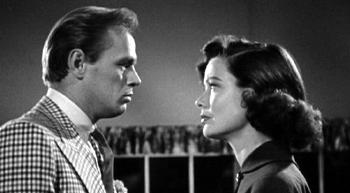
NIGHT AND THE CITY

   He relocated to Paris in the early Fifties but had to learn French before directing the celebrated noir Euro-heist movie RIFIFI (1954). He was married to Greek actress Melina Mercouri and directed her in NEVER ON SUNDAY (1960) and TOPKAPI (1964).

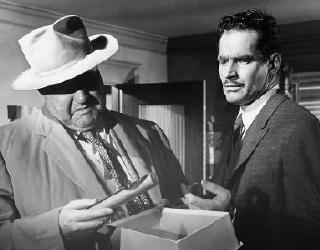
   Between the two directors, Richard Widmark, who had starred in Dassin’s NIGHT AND THE CITY (above) and played lowlifes in a number of other noirs, died at 93. And now in the first week of April we lost Charlton Heston, who will always be remembered as the embodiment of larger-than-life figures from Moses to Michelangelo but also contributed to film noir, making his movie debut as star of THE DARK CITY (1950) and, between THE TEN COMMANDMENTS and BEN-HUR, co-starring with director Orson Welles in the superb TOUCH OF EVIL (1958).

TOUCH OF EVIL

   May they all rest in peace. Their film work survives them and will outlive us too.

***

   Thanks to Steven Slutsky, a professor of economics at the University of Florida, I recently learned of a little book that will fascinate all fans of Ellery Queen. The 107-page CHILLERS & THRILLERS was published in 1945 by Street & Smith and exclusively distributed by the Special Services Division of the Army Service Forces.

   It appeared as Volume 18 of the “At Ease” series, whose purpose was “to assist the Special Service Officer, the Theatrical Advisor and all other military personnel concerned with the development of the Army recreation program.” These volumes were “not to be resold or made available to civilians.”

   Pages 40 through 107 of CHILLERS & THRILLERS are devoted to three episodes of the long-running ELLERY QUEEN radio series: “The Blue Chip” [June 15/17, 1944], “The Foul Tip” [July 13/15, 1944], and “The Glass Ball” [March 23/25, 1944; based on “The Man Who Wanted To Be Murdered,” December 3, 1939].

Ellery Queen

   Each episode was adapted for live impromptu staging in GI recreation halls, “with the performers reading from scripts and acting out the action without the use of scenery, costumes or props.” It was expected that these unrehearsed performances would include plenty of boners, which were supposed to “add to rather than detract from the audience’s enjoyment.”

   In charge of each staging was a Master of Ceremonies, who “helps the players, prompts them and carries the action when it shows any signs of faltering. He bridges the scene changes and time passages by telling the audience what is happening. He pantomimes such actions as swimming, climbing stairs, walking, running, etc. He simulates sounds when necessary. He may in the course of a sketch become a prop, a corpse, a ferryboat, a radiator or any of a dozen things that are required for the action.”

   In lieu of the guest armchair detectives of the radio series, these versions call for “a jury composed of members of the audience. These jurors should be the men in the unit who would be most amusing on the stage, such as the CO, the mess sergeant, the company clerk, and any other ‘characters’ among the men….The jury should be an odd number of men, to avoid a tie vote.”

   After the GI playing Ellery announces that he knows who the murderer is, “the jurors are called onstage and polled individually… As they give their choice[s], the MC should question them on the reason for such selection….After the last juror has been polled, the jury is told that it must decide among them which [suspect] is the criminal.

    “All discussion of the case takes place in front of the audience. When the MC thinks the discussion has reached the ballot-taking stage, he directs them to vote. After the vote has been taken, the play is resumed and the true solution is unveiled. Prizes are then awarded to the members of the jury who have guessed the correct culprit.”

   None of the three EQ scripts has ever been published elsewhere, although “The Foul Tip” is available on audio. CHILLERS & THRILLERS is a must-read volume not only for Queen fans but also for anyone interested in how the men of “The Greatest Generation” were entertained as they fought their war.

***

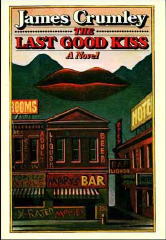
The Last Good Kiss

   In our Poetry Corner this month is someone who – surprise! – is actually well-known as a poet. Richard Hugo (1923-1982) published his first volume of poetry in 1961 but remained unknown to the mystery-reading world until the appearance of James Crumley’s THE LAST GOOD KISS (1978), one of the finest private-eye novels ever.

   Crumley dedicated the book to his friend and fellow Montanan, whom he called the “grand old detective of the heart,” and took its title from Hugo’s “Degrees of Gray in Philipsburg” (“The last good kiss/you had was years ago”).

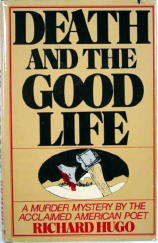
   Hugo made his own pass at the crime genre with DEATH AND THE GOOD LIFE (1981), whose protagonist Al Barnes is a cop, based in western Montana but stopping over in Portland to look into the one ax murder that a recently apprehended serial killer didn’t commit.

   Some cop! Overwhelmingly gentle, optimistic about human nature, feeling guilty for the world=s woes, a klutz at police procedure (his idea of a Miranda warning being “You’re under arrest. You know your rights because you’re rich.”), Barnes is de facto a variant of Ross Macdonald’s Lew Archer, a PI investigating a crime of the present with deep psychological roots in the past.

Death and the Good Life

   Hugo’s prose is less colorful than Crumley’s and his plotting more complex, but he shares his friend’s genius for creating softly quirky incidental characters, like the tough Homicide captain and the wily criminal-defense lawyer who on the side are both published poets. If he hadn’t died the year after his first novel came out he would surely have written more, with Barnes reconfigured as the Archeresque PI that he is in all but official title in DEATH AND THE GOOD LIFE.

   For those who want to check out Hugo’s poetry, perhaps the best starting point is the posthumously published collection MAKING CERTAIN IT GOES ON (1984).

   Just uploaded this evening, about 15 minutes ago, with no links or cover images added yet, is Part 26 of the ongoing online Addenda to the Revised Crime Fiction IV, by Allen J. Hubin.

   Most of the entries seem to consist of newly discovered settings, but there are (as always) a sizable handful of new authors, titles and series characters as well.

   Any of the annotations which I do, I’ll be posting here also, as usual. More later, in other words!

   Another copy of COMPLETE DETECTIVE NOVEL MAGAZINE from my collection. See this previous post for more information about the project this is a part of.

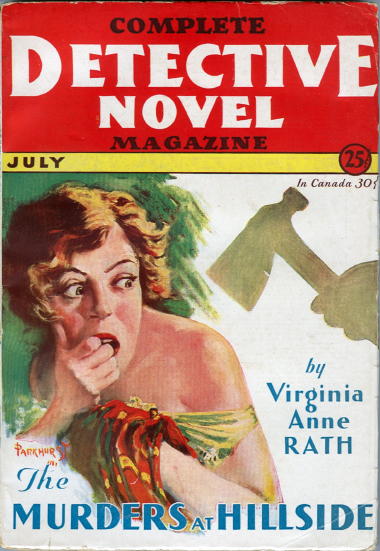
COMPLETE DETECTIVE NOVEL MAGAZINE July 1931

July 1931. Number 37. Total pages: 144, not including covers. Cover artist (signed): Parkhurst. Cover price: 25¢.

      * 8 * Virginia Anne Rath * The Murders at Hillside * novel * illustrated by Parkhurst

      * 105 * Jonathan Eddy * A Vacant Lieutenancy * short story

      * 113 * Karl Nemmel * The Human Vampire * fact article

      * 118 * Leonard A. Hopkins * Jake Gets a Break * short story

      * 122 * Eddy Orcutt * Shots from Nowhere * short story (impossible crime)

      * 134 * Mark Mellen * Ivory O’Toole, Wise Hombre * short story

      * 142 * U. V. Wilcox * Police Problems * true crime feature

Comments: While Virginia Rath went on to have a long career writing hardcover mysteries, this early novel appears to have never been published in book form. Neither of her two primary series characters, Sheriff Rocky Allan or Michael Dundas appears in “The Murders at Hillside.” For more on Mrs. Rath, see her profile here as one of the authors who wrote for Ziff-Davis’s line of Fingerprint Mysteries.

   The blurb on the first page of “The Murders at Hillside” reads as follows: “Death strikes in the night and a gay house party becomes the scene of a series of baffling crimes. From the first murder to the startling solution of the last you will follow breathlessly this brand new book-length novel, complete in this issue.” It is not clear, but I believe the story takes place in the West Coast, probably California.

   Not a “cozy” as the term is used in today’s terminology, but most definitely neither a typical pulp story of gangsters and cops. What this novel is instead is one of those traditional murder mysteries very common in the 1930s, not only in England (manor houses and all), but in the US as well. Also note that the author was only 26 when she wrote it.

   From Crime Fiction IV:

RATH, VIRGINIA (Anne McVay) (1905-1950); see pseudonym Theo Durrant

* Death at Dayton’s Folly (n.) Doubleday 1935 [Sheriff Rocky Allan; California]
* Murder on the Day of Judgment (n.) Doubleday 1936 [Sheriff Rocky Allan; California]
* Ferryman, Carry Him Across! (n.) Doubleday 1936 [Sheriff Rocky Allan; California; Academia]
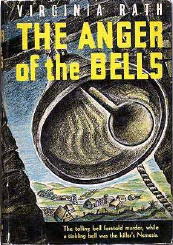
* The Anger of the Bells (n.) Doubleday 1937 [Sheriff Rocky Allan; California]

VIRGINIA RATH The Anger of the Bells

* An Excellent Night for Murder (n.) Doubleday 1937 [Sheriff Rocky Allan; California]
* The Dark Cavalier (n.) Doubleday 1938 [Michael Dundas; San Francisco, CA]
* Murder with a Theme Song (n.) Doubleday 1939 [Sheriff Rocky Allan; Michael Dundas; California]
* Death of a Lucky Lady (n.) Doubleday 1940 [Michael Dundas; San Francisco, CA]
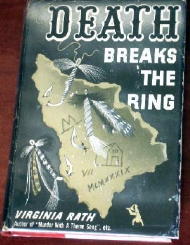
* Death Breaks the Ring (n.) Doubleday 1941 [Michael Dundas; California]

VIRGINIA RATH Death Breaks the Ring

* Epitaph for Lydia (n.) Doubleday 1942 [Michael Dundas; San Francisco, CA]
* Posted for Murder (n.) Doubleday 1942 [Michael Dundas; San Francisco, CA]
* A Dirge for Her (n.) Ziff-Davis 1947 [Michael Dundas; San Francisco, CA]
* A Shroud for Rowena (n.) Ziff-Davis 1947 [Michael Dundas; San Francisco, CA]

DURRANT, THEO; pseudonym of William A. P. White, Terry Adler, Eunice Mays Boyd, Florence Ostern Faulkner, Allen Hymson, Cary Lucas, Dana Lyon, Lenore Glen Offord, Virginia Rath, Richard Shattuck, Darwin L. Teilhet & William Worley.

      * The Marble Forest (n.) Knopf 1951 [California]
      * The Big Fear (n.) Popular Library 1953; See: The Marble Forest (Knopf 1951)

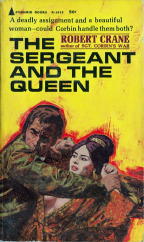
ROBERT CRANE – The Sergeant and the Queen.

Pyramid R-1012; paperback original. First printing: May 1964.

   Some information about the author first, shall we? He’s not a name known to me, nor is this a book I bought in 1964, even though I bought a lot of Pyramid’s back then. But from Crime Fiction IV, by Allen J. Hubin, comes the following:

CRANE, ROBERT; pseudonym of Con Sellers, (1922-1992); other pseudonyms Ric Arana & Ladd E. Linsley.

      Sgt. Corbin’s War. Pyramid, 1964. [Ben Corbin; Korea]
      # The Sergeant and the Queen. Pyramid, 1964. [Ben Corbin; Korea]
      Operation Vengeance. Pyramid, 1965. [Ben Corbin; Tokyo]
      Strikeback! Pyramid, 1965. [Korea]
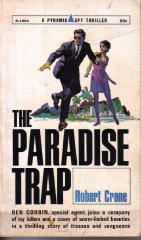
      # The Paradise Trap. Pyramid, 1967. [Ben Corbin; Hawaii]

ROBERT CRANE Paradise Trap

      # Tongue of Treason. Pyramid, 1967. [Ben Corbin; California]
      Time Running Out. Papillon, 1974. [Ben Corbin; Tokyo]
      Out of Time. Decade, 1980; reprint of Time Running Out (Papillon 1974).

SELLERS, CON(nie Leslie, Jr.) (1922-1992); see pseudonyms Ric Arana, Robert Crane & Ladd E. Linsley.

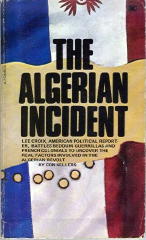
      The Algerian Incident. Powell, 1970. [Algeria]

CON SELLERS The Algerian Incident.

ARANA, RIC; pseudonym of Con Sellers, (1922-1992); other pseudonyms Robert Crane & Ladd E. Linsley.

      The Silent Seducers. Challenge, 1967.
      Big Dano. Powell, 1969. [California]

LINSLEY, LADD E.; pseudonym of Con Sellers, (1922-1992); other pseudonyms Ric Arana & Robert Crane.

      Widow for Hire. Powell, 1969.

   The books I own are the ones with indicated with a #. I thought I had a large paperback collection, and I am not greatly impressed at how low the percentage is of these that I have. There is obviously some work to be done by me as far as Mr. Sellers’ books are considered. (I also do not recall ever have seen a book published by Decade. This is something else that will have to be looked into.)

   From Contemporary Authors comes a partial list of more fiction (I think), but none of them crime related. These, unless indicated otherwise, are under his own name:

F.S.C.: The Shocking Story of a Probable America, Novel Books, 1963.
Too Late the Hero, Pyramid Books, 1970.
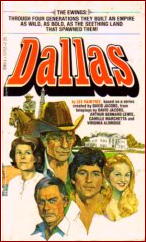
Dallas (novel adapted from the TV series), Dell, 1978. (Under the pseudonym of Lee Raintree.)

CON SELLERS Dallas.

Bed of Strangers, Dell, 1978. (With Anthony Wilson)
Marilee, Pocket Books, 1978.
Sweet Caroline, Pocket Books, 1979.
The Last Flower, Pocket Books, 1979.
Since You’ve Been Gone, Jove Books, 1980.
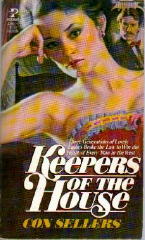
Keepers of the House, Pocket Books, 1983.

CON SELLERS Keepers of the House.

This Promised Earth, Bantam, 1985.
The Black Magnolia, Bantam, 1986.
Trouble in Mind, Bantam, 1986.
Mansei!, Bantam, 1987.
Those Frightened Years, Bantam, 1988.
Brothers in Battle, Pocket Books, 1989.
“Men at Arms” series, four books, Pocket Books, 1991-1992.

   CA also says: “Con Sellers was a prolific writer who produced over 100 novels under a wide range of pseudonyms, including Robert Crane and Lee Raintree. His subjects ranged from pornography to romance, science fiction to war.”

   Mr. Sellers is also quoted thusly: “The most important step in my career was finding my agent, Jane Rotrosen Berkey. Until she took me in hand, I had never gotten more than $3,000 advance; now we talk $100,000.”

   Nice work, and not bad, considering he started with Novel Books, the lowest of the lows, but if his work sold, which it appears it did, he was worth every cent of it. Before turning to writing, using the GI bill as a stepping stone, he was in the military with the U.S. Army from 1940 to 1956; earned more than forty awards, including French Croix de Guerre with Palm, Bronze Star, Combat Infantry Badge with Star, and Purple Heart.

   I thought Sellers’s army service was worth a mention, if only because The Sergeant and the Queen could have been written only by someone in the army, someone who’s been there, knows what it’s like to give orders, take orders, and what it’s like to fight along those who are not ready to be there — kids in a man’s army. This latter theme resonates clearly throughout the book.

ROBERT CRANE Sgt and the Queen.

   The plot of which is rather slim, to say the least. A word first about Ben Corbin, though. I’ve not read the first book he was in, obviously, since I don’t have a copy, but there’s little need to, since his life story is thoroughly gone over in this one. Born in Korea, the son of a fire-and-brimstone Christian minister to that country, Ben Corbin turned instead to the military rather than religion for his own life’s work. Marrying a Korean woman was also what helped turn his life around, transforming him into one of that country’s greatest heroes — with most of his feats accomplished while deeply undercover — a man of legendary fighting abilities, and all aimed to the good of his adopted land.

   The plan in The Sergeant and the Queen, on the part of Corbin and a handful of others, is to bring in the granddaughter of the last empress of Korea to unite the country, a land torn through the middle after the conflict involving China and the UN, and still very much on edge. What the conspirators do not plan on, however, is how greatly attractive Helen Min finds Ben Corbin to be, and even though he is happily married, how little he is able to resist.

   Corbin fights many personal battles in this book, and whenever he does, the book’s forward motion slows to a near crawl. Those who bought this book in 1964 for the action will have found it — when aroused, Ben Corbin is a veritable one-man army, there’s no denying that. But I wonder what they made of the book’s true strength, the portrayal of a man fighting himself, the memories of his father, and a woman who seems to have her way with him, much of it through his own badly conflicted thoughts and emotions.

   A surprising book, in other words, and one not at all what I expected. A minor if not negligible book in the overall scheme of things, but on its own terms? Five stars out of five.

   Over the next few weeks I’ll be posting the covers and contents of all of the issues of a pulp called COMPLETE DETECTIVE NOVEL MAGAZINE that are in my collection. This is in conjunction with a far more reaching project called the Crime Fiction Index, which is being compiled under the direction of Phil Stephensen-Payne.

   Its intent is to index all of the crime fiction magazines ever published in English, expanding upon two previous such checklists, now both long out of print:

      1. Mystery, Detective, and Espionage Fiction: A Checklist of Fiction in U.S. Pulp Magazines, 1915-1974, compiled by Michael L. Cook and Stephen T. Miller.

      2. Monthly Murders: A Checklist and Chronological Listing Of Fiction In The Digest-Size Mystery Magazines In The United States And England, compiled by Michael L. Cook.

   Follow the link above for more information.

   As for COMPLETE DETECTIVE NOVEL MAGAZINE, Phil also has a checklist of all the issues, most with covers, online here.

   Some of the data is has for the magazine is missing or incomplete, nor does he have all the covers. As I have quite a few of the run, I’ve been promising to give him an assist on these for quite a while. To motivate me – sharp sticks haven’t seemed to work – I’ve decided to post the information here on the M*F blog before sending it along to Phil.

   There will be quite a bit of information that will duplicate his, but even if so it will serve as a check, and while he has quite a few of the covers, some I imagine will be upgrades, as the copies I have are in rather nice condition.

   As the title suggests, each issue contained a full-length novel, along with whatever short stories or other features were needed to fill out the magazine. I’ve estimated the content of the “The Lennox Murder” in the issue below to be 98,000 words, so I feel justified, as did the editors of the magazine, to call the lead story a novel.

   Some of these novels in CDNM can be found in hardcover form. Whether the pulp magazine versions were published before or after the hardcover appeared, I’m not sure, as I don’t have any of these in my collection. As far as I know, the novels in the issues I have were never published anywhere else, although some of the author’s other work may indeed have been. I’ll try to point out instances like this as I go along.

   But what this means to readers and collectors of 1920s and 1930s detective fiction, here’s a source of crime novels you may not have heard about before. Since they appeared in magazine form only, they aren’t included in Al Hubin’s Crime Fiction IV, for example, which cites only book appearances, although in either hardcover or paperback form.

   I won’t be presenting these in any particular order. I’m not organized well enough to do that. If I were to wait until anything like that happened, I would never get anything done.

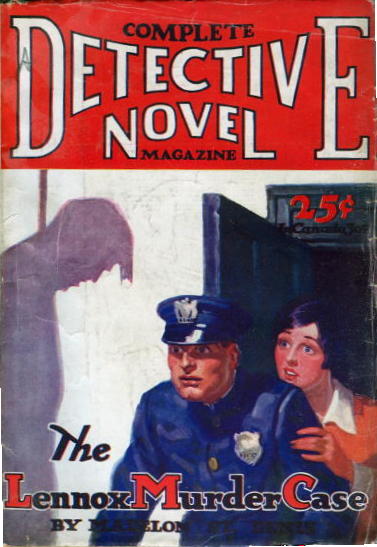
COMPLETE DETECTIVE NOVEL MAGAZINE 0929

September 1929. Number 15. Total pages: 144, not including covers. Cover price: 25¢.

      * 4 * Madelon St. Dennis * The Lennox Murder Case * novel * illustrated by J. Fleming Gould

      * 110 * Harry Van Demark * “The World’s Most Dangerous Woman” * true crime feature

      * 114 * Henry Leverage * The Prize Sucker * short story

      * 118 * Harold de Polo * “Tough Guy” Mahoney * short story

      * 125 * Mark Mellen & John Forbes * Held for Ransom * short story

      * 140 * Anonymous * Headquarters, Where the Readers Get Together * letter column

   Comment: The leading character is a female private eye named Tam O’Brien. The daughter of Ex-Chief of Detectives Rance O’Brien, she’s better known as Tam o’ Shanter, Inquirer. Female PI’s were still fairly scarce in 1929, and I don’t believe I’ve seen her name come up before. Historians of the genre are going to have to add her name to the short list of early ones. (On page 66 there is some discussion of some of the previous cases she’s handled, and they’ll probably come up again, as I start posting some of the earlier issues of CDMN.)

   From Crime Fiction IV:

ST. DENNIS, MADELON

       * The Death Kiss (Fiction League, 1932, hc) [Sydney Treherne; New York City, NY] Film: World Wide, 1933 (scw: Barry Barringer, Gordon Kahn; dir: Edward L. Marin).

       * The Perfumed Lure (Clode, 1932, hc) [Sydney Treherne; New York City, NY]

« Previous PageNext Page »