ROBERT LEE HALL – Murder on Drury Lane. St. Martin’s, paperback reprint; October 1993. Hardcover edition: St. Martin’s, November 1992.

   Checking back over Hall’s career, he seems to have worked exclusively in the historical mystery subgenre. In doing so, he has also been no slouch in choosing either his characters or the period settings he’s put them in. Here’s what I found, in terms of his crime-oriented fiction:

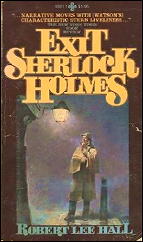
       Exit Sherlock Holmes. Scribner’s, hc, 1977. Playboy Press, pb, 1979.
ROBERT LEE HALL

       The King Edward Plot. McGraw-Hill, hc, 1980. Critics Choice, pb, 1987.
       * Benjamin Franklin Takes the Case. St. Martin’s, hc, 1988; pb, 1993.
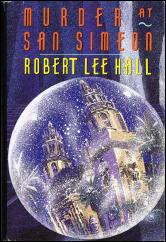
       Murder at San Simeon. St. Martin’s, hc, 1988. No paperback edition.
ROBERT LEE HALL

       * Benjamin Franklin and a Case of Christmas Murder. St. Martin’s, hc, 1991; pb, 1992.
       * Murder on Drury Lane. St. Martin’s, hc, 1992, pb, 1993
       * Benjamin Franklin and the Case of the Artful Murder. St. Martin’s, hc, 1994; pb, 1995.
       * Murder by the Waters. St. Martin’s, hc, 1995; trade pb, 2001.
       * London Blood. St. Martin’s, hc, 1997. No paperback edition.

   The Ben Franklin cases of detection, of which Murder on Drury Lane is one, are marked with an asterisk. Sherlock Holmes made an appearance in Hall’s first mystery only. Murder at San Simeon takes place at the California mansion of William Randolph Hearst, with Marion Davies, Louella Parsons, Jean Harlow and Charlie Chaplin all making at least cameo appearances.

   That leaves The King Edward Plot, which takes place in England in 1906, during the reign of Edward VII, and one online source describes it as “the first novel-length story to feature Holmes as a character.” This does not appear to be so. Holmes’s appearance is not mentioned in a Kirkus review of the book, and the statement seems in itself to contradict the existence of Exit Sherlock Holmes.

   Other mystery novels that Holmes had a role in and which also came before Hall’s first book are:

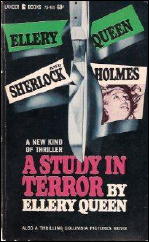
       Ellery Queen [Paul W. Fairman], A Study in Terror, Lancer, 1966.
SHERLOCK HOLMES

       Michael & Mollie Hardwick, The Private Life of Sherlock Holmes, Mayflower (UK), 1970.
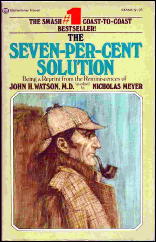
       Nicholas Meyer, The Seven-Per-Cent Solution, Dutton, 1974.
SHERLOCK HOLMES

       Philip José Farmer, The Adventure of the Peerless Peer, Aspen, 1974.
       Don R. Bensen, Sherlock Holmes in New York, Ballantine, 1976.
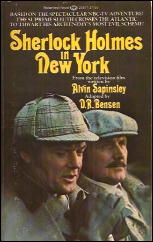
SHERLOCK HOLMES

       Richard L. Boyer, The Giant Rat of Sumatra, Warner, 1976.
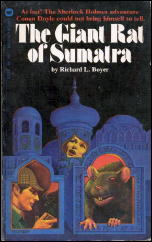
SHERLOCK HOLMES

       Nicholas Meyer, The West End Horror, Dutton, 1976.
       Austin Mitchelson & Nicholas Utechin, The Earthquake Machine, Belmont, 1976
               – Hellbirds, Belmont, 1976.

   I may have missed one or two, but I don’t believe many more than that. Keep in mind that this is a list of novels only, and that I deliberately attempted to avoid self-published works. Ever since 1977 (what happened then, timewise?) the dam has burst, and Sherlock Holmes has unquestionably become the one single fictional character, detective genre or not, who has appeared in the works of more novels by other authors than any other. (You can question the statement, if you like, as long as you can come up with an alternative.)

   I seem to have gone off on a tangent here. The Sherlockian connection that exists in The King Edward Plot, and there is one, is that two of the four amateur detectives who uncover the plot reside at 221A Baker Street. One of them nicknamed “Wiggins.” I will have to read it.

   Mr. Benjamin Franklin is getting restless, I am sorry to say. The book I have just read is about him, and he is being neglected. Here is a quote from page two. Franklin’s son William, a law student while in London, has just walked into the home where the Franklin entourage is staying, but he is unable to talk about the experience he has just had:
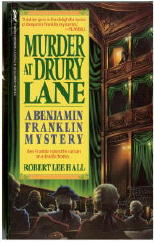
    Mr. Franklin wore his customary brown worsted suit and black, buckled shoes. He sighed. “As my son’s voice appears disarmed, mine must slay the silence; viz.: he set by the law for the Theatre Royal in Drury Lane, where he saw the play. Some soubrette has stole his heart – and his tongue with it.” He lifted an inquiring brow. “Did I hit the mark? Did your enchantress dance in the pantomime?”

ROBERT LEE HALL

    “Desdemona,” breathed William Franklin. “She played Desdemona.” He blinked, as if waking. “But, Father, I did not tell you that I went to the theatre. Indeed I have not been in my chamber since midmorning.”

   If Mr. Franklin’s explanation behind his deductive reasoning processes does not match that of the master, the attempt is well taken, at least by me, and the language is well appropriate for the tale that follows. Telling the story is Nick Handy, a twelve-year old lad who is Mr. Franklin’s illegitimate son. (Franklin made more than one trip to London, and there is a story behind this, one that was told in the first installment of the series. See above.)

   To tell you the truth, the language, the vocabulary and the insight of the narrator is far beyond those of a twelve-year-old boy, but if you assume that Nick is rather precocious and add some sense of wonder, you will soon not notice.

   The year, lest I forget to mention it, is 1758, and Drury Lane (as the title aptly suggests) is the center of the mysterious misadventures taking place. David Garrick hires Ben Franklin to investigate, who obligingly allows young Nick to tag along, making sketches of the various places they go and the people they meet.

   It also turns out that Mr. Franklin is a pioneer in the field of fingerprints and handwriting analysis, but it is the later – with regard to the threatening notes that Garrick has been receiving – that is the more important of the two this time around.

   The pace of the tale is leisurely, to say the least. Perhaps more important to the mystery, until the end, of course, are the sights and sounds of the theater itself, as well as the area and people around it, bit players included. Other famous personages have roles as well: Sir John Fielding, Dr. Samuel Johnson. Horace Walpole attends a play, as does Tobias Smollett.

   A well-manufactured atmosphere has been created here, in other words, with a melodramatic ending that fits the mood perfectly. If the detection takes second place, it is only a minor quibble on my part to say so.
— January 2006

IT IS PURELY MY OPINION
Reviews by L. J. Roberts


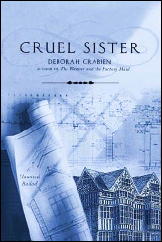
DEBORAH GRABIEN – Cruel Sister. St. Martin’s Press, hardcover, October 2006.

Genre:  Paranormal/Mystery. Leading characters:  Penny Wintercraft-Hawkes and Ringan Laine (4th in series). Setting:   England.

First Sentence:   Under a choking black fog, in which the air itself seemed composed of ash from the winter coal fires, a battered ten-year-old Austin Tilley lorry rumbled and bounced along Westferry Road on the south-eastern edge of London’s Isle of Dogs.

DEBORAH GRABIEN

   Folklorist, singer and restoration consultant Ringan Laine has been hired by his partner Penny’s brother and sister-in-law. They are building a large Elizabethan-style home on the Isle of Dogs next to the Thames.

   Ringan’s first visit to the site makes him uncomfortable and second visit progresses to voices and visions. From there, things become rapidly worse as Penny fears she may lose Ringan forever to the past.

   Having enjoyed the previous three books in this series, I selected this as my Halloween read last year, and am so glad I did. Grabien seamlessly blends the real and the paranormal; what is with what might be, and it works.

   This isn’t icky, creepy stuff, but scary in the anticipation of what might happen. It is also not formulaic. I so appreciate that each book in the series handles the paranormal aspect in a different manner. That, alone, adds to the suspense.

   One need not worry about starting this series at the beginning. Grabien establishes the background and history of previous paranormal experiences easily within the plot without slowing down the story. The dialogue is a little stiff at times, but the stories really are plot driven.

   And a good plot it is. It’s not silly, fluffy or over the top. It starts out innocently enough and then builds. It is also the perfect balance of music, history, mystery and the paranormal; each of which I love and sent me to the internet after finishing the book. It delights me to learn new things and when I can’t easily tell what is factual and what is fictional because the story is so well done, it all seems true.

   I found Cruel Sister completely engrossing; as in I read it straight through in four hours because I couldn’t bear to put it down. There is one more book in the “Haunted
Ballad” series, which I shall definitely read. Hopefully one day, there will be more.

Rating:   Very Good.

PostScript:   This is a clip of the ballad “Cruel Sister”: https://www.youtube.com/watch?v=1gAyqruWCfk&feature=related

      The “Haunted Ballad” mystery series

1. The Weaver and the Factory Maid (2003)

DEBORAH GRABIEN

2. The Famous Flower of Serving Men (2004)
3. Matty Groves (2005)
4. Cruel Sister (2006)
5. New Slain Knight (2007)

      The JP Kinkaid mystery series —

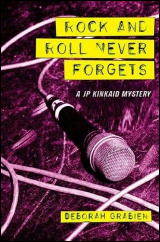
1. Rock & Roll Never Forgets (2008)

DEBORAH GRABIEN

2. While My Guitar Gently Weeps (2009)
3. London Calling (2010)
4. Graceland (2011)

REVIEWED BY TINA KARELSON:         


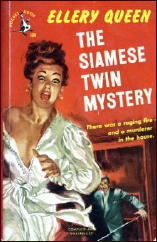
ELLERY QUEEN – The Siamese Twin Mystery. Frederick A. Stokes, hardcover, October 1933. Reprinted many times, in both hardcover and soft, including Pocket Books #109, paperback, 1st printing, June 1941; Pocket #109, 10th printing, 1950 (shown).

ELLERY QUEEN The Siamese Twin Mystery

   Ellery and Inspector Queen are driving back to New York from a vacation. Ellery takes an ill-advised shortcut over a mountain, and soon the situation is dire. Instead of the Mystery Machine, they’re in Ellery’s Duesenberg, but the other elements of a Scooby-Doo episode are all there: a treacherous journey leads to an isolated, spooky house — punctuated by an altercation with a frightening character who accosts them on the road.

   When they approach the darkened house, they are turned away by a creepy servant, but soon the owner offers a slightly more gracious welcome. John S. Xavier, a well-known surgeon, his sultry wife and their guests seem to be hiding something, but they have no choice but to allow Ellery and his father to stay. There’s no escape for anyone, because the base of the mountain is ringed with a forest fire that is gradually creeping upward.

   When the first murder occurs, Inspector Queen takes charge. The authorities can’t reach them until the fire is extinguished. As the flames come closer, the tension builds, causing Ellery and Inspector Queen to make some apparent errors, allowing the killer to strike again.

   The Siamese Twin Mystery is very atmospheric, and the fire threat ratchets up the suspense. Will they correctly identify the killer? Is there more than one killer? And will any of them survive the fire? You’ll have to read it to find out.

REVIEWED BY DAN STUMPF:         


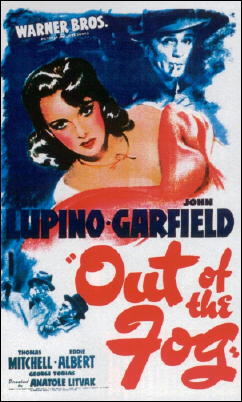
OUT OF THE FOG

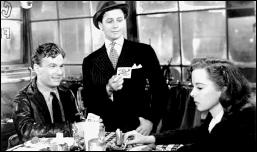
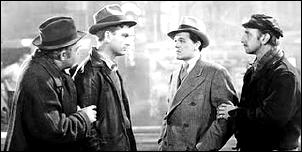
OUT OF THE FOG. Warner Brothers, 1941. John Garfield, Ida Lupino, Thomas Mitchell, Eddie Albert, George Tobias, John Qualen, Aline MacMahon, Jerome Cowan, Odette Myrtil, Leo Gorcey. Based on the play The Gentle People by Irwin Shaw. Director: Anatole Litvak.

   After the three Paula the Ape Woman movies [reviewed here ] and moving on to things more criminous, I watched Out of the Fog, one of those movies that seem to typify a whole era; casting, story, sets and the overall feel of the picture somehow evoke the 1940s Warners “look” so completely, one gets lost in time just watching it.

   John Garfield and Ida Lupino, those two echt-40s sub-stars, light the marquee on this one, he as a petty gangster and she as a pretty working girl, drawn to his shallow glamour and staccato sexuality, but the weight of the plot is carried by Thomas Mitchell and John Qualen as a couple of working stiffs leaned on by Garfield for protection money and finally summoning up the courage to rid the world of him — or so they think.

OUT OF THE FOG

   That’s the plot, but the charm of Fog lies in its stylish execution. Anatole Litvak, a Warner’s house director with a European touch, handles the actors well and moves the plot quickly, with some clever quirky moments, like murder plotted in a bath-house under the rantings of George Tobias as a loud-mouth émigré, or a tense interview with a bland and nasty assistant DA played with complete lack of charm by Jerome Cowan (of whom more later) and best of all, the scenes at night, on a foggy river, with Mitchell and Qualen in the foreground like figures out of Winslow Homer, while small boats blink at them and large ships pass in the rippling background — all shot on a studio set with the artistic camera of James Wong Howe, a cinematographer whose credits stretch from Shanghai Express to Hud and beyond, and who imparts a glowing intimacy to a genuinely likable film.

OUT OF THE FOG

A 1001 MIDNIGHTS Review
by Susan Dunlap


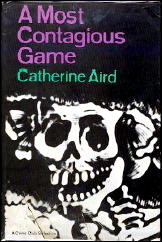
CATHERINE AIRD – A Most Contagious Game. Doubleday Crime Club, US, hardcover, 1967. Bantam, paperback, 1982. Rue Morgue, trade ppbk, 2007. First published in the UK: Macdonald & Co., hardcover, 1967.

CATHERINE AIRD

   Catherine Aird excels at portraying the English countryside’s village life with all its petty prejudices, the gentry and near-gentry, and the castles and ruins that dot the landscape.

   Her series sleuth, Inspector C. S. Sloan, deals with them in the fond yet frustrated manner of a native. Sloan is competent yet low-key, a good foil for the oddities of the suspects. His associates, Superintendent Leeyes, who views each case from the perspective of whatever night-school course he is taking, and Constable Crosby, whose only skill is fast driving, are rather forced and the least believable characters in the series.

   Aird’s best work is outside the Sloan series. A Most Contagious Game gives us Thomas and Dora Harding, a couple portrayed with such fine strokes that they seem to have been taken whole from real life. At fifty-two, Thomas Harding has worked himself into a heart attack and subsequent retirement to an oddly restored Elizabethan country house.

CATHERINE AIRD

   He is frustrated by the limitations his health imposes, and he is bored. Dora vacillates between encouraging his diversions and fearing he will bring another attack upon himself. The concerns of this couple and their interplay give the book a very solid base. But add to that Harding’s diversion — in tracking down the peculiarities of the remodeling of his house, he finds a secret compartment, a priest’s hole, and in it a 150-year-old skeleton.

   Another body, this time of a young woman, is found, and Harding’s search for both killers leads him to the guilty secrets of villagers past and present.

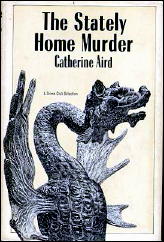
   Additional Aird titles are The Stately Home Murder (1970), Parting Breath (1977), Passing Strange (1981), and Harm’s Way (1984), all of which feature Inspector Sloan. Aird has also written a play and several works of nonfiction.

         ———
   Reprinted with permission from 1001 Midnights, edited by Bill Pronzini & Marcia Muller and published by The Battered Silicon Dispatch Box, 2007.   Copyright © 1986, 2007 by the Pronzini-Muller Family Trust.

   Jamie Sturgeon has continued to search out details of the life of Richard Sheldon, author of Poor Prisoner’s Defense, a mystery novel published in England in 1949. Bill Deeck’s review appeared here on this blog earlier this week.

RICHARD SHELDON Poor Prisoner's Defence

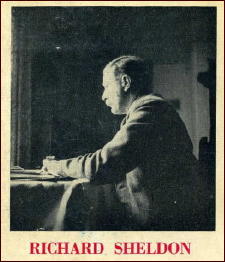
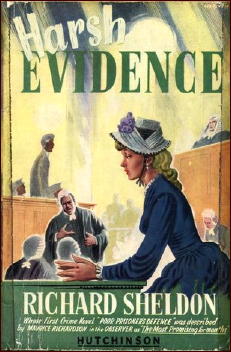
   To this end Jamie has purchased a copy of Harsh Evidence, Sheldon’s second book and final crime novel, and with some success to show for it. A photo of the author is shown to the right, along with the biographical blurb I’ve transcribed and posted below.

   There seems to be sufficient detail here to track down more about Richard Sheldon; indeed if more is learned that may be of general interest, I’ll report about it here.

   A north-countryman by birth and residence, Richard Sheldon was educated at a North of England public school and at Oxford. His is in his “middle forties,” married, with one child. His recreations include forestry, shooting and fishing; he is interested in painting but not in music.

   So much for conventional biographical details! They relate to a man who has at one time been a barrister, university Don, free-lance journalist, a rather amateurish soldier and even a member of a Rural District Council. Of all the occupations in which he has been engaged, Richard Sheldon finds writing at once the most exasperating, the most demanding and the most enthralling.

   His first novel, Poor Prisoner’s Defence, published in 1949, was not written until he found himself for some months in a military hospital during the war. “Richard Sheldon is to be commended to the connoisseur of thrillers,” said the Daily Telegraph; while Maurice Richardson of The Observer wrote: “One of the most promising first crime stories for many months … Don’t miss!”


[UPDATE] 07-09-11.   Jamie has just sent me a cover scan for Sheldon’s second book. Here it is:

RICHARD SHELDON Poor Prisoner's Defence


[UPDATE #2] 07-15-11.   John Herrington has inquired of Random House, current holder of the Hutchinson archives, and he reports back that “Richard Sheldon” is a pseudonym; his real name bears no resemblance to it.

   (Random House cannot say more, because of a data protection act, or so I’m told.)

REVIEWED BY WALTER ALBERT:         


PETER ROBINSON

PETER ROBINSON Alan Banks

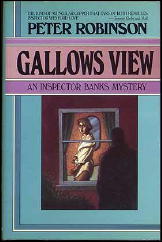
    ● Gallows View. Viking, UK, hardcover, 1987. Scribner, US, hc, 1990; Avon, paperback, 1991.
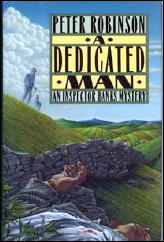
    ● A Dedicated Man. Viking, UK, hardcover, 1989. Scribner, 1991; Avon, paperback, 1992.
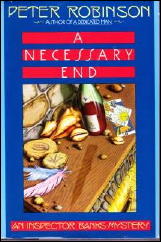
    ● A Necessary End. Viking, Canada, hardcover, 1989; Viking, UK, hc, 1989. Scribner, US, hc, 1992; Avon, paperback, 1993.
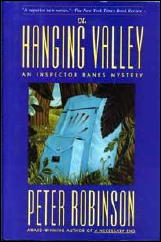
    ● The Hanging Valley. Viking, Canada, hardcover, 1989. Viking, UK, hc, 1990. Scribner, US, hc, 1992; Berkley, paperback, 1994.

   In this British series featuring Chief Inspector Alan Banks, the latter has left London for the presumably quieter duties of a small-town, Northern England station (or whatever they call them in the UK).

PETER ROBINSON Alan Banks

   There are a couple of sergeants to do the routine chores and assist Banks in his investigations; a sympathetic superior (Inspector Gristhorpe) who doesn’t usually get In the way; an attractive, sympathetic wife (Sandra); two attractive, sympathetic children (who cares?); and a more than attractive and sympathetic psychologist who helped out on Banks’ first murder investigation and is still around in the most recent of the series, mighty appealing but not yet a serious threat to the comfortable, happy marriage.

PETER ROBINSON Alan Banks

   The peacefulness is deceptive and there are enough satisfying murders in the district to keep Banks on his mettle and to interrupt the weekend therapeutic stone-wall laying with Gristhorpe every so often.

   The series is sober, solidly plotted and characterized. In these first four books Banks has not developed any annoying eccentricities: even his apparently recently acquired affection for opera seems to be giving way to folk music and less high-brow interests in the fourth book, The Hanging Valley.

   The apparently unmotivated murder of a elderly widow; the brutal killing of a local archaeologist; the stabbing of a policeman that is not as it first appears to be random; and the bludgeoning of a vacationing academic give Banks varying opportunities to practice his methodical, even plodding work.

PETER ROBINSON Alan Banks

   Although Banks pines momentarily (in The Hanging Valley) for “a nice English murder … just like the ones in books,” it might be noted that the basic premise of the plots is not too far removed from the enclosed world of the cosy, with its limited group of suspects.

   In The Necessary End, the longest of the novels, an abrasive, ambitious, unsympathetic former colleague of Banks is sent down from London to lead the Investigation. Banks of course solves the crime, outperforming the flashy, unproductive methods of his rival.

   The only memorable character so far is Katie Greenlock — in The Hanging Valley — and she supplies an ending that leaves any further comments by Banks (or Robinson) superfluous. It’s a haunting, horrific ending, and it has me looking forward to the next several novels in the series.

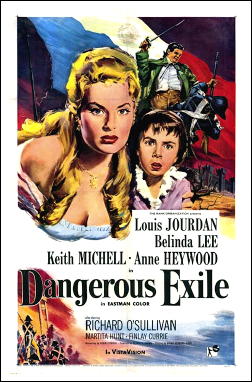
DANGEROUS EXILE. J. Arthur Rank, UK, 1957. Louis Jourdan, Belinda Lee, Keith Michell, Richard O’Sullivan, Martita Hunt, Finlay Currie, Anne Heywood, Brian Rawlinson. Based on the novel A King Reluctant by Vaughan Wilkins. Director: Brian Desmond Hurst.

DANGEROUS EXILE

   History, once in a while, rises to the occasion and outpaces and outdates historical fiction, sometimes in flashy fashion and sometimes not. Either way, does the truth always out? We hope so.

   Dangerous Exile is a film that takes place at the time of the French Revolution, centering as it does upon ten year old Louis XVII, son of Louis XVI and Marie Antoinette and the heir to the throne when his parents are beheaded.

   In this film he makes his way to a mansion on the coast of Wales in a hot air balloon, a very neat conceit at the time the movie was made. As is known now, this could not have happened. The Dauphin died in a Parisian prison cell, still only a little boy, as verified by DNA tests made not so many years ago.

   But let’s go with the fiction. Even if Mars is uninhabitable, the story’s the the thing, as fans of Edgar Rice Burroughs know full well. In Wales the young lad taken in by some British gentry, and to tell you the truth, I like this version of the story better, truth or not.

DANGEROUS EXILE

   Louis Jourdan plays a French aristocrat who smuggles the lad out of his home land, leaving his own son behind to play the part in the would-be king’s place, while Belinda Lee, an American visiting her British aunt, is the woman in whose charge the boy is placed.

   His life, of course, is much happier there, having witnessed at least the death of his mother, and he soon no longer wishes to be king. Richard O’Sullivan, who plays the young boy to perfection – even the smile-producing scene in which he proposes marriage to the beautifully buxom Miss Lee is done well – later became a fixture on British TV, but to all intents and purposes is totally unknown in this country.

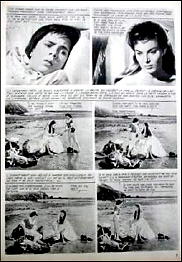
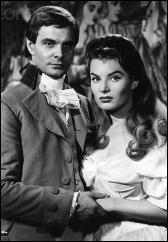
   Knowing more about the intrigue that was going on in France at the time will boost your enjoyment of the story as it goes along, and truth be known, this is a failure I find in myself. Even so, if good old-fashioned swordplay is what you are looking for in movies like this, the action toward the end of the film picks up noticeably, and it’s worth waiting for. (And unlike the photos to the left and above, the film is in color.)

   Dangerous Exile is a minor film, I admit, but when I happened to watch it, it was exactly what I wanted to see at the time.

DANGEROUS EXILE

REVIEWED BY MICHAEL SHONK:


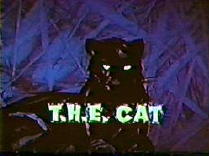
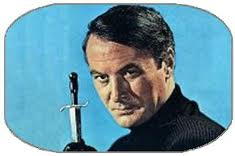
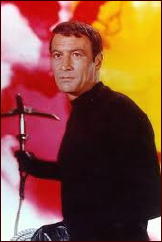
T.H.E. CAT. NBC-TV. 26 episodes. 30 minutes. September 16,1966 through March 31, 1967. Created: Harry Julian Fink. Produced: Boris Sagal. Cast: Robert Loggia (Thomas Hewitt Edward Cat), Robert Carricart (Pepe Coroza), R. G. Armstrong (Police Captain McAllister).

T.H.E. CAT

    In the fifties and sixties, many television series featured a darker hero, a cool intelligent fearless man of action, and a jazz soundtrack to highlight the noir-like visual look of such a man’s world. T.H.E. Cat was among the best of such series.

    “Out of the night comes a man who saves lives at the risk of his own. Once, a circus performer, an aerialist who refused the net. Once, a cat burglar, a master among jewel thieves. And now, a professional bodyguard. Primitive. Savage. In love with danger. T.H.E. Cat.” (from NBC introduction that can be seen at YouTube).

   Robert Loggia was perfect as T.H.E. Cat. His looks, even the way his body moved, made Loggia the ideal choice for the circus performer turned thief turned bodyguard.

T.H.E. CAT

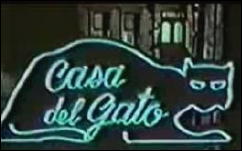
   Much of the series reminds one of Peter Gunn, such as the opening titles and “Casa del Gato,” the jazz nightclub Cat owned with his gypsy friend Pepe. Lalo Schifrin’s wonderful jazz music was as valuable to T.H.E. Cat as Henry Mancini’s music was for Gunn. But T.H.E. Cat went beyond Peter Gunn.

   Created by Harry Julian Fink, who would later create “Dirty Harry,” T.H.E. Cat was set in a violent world full of odd exotic and often damaged people such as a dethroned King, a psychopath who refused to wear shoes, and Cat’s police contact, the one-handed Captain McAllister.

T.H.E. CAT

   Talented Boris Sagal set the look for the series as the first episode’s director and series producer. Not surprisingly, among Sagal’s many director credits include episodes of Peter Gunn and Mike Hammer (1958-1959). Another director for this series worthy of note was Jacques Tourneur (Out of the Past) who directed the episode “Ring of Anasis” (December 30, 1966).

   The series focused on crime over mystery, action over clues, and style over realism. T.H.E. Cat featured scenes worthy of the Bond-like hero of the time.

   In “To Kill a Priest”, Cat faced the killer and his gang in the villain’s own lair, the old Hall of Justice building the villain had bought. Cat threatened the mobster, ignoring the gunmen and their guns pointed a few inches from his head. While of poor quality, this is the only full episode available to view on YouTube. (The link is for Part One of Three.)

T.H.E. CAT

   Despite being filmed in color, the noirish feel to the series was not totally lost. The damaged characters, jazz music, violent action, creative camera angles and lighting, all made T.H.E. Cat a series worth watching then and now. Hopefully, someday the series will make it to the world of the legit DVD, and we will see it in the remastered quality T.H.E. Cat deserves.

THE BACKWARD REVIEWER
William F. Deeck


RICHARD SHELDON – Poor Prisoner’s Defense. Simon and Schuster, US, hardcover, 1949. Hardcover reprint: Unicorn Mystery Book Club, 4-in-1 edition, December 1950. First published in the UK: Hutchinson, hardcover, 1949.

   Offered the junior brief in a [pro bono] “poor prisoner’s defense,” Dick Rayne can’t afford to turn it down, even though he has no experience in murder trials. Rayne has come late to the law and needs any brief he can get to keep going as a barrister. Even working with an incompetent solicitor is better than nothing.

   About a quarter of the novel is taken up by the trial of Rayne’s client for slitting the throat of his alleged paramour. Rayne himself isn’t sure whether he is guilty or not guilty. There is, however, no doubt in the jurors’ minds. A guilty verdict is arrived at, followed by a sentence of death.

   Still uncertain about his client’s guilt, Rayne, with the aid of his wife, begins his own investigation, with limited time and even more limited funds. Since apparently no one on trial in a mystery novel is ever guilty of the crime charged — although Jon Breen, the expert in this area, may be aware of exceptions — the reader knows the defendant didn’t do it.

   Who, then, did do it? That, too, is no surprise, but getting to the solution with Rayne and his wife is an enjoyable process.

— From The MYSTERY FANcier, Vol. 12, No. 3, Summer 1990.


Bibliographic Note:   Richard Sheldon was the author of one other crime novel, that being Harsh Evidence (Hutchinson, 1950). This later book takes place in England in 1874, according to Hubin, which means that Dick Rayne and his wife never had a second chance to show off their investigative abilities.

[UPDATE] 07-07-11.   After some discussion of the author in the comments, centering about the fact that nothing was known about him, Jamie Sturgeon purchased a copy of Sheldon’s second book and was rewarded with not only a photo and but a short biography as well. I’ve created a followup post here to include this and perhaps any additional information that may be found.

« Previous PageNext Page »