Judy and I got home yesterday around 4:30 in the afternoon. It’s 550 miles between here and London, and while it was easy enough, taking two days by car each way, we regretting not leaving more time for visiting with my brother and his family.

   We had no problems crossing the border, but my daughter and her husband did. You can read about their adventure here on Mark’s blog.

   The weather on the day of my niece’s wedding was truly beautiful — a bright blue sky with the temperate in the low 70s — and everything went off well. A day to remember. I hope to have some photos to post here soon.

   It will take another day or so for us to recover, but after that I have a backlog of material to post. I’ll get to it as soon as I can!

   Canada, that is. Ontario. I thought I might get some reviews posted today, but it’s taken more time to get ready than I’d planned on.

   Judy and I are leaving tomorrow around noon. It will take us two days to get there by car, but we’ll be in plenty of time for my brother’s daughter Jocelyn’s wedding on Saturday. My sister and her husband from Michigan will be there, and my daughter and her husband from Illinois are driving up also.

   So it’ll be a small family reunion of sorts as well — the most Lewises in one spot in quite a while. Judy and I looking forward to it — not the driving part so much, but we don’t need to push ourselves, so that’ll be OK — but I’m going to leave the computer at home.

   This blog’s going to be idle for a while, in other words, so hang on till about this time next week. I have plenty of reviews and other stuff piled up for posting as soon as I get back — of both books and movies, lots more of what you’ve been seeing here recently — and the way things look now, there’ll be a few more contributors who’ll be appearing soon.

      Take care, and so long for now.

                     — Steve

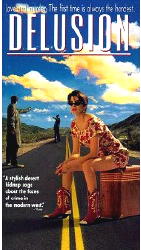
DELUSION. Cineville, 1991. Jim Metzler, Jennifer Rubin, Kyle Secor, Jerry Orbach. Director & co-screenwriter: Carl Colpaert.

DELUSION Jennifer Rubin

   This is a pretty good example of a category that can’t be called anything but neo-noir. Produced way past the usual late 1950s closing date for the first grouping of noir films, and made especially with the term (and the goal of making a) noir film in mind, movies in this particular genre are also made cheaply and have many of the same themes as the originals …

   … but they’re almost always in color — often brilliant, blinding color — and obviously they include a lot more overt violence and sexuality than the directors in the 1940s could ever have dreamed of.

   Most of them have had very limited theatrical releases. Many of these crime-oriented features were direct-to-video (and now direct-to-DVD) and used to show up on HBO, Showtime and Cinemax after 11 o’clock all the time.

   (For some reason they don’t any more, and I don’t know why. Late night programming seems to consist of regular movies that run all day long, over and over, or really awful softcore pornography.)

   Reviews I’ve seen of Delusion have been mixed. The New York Times hated it, but two reviewers for the Washington Post were of totally opposite opinions. I thought the first half was also first-rate; the second half, well, second-rate.

   Here’s a question for you. Suppose you’re a guy into computers, and you’re on the run from your former employer with nearly a half million dollars in cash stashed in the trunk of your car. You’re on the road somewhere in the desert (Nevada, let’s say) and you see the car that just careened past you moments before spin off the highway and land upside down in the sand. Two people, a man and a woman, are struggling to get out.

   Would you stop? Would you offer them a lift?

DELUSION Jennifer Rubin

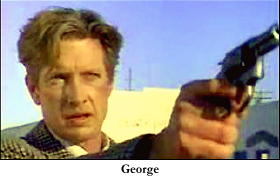
   Generally speaking I guess most people would, and like George O’Brien (Jim Metzler), I guess a lot of people would be ruing their decision within minutes, kicking themselves no end for being so kind-hearted.

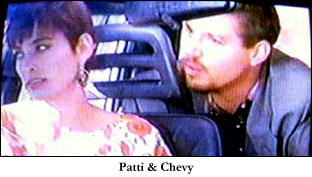
   Two more flaky people — seriously flaky, let’s be emphatic here — than Patti (Jennifer Rubin) and Chevy (Kyle Secor), could scarcely be imagined. How soon can he possibly get them out of his car, George is thinking, and you can just see it in his face and tortured body language as the predicament he’s in starts to sink in.

   Do they have guns? Yes. Do they have other plans in mind? Yes. Or at least Chevy does, on both counts. Patti’s involvement is not so clear. There are a couple of really good twists coming, one of them (or maybe both) involving Chevy’s friend Larry (Jerry Ohrbach) who is living alone in a trailer beside a small lake in the middle of the desert.

   The couple of good twists come a little bit too early, though. I was set up to expect one or two more, and I was disappointed when I didn’t get them – or in other words, as I previously implied, the second half doesn’t begin to match up in a direct comparison with the first.

   It’s still a noir film all the way, however, allowing some forgiveness for a couple of allegedly comic touches, also in the second half.

DELUSION Jennifer Rubin

   As George finds himself sinking more and more quickly into the quicksandish trap he’s let himself in for, the question he finds that he must keep asking himself is, how important is the stolen money to him?

   Jennifer Rubin, by the way, was the original model in Calvin Klein Obsession ads, and this movie was relatively early in her career. She’s quite beautiful, obviously, and in the first half (I keep getting back to this, don’t I?) she’s plays enigmatic very well. Make that extremely well. Once she’s given some dialogue, you know that an actress she wasn’t yet.

   Not that her career went uphill from here. Other than the lead role in the remake of Roger Corman’s The Wasp Woman, which came along later, I don’t see anything but mediocre parts in even more mediocre movies on her resume.

   Uploaded this morning was Part 32 of the ongoing online Addenda to the Revised Crime Fiction IV, by Allen J. Hubin. New and corrected information continues to stream in. Part 31, for example, was uploaded only two months ago.

   The data consists of a few new authors and titles, as always, but again as usual the large portion of it consists of additional facts about books and authors previously included, such as settings, series characters (both added and deleted), and films based on titles in CFIV but not previously noted.

   Tise Vahimagi’s recent article on Eric Ambler’s TV credits revealed four made-for-TV movies or mini-series not previously noted, for example, and new films such as Killshot (Elmore Leonard) and In the Electric Mist (James Lee Burke) have recently appeared as direct-to-DVD released. Both have been included, as well as a French film based on Gil Brewer’s 13 French Street (2007), not known about until a serendipitous discovery on IMDB only two days ago.

   Data at least through Part 32 will be included in the 2009 CD-ROM edition of Crime Fiction IV, which should be available at the time of this year’s Bouchercon. Data accumulated through the rest of the summer will be posted online in Part 33, but (as I understand it) there might not be time for it to be included on the upcoming CD.

   So follow the link above and feel free to browse around. If you spot any errors and would like to make corrections, or if at any time you have additional information to supply, then of course, please do!

THE GOLDEN AGE OF BRITISH MYSTERY FICTION, PART VIII
Reviews by Allen J. Hubin.


EDWARD CANDY Words for Murder

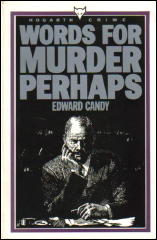
   Edward Candy (Barbara Alison Boodson Neville, 1925-1993) spaced her mysteries widely: two in the first part of the 1950s were followed by two more in the 1970s. Her Words for Murder, Perhaps (Gollancz, 1971; Hogarth Press, 1985) is subtitled “A Detective Story,” but as the most recently published book among those being now reviewed, it is not one in the Golden Age sense: it would appear not to be the author’s objective to fairly challenge the reader.

   But the tale is quite a pleasant one, a neat puzzle in an academic setting. Gregory Roberts (misidentified on the dust jacket as Robert Gregory) lectures at Bantwich University, and teaches also in the “Extra-Mural” (adult education) department.

   He’s about 40, living with his mother after barely surviving a disastrous marriage and ensuing cuckolding, attempted suicide, psychiatric treatment, and divorce. Now his cuckolder and ex-wife’s present husband disappears, and the ex-wife receives a typewritten excerpt from an elegy in the mail.

   Signs seem to point to Roberts, who’s presenting Detective Fiction to a class of adults, including Nan Jones, a widow who seems to be reviving the youth of his soul. Then a fellow extramural lecturer dies of cyanide, amidst evidences of another elegy. Police continue to sniff about, Roberts fears his life is coming unglued, and death marches on…

***

   Death on the Cliff (Benn, 1932) is my first exposure to Thomas Cobb, who produced a number of works in our field during the Golden Age. Cliff is not a brilliant representative of its hallowed era: the puzzle is neither baffling nor compelling, the detection is slight, the people are not fascinating, and the rural English setting is ordinary.

   Lady Roperson, whose 50ish husband is straying regularly from the connubial fold, is found dead on the rocks at the bottom of a cliff near their home. “Misadventure,” says the coroner’s jury – but Margaret Fairbrook, the dead woman’s daughter, immediately turns on her step-father, and Susannah Roperson (his daughter) develops an awful sense that murder has been done. Especially after a second death at almost the same spot as the first.

   A private detective (once of the Yard) comes into the picture but plays a minor role. The truth emerges as Susannah comes to ask the right questions of the right people.

***

SEFTON KYLE Red Hair

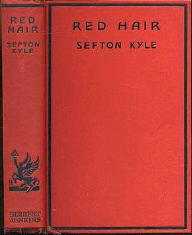
   It’s been established that Sefton Kyle was an alter ego for Roy Vickers, who achieved a certain currency in this country when discovered by Ellery Queen. So I was interested to try one of the Kyle novels (none of which was ever published in this country): Red Hair (Jenkins, 1933).

   Although from the publisher’s plot summary this appeared to be wholly non-criminous, a perusal proved this not to be the case. A murder occurs early and is pivotal to resulting events (though the reader knows at once who did it), and Kyle/Vickers/David Durham’s series Insp. Rason is our contact with Scotland Yard. (Rason’s adventures were chronicled under all three bylines, although the good inspector’s first initial seems to vary from book to book.)

   The book is basically a gothic, and provides all the frustrations of the species. Secretary Patricia Ridge marries her politically rising boss, Sir Brennan Grantley, then discovers his first wife – long thought dead – has resurfaced.

   Instead of confiding in Grantley, she tries to save his career, embarking on a course dotted with deception, theft and murder – a quagmire in which her every effort at extrication results in increased danger. Of course, all ends well as expected. Not recommended.

***

   Charles Ashton was another Golden Age practitioner not known in this country. My first sampling was Death Greets a Guest (Nicholson & Watson, 1936).

   Here a regular meeting of a rural archeological society at Squire Eastwood’s Heatherling Hall is interrupted by a sudden downpour. And by murder: a guest, an artist who accompanied a regular member, is found shot in Eastwood’s summerhouse.

   It seems that no member can be guilty, that no motive exists, and that premeditation could not have been possible. Colonel Bretherton, Chief Constable, and Inspector Williams are baffled, but Major Jack Atherley, champion cricketeer and amateur sleuth, is on hand to sort matters out.

   Competent, readable, pleasant, and quite forgettable.

***

   NOTE: Go here for the previous installment of this column. Unfortunately this marks the end of this particular grouping of reviews, which were first published on the main Mystery*File website some four years ago. It was my thought that reprinting them here on the blog would bring fresh attention to them. By all accounts, it has. Thanks to everyone for their comments over the entire eight installments!

FIRST YOU READ, THEN YOU WRITE
by Francis M. Nevins


   A few weeks ago Turner Classic Movies presented yet another film of the Thirties which, had it been made in the Forties, would have been accepted by everyone as film noir.

   I refer to Crime and Punishment (Columbia, 1935), based on Dostoevski’s classic novel. For obvious budgetary reasons director Josef von Sternberg makes no attempt to recreate mid-19th-century St. Petersburg, and we are told in an opening title that the story could take place at any time and anywhere.

   This is why the protagonist’s name morphs from Rodion to Roderick Raskolnikov, and also why we never see any automobiles or horse-drawn vehicles or any other form of transportation that might give us a clue to whether we are in the 19th or the 20th century.

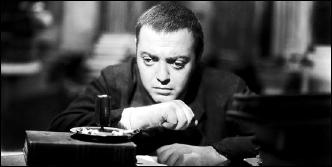
   Amid grotesque shadows and bizarre camera angles, Peter Lorre in his first role after escaping from Hitler’s Europe played Raskolnikov — how could that whiny, sweaty, pop-eyed little toad have ever imagined himself to be an Ubermensch above the law? — while the police detective Porfiry Petrovich was played by Edward Arnold, who the following year would be cast, for one film only, as Nero Wolfe.

   If you missed the TCM debut of this version of Crime and Punishment, watch for it when next it’s shown.

***

   Speaking of Nero, it was my good fortune that I began reading Rex Stout in the late 1950s, when I was in my middle teens and also pigging out on a dozen or more TV Western series a week.

   Why was this a lucky break for me? Because one of those Western series saved me from misunderstanding Archie Goodwin.

   If you were following the Wolfe saga during the Hammett-Chandler era when the novels and novellas were first coming out, you might easily have tried to assimilate Archie to the legion of wisecracking PI/first person narrators of the time, and then rejected the character when you sensed what a poor fit that was.

   Even so astute a critic as John Dickson Carr, writing in 1946, referred to Archie as “insufferable” and a “latter-day Buster Brown.”

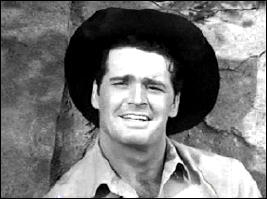
   But if you were fortunate enough to discover Stout in the late Fifties, at a time when millions of Americans including myself were watching Maverick every Sunday evening, you might have recognized Archie Goodwin and Bret Maverick as soul brothers.

   You might have credited Rex Stout with having created in prose the Great American Wiseass prototype which James Garner brought to perfection on film. You might have longed to see one of Stout’s novels filmed with Orson Welles as Wolfe and Garner as Archie. At least I did. What a shame that it never happened!

***

   When did TV movies begin? The first films that networks called by that name were broadcast in the fall of 1964. But if a TV movie is a feature-length film that tells a continuous story and was first seen in a single installment, the genre dates back at least to the suspense thrillers and Westerns that were aired one week out of four, beginning in the fall of 1956, as part of the prestigious CBS anthology series Playhouse 90 (1956-61).

   As a young teen I watched some of those films. Until recently the only one I had revisited as an adult was So Soon to Die (January 17, 1957), starring Richard Basehart and Anne Bancroft and based on the novel of the same name by Jeremy York, one of the many bylines of the hyper-prolific John Creasey (1908-1973).

   A few weeks ago I came upon another, one that I hadn’t seen in more than half a century. The Dungeon (April 10, 1958), written and directed by David Swift, starred Dennis Weaver as a man who, after being acquitted of murder, is kidnapped by a psychotic ex-judge and locked up in a cell in the attic of his isolated mansion, along with several other acquitted defendants.

   A great noir premise and a great cast to boot — Paul Douglas, Julie Adams, Agnes Moorehead, Patty McCormack, Patrick McVey, Thomas Gomez, Werner Klemperer, the list goes on and on. And the tension is heightened by the magnificently ominous music of a never credited Bernard Herrmann.

   I wish Swift had provided a backstory to explain what turned the judge into a sociopath, and my mind, not to say my nose, boggles when I start wondering how his prisoners (one of whom has been held for more than a year!) ever showered or kept clean-shaven or changed clothes. But if you have the good fortune to find this film on DVD as I did, it’s well worth seeing and, thanks to Herrmann, hearing.

***

   The Poetry Corner has been on sabbatical lately but I need to bring it back in order to tout perhaps the finest detective novel to deal centrally with the subject.

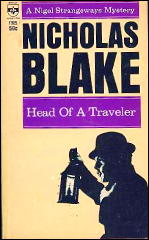
   The author was Nicholas Blake, known outside our genre as C. Day Lewis (1904-1972), poet laureate of England and the father of actor Daniel Day-Lewis. The detective, as always except in Blake’s non-series crime novels, is Nigel Strangeways.

   The title is Head of a Traveler (1949). Thomas Leitch in his essay on Blake in Mystery and Suspense Writers, Volume 1 (Scribner, 1998), describes the novel as “one of his most tormentedly introverted. The central figure is the distinguished poet Robert Seaton, whose household is destroyed by the unexpected discovery of his vanished brother Oswald’s decapitated corpse. The events of the fatal night remain obscure even after Strangeways’ final explanation; the real interest of the novel is in its impassioned examination of the costs of poetry — the lengths to which poets and those who love them will go in pursuit of their craft.”

   Anthony Boucher in his short-lived “Speaking of Crime” column in Ellery Queen’s Mystery Magazine (August 1949) was a bit less enthusiastic: “Blake knows so much about his theme, the nature of poetic creation, that he never quite conveys it convincingly to the reader.”

   Whichever critic is right, when it comes to the intersection of crime fiction and poetry, Head of a Traveler remains the “locus classicus.”

REVIEWED BY WALTER ALBERT:         

BOB THE GAMBLER

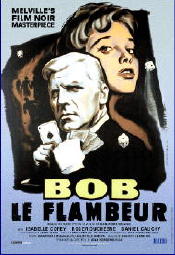
BOB LE FLAMBEUR. Mondial, France, 1956; William Mishkin, US, 1959, as Bob the Gambler. Isabelle Corey, Daniel Cauchy, Roger Duchesne, André Garet, Gérard Buhr, Guy Decomble. Director: Jean-Pierre Melville.

   One of the advantages of being something of a round peg in a department of square holes is that I am occasionally allowed to teach something that “nobody else” has any interest in doing, like the course on French Film that I have just finished teaching.

   Most of the films are by directors like Renoir, Clair, Virgo, Carne, and Ophuls, but I always manage to slip in a genre film by a director not many people would consider essential. In past years this meant films by Clouzot (Le Cor beau and Jenny Lamour).

   This year it was Jean-Pierre Melville’s 1955 thriller, Bob le flambeur (Bob the Gambler), a film that Melville had repudiated before his death in 1972 (“I will not allow this film ever to be screened again”) but that many critics now consider to be his finest achievement in a series of studies of criminals and the criminal milieu.

   Ostensibly, Bob the Gambler is an extended character study leading to a climactic caper, the robbery, by a team of well trained specialists, of the casino at Deauville.
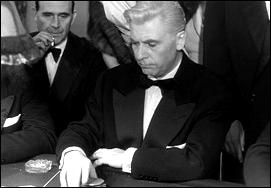
BOB THE GAMBLER

   But Melville manages to undermine almost every cliche of the caper film with a rigorously analytic style that manages to distance the spectator from the characters and cut away from the caper at the climactic moment, only returning to it in the final moments to dispense almost briskly with the basic plot elements and provide a final, comically ironic look at the protagonist, Bob the gambler.

   Melville, in an interview, related how, after seeing Huston’s film The Asphalt Jungle, he realized that he no longer wanted to — or could not — make a classic caper film. He decided instead to make what he called a “comedy of manners” (“comedie de moeurs”), but most American viewers will probably, like the students in my class, find this an odd film indeed.

   Melville’s film preceded New Wave films like Truffaut’s The 400 Blows and Godard’s Breathless by about four years, but the look of the film (shot on location in the streets and buildings of Montmartre) and the use of a jazz sound track seem to look forward to the innovative filmmaking of the late fifties and early sixties.
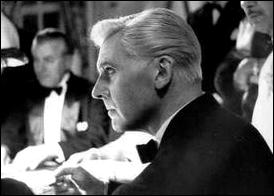
BOB THE GAMBLER

   The credits are presented over shots of Montmartre from the “heights” of Sacre-Coeur (the church) to the “depths” of Place Pigalle, a moral distance underlined by the matter-of-fact narration of Melville.

   But the spectator who expects an explicit moralistic study of the contrasts between the sacred and the profane will be disconcerted as the camera prowls restlessly along the streets, into the back rooms of cafes and restaurants, with Sacre-Coeur only present as a shape dimly glimpsed through the closed curtains of Bob’s elegant apartment.

   The affection the camera shows for the landscape may be disconcerting to the viewer who is looking for a narrative thread that will engage him, but location filming is a prominent feature of New Wave films, as in The 400 Blows, whose “travelogue” beginning is reminiscent of the beginning of Bob, all the more so in that both films benefited from the same superb photographer, Henri Decae.

   The final shot in Bob is of an empty car parked on a lonely stretch of beach and completes a circle initiated by the documentary shots of buildings at the beginning of the film.
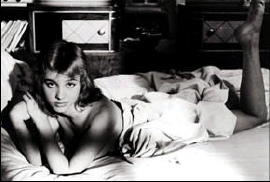
BOB THE GAMBLER

   The inner life of the characters is never explored in a way that is satisfying to the viewer, and it is perhaps appropriate that the frame is emptied of people at the beginning and the end.

   The viewer expecting the tight plotting of Hitchcock or the claustrophobic, fatalistic character study of Huston, will be disappointed. In Melville’s work, fate is chance, but the camera lingers on geometric patterns (wall-paper, windows, a floor covering) that suggest an intercrossing of plot lines that will only be evident on repeated viewings.

   The characters are elusive and the “content” of their relationships is like a crossword puzzle that may or may not be correctly filled in by the spectator.

   Melville’s expressed wish that the film not be re-released has been ignored. The formal, discreet patterns of this apparently open but controlled narrative with something of the look of a photograph by Walker Evans have lost none of their capacity for frustrating the viewer accustomed to the heightened, mounting suspense of Huston’s The Asphalt Jungle (1950) or Kubrick’s The Killing (1956).
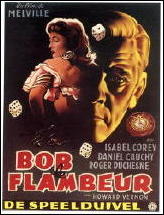
BOB THE GAMBLER

   All three of these films are about defeat and loss, but Bob manages to retrieve an ironic victory from a failure, and the sardonic humor of this victory appears to clash with the conventions it has intermittently adhered to.

   In Breathless, Goddard paid tribute to Melville by including, a reference to the character, Bob (Roger Duchesne), and by using Melville to play the role of a novelist interviewed by Patricia, the young American with whom the small-time Parisian hoodlum, Michel, has fallen in love.

   She betrays Michel, echoing the thematics of betrayal in Bob, where Anne (Isabelle Corey) betrays Paulo and Bob’s careful planning, but the final irony is perhaps Melville’s attempted betrayal of his beautiful and still fascinating portrait of Bob the gambler and his Parisian milieu.

   And one can only wonder to what extent Godard was again tipping his hat to Melville when one of his characters comments that he and his friends avoid Montmartre, which is dangerous for them and their “kind.”

   But Godard met successfully the cinematic challenge of his gifted predecessor and his tribute is, finally, the best witness to Melville’s achievement.

– Reprinted from The MYSTERY FANcier, Vol. 9, No. 2, March/April 1987.


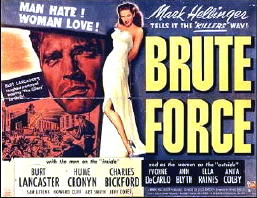
BRUTE FORCE 1947

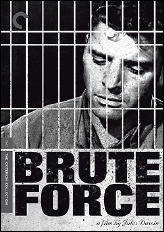
BRUTE FORCE. Universal International, 1947. Burt Lancaster, Hume Cronyn, Charles Bickford. Yvonne De Carlo, Ann Blyth, Ella Raines, Anita Colby, John Hoyt, Howard Duff, Whit Bissell, Art Smith. Director: Jules Dassin.

   A movie that takes place almost entirely behind the walls of a prison is not likely to have many women in it, and if it weren’t for brief flashbacks, there wouldn’t be any at all. Anyone in 1947 who paid 25 cents to see Yvonne De Carlo in this film should have marched right up to the box office afterward and demanded his money back.

   In spite of the posters and lobby cards, a prime example of which you can see below, Miss De Carlo graces the screen for less than five minutes, but I have to admit, she makes the most of them.

BRUTE FORCE 1947

   In this movie she plays the Italian girl friend of the GI in World War II (Howard Duff) who took the rap for her after she shot her father when he broke down and tried to turn him in to the authorities.

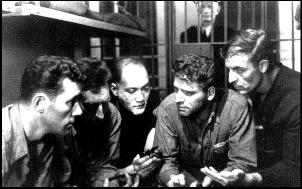
   In fact, it seems that the women in their lives are part of the stories of all of the men in Cell R-17, in one way or another.

   Some are weak (Whit Bissell) and some are strong (Burt Lancaster), but none are really evil — except perhaps Joe Collins (Lancaster), who seems to be a leader of a small gang but whose soft spot is a crippled woman whom he loves (and who does not know what he did for a living).

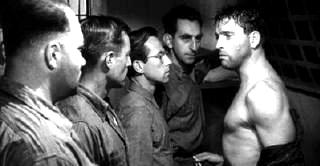
   No matter. When Burt Lancaster glowers at you, with those dark accusing eyes, you know you’ve been glowered at. This seems to have been only his second movie, the first being The Killers (1946), and if his performance in that earlier picture didn’t make an impression on the movie-going public, this one surely did. Joe Collins means to escape, and he doesn’t care how.

BRUTE FORCE 1947

   Standing in his way, however, is not the weak-kneed warden, who simply wants everyone to get along — including Gallagher, the grizzled but pacifistic Charles Bickford who’s in charge of the prison newspaper and expecting to get a parole any day now. No, the other person whose role in this movie you will remember for a long time is Captain Munsey (Hume Cronyn), the slim but sneering and slickly sadistic head of the prison guards whom everybody locked up inside hates with a passion, to the utmost fiber of their being.

BRUTE FORCE 1947

   Some prisoners break under his thumb of iron, some don’t. The ending of this movie — I don’t think it will surprise anyone if I say that indeed there is a break-out eventually does take place — is filled with the chaos of lights blazing, sirens wailing, and the sound of gunfire ringing off the walls.

   Who gets out, who survives? That I can’t tell you, but I can tell you this. No one walked out of the movie when it was playing, and no one asked for their money back. (That the movie gets a little preachy toward the very end is forgivable. No one paid any attention to that anyway. Prison life was hard in 1947, and while it may have changed, it never got any easier.)

MICHAEL ALLEN

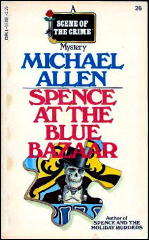
MICHAEL ALLEN – Spence and the Holiday Murders. Walker, hardcover, first U.S. publication 1978. UK title: Spence in Petal Park: Constable, hc, 1977. Paperback reprint: Dell, February 1981; Scene of the Crime #14.

   The season is Christmas, the victim is a swinging young bachelor with an unsuspected habit of snapping photos through the windows of the girls’ school across the way, and so the immediate conclusion is that someone was being blackmailed.

   As everyone has come to expect of the British police procedural, Detective, Superintendent Spence’s investigation is carried out so diligently and smoothly that it could as well serve as a primer for the novice mystery reader.

– From The MYSTERY FANcier, Vol. 3, No. 3, May-June 1979.


   Bibliographic data. [Expanded from the Revised Crime Fiction IV, by Allen J. Hubin] —

ALLEN, MICHAEL (Derek) 1939- . Pseudonym: Michael Bradford. SC: Supt. Ben Spence, in all below:
       Spence in Petal Park. Constable 1977.
       Spence and the Holiday Murders. Walker 1978. Reprint of Spence in Petal Park.
       Spence at the Blue Bazaar. Constable 1979.

MICHAEL ALLEN

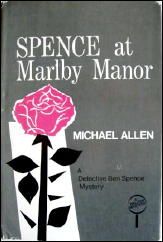
       Spence at Marlby Manor. Walker 1982.

MICHAEL ALLEN

BRADFORD, MICHAEL. Pseudonym of Michael Allen.
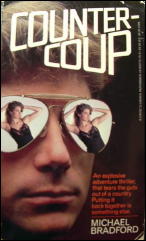
        Counter-Coup. Muller, hc, 1980; Critics Choice, pb, 1986. “Rebels overthrow the South African government and President Kasaboru is on the run with Philip Morgan, formerly of the Metropolitan Police.”

MICHAEL ALLEN

A REVIEW BY DAN STUMPF:         


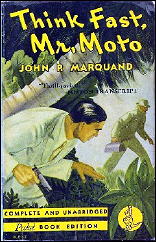
JOHN P. MARQUAND – Think Fast, Mr. Moto. Little Brown, US, hardcover, 1937. Robert Hale, UK, hc, 1938. Film: TCF, 1937 (scw: Norman Foster, Howard Ellis Smith; dir: Foster). Reprinted several time in both hardcover and soft, including Pocket #59, June 1940 (shown).

JOHN P. MARQUAND Think Fast Mr Moto

   The film version of Black Magic seemed to have set off a wave of let’s-go-back-and-read-that-again, which washed John P. Marquand’s 1936 novel Think Fast, Mr. Moto up onto the shores of my consciousness.

   Marquand won a Pulitzer for a book nobody reads anymore, and I’m afraid he’ll generally be remembered more for Moto than for Apley. At that, Think Fast is readable enough, fast enough, mildly surprising in its way, and readily forgettable.

   Something about a Nice Young Man coming to Hawaii to untangle the affairs of a distant, hostile and beautiful relative, getting enmeshed with crooks and smugglers and all that sort of thing. It’s the kind of book that can be flatteringly described as Vapid; not bad, really, but remarkably unremarkable.

   I particularly liked the way the characters seemed pulled out of Hollywood B-movies. When Marquand pits his hero and heroine against an amusing gangster, Chinese warlord, sallow Russian and the redoubtable Mr. Moto, one can’t help but picture Bob Cummings, Dolores Del Rio, Lloyd Nolan, Warner Oland, Mischa Auer — and of course, Peter Lorre.

   One thing I found rather disturbing, though: when Marquand wrote this thing, Japan was raping China; they were doing to China what Hitler did to the Jews, in one of the most brutal invasions in history. But in Think Fast, Mr. Moto, the bad guys are all plotting to smuggle supplies to the disparate elements in China fighting the Japanese, and our nice young man helps Mr. Moto put a stop to all this to keep his family from scandal.

   Makes one wonder where Marquand’s moral compass was.

« Previous PageNext Page »