REVIEWED BY WALTER ALBERT:         


THE TURMOIL Tarkington

THE TURMOIL. Universal-Jewel, 1924. Emmett Corrigan, George Hackathorne, Edward Hearn, Theodore von Fitz, Eileen Percy, Pauline Garon, Eleanor Boardman, Winter Hall. Based on the novel (1915) by Booth Tarkington. Director: Hobart Henley. Shown at Cinecon 39, Hollywood CA, Aug-Sept 2003.

   It’s probably difficult to appreciate the appeal Booth Tarkington had for earlier generations (which include mine). He’s probably best remembered as the novelist who provided the inspiration for Welles’ Magnificent Ambersons, but even earlier I read and reread his Penrod series, the story of an imaginative, adventuresome boy who did all the things that I, a dull, unimaginative, tradition-bound kid, never dared to do.

   The Turmoil, however, is more in the vein of the Ambersons and is the story of a successful father who tries to direct the lives of his three sons, with disastrous results for two of them.

   It’s a dark film that lacks the kind of riveting detail that a William deMille might have brought to it, but somehow manages to focus poignantly on the difficult road to manhood travelled by the third son, with a particularly fine performance by Eleanor Boardman as the young woman whose love he eventually returns.

NOTE:   The cover shown is that of the Grosset & Dunlap “Photoplay” edition, 1924.

MIGNON G. EBERHART – Murder in Waltz Time. Short novel; first published in The American Magazine, May 1953.

   This small gem of a detective story was reprinted in two of Mignon Eberhart’s later story collections, Deadly Is the Diamond (Random House, hc, 1958) and Best Mystery Stories (Warner, pb, 1988), and calling it a “short novel” is stretching it a bit, at best. Without resorting to counting words, I’d say it would run 60 to 100 pages in an ordinary paperback, depending on the size of type.

   As I’m sure you know, many of Rex Stout’s Nero Wolfe tales first appeared in this same format and in this same magazine and were collected later in hardcover in groupings of three or four.

   The American Magazine was always a favorite of mine as a youngster. I liked the cartoons, the photos, and the ads. Today I’m attracted to the same things, but now I like the stories and the artwork as well, plus the tidbits of interest about the movies, and items worth noting about radio and television stars and programs.

   As for Eberhart’s story, it’s a solid detective tale, necessarily boiled down to its pure essentials because of its length. No time for but the briefest characterization, and the motivations barely more. It takes place in a Florida resort where the dancing team of Fran Allen and Steve Greene are the featured attraction, and it’s Fran who finds the body of elderly Miss Flora Halsey.

   And as the investigation goes on, besides her nephew who was staying with her, more and more of the guests staying at the Montego House are found to have known Miss Halsey in the past, making Captain Scott’s job all the more difficult.

   Here’s a paragraph that appears toward the end of the tale. It doesn’t reveal the killer in any way, but *WARNING* it might tell you more of the plot that you’d rather know, but I think it’s entirely indicative of the kind of story it is.

    “Oh, yes, you know about that. Well, Scott’s men had picked up Jenkins at a bus stop. Abernathy recognized him; he’s the steward, all right. Abernathy had been trying to find Henry; he thought Henry was asking for murder, blackmailing the Senator, intending to use Abernathy as a threat, a witness, and put the screws on. Abernathy was too late; Henry had already acted and was murdered. We’ve told them about the Barselius. Bude admits to the lifeboat affair. Admits his sister knew about Henry’s attempts to blackmail him. Admits he had a gun. They can’t find the gun, and he admits his sister may have taken it, but — What’s the matter?”

    “Nothing — nothing. Go on.”

   Don’t get me wrong. As a mystery writer, Eberhart was a pro, through and through, and while I feel I might be admitting something you may find a little strange, I found this story to be much, much more than minimally entertaining.

AND IN THE SAME ISSUE:


FRANCES MALM – The Woman Involved. Short novel; first published in The American Magazine, May 1953.

   There is no mention of Frances Malm in the current edition of Hubin’s bibliography of crime fiction, so unless she wrote tons of short fiction, I doubt that many readers today have ever heard of her. But since there’s more than one crime involved in this novella (my description) I’m reporting on it anyway — as I’m sure you’ve already noticed.

   In length “The Woman Involved” is somewhat longer than the one by Mignon Eberhart, or at least that’s my impression. Once again I didn’t count words.

   When a young woman, Dana Wallace, goes back home to settle her stepfather’s estate she finds, unexpectedly, both a mystery and a romance. A large sum of money is missing from Judge Poole’s checking account, and (with no apparent connection) a brash young man, on his way up and resented by the old guard residents of Middleford for doing so, offers to buy the property where the judge’s home is located.

   Dana does a more-than-decent job of detective work, discovering a number things she did not know about her stepfather, but the emphasis here is rather more with the battle of rich vs. poor in matters of status in small town America, and Frances Malm puts her finger precisely on a number of the sore spots that can arise as a result.

   A minor work, I’d have to truthfully say, and one that in all likelihood has never been reprinted. There’s no doubt that it’s mystery fiction, though, and it’s definitely worth reading.

PostScript. Frances had a sister named Dorothea Malm, who wrote a handful of novels published as gothic romance mysteries in the 1960s.

   The only “real” novel that Frances wrote that I’ve been able to uncover is World Cruise (Doubleday, hardcover, 1960; Cardinal, paperback, 1961). Here’s the cover description of the book, the Cardinal edition: “The compelling story of a beautiful divorcee seeking love and fulfillment on a luxury cruise.”

— September 2003.


UPDATE. 01-01-12. My copy of this magazine has gone into hiding, and I’ve not been able to come up with a cover image, much less any of the interior art. Doing a Google search online, I did find a long partial description of the contents, however:

The American Magazine, May 1953. Vol CIV, No. 5. 144 pages. COVER: What’s Ahead for the Duke and Duchess of Windsor? Painting by Al Brule Articles include: AMERICA’S GLAMOROUS GODMOTHER Oveta Culp Hobby — the little woman who holds one of the biggest jobs in the US. A determined Texan, she looks out for the personal health and welfare of every one of us as US Secretary of the Department of Health, Education, and Welfare. by Clarence Woodbury; COVER ARTICLE: What’s Ahead for the Windsors? The Coronation next month may mean a new career for England’s jobless ex-King. By Roul Tunley. 5 page article; FUN TIME IN THE ROCKIES Canada beckons summer vacationists to its fabulous wonderland. By Richard Neuberg; A PEEK AT THE MOVIES of the MONTH; “Nature Girl” a short story by Elizabeth Stowe; “The Lie” a short story by Cynthia Hope and Frances Ancker; “Murder in Waltz Time” by Mignon G. Eberhart.

   Or in other words, a small time capsule of what life was like in May, 1953.

THE BACKWARD REVIEWER
William F. Deeck


ELIZABETH CURTISS – Nine Doctors and a Madman. Simon and Schuster, hardcover, 1937.

ELZABETH CURTISS Nine Doctors and a Madman

   The subgenre of mysteries dealing with insane asylums seems to be few in number but high in quality. Now Curtiss’s novel can be added to the list, and it is a fine addition.

   One of the nine doctors at Brandmere Hospital is murdered by an inmate, or so it would appear. The inmate says he did it, is in a room alone with the corpse, and has the bloody skewer; the other physical evidence, however, contradicts his claim.

   Nonetheless, he must have done it since no one else in the hospital seems to have had the opportunity, though most of them had a motive. A simple mind, my mind, but I would judge that there’s tricky fair play here.

   Curtiss writes and observes well: “Her hair had been meticulously pinched and plastered into waves which would have turned a Greek sculptor green with envy.”

   Her detective, Nathaniel Bunce, M.D., whom the publisher describes as a psychologist but must be a psychiatrist, is a character who might have achieved greatness if he had appeared in more than two novels, assuming the second matches the quality of this one. [The second being Dead Dogs Bite (Simon & Schuster, 1937).]

   Describing the narrator of the novel, young and naive Dr. Theophilus Bishop, Bunce says: “Your mind … is like a kangaroo. It jumps, high, wide and handsome. It leaves, therefore, vast areas untrodden.”

ADDENDUM:

   For those who may be interested, the novels that I have read that have as a setting mental institutions or have reason to believe deal with that sort of establishment are:

Murder in the Madhouse, by Jonathan Latimer
The Deadly Chase, by Carter Cullen
Shock Treatment, by Winfred van Atta
Night World, by Robert Bloch
The Drowning Pool, by Ross Macdonald
The Goodbye Look, by Ross Macdonald
No Face in the Mirror, by Richard Copeland in the UK, Hugh McLeave in the US
Death in the Doll’s House, by Hannah Lees and Lawrence Blochman
Crazy to Kill, by Ann Cardwell
The Odor of Bitter Almonds, by James G. Edwards
A Mind to Murder, by P. D. James
The Spectacles of Mr. Caligostro, by Harry Stephen Keeler
Snow White and Rose Red, by Ed McBain
A Puzzle for Fools, by Patrick Quentin
Shadow of a Doubt, by June Thomson.

— From The MYSTERY FANcier, Vol. 12, No. 4, Fall 1990.


A TV Review by Michael Shonk.


DEATH RAY 2000. NBC-TV Movie; aired 05 March 1981. (aka T. R. Sloane) Pilot for NBC-TV series A Man Called Sloane (1979-1980). QM Production/Woodruff Production. CAST: Robert Logan as Thomas R. Sloane, Dan O’Herlihy as The Director, Ann Turkel as Sabina, Maggie Cooper as Chrissy, Clive Revill as Erik Clawson, Ji-Tu Cumbuka as Torque, Michele Carey (voice) as Effie. Written and produced by Cliff Gould. Executive Producer: Philip Saltzman. Director: Lee H. Katzin.

DEATH RAY 2000 (Man Called Sloane)

   A gang of nuns walk into Gideon Peak Observatory where a scientist is testing a new top-secret “weather machine,” a device that can control the weather by removing all moisture from the atmosphere. The lone security guard informs them closing is in five minutes. The nuns, with the aid of Torque, a seven foot giant with a metal hand, dismantle the giant ray gun and take the large pieces out the backdoor to their van.

   Torque is most helpful when he substitutes a screwdriver for his index finger to remove some stubborn screws. The screws put up a better fight than the humans did, since security was virtually non-existent. When the scientist interrupts the heist, one of the nuns kills him with deadly thimble like devices on two of her fingers. The nuns and Torque with his Swiss army hand escape with the device.

DEATH RAY 2000 (Man Called Sloane)

   OK, I am hooked all ready. But this classic continues to produce more cheese than Wisconsin. Seems the ray gun is so powerful it can drain water for miles, through any object including mountains, and it can dehydrate people into nothing but bones and cute hair.

   Naturally the government is upset that someone has stolen a top-secret weapon that could destroy the world, a weapon they had left in a public building with only one friendly guard as security. They come to UNIT looking for help and begging for our hero Thomas R. Sloane.

DEATH RAY 2000 (Man Called Sloane)

   UNIT is a top-secret agency located in the farmlands of Kentucky where The Director works out of his house. This being a spy movie the house is of course not your typical home. It contains a six-ton computer named Effie, complete with a sexy female voice. And as all females in this story, Effie has fallen for the only man who can save the world, Thomas R. Sloane the 3rd.

   Sloane, following in the famous footsteps of his father, is a top secret agent and owner of Sloane & Sons, a successful art and antiquity business. We first meet the great spy as he successfully completes his mission in Cuba. He escapes the soldiers by rocketing an elevator through the roof and into the air where a waiting helicopter catches it.

   Robert Logan (77 Sunset Strip, The Adventures of the Wilderness Family) gives Sloane all the passion of someone wanting to take a nap. The rest of the cast is more animated, adding ham to all this cheese.

DEATH RAY 2000 (Man Called Sloane)

   The story travels the usual path, Sloane drives a great car, the evil mastermind has his pets (this time he cuddles with snakes and a spider), recurring fight scenes, sex interrupted or off stage (this is 70s TV), Rube Goldberg death traps, an evil organization named Kartel (“with a K”), and the villain meeting his end at his own hands.

   My favorite moment is when writer Cliff Gould (Mod Squad, Streets of San Francisco) makes his motives clear and uses cheese as a vital clue. Ian Fleming should be so clever.

   The most shocking twist didn’t come from the story, but the production credits for this cheese fest that would have made Aaron Spelling giggle. This was from Quinn Martin! The QM Productions of The Fugitive, The FBI, Cannon, etc.

DEATH RAY 2000 (Man Called Sloane)

   It was the final QM series to debut on television (Barnaby Jones would be the last on the air). There is no better example of how television changed during the seventies than compare Quinn Martin’s first series of 70s, Dan August (1970) to Quinn Martin’s last, A Man Called Sloane (1979).

   The movie was released on VHS but not on DVD. It can also be seen on YouTube in ten parts, starting here.

   There were changes made when this pilot lead to the series, A Man Called Sloane. Most notable was Robert Conrad replacing Robert Logan as Sloane and Torque the Swiss army hand bad guy becoming Sloane’s good guy sidekick.

DEATH RAY 2000 (Man Called Sloane)

REVIEWED BY DAN STUMPF:         


MACBETH. Republic Pictures, 1948. Orson Welles, Jeanette Nolan, Dan O’Herlihy, Roddy McDowall, Edgar Barrier, Peggy Webber. Adapted by Orson Welles (uncredited) from the play by William Shakespeare. Director: Orson Welles.

   On most occasions I need only the flimsiest of excuses to speak of Welles’ 1948 film of Macbeth, which he did for peanuts on the back lots at Republic Studios.

MACBETH Orson Welles

   Like most of his films, it was badly mauled before release, including completely new dubbing and the excision of about 20 minutes running time. It is now, however, restored and available on videotape, and you should run out and get it.

   Someone — me, I think — once said that every hardboiled novel and film noir owes a debt to Shakespeare. Welles seems to have sensed this, turning Macbeth into a very noirish-looking film indeed, with lots of shadows and heavy fog to hide the cheap sets, vaguely menacing blackmailers and detective-types, and a Lady Macbeth (Jeanette Nolan) straight out of James M. Cain.

   Edgar Barrier, normally a rather inexpressive actor, offers a fascinating interpretation of Banquo as co-conspirator, and Dan O’Herlihy makes a tough MacDuff. Welles naturally has a lot of fun with himself as Macbeth, lurching about drunk most of the time, and he has the whole cast speak in beautifully thick Scottish Brogue, so that “Sleep no more, Macbeth has murdered Sleep” comes out: “Slyeep nae Mairlrlrl, MaycBayth hae Mairlrlrlredairlrlrlred Slyeep!”

   A bit hard to follow in the denser passages, but fun to listen to.

— Reprinted from A Shropshire Sleuth #52, March 1992.


MACBETH Orson Welles

REVIEWED BY RAY O’LEARY:
   

MARTHA GRIMES Old Contemptibles

MARTHA GRIMES – The Old Contemptibles. Little Brown, hardcover, 1991. Paperback reprints include: Ballantine, 1992; Onyx, 2006.

   Superintendent Richard Jury is at an antiques flea market when he meets Jane Holdsworth, a widow with a sixteen-year-old son. They begin an affair so intense that Jury is about to propose marriage when she suddenly dies of a barbiturate overdose.

   Though it looks like suicide, there’s enough wrong with the circumstances surrounding her death for Jury to be suspended while the death is under investigation.

   This brings Jury’s friend Melrose Plant onto the scene, where he gets a job with the dead woman’s estranged in-laws to find out what he can. What he discovers is that not only did Jane’s late husband also commit suicide, but also both his mother and the family Cook were killed in supposedly accidental falls.

   Grimes excels here in the creation of characters, and she gives herself plenty of range in which to strut her stuff: besides the usual characters, there are two children, the dead cook, and a couple of senior citizens, one of them a kleptomaniac. With a cast like that, how can it miss?

Blog's 5th Birthday

…and We’re Having a Party!

THE NUMBERS:   3082 Posts

in 48 Categories

680,390 visitors

with 1,167,268 pages viewed

and 12,587 comments left

not including 1,773,557 spam messages deleted.

    Thanks, everyone! As I’ve said before, whenever occasions like this have come along, I couldn’t have done it without you!

I’ll be taking a few days off from the blog — an extended weekend, you might say, beginning today. The end of December is always a busy time of the year, and this year is no exception. I’ll be back on Monday or Tuesday, and even then the blog is likely to remain in low maintenance mode until the New Year comes around.

My most sincere best wishes to you and your families: Merry Christmas, Happy Hanukkah, Cheers All Around!

Reviewed by GLORIA MAXWELL:         


PATRICIA HIGHSMITH – Little Tales of Misogyny. Otto Penzler, hardcover, April 1986. Norton, softcover, August 2002. [See also Comment #4.]

PATRICIA HIGHSMITH Little Tales of Misogyny

   As the title indicates, this book is a collection of sharp, biting indictments of women. The author’s theme is the destructive quality women have over men — innocently wrought, or with knowing spite. This destructiveness is sometimes personally fatal to the woman as well.

   Some stories are macabre, such as “The Hand,” wherein the prospective groom actually receives the hand of the woman he loves — after asking for it in marriage. Others are tongue in cheek fun: “Oona, the Jolly Cave Woman”:

    “It was not necessary to club Oona to have her, but that was the custom…”

   In some cases, the titles alone give an adequate preview for what is in store: “The Breeder,” “The Fully-Licensed Whore, or the Wife,” “The Prude,” “The Victim.” In all, seventeen tales of sparkling satire.

   This book will not be for everyone, and readers who tend to be squeamish or easily shocked are hereby warned to beware. However, for those brave enough, or daring enough, to pick up this jewel, a definite reading treat is in store. Highsmith is truly a master of her storytelling craft and bold enough to tell it like it really is — in a unique, pulsating manner.

— Reprinted from The Poisoned Pen, Vol. 7, No. 1, Fall-Winter 1987.

REVIEWED BY WALTER ALBERT:         


THE FIGHTING BLADE

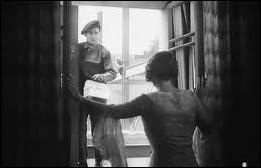
THE FIGHTING BLADE. Inspiration-First National, 1923. Richard Barthelmess, Dorothy Mackaill, Lee Baker, Morgan Wallace, Bradley Barker, Frederick Burton, Stuart Sage, Phil Tead, Walter Horton. Story: Beulah Marie Dix; scenario: Josephine Lovett; art director: Everett Shinn. Director: John S. Robertson. Shown at Cinecon 39, Hollywood CA, Aug-Sept 2003.

   Barthelmess plays Karl Van Kerstenbroock, a Flemish soldier of fortune who joins Cromwell’s forces. Going undercover, he visits the home of the fiancé of Thomsine Mugrove (Mackaill) whose cowardly brother (Bradley Barker) had earlier fled a duel with Van Kerstenbroock. Musgrove risks her life to help Von Kerstenbroock and is rescued by him after he leads Cromwell’s forces to victory.

   Barthelmess is a somewhat unlikely action hero, but character development and conflict are not neglected in this film, handsomely designed by noted contemporary illustrator Everett Shinn. Barthelmess is moody and often diffident in his acting style, a striking contrast to the flamboyance of an Errol Flynn or Douglas Fairbanks, Sr.

   I liked the film, but Jim Goodrich found it lacking the brio he appreciates in a swashbuckler. (I hope that Jim won’t mind if I report that he referred to it, in passing, as a “swishbuckler.”)

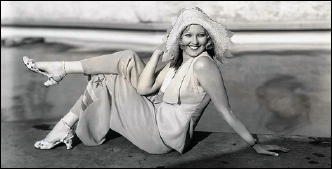
      Dorothy Mackaill:

THE FIGHTING BLADE

« Previous PageNext Page »